<?xml version="1.0" encoding="UTF-8"?><feed
	xmlns="http://www.w3.org/2005/Atom"
	xmlns:thr="http://purl.org/syndication/thread/1.0"
	xml:lang="en-US"
	>
	<title type="text">Ayurella Horn-Muller | Vox</title>
	<subtitle type="text">Our world has too much noise and too little context. Vox helps you understand what matters.</subtitle>

	<updated>2026-04-03T22:31:04+00:00</updated>

	<link rel="alternate" type="text/html" href="https://www.vox.com/author/ayurella-horn-muller" />
	<id>https://www.vox.com/authors/ayurella-horn-muller/rss</id>
	<link rel="self" type="application/atom+xml" href="https://www.vox.com/authors/ayurella-horn-muller/rss" />

	<icon>https://platform.vox.com/wp-content/uploads/sites/2/2024/08/vox_logo_rss_light_mode.png?w=150&amp;h=100&amp;crop=1</icon>
		<entry>
			
			<author>
				<name>Kate Yoder</name>
			</author>
			
			<author>
				<name>Ayurella Horn-Muller</name>
			</author>
			
			<author>
				<name>Clayton Aldern</name>
			</author>
			
			<title type="html"><![CDATA[How climate science is sneakily getting funded under Trump]]></title>
			<link rel="alternate" type="text/html" href="https://www.vox.com/climate/484670/how-climate-science-is-sneakily-getting-funded-under-trump" />
			<id>https://www.vox.com/?p=484670</id>
			<updated>2026-04-03T18:31:04-04:00</updated>
			<published>2026-04-06T07:00:00-04:00</published>
			<category scheme="https://www.vox.com" term="Climate" /><category scheme="https://www.vox.com" term="Future Perfect" /><category scheme="https://www.vox.com" term="Science" />
							<summary type="html"><![CDATA[This story was originally published by Grist and is reproduced here as part of the&#160;Climate Desk&#160;collaboration. At the Department of Agriculture’s research division, everyone knows there’s one word they should never say, according to Ethan Roberts. “The forbidden C-word” — climate. Roberts, union president at the National Center for Agricultural Utilization Research in Peoria, Illinois, [&#8230;]]]></summary>
			
							<content type="html">
											<![CDATA[

						
<figure>

<img alt="an adult and child sit at the washington mall holding signs saying “you can’t delete climate change.” " data-caption="Protesters during the Stand-Up for Science rally in Washington D.C., March 2025. | Dominic Gwinn/Middle East Images/AFP/Getty Images" data-portal-copyright="Dominic Gwinn/Middle East Images/AFP/Getty Images" data-has-syndication-rights="1" src="https://platform.vox.com/wp-content/uploads/sites/2/2026/04/gettyimages-2203749079.jpg?quality=90&#038;strip=all&#038;crop=0,0,100,100" />
	<figcaption>
	Protesters during the Stand-Up for Science rally in Washington D.C., March 2025. | Dominic Gwinn/Middle East Images/AFP/Getty Images	</figcaption>
</figure>
<p class="has-text-align-none"><em>This story was originally published by <a href="https://grist.org/language/climate-federal-research-grants-national-science-foundation/">Grist</a> and is reproduced here as part of the&nbsp;<a href="https://www.climatedesk.org/about-us/">Climate Desk</a>&nbsp;collaboration.</em></p>

<p class="has-text-align-none">At the Department of Agriculture’s research division, everyone knows there’s one word they should never say, according to Ethan Roberts. “The forbidden C-word” — climate.</p>

<p class="has-text-align-none">Roberts, union president at the National Center for Agricultural Utilization Research in Peoria, Illinois, has worked for the federal government for nearly a decade. In that time, the physical science technician has weathered several political administrations, including President Donald Trump’s first term. None compare to what’s happening now.&nbsp;</p>

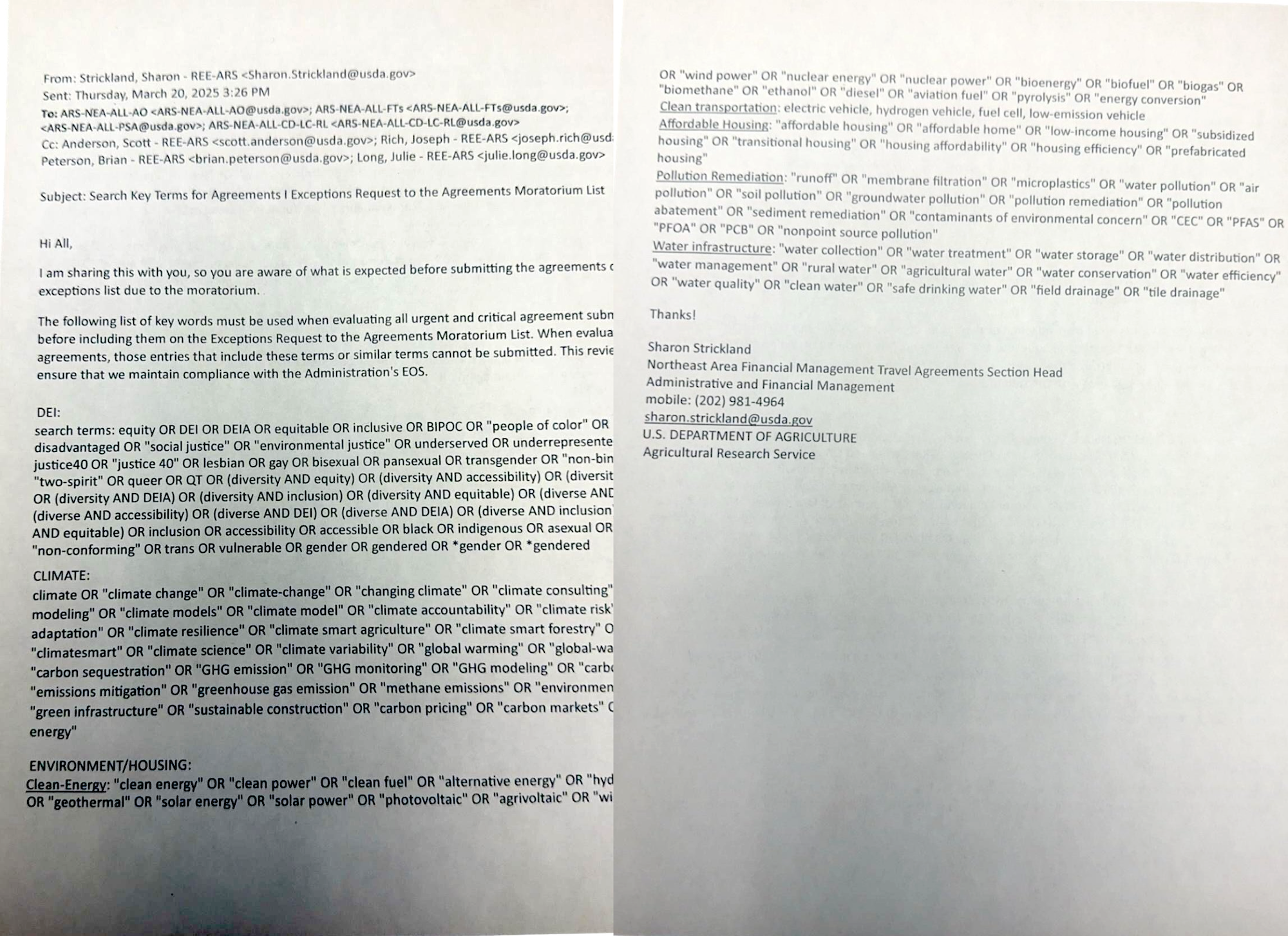
<p class="has-text-align-none">The sweeping transformation became apparent last March, after&nbsp;<a href="https://grist.org/wp-content/uploads/2026/03/more-perfect-banned-words-memo.png">a memo</a>&nbsp;from upper management at the USDA Agricultural Research Service instructed staffers to avoid submitting agreements and other contracts that used any of 100-plus&nbsp;<a href="https://grist.org/food-and-agriculture/usda-unfreezing-clean-energy-money-dei-climate/">newly banned words and phrases</a>. Roughly a third directly&nbsp;<a href="https://sentientmedia.org/phrases-newly-banned-at-usda/" rel="noreferrer noopener" target="_blank">related to</a>&nbsp;climate change, including “global warming,” “climate science,” and “carbon sequestration.”&nbsp;</p>

<p class="has-text-align-none">Roberts met with his union to figure out how to respond to the memo. They concluded that the best course of action was just to avoid the terms and try to get their research published by working around them. Throughout the federal agency, “climate change” was swapped for softer synonyms: “elevated temperatures,” “soil health,” and “extreme weather.”</p>

<p class="has-text-align-none">It’s part of a bigger trend. Across federal agencies and academic institutions, scientists are avoiding words they once used without hesitation. When Trump took office last year — calling coal “clean” and “beautiful” while deriding plans to tackle climate change as a “<a href="https://grist.org/language/strategy-behind-trump-climate-catchphrase-green-new-scam/">green scam</a>” — a so-called climate hushing took hold of the United States, as <a href="https://grist.org/business/companies-climate-plans-trump-earnings-greenhushing/">businesses</a>, <a href="http://grist.org/politics/democrats-arent-talking-about-climate-change-cheap-energy/">politicians</a>, and even <a href="https://grist.org/language/global-heating-climate-news-drought-chaos/">the news media</a> got quieter about global warming. There’s <a href="https://www.nytimes.com/interactive/2025/03/07/us/trump-federal-agencies-websites-words-dei.html" target="_blank" rel="noreferrer noopener">a long list of supposedly “woke” words</a> that agencies have been discouraged from using, many tied to climate change or diversity, equity, and inclusion (DEI) initiatives.</p>

<p class="has-text-align-none">The language changes were accompanied by larger shifts in how the federal government operates. Elon Musk’s Department of Government Efficiency (DOGE), laid off hundreds of thousands of <a href="https://www.washingtonpost.com/politics/2026/03/09/trump-hiring-federal-workers/" target="_blank" rel="noreferrer noopener">federal workers last year</a>. The Trump administration also slashed spending on science, cutting <a href="https://ourpublicservice.org/the-unraveling-of-public-science/" target="_blank" rel="noreferrer noopener">tens of billions of dollars in grants</a> for projects related to the environment and public lands. Researchers are adapting to the new landscape, with some finding creative ways to continue their climate research, from changing their wording to seeking out different sources of funding.   </p>

<p class="has-text-align-none">For federal researchers studying, say, the interplay between weather patterns and soybean diseases, the key is to reframe studies so they don’t clash with the Trump administration’s politics. “Instead of making it about the climate, you would instead just make it about the disease itself, and be like, ‘This disease does these things under these conditions,’ rather than ‘These conditions&nbsp;<em>cause</em>&nbsp;this disease to do this,’” Roberts added. “It’s just changing the focus.”</p>

<p class="has-text-align-none">You can see how federally funded research has changed by looking at the grants approved by the National Science Foundation, or NSF, an agency that provides roughly <a href="https://www.nsf.gov/about" target="_blank" rel="noreferrer noopener">a quarter</a> of the US government’s funding to universities. Grist’s analysis found that the number of NSF grants whose titles or abstracts mentioned “climate change” fell from 889 in 2023 to 148 last year, a 77 percent plunge. Part of that’s a result of NSF staffers approving fewer grants related to climate change under Trump. But researchers self-censoring by omitting the phrase in their proposals also appears to play a role, evidenced by the corresponding rise of “extreme weather” — a synonym that gets around the politicized language.</p>
<img src="https://platform.vox.com/wp-content/uploads/sites/2/2026/04/nsf-climate-interactive-static-vox.png?quality=90&#038;strip=all&#038;crop=0,0,100,100" alt="chart showing the distribution of climate language in NSF grant summaries" title="chart showing the distribution of climate language in NSF grant summaries" data-has-syndication-rights="1" data-caption="" data-portal-copyright="" />
<p class="has-text-align-none">Trent Ford, the state climatologist for Illinois, said he’s started using terms like “weather extremes” and “weather variability” in framing his proposals for grants.&nbsp;</p>

<p class="has-text-align-none">“It’s sort of a weird thing, because on principle, if we’re studying climate change, to not name climate change feels dirty,” said Ford, who’s also a research scientist at the Illinois State Water Survey at the University of Illinois Urbana Champaign. But it’s more of a practical decision than anything else: “We’ve seen where grants that say everything but ‘climate change’ and are obviously studying the impacts of climate change get through with no problem.” He only uses the phrase in grant proposals when he thinks it’s absolutely necessary and when efforts to steer around the term would look too obvious to a reviewer.</p>

<p class="has-text-align-none">Researchers have always had to tailor their framing to align with a funder’s priorities, in this case the federal government. Near the end of President Joe Biden’s term in late 2024, when Ford’s team applied for an NSF grant to study how climate conditions could affect Midwestern agriculture, it made sense to include a line about talking to a&nbsp;<em>diverse</em>&nbsp;group of farmers. But that word became a problem after Trump returned to office.</p>

<p class="has-text-align-none">“By the time the proposal got reviewed by the program manager at NSF, that same language that was required four months ago was now actually a death sentence on it,” Ford said. The NSF liked the proposal, but wanted the researchers to remove the line about reaching a diverse set of agricultural stakeholders and confirm that they would talk to “all American farmers,” Ford said. The team sent it back in, and the NSF approved it last April.</p>

<p class="has-text-align-none">Others weren’t so lucky. Another scientist at the Agricultural Research Service, who asked to remain anonymous out of fear of retaliation, said DOGE eliminated major research programs at the agency and, in the process, wiped out hundreds of thousands of dollars in federal funds for an initiative to grow plants without soil that “really didn’t have anything to do with climate change.” The scientist said it had only been labeled as climate research to “satisfy the previous Biden administration.”<br><br>“Anything, any project, that had ‘CC’ in front of it, was eliminated. Because ‘CC’ stands for climate change,” the staffer said. “So, unfortunately, that came back to bite them during this administration.”   </p>

<p class="has-text-align-none">Though not to this extreme, researchers have&nbsp;<a href="https://www.npr.org/sections/thetwo-way/2017/11/29/564043596/climate-scientists-watch-their-words-hoping-to-stave-off-funding-cuts" rel="noreferrer noopener" target="_blank">found themselves staying away from politically fraught terms</a>&nbsp;like “climate change” before. During the first Trump administration, Austin Becker, a professor at the University of Rhode Island who studies how ports and maritime infrastructure can be made more resilient to hazards like storms and flooding, started avoiding the phrase, even though it’s what motivated his research. “Everything that was ‘climate’ just became ‘coastal resilience,’” he said. “And we’ve kind of just stuck with that ever since.”</p>

<p class="has-text-align-none">Ford initially resisted pressure to stop using the phrase from colleagues he was writing grants with, but he gave in this time around for financial reasons. “Getting a grant could be the difference between a graduate student getting a paycheck and us having to let a graduate student go, or having to let a full-time employee of the university go,” he said.</p>

<p class="has-text-align-none">Some researchers have been looking for grants in new places as federal money dries up. Dana Fisher, a professor at American University and the director of its Center for Environment, Community, and Equity, has procured private funding to research ways to improve and expand communication about climate change in North America. She’s also looking overseas for funding, where she’s had success during past Republican administrations that were hesitant to approve grants for climate research. When George W. Bush was president, Fisher got a grant to study how climate action in US cities and states could influence federal policymaking, an effort funded by the Norwegian Research Council. That fact raised some eyebrows when she mentioned it to people she was interviewing in Congress. “They’re like, ‘Huh?’” Fisher said. “I was like, ‘Well, that’s what happens when there’s a Republican administration.’”</p>

<p class="has-text-align-none">As scarce as funding for anything related to the climate has become under Trump, some topics appear to be even more politically toxic. In Ford’s experience, and from what he’s heard from other researchers, “equity” and “environmental justice” are “actually dirtier words.” The Trump administration has closed the Environmental Protection Agency’s environmental justice offices at its headquarters and in all 10 of its regional offices, and continues to <a href="https://www.eenews.net/articles/trump-epa-lays-off-more-environmental-justice-staff/" target="_blank" rel="noreferrer noopener">lay off EPA staff</a> who helped communities dealing with pollution. Grist’s analysis of grants reveals a similar pattern: Under Trump, mentions of DEI have vanished from NSF grants entirely. Terms like “clean energy” and “pollution” have also declined, but not as sharply as climate change.</p>
<img src="https://platform.vox.com/wp-content/uploads/sites/2/2026/04/nsf-decline-bar-vox.png?quality=90&#038;strip=all&#038;crop=0,0,100,100" alt="" title="" data-has-syndication-rights="1" data-caption="" data-portal-copyright="" />
<p class="has-text-align-none">You could view the federal government’s pressure on scientists to change their language in different ways. Is it Orwellian-style censorship, silencing dissent and policing language? Or simply the right of a funder, whose politics changes with each administration, to ask for research that reflects its concerns? Does it affect what research gets done, or will applicants simply swap in harmless synonyms to ensure the work can continue?&nbsp;</p>

<p class="has-text-align-none">The answer is complicated, according to the USDA’s Roberts. Many of the climate projects at the agency’s research division that have so far avoided cancellation are stuck in funding purgatory, awaiting a fate that could hinge on a politically charged word or two. Scientists are adapting their research to better align with White House priorities, hoping to continue equipping farmers with the knowledge of how to adapt to a warming world — and scrubbing any forbidden language in the meantime.</p>

<p class="has-text-align-none">“Clever word usage, and controlling the scope of how the research is presented, allows for scientists to keep doing the work,” Roberts said. “There’s no one going around hunting these people down, thankfully. Not yet, anyway.”</p>

<hr class="wp-block-separator has-alpha-channel-opacity" />

<p class="has-text-align-none"><strong>A list of words related to climate and the environment included in the leaked USDA ARS banned words memo</strong></p>

<p class="has-text-align-none"><strong>Climate:</strong>&nbsp;climate OR “climate change” OR “climate-change” OR “changing climate” OR “climate consulting” modeling” OR “climate models” OR “climate model” OR “climate accountability” OR “climate risk adaptation” OR “climate resilience” OR “climate smart agriculture” OR “climate smart forestry” O[–] “climatesmart” OR “climate science” OR “climate variability” OR “global warming” OR “global-wa[–] “carbon sequestration” OR “GHG emission” OR “GHG monitoring” OR “GHG modeling” OR “carb[–] “emissions mitigation” OR “greenhouse gas emission” OR “methane&nbsp;emissions” OR “environmen[–] “green infrastructure” OR “sustainable construction” OR “carbon pricing” OR “carbon markets” O[–] energy”</p>

<p class="has-text-align-none"><strong>Clean energy:</strong>&nbsp;“clean energy” OR “clean power” OR “clean fuel” OR “alternative energy” OR “hyd[–] OR “geothermal” OR “solar energy” OR “solar power” OR “photovoltaic” OR “agrivoltaic” OR “wi[–] OR “wind power” OR “nuclear energy” OR “nuclear power” OR “bioenergy” OR “biofuel” OR “biogas” OR “biomethane” OR “ethanol” OR “diesel” OR “aviation fuel” OR “pyrolysis” OR “energy conversion”</p>

<p class="has-text-align-none"><strong>Clean transportation:</strong>&nbsp;electric vehicle, hydrogen vehicle, fuel cell, low-emission vehicle</p>

<p class="has-text-align-none"><strong>Pollution remediation:</strong>&nbsp;“runoff” OR “membrane filtration” OR “microplastics” OR “water pollution” OR “air pollution” OR “soil pollution” OR “groundwater pollution” OR “pollution remediation” OR “pollution abatement” OR “sediment remediation” OR “contaminants of environmental concern” OR “CEC” OR “PFAS” OR “PFOA” OR “PCB” OR “nonpoint source pollution”</p>

<p class="has-text-align-none"><strong>Water infrastructure:</strong>&nbsp;“water collection” OR “water treatment” OR “water storage” OR “water distribution” OR “water management” OR “rural water” OR “agricultural water” OR “water conservation” OR “water efficiency” OR “water quality” OR “clean water” OR “safe drinking water” OR “field drainage” OR “tile drainage”</p>

<p class="has-text-align-none"><em><strong>Note:&nbsp;</strong>The original leaked&nbsp;<a href="https://grist.org/wp-content/uploads/2026/03/more-perfect-banned-words-memo.png">memo screenshot</a>&nbsp;was obtained by More Perfect Union. Cut off words or phrases are marked with [–].</em></p>
						]]>
									</content>
			
					</entry>
			<entry>
			
			<author>
				<name>Ayurella Horn-Muller</name>
			</author>
			
			<title type="html"><![CDATA[How the war in Iran threatens food supply everywhere]]></title>
			<link rel="alternate" type="text/html" href="https://www.vox.com/future-perfect/482370/iran-war-strait-hormuz-fertilizer-food-supply" />
			<id>https://www.vox.com/?p=482370</id>
			<updated>2026-03-16T17:58:41-04:00</updated>
			<published>2026-03-13T07:00:00-04:00</published>
			<category scheme="https://www.vox.com" term="Economy" /><category scheme="https://www.vox.com" term="Explainers" /><category scheme="https://www.vox.com" term="Future Perfect" /><category scheme="https://www.vox.com" term="Iran" /><category scheme="https://www.vox.com" term="Money" /><category scheme="https://www.vox.com" term="Politics" /><category scheme="https://www.vox.com" term="World Politics" />
							<summary type="html"><![CDATA[This story was originally published by&#160;Grist&#160;and is reproduced here as part of the&#160;Climate Desk&#160;collaboration. Up until the end of February, a steady flow of ships bound for destinations across the world would pass daily through the Strait of Hormuz. A narrow channel running between Oman and Iran, the waterway serves as the only natural maritime [&#8230;]]]></summary>
			
							<content type="html">
											<![CDATA[

						
<figure>

<img alt="A man walks on rocks along the shore as oil tankers and cargo ships line up in the Strait of Hormuz." data-caption="A man walks on rocks along the shore as oil tankers and cargo ships line up in the Strait of Hormuz, as seen from Khor Fakkan, United Arab Emirates, March 11, 2026. | AP Photo/Altaf Qadri" data-portal-copyright="AP Photo/Altaf Qadri" data-has-syndication-rights="1" src="https://platform.vox.com/wp-content/uploads/sites/2/2026/03/AP26070516536942.jpg?quality=90&#038;strip=all&#038;crop=0,0,100,100" />
	<figcaption>
	A man walks on rocks along the shore as oil tankers and cargo ships line up in the Strait of Hormuz, as seen from Khor Fakkan, United Arab Emirates, March 11, 2026. | AP Photo/Altaf Qadri	</figcaption>
</figure>
<p class="has-text-align-none"><em>This story was originally published by&nbsp;</em><a href="https://grist.org/food-and-agriculture/the-war-in-iran-could-plunge-the-world-into-hunger/">Grist</a><em>&nbsp;and is reproduced here as part of the&nbsp;<a href="https://www.climatedesk.org/">Climate Desk</a>&nbsp;collaboration.</em></p>

<p class="has-text-align-none">Up until the end of February, a steady flow of ships bound for destinations across the world would pass daily through the Strait of Hormuz. A narrow channel running between Oman and Iran, the waterway serves as the only natural maritime link between the Persian Gulf and the global economy. That all changed on March 2, when, after days of military strikes led by the US and Israel, Iran <a href="https://www.npr.org/2026/03/04/nx-s1-5736104/iran-war-oil-trump-israel-strait-hormuz-closed-energy-crisis">effectively closed</a> the strait for the first time in history and <a href="https://www.reuters.com/world/middle-east/iran-vows-attack-any-ship-trying-pass-through-strait-hormuz-2026-03-02/">warned</a> that any ships passing through would be fired upon. Ever since, vessels moving through the channel have been <a href="https://www.reuters.com/world/middle-east/more-tankers-come-under-attack-us-iran-conflict-spreads-region-2026-03-05/">attacked and set ablaze</a>, and <a href="https://www.reuters.com/business/energy/hormuz-shutdown-worsens-after-us-hits-iranian-warship-tankers-stranded-fifth-day-2026-03-04/">hundreds of tankers</a> remain <a href="https://theconversation.com/why-shadow-tankers-are-the-only-ships-still-moving-through-the-strait-of-hormuz-277785">stranded</a>. At least <a href="https://www.nytimes.com/live/2026/03/11/world/iran-war-news-trump-oil-israel">1,800 people</a> have been killed in the war, including Iran’s Supreme Leader Ayatollah Ali Khamenei and other top government officials.</p>

<p class="has-text-align-none">The Persian Gulf is a linchpin of the planet’s oil and gas production; normally, roughly one-fifth of global oil and gas flows through the strait. Now, as it remains embattled, <a href="https://grist.org/energy/the-iran-war-is-driving-up-energy-prices-these-companies-are-profiting/">oil and gas prices have surged</a>, and many experts <a href="https://grist.org/regulation/trump-iran-war-gas-prices/">warn an energy crisis is imminent</a>. Restaurants across India are <a href="https://www.reuters.com/sustainability/boards-policy-regulation/indian-restaurants-warn-shutdowns-iran-war-makes-cooking-gas-scarce-2026-03-10/">scaling back operations and warning of closures</a> amid fuel shortages from the maritime blockade, while cooking gas prices are <a href="https://apnews.com/live/iran-war-israel-trump--03-11-2026#0000019c-dd99-dd99-abfd-fd9f0b890000">spiking in Sri Lanka</a>.&nbsp;</p>

<p class="has-text-align-none">Another world crisis sparked by the war in Iran may also be in the offing. That’s because the region’s oil and gas production has made it one of the world’s leading exporters of nitrogen fertilizers, which are indispensable to the global food system. To produce the chemicals used to grow much of the planet’s crops, natural gas is broken down to extract hydrogen, which is combined with nitrogen to make ammonia, and then mixed with carbon dioxide to make urea. All told, <a href="https://www.bloomberg.com/news/newsletters/2026-03-06/iran-war-s-impact-on-strait-of-hormuz-threatens-fertilizer-supplies-food-prices">nearly a third</a> of the global trade for nitrogen fertilizer <a href="https://www.ifpri.org/blog/the-iran-war-potential-food-security-impacts/">passes through the Strait of Hormuz</a>, while almost half of the world’s sulfur, essential in producing phosphate fertilizers, also travels through the corridor.&nbsp;</p>

<p class="has-text-align-none">The waterway is a lifeline for food, too. Palm oil exports coming from Southeast Asia face potential major disruptions. <a href="https://www.kpler.com/blog/grain-imports-disrupted-across-the-middle-east-gulf">Grain shipments headed to</a> Gulf countries <a href="https://theconversation.com/strait-of-hormuz-gulf-states-food-security-is-at-immediate-risk-but-wider-shortages-could-push-up-consumer-prices-globally-277214">reliant on rice and wheat imports have been stalled</a>.&nbsp;</p>

<p class="has-text-align-none">“A worrying amount of food, or inputs into modern agriculture, are going through this very small channel,” said Ginni Braich, a data scientist who studies food insecurity at the University of Colorado Boulder’s Better Planet Laboratory. She <a href="https://grist.org/food-and-agriculture/a-new-app-details-where-your-food-comes-from-and-just-how-fragile-the-global-food-system-really-is/">estimates that the strait is in the top 20th percentile</a> of all the world’s transportation corridors just based on the sheer volume of food that passes through it. The sudden and cascading effects of trade halting through the waterway, according to Braich, “really underscores how interconnected everything is, and how fragile … just any small amount of disruption can have huge aftershocks that reverberate all around the world.”</p>
<img src="https://platform.vox.com/wp-content/uploads/sites/2/2026/03/gettyimages-2217887097.jpg?quality=90&#038;strip=all&#038;crop=0,0,100,100" alt="A farmer sprays foliar fertilizer on rows of peanuts in a field." title="A farmer sprays foliar fertilizer on rows of peanuts in a field." data-has-syndication-rights="1" data-caption="A farmer sprays fertilizer on peanuts in a field in Zaozhuang City, Shandong Province, China, in June 2025. | NurPhoto/Getty Images" data-portal-copyright="NurPhoto/Getty Images" />
<p class="has-text-align-none">The timing, Braich said, could not be worse, as spring planting in the northern hemisphere — crop farmers’ biggest season — is approaching. “So, basically, vessels that were leaving the Middle East today would be arriving in mid-April,” she said. “Now, the fact that obviously nothing is leaving means that there’s going to be a large hole in the market for fertilizer.”&nbsp;</p>

<p class="has-text-align-none">If the war persists, <a href="https://www.kpler.com/blog/global-fertiliser-dependency-on-gulf-exports-what-if-hormuz-is-disrupted">experts warn</a> that the drop in supply and the increase of cargo insurance premiums and freight rates could raise prices <a href="https://www.theguardian.com/business/2026/mar/08/iran-israel-us-war-inflation-interest-rates-global-economy-middle-east">for everyone along the supply chain</a>. Unlike with oil, there is no meaningful strategic reserve for nitrogen-based fertilizer, so there’s <a href="https://www.agriculture.com/partners-attack-on-iran-could-disrupt-global-fertilizer-markets-11917178">no equivalent stockpile</a> to help buffer the shocks. While the US <a href="https://farmpolicynews.illinois.edu/2026/03/prolonged-iran-war-could-shrink-us-corn-acres-analysts-say/">does produce some of its own fertilizer</a>, domestic producers cannot rapidly replace millions of tons of fertilizer supplies. Other countries more reliant on fertilizer imports from the Middle East, such as India, will be hit hard by the cessation of traffic on the strait. China, Indonesia, Morocco, and several sub-Saharan African nations are also expected <a href="https://www.nytimes.com/2026/03/07/business/middle-east-war-fertilizer-supplies.html?campaign_id=9&amp;emc=edit_nn_20260309&amp;instance_id=172197&amp;nl=the-morning&amp;regi_id=250690407&amp;segment_id=216368&amp;user_id=f00728c5ea5ad0d57d5e80ff0ecf4a43">to be affected by the global gridlock of sulfur exports</a> flowing from the Gulf.  </p>

<p class="has-text-align-none">Moreover, Braich warned, any prolonged increase in shipping and inventory costs “is going to be felt by the consumer.”&nbsp;</p>

<p class="has-text-align-none">For some, the impact is already here. Prices for key fertilizer products <a href="https://www.ifpri.org/blog/the-iran-war-potential-food-security-impacts/">are up</a> because of the war and are expected to squeeze growers’ profit margins — which could lead farmers to <a href="https://www.wired.com/story/trumps-war-on-iran-could-screw-over-us-farmers/">ration fertilizer use</a>, reducing yields, or even to shift from planting input-intensive crops. US Agriculture Secretary Brooke Rollins told reporters in Atlanta, Georgia, on Tuesday that the Trump administration was “looking at every possible option” to address “skyrocketing” fertilizer costs for US farmers “based on actions on the other side of the world.” </p>

<p class="has-text-align-none">About <a href="https://iopscience.iop.org/article/10.1088/1748-9326/aca815/meta">4 billion people on the planet</a> eat food grown with synthetic nitrogen fertilizers. Roughly half of the global population, in other words, is alive because of these chemicals converted into nutrients for plants, said Lorenzo Rosa, who researches sustainable energy, water, and food systems at the Carnegie Institution for Science at Stanford University.&nbsp;</p>

<p class="has-text-align-none">Of course, the fact that natural gas is the key to mass-producing synthetic fertilizers carries its own terrible climate implications. Together, manufacturing and applying synthetic fertilizers to fields and farms accounts for over 2 percent of global greenhouse gas emissions — <a href="https://ourworldindata.org/global-aviation-emissions">just about equal to the CO2 emissions from global aviation</a>. There are low-emissions <a href="https://www.nature.com/articles/s43016-025-01125-y">alternatives to this process</a>, Rosa argued: Nitrogen could be recycled from waste, and natural gas plants could be powered by local or renewable energy sources and built closer to the farms that require fertilizer.&nbsp; </p>

<p class="has-text-align-none">Normally, the fossil fuel-based, centralized — and, thus, fragile — supply chain for fertilizer and food is far cheaper than its alternative. But major shocks like the US-Israel war against Iran expose the dangerous vulnerability of that system, as efficient and financially sound as it may be. “At some point, a country will have to decide: ‘Do I want the cheap fertilizer, importing it from the Strait of Hormuz or another country? Or do I prefer to pay a green premium and have my own domestic production and energy and food security?’” said Rosa. </p>

<p class="has-text-align-none">Rollins acknowledged this vulnerability in Tuesday’s press conference. “We are getting almost all of our urea, almost all of our phosphate, almost all of our nitrogen from other countries around the world, and that has to stop,” she said. </p>

<p class="has-text-align-none">The catch, however, is that decentralizing this supply chain could inadvertently create a green divide — splitting the world between the nations and farmers who can afford domestically produced fertilizer and those who can’t. Many countries confronting widespread famine in Africa, for instance, already pay <a href="https://www.nytimes.com/2023/10/15/business/nigeria-fertilizer-shortage.html">the highest fertilizer prices in the world</a> and are unable to withstand further inflation.&nbsp;</p>

<p class="has-text-align-none">“There are many stops along the way from closing the Strait of Hormuz to a child in Malawi being fed,” said Cary Fowler, president of the nonprofit Food Security Leadership Council and former US special envoy for global food security in the Biden administration. “The clear thing is that those two things are connected.”</p>

<p class="has-text-align-none">The same countries that stand to face the most harmful food security effects because of the conflict in Iran are also the ones struggling to feed their citizens following the collapse of global food aid after President Donald Trump dissolved the US Agency for International Development, or USAID, last year. Emergencies like these are where the international community’s response becomes increasingly important, Fowler said.  </p>

<p class="has-text-align-none">Besides the dissolution of USAID, which <a href="https://www.nytimes.com/2026/01/15/science/agriculture-science-usaid-global-food.html">halted international research efforts and initiatives </a>to improve farming practices in lower-income nations, the UN’s World Food Programme has in recent months sounded the alarm over historically low donations <a href="https://apnews.com/article/world-food-program-hunger-trump-afghanistan-congo-somalia-sudan-3271c01a60128ae54e4ff4867b904826">from the US</a> and other major Western donors. </p>

<p class="has-text-align-none">“If we don’t invest in that sustainable productivity growth, then we put ourselves in a situation where we’re going to need a lot more humanitarian aid, particularly when there’s flare-ups like we’re experiencing now,” said Fowler. “And that gives us another choice — whether to provide that humanitarian aid or not. And that’s a choice of whether we want to, at least in the short term, solve the problem. Or do we want to watch children starve to death on TV?” </p>

<p class="has-text-align-none">It’s not clear how long the strait will remain closed, although Trump has swung between stating the war with Iran <a href="https://www.nytimes.com/2026/03/01/us/politics/trump-iran-war-interview.html">could stretch on through April</a>, if not longer, and <a href="https://www.npr.org/2026/03/10/nx-s1-5742828/iran-war-us-trump">declaring it nearly done</a>. Last week, the president announced that the US <a href="https://www.nytimes.com/2026/03/03/world/middleeast/trump-tankers-hormuz.html">might</a> begin to escort oil tankers through the embattled channel. “No matter what, the United States will ensure the FREE FLOW of ENERGY to the WORLD,” Trump <a href="https://www.wsj.com/livecoverage/iran-israel-us-strikes-2026/card/trump-says-u-s-navy-will-escort-tankers-through-strait-of-hormuz-if-necessary-H4VgI6p7J1cYdld4PuTW?gaa_at=eafs&amp;gaa_n=AWEtsqf0t9WM6F0n4erjVApamQXeCO-NBg7G_w181judTIccASLSF_D-JO8u06Z_yBU%3D&amp;gaa_ts=69a8cbfd&amp;gaa_sig=1uLqag-JKMvfqFG31xUZ2gPuyDAlK8MZe0lghVLJ95bJWYphfH4zN7jW4Ax5-pHxuYGoFra3JNhFQiPUU-f_fw%3D%3D">wrote</a> on social media, before later declaring “<a href="https://www.nbcnews.com/world/iran/live-blog/live-updates-iran-war-oil-prices-trump-hormuz-israel-rcna262670">death, fire, and fury</a>” if Iran continues its shipping blockade. On Sunday, he told Fox News that ships holding there should “<a href="https://abcnews.com/Politics/trump-faces-escalating-oil-crisis-iran-blocking-strait/story?id=131006275">show some guts</a>” and push through the strait. </p>

<p class="has-text-align-none">The president made no mention of fertilizer — or food.&nbsp;</p>

<p class="has-text-align-none"><em>Rahul Bali of <a href="https://www.wabe.org/">WABE</a>, Atlanta’s NPR station and a Grist partner, contributed reporting.</em></p>
						]]>
									</content>
			
					</entry>
	</feed>