<?xml version="1.0" encoding="UTF-8"?><feed
	xmlns="http://www.w3.org/2005/Atom"
	xmlns:thr="http://purl.org/syndication/thread/1.0"
	xml:lang="en-US"
	>
	<title type="text">Brian Resnick | Vox</title>
	<subtitle type="text">Our world has too much noise and too little context. Vox helps you understand what matters.</subtitle>

	<updated>2024-06-07T19:50:07+00:00</updated>

	<link rel="alternate" type="text/html" href="https://www.vox.com/author/brian-resnick" />
	<id>https://www.vox.com/authors/brian-resnick/rss</id>
	<link rel="self" type="application/atom+xml" href="https://www.vox.com/authors/brian-resnick/rss" />

	<icon>https://platform.vox.com/wp-content/uploads/sites/2/2024/08/vox_logo_rss_light_mode.png?w=150&amp;h=100&amp;crop=1</icon>
		<entry>
			
			<author>
				<name>Brian Resnick</name>
			</author>
			
			<title type="html"><![CDATA[The internet peaked with “the dress,” and then it unraveled]]></title>
			<link rel="alternate" type="text/html" href="https://www.vox.com/24117882/the-dress-blue-black-white-gold-internet-viral-media-perception" />
			<id>https://www.vox.com/24117882/the-internet-peaked-with-the-dress-and-then-it-unraveled</id>
			<updated>2024-06-07T15:50:07-04:00</updated>
			<published>2024-06-03T06:00:00-04:00</published>
			<category scheme="https://www.vox.com" term="Culture" /><category scheme="https://www.vox.com" term="Internet Culture" /><category scheme="https://www.vox.com" term="Science" /><category scheme="https://www.vox.com" term="Technology" />
							<summary type="html"><![CDATA[If you were on the internet on February 26, 2015, you saw The Dress. Prompted by a comment on Tumblr, BuzzFeed writer Cates Holderness posted a simple low-quality image of a striped dress, with the headline “What Colors Are This Dress?” The answers: blue and black or white and gold. The URL: “help-am-i-going-insane-its-definitely-blue.” Do you [&#8230;]]]></summary>
			
							<content type="html">
											<![CDATA[

						
<figure>

<img alt="An illustration depicting the dress from the 2015 viral internet debate and a cell phone shattering with a variety of perceptions represented by arrows." data-caption="" data-portal-copyright="" data-has-syndication-rights="1" src="https://platform.vox.com/wp-content/uploads/sites/2/2024/04/05-TheDress.png?quality=90&#038;strip=all&#038;crop=0,0,100,100" />
	<figcaption>
		</figcaption>
</figure>
<p>If you were on the internet on February 26, 2015, you saw The Dress. <a href="https://www.buzzfeednews.com/article/charliewarzel/226-how-two-runaway-llamas-and-a-dress-gave-us-the-internets">Prompted by a comment on Tumblr</a>, BuzzFeed writer Cates Holderness posted a <a href="https://www.buzzfeed.com/catesish/help-am-i-going-insane-its-definitely-blue">simple low-quality image of a striped dress</a>, with the headline “What Colors Are This Dress?” The answers: blue and black or white and gold. The URL: “help-am-i-going-insane-its-definitely-blue.”</p>

<p>Do you really need me to tell you what happened next? In just a few days, the BuzzFeed <a href="https://money.cnn.com/2015/03/02/media/the-dress-pageviews/">post got 73 million page views</a>, inspiring debate across the world. Seemingly every news outlet (<a href="https://www.vox.com/2015/2/26/8118709/mystery-color-dress">including this one</a>) weighed in on the phenomenon. How was it possible that this one image divided people so neatly into two camps? You either saw — with zero hint of variability — the dress as black and blue, or white and gold. There was no ambiguity. Only a baffling sense of indignation: How could anyone see it differently?</p>

<p>Looking back, the posting of “the dress” represented the high-water mark of “fun” on the mid-2010s internet. Back then, the whole media ecosystem was built around social sharing of viral stories. It seemed like a hopeful path for media. <a href="https://variety.com/2021/digital/news/buzzfeed-public-spac-merger-complex-1235004331/">BuzzFeed and its competitors Vice</a> and <a href="https://www.theinformation.com/briefings/vox-media-raises-100-million-from-penske">Vox Media</a> (which owns this publication) were once worth billions of dollars.</p>

<p>The social-sharing ecosystem made for websites that would, for better or worse, simply ape each other’s most successful content, hoping to replicate a viral moment. It also fostered an internet monoculture. Which could be fun! Wherever you were on the internet, whatever news site you read, the dress would find YOU. It was a shared experience. As were so many other irreverent moments (indeed, the exact same day as the dress, you probably also saw news of two llamas <a href="https://www.nytimes.com/2015/04/27/us/after-great-escape-llamas-and-owners-adjust-to-fame.html">escaping</a> a retirement community in Arizona.)</p>

<div class="wp-block-vox-media-highlight vox-media-highlight">
<h2 class="wp-block-heading">More from <a href="https://www.vox.com/life/352542/this-changed-everything-vox-anniversary-serial-george-floyd-self-care" data-type="link" data-id="https://www.vox.com/life/352542/this-changed-everything-vox-anniversary-serial-george-floyd-self-care">This Changed Everything</a></h2>


<p class="has-text-align-none"><a href="https://www.vox.com/life/24159041/trump-abortion-marvel-ai-china-kardashian-decade-explained">The last 10 years, explained</a></p>


<p class="has-text-align-none"><a href="https://www.vox.com/world-politics/351105/armenia-azerbaijan-war-combat-future">How the self-care industry made us so lonely</a></p>


<p class="has-text-align-none"><a href="https://www.vox.com/culture/351238/serial-true-crime-podcast-criminal-justice-adnan-syed" data-type="link" data-id="https://www.vox.com/culture/351238/serial-true-crime-podcast-criminal-justice-adnan-syed">Serial transformed true crime — and the way we think about criminal justice</a></p>
</div>

<p>Since 2015, the engines of that monoculture have sputtered. Today, BuzzFeed’s news division no longer exists; the company’s stock is trading at around 50 cents a share (it debuted at about $10). Vice has stopped publishing on <a href="https://nymag.com/intelligencer/article/vice-media-is-basically-dead.html">its website and laid off hundreds of staffers</a>. <a href="https://corp.voxmedia.com/" data-source="encore">Vox Media</a> is still standing (woo!), but its <a href="https://www.nytimes.com/2023/02/06/business/vox-penske-media.html">reported value</a> is a fraction of what it used to be (sigh).</p>

<p>The dress brought us together. It was both a metaphor and a warning<strong> </strong>about how our shared sense of reality can so easily be torn apart.</p>

<p>Whether you saw gold and white or black and blue, the meme revealed a truth about human perception. Psychologists call it <a href="https://www.vox.com/science-and-health/20978285/optical-illusion-science-humility-reality-polarization">naive realism</a>. It’s the feeling that&nbsp;our perception of the world reflects its physical truth. If we perceive a dress as looking blue, we assume the actual pigments inside the dress generating the color are blue. It’s hard to believe it could be any other color.</p>

<p>But it’s naive because this is not how our perceptual systems work. I’ve written about this a lot at Vox. The dress and other viral illusions like the <a href="https://www.vox.com/science-and-health/2018/5/16/17360332/yanny-laurel-audio-science-explained-nature-of-reality">similarly ambiguous</a> “Yanny” vs. “Laurel” audio reveal the true nature of how our brains work. We’re guessing. <a href="https://www.vox.com/science-and-health/2019/1/4/17989224/intellectual-humility-explained-psychology-replication">As I reported in 2019</a>:</p>

<blockquote class="wp-block-quote has-text-align-none is-layout-flow wp-block-quote-is-layout-flow">
<p>Much as we might tell ourselves our experience of the world is the truth, our reality will always be an interpretation. Light enters our eyes, sound waves enter our ears, chemicals waft into our noses, and it’s up to our brains to make a guess about what it all is.</p>


<p>Perceptual tricks like &#8230; <a href="https://www.vox.com/2015/2/27/8119901/explain-color-dress">“the dress”</a>&nbsp;&#8230; reveal that our perceptions are not the absolute truth, that the physical phenomena of the universe are indifferent to whether our feeble sensory organs can perceive them correctly. We’re just guessing. Yet these phenomena leave us indignant: How could it be that our perception of the world isn’t the only one?</p>
</blockquote>

<p class="has-text-align-none">Scientists still haven’t figured out precisely why some people see the dress in one shade and some see it in another. Their best guess<strong> </strong>so far is that <a href="https://www.vox.com/science-and-health/20978285/optical-illusion-science-humility-reality-polarization">different people’s brains</a> are making different assumptions about the quality of the light falling on the dress. Is it in bright daylight? Or under an indoor light bulb? Your brain tries to compensate for the different types of lighting to make a guess about the dress’s true color.</p>

<iframe frameborder="0" height="200" src="https://playlist.megaphone.fm/?e=VMP3840081514" width="100%"></iframe>

<p>Why would one brain assume daylight and another assume indoor bulbs? A <a href="https://jov.arvojournals.org/article.aspx?articleid=2617976">weird clue</a> has arisen in studies that try to correlate the color people assume the <a href="https://www.cell.com/current-biology/fulltext/S0960-9822%2815%2900535-7">dress to be with other</a> personal characteristics, like how much time they spend in daylight. One paper found a <a href="https://www.cell.com/current-biology/fulltext/S0960-9822%2815%2900535-7">striking correlation</a>: The time you naturally like to <a data-source="encore" href="https://www.vox.com/sleep">go to sleep</a> and wake up — called a chronotype — could be correlated with dress perception.&nbsp;Night owls, or people who like to go to bed really late and wake up later in the morning, are more likely to see the dress as black and blue. Larks, a.k.a. early risers, are more likely to see it as white and gold.</p>

<p>In 2020, I talked to Pascal Wallisch, a neuroscientist at New York University who has researched this topic. He thinks the correlation is rooted in <a href="https://www.vox.com/science-and-health/20978285/optical-illusion-science-humility-reality-polarization">life experience</a>:</p>

<blockquote class="wp-block-quote has-text-align-none is-layout-flow wp-block-quote-is-layout-flow">
<p>Larks, he hypothesizes, spend more time in daylight than night owls. They’re more familiar with it. So when confronted with an ill<strong>&#8211;</strong>lit image like the dress, they are more likely to assume it is being bathed in bright sunlight, which has a lot of blue in it, Wallisch points out. As a result, their brains filter it out.</p>


<p>Night owls, he thinks, are more likely to assume the dress is under artificial lighting, and filtering that out makes the dress appear black and blue. (The chronotype measure, he admits, is a little crude: Ideally, he’d want to estimate a person’s lifetime exposure to daylight.)</p>
</blockquote>

<p>Other scientists I talked to were less convinced this was the full answer (there are other potential personality traits and lifetime experiences that could factor in as well, they said). Even if there’s more to this story than chronotype, there’s an enduring lesson here. Our differing life experiences can set us up to make different assumptions about the world than others. Unfortunately, as a collective, we still<strong> </strong>don’t have a lot of self-awareness about this process.</p>

<p>“Your brain makes a lot of unconscious inferences, and it doesn’t tell you that it’s an inference,” Wallisch told me. “You see whatever you see. Your brain doesn’t tell you, ‘I took into account how much daylight I’ve seen in my life.’”</p>

<p class="has-text-align-none">Moments like the dress are a useful check on our interpretations. We need <a href="https://www.vox.com/science-and-health/2019/1/4/17989224/intellectual-humility-explained-psychology-replication">intellectual humility</a> to ask ourselves: Could my perceptions be wrong?<em> </em></p>

<p>The dress was an omen because, in many ways, since 2015, the internet has become a worse and worse place to do this humble gut check (not that it was ever a <em>great</em> place for it). It’s become more siloed.<strong> </strong></p>

<figure class="wp-block-pullquote"><blockquote><p>“You see whatever you see&#8221;</p></blockquote></figure>

<p>Its users are seemingly less generous to one another (not that they were ever super generous!). Shaming and mocking are dominant conversational forms (though, yes, irreverence and fun can still be had).</p>

<p>This all matters because our shared sense of reality has fractured in so many important ways. There were huge divides on how people perceived the pandemic, the vaccines that arose to help us through it, the results of the <a href="https://www.vox.com/2020-presidential-election" data-source="encore">2020 election</a>. Not all of this is due to the internet, of course. A lot of factors influence motivated reasoning and <a href="https://www.vox.com/science-and-health/2019/8/8/20706126/motivated-perception-psychology">motivated perceptions</a>, the idea that we see what we want to see. There are leaders and <a href="https://www.vox.com/influencers" data-source="encore">influencers</a> who stoke the flames of conspiracy and misinformation.<strong> </strong>But in a similar way to how our previous experiences can motivate us to see a dress in one shade or another, they can warp our perception of current events, too.</p>

<p>Though, I will admit: Maybe my perception of a more siloed internet is off! It’s hard to gauge. Algorithm-based feeds today are more bespoke than ever before. I can’t know for sure whether my version of the social internet is like anyone else’s. My TikTok feed features a lot of people retiling their bathrooms. That can’t possibly be the average user’s experience, right?</p>

<p>I have no idea if we’re all seeing the same things — and even less of an idea if we’re interpreting them the same way.</p>

<p>More chaos is coming, I fear. <a data-source="encore" href="https://www.vox.com/2023/4/28/23702644/artificial-intelligence-machine-learning-technology">AI tools</a> are making it easier and easier to manipulate images and videos. Every day, it gets easier to generate content that plays into people’s perceptual biases and confirms their prior beliefs — and easier to warp perceptions of the present and possibly even <a href="https://www.vox.com/science-and-health/2018/4/20/17109764/deepfake-ai-false-memory-psychology-mandela-effect">change memories of the past</a>.</p>

<p>The dress represents, arguably, a simpler time on the internet, but also offers a mirror to some of our most frustrating psychological tendencies. What I wonder all the time is: What piece of content is out there, right now, generating different perceptual experiences in people, but we don’t even know we’re seeing it differently?</p>
						]]>
									</content>
			
					</entry>
			<entry>
			
			<author>
				<name>Brian Resnick</name>
			</author>
			
			<author>
				<name>Benji Jones</name>
			</author>
			
			<title type="html"><![CDATA[Watch Sir David Attenborough seduce a cicada with the snap of his fingers]]></title>
			<link rel="alternate" type="text/html" href="https://www.vox.com/science-and-health/2021/5/21/22447212/cicada-2024-brood-david-attenborough" />
			<id>https://www.vox.com/science-and-health/2021/5/21/22447212/cicada-2024-brood-david-attenborough</id>
			<updated>2024-05-06T12:00:46-04:00</updated>
			<published>2024-05-06T12:00:08-04:00</published>
			<category scheme="https://www.vox.com" term="Climate" /><category scheme="https://www.vox.com" term="Science" />
							<summary type="html"><![CDATA[In the coming weeks, billions of periodical cicadas will rise up from the ground across the midwestern and southeastern United States. As they do, they&#8217;ll sprout wings, mate, and die within a few weeks. If you live in an area&#160;where Brood XIII and Brood XIX cicadas are expected, you will not mistake their arrival. In [&#8230;]]]></summary>
			
							<content type="html">
											<![CDATA[

						
<figure>

<img alt="" data-caption="A Brood X cicada molts in Washington, DC. | Mandel Ngan/AFP via Getty Images" data-portal-copyright="Mandel Ngan/AFP via Getty Images" data-has-syndication-rights="1" src="https://platform.vox.com/wp-content/uploads/sites/2/chorus/uploads/chorus_asset/file/22530364/1233012966.jpg?quality=90&#038;strip=all&#038;crop=0,0,100,100" />
	<figcaption>
	A Brood X cicada molts in Washington, DC. | Mandel Ngan/AFP via Getty Images	</figcaption>
</figure>
<p>In the coming weeks, billions of periodical cicadas will rise up from the ground across the midwestern and southeastern United States. As they do, they&rsquo;ll sprout wings, mate, and die within a few weeks.</p>

<p>If you live in an area&nbsp;<a href="https://www.vox.com/science/24047261/cicada-brood-xix-xiii-19-13-map">where Brood XIII and Brood XIX cicadas are expected</a>, you will not mistake their arrival. In addition to littering the ground with exoskeletons, in their frenzied quest for mates, cicadas make a ton of noise.</p>

<p>That loud buzzing sound is produced by a chorus of males, who sing together from the trees to attract females. Interested females respond with a <a href="https://cicadas.uconn.edu/behavior/">quick flip of their wings</a>, which produces more subtle clicking sounds. The males will then change their tunes and try to home in on the clicking females in order to mate.</p>

<p>It turns out that<strong> </strong>humans can summon &mdash; and dare I say, seduce &mdash; a male cicada by imitating those female cicada clicks. Why might you want to do this? Perhaps it could be helpful in collecting <a href="https://www.washingtonpost.com/food/2021/05/05/cicadas-cooking-recipes/">cicadas for a protein-packed<strong> </strong>meal</a>. Up to you!</p>

<p>Esteemed nature documentarian and activist Sir David Attenborough demonstrates how to summon one. &ldquo;I can imitate the female&rsquo;s wing flip with a snap of my fingers,&rdquo; Attenborough says in his unmistakably husky voice in this clip from <a href="https://www.amazon.com/Attenborough-Life-in-the-Undergrowth/dp/B003ULY4GW">a 2005 BBC program</a> below.</p>
<div class="youtube-embed"><iframe title="Amazing Cicada Life Cycle | Sir David Attenborough&#039;s Life In the Undergrowth | BBC" src="https://www.youtube.com/embed/tjLiWy2nT7U?rel=0" allowfullscreen allow="accelerometer *; clipboard-write *; encrypted-media *; gyroscope *; picture-in-picture *; web-share *;"></iframe></div>
<p>By snapping his fingers, Attenborough draws the cicada toward him, closer and closer. And then the cicada jumps toward Attenborough, to continue the courtship in a more intimate matter.</p>

<p>&ldquo;The noise is awful,&rdquo; Attenborough says as the cicada hums sweet nothings into his ear.</p>
<div class="wp-block-vox-media-highlight vox-media-highlight">
<p>Vox is looking for images of pets and wildlife eating cicadas, and we&rsquo;d love your help. If you&rsquo;d like to share your photos, please consider emailing them to&nbsp;<a href="mailto:benji.jones@vox.com">our team</a>. They may be featured in a future story like&nbsp;<a href="https://www.vox.com/22445929/dogs-eating-cicadas-brood-x-fish-bait-birds">this one</a>.</p>
</div>
<p><em><strong>Update, May 6, 12 pm ET:&nbsp;</strong>This piece, originally published in 2016, has been updated for 2024 with details about Brood XIII and XIX.</em></p>
						]]>
									</content>
			
					</entry>
			<entry>
			
			<author>
				<name>Brian Resnick</name>
			</author>
			
			<title type="html"><![CDATA[Where billions of cicadas will emerge this spring (and over the next decade), in one map]]></title>
			<link rel="alternate" type="text/html" href="https://www.vox.com/science/24047261/cicada-brood-xix-xiii-19-13-map" />
			<id>https://www.vox.com/science/24047261/cicada-brood-xix-xiii-19-13-map</id>
			<updated>2024-05-06T12:01:06-04:00</updated>
			<published>2024-05-03T11:43:07-04:00</published>
			<category scheme="https://www.vox.com" term="Science" />
							<summary type="html"><![CDATA[For well over a decade, periodical cicadas do very little. They hang out in the ground, sucking sap out of tree roots. Then, following this absurdly long stint in the soil, they emerge, sprout wings, make a ton of noise, have sex, and die within a few weeks. Their orphan progeny return to the ground [&#8230;]]]></summary>
			
							<content type="html">
											<![CDATA[

						
<figure>

<img alt="" data-caption="" data-portal-copyright="Florilegius/Universal Images Group via Getty Images" data-has-syndication-rights="1" src="https://platform.vox.com/wp-content/uploads/sites/2/chorus/uploads/chorus_asset/file/25243628/1756193381.jpg?quality=90&#038;strip=all&#038;crop=0,12.822362488729,98.162859980139,41.082055906222" />
	<figcaption>
		</figcaption>
</figure>
<p>For well over a decade, periodical cicadas do very little. They hang out in the ground, sucking sap out of tree roots. Then, following this absurdly long stint in the soil, they emerge, sprout wings, make a ton of noise, have sex, and die within a few weeks. Their orphan progeny return to the ground and live the next 17 or 13 years in darkness.</p>

<p>Several species of periodical cicadas appear in the eastern US &mdash; <a href="https://www.vox.com/science-and-health/2017/5/18/15657722/cicada-washington-maryland-baltimore-wake-up">sometimes</a> ahead of schedule &mdash; but it&rsquo;s a different 17- or 13-year crew that wakes up each time. (There are also, separately, some annual cicadas <a href="https://www.epa.gov/safepestcontrol/cicadas">that emerge every year</a>.)</p>

<p>This year, though, will be a rare event. Two groups, or &ldquo;broods,&rdquo;  are waking up during the same season. There will likely be billions, <a href="https://cicadas.uconn.edu/">if not trillions</a>, of the insects.</p>

<p>There&rsquo;s the 17-year-group called Brood XIII, which is concentrated in northern Illinois (brown on the map below), and the 13-year clutch, Brood XIX, which will emerge in southern Illinois, Missouri, Arkansas, and throughout the Southeast (see them in light blue on the map below).</p>

<p>It&rsquo;s the first time <a href="https://www.npr.org/2024/01/21/1225925053/billions-of-cicadas-will-buzz-this-spring-as-two-broods-emerge-at-the-same-time">since 1803</a> that these broods have emerged together.</p>
<img src="https://platform.vox.com/wp-content/uploads/sites/2/chorus/uploads/chorus_asset/file/25242389/Periodical_Cicada_Broods_of_the_United_States__1_.png?quality=90&#038;strip=all&#038;crop=0,0,100,100" alt="" title="" data-has-syndication-rights="1" data-caption="" data-portal-copyright="&lt;a href=&quot;https://en.wikipedia.org/wiki/File:Periodical_Cicada_Broods_of_the_United_States.png&quot;&gt;US Forest Service via Wikimedia Commons&lt;/a&gt;" />
<p>Emerging in these humongous annual batches is&nbsp;<a href="https://www.vox.com/down-to-earth/24148209/cicadas-2024-periodical-brood-eat-ecosystem-impact">likely an evolutionary strategy</a>. There are so many cicadas swarming around all at once that their predators, such as birds and small mammals, can&rsquo;t make a meaningful dent in their numbers. As Vox&rsquo;s Benji Jones <a href="https://www.vox.com/down-to-earth/24148209/cicadas-2024-periodical-brood-eat-ecosystem-impact">explains</a>:</p>
<blockquote class="wp-block-quote has-text-align-none is-layout-flow wp-block-quote-is-layout-flow">
<p>The cicada defense strategy is to flood the forests so that predators become so full they literally can&rsquo;t stomach another bite. That leaves plenty of insects left to mate and lay eggs that will become the next generation of cicadas.</p>
</blockquote>
<p>There are many <a href="https://www.nature.com/articles/497545a">mysteries about cicadas</a>: Why do their alarm clocks use <a href="https://www.nature.com/articles/497545a">prime numbers</a>? For that matter, how <a href="https://entomologytoday.org/2016/03/22/how-do-cicadas-know-when-to-emerge-from-the-ground/">the hell do they keep time</a>? What is clear is that they&rsquo;re coming soon, and in huge numbers, and it won&rsquo;t happen like this again for a long, long time.</p>

<p><em><strong>Update, May 3, 11:42 am ET: </strong>This piece, originally published in 2021, has been updated for 2024, most recently with new details about Brood XIX and Brood XIII.</em></p>
						]]>
									</content>
			
					</entry>
			<entry>
			
			<author>
				<name>Brian Resnick</name>
			</author>
			
			<title type="html"><![CDATA[Is the Earth itself a giant living creature?]]></title>
			<link rel="alternate" type="text/html" href="https://www.vox.com/climate/24118151/gaia-hypothesis-ferris-jabr-book-becoming-earth" />
			<id>https://www.vox.com/climate/24118151/gaia-hypothesis-ferris-jabr-book-becoming-earth</id>
			<updated>2024-04-22T07:07:43-04:00</updated>
			<published>2024-04-22T06:57:00-04:00</published>
			<category scheme="https://www.vox.com" term="Climate" />
							<summary type="html"><![CDATA[In the 1970s, chemist James Lovelock and microbiologist Lynn Margulis put forth a bold theory: The Earth is a giant living organism.&#160; When a mammal is hot, it sweats to cool itself off. If you nick your skin with a knife, the skin will scab and heal. Lovelock and Margulis argued that our planet has [&#8230;]]]></summary>
			
							<content type="html">
											<![CDATA[

						
<figure>

<img alt="" data-caption="" data-portal-copyright="Rachel Victoria Hillis for Vox" data-has-syndication-rights="1" src="https://platform.vox.com/wp-content/uploads/sites/2/chorus/uploads/chorus_asset/file/25384137/RachelHillis_Vox.jpg?quality=90&#038;strip=all&#038;crop=0,0,100,100" />
	<figcaption>
		</figcaption>
</figure>
<p>In the 1970s, chemist James Lovelock and microbiologist Lynn Margulis put forth a bold theory: <a href="https://courses.seas.harvard.edu/climate/eli/Courses/EPS281r/Sources/Gaia/Gaia-hypothesis-wikipedia.pdf">The Earth is a giant living organism</a>.&nbsp;</p>

<p>When a mammal is hot, it sweats to cool itself off. If you nick your skin with a knife, the skin will scab and heal. Lovelock and Margulis argued that our planet has similar processes of self-regulation, which arguably, make it seem like the Earth itself is alive.&nbsp;</p>

<p>The idea wasn&rsquo;t unprecedented in human history. &ldquo;The fundamental concept of a living world is ancient,&rdquo; says <a href="https://www.ferrisjabr.com/">Ferris Jabr</a>, a science journalist and author of the upcoming book <a href="https://bookshop.org/p/books/becoming-earth-how-our-planet-came-to-life-ferris-jabr/20654010?ean=9780593133972"><em>Becoming Earth: How Our Planet Came to Life</em></a>. The book explores all the ways life has shaped our physical world and, in doing so, inevitably revisits the question &ldquo;Is the Earth alive?&rdquo;</p>

<p>Lovelock and Margulis called the idea &ldquo;the Gaia Hypothesis&rdquo; &mdash; named after the ancient Greek goddess of the Earth. It was openly mocked by many in mainstream Western science. &ldquo;For many decades, the Gaia hypothesis was considered kind of this fringe sort of woo-woo idea,&rdquo; Jabr says. &ldquo;Because for biologists,&rdquo; Jabr says, life is a specific thing. &ldquo;It is typically thought of as an organism that is a product of Darwinian evolution by natural selection. And Earth as a planet does not meet those criteria.&rdquo;&nbsp;</p>

<p>It didn&rsquo;t help that the original articulation of Gaia granted Earth a certain degree of sentience. The hypothesis argued &ldquo;all of the living organisms on Earth are <em>collaborating</em> to <em>deliberately</em> create a climate that is suitable for life,&rdquo; as Jabr says. But yet, this idea has persisted, for a few reasons. Scientists have never been able to precisely define <a href="https://www.vox.com/unexplainable/23637531/what-is-life-scientists-dont-agree">what life is</a>. So, it&rsquo;s been hard to dismiss Gaia completely.&nbsp;</p>

<p>The Gaia hypothesis has also evolved over the years. Later iterations deemphasized that life was &ldquo;collaborating&rdquo; to transform the Earth, Jabr explains. Which still leaves a lot to be explored: Certainly living things don&rsquo;t need to be thought of as conscious, or have agency, to be considered alive. Consider the clam, which lacks a central nervous system.</p>
<div class="wp-block-vox-media-highlight vox-media-highlight"><h2 class="wp-block-heading"><strong>What questions do you have for our climate team?</strong></h2>
<p>Let us know by <a href="https://forms.gle/wGz7xMwei5bF3ExX9">filling out this form</a>.</p>
</div>
<p>Jabr found in the years since Gaia was first introduced, scientists have uncovered more connections between biology, ecology, and geology, which make the boundaries between these disciplines appear even more fuzzy. The Amazon rainforest essentially &ldquo;<a href="https://science.nasa.gov/science-research/earth-science/climate-science/new-study-shows-the-amazon-makes-its-own-rainy-season/">summons</a>&rdquo; its own rain, as Jabr explains in his book. They learned how life <a href="https://www.newscientist.com/article/mg22029443-100-early-life-built-earths-continents/#:~:text=By%20about%202.5%20billion%20years,of%20sediment%20into%20the%20ocean.">is involved in the process </a>that generated the continents. Life plays a role in <a href="https://news.yale.edu/2016/07/25/new-evidence-long-term-planetary-thermostat-remove-excess-co2">regulating Earth&rsquo;s temperature</a>. They&rsquo;ve learned that just about everywhere you look on Earth, you find life influencing the physical properties of our planet.&nbsp;</p>

<p>In reporting his book, Jabr comes to the conclusion that not only is the Earth indeed a living creature, but thinking about it in such a way might help inspire action in dealing with the <a href="https://www.vox.com/climate" data-source="encore">climate crisis</a>.&nbsp;</p>

<p>Brian Resnick spoke to Jabr for an episode of <a href="https://www.vox.com/unexplainable"><em>Unexplainable</em></a>, Vox&rsquo;s podcast that explores scientific mysteries, unanswered questions, and all the things we learn by diving into the unknown.&nbsp;You can <a href="https://link.chtbl.com/Unexp417">listen to the full conversation</a> <a href="https://www.vox.com/unexplainable">here.</a> This interview has been edited for length and clarity.</p>
<iframe frameborder="0" height="200" src="https://playlist.megaphone.fm/?e=VMP3104189064" width="100%"></iframe><h3 class="wp-block-heading"><strong>Brian Resnick</strong></h3>
<p>Do you think the Earth is alive?</p>
<h3 class="wp-block-heading"><strong>Ferris Jabr</strong></h3>
<p>I do. I think Earth is alive. We can think of Earth as a genuine living entity, in a meaningful sense, and in a scientific sense. There are four parts to the argument that substantiate that statement.&nbsp;</p>
<h3 class="wp-block-heading"><strong>Brian Resnick</strong></h3>
<p>What&rsquo;s the first?&nbsp;</p>
<h3 class="wp-block-heading"><strong>Ferris Jabr</strong></h3>
<p>Life isn&rsquo;t just <em>on</em> Earth. It literally <em>came out</em> of Earth. It is literally part of Earth. It is Earth. All of the matter that we refer to as life is Earth animated &mdash; that&rsquo;s how I come to think about it. If you accept that, then at a bare minimum, you have to accept as a scientific fact that the surface of the planet is genuinely alive, because it is matter that has become animated.</p>
<h3 class="wp-block-heading"><strong>Brian Resnick</strong></h3>
<p>Earth animated? What do you mean by that?</p>
<h3 class="wp-block-heading"><strong>Ferris Jabr</strong></h3>
<p>Every single living organism is literally made of Earth. All of its constituent elements and components are parts of the planet. We all come from the planet. We all return to the planet. It&rsquo;s just a big cycle. And so life, the biological matter on the planet, is literally the matter of the planet, animated. It is <em>living matter.</em></p>

<p>Imagine a vast beach and sandcastles and other sculptures spontaneously emerge from the sand. They are still made of sand, right? They&rsquo;re not suddenly divorced from the beach just because they&rsquo;ve arisen from the beach. Those castles and sculptures are still literally the beach. And I think it&rsquo;s the same with life and Earth.&nbsp;</p>
<h3 class="wp-block-heading"><strong>Brian Resnick</strong></h3>
<p>So, the physical components of Earth are the material of life. And so distinguishing these two &mdash; Earth and life &mdash; seems silly because they comprise each other?</p>
<h3 class="wp-block-heading"><strong>Ferris Jabr</strong></h3>
<p>The more you think about this, the more the boundaries dissolve.</p>

<p>Every layer of the planet that we&rsquo;ve been able to access, we find life there. And in the deepest mines that we have dug, we continue to find microbes and sometimes even more complex organisms like nematodes, these tiny, worm-like creatures.&nbsp;</p>
<h3 class="wp-block-heading"><strong>Brian Resnick</strong></h3>
<p>So all life contains Earth, and Earth contains life?</p>
<h3 class="wp-block-heading"><strong>Ferris Jabr</strong></h3>
<p>There are components of the Earth that are not alive in any way. The center of the planet, it&rsquo;s all molten rock and there might be some solid metal in the core.</p>

<p>But think about a redwood tree: It is mostly dead wood in terms of its volume and mass. It is mostly nonliving tissue. And then a little bit of tissue that is laced with living cells. So, you know, most complex multicellular living entities are a jumble of the animate and inanimate. Earth is not unusual in that way.&nbsp;</p>
<h3 class="wp-block-heading"><strong>Brian Resnick</strong></h3>
<p>What is part two of your argument?</p>
<h3 class="wp-block-heading"><strong>Ferris Jabr</strong></h3>
<p>All these organisms [on Earth], they give Earth a kind of anatomy and physiology. Life dramatically increases the planet&rsquo;s capacity to absorb, store, and transform energy, to exchange gases, and to perform complex chemical reactions.</p>
<h3 class="wp-block-heading"><strong>Brian Resnick</strong></h3>
<p>What&rsquo;s a good example of this?&nbsp;</p>
<h3 class="wp-block-heading"><strong>Ferris Jabr</strong></h3>
<p>You can think of all of the photosynthetic life on the planet acting in concert. It&rsquo;s not that they&rsquo;re deliberately collaborating to do something, but they&rsquo;re all doing their own thing at the same time.&nbsp;</p>

<p><a href="https://www.vox.com/space" data-source="encore">NASA</a> has made these amazing videos and animations and they&rsquo;ve literally called them &ldquo;<a href="https://www.youtube.com/watch?v=8uDYfpw1gg0">Earth breathing</a>,&rdquo; because you can see how the levels of carbon dioxide and oxygen in the atmosphere fluctuate with the seasons. The amount of vegetation that rings the continents, especially in the Northern Hemisphere, in the mid-latitudes, it changes dramatically with the seasons. It has a sinuous rhythm. It looks like a pulse or like breathing.&nbsp;</p>
<div class="youtube-embed"><iframe title="Watching the Earth Breathe: a Visualization of Seasonal Vegetation and its effect on Earth" src="https://www.youtube.com/embed/8uDYfpw1gg0?rel=0" allowfullscreen allow="accelerometer *; clipboard-write *; encrypted-media *; gyroscope *; picture-in-picture *; web-share *;"></iframe></div><h3 class="wp-block-heading"><strong>Brian Resnick</strong></h3>
<p>So, are you saying something like all of the algae or plankton in the ocean are generating this together? &hellip; Is that kind of like how all of the cells in my lungs are working together to exchange gases? Or is that not quite the right way to think about it?&nbsp;</p>
<h3 class="wp-block-heading"><strong>Ferris Jabr</strong></h3>
<p>I think we have to be careful with making too direct a comparison. You as an organism are a product of evolution by natural selection. Your structure, your anatomy is something that was written into your genome. That&rsquo;s not how the Earth system formed.</p>
<h3 class="wp-block-heading"><strong>Brian Resnick</strong></h3>
<p>I&rsquo;m realizing a key to this conversation is what you just corrected me on. When we&rsquo;re discussing this notion about the &ldquo;Earth being alive,&rdquo; we&rsquo;re not suggesting it&rsquo;s not alive in the same way you and I are. But there&rsquo;s these equivalent processes that look very similar to the way my body maintains homeostasis, for example.<strong> </strong>It&rsquo;s not like the Earth is exchanging gases and doing metabolism-like things in the way I&rsquo;ve been evolved to. It&rsquo;s not achieving homeostasis the way you or I do. But yet it is doing something that seems analogous. Is that the kind of thing that you&rsquo;re arguing here, overall?&nbsp;</p>
<h3 class="wp-block-heading"><strong>Ferris Jabr</strong></h3>
<p>Absolutely.</p>

<p>When we&rsquo;re looking at the planet, we see life-like qualities, things that resemble the characteristics of the organism, which is the most familiar life form to us. But it is not exactly the same. It is still genuinely alive, in my opinion, but is not exactly an organism.</p>

<p>Life is a phenomenon that occurs at multiple scales. The way I think of it is that it&rsquo;s not identical at all of those scales, but it rhymes and there are analogies between each of those scales.&nbsp;</p>

<p>I like to think of a leaf on a tree in a forest on a planet.</p>

<p>There&rsquo;s no disagreement whatsoever within science that the cells that compose that leaf are alive. The tissues that those cells form are alive. The leaf as a whole is a living tissue. The tree we consider an organism that is also alive. We consider each of those layers to be alive. There&rsquo;s no debate or controversy about that.&nbsp;</p>

<p>Once we go above the scale of the organism, this is where the debate begins. Can we think of the forest, the ecosystem, as alive as well? And then one more level higher. Can we think of the planet as alive?&nbsp;</p>

<p>My argument is, yes, that each of those levels, each of those scales is equally alive but not identical. And there are analogous processes that happen at each. But they&rsquo;re not exactly the same.&nbsp;</p>
<h3 class="wp-block-heading"><strong>Brian Resnick</strong></h3>
<p>What is the next plank of your argument?&nbsp;</p>
<h3 class="wp-block-heading"><strong>Ferris Jabr</strong></h3>
<p>Life is also an engine of planetary evolution. The planet evolves over time dramatically. It is not exactly the same as standard Darwinian evolution through natural selection, but it is very much a type of evolution.&nbsp;</p>

<p>Organisms and their environments continually co-evolve. Each is profoundly changing the other.&nbsp;</p>

<p>This reciprocal transformation is responsible for many of the planet&rsquo;s defining features: for our breathable atmosphere, our blue sky, our bountiful oceans, our fertile soils. This is all because of life and because of the way that life has changed the planetary environments. These are not default features of the planet. Life has created them over time.&nbsp;&nbsp;</p>
<h3 class="wp-block-heading"><strong>Brian Resnick </strong></h3>
<p>What is the most stunning example of how life has actually changed the planet?&nbsp;</p>
<h3 class="wp-block-heading"><strong>Ferris Jabr</strong></h3>
<p>In the beginning, Earth had essentially no free oxygen in its atmosphere, and the sky was probably a hazy orange. And when cyanobacteria began to oxygenate the atmosphere through the innovation of photosynthesis, the sky probably started shifting toward the blue part of the spectrum.</p>

<p>The entire chemistry of the planet changed. I mean, you suddenly had an oxygen-rich environment, whereas before it was an oxygen-poor environment. That changes absolutely everything.</p>
<h3 class="wp-block-heading"><strong>Brian Resnick </strong></h3>
<p>Okay, so to get back to what you were saying before, it&rsquo;s not that Earth evolves in the same way that organisms evolve. But it evolves with a different mechanism, is that right?</p>
<h3 class="wp-block-heading"><strong>Ferris Jabr</strong></h3>
<p>Evolutionary biologists will say a planet cannot evolve because it doesn&rsquo;t have a cohesive genome. There&rsquo;s no genetic inheritance going on; there&rsquo;s no sexual reproduction going on.&nbsp;</p>

<p>But there are analogous processes by which changes are passed down from generation to generation that are not genetically encoded.&nbsp;</p>

<p>If we think about a bunch of large mammals, they&rsquo;re transforming their landscape <a href="https://pleistocenepark.ru/">by walking through it</a> with their immense hefts. They&rsquo;re tearing down vegetation. They&rsquo;re digging in, uprooting things. They&rsquo;re changing the landscape.&nbsp;</p>

<p>Those changes persist. And so their descendants now are evolving in a new environment changed by their predecessors. These environmental changes are not themselves genetically encoded, but they are being passed from generation to generation, and they are inevitably influencing the evolution that follows.&nbsp;</p>
<h3 class="wp-block-heading"><strong>Brian Resnick</strong></h3>
<p>If a fundamental part of life is that it changes the world in which it exists, how are we different for accelerating the climate crisis?<em> </em>Because you look at the history of the Earth and you say, well, life has powerfully changed it. Who&rsquo;s to say what we&rsquo;re doing is necessarily not a natural process?</p>
<h3 class="wp-block-heading"><strong>Ferris Jabr</strong></h3>
<p>It&rsquo;s simultaneously humbling and empowering to recognize ourselves as simply the latest chapter in this long evolutionary saga of life changing the planet. It is a basic property of life to change its environment, and we&rsquo;re not an exception to that.</p>

<p>But I do think there&rsquo;s a major distinction between what our species has done and what has happened before in terms of the combined scale and speed and the variety of our changes to the planet. I don&rsquo;t think there&rsquo;s any species or creature before us that has changed the planet on such a large scale so quickly and in so many different ways simultaneously.&nbsp;</p>

<p>We have radically altered the atmosphere, the oceans, and the continents. We&rsquo;ve done it in a couple of centuries. That&rsquo;s a huge part of the reason for why the crisis we&rsquo;re going through right now is a crisis. It has so much to do with the scale and the speed of it.&nbsp;</p>
<h3 class="wp-block-heading"><strong>Brian Resnick</strong></h3>
<p>What&rsquo;s part four of your argument?</p>
<h3 class="wp-block-heading"><strong>Ferris Jabr </strong></h3>
<p>This co-evolution, on the whole, has amplified the planet&rsquo;s capacity for self-regulation and enhanced Earth&rsquo;s resilience. Earth has remained alive for, you know, around 4 billion years, despite repeated catastrophes of unfathomable scale, unlike anything that we have ever experienced in human history. We have to account for that resilience, for that incredible persistence through time.</p>

<p>It is not a deliberate thing. You know, it is not a conscious or collaborative thing. It is simply an inevitable physical process, just as evolution by natural selection is an inevitable physical process.</p>

<p>Even in the mass extinctions in Earth&rsquo;s history, life recedes to its most fundamental and most resilient forms: <em>microbes</em>. And then life sprouts from there.&nbsp;</p>
<h3 class="wp-block-heading"><strong>Brian Resnick</strong></h3>
<p>Are you sure you&rsquo;re right about all this? Is the scientific community coming around to accept this notion that Earth is indeed alive?</p>
<h3 class="wp-block-heading"><strong>Ferris Jabr</strong></h3>
<p>I mean, this book is my personal synthesis, an argument. You know, this is my viewpoint. This is how I have come to see the Earth. There are scientists who agree with me, but I would not say that this is the consensus of modern mainstream science. I think the statement that Earth is alive remains quite controversial and provocative. However, everything else we&rsquo;ve been talking about, the co-evolution of life and environment, the fact that life has profoundly changed the planet. These are all well-accepted points.</p>
<h3 class="wp-block-heading"><strong>Brian Resnick</strong></h3>
<p>Which part are you most likely wrong about? Or which part do you feel like has the most room for doubt?&nbsp;</p>
<h3 class="wp-block-heading"><strong>Ferris Jabr</strong></h3>
<p>We do not have a precise, universally accepted definition of life. We haven&rsquo;t explained it on the most fundamental level. Like 100 years from now, will we have a fundamental explanation for life that we&rsquo;re missing right now? And if we do, will that make thinking of planets as alive defunct? And so, I think open-mindedness is fundamental to any scientific thinking or scientific process. And we have to be open to the idea that a century from now, or even sooner, all of this will be wrong.</p>

<p>And that&rsquo;s part of what I find thrilling: We don&rsquo;t have all of the answers yet. Right? These are incredibly challenging ideas and concepts that we are still working out. If we had figured it out, then we wouldn&rsquo;t be talking about the Gaia hypothesis anymore. The Gaia would have been officially dead a long time ago. But I think the reason that it remains relevant and continues to be debated means that we just haven&rsquo;t figured it out yet.</p>
<h3 class="wp-block-heading"><strong>Brian Resnick</strong></h3>
<p>Why is it useful to think of the Earth as alive?&nbsp;</p>
<h3 class="wp-block-heading"><strong>Ferris Jabr</strong></h3>
<p>There&rsquo;s a massive difference between thinking of ourselves as living creatures that simply reside on a planet, that simply inhabit a planet, versus being a component of a much larger living entity. When we properly understand our role within the living Earth system, I think the moral urgency of the climate crisis really comes into focus.&nbsp;</p>

<p>All of a sudden it&rsquo;s not just that, <em>oh, the bad humans have harmed the environment and we need to do something about it.</em> It&rsquo;s that each of us is literally Earth animated, and we are one part of this much larger, living entity. It&rsquo;s a realization that everything that we are all doing moment to moment, day to day, is affecting this larger living entity in some way.&nbsp;</p>
<h3 class="wp-block-heading"><strong>Brian Resnick</strong></h3>
<p>So, the simple point that you&rsquo;re making is that we are Earth, and don&rsquo;t self-harm.&nbsp;</p>
<h3 class="wp-block-heading"><strong>Ferris Jabr</strong></h3>
<p>Right, exactly.</p>
						]]>
									</content>
			
					</entry>
			<entry>
			
			<author>
				<name>Brian Resnick</name>
			</author>
			
			<title type="html"><![CDATA[When is the next total solar eclipse?]]></title>
			<link rel="alternate" type="text/html" href="https://www.vox.com/science/24117884/when-is-the-next-total-solar-eclipse" />
			<id>https://www.vox.com/science/24117884/when-is-the-next-total-solar-eclipse</id>
			<updated>2024-04-08T10:45:30-04:00</updated>
			<published>2024-04-08T06:00:00-04:00</published>
			<category scheme="https://www.vox.com" term="Science" />
							<summary type="html"><![CDATA[Total solar eclipses&#160;like the&#160;one crossing America today&#160;are beautiful, but they&#8217;re fleeting. Totality, when the sun is completely covered by the moon, lasts just a few minutes. And the whole thing &#8212; from the start of the partial eclipse to the end &#8212; takes just a few hours. The experience is sublime, but it&#8217;ll leave you [&#8230;]]]></summary>
			
							<content type="html">
											<![CDATA[

						
<figure>

<img alt="" data-caption="" data-portal-copyright="Camilo Freedman/SOPA Images/LightRocket via Getty Images" data-has-syndication-rights="1" src="https://platform.vox.com/wp-content/uploads/sites/2/chorus/uploads/chorus_asset/file/25366152/1726781622.jpg?quality=90&#038;strip=all&#038;crop=0,0,100,100" />
	<figcaption>
		</figcaption>
</figure>
<p>Total solar eclipses&nbsp;like the<a href="https://www.vox.com/science/24105742/total-solar-eclipse-united-state-april-8-path-map-start-time-safety">&nbsp;one crossing America today</a>&nbsp;are beautiful, but they&rsquo;re fleeting. Totality, when the sun is completely covered by the moon, lasts just a few minutes. And the whole thing &mdash; from the start of the partial eclipse to the end &mdash; takes just a few hours. The experience is sublime, but it&rsquo;ll leave you wanting more.</p>

<p>Here&rsquo;s the good news: Total solar eclipses happen&nbsp;somewhere<em>&nbsp;</em>in the world about every 18 months. That&rsquo;s how long it takes for the&nbsp;<a href="https://www.vox.com/science/24105742/total-solar-eclipse-united-state-april-8-path-map-start-time-safety">specific conditions that create eclipses&nbsp;</a>(the phases of the moon, the distance of the moon to Earth, and the moon crossing the plane of Earth&rsquo;s orbit) to line back up.</p>
<div class="wp-block-vox-media-highlight vox-media-highlight"><h2 class="wp-block-heading"><strong>The big questions about </strong><a href="https://www.vox.com/science/2024/4/3/24119057/total-solar-eclipse-2024-explainers-analysis-updates"><strong>solar eclipses</strong></a></h2><ul class="wp-block-list"><li><a href="https://www.vox.com/science/24105742/total-solar-eclipse-united-state-april-8-path-map-start-time-safety">Why is this year’s event different?</a></li><li><a href="https://www.vox.com/unexplainable/24119250/shes-been-chasing-solar-eclipses-for-three-decades-whats-she-after">What are eclipse chasers?</a></li><li><a href="https://www.vox.com/science/24119318/solar-eclipse-2024-safety-glasses">How to protect your eyes</a></li><li><a href="https://www.vox.com/travel/2024/4/4/24120289/solar-eclipse-2024-tourism-texas-vermont-new-york">What is the economic impact?</a></li><li><a href="https://www.vox.com/science-and-health/2017/7/17/15965422/solar-eclipse-2017-august-totality-awesome">What makes eclipses thrilling to watch?</a></li><li><a href="https://www.vox.com/24121090/solar-eclipse-2024-power-grid-energy-electricity-ercot">Will the eclipse affect the energy grid?</a></li><li><a href="https://www.vox.com/science/24117884/when-is-the-next-total-solar-eclipse">When is the next one?</a></li></ul></div>
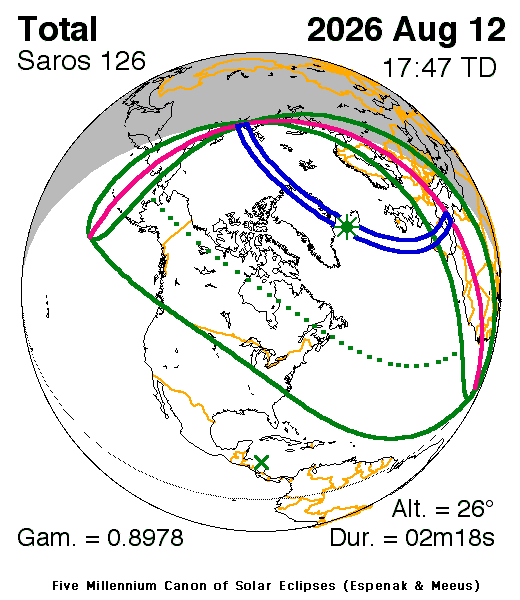
<p>The next total solar eclipse will be on <a href="https://eclipse.gsfc.nasa.gov/5MCSEmap/2001-2100/2026-08-12.gif">August 12, 2026</a>, and it will pass over Spain, Iceland, and Greenland. The one after that? August 2, 2027, <a href="https://www.timeanddate.com/eclipse/solar/2027-august-2">over North Africa</a>.</p>

<p><a href="https://www.vox.com/space" data-source="encore">NASA</a> keeps a<em>&nbsp;</em>catalog of all the eclipses (both&nbsp;<a href="http://eclipse.gsfc.nasa.gov/SEpubs/5MCSE.html">solar</a>&nbsp;and&nbsp;<a href="http://eclipse.gsfc.nasa.gov/LEcat5/LEcatalog.html">lunar</a>) that have occurred or will occur from 1999 BCE to 3000 CE.</p>

<p>That&rsquo;s why we know, for instance, that on January 27, 2837, a total solar eclipse <a href="http://eclipse.gsfc.nasa.gov/SEsearch/SEsearchmap.php?Ecl=28370127">will pass over southern Mexico</a>. (Will any humans<strong> </strong>be around to see it?)</p>

<p>The next solar eclipse over the United States will be visible in <a href="https://nationaleclipse.com/maps/map_03302033.html#:~:text=On%20March%2030%2C%202033%2C%20a,2%20minutes%20and%2037%20seconds.">Alaska in 2033</a>. And the next one in the lower 48 states will be in 2045.</p>
<img src="https://platform.vox.com/wp-content/uploads/sites/2/chorus/uploads/chorus_asset/file/8889767/21stCenturyNorthAmericanEclipses.png?quality=90&#038;strip=all&#038;crop=0,0,100,100" alt="A globe showing the paths of all solar eclipses of the 21st century." title="A globe showing the paths of all solar eclipses of the 21st century." data-has-syndication-rights="1" data-caption="" data-portal-copyright="&lt;a href=&quot;https://www.greatamericaneclipse.com/future/&quot;&gt;Great American Eclipse&lt;/a&gt;" />
						]]>
									</content>
			
					</entry>
			<entry>
			
			<author>
				<name>Brian Resnick</name>
			</author>
			
			<title type="html"><![CDATA[Why you absolutely cannot stare at the sun without eclipse glasses]]></title>
			<link rel="alternate" type="text/html" href="https://www.vox.com/science/24119318/solar-eclipse-2024-safety-glasses" />
			<id>https://www.vox.com/science/24119318/solar-eclipse-2024-safety-glasses</id>
			<updated>2024-04-04T15:52:58-04:00</updated>
			<published>2024-04-03T12:00:00-04:00</published>
			<category scheme="https://www.vox.com" term="Science" />
							<summary type="html"><![CDATA[When the total solar eclipse comes to the United States on April 8, there is one rule you must remember: Never stare directly into the sun. Even when the sun is partially obscured by the moon, its rays are still strong enough to permanently damage your eyesight. The only time to look upon the eclipse [&#8230;]]]></summary>
			
							<content type="html">
											<![CDATA[

						
<figure>

<img alt="" data-caption="Be safe and look cool during the total solar eclipse. | Carlos Tischler/Eyepix Group/Future Publishing via Getty Images" data-portal-copyright="Carlos Tischler/Eyepix Group/Future Publishing via Getty Images" data-has-syndication-rights="1" src="https://platform.vox.com/wp-content/uploads/sites/2/chorus/uploads/chorus_asset/file/25369101/1726772288.jpg?quality=90&#038;strip=all&#038;crop=0,0,100,100" />
	<figcaption>
	Be safe and look cool during the total solar eclipse. | Carlos Tischler/Eyepix Group/Future Publishing via Getty Images	</figcaption>
</figure>
<p>When the total solar eclipse <a href="https://www.vox.com/science/24105742/total-solar-eclipse-united-state-april-8-path-map-start-time-safety">comes to the United States on April 8,</a> there is one rule you must remember: Never stare directly into the sun. Even when the sun is partially obscured by the moon, its rays are still strong enough to permanently damage your eyesight. The only time to look upon the eclipse without glasses is when the sun is <em>fully</em> <em>covered</em> by the moon during totality, which only will last three or four minutes, depending where you are. If you are not in the <a href="https://www.vox.com/science/24105742/total-solar-eclipse-united-state-april-8-path-map-start-time-safety">narrow path of the totality,</a> spanning from Texas to Maine in the United States, this will not be an option for you.</p>

<p>To look at the sun during the eclipse&rsquo;s partial phase, you either have to find some eclipse glasses, or use an indirect method &mdash; like a pinhole projector (more on that below) &mdash; to view the eclipse. Because if you don&rsquo;t, you risk permanent eye damage.</p>

<p>So here&rsquo;s a short guide to why staring at the sun is so bad for you, and what you need to look out for when purchasing (you can <a href="https://www.eclipseglasses.com/">still get yours with rush shipping</a>) or<strong> </strong>using eclipse glasses.</p>
<h2 class="wp-block-heading">How the sun can burn a hole in your eyeball</h2>
<p>The sun is the most powerful source of energy in the solar system. It&rsquo;s the most energetic object for light-years in all directions (it&rsquo;s literally a huge fusion reactor). The energy it expels is so intense it can actually burn holes in your vision.</p>

<p>And it&rsquo;s particularly dangerous because of the anatomy of our eyes, <a href="https://nyuscholars.nyu.edu/en/persons/joel-schuman">Joel Schuman</a>, chair of ophthalmology at NYU Langone Health, told me in 2017. When light enters our eyes, the lens focuses light to the retina, located in the back of the eye. We see thanks to the retina&rsquo;s chemical sensors picking up on the presence of light and transmitting information to the brain.</p>

<p>The retina can handle indirect sunlight just fine. But think of what happens when you hold a magnifying glass up to the sun. It focuses light intensely enough to start a fire.</p>

<p>Something similar happens with the lens in your eye when it&rsquo;s focused directly on the sun.</p>

<p>&ldquo;The light from the sun is very intense and concentrated into a very small area, and then that light is converted into heat and that heat cooks the retina,&rdquo; Schuman said. &ldquo;So you have a permanent area that you don&rsquo;t see, a permanent blind spot.&rdquo; What&rsquo;s worse, a retina burn doesn&rsquo;t heal like a sunburn on the skin. It actually doesn&rsquo;t heal at all.</p>
<img src="https://platform.vox.com/wp-content/uploads/sites/2/chorus/uploads/chorus_asset/file/9063777/Schematic_diagram_of_the_human_eye_with_English_annotations.svg.png?quality=90&#038;strip=all&#038;crop=0,0,100,100" alt="" title="" data-has-syndication-rights="1" data-caption="" data-portal-copyright="Wikimedia Commons" />
<p>It doesn&rsquo;t heal because the retina is nerve tissue, Schuman explained, which doesn&rsquo;t readily regenerate. Think of it like a spinal cord tear: permanent. And because the light from the sun hits the center of the retina, this burn occludes the sharpest region of central vision.</p>

<p>&ldquo;Oh, 20 seconds probably, that&rsquo;s all it took,&rdquo;&nbsp;Louis Tomososki, an Oregon man who was partially blinded during a total solar eclipse in 1963, told a <a href="http://www.wsmv.com/story/36144284/oregon-man-shares-warning-after-being-partially-blinded-by-1963-eclipse">local NBC affiliate</a>. &ldquo;Looking at someone and being able see their face &mdash; but not their nose&rdquo; is how he described it to NBC.</p>

<p>In less severe cases, Schuman said, there may just be swelling in the retina. This can be treated with steroids or other anti-inflammatory drugs.</p>
<div class="wp-block-vox-media-highlight vox-media-highlight"><h2 class="wp-block-heading"><strong>The big questions about </strong><a href="https://www.vox.com/science/2024/4/3/24119057/total-solar-eclipse-2024-explainers-analysis-updates"><strong>solar eclipses</strong></a></h2><ul class="wp-block-list"><li><a href="https://www.vox.com/science/24105742/total-solar-eclipse-united-state-april-8-path-map-start-time-safety">Why is this year’s event different?</a></li><li><a href="https://www.vox.com/unexplainable/24119250/shes-been-chasing-solar-eclipses-for-three-decades-whats-she-after">What are eclipse chasers?</a></li><li><a href="https://www.vox.com/science/24119318/solar-eclipse-2024-safety-glasses">How to protect your eyes</a></li><li><a href="https://www.vox.com/travel/2024/4/4/24120289/solar-eclipse-2024-tourism-texas-vermont-new-york">What is the economic impact?</a></li><li><a href="https://www.vox.com/science-and-health/2017/7/17/15965422/solar-eclipse-2017-august-totality-awesome">What makes eclipses thrilling to watch?</a></li><li><a href="https://www.vox.com/24121090/solar-eclipse-2024-power-grid-energy-electricity-ercot">Will the eclipse affect the energy grid?</a></li><li><a href="https://www.vox.com/science/24117884/when-is-the-next-total-solar-eclipse">When is the next one?</a></li></ul></div>
<p>So be sure, if you think your eyes have been damaged, to see a doctor for treatment!</p>

<p>Normally we don&rsquo;t look at the sun because it&rsquo;s uncomfortable. But an eclipse is an opportunity to appreciate our place in the universe.</p>

<p>In 1999, a solar eclipse passed over the United Kingdom. Just one hospital alone in Leicester had 45 patients complaining of eye trouble, the journal <em>Lancet</em> <a href="http://www.sciencedirect.com/science/article/pii/S0140673600035972">reported</a>. Twenty of the cases involved burns or inflammation to the retina.</p>
<h2 class="wp-block-heading">So how do eclipse glasses work?</h2>
<p>On April 8, a total or partial solar eclipse will be visible from <a href="https://www.vox.com/science/24105742/total-solar-eclipse-united-state-april-8-path-map-start-time-safety">the entire continental United States</a>. But wherever you are, &ldquo;it is never safe to look directly at the sun&rsquo;s rays &mdash; even if the sun is partly obscured,&rdquo; <a href="https://www.vox.com/space" data-source="encore">NASA</a> warns. Even when the sun is 99 percent obscured, it can still cause damage.</p>

<p>That&rsquo;s why during a partial eclipse &mdash; and even through the early and later phases of a total eclipse when you can see the last bits of sun peeking through the craters of the moon &mdash; you&rsquo;ll need eye protection. You can only take off the protective glasses when the moon has <em>completely</em> covered the sun during totality.</p>

<p>Regular sunglasses won&rsquo;t block enough light. You&rsquo;ll need glasses that filter all but&nbsp;<a href="https://eclipse.gsfc.nasa.gov/SEhelp/safety2.html">0.003 percent&nbsp;of visible light</a> and block out most ultraviolet and infrared as well. &ldquo;Such filters usually have a thin layer of aluminum, chromium or silver deposited on their surfaces that attenuates ultraviolet, visible, and infrared energy,&rdquo; NASA&rsquo;s eye safety page <a href="https://eclipse.gsfc.nasa.gov/SEhelp/safety.html">explains</a>. Using photo or X-ray film <a href="https://eclipse.gsfc.nasa.gov/SEhelp/safety2.html">is not safe</a>.</p>

<p>(The same goes for looking through binoculars, mirrored cameras, or telescopes: If you&rsquo;re looking at the sun through them, you&rsquo;ll need to put special filters on the lenses.)</p>

<p>You could grab a pair of the&nbsp;<a href="https://eclipse.aas.org/eye-safety#welding">darkest available</a>&nbsp;(No. 14) welder&rsquo;s glasses. But this is even easier: Pick up a dirt-cheap pair of disposable eclipse glasses. The American Astronomical Society (AAS)&nbsp;<a href="https://eclipse.aas.org/eye-safety/viewers-filters">points out</a>&nbsp;several manufacturers that meet international standards for eclipse eye protection. They are:</p>
<ul class="wp-block-list"><li><a href="https://www.grafixplastics.com/materials-plastic-film-plastic-sheets/specialty-materials/solar-eclipse-products/">Grafix Plastics</a></li><li><a href="https://haloeclipse.com/collections/phoenix">Halo Eclipse Spectacles</a></li><li><a href="http://www.eclipseglasses.com/">American Paper Optics</a>/<a href="http://www.eclipseglasses.com/">eclipseglasses.com</a></li><li><a href="https://www.seymoursolar.com/store/p248/Helios_Film_Sheets.html#/">Seymour Solar</a></li><li><a href="https://flipnshades.com/">Flip’n Shades</a></li><li><a href="https://shop.icstars.com/collections/eclipse-glasses">DayStar Filters</a></li><li><a href="https://www.rainbowsymphonystore.com/collections/eclipse-glasses-safe-solar-viewers">Rainbow Symphony</a></li><li><a href="http://thousandoaksoptical.com/products/eclipse/">Thousand Oaks Optical</a></li></ul>
<p>(The AAS has&nbsp;<a href="https://eclipse.aas.org/eye-safety/viewers-filters">more information</a>&nbsp;on eclipse glasses retailers.)</p>

<p>Importantly, the AAS does not recommend &ldquo;searching for eclipse glasses on <a href="https://www.vox.com/amazon" data-source="encore">Amazon</a>, eBay, Temu, or any other online marketplace and buying from whichever vendor offers the lowest price.&rdquo; To avoid a counterfeit, the American Astronomical Society recommends using glasses purchased from its list of approved, vendors. Be sure to identify the manufacturer of the glasses and see that they are on the approved list above. (The AAS also has a helpful guide to spot fake or counterfeit glasses <a href="https://aas.org/press/american-astronomical-society-warns-counterfeit-fake-eclipse-glasses">here</a>.)</p>

<p>The good news is you might be able to pick up a verified pair for free at a local library. The Space Science Institute has&nbsp;<a href="https://www.starnetlibraries.org/about/our-projects/solar-eclipse-activities-libraries-seal/">donated 5 million solar eclipse glasses</a>&nbsp;to 10,000 libraries across the United States. Call your local library and ask whether they have any available.</p>
<h2 class="wp-block-heading">The safest way to view an eclipse: through a pinhole projector</h2>
<p>Or if you don&rsquo;t want to risk looking directly at the sun at all, try making a pinhole projector. All it takes is a piece of paper and a pin. The pinhole mimics the properties of a lens, and it will project the image of the sun onto a flat surface. <a href="https://www.theverge.com/" data-source="encore">The Verge</a><a href="https://www.theverge.com/2017/8/9/16109520/how-to-diy-pinhole-projector-solar-eclipse-cardboard-paper-budget-safe"> has a great, thorough</a> guide on how this all works.</p>

<p>One last reminder: If you&rsquo;re in the <a href="https://www.vox.com/science-and-health/2017/6/15/15804336/2017-solar-eclipse-map-united-states-nasa">path of the total solar eclipse</a>, you can take off the protective glasses the moment the moon is covering the sun 100 percent. Actually, if you don&rsquo;t, you&rsquo;ll miss the best part of the whole phenomenon: seeing the sun&rsquo;s outer atmosphere, the corona.</p>
<div class="video-container"><iframe src="https://volume.vox-cdn.com/embed/48e9ad6d6?player_type=youtube&#038;loop=1&#038;placement=article&#038;tracking=article:rss" allowfullscreen frameborder="0" allow=""></iframe></div>
						]]>
									</content>
			
					</entry>
			<entry>
			
			<author>
				<name>Brian Resnick</name>
			</author>
			
			<title type="html"><![CDATA[The total solar eclipse is returning to the United States — better than before]]></title>
			<link rel="alternate" type="text/html" href="https://www.vox.com/science/24105742/total-solar-eclipse-united-state-april-8-path-map-start-time-safety" />
			<id>https://www.vox.com/science/24105742/total-solar-eclipse-united-state-april-8-path-map-start-time-safety</id>
			<updated>2024-04-04T15:48:57-04:00</updated>
			<published>2024-04-02T10:21:43-04:00</published>
			<category scheme="https://www.vox.com" term="Science" />
							<summary type="html"><![CDATA[On April 8, 2024, millions of Americans will be able to see a rare celestial occurrence: a total solar eclipse. It&#8217;s going to be awesome. If you&#8217;re in the center of the moon&#8217;s shadow, known as the totality, the sky will go dark for a few minutes in the middle of the day. The temperature [&#8230;]]]></summary>
			
							<content type="html">
											<![CDATA[

						
<figure>

<img alt="" data-caption="A diamond-ring effect during a total eclipse of the sun on August 21, 2017, as viewed from the Cohen Recreation Center in Chester, Illinois. | Keith Gillett/Icon Sportswire via Getty Images" data-portal-copyright="Keith Gillett/Icon Sportswire via Getty Images" data-has-syndication-rights="1" src="https://platform.vox.com/wp-content/uploads/sites/2/chorus/uploads/chorus_asset/file/25348387/836577298.jpg?quality=90&#038;strip=all&#038;crop=0,0,100,100" />
	<figcaption>
	A diamond-ring effect during a total eclipse of the sun on August 21, 2017, as viewed from the Cohen Recreation Center in Chester, Illinois. | Keith Gillett/Icon Sportswire via Getty Images	</figcaption>
</figure>
<p>On April 8, 2024, millions of Americans will be able to see a rare celestial occurrence: a total solar eclipse.</p>

<p>It&rsquo;s going to be <a href="https://www.vox.com/science-and-health/2017/8/21/16178726/total-solar-eclipse-2017-first-time-awe-big">awesome</a>. If you&rsquo;re in the center of the moon&rsquo;s shadow, known as the totality, the sky will go dark for a few minutes in the middle of the day. The temperature <a href="https://www.space.com/37201-solar-eclipse-temperature-drop.html">will drop</a>, stars will appear, and birds will become confused and start chirping their nighttime songs.</p>

<p>And it&rsquo;s all because of a cosmic coincidence: From the Earth, the moon and the sun <a href="https://www.astronomy.com/science/why-is-the-moon-exactly-the-same-apparent-size-from-earth-as-the-sun-surely-this-cannot-be-just-coincidence-the-odds-against-such-a-perfect-match-are-enormous/">appear to be roughly the same size</a>.</p>

<p>By many measures, April&rsquo;s event will (please excuse the pun) eclipse the last total solar eclipse that <a href="https://www.vox.com/science-and-health/2017/7/25/15925410/total-solar-eclipse-2017-explained">passed over the United States</a> in 2017. There are few reasons. The shadow of totality will be twice as wide as that of the 2017 eclipse (more on why below), so it will be easier to find a place to view it in any given state. The time of totality &mdash; how long the moon is completely covering the sun &mdash; will also be almost twice as long, at over four minutes in many locations. The eclipse is <a href="https://www.vox.com/science/2024/1/31/24047913/solar-maximum-cycle-explained-25-flares-coronal-mass-ejection">occurring near the peak of the sun&rsquo;s 11</a>-year magnetic cycle, which <a href="https://www.space.com/solar-maximum-gives-unique-view-sun-corona-during-total-solar-eclipse-april-8-2024">could increase the chances </a>of seeing great loops of the sun&rsquo;s plasma sprouting from the side of the eclipse.</p>

<p>&ldquo;And I think even more importantly, 2024 passes over a much bigger population,&rdquo; says Ernie Wright, who works in <a href="https://svs.gsfc.nasa.gov/">NASA&rsquo;s Scientific Visualization Studio</a>. He did the eclipse calculations underlying many of the maps and illustrations you&rsquo;ll see in this article. &ldquo;More than twice as many people actually live in the path and don&rsquo;t have to go anywhere to see it.&rdquo;</p>
<div class="wp-block-vox-media-highlight vox-media-highlight"><h2 class="wp-block-heading"><strong>The big questions about </strong><a href="https://www.vox.com/science/2024/4/3/24119057/total-solar-eclipse-2024-explainers-analysis-updates"><strong>solar eclipses</strong></a></h2><ul class="wp-block-list"><li><a href="https://www.vox.com/science/24105742/total-solar-eclipse-united-state-april-8-path-map-start-time-safety">Why is this year’s event different?</a></li><li><a href="https://www.vox.com/unexplainable/24119250/shes-been-chasing-solar-eclipses-for-three-decades-whats-she-after">What are eclipse chasers?</a></li><li><a href="https://www.vox.com/science/24119318/solar-eclipse-2024-safety-glasses">How to protect your eyes</a></li><li><a href="https://www.vox.com/travel/2024/4/4/24120289/solar-eclipse-2024-tourism-texas-vermont-new-york">What is the economic impact?</a></li><li><a href="https://www.vox.com/science-and-health/2017/7/17/15965422/solar-eclipse-2017-august-totality-awesome">What makes eclipses thrilling to watch?</a></li><li><a href="https://www.vox.com/24121090/solar-eclipse-2024-power-grid-energy-electricity-ercot">Will the eclipse affect the energy grid?</a></li><li><a href="https://www.vox.com/science/24117884/when-is-the-next-total-solar-eclipse">When is the next one?</a></li></ul></div>
<p>If you live anywhere in the path from Kerrville, Texas, to Houlton, Maine, you&rsquo;re in luck. If you want to travel to see it, book accommodations now! Hotels in many <a href="https://www.google.com/search?sca_esv=def40fa9418a875e&amp;q=eclipse+accommodations+filling+up&amp;tbm=nws&amp;source=lnms&amp;prmd=ivnsmbtz&amp;sa=X&amp;ved=2ahUKEwi-sKLIiIaFAxUgEFkFHXQpBC0Q0pQJegQICxAB&amp;biw=1320&amp;bih=830&amp;dpr=2.2">areas are filling up</a>. But even if you can&rsquo;t get to the path of totality, you&rsquo;ll be able to view at least a partial solar eclipse (which is pretty cool) from any location in the lower 48 United States. It will be the last total solar eclipse in the lower 48 United States until 2045. So, if you&rsquo;ve been eager to see one in the US, now is your last chance for 21 years.</p>

<p>Here&rsquo;s everything you need to know about the upcoming eclipse.</p>
<h2 class="wp-block-heading">Why do we have solar eclipses?</h2>
<p>There&rsquo;s a simple answer: The moon occasionally covers the sun in its path across the sky. But it&rsquo;s more complicated than that. Three cosmic conditions have to be met to produce the shadow.</p>

<p><strong>First, there has to be a new moon.</strong></p>

<p>One side of the moon is always lit by the sun, but the lit side isn&rsquo;t always facing the Earth. This is how we get the phases of the moon. For a solar eclipse to occur, it needs to be in its &ldquo;new moon&rdquo; phase.</p>

<p>During the new moon, the dark side of the moon is directly facing the Earth.</p>
<img src="https://platform.vox.com/wp-content/uploads/sites/2/chorus/uploads/chorus_asset/file/25348346/phases.2024_03_21_15_18_24.gif?quality=90&#038;strip=all&#038;crop=0,0,100,100" alt="An animated graphic shows the Moon’s orbit around the Earth and how much of the light and dark sides of the moon are facing it at any point." title="An animated graphic shows the Moon’s orbit around the Earth and how much of the light and dark sides of the moon are facing it at any point." data-has-syndication-rights="1" data-caption="" data-portal-copyright="&lt;a href=&quot;mailto:ernest.t.wright@nasa.gov?subject=Mail%20From%20SVS%20Web%20Site:%20Animation%20ID%204314&quot;&gt;Ernie Wright&lt;/a&gt;/NASA" />
<p><strong>Then, the moon has to cross the plane of Earth&rsquo;s orbit.</strong></p>

<p>If the dark side of the moon has to be facing the Earth for a solar eclipse to occur, why don&rsquo;t we have them every new moon? The moon&rsquo;s orbit isn&rsquo;t perfectly matched up with the Earth&rsquo;s.</p>

<p>That&rsquo;s<em> </em>because the moon is tilted on a 5-degree axis. No one is <a href="https://www.nature.com/nature/journal/v539/n7629/full/nature19846.html">completely sure why</a> the moon is slightly skewed, but it might have to do with how it was likely formed: from a massive object smashing into Earth.</p>
<img src="https://platform.vox.com/wp-content/uploads/sites/2/chorus/uploads/chorus_asset/file/8890867/Screen_Shot_2017_07_21_at_11.27.44_AM.png?quality=90&#038;strip=all&#038;crop=0,0,100,100" alt="The moon’s shadow projects into space, not in line with the Earth." title="The moon’s shadow projects into space, not in line with the Earth." data-has-syndication-rights="1" data-caption="A depiction of the a new moon’s shadow missing the Earth. | NASA" data-portal-copyright="NASA" />
<p>This means during most new moons, the shadow misses the Earth.</p>

<p>But there are two points in the moon&rsquo;s orbit where the shadow can fall on the Earth. These are called nodes.</p>
<img src="https://platform.vox.com/wp-content/uploads/sites/2/chorus/uploads/chorus_asset/file/8890871/Screen_Shot_2017_07_21_at_11.29.02_AM.png?quality=90&#038;strip=all&#038;crop=0,0,100,100" alt="The nodes are located at two directly opposite points in the moon’s orbit." title="The nodes are located at two directly opposite points in the moon’s orbit." data-has-syndication-rights="1" data-caption="" data-portal-copyright="Joss Fong/Vox" />
<p>For a total eclipse to occur, the moon needs to be at or very close to one of the nodes.</p>
<img src="https://platform.vox.com/wp-content/uploads/sites/2/chorus/uploads/chorus_asset/file/8886227/2017_07_20_15_18_53.gif?quality=90&#038;strip=all&#038;crop=0,0,100,100" alt="An animate graphic shows the moon lining up between the Earth and the sun at a node." title="An animate graphic shows the moon lining up between the Earth and the sun at a node." data-has-syndication-rights="1" data-caption="" data-portal-copyright="Joss Fong/Vox" />
<p><strong>Finally, whether the entire sun is covered depends on the moon&rsquo;s distance to the Earth.</strong></p>

<p>You might remember this from middle school science: The moon&rsquo;s orbit around the Earth is not a perfect circle. It&rsquo;s an ellipse.</p>
<img src="https://platform.vox.com/wp-content/uploads/sites/2/chorus/uploads/chorus_asset/file/8890469/Moon_apsidal_precession.png?quality=90&#038;strip=all&#038;crop=0,0,100,100" alt="The elliptical orbit of the moon around the Earth." title="The elliptical orbit of the moon around the Earth." data-has-syndication-rights="1" data-caption="" data-portal-copyright="&lt;a href=&quot;https://en.wikipedia.org/wiki/Orbit_of_the_Moon#/media/File:Moon_apsidal_precession.png&quot;&gt;Wikipedia&lt;/a&gt;" />
<p>There&rsquo;s a point in the orbit where the moon is the farthest it gets from the sun and a point where it&rsquo;s the closest. For a total eclipse to occur, the moon needs to be near its closest approach to Earth.</p>

<p>If the eclipse occurs when the moon is close, it will totally block out the sun. If it&rsquo;s farther away, we get what&rsquo;s called a &ldquo;<a href="https://www.vox.com/science/2023/10/13/23916179/solar-eclipse-2023-live-stream-start-time-us-oregon-california-texas-arizona">ring of fire</a>&rdquo; eclipse.</p>
<h2 class="wp-block-heading">How do we know when eclipses will happen?</h2>
<p>The three conditions that conspire to create eclipses &mdash; the new moon, the moon crossing the plane of Earth&rsquo;s orbit, and the moon&rsquo;s distance to the Earth &mdash; all recur on slightly different time scales.</p>
<ul class="wp-block-list"><li>It takes the moon 27.212 days to return to a node (this is called a draconic month).</li><li>Every 27.554 days, the moon returns to its closest approach to Earth (an anomalistic month).</li><li>The moon finishes cycling through all its phases once every 29.530 days (a synodic month). </li></ul>
<p>The system that keeps track of all three months and when they overlap is called <a href="https://eclipse.gsfc.nasa.gov/SEsaros/SEsaros.html">the Saros cycle</a>, and it predicts both solar and lunar eclipses. Saros is ancient: <a href="https://link.springer.com/referenceworkentry/10.1007/1-4020-4520-4_350#:~:text=An%20important%20lunar%20periodicity%20that,Thales%20of%20Miletus%20(q.v.).">The Babylonians discovered </a>it in the few centuries before the start of the common era. And they worked it all out just by making careful observations of the moon for hundreds of years.</p>

<p>Today, <a href="https://www.vox.com/space" data-source="encore">NASA</a> doesn&rsquo;t have to rely on the Saros cycle alone to predict eclipses. &ldquo;It starts with knowing where the Earth, the moon, and the sun are,&rdquo; Wright says of making eclipse prediction and maps. &ldquo;But then you need to calculate, based on the geometry, what the shape of that shadow is and where it&rsquo;s going to hit the Earth.&rdquo;</p>

<p>The GIF below, produced by Wright and colleagues, demonstrates how the moon casts it shadow.</p>
<img src="https://platform.vox.com/wp-content/uploads/sites/2/chorus/uploads/chorus_asset/file/25346633/eclipse24_flyaround_1080p30.2024_03_20_16_13_17.gif?quality=90&#038;strip=all&#038;crop=0,0,100,100" alt="The path of the moon’s shadow across the Earth." title="The path of the moon’s shadow across the Earth." data-has-syndication-rights="1" data-caption="" data-portal-copyright="&lt;a href=&quot;https://svs.gsfc.nasa.gov/5186/&quot;&gt;NASA Scientific Visualization Studio&lt;/a&gt;" />
<p>To make extremely accurate maps and projections of the eclipse, Wright says, he even takes into account how the moon isn&rsquo;t a perfect sphere. The edge of the moon &ldquo;has mountains and valleys on it, and that actually affects the shape of the shadow,&rdquo; he says. &ldquo;And so with some extra calculation, you can take that into account. It&rsquo;s the reason, when you look at my map, the shadow shape on the ground is not a perfect oval. It&rsquo;s kind of a potato shape.&rdquo;</p>

<p>You can see that potato shadow shape in Wright&rsquo;s animation of the shadow passing over Arkansas, Indiana, and Ohio. (<a href="https://svs.gsfc.nasa.gov/5219/">See the entire video of the shadow&rsquo;s path here.</a>)</p>
<img src="https://platform.vox.com/wp-content/uploads/sites/2/chorus/uploads/chorus_asset/file/25346682/potato.gif?quality=90&#038;strip=all&#038;crop=0,0,100,100" alt="The moon’s shadow moves northeast across Arkansas, Indiana, and Ohio." title="The moon’s shadow moves northeast across Arkansas, Indiana, and Ohio." data-has-syndication-rights="1" data-caption="" data-portal-copyright="&lt;a href=&quot;https://svs.gsfc.nasa.gov/5219/&quot;&gt;Ernie Wright/NASA Scientific Visualization Studio&lt;/a&gt;" /><h2 class="wp-block-heading">Can eclipses happen anywhere on Earth?</h2>
<p>Eventually, every spot on Earth will see an eclipse. Wright made a map <a href="https://svs.gsfc.nasa.gov/5222">overlaying all the paths</a> of every total solar eclipse that has occurred since the year 2000 BCE and will occur up to the year 3000 CE. The brighter the color, the more eclipses have occurred in that spot. Every spot on his map is colored in by at least one eclipse, Wright says &mdash; the map below <a href="https://svs.gsfc.nasa.gov/5222">comprises 14.6 million pixels</a>, and they all are colored in.</p>
<img src="https://platform.vox.com/wp-content/uploads/sites/2/chorus/uploads/chorus_asset/file/25345836/eclipse_freq_heatmap_print.jpg?quality=90&#038;strip=all&#038;crop=0,0,100,100" alt="Ernie Wright’s overlay map." title="Ernie Wright’s overlay map." data-has-syndication-rights="1" data-caption="" data-portal-copyright="&lt;a href=&quot;https://svs.gsfc.nasa.gov/5222&quot;&gt;NASA Scientific Visualization Studio/Ernie Wright&lt;/a&gt;" /><h2 class="wp-block-heading">Do some places see more eclipses than others?</h2>
<p>Interestingly, with the map above, Wright finds more eclipses have occurred and will occur in the Northern Hemisphere than in the South. There&rsquo;s a reason for this. During the summer months in the Northern Hemisphere, the Earth is slightly farther away from the sun than when it is summer in the Southern Hemisphere. &ldquo;During Northern Hemisphere summer, we&rsquo;re a little bit farther away from the sun, so the sun looks slightly smaller in the sky,&rdquo; he explains. &ldquo;That makes it a little easier for the moon to cover the sun.&rdquo; And eclipses are more likely in the summer &ldquo;just because the Sun is up longer then,&rdquo; he <a href="https://svs.gsfc.nasa.gov/5222">explains</a> in his post on the NASA website.</p>
<h2 class="wp-block-heading">Which places are going to get totality? When? And for how long?</h2>
<p>In the United States, the total solar eclipse in April will cut a path from Texas all the way up to Maine. What time the eclipse starts and how long it lasts are dependent on the spot you choose to observe it. For example, in Kerrville, Texas, the totality will start at 1:32 pm local time and last for 4 minutes and 24 seconds. In Houlton, Maine, the totality starts at 3:32 pm local time and only lasts for 3 minutes and 20 seconds.</p>

<p>For all the information on when the eclipse starts, check out NASA&rsquo;s great interactive <a href="https://eclipse-explorer.smce.nasa.gov/">Eclipse Explorer</a>. Click on any city on the map there to see local eclipse information, including start times and lengths of totality.</p>
<img src="https://platform.vox.com/wp-content/uploads/sites/2/chorus/uploads/chorus_asset/file/25347480/eclipse_map_2024_1920.png?quality=90&#038;strip=all&#038;crop=0,0,100,100" alt="The path of the April 2024 solar eclipse across the United States as seen on the Eclipse Explorer website." title="The path of the April 2024 solar eclipse across the United States as seen on the Eclipse Explorer website." data-has-syndication-rights="1" data-caption="" data-portal-copyright="&lt;a href=&quot;https://eclipse-explorer.smce.nasa.gov/&quot;&gt;NASA&lt;/a&gt;" /><h2 class="wp-block-heading">Why will this eclipse last longer than the 2017 one?</h2>
<p>In 2017, the length of totality for most places in the US hovered around the two-minute mark. This year&rsquo;s eclipse will last around three or four minutes, depending on the location<em>.</em></p>

<p>Why is this one so much longer? Again, it all has to do with the moon&rsquo;s slightly elliptical orbit around the Earth. The oval shape of the orbit means &ldquo;every month there are times when the moon is closer and times when it&rsquo;s farther away,&rdquo; Wright says. &ldquo;We can only get total eclipses when the moon is pretty close to us.&rdquo; Otherwise the result is that annular &ldquo;ring of fire&rdquo; eclipse, where the sun isn&rsquo;t completely blocked out. But during the 2024 eclipse, the moon will be nearer to the Earth than it was in 2017.</p>

<p>The closer the moon is, the bigger it appears to us in the sky and the larger the shadow it casts, including during an eclipse. And a bigger shadow takes a longer time to clear an area.</p>
<h2 class="wp-block-heading">Outside the totality, what will the rest of the country see?</h2>
<p>The entire lower 48 United States will be able to observe at least a partial eclipse, where just a portion of the sun is covered by the moon. (You&rsquo;ll need special solar eclipse glasses to view it safely &mdash; more on those below.) The Pacific Northwest will see about a quarter of the sun obscured, while the Southeast will see around 75 percent. For exactly what you&rsquo;ll see in your area and when, check out <a href="https://eclipse-explorer.smce.nasa.gov/">NASA&rsquo;s Eclipse Explorer</a>.</p>
<img src="https://platform.vox.com/wp-content/uploads/sites/2/chorus/uploads/chorus_asset/file/25347508/Screen_Shot_2024_03_21_at_8.19.17_AM.png?quality=90&#038;strip=all&#038;crop=0,0,100,100" alt="A map shows which parts of the US will see 25%, 50%, 75%, and 100% of the sun obscured during the eclipse." title="A map shows which parts of the US will see 25%, 50%, 75%, and 100% of the sun obscured during the eclipse." data-has-syndication-rights="1" data-caption="" data-portal-copyright="&lt;a href=&quot;https://eclipse-explorer.smce.nasa.gov/&quot;&gt;NASA Scientific Visualization Studio&lt;/a&gt;" /><h2 class="wp-block-heading">Can I livestream totality?</h2>
<p>Yes! NASA is going to stream live coverage of the eclipse from several sites across the path of totality, starting at 1 pm Eastern Standard Time on April 8.</p>
<div class="youtube-embed"><iframe title="NASA Live: Official Stream of NASA TV" src="https://www.youtube.com/embed/21X5lGlDOfg?rel=0" allowfullscreen allow="accelerometer *; clipboard-write *; encrypted-media *; gyroscope *; picture-in-picture *; web-share *;"></iframe></div><h2 class="wp-block-heading">Are there any places in the US that got totality in 2017 and have it again in 2024?</h2>
<p>Carbondale, Illinois, and the surrounding area in <a href="https://news.siu.edu/2015/03/030615tew15003.php">southern Illinois</a> are getting a <a href="https://eclipse.siu.edu/">repeat total solar eclipse</a>. Way to go! Wright says that, on average, an area should see a repeat eclipse once every 365 years. &ldquo;To have two of them happen within seven years is, you know &mdash; it&rsquo;s pretty lucky for Carbondale,&rdquo; he says.</p>
<h2 class="wp-block-heading">Do we know where the next total solar eclipse is going to be?</h2>
<p>Absolutely. There&rsquo;s a total solar eclipse roughly once every 18 months.</p>

<p>The next total solar eclipse will be on <a href="https://eclipse.gsfc.nasa.gov/5MCSEmap/2001-2100/2026-08-12.gif">August 12, 2026,</a> and it will pass over Spain, Iceland, and Greenland.</p>

<p>NASA keeps a<em>&nbsp;</em>catalog of all the eclipses (both&nbsp;<a href="http://eclipse.gsfc.nasa.gov/SEpubs/5MCSE.html">solar</a>&nbsp;and&nbsp;<a href="http://eclipse.gsfc.nasa.gov/LEcat5/LEcatalog.html">lunar</a>) that have occurred or will occur from 1999 BCE to the 3000 CE. That&rsquo;s five&nbsp;millennia<em>, </em>mind you.</p>

<p>That&rsquo;s why we know, for instance, that on January 27, 2837, a total solar eclipse <a href="http://eclipse.gsfc.nasa.gov/SEsearch/SEsearchmap.php?Ecl=28370127">will pass over southern Mexico</a>. (Will any humans<strong> </strong>be around to see it?)</p>

<p>The next solar eclipse over the United States will be visible in <a href="https://nationaleclipse.com/maps/map_03302033.html#:~:text=On%20March%2030%2C%202033%2C%20a,2%20minutes%20and%2037%20seconds.">Alaska in 2033</a>. And the next one in the lower 48 states will be in 2045.</p>
<img src="https://platform.vox.com/wp-content/uploads/sites/2/chorus/uploads/chorus_asset/file/8889767/21stCenturyNorthAmericanEclipses.png?quality=90&#038;strip=all&#038;crop=0,0,100,100" alt="A globe showing the paths of all solar eclipses of the 21st century." title="A globe showing the paths of all solar eclipses of the 21st century." data-has-syndication-rights="1" data-caption="" data-portal-copyright="&lt;a href=&quot;https://www.greatamericaneclipse.com/future/&quot;&gt;Great American Eclipse&lt;/a&gt;" /><h2 class="wp-block-heading">Okay, enough with the astronomy. What happens on the ground during a total solar eclipse?</h2>
<p>If you&rsquo;re in the path of the total solar eclipse, expect to do a fair amount of waiting around for the big moment.</p>

<p>The eclipse goes through a few phases. In Kerrville, Texas,<strong> </strong>the partial eclipse phase starts around 12:14 pm, but the totality doesn&rsquo;t begin until 1:32 pm.</p>

<p>For anywhere in the path of totality, the first thing you&rsquo;re going to see is a partial eclipse: the moon slowly starting to obscure the sun. For this part of the eclipse, be sure to wear special eclipse glasses (more on them below).</p>
<img src="https://platform.vox.com/wp-content/uploads/sites/2/chorus/uploads/chorus_asset/file/8889931/GettyImages_514440612.jpg?quality=90&#038;strip=all&#038;crop=0,0,100,100" alt="A partial solar eclipse." title="A partial solar eclipse." data-has-syndication-rights="1" data-caption="" data-portal-copyright="Sijori Images/Barcroft India/Barcroft Media via Getty Images" />
<p>During a partial solar eclipse, shadows form eerie crescent shapes.</p>
<img src="https://platform.vox.com/wp-content/uploads/sites/2/chorus/uploads/chorus_asset/file/8889937/304442914_1843e48d16_o.jpg?quality=90&#038;strip=all&#038;crop=0,0,100,100" alt="Crescent-shaped shadows on a park bench." title="Crescent-shaped shadows on a park bench." data-has-syndication-rights="1" data-caption="" data-portal-copyright="&lt;a href=&quot;https://www.flickr.com/photos/fdecomite/&quot;&gt;fdecomite&lt;/a&gt;/Flickr" />
<p>When totality nears, that&rsquo;s when the show really begins. There are a couple of awesome phenomena that you can look out for.</p>

<p>Right before totality, the last glimpse of light from the sun will form a &ldquo;diamond ring&rdquo; in the sky.</p>
<img src="https://platform.vox.com/wp-content/uploads/sites/2/chorus/uploads/chorus_asset/file/8889727/GettyImages_90757606.jpg?quality=90&#038;strip=all&#038;crop=0,0,100,100" alt="A black circle in a dark sky surrounded by a ring of light with a larger bit of light showing in one place, making the light look like a diamond ring." title="A black circle in a dark sky surrounded by a ring of light with a larger bit of light showing in one place, making the light look like a diamond ring." data-has-syndication-rights="1" data-caption="" data-portal-copyright="SSPL/Getty Images" />
<p>You&rsquo;ll also be able to see &ldquo;Baily&rsquo;s beads&rdquo; (named after astronomer Francis Baily): bits of light poking through canyons and craters on the roughed-up surface of the moon.</p>
<img src="https://platform.vox.com/wp-content/uploads/sites/2/chorus/uploads/chorus_asset/file/8889725/GettyImages_90757609.jpg?quality=90&#038;strip=all&#038;crop=0,0,100,100" alt="Beadlike blobs of light visible around the edge of a dark moon." title="Beadlike blobs of light visible around the edge of a dark moon." data-has-syndication-rights="1" data-caption="" data-portal-copyright="SSPL/Getty Image" />
<p>Insider tip: Wright says if you want to see more Baily&rsquo;s beads, choose to watch the eclipse near the edge of the totality zone on the map. &ldquo;The edge of the moon is grazing the edge of the sun at that point on the path,&rdquo; Wright says.</p>

<p>Then comes totality: when the moon is fully covering the sun. This is what you&rsquo;ve been waiting for. When the totality happens, the sky goes dark. Stars come out. You can see the corona &mdash; the sun&rsquo;s wispy outer atmosphere. This is normally too faint to see, even if you are wearing solar eclipse glasses. But with the moon blocking the sun&rsquo;s light, it shines through in an almost ghostly manner. You might also see little prominences jutting out of the <a href="https://eclipse2017.nasa.gov/solar-prominences">side of the shadow</a> (seen in red in the image below). These are regions of intense magnetism where the sun&rsquo;s plasma extends outward from the surface.</p>
<img src="https://platform.vox.com/wp-content/uploads/sites/2/chorus/uploads/chorus_asset/file/25347525/1409036893.jpg?quality=90&#038;strip=all&#038;crop=0,0,100,100" alt="The sun as the moon blocks it and the misty light around the sun is visible." title="The sun as the moon blocks it and the misty light around the sun is visible." data-has-syndication-rights="1" data-caption="The sun’s corona is visible as the moon obscures the sun during the Great American Solar Eclipse, in Madras, Oregon, on August 21, 2017. | Carlos Avila Gonzalez/San Francisco Chronicle via Getty Images" data-portal-copyright="Carlos Avila Gonzalez/San Francisco Chronicle via Getty Images" />
<p>While you&rsquo;re dazzled by the corona, consider this: The sun&rsquo;s atmosphere is actually hotter than its surface, but&nbsp;<a href="https://www.nasa.gov/feature/goddard/sounding-rockets/strong-evidence-for-coronal-heating-theory-presented-at-2015-tess-meeting">no one really knows why</a>.&nbsp;</p>
<h2 class="wp-block-heading">What’s so awesome about totality?</h2>
<p>Photos can&rsquo;t really capture the awesomeness of totality.</p>

<p>&ldquo;Anytime you&rsquo;ve ever taken a picture of the full moon, it never captures how it felt in your eyes and in your heart, you know what I mean?&rdquo; Rhonda Coleman, an eclipse chaser, <a href="https://www.vox.com/science-and-health/2017/8/10/16114762/total-solar-eclipse-chasers-2017">told me in 2017</a>. &ldquo;It seems to fill the sky, but your photograph will only be a memory.&rdquo;</p>

<p>I saw the 2017 eclipse in South Carolina. Here&rsquo;s how I described it at the <a href="https://www.vox.com/science-and-health/2017/8/21/16178726/total-solar-eclipse-2017-first-time-awe-big">time</a>:</p>
<blockquote class="wp-block-quote has-text-align-none is-layout-flow wp-block-quote-is-layout-flow">
<p>When the shadow fully took over the sun, the crickets chirped, the kids screamed, Venus appeared bright in the sky next to the sun, and I lay down before a black, black disc that was<em>&nbsp;</em>surrounded by the most angelic white light I&rsquo;ve ever seen. It must be the color Renaissance painters yearned for when painting pictures of God in heaven &mdash; sublime, gentle, powerful, and singular.</p>
</blockquote>
<p>So yeah, viewing the eclipse might bring out overwrought prose in you too. You&rsquo;ve been warned!</p>
<h2 class="wp-block-heading">Will it change my life?</h2>
<p>Many people report feeling a profound sense of awe during and after a total solar eclipse. &ldquo;You suddenly feel as though you can see the clockwork of the solar system,&rdquo; Wright t<a href="https://www.vox.com/science-and-health/2017/7/25/15925410/total-solar-eclipse-2017-explained">old me back in 2017</a>.</p>

<p>He continued:</p>
<blockquote class="wp-block-quote has-text-align-none is-layout-flow wp-block-quote-is-layout-flow">
<p>We kind of know &mdash; in the back of our minds &mdash; that we live in a giant ball and it revolves around a hot ball of gas, and we&rsquo;re floating in space. But you don&rsquo;t really believe it until you see something like a total solar eclipse, where everything is all lined up and you go whoaaa. Other planets pop out. You got instant nighttime. And you can see Mercury and Venus usually. And sometimes Mars and Jupiter. &#8230; It looks like the pictures from the textbook. It&rsquo;s not entirely a science thing anymore. &#8230; It&rsquo;s mostly a thing where you have a better appreciation of where you are in the solar system.</p>
</blockquote>
<p>Your experience may vary.</p>
<h2 class="wp-block-heading">Do normal laws apply during totality, or am I allowed to do weird, wolflike things without the fear of repercussions?</h2>
<p>Arguably, you can do weird, wolflike things any day of the year. But check your local and federal laws before proceeding.</p>
<h2 class="wp-block-heading">Will my pets freak out?</h2>
<p>In 2017, I posed this question to Bill Kramer, a 16-plus-time eclipse viewer who runs <a href="http://eclipse-chasers.com/">Eclipse Chasers</a>, an online community for, well, you know.</p>

<p>Kramer says pets get confused and will think it&rsquo;s nighttime.</p>

<p>&ldquo;Some dogs bark at the eclipse,&rdquo; he says. &ldquo;Some dogs detect the emotion of the moment, or anxiety beforehand, and react accordingly. Never heard of one reacting like some do to fireworks or gunshots. The eclipse is a silent thing, except for the ambient sounds and cheers.&nbsp;&#8230; Cats, on the other hand, are cats.&rdquo;</p>

<p>During the 2017 eclipse, zoos reported odd <a href="https://www.cnn.com/2024/03/13/world/eclipse-zoo-animal-behavior-nasa-soundscapes-scn/index.html">behavior with their animals</a>. At a zoo in South Carolina, CNN recalled <a href="https://www.cnn.com/2024/03/13/world/eclipse-zoo-animal-behavior-nasa-soundscapes-scn/index.html">in a recent news story</a>, &ldquo;the giraffes gathered and broke into a gallop, the Gal&aacute;pagos tortoises began to mate, and the gorillas started to get ready for bed.&rdquo;</p>

<p>How animals react to eclipses is still something of a mystery overall. This April you can sign up to be part of a National Science Foundation-funded citizens science project to help collect data. More information on that on the <a href="https://scistarter.org/solar-eclipse-safari-resources">SciStarter website</a>.</p>
<h2 class="wp-block-heading">Will bad weather ruin the eclipse?</h2>
<p>Always a risk.</p>

<p>If you&rsquo;re feeling really anxious about picking out the &ldquo;perfect&rdquo; spot to view, you&rsquo;ll want to find a place with little cloud cover. An eclipse on a cloud-covered day is still cool (it will get very, very dark), but you won&rsquo;t be able to see the dark mask of the moon in front of the sun.</p>

<p>The weather, as you know, can be hard to predict. But the National Oceanic and Atmospheric Administration (NOAA) is here to help. The agency has created an interactive map (<a href="https://ncsu.maps.arcgis.com/apps/webappviewer/index.html?id=a65a18758b264f1790665a68b858b3d6">click for the full map</a>; see a static version of it below) that projects the likelihood of cloud cover for many cities in the path of the eclipse based on historical weather data.</p>

<p>For example, in Cleveland, Ohio, there&rsquo;s a 43 percent chance of it being overcast. That&rsquo;s a relatively bad bet compared to Waco, Texas, where there is a 25.8 percent chance of it being overcast.</p>
<img src="https://platform.vox.com/wp-content/uploads/sites/2/chorus/uploads/chorus_asset/file/25344038/LikelihoodOfViewability2024_Short.jpeg?quality=90&#038;strip=all&#038;crop=0,0,100,100" alt="NOAA’s historical likelihood of eclipse viewability for the United States." title="NOAA’s historical likelihood of eclipse viewability for the United States." data-has-syndication-rights="1" data-caption="" data-portal-copyright="NOAA" />
<p>The Washington Post is keeping track of <a href="https://www.washingtonpost.com/weather/2024/03/29/cloud-cover-eclipse-forecast-maps-cities/">the eclipse day forecasts</a>. Check them out for daily updates.</p>
<h2 class="wp-block-heading">Will I go blind?</h2>
<p>Not if you&rsquo;re careful! On a normal day, staring straight into the sun can harm your eyes. On eclipse day, it is no different.</p>

<p>NASA <a href="https://www.nasa.gov/content/eye-safety-during-a-total-solar-eclipse">warns</a>: &ldquo;It is never safe to look directly at the sun&rsquo;s rays &mdash; even if the sun is partly obscured.&rdquo; So don&rsquo;t look at the partial eclipse directly!</p>

<p>The intense light from the sun can damage your retinas and cause &ldquo;permanent scotoma or &lsquo;blind spot&rsquo; in the central vision,&rdquo;<a href="http://www.sciencedirect.com/science/article/pii/S0140673600035972"> according to</a> the<em> </em>Lancet<em>. </em>Even when the sun is 99 percent obscured, it can still cause damage.</p>

<p>During the partial eclipse phases, and even through the eclipse&rsquo;s &ldquo;Baily&rsquo;s beads&rdquo; and &ldquo;diamond ring&rdquo; phases &mdash; when you can see the last bits of sun peeking through the craters of the moon &mdash; you need eye protection. You can only take the protective glasses off when the moon has completely covered the sun during totality.</p>

<p>Regular sunglasses won&rsquo;t block enough light. You&rsquo;ll need glasses that filter all but&nbsp;<a href="https://eclipse.gsfc.nasa.gov/SEhelp/safety2.html">0.003 percent&nbsp;of visible light</a> and block out most ultraviolet and infrared as well. &ldquo;Such filters usually have a thin layer of aluminum, chromium or silver deposited on their surfaces that attenuates ultraviolet, visible, and infrared energy,&rdquo; NASA&rsquo;s eye safety page explains.</p>

<p>You could grab a pair of the <a href="http://blog.phillips-safety.com/view-the-eclipse-with-only-shade-14-solar-eclipse-glasses/">darkest available</a> (No. 14) welder&rsquo;s glasses. But this is even easier: Pick up a dirt-cheap pair of disposable eclipse glasses. The American Astronomical Society (AAS) <a href="https://eclipse.aas.org/eye-safety/viewers-filters">points out</a> there are several manufacturers that meet international standards for eclipse eye protection. They are:</p>
<ul class="wp-block-list"><li><a href="https://www.grafixplastics.com/materials-plastic-film-plastic-sheets/specialty-materials/solar-eclipse-products/">Grafix Plastics</a></li><li><a href="https://haloeclipse.com/collections/phoenix">Halo Eclipse Spectacles</a></li><li><a href="http://www.eclipseglasses.com/">American Paper Optics</a>/<a href="http://www.eclipseglasses.com/">eclipseglasses.com</a></li><li><a href="https://www.seymoursolar.com/store/p248/Helios_Film_Sheets.html#/">Seymour Solar</a></li><li><a href="https://flipnshades.com/">Flip’n Shades</a> </li><li><a href="https://shop.icstars.com/collections/eclipse-glasses">DayStar Filters</a></li><li><a href="https://www.rainbowsymphonystore.com/collections/eclipse-glasses-safe-solar-viewers">Rainbow Symphony</a></li><li><a href="http://thousandoaksoptical.com/products/eclipse/">Thousand Oaks Optical</a></li></ul>
<p>The AAS has <a href="https://eclipse.aas.org/eye-safety/viewers-filters">more information</a> on eclipse glasses retailers.</p>

<p>Importantly, the AAS does not recommend &ldquo;searching for eclipse glasses on Amazon, eBay, Temu, or any other online marketplace and buying from whichever vendor offers the lowest price.&rdquo; Be sure to identify the manufacturer of the glasses and see that they are on the approved list above.</p>

<p>The good news is you might be able to pick up a verified pair for free at a local library. The Space Science Institute has <a href="https://www.starnetlibraries.org/about/our-projects/solar-eclipse-activities-libraries-seal/">donated 5 million solar eclipse glasses</a> to 10,000 libraries across the United States. Call your local library and ask whether they have any available.</p>
<h2 class="wp-block-heading">What does a total solar eclipse look like from space?</h2>
<p>In 1999, a French astronaut on the Mir space station <a href="https://www.nasa.gov/content/solar-eclipse-from-the-international-space-station">snapped</a> this photo of a total solar eclipse over Europe.</p>
<img src="https://platform.vox.com/wp-content/uploads/sites/2/chorus/uploads/chorus_asset/file/8889999/eclipse99_mir_big.jpg?quality=90&#038;strip=all&#038;crop=0,0,100,100" alt="The Earth, seen from space, with a dark, splotch shadow on its surface." title="The Earth, seen from space, with a dark, splotch shadow on its surface." data-has-syndication-rights="1" data-caption="" data-portal-copyright="&lt;a href=&quot;https://apod.nasa.gov/apod/ap040926.html]&quot;&gt;Via NASA&lt;/a&gt;" /><h2 class="wp-block-heading">If you’ve made it this far, you might be thinking, “I can’t believe I just read more than 3,000 words on the total solar eclipse. Could you just show me some awesome eclipse photos now?”</h2>
<p>Sure.</p>
<img src="https://platform.vox.com/wp-content/uploads/sites/2/chorus/uploads/chorus_asset/file/25347522/1153328332.jpg?quality=90&#038;strip=all&#038;crop=0,0,100,100" alt="A total eclipse with a bright, diffuse halo of light." title="A total eclipse with a bright, diffuse halo of light." data-has-syndication-rights="1" data-caption="Solar eclipse seen from the city of La Serana, 500 kilometers north of Santiago, Chile, on July 2, 2019.  | Sebastian Brogca/Anadolu Agency/Getty Images" data-portal-copyright="Sebastian Brogca/Anadolu Agency/Getty Images" /><img src="https://platform.vox.com/wp-content/uploads/sites/2/chorus/uploads/chorus_asset/file/25347528/1153328335.jpg?quality=90&#038;strip=all&#038;crop=0,0,100,100" alt="A total eclipse, small in the sky, hovers over a dark landscape." title="A total eclipse, small in the sky, hovers over a dark landscape." data-has-syndication-rights="1" data-caption="Another view of the July 2019 solar eclipse from La Serana, Chile. | Sebastian Brogca/Anadolu Agency/Getty Images" data-portal-copyright="Sebastian Brogca/Anadolu Agency/Getty Images" /><img src="https://platform.vox.com/wp-content/uploads/sites/2/chorus/uploads/chorus_asset/file/25347532/838153708.jpg?quality=90&#038;strip=all&#038;crop=0,0,100,100" alt="A high-contrast total solar eclipse with wispy light around it." title="A high-contrast total solar eclipse with wispy light around it." data-has-syndication-rights="1" data-caption="Total eclipse of the sun in 2017. | Jonathan Newton/Washington Post via Getty Images" data-portal-copyright="Jonathan Newton/Washington Post via Getty Images" />
<p><em><strong>Update, April 2, 10:21 am ET: </strong>This story was originally published on March 22 and has been updated to include additional information about the solar eclipse on April 8. </em></p>
						]]>
									</content>
			
					</entry>
			<entry>
			
			<author>
				<name>Brian Resnick</name>
			</author>
			
			<author>
				<name>Joss Fong</name>
			</author>
			
			<title type="html"><![CDATA[Why a total solar eclipse is a life-changing event, according to 8 eclipse chasers]]></title>
			<link rel="alternate" type="text/html" href="https://www.vox.com/science-and-health/2017/8/10/16114762/total-solar-eclipse-chasers-2017" />
			<id>https://www.vox.com/science-and-health/2017/8/10/16114762/total-solar-eclipse-chasers-2017</id>
			<updated>2024-04-04T15:44:39-04:00</updated>
			<published>2024-04-02T10:19:00-04:00</published>
			<category scheme="https://www.vox.com" term="Science" /><category scheme="https://www.vox.com" term="Video" />
							<summary type="html"><![CDATA[There&#8217;s a total solar eclipse somewhere on Earth once every 18 months or so. And whether it&#8217;s passing over a barren, ice-cragged coast of Antarctica, a remote African desert, or a lonely patch of ocean, you can be sure there will be an umbraphile &#8212; a shadow-loving eclipse chaser &#8212; there to see it. Eclipse [&#8230;]]]></summary>
			
							<content type="html">
											<![CDATA[

						<p>There&rsquo;s a <a href="https://www.vox.com/science-and-health/2017/7/25/15925410/total-solar-eclipse-2017-explained">total solar eclipse</a> <em>somewhere</em> on Earth once every 18 months or so. And whether it&rsquo;s passing over a barren, ice-cragged coast of Antarctica, a remote African desert, or a lonely patch of ocean, you can be sure there will be an umbraphile &mdash; a shadow-loving eclipse chaser &mdash; there to see it.</p>

<p>Eclipse chasers are people who plan their lives around (and spend small fortunes on) eclipse travel.<strong> </strong><a href="https://www.vox.com/science/24105742/total-solar-eclipse-united-state-april-8-path-map-start-time-safety">This year</a>, of course, they&rsquo;ll be joining millions of people in the United States to see the total solar eclipse on April 8.</p>
<div class="wp-block-vox-media-highlight vox-media-highlight"><h2 class="wp-block-heading"><strong>The big questions about </strong><a href="https://www.vox.com/science/2024/4/3/24119057/total-solar-eclipse-2024-explainers-analysis-updates"><strong>solar eclipses</strong></a></h2><ul class="wp-block-list"><li><a href="https://www.vox.com/science/24105742/total-solar-eclipse-united-state-april-8-path-map-start-time-safety">Why is this year’s event different?</a></li><li><a href="https://www.vox.com/unexplainable/24119250/shes-been-chasing-solar-eclipses-for-three-decades-whats-she-after">What are eclipse chasers?</a></li><li><a href="https://www.vox.com/science/24119318/solar-eclipse-2024-safety-glasses">How to protect your eyes</a></li><li><a href="https://www.vox.com/travel/2024/4/4/24120289/solar-eclipse-2024-tourism-texas-vermont-new-york">What is the economic impact?</a></li><li><a href="https://www.vox.com/science-and-health/2017/7/17/15965422/solar-eclipse-2017-august-totality-awesome">What makes eclipses thrilling to watch?</a></li><li><a href="https://www.vox.com/24121090/solar-eclipse-2024-power-grid-energy-electricity-ercot">Will the eclipse affect the energy grid?</a></li><li><a href="https://www.vox.com/science/24117884/when-is-the-next-total-solar-eclipse">When is the next one?</a></li></ul></div>
<p>Before the last US eclipse in 2017, we wanted to know: What&rsquo;s so special about total solar eclipses that you would chase them around the world? So we called up eight eclipse chasers and talked to them for hours, asking them all a similar set of questions. Their responses were much more moving and poetic than we anticipated. Chasing eclipses is not about a cheap thrill. It&rsquo;s more like a pilgrimage, but one with a constantly moving shrine. &ldquo;There are insufficient superlatives in the English language, or any language for that matter, to adequately describe the experience of a total solar eclipse,&rdquo; one told us.</p>

<p>Let&rsquo;s try.</p>

<p>These conversations took place in 2017, and they have been lightly edited for length and clarity.</p>
<h2 class="wp-block-heading">How many total solar eclipses have you seen?</h2><img src="https://platform.vox.com/wp-content/uploads/sites/2/chorus/uploads/chorus_asset/file/9087317/rhonda_eclipse.png?quality=90&#038;strip=all&#038;crop=0,0,100,100" alt="" title="" data-has-syndication-rights="1" data-caption="Rhonda Coleman | Bella Lucy/Vox" data-portal-copyright="Bella Lucy/Vox" /><h3 class="wp-block-heading">Rhonda Coleman, eclipse-chasing resident of Bend, Oregon</h3>
<p>Six. &hellip; I&#8217;m a very modest chaser. Some people have [seen] dozens.</p>
<h3 class="wp-block-heading">Glenn Schneider, astronomer at the University of Arizona</h3>
<p>Thirty-three.</p>
<h3 class="wp-block-heading">Bill Kramer,  a retired computer engineer who runs the website <a href="http://eclipse-chaser.com">Eclipse-chaser.com</a></h3>
<p>Sixteen total solar eclipses.</p>
<h3 class="wp-block-heading">Fred Espenak, a retired <a href="https://www.vox.com/space" data-source="encore">NASA</a> astrophysicist who has predicted the <a href="https://www.google.com/search?q=fred+espenak%2C+cannon&#038;oq=fred+espenak%2C+cannon&#038;aqs=chrome..69i57.3429j0j9&#038;sourceid=chrome&#038;ie=UTF-8">next 1,000 years of eclipses </a></h3>
<p>I&#8217;ve been to 27 total eclipses and I&#8217;ve seen about 20 of them.&nbsp;Seven clouded out.</p>
<img src="https://platform.vox.com/wp-content/uploads/sites/2/chorus/uploads/chorus_asset/file/9087467/david_eclipse.png?quality=90&#038;strip=all&#038;crop=0,0,100,100" alt="" title="" data-has-syndication-rights="1" data-caption="David Makepeace | Bella Lucy/Vox" data-portal-copyright="Bella Lucy/Vox" /><h3 class="wp-block-heading">David Makepeace, eclipse chaser and filmmaker</h3>
<p>This one in America will be my 16th.</p>
<h3 class="wp-block-heading">Joe Rao, meteorologist in New York</h3>
<p>I&#8217;ve seen a grand total of 11 total eclipses.</p>
<h3 class="wp-block-heading">Kate Russo, clinical psychologist and author of <a href="https://www.amazon.com/dp/199970780X"><em>Being in the Shadow</em>:<em> Stories of first-time eclipse experience</em></a></h3>
<p>I&#8217;ve seen 10 total solar eclipses, and of those, two were clouded out.</p>
<h3 class="wp-block-heading">Mike Kentrianakis, astronomer with the American Astronomical Society’s <a href="https://eclipse.aas.org/about-us">solar eclipse task force</a></h3>
<p>I have seen 10 total solar eclipses.</p>
<h2 class="wp-block-heading">Tell us about your first time </h2><h3 class="wp-block-heading">Joe Rao</h3>
<p>They say you never forget your first kiss, you never forget making love for the first time, and as far as an eclipse chaser goes, you always remember your first time in the shadow.</p>
<h3 class="wp-block-heading">David Makepeace</h3>
<p>I flew to Mexico to see a girl. I didn&#8217;t go to see an eclipse. And then the eclipse came, and it completely floored me.</p>

<p>I was completely unprepared for the vision I saw in the sky, and for how intense the feeling was of all of a sudden being lifted in my consciousness off the globe, off this two-dimensional life I was living. It opened up a three-dimensionality that I was not prepared for. &#8230; In some sense, I&#8217;ve spent the past 26 years also trying to come to terms with that.</p>
<h3 class="wp-block-heading">Bill Kramer</h3>
<p>We were bobbing in the water, clear sky all around us; the sea was relatively calm. This eclipse darkness wall came flashing across the water &mdash; and covered us in darkness. And there was this eclipse. &ldquo;This is like looking upon the eye of God.&rdquo; That&#8217;s the nearest thing I could equate it to.</p>
<h3 class="wp-block-heading">Glenn Schneider</h3>
<p>I was literally transfixed, I couldn&#8217;t move. I couldn&#8217;t operate my cameras. I didn&#8217;t even think about the telescope. My binoculars hung around my neck and I just stood there staring up at the hole in the sky. &#8230; When it was over, I just stood there unable to move until somebody finally shook me back into reality.</p>
<h3 class="wp-block-heading">Fred Espenak</h3>
<p>By the time the total eclipse ended &hellip; I had already promised myself that once in a lifetime was not enough. It was just spectacular and much too short.&nbsp;I&#8217;ve been to the majority of them since then over the past 47 years.</p>
<h3 class="wp-block-heading">Kate Russo</h3>
<p>I had no idea that it was going to be so powerful and emotive and euphoric and exciting. &#8230; It&#8217;s very unlike any other experience. This is why us eclipse chasers are so passionate. We so want to share this experience with other people.</p>
<h2 class="wp-block-heading">What does it feel like to experience a total solar eclipse? Why are you hooked?</h2><h3 class="wp-block-heading">Bill Kramer</h3>
<p>There are insufficient superlatives in the English language &mdash; or any language, for that matter &mdash; to adequately describe the experience of a total solar eclipse.</p>

<p>I always tell people my fifth eclipse is when my hands stopped shaking during totality. I made a comment of that, and a guy who&#8217;s seen more eclipses than I came back and said, &#8220;Really? Your hands stopped shaking?&#8221;</p>
<h3 class="wp-block-heading">Kate Russo</h3>
<p>When I talk about seeing a total solar eclipse, nobody gets it. Nobody can actually understand what it&#8217;s like in that situation because it&#8217;s just not within our human experience. The rules of nature are turned upside down, so we just cannot imagine it. &nbsp;</p>
<h3 class="wp-block-heading">Joe Rao</h3>
<p>How much alien stimulation can the mind process in just a little over two minutes? If I told you that I was in a major thunderstorm, or I saw a gorgeous sunset, you can relate to that. Because I&#8217;m sure you have experienced a big thunderstorm in your life, and I&#8217;m sure you&#8217;ve seen more than your share of beautiful sunsets. When I tell people about my first total eclipse, or any total eclipse, it&#8217;s impossible to relate that.</p>
<h3 class="wp-block-heading">Rhonda Coleman</h3>
<p>It&#8217;s very &#8230; it almost is like a bit of a dreadful feeling. It&#8217;s like, &#8220;Whoa, wait a minute. What&#8217;s happening to my planet?&#8221; &#8230; It&#8217;s a topsy-turvy world. It&#8217;s not like night. It&#8217;s not like day. It&#8217;s not like twilight. It&#8217;s like nothing you&#8217;ve ever felt before.</p>
<h3 class="wp-block-heading">Fred Espenak</h3>
<p>You experience the <a href="https://en.wikipedia.org/wiki/Harmonices_Mundi">music of the spheres</a>, as Kepler called them, the mechanics of the solar system in action.</p>

<p>You get an overwhelming sense of humbleness and how small and petty we really are compared to the mechanics of the solar system, the clockwork of the universe. These events that are taking place, that in no way can we affect or stop. It gives us a sense of how tiny we are and yet how we&#8217;re connected to the whole system. All this happens all at once.</p>
<h3 class="wp-block-heading">David Makepeace</h3>
<p>I&nbsp;saw the total eclipse and I realized that I was living in a much deeper, much more dynamic universe than I had previously considered.</p>
<img src="https://platform.vox.com/wp-content/uploads/sites/2/chorus/uploads/chorus_asset/file/9087497/mike_eclipse.png?quality=90&#038;strip=all&#038;crop=0,0,100,100" alt="" title="" data-has-syndication-rights="1" data-caption="Mike Kentriankis | Bella Lucy/Vox" data-portal-copyright="Bella Lucy/Vox" /><h3 class="wp-block-heading">Mike Kentrianakis</h3>
<p>This is the grandest of all astronomical spectacles. It&#8217;s actually the greatest natural wonder that you could possibly see. Except, of course, the birth of a child.</p>
<h2 class="wp-block-heading">How do other people typically react to totality, when the sun is completely covered by the moon?</h2><h3 class="wp-block-heading">Fred Espenak</h3>
<p>Daylight suddenly changes to an eerie twilight in just a handful of seconds, and that&#8217;s dramatic enough. Then it tends to get quiet. The bright sun that was there just moments ago has vanished. It&#8217;s replaced by this black orb of the moon.</p>

<p>You hear some people saying: &#8220;Oh my God, oh my God, oh my God,&#8221; and they just say it for three minutes. Others are totally speechless. Some people might even be praying. Others, just tears of joy running down their cheek.</p>
<h3 class="wp-block-heading">Kate Russo</h3>
<p>Even really hard-nosed scientists can get very, very moved during totality, and it&#8217;s not uncommon to see people afterward with tears and hugging and feeling very choked up.</p>
<h2 class="wp-block-heading">What’s the farthest you’ve gone to see one? Or the most difficult journey?</h2><img src="https://platform.vox.com/wp-content/uploads/sites/2/chorus/uploads/chorus_asset/file/9087413/joe_eclipse.png?quality=90&#038;strip=all&#038;crop=0,0,100,100" alt="" title="" data-has-syndication-rights="1" data-caption="Joe Rao | Bella Lucy/Vox" data-portal-copyright="Bella Lucy/Vox" /><h3 class="wp-block-heading">Joe Rao</h3>
<p>You do crazy things to see a total eclipse of the sun. In 1990, for example, I managed to get a commercial airline to change the itinerary of their flight. I noticed that there was one particular flight from Honolulu to San Francisco where if they were to delay the flight by 41 minutes, they would be over the Pacific Ocean, and they&#8217;d be able to see a total eclipse of the sun. I contacted the airline &#8230; they thought it was a heck of a great idea, and they did it.&nbsp;</p>
<h3 class="wp-block-heading">David Makepeace</h3>
<p>The most extreme eclipse chase that I&#8217;ve ever been on I saw from the coast of the far side of Antarctica. This huge, gorgeous Russian icebreaker ship that took more than 100 eclipse chasers from the tip of Africa down through the Indian Ocean to the Antarctic coast. Then we positioned ourselves precisely in the path of totality and were able to witness humanity&#8217;s first glimpse of a total eclipse of the sun from the ice continent. &nbsp;</p>
<h3 class="wp-block-heading">Glenn Schneider</h3>
<p>The first eclipse I saw by air, which was in 1986, was one of the most difficult eclipses to get to. Only nine people on earth actually saw that eclipse as a central total eclipse. The width of the path was less than a kilometer. We had to fly about 1,000 kilometers out of Reykjavik, Iceland, between Iceland and Greenland to see that. That was before the days of GPS navigation. It was a rather, rather dicey thing to do.</p>
<h2 class="wp-block-heading">Is a partial solar eclipse just as good?</h2><h3 class="wp-block-heading">Fred Espenak</h3>
<p>The difference between a 99 percent eclipse and a 100 percent total eclipse is enormous. I like to use the analogy [that] it&#8217;s like getting five out of six numbers right on the jackpot. If you got five out of six, you were close, but you lost. &#8230; Only 100 percent counts.</p>
<h3 class="wp-block-heading">Kate Russo</h3>
<p>When you come across someone who says that they thought it was overrated, if you ask a bit about where they were, it turns out that they didn&#8217;t see a total eclipse. They saw a partial eclipse, but they&#8217;re convinced it was a total.</p>
<h2 class="wp-block-heading">Is it an “addiction”?</h2><h3 class="wp-block-heading">Joe Rao</h3>
<p>I tell people, total eclipses of the sun are like potato chips. When you see it for the first time, the first thing that comes out of your mouth after the eclipse is over is, &#8220;When&#8217;s the next one?&#8221;&nbsp;And you become hooked.</p>
<img src="https://platform.vox.com/wp-content/uploads/sites/2/chorus/uploads/chorus_asset/file/9087445/glenn_eclipse.png?quality=90&#038;strip=all&#038;crop=0,0,100,100" alt="" title="" data-has-syndication-rights="1" data-caption="Glenn Schneider | Bella Lucy/Vox" data-portal-copyright="Bella Lucy/Vox" /><h3 class="wp-block-heading">Glenn Schneider</h3>
<p>It almost becomes like there is not a choice. You plan your future travels and life years and years ahead. It&#8217;s not like there&#8217;s any question where you&#8217;re going to be taking your vacation 12 years from now. You&#8217;ve already got it figured out.</p>
<h3 class="wp-block-heading">David Makepeace</h3>
<p>The corona looks different every single time. You don&#8217;t know how many <a href="https://www.google.com/search?q=baily%27s+beads&amp;oq=baily%27s+beads&amp;aqs=chrome..69i57j0l5.2271j0j7&amp;sourceid=chrome&amp;ie=UTF-8">Baily&#8217;s beads </a>or what kind of prominences you&#8217;ll see shooting off the surface of the sun. It is an experience of the most grand and exalted nature, so why would you not want to immerse yourself in that as much as possible?</p>
<h2 class="wp-block-heading">Does eclipse chasing come with a cost, personal or otherwise?</h2><h3 class="wp-block-heading">Rhonda Coleman</h3>
<p>Financial, I&#8217;ll give you that.</p>
<h3 class="wp-block-heading">David Makepeace</h3>
<p>God, I probably spent over $100,000 doing the travel in the past two and a half decades. You could say that I&#8217;ve been so caught up in the learning and in the growth personally that&#8217;s come from this that I&#8217;ve put off marriage and a family. I&#8217;ve sort of resisted the accumulation of material possessions so that I have the funds to be able to afford this kind of travel. &nbsp;</p>
<h2 class="wp-block-heading">Are eclipses a form of psychological balm?</h2><img src="https://platform.vox.com/wp-content/uploads/sites/2/chorus/uploads/chorus_asset/file/9087449/kate_eclipse.png?quality=90&#038;strip=all&#038;crop=0,0,100,100" alt="" title="" data-has-syndication-rights="1" data-caption="Kate Russo | Bella Lucy/Vox" data-portal-copyright="Bella Lucy/Vox" /><h3 class="wp-block-heading">Kate Russo</h3>
<p>It&#8217;s like something that is a reminder of how wonderful life is. It gives you life insights that you normally get only at times when you&#8217;ve experienced loss.</p>
<h2 class="wp-block-heading">How many more eclipses do you hope to see?</h2><h3 class="wp-block-heading">Rhonda Coleman</h3>
<p>I figure if I live to be 87 and beyond, which I&#8217;m doing pretty well so far, my last one will be, again in the United States, when I&#8217;m 87. I think it&#8217;s going to be in North Dakota or something like that. I think I can get there. I&#8217;m 58.</p>
<h3 class="wp-block-heading">Glenn Schneider</h3>
<p>I&#8217;ve already told my daughter where she needs to go to watch the 2079 eclipse on May 1, 2079. I don&#8217;t expect to make it, but I hope she can.</p>
<h3 class="wp-block-heading">Fred Espenak</h3>
<p>I certainly hope to see another dozen or more eclipses.</p>
<h3 class="wp-block-heading">Mike Kentrianakis</h3>
<p>Our life is now measured by a greater cycle. It&#8217;s no longer a second and a minute hand, and an hour, a day. But if you start using eclipse cycles, how many do you have? Not that many.</p>
<h2 class="wp-block-heading">Should first-timers try to take pictures?</h2><h3 class="wp-block-heading">Rhonda Coleman</h3>
<p>Anytime you&#8217;ve ever taken a picture of the full moon, it never captures how it felt in your eyes and in your heart, you know what I mean? It seems to fill the sky, but your photograph will only be a memory.</p>
<h3 class="wp-block-heading">Mike Kentrianakis</h3>
<p>The photograph just doesn&#8217;t do it justice. It&#8217;s almost like looking at a shadow of a building and not looking at the building. It&#8217;s a representation of what you would know it to be &#8230; a sketch of a missing person.</p>
<h3 class="wp-block-heading">Joe Rao</h3>
<p>Don&#8217;t try to photograph it. Please don&#8217;t.</p>

<p>Trying to photograph your first total eclipse of the sun is like &#8230; your first girlfriend or boyfriend. You&#8217;re not very good, it&#8217;s over very quickly, and you just want to do it again.</p>
<h3 class="wp-block-heading">Fred Espenak</h3>
<p>I recommend not trying to photograph it unless you are really a hardcore, absolutely-have-to-photograph-everything-in-your-life kind of person. &#8230; You don&#8217;t want to be dealing with technology during the eclipse.</p>
<h3 class="wp-block-heading">David Makepeace</h3>
<p>Totality &#8230; I absolutely guarantee it will seem like eight seconds.</p>
<h3 class="wp-block-heading">Bill Kramer</h3>
<p>Whatever you do, don&#8217;t use a flash. Because it&#8217;s dark and you&#8217;ve got people that are looking at the eclipse. Are you going to flash blind them?</p>
<h2 class="wp-block-heading">Should everyone try to see a total solar eclipse?</h2><h3 class="wp-block-heading">Joe Rao</h3>
<p>It should be on everybody&#8217;s bucket list, and if you don&#8217;t have a total eclipse of the sun on your bucket list, I personally will take a giant pencil with an eraser and erase something from off that bucket list and add total eclipse of the sun, because everybody, as they say, has to see it.</p>

<p><em><strong>Update, April 2, 10:18 am ET: </strong>This story was originally published on August 10, 2017, and has been updated to include more information about the 2024 solar eclipse on April 8. </em></p>
						]]>
									</content>
			
					</entry>
			<entry>
			
			<author>
				<name>Brian Resnick</name>
			</author>
			
			<title type="html"><![CDATA[17 astounding scientific mysteries that researchers can’t yet solve]]></title>
			<link rel="alternate" type="text/html" href="https://www.vox.com/unexplainable/24094267/17-scientific-mysteries-unsolved-dark-matter-life" />
			<id>https://www.vox.com/unexplainable/24094267/17-scientific-mysteries-unsolved-dark-matter-life</id>
			<updated>2024-03-18T12:31:47-04:00</updated>
			<published>2024-03-17T08:00:00-04:00</published>
			<category scheme="https://www.vox.com" term="Podcasts" /><category scheme="https://www.vox.com" term="Science" /><category scheme="https://www.vox.com" term="Unexplainable" />
							<summary type="html"><![CDATA[Three years ago, Vox launched Unexplainable, a podcast about unanswered questions and what we learn when we explore the unknown. There&#8217;s a line I think about all the time from our very first episode. &#8220;Whatever we know is provisional,&#8221; Priya Natarajan, a Yale physicist, told us about research on dark matter. But the sentiment also [&#8230;]]]></summary>
			
							<content type="html">
											<![CDATA[

						
<figure>

<img alt="" data-caption="" data-portal-copyright="Getty Images" data-has-syndication-rights="1" src="https://platform.vox.com/wp-content/uploads/sites/2/chorus/uploads/chorus_asset/file/25337682/GettyImages_1530562630.jpg?quality=90&#038;strip=all&#038;crop=0,0,100,100" />
	<figcaption>
		</figcaption>
</figure>
<p>Three years ago, Vox launched <a href="https://www.vox.com/unexplainable/"><em>Unexplainable</em></a>, a podcast about unanswered questions and what we learn when we explore the unknown. There&rsquo;s a line I think about all the time from our very first episode.</p>

<p>&ldquo;Whatever we know is provisional,&rdquo; <a href="https://campuspress.yale.edu/priya/">Priya Natarajan</a>, a Yale physicist, told us about research on dark matter. But the sentiment also applies to science overall. &ldquo;It is apt to change. What motivates people like me to continue doing science is the fact that it keeps opening up more and more questions. Nothing is ultimately resolved.&rdquo;</p>

<p><em><a href="https://www.vox.com/unexplainable" data-source="encore">Unexplainable</a></em> isn&rsquo;t about how scientists don&rsquo;t know <em>anything</em>. Science is a process of narrowing a gap between the questions we have and the capabilities of our tools and know-how to answer them. In many cases, that gap appears closed. No one doubts, for instance, the existence of gravity.</p>

<p>But even then, it is a scientist&rsquo;s job to have<a href="https://www.vox.com/science-and-health/2019/1/4/17989224/intellectual-humility-explained-psychology-replication"> intellectual humility,</a> or at least to be open to the idea that there&rsquo;s still a piece missing &mdash; as there is with <a href="https://arstechnica.com/science/2016/08/cern-confirms-hints-of-hypothetical-particle-have-disappeared/">gravity</a> &mdash; knowing the results could just end up confirming what they thought in the first place.</p>

<p>Really, science is about a big question: How do we know when we&rsquo;ve completely learned something?</p>

<p>What this series has taught us is that answering the question is a journey. Sometimes the stories on that journey are exciting &mdash; like what happens<strong> </strong>when <a href="https://www.vox.com/space" data-source="encore">NASA</a> launches a<a href="https://www.vox.com/science-and-health/22664709/james-webb-space-telescope-launch-date-december-science-hubble"> staggeringly powerful observatory into space</a>. Sometimes they are frustrating, especially when answers to a question are held back by powerful forces like <a href="https://podcasts.apple.com/hu/podcast/the-mysteries-of-endometriosis/id1554578197?i=1000532358838">scientific funding</a>, <a href="https://www.vox.com/science-and-health/22360363/replication-crisis-psychological-science-accelerator">perverse incentives</a>, or <a href="https://www.vox.com/unexplainable/24093231/leah-hazard-womb-today-explained-menstruation-menstrual-effluent-uterus-endometriosis-fibroids">stigma</a>.</p>

<p>Most often, though, the stories are deeply human: We ask questions because we&rsquo;re trying to <a href="https://www.vox.com/science-and-health/22947671/the-five-senses-touch-hearing-taste-smell-podcast-explainers">understand our imperfect bodies,</a> our <a href="https://www.vox.com/down-to-earth/23329291/animals-extinction-lost-species">beautiful but fragile world,</a> and <a href="https://www.vox.com/science/24040534/jwst-galaxies-big-bright-mystery-black-holes-cosmology">our place in the universe</a> just a bit better.</p>

<p>We&rsquo;re drawn to questions because<strong> </strong>they are optimistic. They invite us to dream of a better world in which they are answered, where the gaps between questions and our capabilities to answer them are smaller. Scientific knowledge is a gift we can give the future. It&rsquo;s worth getting right.</p>

<p>Here are some of the questions that astounded us the most.</p>
<h2 class="wp-block-heading">1) What is the universe made out of?</h2><img src="https://platform.vox.com/wp-content/uploads/sites/2/chorus/uploads/chorus_asset/file/22053291/heic1506f.jpg?quality=90&#038;strip=all&#038;crop=0,0,100,100" alt="" title="" data-has-syndication-rights="1" data-caption="Shown in blue on the image is a map of the dark matter found within a galaxy cluster. | NASA" data-portal-copyright="NASA" />
<p>If you go outside on a dark night, in the darkest places on Earth, you can see as many as 9,000&nbsp;<a href="https://skyandtelescope.org/astronomy-resources/how-many-stars-night-sky-09172014/">stars</a>. They present as tiny points of light, but in reality, they are massive infernos. And while these stars seem astonishingly numerous to our eyes, they represent just the tiniest fraction of all the stars in our galaxy, let alone the universe.</p>

<p>All the stars in all the galaxies in all the universe barely even begin to account for all the stuff&nbsp;out there. Most of the matter in the universe is unseeable, untouchable, and, to this day, undiscovered.</p>

<p>Scientists call this unexplained stuff &ldquo;dark matter,&rdquo; and they believe there&rsquo;s five times more of it in the universe than normal matter &mdash; the stuff that makes up you and me, stars, planets, black holes, and everything we can see in the night sky or touch here on Earth. It&rsquo;s strange even calling all that &ldquo;normal&rdquo; matter because, in the grand scheme of the cosmos, normal matter is the rare stuff. But to this day, no one knows what dark matter is.</p>

<p>So, how might scientists actually &ldquo;discover&rdquo; it?</p>
<iframe frameborder="0" height="200" src="https://playlist.megaphone.fm/?e=VMP5411407328" width="100%"></iframe>
<p><em><strong>Further reading:</strong> </em><a href="https://www.vox.com/science-and-health/21537034/dark-matter-unexplainable-podcast">Dark matter holds our universe together. No one knows what it is.</a></p>
<hr class="wp-block-separator" /><h2 class="wp-block-heading">2) How did life start on Earth?<strong> </strong></h2><img src="https://platform.vox.com/wp-content/uploads/sites/2/chorus/uploads/chorus_asset/file/24467042/857129344.jpg?quality=90&#038;strip=all&#038;crop=0,0,100,100" alt="Drawing of a unicellular organism." title="Drawing of a unicellular organism." data-has-syndication-rights="1" data-caption="Even single-celled organisms can be incredibly intricate. So how did the first one form? | DeAgostini/Getty Images" data-portal-copyright="DeAgostini/Getty Images" />
<p>For decades, scientists have been trying to recreate in labs the conditions of early Earth. The thinking is, perhaps if they can mimic those conditions, they will eventually be able to create something similar to the first simple cells that formed here billions of years ago. From there, they could piece together a story about how life started on Earth.</p>

<p>This line of research has demonstrated some stunning successes. In the 1950s, scientists Harold Urey and Stanley Miller&nbsp;<a href="https://nature.berkeley.edu/garbelottoat/?p=582">showed</a>&nbsp;that it&rsquo;s possible to synthesize the amino acid glycine &mdash; i.e., one of life&rsquo;s most basic building blocks &mdash; by mixing gases believed to have filled the atmosphere billions of years ago and adding heat and simulated lightning.</p>

<p>Since then, scientists have been able to make lipid blobs that look a lot like cell membranes. They&rsquo;ve gotten RNA molecules to form, which are like simplified DNA. But getting all these components of life to form in a lab and assemble into a simple cell &mdash; that hasn&rsquo;t happened.</p>

<p>So what&rsquo;s standing in the way? What would it mean if scientists succeeded in creating life in a bottle? They could uncover not just the story of the origin of life on Earth, but come to a shocking conclusion about how common life must be in the universe.</p>
<iframe loading="lazy" frameborder="0" height="200" src="https://playlist.megaphone.fm/?e=VMP5597083531" width="100%"></iframe>
<p><em><strong>Further reading: </strong></em><a href="https://www.vox.com/unexplainable/23616700/unexplainable-mysteries-life-earth">3 unexplainable mysteries of life on Earth</a></p>
<hr class="wp-block-separator" /><h2 class="wp-block-heading">3) How did dogs evolve from wolves?</h2><img src="https://platform.vox.com/wp-content/uploads/sites/2/chorus/uploads/chorus_asset/file/24822845/1531243236.jpg?quality=90&#038;strip=all&#038;crop=0,0,100,100" alt="A close-up on a wolf’s face." title="A close-up on a wolf’s face." data-has-syndication-rights="1" data-caption="A young wolf stands in its enclosure at Eekholt Zoo in Germany. | Christian Charisius/picture alliance via Getty Images" data-portal-copyright="Christian Charisius/picture alliance via Getty Images" />
<p>Wolves and dogs are nearly genetically identical, sharing 99.9 percent of their DNA (and are more similar to each other than <a href="http://scienceline.ucsb.edu/getkey.php?key=5474">we are to our close animal relatives, like chimps</a>), yet they behave differently. Wolves &ldquo;still have all of their natural hunting behaviors which dogs don&rsquo;t have,&rdquo; Kathryn Lord, a scientist who studies the evolution of behavior, says. &ldquo;In the wolves, everything you greatly fear seeing in a dog pup is totally normal.&rdquo;</p>

<p>Scientists still don&rsquo;t know what precisely caused wolves and dogs to diverge from one another some 20,000 years ago. There are two main hypotheses. Either we humans domesticated wolves through a painstaking and dangerous process (possibly involving breastfeeding wolf pups!), or the wolves, essentially, domesticated themselves by venturing closer and closer to our trash (i.e., food).</p>

<p>The answer is more than just trivia. &ldquo;A better understanding of how this might have happened long ago might give us a better understanding also to how animals and plants and such today might be able to &mdash; or not able to &mdash; adapt to us,&rdquo; Lord says.</p>

<p>And to find out, Lord has been playing with some puppies:</p>
<iframe loading="lazy" frameborder="0" height="200" src="https://playlist.megaphone.fm/?e=VMP6731560458" width="100%"></iframe>
<p><em><strong>Further reading: </strong></em><a href="https://www.vox.com/down-to-earth/22928965/gray-wolves-endangered-species-john-vucetich">How gray wolves divided America</a></p>
<hr class="wp-block-separator" /><h2 class="wp-block-heading">4) Can animals feel grief?</h2><img src="https://platform.vox.com/wp-content/uploads/sites/2/chorus/uploads/chorus_asset/file/24822850/1090587404.jpg?quality=90&#038;strip=all&#038;crop=0,0,100,100" alt="An orca swimming." title="An orca swimming." data-has-syndication-rights="1" data-caption="An orca chases herrings on January 14, 2019, in the Reisafjorden fjord region, near the Norwegian northern city of Tromso in the Arctic Circle. | Olivier Morin/AFP via Getty Images" data-portal-copyright="Olivier Morin/AFP via Getty Images" />
<p>In 2018, <a href="https://www.theatlantic.com/science/archive/2018/08/orca-family-grief/567470/">a mother orca</a> carried the carcass of her dead calf for 17 days, covering thousands of miles of ocean. The journey inspired <a href="https://www.cnn.com/2018/08/12/us/orca-whale-not-carrying-dead-baby-trnd/index.html#:~:text=An%20apparently%20grieving%20female%20orca,days%20after%20the%20baby's%20birth.">many media reports</a>, but also, one big question: Was this mother orca grieving?</p>

<p>Similar stories have popped up across the animal kingdom: of a dog refusing <a href="https://www.thesun.co.uk/news/5643773/faithful-dog-capitan-cemetery-master-argentina/">to leave its deceased owner&rsquo;s grave</a>, of elephants apparently convening in &ldquo;<a href="https://www.nytimes.com/2022/05/17/science/elephants-mourning-grief.html">mourning</a>,&rdquo; of geese that <a href="https://birdsandwetlands.com/do-geese-mourn/">appear to grieve the loss of a mate</a> and refuse to eat.</p>

<p>Though it&rsquo;s easy to look at these behaviors and assume these animals experience a human-like version of grief, the science of studying animal emotion and death behaviors is much trickier. Some scientists suggest it&rsquo;s not possible to know the interior life of an animal. Others say there&rsquo;s a lot to be learned about the evolutionary history of grief if we go with the assumption that this is grief.</p>

<p>&ldquo;There&rsquo;s a principle in science of parsimony that was to say if something evolved in one species, it&rsquo;s very unlikely that, you know, it didn&rsquo;t also evolve in other species,&rdquo; says Jessica Pierce, a bioethicist.</p>

<p>On <em>Unexplainable</em>, Pierce and two other researchers help us think through this thorny question: What can we learn from animal reactions to death?</p>
<iframe loading="lazy" frameborder="0" height="200" src="https://playlist.megaphone.fm/?e=VMP3533126481" width="100%"></iframe>
<p><em><strong>Further reading: </strong></em><a href="https://www.vox.com/future-perfect/2019/7/20/20700775/fish-pain-love-emotion-animal-cognition-study">Breakups really suck, even if you&rsquo;re a fish</a></p>
<hr class="wp-block-separator" /><h2 class="wp-block-heading">5) What will animals look like in the future?</h2><img src="https://platform.vox.com/wp-content/uploads/sites/2/chorus/uploads/chorus_asset/file/22941782/zoofinal_lede.jpg?quality=90&#038;strip=all&#038;crop=0,0,100,100" alt="An illustration of a dodo-like bird, a large praying mantis, and an aquatic rat." title="An illustration of a dodo-like bird, a large praying mantis, and an aquatic rat." data-has-syndication-rights="1" data-caption="" data-portal-copyright="Amanda Northrop/Vox" />
<p>It&rsquo;s impossible to completely predict how evolution will play out in the future, but that doesn&rsquo;t mean we can&rsquo;t try. Reporter Mandy Nguyen asked biologists and other experts to weigh in: What would animals look like a million years from now?</p>

<p>The experts took the question seriously. &ldquo;I do think it&rsquo;s a really useful and important exercise,&rdquo; Liz Alter, professor of evolutionary biology at California State University Monterey Bay, told Nguyen. In thinking about the forces that will shape the future of life on Earth, we need to think about how humans are changing environments right now.</p>
<iframe loading="lazy" frameborder="0" height="200" src="https://playlist.megaphone.fm/?e=VMP5655665633" width="100%"></iframe>
<p><em><strong>Further reading:</strong> </em><a href="https://www.vox.com/down-to-earth/22734772/future-animals-evolution-unexplainable">The animals that may exist in a million years, imagined by biologists</a></p>
<hr class="wp-block-separator" /><h2 class="wp-block-heading">6) What’s the secret to a great romantic relationship?</h2><img src="https://platform.vox.com/wp-content/uploads/sites/2/chorus/uploads/chorus_asset/file/23226574/GettyImages_588495757.jpg?quality=90&#038;strip=all&#038;crop=0,0,100,100" alt="An illustration of a chalkboard covered in formulas with a valentine heart superimposed in the middle." title="An illustration of a chalkboard covered in formulas with a valentine heart superimposed in the middle." data-has-syndication-rights="1" data-caption="" data-portal-copyright="Getty Images/Westend61" />
<p>Scientists grapple with the same relationship questions matchmakers,&nbsp;<a href="https://www.vox.com/e/22675070">romance authors</a>, poets, and anyone who has ever been single do.</p>

<p>&ldquo;The big mystery is &mdash; do&nbsp;you&nbsp;really know who you want?&rdquo; says&nbsp;<a href="https://psych.ucsb.edu/people/faculty/daniel-conroy-beam">Dan Conroy-Beam</a>, a University of California Santa Barbara psychologist who studies relationship formation. Single people often have an imagined perfect partner, but is this person really the one who will make them happy?</p>

<p>The question seems simple, but it&rsquo;s not trivial. A lot of time, energy, and heartache goes into finding solid relationships. &ldquo;In a lot of senses, who you choose as a partner is the most important decision you&rsquo;ll ever make,&rdquo; Conroy-Beam says. &ldquo;That&rsquo;s going to affect your happiness, your health, and your overall well-being.&rdquo;</p>

<p>Scientists don&rsquo;t have all the answers, and they often disagree on which answers are even possible. But I found that their hypotheses &mdash; along with some advice from matchmakers and relationship coaches &mdash; can help us think through how love starts and how to maintain it once it&rsquo;s found.</p>
<iframe loading="lazy" frameborder="0" height="200" src="https://playlist.megaphone.fm/?e=VMP2005293734" width="100%"></iframe>
<p><em><strong>Further reading:</strong> </em><a href="https://www.vox.com/science-and-health/2022/2/9/22914378/the-science-and-mystery-of-love">What science still can&rsquo;t explain about love</a></p>
<hr class="wp-block-separator" /><h2 class="wp-block-heading">7) Where the heck does our moon come from?</h2><img src="https://platform.vox.com/wp-content/uploads/sites/2/chorus/uploads/chorus_asset/file/23630261/GettyImages_1354421254.jpg?quality=90&#038;strip=all&#038;crop=0,0,100,100" alt="" title="" data-has-syndication-rights="1" data-caption="This view from the Apollo 11 spacecraft shows the Earth rising above the moon’s horizon. | HUM Images/Universal Images Group" data-portal-copyright="HUM Images/Universal Images Group" />
<p>Before the moon landings, scientists thought they knew how the moon came to be, assuming it formed a lot like other planets did: Debris and dust leftover from the formation of the sun essentially clumped together to form rocky worlds like Earth and the moon.</p>

<p>But then, Apollo astronauts brought samples back from the lunar surface, and those rocks told a totally different story.</p>

<p>&ldquo;Geologists had found that the moon was covered in a special kind of rock called anorthosite,&rdquo;&nbsp;<em>Unexplainable</em>&nbsp;producer Meradith Hoddinott explains on the show. &ldquo;Glittery, bright, and reflective, this is the rock that makes the moon shine white in the night sky. And at the time, it was thought, this rock can only be formed in a very specific way: magma.&rdquo;</p>

<p>The indication there was magma means the moon must have formed in some sort of epic cataclysm: &ldquo;Something that poured so much energy into the moon that it literally melted,&rdquo; Hoddinott says. Scientists aren&rsquo;t precisely sure how it all played out, but each scenario is a cinematic story of fiery apocalyptic proportions.</p>
<iframe loading="lazy" frameborder="0" height="200" src="https://playlist.megaphone.fm/?e=VMP8164728368" width="100%"></iframe>
<p><em><strong>Further reading:</strong></em> <a href="https://www.vox.com/the-highlight/2019/6/21/18677691/apollo-anniversary-moon-rock-lunar-sample-geology">How Apollo moon rocks reveal the epic history of the cosmos</a></p>
<hr class="wp-block-separator" /><h2 class="wp-block-heading">8) How does sound become hearing?</h2><img src="https://platform.vox.com/wp-content/uploads/sites/2/chorus/uploads/chorus_asset/file/25337565/GettyImages_1129342275.jpg?quality=90&#038;strip=all&#038;crop=0,0,100,100" alt="A man wearing headphones." title="A man wearing headphones." data-has-syndication-rights="1" data-caption="" data-portal-copyright="Getty Images/iStockphoto" />
<p>Sound enters our ears, light enters our eyes, chemicals splash up in our nose and mouth, and mechanical forces graze our skin. It&rsquo;s up to our brains to make sense of what it all means and create a seamless conscious experience of the world.</p>

<p>In the 1970s, psychologist&nbsp;<a href="https://deutsch.ucsd.edu/psychology/pages.php?i=101">Diana Deutsch</a>&nbsp;discovered an audio illusion that made her feel like her brain was a little bit broken. &ldquo;It seemed to me that I&rsquo;d entered another universe or I&rsquo;d gone crazy or something &#8230; the world had just turned upside down!&rdquo; Deutsch recalls on <em>Unexplainable</em>.</p>

<p>Like the&nbsp;<a href="https://www.vox.com/science-and-health/20978285/optical-illusion-science-humility-reality-polarization">visual illusions that trick our eyes</a>&nbsp;into seeing impossible things, the audio illusion Deutsch discovered in the 1970s fooled her ears. Sometimes illusions make us feel like, as Deutsch says, something is off with our minds. But really, these misperceptions show how our brains work.</p>

<p>Illusions teach us that our reality isn&rsquo;t a direct real-time feed coming from our ears, eyes, skin, and the rest of our bodies. Instead, what we experience is our brain&rsquo;s best guess.</p>

<p>But how do our brains do this? And how can scientists use that information to help people, invent new tools, or understand ourselves better?</p>
<iframe loading="lazy" frameborder="0" height="200" src="https://playlist.megaphone.fm/?e=VMP3085174791" width="100%"></iframe>
<p><em><strong>Further reading: </strong></em><a href="https://www.vox.com/science-and-health/22947671/the-five-senses-touch-hearing-taste-smell-podcast-explainers">What science still doesn&rsquo;t know about the five senses</a></p>
<hr class="wp-block-separator" /><h2 class="wp-block-heading">9) Why don’t doctors know more about endometriosis?</h2><img src="https://platform.vox.com/wp-content/uploads/sites/2/chorus/uploads/chorus_asset/file/25337619/1701274698.jpg?quality=90&#038;strip=all&#038;crop=0,0,100,100" alt="Durga Puja Preparations In Kolkata, India" title="Durga Puja Preparations In Kolkata, India" data-has-syndication-rights="1" data-caption="" data-portal-copyright="Sudipta Das/NurPhoto via Getty Images" />
<p>Endometriosis is a disease in which tissue similar to what grows inside the uterus grows elsewhere in the body. It&rsquo;s a chronic condition that can be debilitatingly painful. Yet doctors don&rsquo;t fully understand what causes it, and treatment options are limited.</p>

<p>Worse, many people with endometriosis find that doctors can be dismissive of their concerns. It can take years to get an accurate diagnosis, and research into the condition has been poorly funded.</p>

<p>Vox reporter Byrd Pinkerton highlighted how frustrating it can be to suffer from an often-ignored, chronic condition. &ldquo;It&rsquo;s just so, so, so soul-crushing to just live in this body day in and day out,&rdquo; one patient told Pinkerton.</p>
<iframe loading="lazy" frameborder="0" height="200" src="https://playlist.megaphone.fm/?e=VMP5787516194" width="100%"></iframe>
<p><strong><em>Further reading:</em> </strong><a href="https://www.vox.com/unexplainable/24093231/leah-hazard-womb-today-explained-menstruation-menstrual-effluent-uterus-endometriosis-fibroids">Menstrual fluid&rsquo;s underexplored medical treasures</a></p>
<hr class="wp-block-separator" /><h2 class="wp-block-heading">10) Is there anything alive in the human poop left on the moon?</h2><img src="https://platform.vox.com/wp-content/uploads/sites/2/chorus/uploads/chorus_asset/file/23630269/21473328149_edd472022d_o.jpeg?quality=90&#038;strip=all&#038;crop=0,0,100,100" alt="" title="" data-has-syndication-rights="1" data-caption="A bag of astronaut detritus left on the moon in 1969. | NASA" data-portal-copyright="NASA" />
<p>During the Apollo moon missions, astronauts went to the moon and, to save weight for returning to Earth, they dumped their waste behind. Across all the Apollo missions, astronauts left&nbsp;96&nbsp;<a href="https://www.vox.com/2015/3/8/8163259/moon-objects-weird">bags</a> of <a href="https://www.theatlantic.com/technology/archive/2012/12/the-trash-weve-left-on-the-moon/266465/">human waste</a>&nbsp;on the moon, and they pose a fascinating astrobiological question.</p>

<p>Human waste &mdash; and in particular, feces &mdash; is teeming with microbial life. With the Apollo moon landings, we took microbial life on Earth to the most extreme environment it has ever been in. Which means the waste on the moon represents a natural, though unintended, experiment.</p>

<p>The question the experiment could answer: How resilient is life in the face of the moon&rsquo;s brutal environment? And for that matter, if microbes can survive on the moon, can they survive&nbsp;interplanetary or <a href="https://twitter.com/DrPhiltill/status/1098619425916362753?s=19">interstellar travel</a>? If they can survive, then maybe it&rsquo;s possible that life can spread from planet to planet, riding on the backs of asteroids or other such space debris.</p>
<iframe loading="lazy" frameborder="0" height="200" src="https://playlist.megaphone.fm/?e=VMP5196552244" width="100%"></iframe>
<p><em><strong>Further reading: </strong></em><a href="https://www.vox.com/science-and-health/2019/3/22/18236125/apollo-moon-poop-mars-science">Apollo astronauts left their poop on the moon. We gotta go back for that shit.</a></p>
<hr class="wp-block-separator" /><h2 class="wp-block-heading">11) Was there an advanced civilization on Earth before humans?</h2><img src="https://platform.vox.com/wp-content/uploads/sites/2/chorus/uploads/chorus_asset/file/23630260/GettyImages_1316974877.jpg?quality=90&#038;strip=all&#038;crop=0,0,100,100" alt="" title="" data-has-syndication-rights="1" data-caption="Illustration of the supercontinent Gondwana, a landmass that was fully formed by around 550 million years ago and began to break up about 180 million years ago. | Science Photo Libra/Getty Images" data-portal-copyright="Science Photo Libra/Getty Images" />
<p>Many scientists have long wondered: Is there intelligent life out in the deep reaches of space? Climate scientist Gavin Schmidt and astrophysicist Adam Frank have a different question: Was there intelligent life in the deep reaches of Earth&rsquo;s history? Could we find evidence of an advanced non-human civilization that lived perhaps hundreds of millions of years ago, buried in the Earth&rsquo;s crust?</p>

<p>This is not strictly a &ldquo;solar system&rdquo; mystery, but it is cosmic in scope. At the heart of it, Schmidt and Frank are asking: How likely is an intelligent life form on any planet &mdash; here or in the deepest reaches of space &mdash; to leave a mark, a sign that they existed? And for that matter: Hundreds of millions of years from now, will some alien explorers landing on Earth be able to find traces of humans if we&rsquo;re long, long gone?</p>
<iframe loading="lazy" frameborder="0" height="200" src="https://playlist.megaphone.fm/?e=VMP2922151017" width="100%"></iframe>
<p><em><strong>Further reading: </strong></em><a href="https://www.cambridge.org/core/journals/international-journal-of-astrobiology/article/silurian-hypothesis-would-it-be-possible-to-detect-an-industrial-civilization-in-the-geological-record/77818514AA6907750B8F4339F7C70EC6">The Silurian hypothesis: Would it be possible to detect an industrial civilization in the geological record?</a></p>
<hr class="wp-block-separator" /><h2 class="wp-block-heading">12) What is the definition of “life”?</h2><img src="https://platform.vox.com/wp-content/uploads/sites/2/chorus/uploads/chorus_asset/file/25337570/456761468.jpg?quality=90&#038;strip=all&#038;crop=0,0,100,100" alt="A close-up photograph of the face of a fuzzy black bird of prey with a blobby orange growth over it’s beak." title="A close-up photograph of the face of a fuzzy black bird of prey with a blobby orange growth over it’s beak." data-has-syndication-rights="1" data-caption="A king vulture, native to the jungles of Central and South America, on display at the Los Angeles Zoo on October 6, 2014.  | Mark Ralston/AFP via Getty Images" data-portal-copyright="Mark Ralston/AFP via Getty Images" />
<p>We know life when we see it. Flying birds are clearly alive, as are microscopic creatures like tardigrades that scurry around in a single drop of water.</p>

<p>But do we, humans, know what life fundamentally is? No.</p>

<p>&ldquo;No one has been able to define life, and some people will tell you it&rsquo;s not possible to,&rdquo; says New York Times columnist and science reporter Carl Zimmer. It&rsquo;s not for a lack of trying. &ldquo;There are hundreds, hundreds of definitions of life that scientists themselves have published in the scientific literature,&rdquo; he says.</p>

<p>The problem is, for every definition of life, there&rsquo;s a creature or perplexing life-like entity that just sends us right back to the drawing board.</p>
<iframe loading="lazy" frameborder="0" height="200" src="https://playlist.megaphone.fm/?e=VMP8592865804" width="100%"></iframe>
<p><em><strong>Further reading: </strong></em><a href="https://www.vox.com/unexplainable/23637531/what-is-life-scientists-dont-agree">What is life? Scientists still can&rsquo;t agree.</a></p>
<hr class="wp-block-separator" /><h2 class="wp-block-heading">13) How should we define death?</h2><img src="https://platform.vox.com/wp-content/uploads/sites/2/chorus/uploads/chorus_asset/file/25337647/GettyImages_a0028_000177.jpg?quality=90&#038;strip=all&#038;crop=0,0,100,100" alt="A parking meter with a one-hour time limit and its red flag that reads “time expired.”" title="A parking meter with a one-hour time limit and its red flag that reads “time expired.”" data-has-syndication-rights="1" data-caption="" data-portal-copyright="Getty Images" />
<p>Death used to be fairly self-evident. Someone stopped breathing, their heart stopped beating &mdash; they were dead. But new technologies have forced us to ask: When is someone actually dead?</p>

<p>Now, new research is raising a further question: Might it even be possible, in some instances or for just a brief moment, to reverse death?&nbsp;It sounds outlandish, but researchers at Yale University describe how they were able to partially revive disembodied pigs&rsquo; brains several hours after the pigs&rsquo; death.</p>

<p>If this technology progresses, could it redefine death?</p>
<iframe loading="lazy" frameborder="0" height="200" src="https://playlist.megaphone.fm/?e=VMP1619308404" width="100%"></iframe>
<p><strong><em>Further reading:</em> </strong><a href="https://www.vox.com/2018/8/6/17635098/jahi-mcmath-2018-brain-death-definition">There&rsquo;s a surprisingly rich debate about how to define death</a></p>
<hr class="wp-block-separator" /><h2 class="wp-block-heading">14) What did dinosaurs sound like?</h2><img src="https://platform.vox.com/wp-content/uploads/sites/2/chorus/uploads/chorus_asset/file/24760475/1258998202.jpg?quality=90&#038;strip=all&#038;crop=0,0,100,100" alt="The skeleton of a dinosaur." title="The skeleton of a dinosaur." data-has-syndication-rights="1" data-caption="A life-size dinosaur model is seen on display at the California Academy of Sciences in San Francisco, California. | Tayfun Coskun/Anadolu Agency via Getty Images" data-portal-copyright="Tayfun Coskun/Anadolu Agency via Getty Images" />
<p>What would it be like to be near a dinosaur? From fossil evidence, scientists can get a decent sense of what these ancient creatures looked like. But they still don&rsquo;t know what they would have sounded like. Whereas hard tissues like bone can fossilize and leave us information about dinosaur stature and shape millions of years later, soft tissues &mdash; like the muscle and cartilage that help generate sound &mdash; do not fossilize as readily.</p>

<p>Many Hollywood depictions of dinosaur roars are not based in scientific reality (the T-Rex roar in Jurassic Park is partially based on <a href="https://blogs.scientificamerican.com/guest-blog/the-animals-hiding-in-a-t-rexs-roar/">an elephant</a>. A mammal! Dinosaurs were reptiles!). So where do scientists start in trying to imagine realistic dinosaur noises? They look to dinosaurs&rsquo; closest relatives alive on Earth today.</p>
<iframe loading="lazy" frameborder="0" height="200" src="https://playlist.megaphone.fm/?e=VMP2911361836" width="100%"></iframe>
<p><em><strong>Further reading:</strong> </em><a href="https://www.vox.com/unexplainable/2022/8/24/23318134/dinosaur-roar-science-birds-crocodiles-paleontology">What did dinosaurs actually sound like? Take a listen.</a></p>
<hr class="wp-block-separator" /><h2 class="wp-block-heading">15) Is there such a thing as perfect internet encryption?</h2><img src="https://platform.vox.com/wp-content/uploads/sites/2/chorus/uploads/chorus_asset/file/25337589/GettyImages_1457931898.jpg?quality=90&#038;strip=all&#038;crop=0,0,100,100" alt="Illustration of a computer chip in the shape of a padlock with glowing lines radiating from it in the four cardinal directions." title="Illustration of a computer chip in the shape of a padlock with glowing lines radiating from it in the four cardinal directions." data-has-syndication-rights="1" data-caption="" data-portal-copyright="Getty Images" />
<p>Today&rsquo;s internet is built on a series of locks and keys that protect your private information as it travels through cyberspace. &ldquo;Encryption is basically like this cloak that wraps your private information,&rdquo; <em>Unexplainable</em>&rsquo;s Meradith Hoddinott says on the show. If someone intercepts your message as it travels around the web, &ldquo;it just looks like random static.&rdquo;</p>

<p>But there&rsquo;s a fear: With increases in computing power, it&rsquo;s possible that one day all these locks can be broken.</p>

<p>So cryptographers are trying to probe deep, complicated mathematical theory. They want to know: Could a perfect, unbreakable &ldquo;lock&rdquo; even exist?</p>
<iframe loading="lazy" frameborder="0" height="200" src="https://playlist.megaphone.fm/?e=VMP1399619625" width="100%"></iframe>
<p><em><strong>Further reading: </strong></em><a href="https://www.technologyreview.com/2023/10/19/1081389/unbreakable-encryption-quantum-computers-cryptography-math-problems/">Inside the quest for unbreakable encryption</a> at MIT Tech Review</p>
<hr class="wp-block-separator" /><h2 class="wp-block-heading">16) Is it safe to use weed during pregnancy?</h2><img src="https://platform.vox.com/wp-content/uploads/sites/2/chorus/uploads/chorus_asset/file/24645103/GettyImages_1094956880.jpg?quality=90&#038;strip=all&#038;crop=0,0,100,100" alt="Illustration of a headless pregnant body whose hand is holding a lit cigarette." title="Illustration of a headless pregnant body whose hand is holding a lit cigarette." data-has-syndication-rights="1" data-caption="" data-portal-copyright="Getty Images/fStop" />
<p>There is really good research out there that shows that if a parent drinks too much alcohol during pregnancy, it can have clear&nbsp;<a href="https://www.cdc.gov/ncbddd/fasd/alcohol-use.html"><strong>consequences for the child</strong></a>, affecting everything from their weight and size to their cognitive abilities, vision, and hearing. There is also good evidence that smoking cigarettes&nbsp;<a href="https://www.vox.com/2019/3/12/18260001/smoking-pregnant-sids-suid"><strong>can harm</strong></a>&nbsp;a fetus.</p>

<p>As Vox reporter Keren Landman found in recent reporting, by contrast, the consequences of cannabis use are less obvious. The studies that have been done have had&nbsp;<a href="https://nida.nih.gov/publications/research-reports/marijuana/can-marijuana-use-during-pregnancy-harm-baby"><strong>mixed results</strong></a>. Researchers aren&rsquo;t entirely clear on whether cannabis use affects birth weights, and while there are some connections drawn between cannabis use in pregnancy and attention, hyperactivity, and aggression in kids, these results are also not clear-cut.</p>

<p>In spite of these mixed results, Landman found that cannabis use in pregnancy is still heavily penalized in states across the US &mdash; even in states where the drug is legal. Pregnant parents sometimes use cannabis to help them cope with morning sickness or other pregnancy symptoms, but in many states, they can have their children taken away by child protective services, or even be&nbsp;<a href="https://www.thecut.com/2022/01/weed-cannabis-safety-pregnancy-breastfeeding.html"><strong>arrested and jailed</strong></a>.</p>

<p>Why is there such a mismatch between the science and the policy? And how can we improve both, and make parents feel safe discussing cannabis use with their providers?</p>
<iframe loading="lazy" frameborder="0" height="200" src="https://playlist.megaphone.fm/?e=VMP7657419552" width="100%"></iframe>
<p><em><strong>Further reading: </strong></em><a href="https://www.vox.com/science/23732852/weed-pregnancy-prenatal-marijuana-cannabis-safety-state-policies">Is weed safe in pregnancy?</a></p>
<hr class="wp-block-separator" /><h2 class="wp-block-heading">17) How will <em>everything</em> end?</h2><img src="https://platform.vox.com/wp-content/uploads/sites/2/chorus/uploads/chorus_asset/file/24371303/STScI_01G8H1NK4W8CJYHF2DDFD1W0DQ.png?quality=90&#038;strip=all&#038;crop=0,0,100,100" alt="" title="" data-has-syndication-rights="1" data-caption="The first image released from the Webb space telescope. | NASA, ESA, CSA, STScI, Webb ERO" data-portal-copyright="NASA, ESA, CSA, STScI, Webb ERO" />
<p>In the early 1900s, <a href="https://www.aavso.org/henrietta-leavitt-%E2%80%93-celebrating-forgotten-astronomer"><strong>Henrietta Leavitt</strong></a>, a Massachusetts-born &ldquo;computer&rdquo; who worked at the Harvard College Observatory, <a href="http://adsabs.harvard.edu/full/1908AnHar..60...87L"><strong>published a discovery that</strong></a><strong> </strong>may sound small but is one of the most important in the history of astronomy: She found a way to measure the distance to certain stars.</p>

<p>Over time, scientists kept building on Leavitt&rsquo;s ruler to measure the universe. As they used these measuring tools, their understanding of the universe evolved. They realized it is far bigger than previously thought, there are billions of galaxies, and it&rsquo;s expanding: Those galaxies are moving farther and farther away from one another.</p>

<p>Astronomers also realized that the universe had a beginning. If galaxies are moving away from one another now, it means they were closer together in the past &mdash; which led scientists to the idea of the Big Bang.</p>

<p>It also led them to realize that the universe may, eventually, end.</p>
<iframe loading="lazy" frameborder="0" height="200" src="https://playlist.megaphone.fm/?e=VMP6511326958" width="100%"></iframe>
<p><em><strong>Further reading:</strong> </em><a href="https://www.vox.com/unexplainable/22547100/henrietta-leavitt-cosmic-ruler-podcast">How scientists discovered the universe is really freaking huge</a></p>
<h2 class="wp-block-heading">There are more than 100 episodes of the <em>Unexplainable</em> podcast. Find the complete archive <a href="https://cms.megaphone.fm/channel/unexplainable?selected=VMP5390481926">here</a>.</h2>
						]]>
									</content>
			
					</entry>
			<entry>
			
			<author>
				<name>Brian Resnick</name>
			</author>
			
			<title type="html"><![CDATA[Are we breaking the Atlantic Ocean?]]></title>
			<link rel="alternate" type="text/html" href="https://www.vox.com/climate/24099459/amoc-atlantic-meridional-overturning-circulation-freeze-europe" />
			<id>https://www.vox.com/climate/24099459/amoc-atlantic-meridional-overturning-circulation-freeze-europe</id>
			<updated>2024-03-14T07:59:45-04:00</updated>
			<published>2024-03-13T15:20:08-04:00</published>
			<category scheme="https://www.vox.com" term="Climate" /><category scheme="https://www.vox.com" term="Science" />
							<summary type="html"><![CDATA[Of all the potential consequences of global warming, one of the most unexpected is that temperatures in some parts of the world&#160;could plummet.&#160; A recent paper in Science Advances outlined a scenario where, given enough ice melting into the North Atlantic, average temperatures in cities like Bergen, Norway, could drop 15 degrees Celsius (a bone-chilling [&#8230;]]]></summary>
			
							<content type="html">
											<![CDATA[

						
<figure>

<img alt="" data-caption="The Atlantic Ocean helps regulate global climate. Could we push it toward a catastrophic failure? | Mike Hill/Getty Images" data-portal-copyright="Mike Hill/Getty Images" data-has-syndication-rights="1" src="https://platform.vox.com/wp-content/uploads/sites/2/chorus/uploads/chorus_asset/file/25333764/GettyImages_82656070.jpg?quality=90&#038;strip=all&#038;crop=0,0,100,100" />
	<figcaption>
	The Atlantic Ocean helps regulate global climate. Could we push it toward a catastrophic failure? | Mike Hill/Getty Images	</figcaption>
</figure>
<p>Of all the potential consequences of <a href="https://www.vox.com/climate" data-source="encore">global warming</a>, one of the most unexpected is that temperatures in some parts of the world&nbsp;could plummet.&nbsp;</p>

<p><a href="https://www.science.org/doi/10.1126/sciadv.adk1189">A recent paper</a> in <em>Science Advances </em>outlined a scenario where, given enough ice melting into the North Atlantic, average temperatures in cities like Bergen, Norway, could drop 15 degrees Celsius (a bone-chilling dip of 27 degrees in Fahrenheit). London could drop around 10&deg;C (18&deg;F).&nbsp;</p>

<p>But not only would temperatures in Europe plummet, the change would trigger a climate tipping point, generating cascading effects around the world. There would be more than two feet <a href="https://insideclimatenews.org/news/09022024/climate-impacts-from-collapse-of-atlantic-meridional-overturning-current-could-be-worse-than-expected/#:~:text=Along%20with%20changes%20in%20rain,AMOC%20collapse%2C%E2%80%9D%20he%20said.">of extra sea level rise in North America</a>. The Southern Hemisphere <a href="https://esd.copernicus.org/articles/12/601/2021/">could grow warmer,</a> potentially further <a href="https://esd.copernicus.org/articles/12/601/2021/">destabilizing</a> Antarctica&rsquo;s ice sheets. In the Amazon rainforest, <a href="https://esd.copernicus.org/articles/12/601/2021/">some parts would get rainier and others would dry out</a>. Wildlife would suffer too, <a href="https://news.mongabay.com/2023/11/climate-change-threatens-the-north-atlantics-currents-ecosystems-and-stability-commentary/">as essential nutrients</a> for marine life would not as readily reach the Northern Atlantic.</p>

<p>And all of this would happen <a href="https://www.vox.com/2014/10/22/18093148/what-is-sea-level-rise">on top of the sea level rise</a> that is already expected to disrupt so much of our world.&nbsp;</p>

<p>This scenario is high stakes, as it would vastly reshape the world as we know it. But it is also very uncertain, and hinges on a question scientists don&rsquo;t know the answer to: Are humans going to break the Atlantic ocean?&nbsp;</p>

<p>&ldquo;This is a sort of $2 million question,&rdquo; <a href="https://www.aos.wisc.edu/faculty/Wagner/">Till Wagner</a>, an atmospheric and ocean scientist at the University of Wisconsin-Madison, says. &ldquo;Can this actually happen? And if so, when?&rdquo;</p>
<h2 class="wp-block-heading">The AMOC, explained </h2>
<p>To understand how the Atlantic Ocean can break, we have to understand a feature found in no other body of water on Earth: a mechanism called the <a href="https://oceanservice.noaa.gov/facts/amoc.html#:~:text=These%20currents%20are%20carried%20in,cycle%20within%20the%20Atlantic%20Ocean.">Atlantic Meridional Overturning Circulation</a> (or just AMOC).</p>

<p>&ldquo;Meridional&rdquo; means a North-South orientation; &ldquo;overturning&rdquo; means there&rsquo;s a vertical component, where water on the surface of the ocean sinks to the deep reaches; and &ldquo;circulation&rdquo; means the flow of liquid.&nbsp;</p>

<p>The AMOC is a three-dimensional ocean current &mdash; a sort of &ldquo;conveyor belt&rdquo; connecting water on the surface of the ocean to deep water below.</p>

<p>In the AMOC, warm water from the tropics moves northward on the surface along the coast of North America (this feature is more commonly known as the <a href="https://www.whoi.edu/oceanus/feature/will-the-gulf-stream-really-shut-down/">Gulf Stream</a>). But when the water reaches the Northern latitudes, it grows colder. Colder water is denser than warm water. So from there, the cold water sinks closer to the ocean floor and heads southward, where the cycle starts again.&nbsp;</p>
<img src="https://platform.vox.com/wp-content/uploads/sites/2/chorus/uploads/chorus_asset/file/25334184/Global_Ocean_Circulation_GIF__1_.gif?quality=90&#038;strip=all&#038;crop=0,0,100,100" alt="A map showing all the continents and oceans is criss-crossed by a looping red and blue line depicting current circulation." title="A map showing all the continents and oceans is criss-crossed by a looping red and blue line depicting current circulation." data-has-syndication-rights="1" data-caption="A simplified animation showing the overturning circulation. Red lines are surface currents, blue are underwater. | NASA/&lt;a href=&quot;https://svs.gsfc.nasa.gov/3652&quot;&gt;Goddard Space Flight Center Scientific Visualization Studio&lt;/a&gt;" data-portal-copyright="NASA/&lt;a href=&quot;https://svs.gsfc.nasa.gov/3652&quot;&gt;Goddard Space Flight Center Scientific Visualization Studio&lt;/a&gt;" />
<p><strong>&ldquo;</strong>This overturning is really important for climate,&rdquo; says <a href="https://www2.whoi.edu/staff/nfoukal/">Nicholas Foukal,</a> a scientist at the Woods Hole Oceanographic Institution. The AMOC is primarily a means for transferring heat. Heat from the tropics is transported over to Europe, which maintains milder temperatures despite the high Northern latitude of many of its countries. (The United Kingdom is roughly the same latitude as Newfoundland and Labrador in Canada, but the average January high temperature in London is 47&deg;F, whereas in St. John&rsquo;s, Canada, the <a href="https://weatherspark.com/m/29672/1/Average-Weather-in-January-in-St.-John's-Canada">average January high is closer to 32&deg;F</a>.)&nbsp;&nbsp;</p>

<p>&ldquo;The concern is, as we&rsquo;re melting ice sheets, it could introduce more fresh water to the Arctic,&rdquo; <a href="https://www2.whoi.edu/staff/nfoukal/">Foukal</a> says, producing a layer of fresh water on top of salt water.&nbsp;</p>

<p>Fresh water is less dense than salty water. Which is why ocean scientists suspect, over time, if you introduce enough fresh water into the Arctic, the water up there won&rsquo;t be dense enough to sink and then move southward.&nbsp;</p>

<p>A strong enough slowdown in the AMOC could trigger its death spiral. &ldquo;It&rsquo;s a positive feedback loop,&rdquo; Foukal says. &ldquo;If you strengthen it in one direction, it will continue to strengthen.&rdquo; If you pump the brakes on it hard enough, &ldquo;it will turn off.&rdquo;&nbsp;</p>

<p>Scientists are concerned about this happening in the future, because they think this death spiral has happened before.</p>

<p><a href="https://www.nature.com/articles/s41561-018-0169-6">Around 13,000 </a>years ago, the Earth was emerging from its last ice age. Temperatures had been rising for thousands of years. Ice was melting. And then, suddenly, <em>screech</em>. For <a href="https://www.pnas.org/doi/full/10.1073/pnas.2007869117">about 1,300 years</a>, temperatures plummeted: The ice age was back on. The period is called the &ldquo;younger dryas&rdquo; &mdash; named for the <a href="https://ocp.ldeo.columbia.edu/res/div/ocp/arch/peteet.shtml">cold-hearty dryas flowers</a> that thrived during this period.</p>

<p>The best explanation for what happened during this time was that ice had been acting<a href="https://rajpub.com/index.php/jns/article/view/8961#:~:text=The%20Younger%20Dryas%20cold%20climate%20event%20in%20Europe%20began%20abruptly,Hudson%20Strait%20in%20northern%20Canada."> as a dam </a>for an absolutely enormous lake that existed in modern-day Canada. When that dam burst, <a href="https://agupubs.onlinelibrary.wiley.com/doi/full/10.1029/2021GL093919">an estimated 21,000 cubic kilometers of fresh water </a>(5038 cubic miles) diluted the salt content of the sea, triggering the system&rsquo;s failure. For a comparison, today, Lake Superior contains <a href="https://www.glc.org/lakes/lake-superior#:~:text=Not%20only%20is%20Lake%20Superior,plus%20three%20additional%20Lake%20Eries.">around 3,000 cubic miles of water.</a> All that fresh water, the theory goes, caused the AMOC to collapse.</p>
<h2 class="wp-block-heading">Where is the point of no return?</h2>
<p>Scientists will know when the AMOC is shutting down &ldquo;when we see an acceleration in its decline,&rdquo; says <a href="https://scholar.google.com/citations?user=nMGFMnQAAAAJ&amp;hl=en">Ren&eacute; van Westen,</a> a climate scientist at Utrecht University in the Netherlands. The good news&nbsp;is that &ldquo;we have <a href="https://usclivar.org/amoc/amoc-time-series">measurements in place</a>,&rdquo; he says. &ldquo;And at the moment they don&rsquo;t show any evidence that it has tipped. It only shows evidence that it is weaker at the moment.&rdquo;&nbsp;</p>

<p>Though when it does show that evidence of tipping, he says, &ldquo;we&rsquo;re already too late.&rdquo;&nbsp;</p>

<p>Europe&rsquo;s temperatures won&rsquo;t plunge overnight. Once the accelerated decline starts, Van Westen says, we would only have about 100 years before the AMOC completely shuts down.&nbsp;</p>

<p>A big source of uncertainty is that scientists just don&rsquo;t completely understand what drives the AMOC. They know it&rsquo;s affected by temperature and salinity, but they don&rsquo;t have a precise formula putting it all together. &ldquo;We don&rsquo;t have &lsquo;plug in this temperature, this salinity into this equation, and you get an overturning of X cubic meters per second,&rsquo;&rdquo; Foukal says. &ldquo;It just doesn&rsquo;t exist.<em>&rdquo;&nbsp;</em></p>

<p>Scientists have only been measuring the AMOC directly <a href="https://www.nature.com/articles/s41467-023-39810-w">since 2004</a>. For such an important regulator of global climate and weather, there&rsquo;s just not a ton of data on it.&nbsp;</p>

<p>And while there is convincing historical evidence that the AMOC collapsed during <a href="https://www.nature.com/articles/s41598-018-29226-8">the younger dryas</a>, it might not be a great analog to what&rsquo;s happening today.&nbsp;</p>

<p>Back then, much of the Earth&rsquo;s water was still locked up in ice. &ldquo;Sea level was about a hundred meters below what it is right now,&rdquo; Foukal says. The fresh water that burst and emptied into the ocean immediately went into the deepest parts. &ldquo;That&rsquo;s a very different system than what it is right now,&rdquo; he says.&nbsp;The geography of the world was simply different, and maybe the AMOC shutdown played out differently then.</p>

<p>Despite those limitations, scientists do try to create computer models of the AMOC, and see what it takes to shut it down.&nbsp;</p>

<p>Recently Van Westen and co-authors published a <a href="https://www.science.org/doi/10.1126/sciadv.adk1189">modeling paper </a>showing that you would need to dump a truly <a href="https://www.science.org/doi/10.1126/sciadv.adk1189#body-ref-R55">staggering amount</a> of water into the Atlantic to cause the AMOC to collapse. &ldquo;That is not very likely to happen in the near future,&rdquo; Van Westen says, but adds that their model might be overstating the amount of water it could take to tip the AMOC. Overall, he says we&rsquo;re &ldquo;not certain how much additional melt water&rdquo; is needed.</p>

<p>A separate recent <a href="https://www.nature.com/articles/s41467-023-39810-w">modeling paper</a> looked at trends in ocean temperature fluctuations in a particular area of the North Atlantic, and similarly concluded that an AMOC tip is possible starting between 2025 and 2095. Though they caution that &ldquo;these results are under the assumption that the model is approximately correct.&rdquo; (Modeling the entire ocean is very hard, and every model has limitations. &ldquo;The trickiest part about modeling this is the whole system is very dependent on how the ocean and the atmosphere interact with each other,&rdquo; Wagner says.)</p>

<p>I asked the scientists what to make of the conclusions of the two papers, which have <a href="https://www.theguardian.com/environment/2024/feb/09/atlantic-ocean-circulation-nearing-devastating-tipping-point-study-finds">generated</a> some <a href="https://www.sciencealert.com/its-confirmed-a-major-atlantic-ocean-current-is-verging-on-collapse">concerning headlines</a>. Their take isn&rsquo;t as apocalyptic as some of the headlines.&nbsp;&nbsp;</p>

<p>&ldquo;There is an underlying potential for collapse &mdash; I think that exists,&rdquo; Wagner says. &ldquo;We have just simply not enough information to assess whether it is imminent or accessible in a realistic world. It might be that you would have to put our climate into such a strange state in order to shut the AMOC down.&rdquo;&nbsp;</p>

<p>Of his own study, Van Westen says the strongest thing they can conclude is: &ldquo;We have some indications that we are moving closer to the tipping point. But this doesn&rsquo;t mean that we are crossing the tipping point. So I think that is a very important message. What we sketched over here is a potential future scenario.&rdquo;&nbsp;</p>
<h2 class="wp-block-heading">An uncomfortable uncertainty </h2>
<p>The science here is uncomfortably uncertain. It&rsquo;s not like a type of cancer, Wagner explains as an example, where you can track 10,000 patients and see 1,000 of them die. In that case you could conclude the probability of dying from that cancer is 10 percent. &ldquo;In this case, we only have one AMOC.&rdquo; There&rsquo;s no way to calculate such certain odds of it collapsing.&nbsp;&nbsp;</p>

<p>So instead we have modeling papers, and scientists working on a mathematical understanding of this system. I&rsquo;m told the uncertainties around the AMOC might be reduced with more direct observations of the system. But another problem is that we&rsquo;re changing the climate so rapidly. If we understand how the AMOC works today, &ldquo;it doesn&rsquo;t mean we understand how it&rsquo;s going to work in the future,&rdquo; Foukal says. &ldquo;And that&rsquo;s because we&rsquo;re perturbing our climate system so drastically.&rdquo;&nbsp;</p>

<p>This system is <em>complicated</em>. As you warm the oceans, Van Westen says, the impact salinity has on water density can change. But not in a straightforward way &mdash; it&rsquo;s possible, he says, the rising temperature of the ocean could, at times, counteract the impact of the fresh water.&nbsp;</p>

<p>&ldquo;The lower latitudes are expected to increase in surface salinity due to higher temperatures and hence more evaporation,&rdquo; Van Westen explains. &ldquo;However, higher latitudes may freshen due to ice melt and receive more precipitation. Depending on the trends and ocean currents, you can have different salinity responses.&rdquo;</p>

<p>Those future potential ocean temperature changes weren&rsquo;t factored into the current model &mdash; though Van Westen says he and colleagues are working on one that does.&nbsp;&nbsp;</p>

<p>There are some consequences of climate change that are certain. Temperatures will rise, and ice will melt. Sea level will rise. Weather patterns will shift. But some of climate change&rsquo;s most impactful consequences are still deeply unclear. It&rsquo;s scary: There&rsquo;s a non-zero chance of this happening, and we might not know it is until it&rsquo;s too late.&nbsp;</p>

<p>&ldquo;We need to rule out such a potential future scenario,&rdquo; Van Westen says. &ldquo;And therefore, very urgent climate action is needed to limit our impact on Earth.<em>&rdquo;&nbsp;</em></p>
						]]>
									</content>
			
					</entry>
	</feed>