Celia Ford | VoxOur world has too much noise and too little context. Vox helps you understand what matters.2025-03-24T10:07:04+00:00https://www.vox.com/authors/celia-ford/rsshttps://platform.vox.com/wp-content/uploads/sites/2/2024/08/vox_logo_rss_light_mode.png?w=150&h=100&crop=1Celia Ford<![CDATA[The harrowing lives of animal researchers]]>https://www.vox.com/?p=4005342025-03-24T06:07:04-04:002025-03-24T06:07:00-04:00
In the middle of the Caribbean Sea, over 1,000 rhesus macaques live on an island that measures less than a tenth of a mile across. Descendants of a monkey colony imported from India 86 years ago sunbathe, climb trees, and wade in the ocean on Puerto Rico’s Isla de los Monos.
The island serves as a 38-acre open-air laboratory, with these semi-wild macaques as subjects. The monkeys offer a tantalizing opportunity for scientists hoping to observe animal behavior as close to the wild as they can get, while also having ready access to the monkeys’ brains, bodies, and genes. That often means killing them.
One morning in 2021, researchers transported a monkey, like thousands before him, to a laboratory at the Caribbean Primate Research Center (CPRC) at the University of Puerto Rico less than 50 miles away. “We watched him die,” former research assistant Alyssa told me in a video call last summer. “And then we did what we always do, which is take him apart.” (Vox has changed her name to protect her from retaliation.) Killing and dissecting monkeys — up to seven per day, she remembers— was part of the lab’s standard protocol.
During the culling season in the fall, hundreds of monkeys are killed to control the population of the tiny island. Rather than let their bodies go to waste, Alyssa’s team dissected them, meticulously preserving their muscles, organs, and brains for studies attempting to connect the monkeys’ social lives to their anatomy and genetics.
Alyssa joined the lab in 2021, after graduating college. Before accepting the job, the lab’s principal investigator called her, asking whether she was comfortable with blood. She said yes — she wasn’t squeamish, and had no trouble dissecting frogs and lamb hearts in school. “It didn’t raise any flags for me at all,” she said.
Alyssa’s soon-to-be boss then described perfusion, a euthanasia procedure where, in their lab, a deeply anesthetized monkey is strapped to a table and pumped with saline and preservatives while their blood is pumped out. This preserves the animal’s tissue for study after death. But, Alyssa said, he left out that the researchers would be witnessing living animals die in front of them, “no matter whether it was old, whether it was an infant…” She paused. “We dissected infants.”
Every day, Alyssa watched at least one monkey die on an operating table, before she would immediately start cutting into it. Her job was to carefully separate all of the organs and tissues and store them in a freezer, preserving them until other scientists could analyze them. She wore a specially fitted mask to avoid breathing in bone dust while sawing through skulls.
How I reported this
From day one of my Future Perfect fellowship — exactly one year after my last day working with monkeys as a PhD student — I knew I wanted to write this story. I was sure I wasn’t alone in my post-animal research angst, but I wanted to find others willing to share their experiences with me.
I ended up speaking with nearly a dozen people, these interviews capturing all of my own unspoken feelings: that it’s impossible to explain what one sees in these facilities, but dissociating from it is impossible, too.
Over the next several months, I weaved pieces of these conversations together with my reporting on mental health in academia and animal testing regulation. The nuance of this piece was tricky, and my goal throughout was to highlight flaws in the academic system without undermining the value and necessity of the research itself.
I worked with a team of editors, fact-checkers, and lawyers to get there. (The first draft of this piece was nearly twice as long as what you’re reading now!)
As she settled into her new routine, she realized just how difficult her day-to-day life would be to explain to outsiders. “The thing that was so crazy to me,” Alyssa said, “was no one else will know what has happened here.”
She vented about the monkeys on her daily calls to her boyfriend some 1,600 miles away back home. But he couldn’t handle story after story of relentless, visceral gore, so Alyssa turned to her therapist. After crying over the phone, she waited for the calm reassurance she’d come to expect. Instead, her therapist told Alyssa that she was really worried for her mental health. “I surprised myself with how alone I was feeling,” she remembered.
The night terrors began when she came back home. Culling season was over, but Alyssa woke up to panic attacks for months. She’d flinch whenever someone approached her from behind at work or surprised her in public. Symptoms piled up for months before a psychiatrist named what she was experiencing: post-traumatic stress disorder.
A multimedia artist as well as a scientist, Alyssa started creating art inspired by the necropsies seared into her memory — anything to make the images visible to the outside world. During our video call, she reached out of frame and pulled out a life-sized crochet replica of a macaque’s gastrointestinal system.
In the necropsy lab, Alyssa cut each monkey’s gastrointestinal tract from rectum to esophagus, picked it up with triple-gloved hands, and weighed it — part of their standard protocol for collecting and preserving tissues after dissection. An adult macaque’s intestines can be over a dozen feet long, and weigh a good deal more than a ball of yarn. To make the plush guts feel as hefty as she remembered, “I put beads inside them,” she said, “so when you lift it up, it would feel like what you would do every day.”
“I made three: a big, a medium, and an infant-sized.” Alyssa said, holding the tiniest replica, a fuzzy marble-filled snake, to the camera. “I was obsessed with describing to other people what we had seen in that place.”
Alyssa’s experience is anything but rare. Animal research, while largely hidden from public view, is widespread across the life sciences. Animals are used in everything from safety testing for medicines, cosmetics, and pesticides to exploring open-ended questions about how the mind and body work. The drugs we take, the products we use, and the medical breakthroughs we celebrate have been made possible in large part by lab animals and the people who, in the name of science, kill them.
While it’s difficult to find the exact number of scientists, veterinarians, and animal caretakers working in research facilities, we know that somewhere around 100 million animals — mice, rats, dogs, cats, rabbits, monkeys, fish, and birds, among others — are used for research and testing worldwide each year. While the Government Accountability Office reported in 2024 that NIH spends about $5.5 billion annually to support animal research, other estimates by activist groups like PETA are significantly higher.
Animal research is traumatic — obviously for the animals unlucky enough to be involved, but also for many of the humans tasked with harming them. Yet from day one, institutions teach animal researchers that expressing discomfort is akin to weakness, or tantamount to dismissing the value of science altogether. To compete for increasingly rare tenure-track jobs, graduate students and postdocs have no choice but to learn to suppress their emotions and get the work done. Principal investigators, senior scientists who direct animal research labs, often don’t care whether inserting electrodes into a conscious, chronically ill monkey’s brain makes you squeamish. If you can’t handle the heat, they say, get out of the kitchen.
I would know. I spent thousands of hours immersed in the world of researching monkeys (known in the scientific community as NHPs, or nonhuman primates), attempting to study how the brain weighs options during decision-making. In 2023, I graduated from the University of California Berkeley with a PhD in neuroscience, questionable data, zero academic publications, and an intense combination of guilt, rage, and burnout that I’m only just beginning to process.
It’s not clear exactly how many researchers suffer mental health consequences from their work, and it’s impossible to disentangle the psychological side effects of harming animals from those of trying to survive in an unforgiving, underpaid, and poorly regulated workplace. I do know that many people I know who worked in an animal research facility, myself included, left feeling broken. “Everybody that I know has horror stories,” Alyssa agreed.
In an emailed statement, CPRC told Vox that it is “deeply committed to supporting our researchers’ mental health and well-being,” and that its researchers are encouraged to seek mental health resources. “As an organization, we remain steadfast in our commitment to upholding the highest ethical, safety, and compliance standards. Our operations align with all applicable federal and institutional guidelines. We actively foster a professional, respectful, and collaborative environment where researchers can openly discuss challenges and seek support,” the statement said.
Academic institutions have long avoided talking openly about the trauma of animal research. In part, they’re afraid that acknowledging it might invite scrutiny from animal rights activists and undermine the public’s already damaged trust in science. The reality is that it’s easier to downplaythe emotional toll of animal testing than to confront the ethical and logistical challenges of dealing with it, given just how central it is to biomedical research.
Now, as the Trump administration wages an unprecedented war on scientific institutions, this might feel like a particularly sensitive time to air uncomfortable conversations about painful aspects of science out in the open. But the scientific community can no longer avoid hard conversations about the psychological costs borne by young scientists. If universities and funding agencies admit that there’s a problem, they can take meaningful steps — like providing better mental health resources and investing in non-animal research methods — to improve conditions for everyone.
But if young researchers are left to suffer in silence, it is science itself that will suffer, as bright, empathetic minds turn away from some of the most important questions in research — or worse, leave the field altogether.
Why do we still experiment on animals?
The practice of experimenting on animals is as old as biological science itself. To understand a machine, you have to take it apart and figure out how the pieces fit together. Living bodies are biological machines — to understand how bodies grow, get sick, and recover, scientists have to take them apart.
In the earliest days of Western science, dissection of both animals and human cadavers laid the groundwork for modern surgery and medicine. Today, scientists have many more tools at their disposal, enabling them to make specific cells in a mouse’s brain glow under a microscope or to remote-control a living fruit fly. What hasn’t changed is that most of the time, animals are killed when an experiment ends — whether by relatively hands-off methods like gas chambers, or wincingly hands-on methods like snapping their necks, which goes by the more clinical term “cervical dislocation.”
For all its ethical problems, animal research has yielded medical breakthroughs that we take for granted today. Without lab animals, we wouldn’t have polio vaccines, PrEP (an HIV-prevention medication that slashes sexual transmission risk by 99 percent), or deep brain stimulation for Parkinson’s disease.
But animals often make poor substitutes for humans. Much of biomedical science ends up stranded in what researchers call the “valley of death”: the huge divide between promising preclinical studies, many of which involve testing on animals, and genuine breakthroughs in human medicine. Over 90 percent of preclinical trials for cancer drugs, for example, don’t translate to successful clinical trials, because treatments that seem to work in mice fail in humans.
Complex socio-psychological conditions like depression are especially challenging to model in caged animals that can’t have natural — much less human-like — experiences. Even monkeys, our close genetic relatives, are stressed and often behave abnormally when caged in a lab, making them poor proxies for uncaged humans.
Some newer tools, like AI modelsand 3D-printed human tissues, are beginning to replace animals in some studies, But not all animal-based methods have alternatives. AI, for example, has to be trained on real-world data to accurately reflect real-world biology. If that data doesn’t exist yet, scientists need to collect it — usually from the body of a lab animal. And many of medicine’s most urgent, complex problems, like cancer, affect the whole body in ways that are hard to predict without invasively experimenting on a living organism.
Meanwhile, funding agencies and research institutions are striving to prove the legitimacy of animal research to the public even as the Trump administration seeks to defund science. Animal researchers know that their work is heavily scrutinized by animal rights activists, who are looking for vulnerabilities to galvanize the public around. Americans are divided on animal research, but the vast majority say it should be phased out in favor of non-animal methods.
One postdoctoral researcher I spoke with, who works with mice, told me that a lab on her campus lost NIH funding following a PETA campaign, which also drove hate mail and threats against the scientists who worked there. These experiences breed defensiveness and close researchers off from engaging with critics. “Our interactions with [animal rights] groups are often at conferences, with people protesting outside and yelling at you,” she said. “It just propagates that negative interaction.”
So young animal researchers with misgivings are told to keep quiet. When I was in grad school, senior scientists told me that publicly expressing discomfort — or even sharing day-to-day details of my work — would only enrage animal rights activists and potentially fuel further distrust in science. But this silence comes at a cost, stifling innovation and entrenching outdated methods.
“We’re highly leveraged by the system to keep doing what we’ve always done,” said Garet Lahvis, former graduate program director of behavioral neuroscience at Oregon Health and Science University. (Lahvis previously wrote about experimenting on caged primates for Vox.) Turning against a tried-and-true method would require a scientist to invalidate their existing body of work, or at least acknowledge that it was unethical, ineffective, or inefficient. So, many don’t.
Here, I walked through what experimenting on animals actually looks like, why scientists do it, and who is looking out for the welfare of the animals. I also spoke with some researchers who are developing new animal-free tools for biomedical research, and discussed what it will take to replace animals entirely.
Over the past few decades, meanwhile, the grant application process has become increasingly competitive, driving scientists to do whatever it takes to make their project proposals sound appealing to potential funders. A 2023 survey of biomedical researchers found that reviewers of grants and peer-reviewed publications generally remain biased in favor of projects with animal-based methods, creating an incentive for scientists to use animals.
Lisa Jones-Engel, a former senior scientist at the University of Washington National Primate Research Center (WaNPRC) and current senior science adviser at People for the Ethical Treatment of Animals (PETA), recalled serving on the Institutional Animal Care and Use Committee, an ethics oversight panel responsible for reviewing and approving the university’s animal research proposals. She went line by line through each protocol to find ethical breaches worth addressing, but was constantly shut down by her colleagues, who she suspected were more interested in quickly pushing proposals through the pipeline than protecting animal welfare.
“We encourage responsibility and accountability for ensuring ethical and responsible animal care, science, and human welfare,” WaNPRC told Vox in an email. The university did not comment on Jones-Engel’s experience, but emphasized that researchers are encouraged to report ethical concerns to their principal adviser, department chair, or anonymously, if necessary.
“I spent 17 years at the university, and it nearly killed me,” Jones-Engel told me. “I thought that I could single-handedly bring about change just by laying the science out in front of my scientific colleagues. It turns out that I wasn’t able to do that.”
Why would anyone sign up for this?
Madeline Krasno grew up loving animals, and hoped to follow in Jane Goodall’s footsteps as a primatologist. In 2011, the then-20-year-old applied to be a student caretaker at the Harlow Primate Lab at the University of Wisconsin-Madison. There, she and one other undergraduate were responsible for weekend feeding, medication, and cleaning the rooms of over 500 monkeys. She believed what she was told: Those monkeys were contributing to important biomedical studies, helping scientists make necessary public health breakthroughs. At least, she recalled, “That’s what you tell yourself to make this okay.”
To boost their chances of getting into competitive graduate programs, many undergrads and recent college graduates eagerly accept entry-level, relatively low-paid jobs like these.
Day one at a primate research center in the US can shock even the most hardened scientist. As a neuroscience PhD student, I spent a lot of time in my lab’s monkey housing room, which always smelled like stale urine and honey. Netflix shows played for a few hours a day on a wall-mounted TV as veterinarian-approved “enrichment” for the animals, who lived in pairs in metal cages smaller than my full-size bed.
Some research groups, like mine, introduce new trainees to these spaces right away to gauge whether they have the stomach for it. Others don’t expose trainees to the most disturbing aspects of their work until they’ve proven themselves trustworthy.
“Don’t mess with us. We will ruin your career.”
Former research assistant Mayo Asada wasn’t invited into her neurobiology lab’s back rooms, where surgeries take place, for the first month that she worked at the California National Primate Research Center at UC Davis (CNPRC) in 2021. The first time Asada saw her lab’s monkeys, it was necropsy day. She watched a handler bring a young male monkey into a sterile examination room, “holding his hand to keep him calm.” The monkey was anesthetized and pumped with saline, like the monkeys in Alyssa’s lab. As blood left the unconscious monkey, Asada watched as people began removing parts of his body. “We know that you weren’t expecting to see this,” Asada was told.
“I wasn’t sure if he was conscious, or how aware he was of what was happening,” Asada remembers, referring to the monkey. “I was hoping by then that he was in an altered state.” Asada paused. “I honestly don’t remember the rest. I just remember the pieces being separated onto different tables.”
Despite her shock and discomfort, Asada stuck around. Biomedical careers, especially in academia, often hinge on your superiors’ opinions. If your well-connected adviser likes you, their glowing letter of recommendation can open doors to prestigious jobs. If they don’t, those doors slam shut. The vibe she remembered from superiors in her lab, Asada said, was: “Don’t mess with us. We will ruin your career.”
UC Davis told Vox in a statement that it offers free mental health counseling services to employees and students, and that “harassment, discrimination, bullying, and other abusive conduct violates university policy. Anyone experiencing or witnessing such conduct is encouraged to report it: we take such reports very seriously and reports are investigated and addressed according to applicable policies and procedures.”
Many early-career researchers believe that the knowledge they gain from their experiments will justify the harm they will cause. After all, breakthrough treatments like gene therapy and organ transplantation were refined in lab animals before humans. I spent years convincing myself that by recording the brain activity of monkeys, I could uncover crucial information about mental health that would someday revolutionize how we treat depression. Eventually, the emotional labor of justifying the work outweighed my belief in its purpose.
Monkey research makes up a small share of all animal research — but working with much more widely used rodent species can still be harrowing, if to a lesser degree than for scientists experimenting on our primate cousins. On the subreddit r/labrats, an anonymous forum for over 650,000 biologists, many posts feature variations on the same existential crisis: reckoning with the intense pressure to harm animals, whether for the sake of public health or professional advancement.
One recent post asked how people “get past the initial ick” of killing mice. Many users replied, quite simply, that you don’t. In the comments, researchers describe a wide range of coping mechanisms: Sing to the animals. Thank each mouse before putting them in the carbon dioxide chamber. Practice until you can perform injections as painlessly as possible. Or, one user wrote, “just do it until you’re numb to it.”
While hosing down cages, Krasno blasted Adele’s then-new album 21 through noise-canceling headphones to drown out the screeching monkeys around her. Now, she can’t listen to “Rolling in the Deep” without being transported back to those rooms, and the guilt she felt in her complacency. “I’m just trying to do what I can for them,” she remembered, “but also to, like, get the fuck out.”
In an email statement, UW-Madison shared that it offers confidential counseling and crisis support to students and employees, and leads workshops on identifying and responding to stress related to caring for people and animals.
How academia creates a culture of silence
As an animal researcher, my life was dictated by animal care.
Several times a week, I performed a standard procedure to keep the window into each monkey’s brain — a small hole cut through their skull — open and infection-free. While listening to an episode of This American Life or All Songs Considered, I’d fix a monkey’s head in place, lift a plastic covering off his exposed skull opening, and gently swab and suction new wisps of tissue growth from the leathery membrane covering his brain.
Picture a gloved dental hygienist, sticking a metal pick and a suction doodad in your mouth, casually chitchatting while you’re stuck staring at the ceiling. Over time, I learned to dissociate enough to pretend I was just one of those hygienists.
But intentionally separating your mind and body is exhausting work. After five years of drowning out screeches and whirring medical tools with podcasts and noise-canceling headphones, I couldn’t feel anything anymore. I spent those years lying about my job on dates, omitting details from my closest friends, and filtering myself in calls with my therapist. At first, I told myself that they wouldn’t understand. Eventually, as my experiments failed over and over, it stopped making sense to me, too.
“We are the mad scientists. We are like the people in horror films, torturing them. It’s crazy what we do to handle it.”
Almost every researcher I spoke with had a similar experience. Andrew — a former graduate student, whose name has been changed to protect him from harassment — left his position at a major US primate research center in 2022, after spending two years studying infectious diseases in juvenile monkeys. A long-time animal lover, he was initially horrified by the deaths and dissections required to investigate the effects of viral infections on developing brains and bodies. To get through his master’s degree, he dissociated.
“We are the mad scientists. We are like the people in horror films, torturing them. It’s crazy what we do to handle it,” he told me last summer. In the end, the forced apathy crushed what enthusiasm he once had for academic research. “It felt like I was chewed up and spit out.”
For some researchers, the numbness, anxiety, and distress linger long after the work is done. At CNPRC, Asada turned to alcohol to self-medicate. “I don’t like drinking, but I would drink myself to sleep every night,” she said. “What prompted me to leave was realizing that no one that worked there was okay.” (UC Davis, in a statement, said students can access support through Student Health and Counseling Services, and employees through the Academic and Staff Assistance Program.)
Academic science has a well-documented mental health problem. A 2018 survey of about 2,300 early-career science researchers across 26 countries reported that 41 percent had moderate to severe anxiety, and 39 percent had moderate to severe depression — often correlated with reports of poor work-life balance and bad relationships with advisers. One study of about 200 Korean scientists found that animal researchers had significantly higher anxiety scores than non-animal researchers.
Since then, the problem has only gotten worse — depression is so common in academia that researchers across fields accept it as part of the job. In Sweden — where the population ranks far above that of the US in overall happiness — researchers followed over 20,000 PhD students in the course of their studies, and found that for students in the natural sciences, use of psychiatric medication steadily climbed year after year, nearly doubling by the time they graduated. In other words, if 13 out of 100 people started their biology PhD program with a prescription for antidepressants, 26 were likely to graduate with one.
Nor does it help that the scientific enterprise runs a bit like a feudal system, with powerful professors at the top, and postdoctoral researchers, graduate students, and research assistants at the bottom. The only real way to advance is through having a well-connected mentor at a prestigious, highly-resourced university. But that means anything that might alienate that senior scientist — like questioning the lab’s animal care protocols or experimental techniques — could place your job or even your scientific future at risk.
“So much of science relies on senior research leaders, who don’t have to get their hands dirty anymore, convincing their junior colleagues they have no other options than to do work so violent and disturbing that it makes many of them suicidal,” a pseudonymous X account, run by a graduate student in the sciences who works with non-animal models, posted last August.
The limits of “compassion fatigue”
What limited peer-reviewed research has been done on the mental health effects of lab animal care — usually surveys of veterinarians and animal care technicians — focuses on the concept of “compassion fatigue,” a form of burnout brought on by providing care in exhausting, traumatic environments. Institutions know that early-career scientists struggling with their mental health, even brilliant ones, are likely to leave academia. Academic departments with doctoral training programs also know that losing students looks bad on grant applications, leading reviewers to question their stability and leadership.
Some universities are trying to respond to the crisis. Dare 2 Care, a program at the University of Washington, aims to remedy compassion fatigue by suggesting that workers do things like connect with peers, place heart-shaped stickers indicating planned euthanasia dates on mouse cages, and express gratitude to lab animals for their sacrifice. Giving workers the chance to emotionally prepare for the end of a study — when animals like mice are usually killed — “fosters a sense of closure and reduces emotional distress,” WaNPRC told Vox in an email.
But “these animals are not choosing to be sacrificed,” said Krasno. Compassion fatigue training, she suspects, is more of a Band-Aid than a solution, with the primary goal of boosting staff retention by reframing an employee’s unease as a personal issue to be managed, rather than an inevitable consequence of their work. Compassion fatigue is a common experience for lab veterinarians and animal care technicians — the workers who are tasked with day-to-day maintenance work, like cleaning cages, prepping food, and physically examining lab animals. But one study reported that over three-quarters of animal care workers surveyed felt that institutional compassion fatigue programs didn’t help them manage their symptoms. WaNPRC pointed me to another report, which found that only 24 percent of surveyed animal care workers said compassion fatigue support programming helped improve their symptoms.
What institutions ask of tech staff “is hurting these people,” said Jones-Engel, who worked with lab primates for 17 years before becoming a scientist at PETA. “They’re the ones that have to look in the eyes of the monkeys every day. They have to pull that mouse box out and see there were three cannibalized pups in there.”
Compared to care staff, none of the young scientists — grad students, postdocs, and research assistants — I spoke with felt that compassion fatigue was the best way to characterize their experience. It’s a subtle but crucial difference: While care workers face burnout from tending to unhappy animals in bleak spaces, researchers have to view the animals as tools to be used — and the researchers are the ones using them.
Researchers are worn down by the pressure to treat animals as data points. A sick or uncooperative animal can derail months of work, jeopardizing their ability to graduate, publish papers, or compete for scarce academic jobs. Killing living things that you’ve intentionally distanced yourself from — while convincing yourself that it serves some greater utilitarian purpose — is part of the job.
“And then you’re just supposed to go home and eat dinner and exist in your life, and not feel the impact of repeatedly taking someone’s life,” said Krasno. “It’s a highly traumatic field, but somehow, animal researchers get forgotten.”
How do we fix this?
However entrenched animal research feels right now, the world of biomedical research is on the brink of massive change. Within decades, invasive research on lab animals could be obsolete, as new technology allows scientists to test cancer treatments on tissues grown from a patient’s own cells, or create detailed maps of Alzheimer’s disease in human brains.
“Everyone recognizes that the goal is to eventually try to replace animals,” Naomi Charalambakis, the then-associate director of science policy at the Federation of American Societies for Experimental Biology, the largest biomedical coalition in the US, told Scientific American last year.
The financial incentive to replace animal testing, too, is clear and compelling. Like keeping humans alive in prison, keeping animals alive in labs is incredibly expensive. Lab monkeys, which are in short supply, are especially costly, now selling for tens of thousands of dollars each.
At this point, Jones-Engel believes it’s all but inevitable that animal testing will be phased out. It’s just a matter of when.
“It’s not just that the writing’s on the wall,” she said. “The writing is like, plastered. It’s a giant neon sign saying ‘We’re done.’”
But the push to phase out animal testing depends on more than just greater efficiency — it calls for a reckoning with a legacy of harm. For the scientific community to truly evolve, it will need to confront its history and acknowledge the possibility of change. Helping animal researchers understand and grapple with their own experiences is a crucial first step.
It may be tempting to dismiss people who experiment on animals as villains who don’t deserve empathy or institutional support. Considering the well-being of those who cause harm for a living might feel incongruous, like imagining a peer support group for executioners. But new animal researchers often don’t know what they’re getting themselves into, and sometimes even choose to work in these labs because they love animals.
Many institutions know this, so they require first-year grad students to complete several lab rotations, or trial runs where trainees typically spend two to three months in a handful of research groups, before committing to the team they’ll work with for the next few years. But not all programs offer such rotations, including programs where students could end up working with animals. They should.
And lab workers also need to have faith that when they report violations, their campus’s Institutional Animal Care and Use Committee (IACUC), an internal body that oversees each university’s animal research, will take them seriously. Right now, though, these panels are strongly biased toward approving animal experiments. To signal a genuine commitment to animal welfare, institutions should rebalance IACUCs to include a greater percentage of members who aren’t affiliated with the university’s scientific research.
At bare minimum, institutions need to acknowledge the trauma they expose workers to and provide adequate mental health care for researchers. Simple measures like furnishing warm, naturally lit spaces for personal time and conversation during breaks — and protecting that break time — can make room for vulnerability in an otherwise sterile environment.
University counselors should be trained to help animal researchers navigate complex feelings of guilt, grief, and anxiety, without pressure to reconcile those feelings with any particular ethical stance. In parallel, senior scientists — many of whom were hired for their science chops, not their empathetic leadership — should be taught compassionate mentorship, and how to respond to challenging situations with empathy and tact. Principal investigators “don’t get enough training as it is on how to mentor and train others,” said Jocelyn Breton, a postdoctoral researcher at Northeastern University and soon-to-be neuroscience professor at Smith College.
Breton has mentored many first-time animal researchers in the decade since she started working with mice and rats. “It’s really hard,” she tells her students, “and it doesn’t get easier.” Her current lab has a dedicated meeting every semester to discuss animal ethics and hold space for people to bring up concerns, and she checks in with her trainees frequently. Before exposing new students to animal death, she briefs them on what to expect. Afterward, she checks in, shares her own emotional experience, and gives students the freedom to set their own boundaries. Students have passed out watching perfusions, she told me, and some trainees quit. Creating a space where trainees feel comfortable choosing to leave is the point.
“You have to strive to have an ethical identity”
John Gluck, a research professor at the Kennedy Institute of Ethics at Georgetown University who built his career on animal research, credits this kind of openness to dialogue with changing his mind about the use of animals in science. As a graduate student in the 1960s, before animal welfare laws were established in the US, he worked in psychologist Harry Harlow’s infamous monkey lab at UW Madison, where Madeline Krasno cleaned cages decades later. Gluck remembers researchers performing brain surgery with their bare hands and relatively limited experience. Animal welfare was an afterthought.
So, you’re feeling weird about animal research?
After our video call, John Gluck emailed me a list of suggestions for other academics, particularly principal investigators of animal research labs, who are ready to start exploring their ambivalence about animal testing. Here are his suggestions, edited for length:
Keep a private journal of moments when questions concerning the validity of animal testing emerge.
Sit in on relevant philosophy and ethics talks.
If you have not yet served on an IACUC, consider getting an appointment. Remain mostly quiet as you take in the process, and consider: Is it a process that screens questionable science, and protects experimental animals from misuse?
Make time to meet with students and caregivers working with the animals in your studies. Have open conversations about their concerns, and reflect on your own comfort and openness during these conversations.
Engage individuals from animal welfare groups and listen to their point of view.
Freely observe the animals associated with your research, with no particular focus.
Learn about the natural behavior of animals commonly used in your research.
With Harlow’s help, Gluck landed a tenure-track faculty job at the University of New Mexico, where he launched a monkey lab in Harlow’s image — exactly as he was expected to. In 1977, two years after philosopher Peter Singer’s Animal Liberation was published, his lab was attacked by animal rights activists, who released all of the monkeys living there. Gluck was incensed.
“For years, my fury blocked the self-reflection that is expected of any scientist who harms vulnerable animals for presumed human benefit,” Gluck wrote in a 2011 letter to the scientific journal Nature. “I dismissed even reasonable ethical questions directed at me and my work.”
But over time, Gluck told me, conversations with students and veterinarians slowly opened his mind. Gluck took leave from his faculty job to immerse himself in a bioethics fellowship that ultimately convinced him to leave animal research behind. “What can I say? You just can’t keep publishing mistakes,” he said.
Scientists, including a younger Gluck, often dismiss animal welfare activists. He remembers one major scientist responding to protests by saying, “I’d have them all put in a psychiatric facility.” In conversations I’ve had with supporters of animal research, I’ve sensed a similar disdain, even fear, toward people working for organizations like PETA.
But Gluck says that animal researchers need to give them more credit, or at least actually talk to them: “We’re not listening.”
I asked him what advice he would give to other scientists considering shifting their research model. “You have to strive to have an ethical identity,” he said. “Otherwise, what are you doing? You might as well be working in a bowling alley.”
Not every scientist will, or needs to, make the same radical shift as Gluck did. But there is power in openness, and in loosening one’s grip on the way things have always been. And soon, scientists may be forced to confront the consequences of both the status quo and the sudden upheaval of their institutions by the Trump administration.
The future of biomedical research will depend on rebuilding and sustaining a thoughtful, empathetic workforce — and on our ability to ensure that discovery doesn’t come at the expense of those who make it possible.
Correction, March 6, 2025: A previous version of this story misstated the NIH’s funding going toward research projects involving animals. The Government Accountability Office reported NIH funding at about $5.5 billion annually; other estimates are higher.
]]>
Celia Ford<![CDATA[Trump’s attacks on higher ed could provide a chance to reimagine the university]]>https://www.vox.com/?p=4038692025-03-17T12:44:10-04:002025-03-17T06:30:00-04:00
On Monday, the National Institutes of Health (NIH) posted on X that it would terminate over 400 grants, adding up to some $250 million in funding, to Columbia University over its response to pro-Palestinian protests. The following day, the Trump administration pulled $800 million in USAID-related grants from Johns Hopkins University, academia’s biggest research and development spender.
These cuts come on top of last month’s announcement of major rollbacks to what are known as indirect costs — money the NIH gives research institutions on top of project-specific grants to cover necessary expenses like building maintenance, utilities, and administrative staff salaries. Many universities — both large and small, public and private — rely on the NIH to sustain a lot of their day-to-day operations.
Any threat to that funding poses an existential threat to higher education. Without the jobs, medical research, and technological developments made possible by these institutions, people outside of academia could miss out on breakthrough treatments for diseases like cancer, and will be more vulnerable to public health crises. As a result, the US will likely lose its technological competitiveness on a global scale, which could damage the economy in the long run.
Why exactly has the Trump administration seemingly declared war on academic biomedical research? In theory, depriving future researchers of places in academia could push them toward the private sector, which potentially aligns with a conservative pro-business approach. But the antipathy goes deeper than that.
Vice President JD Vance has said that “the universities are the enemy.” Attacking science and higher education, whether under the guise of reducing taxpayer waste or punishing antisemitism, was always part of this administration’s plan. But its haphazard destabilization of the scientific enterprise won’t automatically funnel would-be biomedical PhDs into pharmaceutical or biotech companies, especially when there already aren’t enough jobs in those industries now to absorb the flood of highly educated people applying for them. If turned away from grad school, it’s more likely that young scientists will take their talents to other countries, or leave the field altogether.
While the headlines have been about STEM funding, academic departments that fall far outside the NIH’s purview — like history, or comparative literature — are also being affected. That’s because research groups in STEM departments bring in the big federal grants universities depend on, while arts and humanities research largely rely on money the university pulls from endowments, tuition, and state funding. Without the NIH’s money, universities may be forced to divert funds from humanities to STEM departments, where research facilities and equipment are way more expensive.
As a result, when well-resourced STEM departments fall, they take humanities down with them. And when graduate programs downsize, universities lose the PhD students that keep research and undergraduate education afloat. And without grad student labor, the whole academic system crumbles.
Academics are terrified, and they should be. There’s only so much instability that young scholars can stomach to chase careers that the government is actively destroying. We risk losing an entire generation of future experts, and the potential harm that could cause is incalculable.
And yet, even academia’s stoutest defenders would acknowledge there were serious problems with STEM graduate education even before Trump took office again. If done intentionally, downsizing PhD training programs could be a good thing. While the way these sudden funding cuts are being carried out cause far more chaos than positive change, universities do need fewer PhD students — and to take better care of those they admit.
We have too many grad students
For most of American history, higher education was limited to the privileged few. That changed after World War II, when the GI Bill made universities dramatically more accessible. Cold War-era investments, many of them motivated by post-Sputnik competition with the Soviet Union, subsidized the growth of PhD programs in STEM fields, all aiming to advance the nation’s strategic interests in science and military readiness. And those fields kept growing.
Today, the pool of potential PhD candidates across all disciplines is much larger than it was during the Cold War. Roughly 40 percent of Americans over 25 are college graduates, and over 8.5 million of them have a doctorate or professional degree. Earning a medical, law, or business administration degree often equips students for high-earning careers (and, in many cases, hundreds of thousands of dollars in debt).
But the academic job market is bleak for newly minted PhDs, and it has been for decades. In STEM fields, it’s not uncommon for PhD grads to spend at least five years in postdoctoral positions, earning under $60,000 annually, all with no guarantee of ever landing a faculty job. And while STEM grads who can’t find a home in academia can often turn to jobs in biopharma or engineering, humanities graduates are much more dependent on academic employment — and those jobs are increasingly scarce. In 2020, fewer than half of new humanities PhDs had a job lined up at graduation.
When much of what you’re producing can’t find a market, it’s a good sign you’re oversupplying. But while the glut of PhDs is bad for recent graduates, it is convenient for universities that use grad students as a cheap, talented, and highly motivated workforce. Because they are often defined as “trainees,” universities often get away with treating early-career academics like apprentices, rather than workers.
More grad students means more research and teaching for a fraction of the cost of hiring full-time professors to do the same. (Perhaps unsurprisingly, unionization efforts among grad students are generally met with hostility from administration and faculty, who fear stalled scientific progress and undergraduate education.)
As universities are forced to pare down on graduate admissions in light of Trump’s attacks on science and higher education, they’ll have to reckon with the consequences of losing the people who do the bulk of academia’s dirty work. With fewer junior scientists, research groups will produce less data and publish fewer papers, potentially jeopardizing the careers of young professors who rely on trainees and publications to earn tenure. Fewer graduate student instructors will also mean inflated class sizes for undergraduates.
It’s easy to dismiss cuts to PhD programs as problems confined to ivory towers. I spent six years earning a neuroscience PhD, and it’s difficult to garner sympathy for someone who voluntarily sacrificed the bulk of her twenties studying the intricacies of the orbitofrontal cortex. But the truth is that academic research lays the groundwork for virtually every innovation and advancement that comes from private corporations. Fundamental research — even that which doesn’t have any obvious market value — drives progress. When universities lose part of their academic workforce, the costs extend far beyond campus.
The question isn’t whether we need researchers — we do. It’s how we can sustainably support knowledge production while treating academic workers with the dignity they deserve.
PhD programs have no choice but to focus on quality, not quantity
“As long as I’ve been in the profession, science has run on a series of strange cultural practices that rely on uncompensated labor,” C. Brandon Ogbunu, an assistant professor in the Department of Ecology and Evolutionary Biology at Yale, wrote in Undark last week.
Generations of researchers have accepted these conditions as part of the job, but they’re not. Exploitative systems can — and should — be dismantled and rebuilt. Not through the chaos and confusion of Trump’s cuts, but through gradual admissions reductions and strategic cuts to brand-boosting money pits (like sports).
There is an opportunity to envision a better academia — one that values, adequately trains, and fairly compensates young scholars. When researchers aren’t scrambling to make ends meet or anxious about their career prospects, they can devote more mental energy to their work. Properly supported scholars take bigger intellectual risks, and are more likely to pursue ambitious, potentially groundbreaking work. And, quite simply, all workers deserve a living wage.
Ranking systems, which are used to recruit students and establish a reputation, often include ratios of doctoral students to total students or faculty in their calculations. NIH grants also require applicants to prove they’ve trained and retained PhD students, incentivizing universities to produce more PhDs — whether those graduates have job prospects or not. One potential fix: admit fewer grad students, pay each student more, and measure success in terms of individual job placements, mentorship quality, and research impact. Long-term positions for senior scientists and lecturers can pick up the slack, and maintain institutional memory better than a transient workforce-in-training ever could.
Without these incentives, departments won’t be punished by funders for reducing graduate program admissions or for supporting students in leaving if grad school ends up being a poor fit. With fewer students to support, universities could afford to increase PhD stipends, many of which currently fall well below the cost of living, especially in humanities departments. (PhD stipends usually range between $20,000 and $45,000 per year, with many universities paying humanities and social science students thousands less than that.)
As the foreign aid community comes to terms with the fact that it needs to be ruthless about prioritizing what it can do with fewer resources, academia may need to do the same. As devastating as these cuts to higher education are, it may be the shock the system needs to make much-needed changes. Pulling the rug out from under hopeful PhD applicants was not the way to downsize academia — but we do have too many PhDs. On the other side of this chaos, if there’s anything left at all, could be a pared-down system that prioritizes quality over quantity.
The Economist published a cynical take on grad school back in 2010: “Many of those who embark on a PhD are the smartest in their class and will have been the best at everything they have done,” they write. “Few will be willing to accept that the system they are entering could be designed for the benefit of others, that even hard work and brilliance may well not be enough to succeed, and that they would be better off doing something else.”
But producing specialized knowledge creators and expert researchers is a good deal for any country trying to solve big societal problems, and devaluing it risks driving smart people out of the US, where their work is under attack. While PhD programs often fail to teach students how to teach, communicate with regular people, or navigate corporate politics, they do train people to read deeply, plan challenging projects, and execute them with discipline. We need that now more than ever.
]]>
Celia Ford<![CDATA[The case for using your brain — even if AI can think for you]]>https://www.vox.com/?p=4031002025-03-12T09:27:49-04:002025-03-10T14:16:49-04:00
My job, like many of yours, demands more from my brain than it is biologically capable of.
For all its complexity, the human brain is frustratingly slow, running at about 10 bits per second — less bandwidth than a 1960s dial-up modem. That’s not enough to keep up with the constant firehose of information we’re exposed to every day. “Raw-dogging” cognition while competing in today’s economy is like bodybuilding without steroids: a noble pursuit, but not a way to win.
Inside this story:
The philosophical argument that phones, the internet, and AI tools are extensions of our minds
Why humans love to outsource thinking
How relying on devices changes our brains
What happens when technological tools both enhance and undermine our ability to think for ourselves
Humans have never relied on sheer brainpower alone, of course. We are tool-using creatures with a long history of offloading mental labor. Cave paintings, for example, allowed our prehistoric relatives to share and preserve stories that would otherwise be trapped in their heads. But paleolithic humans didn’t carry tiny, all-knowing supercomputers in their loincloths.
Using tools — from handwritten texts to sophisticated navigation apps — allows humans to punch above our biological weight. Even basic applications like spell-check and autofill help me write better and faster than my monastic ancestors could only dream of.
Today’s generative AI models were trained on a volume of text at least five times greater than the sum of all books that existed on Earth 500 years ago. A recent paper by researchers at Microsoft and Carnegie Mellon University found that higher dependence on AI tools at work was linked to reduced critical thinking skills. In their words, outsourcing thoughts to AI leaves people’s minds “atrophied and unprepared,” which can “result in the deterioration of cognitive faculties that ought to be preserved.”
The mind is so deeply attached to the self that it can be unsettling to consider how much thinking we don’t do ourselves. Reports like this may trigger a sense of human defensiveness, a fear that the human brain — you, really — is becoming obsolete. It makes me want to practice mental math, read a book, and throw my phone into the ocean.
But the question isn’t whether we should avoid outsourcing cognition altogether — we can’t, nor should we. Rather, we need to decide what cognitive skills are too precious to give up.
The extended mind, explained
In 1998, philosophers Andy Clark and David Chalmers published their theory of the extended mind, positing that the mind extends beyond the “boundaries of skin and skull,” such that the biological brain couples with the technology, spaces, and people it interacts with. Following this logic, by outsourcing my cognitive faculties to my phone, it becomes part of my mind.
I call my friends without knowing their phone numbers, write articles without memorizing source texts, and set calendar reminders to juggle more tasks than I could remember myself. The intimate coupling between my brain and my devices is both self-evident and extremely normal.
In fact, Clark and Chalmers point out that the brain develops with the assumption that we will use tools and interact with our surroundings. Written language is a prime example. Reading isn’t hard-coded into our genome, like the capacity for speech is, and until recently, only a small minority of humans were literate. But as children learn to read and write, neural pathways that process visual information from the eyes reorganize themselves, creating a specialized visual word form area — which responds to written words more than other images — about an inch above the left ear. The process physically reshapes the brain.
And as the tools we use evolve, for better or for worse, the mind appears to follow. Over the last 40 years, the percentage of 13-year-olds who reported reading for fun almost every day dropped from 35 percent to 14 percent. At the same time, they are doing worse on tests measuring critical thinking skills and the ability to recognize reliable sources. Some cognitive neuroscience research even suggests that shifting from deep reading to shallower forms of media consumption, like short-form videos, can disrupt the development of reading-related brain circuits. While evidence is still limited, severalstudies have found that short-form video consumption negatively impacts attention, an effect sometimes called “TikTok Brain.”
Ned Block, Chalmers’ colleague at New York University, says that the extended mind thesis was false when it was introduced in the ’90s, but has since become true. For the brain to be truly coupled with an outside resource, the authors argue, the device needs to be as reliably accessible as the brain itself. To critics, the examples Clark and Chalmers came up with at the time (e.g., a Filofax filled with notes and reminders) felt like a bit of a stretch.
But today, my phone is the first thing I touch when I wake up, and the last thing I touch before going to bed. It’s rarely out of arm’s reach, whether I’m at work, a bar, or the beach. A year after the first iPhone was released, a study coined the term “nomophobia,” short for “no-mobile-phone-phobia”: the powerful feeling of anxiety one gets when they’re separated from their devices.
In their paper, Clark and Chalmers introduced a thought experiment: Imagine two people, Inga and Otto, both traveling to the same familiar place. While Inga relies on her memory, Otto — who has Alzheimer’s disease — consults his notebook, which he carries everywhere. (Today, we could imagine Otto consulting his smartphone.) “In the really deep, essential respects, Otto’s case is just like Inga’s,” they write. “The information is reliably there, easily and automatically accessible, and it plays a central role in guiding Otto’s thought and action.” That, they argue, is enough.
Of course, if it doesn’t matter whether my cognitive faculties live in my skull or my smartphone, why bother using my brain at all? I could simply outsource the work, keep up appearances in society, and let my brain rot in peace.
The potential side effects of the extended mind are difficult to study. Our reliance on digital tools is relatively new, and the tools neuroscientists have to observe human brain activity are imprecise and confined to labs. But emerging research points to a reality as uncomfortable as it is self-evident: Allowing digital prosthetics to think for us may compromise our ability to think on our own.
Why we outsource our mental labor
Humans generally don’t like thinking too hard. One recent analysis of over 170 studies spanning 29 countries and 358 different tasks — from learning how to use new technology to practicing golf swings — found that in all cases, people felt greater frustration and stress when they had to use more brainpower. When given the option, lab rats and humans alike usually choose the path of least resistance. Human study participants have even opted to squeeze a ball really hard or get poked by a burning hot stick to avoid mental labor.
Still, people choose to do challenging things — for fun, even! — all the time. Working harder tends to lead to better outcomes, like earning a promotion or resolving a time-sensitive problem. And when cognitive effort is rewarded, people learn to value mental labor itself, even in the absence of an obvious short-term payoff.
But the world gives us plenty of reasons to work smarter, not harder. When external pressures, like tight deadlines or intense competition, raise the stakes, we’re forced to triage our cognitive resources. The demands of always-on capitalism compel the mind to rely on cloud storage, calendar reminders, and chatbots.
Julia Soares, an assistant professor of cognitive science at Mississippi State University, said this tendency aligns with the decades-old social science concept of the cognitive miser. “People get a little bit cheap with their cognitive resources,” she said, especially “when they get stuck on using digital devices.” That’s why rather than constantly juggle an overwhelming to-do list in my mind, for example, I choose to set reminders, alerts, and events for everything short of brushing my teeth.
There’s a word for this habit: “intention offloading,” or the act of using external tools to help us remember to do things in the future. These tools can be low-tech, like leaving a package by the door so you remember to return it. They can also be digital and relatively hands-off, like recurring Google Calendar events or Slack reminders at work. Either way, “we can notice the information disappearing from people’s brains after they know that it’s also stored outside,” said Sam Gilbert, a cognitive neuroscientist at University College London.
A decade ago, his research group ran an experiment where people had to remember a to-do item while lying in an fMRI scanner. In different conditions, they either tried to remember it on their own or were instructed to set an external reminder. Gilbert observed that brain activity in the part of the prefrontal cortex that normally reflects future plans was strongly reduced when an external reminder was used.
“That sounds scary, but I think that’s exactly as it should be,” Gilbert told me. “Once you know that information is duplicated outside the brain, you can use your brain for something else.”
Something similar seems to happen when people follow turn-by-turn directions instead of navigating on their own. Networks of cells in the posterior hippocampus — part of a seahorse-shaped brain region best known for its role in memory and navigation — form our mental map of the world. This map literally grows with practice. London taxi drivers, who have to memorize all possible routes across tens of thousands of roads to earn their license, have a larger and more developed posterior hippocampus relative to London bus drivers, who simply follow preset routes.
Growing up zillennial, I remember watching my parents print out and memorize MapQuest directions before heading off on a long drive. By the time I could get behind the wheel, I had a smartphone equipped with GPS. As a new driver, I let my phone handle directions while I handled singing along to Arctic Monkeys songs. It may be no coincidence that my sense of direction today is awful. I can’t remember a parking spot to save my life, and one tiny detour or a dead phone can have me accidentally taking the road less traveled.
My posterior hippocampus probably isn’t withering away — the “navigation” it’s involved in extends to more abstract scenarios, like navigating social media networks — so the cognitive liberation provided by GPS feels worth the cost. Navigation doesn’t feel central to my identity. I’m willing to outsource it.
But as newer technologies take over more of our intimate thought processes, it’s worth carefully weighing the consequences of relinquishing control, lest we lose things we truly value.
Do our devices actually make us less smart?
Back in 2004, Google co-founder Sergey Brin told Newsweek, “Certainly if you had all the world’s information directly attached to your brain, or an artificial brain that was smarter than your brain, you’d be better off.”
We essentially live in that world today, but it’s not clear that we’re better off. As I write this, I have the power to answer nearly any question imaginable using one of the two incredibly powerful computers in front of me. The internet provides instant access to a sea of information, and AI search can save me the trouble of having to wade through it. All of the knowledge we need lives in data centers, which increasingly makes storing any of it in my brain feel like an unnecessary luxury.
As Nicholas Carr wrote for The Atlantic nearly 17 years ago, when early Google was our main cognitive partner: “My mind expects to take in information the way the Net distributes it: in a swiftly moving stream of particles. Once I was a scuba diver in the sea of words. Now I zip along the surface like a guy on a Jet Ski.”
A couple of years later, the leading academic journal Sciencepublished a study declaring that Google does indeed make us less intelligent. Researchers found that when people expect to have future access to information — as one does when the entire internet lives in their pocket — their memory retention and independent problem-solving skills decline.
This sparked broader conversations about what some experts call “digital dementia,” essentially the academic term for “brain rot”: the theory that overusing digital devices breaks down cognitive abilities. One group of Canadian researchers even published a paper predicting that excessive screen time will cause rates of Alzheimer’s disease and related dementias to skyrocket by 2060.
However, long-term studies tracking older adults over time show that seniors who use their phones to help them remember things are actually less likely to develop dementia. Technology that automates recurring, mundane tasks — the stuff our brains struggle with anyway — isn’t the problem. What should concern us is surrendering our intellectual autonomy by letting devices think for us, rather than with us. And that’s precisely what appears to be happening with AI.
Ten years ago, a series of experiments led by Matthew Fisher, now a marketing professor at Southern Methodist University’s Cox School of Business, found that people who searched the internet for information felt smarter than they actually are. Fisher suspects that this is because old-school internet searching, following hyperlinks and stumbling across information, feels like following your own native train of thought. But it’s important to know what you don’t know.
The conversational nature of AI chatbots draws a clear psychological boundary that traditional web searches don’t. While the internet feels like an extension of the mind, “When I’m talking to ChatGPT, it doesn’t feel like it’s a part of me. If anything, I feel kind of dumb talking to it,” Fisher told me. “It highlights my own ignorance.”
Recognizing AI as separate from ourselves could theoretically inspire us to question its responses. But if interacting with AI as if it’s an oracle — like many do — risks blindly accepting its outputs. As soon as ChatGPT was released, students began submitting AI-written essays filled with hallucinated references. AI-powered hiring tools regularly review AI-generated job applications, and some doctors use ChatGPT in their practice, despite its not always reliable ability to cite its sources.
This tension between preserving our cognitive integrity and embracing technological assistance permeates the workplace, where today, the brain alone is rarely enough.
What’s the real trade-off?
There’s something in economics called the Jevons paradox: the idea that increased efficiency leads to increased consumption. When applied to AI, it suggests that as digital tools make workers more efficient, it increases demand for their labor. Given the opportunity to expand our minds with automated workflows and generative AI, we’ll take it. And as technology advances, expectations expand to match, leaving us with higher baseline demands.
To keep up with the requirements of a knowledge sector job in 2025, you need more than your own mind. The standard for productivity has shifted dramatically in recent years. Under-resourced newsrooms, for example, require journalists to not only report and write, but also fact-check, monitor trends, and maintain a personal brand across multiple platforms. Software engineers face ever-tightening sprint deadlines while creating the very tools upending their jobs. Across fields, the processing limits of the human brain can’t compete with expectations of constant availability, instant information recall, and perpetual content creation.
How to fight brain rot:
Immerse yourself in reading. If not a book, try sitting with a magazine feature. It’s one of the best ways to improve focus, imagination, and overall brain health.
Multitask less. Our brains are horrible at it. Ron Swanson was right when he said, “Never half-ass two things. Whole-ass one thing.”
Think before handing AI the wheel. Ask yourself: “Would solving this problem myself be a total waste of time? Or will it help me understand something more deeply?” If the answer leans more toward the latter, take a stab at it yourself before passing the question off to a chatbot.
Try a digital detox (yes, really). Taking intentional time away from social media, your phone, or screens altogether can help reset your relationship with your devices.
Insisting on avoiding the tools in front of you can mean failing to meet increasingly high expectations. “If I’m going to see my doctor,” said Fisher, “I don’t want them to only give me information they’ve memorized. I want them to have as many resources at their disposal as possible to find the correct answer.”
In high-stakes situations, prioritizing accuracy over cognitive self-reliance seems obvious. The challenge becomes knowing where to draw the line.
Some tasks, like memorizing phone numbers and drafting insurance appeal letters, we’ve happily surrendered without much consideration. The patience and focus required to solve hard problems, however, seems worth holding onto. As a kid, I could sit and read a book for hours without even thinking about getting up. Now, I can barely read a single 800-word news article without feeling a physical compulsion to check Instagram.
It’s increasingly difficult to convince myself that solving a hard problem is actually worth solving when easier alternatives are just a click away. Why bother taking the time to write a LinkedIn post promoting my work, when AI can do it faster (and likely better)? Everyone else is doing it.
But taking the time to wrestle with challenging ideas on your own “can give you surprising insights or perspectives that wouldn’t have been otherwise available to you,” said Fisher. For example, Soares told me that putting pen to paper, while a kind of analog offloading itself, “exponentially increases my ability to think by creating a change in the world — the writing on the page in front of me.”
The connections we make between seemingly unrelated concepts often come when we’re showering or taking a walk, alone with our wandering thoughts. This can’t happen when the information lives elsewhere. Soares cautioned that we should be mindful about allowing tech to “steal something away from us that we would not have otherwise” — like mind wandering.
When used with intention and discernment, you can reap the benefits of AI without compromising your cognitive integrity. It’s similar to today’s food environment: In theory, we have unprecedented access to healthy options, but only if you’re informed, deliberate, and in many cases, wealthy. But the food environment, like the digital tool environment, is built to push you toward options that are highly palatable and cheap to produce — often, not what’s actually good for you.
The ability to use AI selectively, without losing your mind, might be an elite privilege. While wealthier households generally have more digital devices, poor teens spend more time on their devices than those from rich families. It seems that as people’s access to technology increases, so does their ability to restrict that access. The same may be true for AI: While people with higher incomes and education levels are more aware of examples of AI use in daily life, a study published earlier this year found that less educated people are more likely to blindly trust AI. The more people trust AI, the more likely they are to hand over their mental workload, without bothering to evaluate the outcome. They write, “This trust creates a dependence on AI for routine cognitive tasks, thus reducing the necessity for individuals to engage deeply with the information they process.”
We won’t know for many years exactly what our devices are doing to our brains; we don’t have the neurological tools, and there hasn’t been enough time for longitudinal studies to track the full impact. But we have an intuitive sense of what our devices are doing to our psyche, and it’s not great. The scattered attention, the weakened ability to focus, the constant urge to check for updates — these are tangible changes to how we experience the world.
Even more worrying than brain rot is the fact that a handful of very rich people are developing AI at breakneck speed, without asking society for permission. As my colleague Sigal Samuel has written, Sam Altman, CEO of OpenAI, literally said his company’s goal is to create “magic intelligence in the sky” — without attempting to seek buy-in from the public. The question isn’t just how these tools reshape our individual cognition, but how they will irrevocably change society.
“Plagiarism, misinformation, and power imbalances worry me 100 times more than I worry that we might be losing our cognitive abilities by overusing technology,” Gilbert said. The real risk may not be that we outsource too much thinking, but that we surrender our agency to decide which thoughts are worth thinking at all.
]]>
Celia Ford<![CDATA[Meta’s brain-to-text tech is here. We are not remotely ready.]]>https://www.vox.com/?p=4001462025-02-19T11:10:06-05:002025-02-19T11:10:00-05:00
Mark Zuckerberg, mindreader? | David Paul Morris/Bloomberg via Getty Images
Elon Musk has arguably been the boldest broligarch when it comes to brain-machine interfaces. But Mark Zuckerberg is hot on his heels.
Since then, Meta-funded researchers have figured out how to decode speech from activity recorded from surgically implanted electrodes inside people’s brains. While brain surgery could feel worth it for a paralyzed person who wants to regain the ability to communicate, invasive devices like these are a hard sell for someone who just wants to type faster. Commercial devices regular people might actually want need to be wearable and removable, rather than permanent.
Sign up here to explore the big, complicated problems the world faces and the most efficient ways to solve them. Sent twice a week.
Meta tabled its efforts to build consumer brain-computer interfaces a few years ago: Brain-reading headbands weren’t ready for prime time. Instead of developing new gadgets directly, the company has been investing in slower-burning neuroscience research. Their hope is that studying the brain will help them build AI that’s better at stuff humans are good at, like processing language. Some of this research still focused on mind-reading: specifically, decoding how the brain produces sentences.
In collaboration with the Basque Center on Cognition, Brain and Language, researchers at Meta’s Fundamental Artificial Intelligence Research (FAIR) lab were able to accurately decode unspoken sentences from brain signals recorded outside the skull — no surgery required.
And as brain-to-text devices inch closer toward commercial viability in the not-so-distant future, we’ll need to grapple with what it means for Meta to be their gatekeeper. In the lab, mind-reading technology promises to reveal previously unknowable information about how our brains construct thoughts, make decisions, and guide our actions. But out in the world, tech companies may misuse our brain data unless we establish and enforce regulations to stop them.
Meta can decode unspoken sentences from your brain’s magnetic fields
Until a couple years ago, researchers couldn’t decode unspoken language without implanting electrodes inside the brain, which requires surgery. In 2023, scientists at the University of Texas used fMRI, coupled with a version of the AI models that power ChatGPT, to decode the gist of unspoken sentences from brain activity. But fMRI machines cost millions of dollars and can outweigh a fully grown elephant, limiting their usefulness outside the lab.
Because neuroscientists are generally unwilling to stick recording devices inside of a human’s brain, most studies of the human brain involve measuring some proxy for neural activity itself. fMRI scanners measure how much blood flows to brain cells while they work, which entails a bit of a lag. Another method, called magnetoencephalography (MEG), measures magnetic fields brain cells create when they send electrical signals. While neither of these techniques can track what individual cells are doing, they both provide a rough snapshot of the brain’s activity patterns while someone is doing a task, like reading or typing. The cool thing is that unlike fMRI, MEG can record the brain in near-real time.
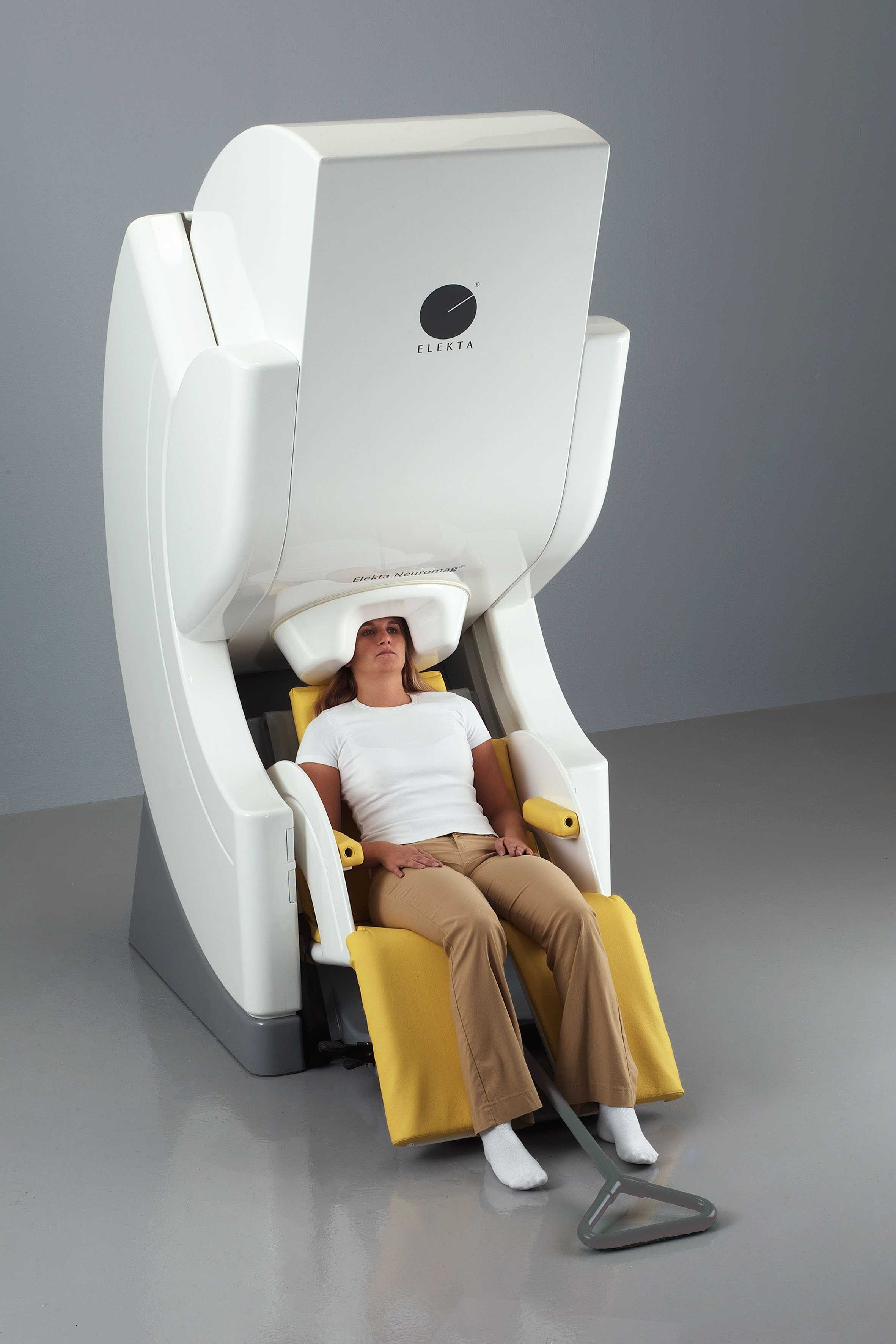
So, Meta researchers recruited 35 volunteers to type sentences on a keyboard while sitting in an MEG scanner, which looks like a salon hair-drying chair from outer space. Some also had EEG (electroencephalography) electrodes gelled to their face and scalp to record electrical signals radiating from brain cells through their skulls.
Each person’s brain activity helped train an AI model to guess what they typed. Essentially, part of the model learned to match patterns of brain activity to the letters someone was typing at the time. Researchers fed another part of the model a bunch of Wikipedia articles to teach it how sentences work, and what words often appear next to each other in different contexts. With this information, if someone meant to type “I love you,” but their brain signals read “I lovr yoi” — possibly because their brain actually led them to make a typo — the model could effectively autocorrect that prediction, because it knows how letters and words should work in context.
Using EEG, which is much more portable than an fMRI or MEG scanner, Meta researchers were able to use AI to decode the exact letters someone was typing about a third of the time. That doesn’t sound particularly impressive, until you consider that EEG records brain cells via electrodes outside the skull, many layers of separation away from the brain itself. It’s like trying to eavesdrop on a conversation at a crowded bar by standing outside and holding a glass against the wall: Given all the noise, catching even a third of that conversation is already quite challenging.
MEG captures brain activity more precisely than EEG, because magnetic signals from brain cells don’t get as distorted by the skull as electrical signals. By feeding MEG data to their AI model, Meta researchers accurately decoded between 70 to 80 percent of what people typed, blowing previous models out of the water. So, if Meta ever wants to build mind-reading headbands, recording magnetic fields might be their best bet.
Like fMRI, the MEG device used in this study was huge and expensive. But wearable helmet-like MEG scanners, which only weigh a few pounds, already exist and are even more sensitive than non-portable scanners. These portable MEG devices are just a couple pounds heavier than the Quest 3, Meta’s latest VR headset, and about as silly-looking. While these MEG devices still don’t work outside of special magnetically-shielded rooms (nor are they available to the public yet), it’s not hard to imagine a future where they could.
Tech companies won’t protect brain data unless we make them
Meta isn’t the only tech giant investing heavily in neuroscience research. Google and Microsoft both have teams dedicated to studying the brain, and NVIDIA and IBM both collaborate with neuroscience research institutions.
Here, Meta used the brain data they collected while people typed to study how the brain transforms abstract ideas into words, syllables, and letters, with the long-term goal of figuring out how to help AI chatbots do the same.
The data support a long-held hypothesis held by neuroscientists and linguists, proposing that we produce speech from the top down. As I prepare to say something, my brain pictures the whole thing first (“I’m going to lunch soon”), then zooms in on one word (“going”), then one syllable (“go-”). As I type, my brain focuses on each specific letter (“g,” “o,”…) as it tells my fingers what to do. Meta saw that these representations — context, words, syllables, letters — all overlap during language production, peaking and fading in strength at different times.
Understanding language production will also, in theory, help Meta achieve their stated goal of “restor[ing] communication for those who have lost the ability to speak.” And there are indeed millions of people recovering from traumatic brain injury,stroke, or another neurological disorder that makes it hard to talk. A wearable device that makes communication easy again could be a hugely positive force in someone’s life.
But we know that’s not their only motivation. For Silicon Valley, the brain also represents the final barrier between humans and their devices.
A quick sanity check: Meta’s goal was never to merge humans with computers (that’s Musk’s thing), but to sell a portable, removable headset that someone could use to type or play video games with their mind. To manifest a device like this, Meta needs to cross two huge technological hurdles, and one even bigger ethical one.
First, they need to decode unspoken thoughts from outside the skull. Check.
Second, they need to do that with a device that someone could reasonably afford, keep in their house, and wear on their head. For now, this is pretty far off.
Most importantly, once these devices exist, we’ll need robust protections for people’s cognitive liberty — our fundamental right to control our own consciousness. The time for these safeguards isn’t after they hit stores. It’s now.
“Facebook is already great at peering into your brain without any need for electrodes or fMRI or anything. They know much of your cognitive profile just from how you use the internet,” Roland Nadler, a neuroethicist at the University of British Columbia, told my colleague Sigal Samuel back in 2019.
Meta already uses AI to extrapolate your mental health from your digital footprint. They use AI to flag, and sometimes delete, posts about self-harm and suicide, and can trigger nonconsensual “wellness checks” when they detect concerning messages on Messenger or WhatsApp.
Given how much convenience we gain by giving away personal data — food deliveries, remote work, connecting with friends online — lots of people give up on digital privacy altogether. Even though many people feel uncomfortable with the amount of personal information companies take from us, they also believe they have no control over their privacy.
Last year, neuroscientists, lawyers, and lawmakers began passing legislation to explicitly include neural data in state privacy laws. Some smaller neurotech companies are already gathering brain data from consumer products — stronger protections need to be put in place before massive companies like Meta can do the same.
Zuckerberg has spent the past two months racing to Trump-ify Meta. His company is unlikely to handle our most private data with care, at least not unprompted.
But in a world where Meta-branded brain-to-text headbands are as normal as keyboards are now, sharing brain data might feel like a prerequisite for participating in normal life. Imagine a workplace where, instead of giving you a monitor and a keyboard at the office, they give you a text-decoding helmet and tell you to strap in. If mind-typing becomes the default for computer systems, then avoiding brain-to-text devices will feel like avoiding smartphones: possible, sure. But certainly not the path of least resistance.
As our mental security becomes less guaranteed, we’ll need to decide whether the convenience of controlling stuff with our minds is worth letting tech companies colonize our last truly private space.
]]>
Celia Ford<![CDATA[Researchers are terrified of Trump’s freeze on science. The rest of us should be, too.]]>https://www.vox.com/?p=3969112025-01-27T19:02:05-05:002025-01-28T07:00:00-05:00
President Donald Trump signs executive orders in the Oval Office on January 20, 2025, in Washington, DC. | Anna Moneymaker/Getty Images
Less than two days after President Donald Trump’s inauguration, Evangeline Warren, a sociology PhD student at the Ohio State University, logged into a professional development workshop alongside a hundred other young researchers. Just about everyone online was either employed by, or receiving grants from, the National Institutes of Health (NIH), the largest single funder of biomedical and behavioral research in the world.
Mid-presentation, a senior organizer interrupted, informing attendees that the NIH was no longer “allowed to do any external communication,” Warren said. Without further explanation, the video call ended.
Warren’s experience was hardly unique in the first week of Trump’s second term. Hundreds of scientists flocked to Bluesky, a decentralized Twitter alternative, to report sudden, vague cancellations of long-scheduled meetings about government-funded science. These delays piled on top of a broader freeze on federal health agency communications issued by the Trump administration last week. In the past few days he has called for the US to stop working with the World Health Organization, suspended public reports from the Centers for Disease Control and Prevention (CDC), and banned travel for Health and Human Services staff — all without explanation.
While briefly pausing communications during a presidential transition is normal, indefinitely disrupting the grant process like this is unheard of, according to several researchers at the NIH and NIH-funded universities. Rescheduling work meetings with a lot of moving parts would be a logistical nuisance for anyone. But when the memo comes from an administration that has repeatedly threatened to take down federal science agencies, a canceled meeting can feel more like the first step in a broader attack on public health and higher education.
This isn’t the first time the Trump administration has come for public health research, but it’s the first time their blows could actually land. Trump proposed deep cuts to the NIH in his first term, but the agency managed to stay on track, thanks to generous budget increases from a supportive Congress. Now, with anti-establishment allies like Robert F. Kennedy Jr. poised to take control of the Department of Health and Human Services, dozens of scientists told me that they’re afraid that last week’s actions mark the beginning of the end of public science. If NIH-funded research grinds to a halt, long-awaited treatments for everything from cancer to diabetes — and whatever infectious disease might spark the next pandemic — could be delayed for years.
A senior researcher at the NIH, who spoke to Vox anonymously out of fear of retribution, told me, “It’s actually fucking scary.”
The Trump administration’s freeze on government science, explained
Last Tuesday, the Trump administration told agencies within the Department of Health and Human Services — including the National Institutes of Health (NIH), Food and Drug Administration (FDA), and Centers for Disease Control and Prevention — to pause all public communications until February 1, including weekly scientific reports, social media posts, and public health data releases. The next day, panicked researchers posted on Bluesky and Reddit about canceled meetings, rescinded job offers and grants, and travel bans, unsure whether these disruptions were part of the communications freeze.
Nearly all biomedical researchers in academia, and many working for private companies, rely in some way on money from the NIH. Labs are run like small businesses, with senior scientists constantly applying for grants to keep the lights on, buy supplies, and pay their salaries. NIH grants account for a large portion of academic research funding, and universities rely on the federal government to help pay for buildings, expensive equipment like microscopes and MRI scanners, and staff.
Once someone submits a grant application to the NIH, it goes to a “study section,” a panel of 20–30 scientists chosen to review a stack of applications in their area of expertise. (It’s kind of like jury duty for nerds.) Panelists assign each project proposal a score based on its scientific promise, then pass the graded projects on to a separate “advisory council,” a group of scientists, ethicists, public health experts, and laypeople, which chooses which projects to fund.
Wrangling two dozen scientists with packed schedules to do a bunch of barely paid work requires advanced planning and months of logistical preparation. Rescheduling a canceled meeting can take months, which can then delay awarded funds just as long. Freezing the grant system affects clinical trials, too — some people have already reported canceled appointments for potentially life-saving experimental cancer treatments. (A memo shared with agency leaders yesterday clarified that ongoing clinical trials should not be affected.) Jaime Seltzer, the scientific director at MEAction, a nonprofit serving people with infection-associated chronic illness, told me that despite working outside of academia, she’s worried that if she loses access to crucial NIH-affiliated staff and data repositories, their work on long Covid and chronic fatigue syndrome will be put on hold.
Scientists at the NIH were told that purchasing and equipment repairs are also on hold, which could prevent researchers from replacing basic supplies like gloves, medicine, and equipment. Many experiments hinge on precise timing: even a one-week delay in purchasing could derail an entire project, setting research back months. Because scientific institutions are powered by short-term grants and young, transient workers, an experiment delayed by a few months may never get done at all.
Adding to the confusion, employees received an email last Tuesday announcing that HHS is closing all diversity, equity, inclusion, and accessibility (DEIA) offices and ending all DEIA-related contracts. The email warned, “We are aware of efforts by some in government to disguise these programs by using coded or imprecise language,” and that “failure to report this information within 10 days may result in adverse consequences.”
Nearly a week after Trump’s first round of executive orders, researchers still don’t know what’s going on. The NIH is made up of 27 institutes and centers, each with its own leadership. Without a trusted director to provide clear guidance, administrators are scrambling to interpret and implement unclear memos from above.
Trump’s nominee to lead the NIH, Jay Bhattacharya, hasn’t been confirmed yet by the Senate. The administration temporarily put the agency in the hands of interim director Matthew Memoli, an established researcher at the National Institute of Allergy and Infectious Diseases, one of many NIH centers. This power vacuum follows 12 years of remarkably steady leadership under former director Francis Collins, a geneticist and devout Christian known for his ambition, hard-earned expertise, and bipartisan appeal. While some scientists were relieved to see the interim role filled last week, many others suspect that his appointment had more to do with his opposition to Covid vaccine mandates than anything else.
Scientists are freaking out, and they’re right to worry
The vibes across academia are bleak. “I have worked this difficult, stressful, underpaid job because I thought what I was doing was important,” one user wrote on the subreddit r/Professors. “I’ve never felt so unappreciated and vilified.”
The post’s title: “Why bother.”
Over the past few days, dozens of researchers — including senior NIH employees — reached out to share their concerns with me. Most requested anonymity, given the potential repercussions of violating the public communications ban.
The disruptions appear to extend beyond the NIH. One scientist at a private biotech company shared two emails with me: the first, sent earlier this month, awarded him a USDA small business grant. Last Wednesday, a second email informed him that the grant is now under moratorium. A South African professor told me that an NIH-affiliated meeting series organized in his home country got scrapped. Organizers for the Department of Defense’s flagship scientific conference alerted attendees that their website would be offline “for an unspecified period of time for an unanticipated review,” according to an email shared by a postdoc preparing for the meeting.
Fears that the crackdown on diversity programs would come for science have also been realized. The diversity supplement program for NIH grants, which funds historically underrepresented students and scientists, has a newly updated “expiration date” of January 24, which already passed. “I’m afraid,” said Lindsay Ejoh, a neuroscience PhD student at the University of Pennsylvania, in an Instagram reel posted on January 23. She was planning on using a diversity supplement to fund her chronic pain research for the next five years. “Now, my career, and the careers of countless others, is up in the air.”
No one knows when the NIH freeze will end. Normal operations could resume as soon as this weekend, if public communications reopen on Saturday, February 1 as promised. However, “the communication that was shared with us wasn’t end-dated, which may have been in anticipation of potential extensions,” one NIH-affiliated scientist told me. “Everyone wants to be careful to not make too drastic of shifts.”
“The NIH freak-out may have less to do with the present disruption (however long it lasts) than with what it signifies,” wrote Ian Bogost, a Washington University in St. Louis professor, for the Atlantic on Friday. The threat of an indefinite disruption to the grant system forced scientists to confront their vulnerability: one delayed meeting can potentially derail years of experiments, or close doors to future career opportunities.
For those at federal agencies and in higher education, the Trump administration’s actions jeopardize their mission and their paychecks. For patients with life-threatening conditions pinning their hopes on experimental treatments, halting clinical trials could be deadly.
For the rest of us, a disruption to government science is like a car crash five miles up the road. The incident itself may be too distant to see, but its ripple effects will reach us. Even if everything goes back to normal next week, researchers have already been reminded that at any moment, their life’s work could be upended by an executive order. It’s been seven days — with about 1,149 days left of Trump’s second term, the potential for chaos is incalculable.
Derailing the federal grant review process is actually everyone’s problem
Before the pandemic, people across the political spectrum held scientists in higher regard than nearly anyone else, including journalists, elected officials, and teachers. But Covid tanked Republican trust in science, and it still hasn’t recovered.
The federal research grant system is far from perfect, and many scientists agree that it should change. Groups that agree on little else, from left-wing animal rights activists to anti-establishment conservatives, have expressed optimism about the massive public health overhaul promised by RFK Jr., Trump’s pick to lead HHS, the government agency that oversees the NIH. In theory, burning it all down and starting over, while painful in the short term, could create space to rebuild a better system.
The problem is that Trump’s second administration seemingly has no intention of rebuilding a better system. Project 2025, the detailed right-wing policy blueprint organized by the conservative think tank the Heritage Foundation, includes the actions we’re watching unfold. The blueprint includes a 54-page plan for the Department of Health and Human Services (HHS), highlighting public health goals like “protecting life, conscience, and bodily integrity” and “promoting stable and flourishing married families.” To this end, Project 2025 proposes, among many other things, banning embryonic stem cell research, breaking up the NIH, and abolishing DEI initiatives.
The end goal isn’t to improve and strengthen American science; the goal is to break it down, and ultimately rebuild it in alignment with hardline religious ideology.
RFK Jr.’s first confirmation hearing is scheduled for this Wednesday — if he takes charge of HHS, he could cut off over $6 billion of grants from the NIH’s National Institute of Allergy and Infectious Diseases, which funds crucial research on conditions like HIV, inflammation, and long Covid.
Meanwhile, Bhattacharya, Trump’s pick to lead the NIH, is best known for opposing lockdowns during the pandemic.Some researchers fear that his nomination signals that the NIH, which has historically received bipartisan support, is not safe from the new administration. He has previously said that the government needs to “turn the NIH from something that’s sort of how to control society into something that’s aimed at the discovery of truth.” Last week amplified many scientists’ worries that Bhattacharya will make good on his promises to overhaul the NIH and consider measures of “academic freedom” in deciding which universities to award grants to.
When I asked scientists about their biggest concerns, many had the same response: whether the current freeze lasts a week or a year, destabilizing government science will push young researchers out of the field.
For a PhD student wrapping up their studies, landing a well-timed grant can make the difference between pursuing an academic career or leaving. “The United States has stood as a beacon for young people wanting to study science for decades,” said Seltzer. “But, with actions like these, our government has guaranteed that many will take their considerable talents elsewhere.”
Warren, now wrapping up her final semester of graduate school, is grateful that her doctoral research won’t be affected. But if delays continue, she won’t be able to apply for postdoctoral fellowships or build on her findings. Unfortunately, there’s only so much uncertainty young, underpaid workers are willing to stomach for the sake of pursuing a passion the public doesn’t seem to support.
“It’s heartbreaking,” she said. “There are people in my position making pragmatic decisions about their careers. There are people we will absolutely lose to industry, whose brilliance will go toward a company instead of public good.”
]]>
Celia Ford<![CDATA[The frustrating reason we’re not saving more kids from malaria]]>https://www.vox.com/?p=3953552025-01-20T20:49:34-05:002025-01-21T09:00:00-05:00
Staff inspects vials of the R21 Malaria Vaccine at the Serum Institute of India headquarters in Hadapsar, Pune, on February 27, 2024. | Indranil Mukherjee/AFP via Getty Images
Malaria kills more than a thousand children every day. Measures like antimalarial medications and insecticide-treated bed nets, which stop infected mosquitoes from transmitting the disease-causing parasite to people while they sleep, have saved millions of lives at a relatively low cost. Yet despite these interventions, which reduced mortality by about 29 percent, over 430,000 children died from malaria last year. With the recent approval of two new malaria vaccines, RTS,S and R21, we have the opportunity to make another leap in the fight to eradicate malaria.
Malaria can be deadly for people of all ages, but it’s especially life-threatening for young kids: Over 75 percent of malaria deaths happen in children under 5. For now, malaria-endemic countries — like Cameroon, Burkina Faso, and the Democratic Republic of the Congo (DRC) — are focusing vaccination efforts on infants, who are already brought into clinics for routine shots anyway. Over the past year, 10.2 million doses were delivered to children across 17 countries. (So far, neither vaccine is approved for adults.)
The shots are largely paid for by Gavi, an international organization that uses donations from rich governments and philanthropies to subsidize lifesaving vaccine rollouts in countries with a gross national income per capita below $1,810 — about 2 percent that of the United States.
Last summer, Gavi announced its goal to raise $9 billion to fund immunizations from 2026 to 2030, with over $1.1 billion of those funds earmarked for new malaria vaccines. That’s enough to save around 180,000 children’s lives over the next five years.
But we could theoretically save many more.
A new paper by the Center for Global Development (CGD) estimates that 800,000 more child deaths could be avoided between now and 2030 — if Gavi buys and distributes as many vaccines as manufacturers can make. Though manufacturers say they have over 100 million doses ready to go, Gavi’s plan would buy only a fraction of them. To buy all of the currently available doses and put them into the field now, Gavi would need to triple its $1.4 billion malaria vaccine budget.
CGD’s proposed strategy — to buy and distribute as many doses as possible today, and trust that manufacturers will replenish their supply quickly — goes against conventional wisdom about vaccine rollouts. Gavi’s current strategy is to gradually ramp up R21 vaccinations, prioritizing the most vulnerable children first, while only distributing as many doses as can be stably purchased in the long run. By doing so, Gavi hopes to balance the urgent need to save lives with the importance of maintaining a sustainable vaccine supply. This is how most vaccines are introduced, including the first Covid vaccines in the US: quickly get them to the people who need them most, then ramp up to bigger populations slowly enough that suppliers can keep up.
Scott Gordon, head of Gavi’s malaria vaccine program, said that the success of a vaccine rollout largely depends on how ready a country is to get those shots into arms. Both available malaria vaccines require at least three doses to work, which means giving a person one shot isn’t enough. Clinics have to make sure people come back.
But other global health experts argue that now is the time for a more aggressive approach, to take advantage of the opportunity presented by these new vaccines.
“We suddenly have a tool where we can save lives at fairly low costs,” said Justin Sandefur, senior fellow at the Center for Global Development and co-author of its new paper. He argues that shying away from the most ambitious vaccine rollout possible costs too many lives to justify: “Logistically, bureaucratically, and politically, this is the kind of thing that we know how to do.”
Choosing the right vaccine will give countries more bang for their buck
The RTS,S and R21 vaccines are very biologically similar. Both vaccines target the same protein on the surface of malaria-causing parasites, teaching the body to attack the parasites before they make it to the liver and cause an infection.
The RTS,S vaccine, which was recommended for use by the World Health Organization in 2021, is about 56 percent effective — much better than nothing, but short of the WHO’s 75 percent target. Last December, the WHO also prequalified the R21 vaccine, which performed about 20 percent better at preventing severe malaria than RTS,S in its clinical trials. “Prequalification” is essentially approval: It means WHO believes R21 is safe, effective, and ready to be sold to UN agencies.
Effectiveness aside, R21 is much cheaper: $3.90 per dose, versus $10 per RTS,S dose. Because R21 particles are more densely packed with malaria protein antigens than RTS,S, a single dose of R21 can be much smaller than a single dose of RTS,S. Some other chemical differences also make R21 simpler to manufacture than RTS,S. As it currently stands, Serum Institute of India’s production capacity for R21 is nearly seven times greater than GSK’s production capacity for RTS,S. In fact, Serum Institute has already made 100 million doses, and it says it has the capacity to make even more.
Demand for the vaccine is high among parents in malaria-endemic countries who are well aware of the danger to their children. But so far, it’s been hard for clinics to ensure parents bring their babies back for all four doses they need. Many people, in African countries and elsewhere, are hesitant to get themselves and their children vaccinated against anything at all. But demanding poor parents in rural areas to travel long distances to get to a clinic not once, but four times creates extra logistical hurdles.
Ghana, for example, used a combination of strategies to get people to return for all their shots, including sending text reminders and making vaccinations part of regular checkups at local clinics. While public health experts considered the rollout an overall success, Ghana still struggled with monitoring and logistics. With these challenges in mind, Gavi plans to ramp up R21 vaccinations gradually, to avoid overwhelming health care systems and to make sure the vaccine supply remains stable in the long run.
Phase 3 clinical trials suggest that three doses of the R21 vaccine work about as well as four doses, the last of which would be administered as a booster shot a year after the first three. But protection offered by only one or two doses seems to deteriorate relatively quickly without the final shots, according to some preliminary field reports. Experiments haven’t specifically tested the efficacy of getting one or two doses yet, but while even a single dose may reduce malaria risk relative to getting no shots at all, existing evidence suggests it’s nowhere near as effective as a full four-dose course.
It comes down to a couple of major strategic questions, neither of which have clear answers. First, would more lives be saved by fully vaccinating fewer people, or by partially vaccinating more people? In either case, organizations still have to decide whether to buy and use up all the doses that Serum Institute has to offer, potentially trading lives saved in the short term for supply stability lost in the long term, or to proceed with a more gradual rollout.
The problems with Gavi’s current vaccine rollout plan
Despite R21’s advantages, Gavi isn’t accepting applications from countries who want to update older requests for RTS,S to request R21 instead. The situation is baffling, Sandefur told me: The group’s strategy seems to be standing in the way of its own vaccination goals.
Gavi’s goal is to help vaccinate at least 50 million children against malaria by 2030. Combined with other tools like bed nets, insecticides, and antimalarial medication, Gavi estimates malaria vaccines could reduce the burden of malaria on poor countries by up to 92 percent.
At its current pace, Gavi’s rollout plan will require a decade to fully vaccinate everyone who’s eligible. GlaxoSmithKline (GSK) and Serum Institute, the makers of RTS,S and R21, theoretically have the combined capacity to produce as many as 115 million vaccine doses per year. That’s enough to fully vaccinate 25 million children right now. If Gavi bought and distributed every available dose, it would meet its 2030 goal in just one year, and save about 300,000 kids who might otherwise die.
By gradually incorporating RTS,S and R21 vaccines into their regular slate of vaccines, countries can harness the health care infrastructure they already have available and deliver shots at routine checkups.
Vaccinating all infants also means everyone will eventually be vaccinated against malaria. But focusing on getting everyone protected in the long run sacrifices the opportunity to save more lives in the short term. Vaccinating infants maximizes the number of lives saved per shot, but focusing exclusively on infants now, despite the vaccines being approved for children up to 5 years old, will leave many kids unprotected.
Gavi’s long-standing view is that having multiple vaccines on the marketplace inspires competition, which helps them get better procurement prices, adds to the challenge. This would make sense if they were paying for a cheaper less-effective vaccine to drive down the cost of a better, more expensive vaccine.
But they’re doing the opposite, Sandefur said, by purchasing a vaccine that’s not better than R21 but costs significantly more. Several countries that originally requested RTS,S have since asked Gavi to switch to R21 to lower their end of the bill. At first, Gavi was hesitant, but they have since started to direct R21 to richer countries that can pay more of their share, saving RTS,S for poorer countries who won’t have to pay more.
The new vaccine does reportedly have some skeptics, however. In conversations that informed their latest analysis, the Center for Global Development’s experts said they heard the same thing again and again: “Gates hates this vaccine.”
But why would the Gates Foundation, which spends millions upon millions of dollars vaccinating the Global South, not like an effective vaccine that could save hundreds of thousands of lives?
It’s not that the Gates Foundation is snubbing malaria vaccines — as one of Gavi’s biggest donors, Gates is helping to fund the R21 rollout. But rather than put all its eggs in the R21 basket, it’s also investing in self-replicating vaccines and monoclonal antibodies (like the one my colleague Dylan Matthews tested in a human challenge trial earlier this year). Philip Welkhoff, director of the Gates Foundation’s malaria program, said, “We should work to save as many lives as possible with existing tools and resources — including these vaccines — while continuing to innovate to develop the next generation of tools which will be required to end malaria for good.”
The problem, though, is that these next-gen vaccines are still years away. Withholding decent vaccines while waiting for better ones could result in thousands of preventable deaths. One monoclonal antibody treatment, called L9LS, is undergoing phase 2 clinical trials, and results are promising so far. However, Welkhoff estimates that this treatment is still at least five years away from being widely available, much less affordable. “The risk of regret from underspending on vaccine rollout today,” the Center for Global Development states, “far outweighs any risk of regret from spending too much.”
Gavi’s $1.4 billion budget falls about $2.6 billion short
Gavi has budgeted $1.4 billion to vaccinate 52 million children by 2030. According to the Center for Global Development’s calculations, it would need another $2 billion to vaccinate all infants in malaria-endemic countries, and another $1 billion on top of that if it also vaccinated toddlers under three. But “Gavi’s only got so much money,” Sandefur said. “They’re not actually sure they’re going to get the money that they’re banking on,” much less the extra $2 to 3 billion it will take to save the maximum number of lives.
The big thing stopping an ambitious vaccine rollout in the Global South is money. Getting a full multi-dose vaccine regimen to people is challenging enough in rich countries; remember Covid? It’s much harder in countries like the DRC, where the government spends as little as $2 per capita on health (the US spends about $12,500). Vaccines cost more than the doses themselves. Getting shots in arms requires basic supplies like syringes and alcohol wipes, keeping vaccine doses refrigerated, and training clinicians in far-flung clinics — all of which cost money. Then countries have to pay for community outreach programs. “It’s just like in the US,” said Sandefur. “You’re going to have to win the public debate about this being a good thing for the community to embrace.”
Even if Gavi rustles up enough money to buy every available dose of the R21 vaccine that Serum Institute has available, Sandefur said “it’s not clear that they’ve budgeted for the spending you would need to actually do the rollout.”
Sandefur’s impression, after visiting the DRC in September, is that all of this data-crunching is a bit academic. “We’re all sitting there trying to work out numbers,” he said, “and I think the country just has a demand to go big.”
Nigeria has the largest malaria burden in the world, and may want these vaccines more than anyone. Nigeria only misses Gavi’s income cutoff by a couple of hundred dollars per capita, but it’s been hovering just above that line for enough years that — per Gavi’s pricing system — they’re expected to pay more for new malaria vaccines than they currently spend per child on health care. So, they’re not buying them. Every year that Nigeria can’t afford vaccines, 95,000 children under 5 could die. Given numbers that stark, the Center for Global Development is urging Gavi to bend its eligibility rules enough to give Nigeria more support.
Where will the money come from?
In a dream scenario, Gavi could simply ask Elon Musk to fork over 0.5 percent of his wealth to fill its $2 billion funding gap. But since he’s busy cozying up with President Donald Trump and planning a $2 trillion federal budget cut in the US, that seems unlikely.
More realistically, Sandefur suspects the money will come “in bits and pieces, almost certainly, if it comes at all. I’m not sure that it will.”
Some of it will need to come from stepped-up contributions from rich countries like the US and the UK. This March, Gavi will co-host a pledging summit with the European Union and the Gates Foundation in an attempt to raise at least $9 billion. The guest list includes government leaders from wealthy countries, vaccine manufacturers, and private company executives. Support for the program is more bipartisan than most things in the current political landscape, which is good. But Western countries generally don’t treat the fight against malaria with the same urgency as they treated the Covid-19 pandemic. In order for Gavi to hit its funding goal, rich countries like the US and the UK will all need to donate more than they have in the past.
The Global Fund, which invests in anti-malarial treatments like bed nets, doesn’t currently fund the new vaccine rollout. “They’re very worried that malaria vaccines are going to come and steal their malaria budget,” Sandefur said. New dual insecticide-treated bed nets are cheaper than a full four-dose vaccine regimen, making them a great, cost-effective tool in areas where malaria transmission rates are relatively low. At their current efficacy rates, neither available vaccine can replace tools like antimalarial drugs and bed nets. But vaccines should be treated as an extra line of defense, on top of other things like insecticides and first-line drugs. At least temporarily, Sandefur suggested that the Global Fund help Gavi pay for the vaccine rollout. (The Global Fund did not respond to a request for comment.)
This is also an opportunity for everyday folks to step up and help fund the rollout of existing vaccines — not just innovative pilots and technical assistance at the margins, Sandefur said. “Let’s buy some vaccines, guys.”
Malaria has long been a target for effective altruists, because it’s a massive problem with several existing, low-cost solutions. Open Philanthropy, a foundation that does rigorous research to guide charitable giving, helped fund the clinical trials that got R21 recommended by the WHO. But while two of the top four charities listed by GiveWell, a nonprofit focused on cost-effective, high-impact charity, support malaria prevention efforts, neither buy vaccines directly. Sandefur thinks this should change.
“You can fix this with a shot,” he emphasized. “Let’s go ahead and do that.”
]]>
Celia Ford<![CDATA[Animal rights advocates are ready for Trump’s war on science]]>https://www.vox.com/?p=3949232025-01-16T10:47:44-05:002025-01-15T08:30:00-05:00
But people across the political spectrum agree on animal testing. Or, more accurately, no one knows what to think: About half of each party supports the use of animals in scientific research, while the other half opposes it.
Sign up here to explore the big, complicated problems the world faces and the most efficient ways to solve them. Sent twice a week.
Less federal science funding could, as a side effect, mean less animal testing. Animal advocates I spoke to welcome these potential changes. The National Institutes of Health (NIH) is the largest public funder of biomedical research in the world, so the lives of millions of animals depend on what happens to it.
In the long run, forcing scientists to shift away from animal models by drying up existing funding sources could not just benefit animals used in experiments, but also make science better. Replacing animals with human-centered tools will provide better insight into human biology, speeding up the development of much-needed treatments for diseases like cancer and Alzheimer’s disease.
Trump’s war on science, however, has little to do with improving human or animal lives. He famously loves meat — especially if it’s well done — and, with a handful of exceptions, doesn’t seem concerned with animal welfare. In fact, his first term saw a significant drop in penalizing animal welfare violations. Rather, the Trump administration’s plans to defund animal testing while deregulating animal welfare are two sides of the same coin, and its attacks on science could worsen already-lax protections for lab animals and drive some scientists out of the field altogether.
What did Trump 1.0 mean for lab animals?
Looking back at Trump’s first four years gives us some sense of what his next term could look like for animal experimentation.
In 2019, Trump-appointed Environmental Protection Agency head Andrew Wheeler announced ambitious plans to cut the number of EPA-funded mammal studies by 30 percent by 2025, and to completely eliminate them by 2035. The initiative, lauded by animal rights groups alongside Trump loyalists like former Rep. Matt Gaetz, awarded grants to research teams developing human-based methods that can replace animals in studies of environmental toxins. Then, just two years later, President Joe Biden’s EPA quietly removed that self-imposed timeline from a report on the plan to develop non-animal-based technologies, and have since abandoned the 2035 deadline altogether. The Biden administration loosened the plan in response to concerned environmentalists and scientists, who feared that new methods weren’t ready to replace animals in tests that determine whether potentially dangerous chemicals get cleared for use in consumer products.
Meanwhile, during the first Trump administration, White Coat Waste, a bipartisan anti-animal testing nonprofit, gained traction by harnessing the tension between left-leaning researchers and anti-establishment conservatives that had been growing during the Covid pandemic. Their strategy: appeal to conservatives by framing animal testing as a waste of taxpayer money, while still engaging more liberal activists motivated by compassion for animals. It’s proven to be remarkably effective, and they’ve successfully shut down over 114 labs and experiments, including the FDA’s largest primate lab.
“Based on our success with the first Trump administration, we’re very excited to make even more progress under Trump 2.0,” Justin Goodman, senior vice president of advocacy and public policy at White Coat Waste, told me.
While some lab animals benefitted from the shutdowns, the vast majority did not. Enforcement of the Animal Welfare Act, which sets basic standards for the treatment and housing of certain lab and farm animals, fell sharply during Trump’s first term as federal officers were reportedly directed to emphasize education for violators rather than enforcement, allowing animal suffering to go largely unchecked. Just two weeks after Trump’s first inauguration, the USDA suddenly deleted inspection reports and records of enforcement actions against violators of the Animal Welfare Act — crucial documents for journalists and animal welfare advocates. While the reports were restored three years later in response to pressure from lawmakers and animal welfare groups, their removal serves as a powerful reminder that unchecked abuse is a common side effect of deregulation.
Trump 2.0 poses a double-edged sword for lab animals
Still, groups like White Coat Waste believe they can convince the Trump administration to get animals out of labs, and aren’t concerned that their agenda is also supported by, say, pharmaceutical corporations that want a fast track to market approval, or hardline MAGA science skeptics.
In the world of lab animal welfare, the converging interests of progressive animal rights activists and conservative government skeptics make policy reform possible. Across the political spectrum, the goal is the same: get animals out of labs. Organizations like White Coat Waste are embracing it. “I’m not particularly concerned with why people oppose animal testing or want to cut it,” Goodman told me. “I’m just concerned that it will happen at all.”
From this perspective, whether Trump truly cares about animals or not is irrelevant, as long as he commits to defunding and deregulating science. “That’s where the interests of animal advocates and the incoming administration align,” said Delcianna Winders, director of the Animal Law and Policy Institute at Vermont Law and Graduate School. “They both care about excessive government spending on animal experimentation.”
Some of Trump’s appointees — including nominated heads of the NIH and the FDA, Bhattacharya and Marty Makary, respectively — have spoken out against animal testing, with Bhattacharya calling White Coat Waste “absolute heroes.” RFK Jr., chosen to lead the Department of Health and Human Services, has a strange relationship with animals that includes leaving a dead bear in Central Park for laughs and keeping a pet emu. Regardless, his track record of confronting bastions of biomedical research makes animal advocates hopeful.
“We are extremely excited that an administration that is skeptical of science and also skeptical of federal spending is coming into power,” Goodman said.
Winders is also optimistic that cutting funding for animal experimentation will save animal lives in the long run. Without grant money from federal funding agencies, scientists who currently rely on animal methods will be forced to figure something else out. Optimistically, this could give the biomedical research industry a much-needed kick in the pants to innovate human-centered replacements for animal models. Scientists are unlikely to change their tried-and-true research methods unless there’s an exceptionally strong incentive like sweeping shifts in government funding — the pull of inertia, and the fear of invalidating their existing body of work, are too powerful.
This week, White Coat Waste published a Trump 2.0 wish list, asking the new administration to defund dog and cat experiments, cut off NIH-funded labs in China, phase animal testing out of the EPA, and axe the National Institute of Allergy and Infectious Diseases, whose funded projects include gain-of-function experiments on animals, entirely. The plan, they hope, “would cut billions in wasteful government spending annually and Make America Greater for Animals.” With support from key Trump allies, their wishes could be granted.
But there will likely be consequences. Cutting federal support for biomedical research could trigger a mass exodus from academic science, a kind of domestic brain drain that could hinder the development of new drugs and vaccines for a generation. And because neither Trump’s administration nor White Coat Waste targets private corporations, scientists who move from universities to pharmaceutical and biotechnology companies will likely be able to continue experimenting on animals there. While some private companies receive federal grants for projects involving lab animals, they’re often more lightly monitored than academic and government labs.
And in the short term, while defunded research groups wrap up their existing projects, the mistreatment of lab animals could actually increase if the Trump administration continues its past pattern of lax enforcement of the Animal Welfare Act. While research facilities currently face only minor fines — or just a slap on the wrist — for animal welfare violations, Winders fears that Trump’s Justice Department could eliminate even these minor penalties, leaving labs with no consequences for mistreating animals. “It’s a double-edged sword,” Winders said. Her concern is that, under Trump 2.0, the Department of Justice will gut this authority, announcing that agencies will no longer be able to assess civil penalties on their own. This “would effectively mean that research facilities could violate the Animal Welfare Act with total license, without any fear of repercussions.”
What about the scientists?
Over the last month, the Department of Government Efficiency (DOGE), a proposed advisory organization led by Elon Musk and Vivek Ramaswamy, has taken to X to memeify absurd-sounding science studies: $1,513,299 to analyze motion sickness in kittens, or $419,470 to see whether lonely rats use cocaine more than happy rats. Musk and his allies point to these studies as examples of wasted taxpayer dollars, and it’s not wrong to claim that the federal government funds some relatively low-impact studies that harm animals — they do. But Stuart Buck, the executive director of the Good Science Project, fears that tearing apart experiments for not having direct real-world applications risks devaluing the entire scientific enterprise.
“There are so many cases in science,” he told me, “where truly groundbreaking discoveries were not appreciated at the time, or they went unfunded, or people thought they were kind of ridiculous.” Ozempic, for example, would not exist today unless some scientists shot Gila monster venom into guinea pig cells 40-odd years ago. In fact, Buck thinks, “we need more frivolous studies.”
To be clear: Whatever Trump’s ambitions, no one is going to announce that all animal research is banned, unlock cage doors at the NIH, and set all the monkeys free.
If biomedical research funding is scaled back, change will come slowly. Scientists will be able to finish projects funded by existing grants — but might not be able to apply for new ones. If done carefully, this could be good for both animals and science. There’s a genuine need to incentivize a transition to better methods where animal models are currently falling short. PETA’s latest research modernization plan, for example, which will be published later this month, proposes specifically ending animal use in research areas where evidence suggests animals are poor models of human biology — like psychiatric conditions and inflammatory disease — and doing more research to see whether animals can be effectively replaced elsewhere. Americans, including scientists, overwhelmingly agree that we should phase out animal experiments. Animals shouldn’t have to die to save human lives. But forcing this change through defunding and deregulation, rather than careful scientific advancement, risks creating a system where both human and animal welfare lose out.
]]>
Celia Ford<![CDATA[What in the world is pink cocaine?]]>https://www.vox.com/?p=3780462024-12-04T09:00:12-05:002024-12-04T09:00:00-05:00
On August 10, 24-year-old Instagram model Maecee Marie Lathers killed two people in a car crash in Miami. Topless, vomiting, and screaming, Lathers told police officers that she was under the influence of a drug called “tusi,” a pink powder that’s gaining popularity in the US. A toxicology report later found that while she hadn’t been drinking, there were several other drugs in her system — but nothing called tusi.
“Tucibi” — also called tusi or pink cocaine — is a Spanish phonetic play on 2C-B, a California-born synthetic psychedelic originally popular amongst Gen X psychonauts and ravers seeking a euphoric, trippy high. However, despite either of its names, pink cocaine rarely contains 2C-B or cocaine at all.
In the 2000s, 2C-B made its way from European nightclubs to Colombia, where it devolved into something else entirely: a pink powdered cocktail of every type of party drug you might find at Coachella. It’s essentially a Gen Z speedball: Rather than blending cocaine and heroin, pink cocaine mixes ketamine with stimulants like MDMA and even caffeine. It can also include a chaotic sprinkling of methamphetamine, DMT, and oxycodone, among other substances.
Largely through artful cartel marketing portraying tusi as pretty, fun, and accessible, this blend of cheap drug leftovers has become the substance of choice for Colombian DJs and Mexican rappers, a wolf in sheep’s clothing for European ravers, and a source of confusion for everyone else. Tusi is making its way across the world, and it’s increasingly important that potential users know what it is.
The global war on drugs was originally organized around the production and trafficking of plant-based drugs like cocaine, heroin, and marijuana. But in recent years, drug manufacturers have turned to synthetic drugs like MDMA, ketamine, and fentanyl, which are easier to mass produce and smuggle across borders. Pink cocaine is everything new all at once — easy money for producers, a cheap Instagrammable high for users, and a massive headache for law enforcement.
The biggest problem: like playing a game of Russian roulette, only luck decides whether you’ll have fun — or die.
How 2C-B became tucibi
2,5-dimethoxy-4-bromophenethylamine, or 2C-B, was first synthesized in the 1970s by Californian biochemist and psychonaut Alexander Shulgin, who is best known for introducing MDMA to the world of psychotherapy. Of the over 100 psychedelics Shulgin created, 2C-B was his favorite — in his words, “one of the most graceful, erotic, sensual, introspective compounds I have ever invented.”
The effects of 2C-B are often described as an MDMA-LSD hybrid, giving users both a heightened, vibrant sensory experience and a feeling of euphoria and openness. In many ways, Shulgin viewed 2C-B as a counterpart to MDMA, which has been touted for its therapeutic potential for 40 years, well before it became popular as a club drug. Not only are the two drugs chemically similar, but their psychoactive effects complement each other. “Once the MDMA has shown you where your problems are,” Shulgin wrote, “the 2C-B opens up the emotional, intuitive, and archetypal area of your psyche to help you solve them.”
Anecdotally, many people report that 2C-B’s psychedelic effects are relatively mild and short-lived. Trips last a few hours, unlike the full-day trip provided by LSD. Like other hallucinogens, 2C-B generally doesn’t cause a next-day hangover, according to users interviewed by Vice. It can also have less fun side effects like anxiety, nausea, headaches, or elevated heart rate, any of which can get dangerous in situations where users are dancing — and likely not drinking enough water — in crowded, hot spaces.
But over the past decade, it’s become an increasingly popular party drug in Latin America, Europe, and the US. The 2019 Global Drug Survey of over 120,000 people from more than 30 countries reported that darknet purchases of 2C-B and other drugs have been on the rise since 2014.
In the early 2000s, wealthy young people smuggled small amounts of 2C-B from Europe to Colombia, where it quickly became popular in Colombia’s elite club scene. By 2012, models, politicians, and actors were shelling out 130,000 pesos (about $71 at the time) for a gram of 2C-B — over 10 times the price of cocaine. “The media positioned it as an elite drug,” said Julian Quintero, a sociologist, drug researcher, and director of the Technical Social Action Corporation (ATS), a Colombian drug policy nonprofit. “Very few could access it.”
While 2C-B was considered high-class, it wasn’t much to look at. It was usually sold as a plain-looking pill or an off-white, bitter powder that hurts to snort. To make the drug more appealing, narcos started mixing the powder with sweet pink food coloring. Soon, demand outpaced the supply of 2C-B available in Latin America, so Colombian dealers cut the powder with cheaper, longer-lasting, and more abundant European imports like MDMA and ketamine.
People began calling the pink powder “tusi,” a Spanish spelling of the English pronunciation of “2C.” In the early 2010s, Quintero said, tusi still reliably contained about 10 percent 2C-B, mixed in with the MDMA and ketamine. But by the mid-2010s, the 2C-B component disappeared.
Removing the priciest ingredient, Quintero told me, was the “magic formula.” Today, a gram of tusi costs $10, not $100, making it accessible to just about anyone who can afford a night out.
Joseph Palamar, a drug use epidemiologist at New York University and deputy director of the National Drug Early Warning System, said that the homophones — “tusi” and “2C-B” — initially confused old school ’90s ravers, who only knew of the original 2C-B and likely thought that’s what they were taking. But, he said, “new school people probably don’t know the difference.”
One surprising thing
Despite the flurry of headlines announcing that, according to an anonymous tip, Liam Payne’s autopsy found pink cocaine in his system, there’s no chemical test for pink cocaine. You can only test for its common ingredients, like ketamine and MDMA. If both of those substances are found at once, it might be pink cocaine — but there’s no way to know for sure.
“Those who use cocaine represent the old. Those who use tusi represent the new”
Calling the powder “pink cocaine,” or polvo rosa, has even less to do with the drug’s contents. “The name ‘pink cocaine’ is one of many fantasies invented by the police to name things they don’t understand,” Quintero said.
Much of polvo rosa’srise in the club scene can be attributed to its Instagram-ready aesthetic. “The fact that it’s a pretty color draws a lot of people in,” Palamar said.
It’s a brilliant marketing strategy: transform a bland-looking, expensive, exclusive synthetic drug into an Instagram-worthy accessory that almost any partygoer can afford — simply by changing just about everything in it. If tusi had a standard recipe — something potential users could make informed decisions about — this wouldn’t be as big a deal. But as tusi became more popular, the color told users increasingly little about what they were ingesting.
“The thing is,” Palamar said, “anyone could dye any powder pink.”
The initial rise of tusi in Latin America was part of a broader trend: Coca and opium production declined between 2007 and 2012 for a number of factors, including increased seizures of heroin exported to the US and evolving drug preferences. At the same time, the production and trafficking of synthetic drugs like 2C-B, MDMA, and ketamine grew. La Empreza, a street gang claiming to be the first to make and sell tusi in Colombia, told Vice in 2022 that in addition to MDMA, ketamine, and caffeine, their recipe for the drug includes synthetic methamphetamines, LSD, and fentanyl, among other chemicals.
A batch of tusi is essentially made by tossing assorted drugs into a pan, adding a dash of pink food coloring, and stirring the mixture by hand. This isn’t even a great way to make a salad — the dressing won’t be evenly distributed across the greens, and some bites will wind up with more toppings than others. When mixing a powder and liquid drug salad, it’s nearly impossible to ensure that each dose of the final product will contain the same ratio of ingredients. When preparing non-toxic food, perfectly even distribution isn’t usually a concern, but a gram of powder that may contain a mystery dose of a powerful sedative like ketamine — or even the far deadlier fentanyl — is dangerous.
The fact that tusi is so easy to make doesn’t just make it risky — it’s making it more popular. Because tusi is synthetic, lacks a standard recipe, and doesn’t require special equipment beyond kitchenware to make, nearly anyone can prepare it themselves. “Tusi not only emerged as a new drug for a new generation, but also popularized the idea that you can make your own drugs at home,” Quintero said.
As of a couple years ago, tusi was the fifth most popular drug in Colombia. Pink cocaine has become synonymous with Colombian guaracha, a style of electronic house music often referencing the drug in the lyrics. In the song “Magia Rosa” by DJ Goozo, Massianello, and NesBunny, featured vocalist Paulette sings: “Quiero magia rosas que me ponga poderosa.” In English, this roughly translates to “I want pink magic to become powerful.”
Quintero told me that the rise of tusi paralleled the rise of reggaeton, guaracha, small-scale drug dealers, and sexual tourism to Colombia, lending the drug a distinct cultural ethos for a younger generation. “Those who use cocaine represent the old,” he said. “Those who use tusi represent the new.”
Perhaps nowhere outside Colombia is tusi more celebrated in pop culture than Mexico. While tusi isn’t often mentioned by the Mexican government or mainstream news media, it frequently appears in corridos tumbados — a genre of Mexican regional music blending the vibrant accordions, plucky bass lines, and quintessential trumpets of traditional corridos with hip-hop and reggaeton. Peso Pluma, a 25-year-old Mexican rapper, skyrocketed to global stardom last year with the love song “Ella Baila Sola,” a collaboration with regional group Eslabon Armado.
But a large swath of corridos tumbados are considered narcocorridos, or songs centered around the plight of cartels or drugs. Three of his songs — “Lady Gaga,” “Rosa Pastel,” and “Las Morras” — mention using pink cocaine as part of a glamorous lifestyle, and music videos for those three songs alone have racked up over 500 million views combined. (Sometimes, the glamorous lifestyle isn’t so glamorous: Peso Pluma had to cancel and reschedule concerts last year because of death threats from a cartel.)
Europe, home to hard-partying tourist destinations like Ibiza, isn’t a stranger to trippy, risky drugs. Combinations of ketamine and MDMA have been trending among festivalgoers across the world lately, priming the club scene for tusi’s arrival.
The drug first arrived in Europe sometime within the last decade or so. Claudio Vidal, a director at Energy Control, a drug harm reduction nonprofit in Spain, told me that while the first big pink cocaine drug bust happened in 2016, Energy Control first analyzed samples of pink powder in 2011.
In 2022, the United Nations Office on Drugs and Crime reported tusi popping up at music festivals in Austria, Switzerland, and the UK, in addition to party scenes in Spain and Italy. That same year, a survey of nearly 1,500 recreational drug users at European EDM festivals found that about 20 percent had tried tusi in the last 12 months. And this summer, pink cocaine started to gain traction in US states like New York and California for many of the same reasons it blew up in Colombia: it’s relatively affordable, theoretically fun, and pink.
But, Vidal said, we don’t know enough yet to tell exactly where tusi is most popular, or who exactly is using it. The biggest challenge in studying pink cocaine is that, despite its rising prevalence in pop culture, it’s hard to rigorously study a drug that’s largely defined by what it isn’t. “We do not have enough data,” Vidal said.
How dangerous is it, really?
Given the lack of research examining pink cocaine specifically, no one knows how many people are having bad reactions to it yet.
Drugs like ketamine and MDMA are unlikely to cause physical dependence — people aren’t generally using these substances to relieve withdrawal symptoms, like one might if they were addicted to opiates. That doesn’t mean they can’t create a kind of psychological dependence — as Palamar said, “A lot of people become accustomed to their world on ketamine,” which can make it hard to stop using it.
Vidal hasn’t seen a tusi-related spike in demand for treatment at addiction treatment centers in Spain — at least not yet. More research will be necessary to see whether tusi users aren’t checking into treatment centers because they don’t have a substance use disorder, or because they’re avoiding treatment out of fear, stigma, or something else.
But that may change as tusi itself changes. In its 2023 report, Energy Control found that Colombian manufacturers were starting to add addictive substances like benzodiazepines to batches of tusi. Quintero suspects they are also adding opioids like heroin, morphine, and oxycodone “with the aim of creating dependency.”
Cases of pink cocaine being contaminated with fentanyl have yet to be reported in the US, but that hasn’t stopped Palamar from worrying about it. Over the past several years, potentially fatal doses of fentanyl have been found in samples of fake prescription pills, methamphetamine, and cocaine. Given its rising popularity, it’s reasonable to think that pink cocaine could be next.
But, at least for now, the biggest risks with pink cocaine don’t seem to be addiction or fatal overdose. Taking a mystery drug cocktail — especially if it’s mixed with alcohol on a night out — can get someone far more intoxicated than they planned for.
Unlike opioids, which can cause severe, potentially deadly respiratory depression, “pink cocaine and the things that are in it generally don’t stop people from breathing, which is good,” said Maryann Amirshahi, a DC-based ER doctor and co-medical director of the National Capital Poison Center. The most risky thing, Quintero said, “is that young people making it at home don’t know chemistry, and are adding any substances or medications they find in their houses.”
Imagine going to a rave for your friend’s birthday. (For the sake of this thought experiment, you’re in your mid-20s, you’ve all been drinking, and you’ve vowed to dance until the sun comes up.) While waiting in line for the bathroom, a kind stranger offers your friend a pink powder, saying it’ll be fun. She goes for it, assuming it’s an upper. Before too long, she’s throwing up and struggling to stand — and she winds up spending the rest of her birthday spaced out on a couch.
If someone uses a stimulant like cocaine or MDMA (which, despite being commonly labeled as a psychedelic, is an amphetamine derivative), it can cause side effects ranging from mild nausea to something as potentially deadly as heart failure. Still, people generally remain tethered to reality.
Palamar cautioned that being exposed to ketamine, a powerful drug that numbs pain and warps perception, after drinking is nothing like trying a little cocaine.
“It’s not a happy drug,” he said. “If you do enough of it, you feel like you’re on another planet.” While it doesn’t stop breathing, it does dramatically reduce one’s awareness of their surroundings, especially when mixed with alcohol — which increases the risk of doing something embarrassing, getting injured, or being sexually assaulted.
Of course, as we probably all learned in high school drug education, the best way to minimize these risks is to not do drugs. But if you’re going to use drugs, Palamar urges users to act with intention: Know what your drugs are made of, and dose with caution. All of the experts I spoke with strongly discourage people from trying unknown blends like pink cocaine, because intentional, risk-minimizing use is basically impossible.
The biggest thing to worry about with pink cocaine is accidentally taking too much ketamine. If you think you might be exposed to ketamine, don’t drink, and don’t place yourself in unfamiliar social situations without support. “You’ve got to be around people you trust,” Palamar said, “because you could become very vulnerable.”
One common misconception is that mixing uppers and downers, like MDMA and ketamine, will balance each other out. “The problem is, you can’t always time that,” Amirshahi said. If the downer lasts longer than the upper, “you may end up on the floor in a coma,” she said. Vice versa, and you risk experiencing an “emergence reaction” — a psychotic break upon leaving the “k-hole,” an intense out-of-body experience brought on by high doses of ketamine. “You don’t know how much or what you’re getting, so it’s really hard to titrate, or make that balance.”
Although according to experts, the risk of accidental fentanyl exposure appears relatively low in the US, it’s potentially deadly and worth taking seriously. You don’t have to be a professional chemist to run basic drug safety tests — harm reduction organizations like FentCheck and DanceSafe work with bars, nightclubs, and festivals to distribute relatively low-cost drug tests to potential users. Low-cost paper fentanyl test strips can detect fentanyl in drug samples. They work like at-home Covid-19 antigen tests, where you place a nasal swab on a strip of paper and wait for a line to appear if the virus is detected. For a fentanyl test, instead of a nasal swab, you’d add a few milligrams of your drug of choice. While these tests are relatively effective, they don’t work as well when MDMA is present, and can report false positives when testing an MDMA-containing drug blend like pink cocaine.
Liquid reagent kits, like those provided by DanceSafe, contain chemicals that change colors in the presence of a range of different drugs. However, Vidal cautions that these tests also don’t work very well on tusi. Because the reagent usually provided for ketamine also reacts to MDMA, if both drugs are present (as they usually are), it’s hard to interpret the results. And as a general rule, Amirshahi recommends always having naloxone, an opioid overdose-reversing nasal spray, on hand — and being prepared to administer it.
In Spain, Vidal said the drug is continuing to evolve — not just chemically, but aesthetically. Powders with other colors and flavorings — not just pink — made of the same general stuff are also being marketed as “tusi.”
Pink cocaine appears to be riding on the back of ketamine’s meteoric rise in popularity, mostly because it’s cheap and easy to make. But it may also be the case that pink cocaine offers both social capital and a means of escape. With this powder, anyone can project an image of enviable glamour on social media, and take an affordable trip to another planet, if only for a couple hours — at least, that’s the image cartels are projecting. In reality, it’s a bottom-of-the-barrel powder that’s not that special. It’s just pink.
]]>
Celia Ford<![CDATA[Men are struggling. Here’s how your philanthropy can help.]]>https://www.vox.com/?p=3881552024-12-03T20:31:30-05:002024-12-03T07:00:00-05:00
But one grant went to Richard Reeves, president of the American Institute for Boys and Men, a new nonpartisan think tank distinctly not centered on girls or women. “I doubt anyone was more surprised than me,” Reeves told me.
As never-ending headlines will remind you, women globally face sexual harassment and assault, the rollback of reproductive rights and bodily autonomy, gender-based violence, and in low-income countries, limited access to education. It can be easy to forget that in many ways, women are doing much better now than they once were. As recently as 1970, girls trailed behind boys in academic performance. But at least in the US, today’s women have more than caught up: Many more women earn bachelor’s degrees than men, and young girls outperform boys in K–12 schools.
As a progressive person, it can feel uncool — problematic, even — to wonder whether men are doing all right. Okay, so maybe men have fallen behind for a cosmic millisecond, after millennia of reaping the patriarchy’s rewards. Should I break out the world’s smallest violin?
“I think some visceral skepticism about this is entirely appropriate,” Reeves said. “I think that to try and wave that away is just naive.”
But the world does appear to be in the midst of a masculinity crisis: Today’s men and boys are lost, lonely, and dying by suicide at alarming rates. The increasingly toxic, polarized political landscape largely hinges on young men desperately seeking affirmation from whoever will give it to them. Moderates and the left have struggled to construct a more palatable modern masculinity, and it’s driving many young men toward the far-right “manosphere” — where anachronistic attitudes about women, society, and gender roles are resurging.
Men need better support, but that does not need to come at the expense of helping women. People of all genders are enmeshed in the same communities — if men can help each other find their place amid changes in the culture and the labor market, that security and self-confidence will have ripple effects across their social networks. Shifting some focus — and charitable dollars — toward issues specifically affecting men’s health, education, and employment will benefit everyone.
But it is also true that gender gaps in education and health have nearly closed and women have gained an earth-shattering amount of economic freedom in less than a century. Before 1974 — when some Gen X-ers were already well into elementary school — US banks could stop women from opening an account without their husband’s signature. Now, roughly two-thirds of women worldwide have bank accounts, about the same as men.
People can feel the difference. In a recent Pew survey of over 6,200 American adults, most agreed that women are doing better than they were 20 years ago in terms of being promoted to leadership positions at work, getting well-paying jobs, and being admitted into a college or university. Most people also said that evolving gender roles — more women working outside the home and more men taking charge of chores and child care — have helped women lead more satisfying lives.
The Vox guide to giving
The holiday season is giving season. This year, Vox is exploring every element of charitable giving — from making the case for donating 10 percent of your income, to recommending specific charities for specific causes, to explaining what you can do to make a difference beyond donations. You can find all of our giving guide stories here.
“One of the huge contributions of the women’s movement has been to break away from a narrow view about what femininity is,” Reeves said, “without destroying the very idea of femininity.”
Just look at Barbie. Since debuting as a model in 1959, she has had over 200 careers in six decades, spanning nearly every industry imaginable. Barbie’s career journey reflects the expansiveness of girlhood: Increasingly, young girls are taught to imagine themselves as whatever they want, whether that’s a ballerina, a business leader, or a microbiologist.
But Barbie’s boyfriend, Ken, has held only about 40 jobs since his debut in 1961. Of those, roughly half involved sports or serving in the military. As Greta Gerwig’s 2023 blockbuster movie put it: “She’s everything. He’s just Ken.”
In the real world, as women gain ground in school and at work, many men feel they are falling behind — and they don’t have many good options to find support. Male vulnerability is widely stigmatized, leading men to stay silent when they’re struggling.
The left seems to fear that focusing on men will undermine women’s progress. The right, meanwhile, responded with reactionary gender politics, accusing the left of trying to destroy traditional masculinity entirely.
Well-established institutions have contributed to that gendered polarization. A few years ago, new research led the American Psychological Association (APA) to conclude that “traditional masculinity — marked by stoicism, competitiveness, dominance and aggression — is, on the whole, harmful,” aligning with the public discourse around gender during the Me Too movement and its critique of “toxic masculinity.”
But some advocates for modern masculinity fear the APA’s insinuation that masculinity itself is the problem was an overreaction that generated a worrying backlash. As established models of masculinity were dismantled, no coherent alternatives have emerged to take their place, leaving a void open for the manosphere to fill. “It’s a bit like the kaleidoscope’s been shaken but the pieces haven’t settled yet,” Reeves said.
Feminist allies like Justin Baldoni made undefining masculinity a personal brand, exploring what it means to be a modern man through panels, podcasts, and memoirs. But “you’re not going to pull in the masses with the Justin Baldonis of the world,” said Zac Seidler, global director of men’s health research at Movember, a global men’s health charity.
Men are going through an identity crisis, where seeking motivation, purpose, and meaning have become rooted in politics, acting as a pipeline to radicalization rather than something deeper like community. Reeves said the tricky part of getting men unstuck is asking, “How do we not get trapped by something, while still recognizing that it is a thing?”
In 2014, then-President Barack Obama attempted to walk this line with the My Brother’s Keeper program, which collected over $300 million in the mid-2010s to expand education and job opportunities for at-risk young men of color. At the time, many people pushed back against their gendered mission. In a 2014 essay for the New York Times, law professor Kimberlé W. Crenshaw — who first coined the term “intersectionality” — wrote that the initiative “amounts to an abandonment of women of color” and that progressive support for the initiative signaled “the consequent erasure of females of color is regarded as neither politically nor morally significant.” Over 1,000 women of color agreed, signing a letter arguing that women and girls should be included in the program.
Their vigilance is understandable: The vast majority of philanthropy is gender-neutral, with nearly a third of charitable donations going to religious organizations alone. Less than 2 percent of philanthropic giving in the United States directly benefits women and girls. While $10.2 billion out of $516.65 billion looks like a shockingly small slice of Americans’ donations, some estimates suggest that initiatives focused on men and boys receive an even smaller slice of our charitable dollars.
Because most men’s health initiatives are relatively small and underfunded, “a little bit of philanthropy could really go quite a long way,” Reeves said. Grants like the one he received from Gates send a strong signal to philanthropists that advancing gender equity isn’t a zero-sum game: Addressing issues affecting men and boys doesn’t have to take anything away from women and girls.
The data has spoken: Men are struggling
This identity crisis appears to be manifesting, in part, as a mental health crisis. Men are four times more likely than women to die by suicide, and suicide rates have risen by 30 percent among young men since 2010. If men’s suicide rates were the same as women’s for the past 25 years, 546,000 menmight still be alive today — that’s greater than the population of Atlanta.
Over the past 20-odd years, public health campaigns have focused on getting men into therapy. They’re working, kind of: While women in the US are still more likely to seek mental health care than men, the fraction of men who received some form of counseling roughly doubled between 2002 and 2023.
The real problem, Seidler wrote, is that “the focus on getting men through the therapy door has led to a neglect of what happens once they get there.” The APA itself frames masculinity as harmful and places the burden of becoming an optimal therapy participant on men in distress. In a survey of over 2,000 Australian men, almost half said they dropped out of therapy without telling their therapist. When asked, over half of them said they didn’t drop out because of stigma or cost; they left because they didn’t feel connected with their therapist.
Rather than condemning manhood outright, Seidler advocates for therapists to work with, rather than against, stereotypically masculine traits like stoicism, protectiveness, and problem-solving.
“There are certain facets of traditional masculinity that have served men very well, and that do not need to harm women or other groups,” Seidler said. “How can we talk about them in a positive light, and try to make them healthy rather than harmful?”
The big problem: Most therapists don’t know how to connect with men. Part of it is simply that only about a quarter of therapists are men (and Black men make up a small slice of the psychology workforce in the US). Seidler’s research has also found that regardless of gender, many therapists dismiss men as “not psychologically minded,” and view some young men as unteachable.
Seidler frames suicidality in men as a problem of relationships — not just an internal mental illness, but a struggle to relate with others. Whether it is hardwired or not, many men resonate with a social model that positions them as protectors and providers. When those roles are taken away — through a sudden layoff, for instance, or a devastating breakup — men can lose their sense of purpose.
Alcohol overdoses and suicide, for instance, killed about three times more working-class men than non-working-class men — and all men are more vulnerable to deaths of despair than working-class women. Reeves predicts that this is, at least in part, because working-class men are more vulnerable to work-related injuries and health challenges that ultimately put them out of work. These men are also less likely to be married or have close friends.
But it doesn’t have to be this way. Right-wing influencers already exploit protector-provider tropes to give young men a sense of identity, but there’s room for the political mainstream to work with these themes, too — without maligning women in the process.
How can we help?
Okay, maybe men do need help. So what do we do?
“When it comes to gender,” Reeves said, “one of the things that I hear a lot is that someone puts a program in place, and the people who show up skew female.”
If boys and men don’t show up, Reeves urges organizers to ask themselves what can be done to help them show up. For example, he points to a strategy that military leaders use to invite challenging conversations. They call it “intrusive leadership,” but really, it’s just intentionally asking, “Are you okay?” It sounds simple, but when an empathetic leader invites someone who looks up to them to be vulnerable, it can go a long way.
When I asked experts how charitable donations can most effectively help address men’s issues, they all agreed that funding more research is a top priority. “At the moment, everything is guesswork,” Seidler said. To find out what young men need, elder men need to ask them. “Every young boy is on Twitch,” Seidler said. His approach at Movember: “Go to where the men are.”
For example, Movember recently partnered with BLAST, an esports tournament organizer, to discuss men’s mental health at its world final event. The nonprofit also runs an annual initiative encouraging hairdressers to invite their clients to chat about their lives at the barbershop, where they’re more likely to open up, complete with an online tool to practice starting the conversation.
Reeves also advocates for funding initiatives that train men in HEAL professions — jobs in the fields of health, education, administration, and literacy — to mirror successful campaigns to recruit more women into STEM (science, technology, engineering, and math). Men in Mind, an Australian program led by Seidler, is experimenting with a training program that aims to equip therapists of all genders to better navigate sessions with male clients. Early results are promising, but no equivalent exists in the US.
Reeves said piloting programs like this in the US could be a high-impact area for targeted male-focused philanthropy — not just in psychology, but in education, nursing, and other traditionally female-dominated professions. Existing organizations are mostly small and underdeveloped: the Society of Women Engineers, for instance, had a revenue of $17.6 million in 2023. Real Men Teach, which supports future male educators of color, raised about $26,000. To a nonprofit of that scale, Reeves said, “a little bit of philanthropy could really go quite a long way.”
Funding classroom studies that focus on young boys themselves could help tackle the other side of the issue. For example, studies show that boys tend to benefit from more hands-on learning over a “sit and get” approach. Reeves thinks that “high-dose tutoring,” or close instruction multiple times a week in addition to standard classroom learning, is one option. Investing more heavily in apprenticeships and vocational training, which tend to skew male, is another — young men seem to learn better when goals are clear and results are immediate.
Okay, I’m sold. Where should I donate?
I asked Richard Reeves, Zac Seidler, and Albert Pless — chair of the American Public Health Association’s Men’s Health Caucus — which men’s health organizations they think deserve more support. Here are their recommendations:
The most important thing to remember: Acknowledging that men and boys are struggling does not take away from the fact that women and girls have struggled for generations. Charitable giving doesn’t have to be a zero-sum game. The cause of gender equality will only be enhanced by empowering men to lift up their own communities.
“We have to lift all boats,” Seidler said. “Without that mentality, we will suffer. Women and girls will suffer as well.”
Reeves agreed: “It’s very, very hard to imagine a world of flourishing women in a world of floundering men.”
]]>
Celia Ford<![CDATA[Only 1 percent of neuroscience faculty is Black. Kaela Singleton hopes to change that.]]>https://www.vox.com/?p=3845222024-11-21T09:59:55-05:002024-11-21T06:00:00-05:00
Being a scientist is hard. Being a young scientist is harder. Academic institutions squeeze cheap labor out of graduate students and postdocs who are busy competing for publications and increasingly limited faculty jobs, sucking joy from once-enthusiastic trainees.
While people generally think of scientists as smart and competent, they’re rarely viewed as warm or caring. If you ask kids to tell you what a scientist looks like, many will describe a geeky, emotionally inept white man in a lab coat.
Kaela Singleton, a neuroscientist by training, has racked up an enviable number of publications, fellowships, and awards in the field. She is also undeniably cool and unapologetically empathetic — for every accolade she’s earned, she’s shown students and mentees how to do the same. Her predominantly white graduate school, however, was not a welcoming space for a Black, queer scientist like herself.
Unfortunately, her experience is not uncommon. Being a Black scientist is really hard. Black students earn fewer than 10 percent of all doctorates across all science and math disciplines. In practice, this means it’s very normal to be the only Black neuroscience student in a given course — and possibly the only Black or brown person in their graduating class — making daily experiences of racism a near-inevitable job hazard.
Back in July 2020, science writer Christian Cooper was birdwatching in Central Park when a white woman falsely claimed that he was assaulting her. At the same time, people were organizing protests across the US in response to the murders of Ahmaud Arbery, Breonna Taylor, and George Floyd. In response, Black birdwatchers flocked to Twitter for #BlackBirdersWeek, an initiative celebrating Black scientists and nature enthusiasts pursuing what they love in naturalist and academic spaces that have historically marginalized people of color.
#BlackBirdersWeek inspired #BlackInAstro, a similar online movement celebrating Black scientists studying the cosmos, in the midst of a news cycle focused on police brutality, death, and unrest. Scrolling through a Twitter feed full of joyful Black nerds, neuroscientists Singleton and Angeline Dukes were “deeply jealous,” Singleton remembers. A few Zoom meetings later, #BlackInNeuro was born, a grassroots effort empowering hundreds of neuroscientists across over 60 countries to push for diversity, accountability, and justice in a historically white academic space.
“I don’t think any of us thought it would be as popular as it was,” said Singleton. But Black in Neuro, now a registered nonprofit organization, continued to grow: Today, its community directory lists over 1,400 Black neuroscientists across all career stages. Beyond existing as a database of underrepresented scientists, Black in Neuro hosts regular workshops, seminars, and social events centered on research, wellness, and professional development.
After co-founding the organization, Singleton became the president of Black in Neuro in 2023, where she has worked to resist and rebuild systems that try to strip the joy out of scientific discovery. Today, she works as a director of grants management at the Cure Alzheimer’s Fund, which funds accelerated research to prevent, slow, or reverse the disease. While she has taken a step back from academia, Singleton continues to mentor young scientists and nurture the supportive academic communities she knows they deserve.
“The coolest thing about being president of Black in Neuro is that I get to be a leader of leaders,” Singleton told me. “On my worst day, someone is ready to step up. But on my best day, it feels like how I imagine Justice League feels, where everybody has their strengths, and we build off one another.”
The conversation has been edited for length and clarity.
What was your relationship with science like growing up?
I wasn’t a science kid, not even a little bit. I was really into books, some pretty depressing music, and telling stories. The only thing that I was ever really excited about in school was one neuroanatomy class I had in seventh grade. When I decided to go to college for neuroscience, all of my teachers were like, “What are you talking about? You don’t even like biology.”
Agnes Scott is where I did my undergrad, it’s a private all-women’s liberal arts college. Naively, when I got there, I was like, “I’ll do neuroscience.” Agnes Scott is technically a minority-serving institution, and it was easy for me to think this was doable.
When I went to Georgetown [for graduate school], it was the first time I had ever been around people who didn’t have open conversations about racism and sexism, or lead by example in that way. To go from such a free-flowing exchange of ideas, to a place where everybody was really invested in objectivity and science and empiricism, and less about nurturing the growth of you as an individual, as a person — it was a hard left.
I hear old-school academics say that science is supposed to be apolitical and objective, or somehow exist outside of culture. I imagine you have thoughts about that.
There’s a PDF on the internet about the characteristics of white supremacy, and how they show up in the workplace. Things like objectivity, making things impersonal, and encouraging people to be devoid of their personhood at work all strip us of our creativity, our empathy, and our humanity — which, as I’ve gone through my career, are the bits of myself that I have tried to hold onto the most.
I hope when people meet me, they feel that I am warm and that I am soft, and that I actually don’t care if they take me seriously. I hope that they can sense a sincerity about the idea that my whimsy, my forethought, and my kindness have been battle-tested, because at every turn in this career, people have tried to tell me that I need to be more serious — that I need to be less caring in the name of objectivity. But you can’t talk about curing diseases and helping the climate if you’re not talking about things that are actively going on in our lives.
Academia asks for so much of your resources, in exchange for being at the forefront of discovery. But when you’re living in a neoliberal capitalist society, what does that really do for you? I think about, in 2020, Black students showing up to learn virtually after the murders of George Floyd and Breonna Taylor. I think about Palestinians and Arab students showing up to work every day, while a genocide is unfolding.
We’re all supposed to be devoid of humanity, and it has real consequences.
In an interview with Nature, you said that you attribute many of your successes and professional doubts to the stereotype of Black resilience. How has that trope shaped your career, for better or for worse?
I think my least favorite thing in life is to be called “resilient,” because it means that people only see me through the lens of difficulty. They love the idea that I am resilient, but they don’t actually care about any of the things that made me resilient.
When we talk about resilience, no one is discussing what it costs you. I experienced a lot of racism in grad school that I just internalized — that energy goes somewhere, and it’s taken years for me to unpack that, and to deal with the internalized shame. I also think the idea of resilience stems from Jim Crow-era thinking about Black people — like, you’re one of the “good ones.” It again strips you of your personhood.
There are ways that resilience has shaped me for the better. It pushed me to do things I did not think I was capable of doing, and that’s something. But there’s a fine line between that, and putting someone in a traumatic situation to get them to do something. Older people are sometimes like, “What doesn’t kill you makes you stronger,” but not in a fun Kelly Clarkson way.
In the summer of 2020, it felt like every university scrambled to implement DEI initiatives. Many of those initiatives lost steam once the moment passed, but Black in Neuro has continued growing for years now. How did you keep it going?
A big portion of it is building community. A bigger portion is being a safe, inviting place for younger Black people in neuroscience.
Another big thing that works in our favor is that neuroscience, as a field, is incredibly interdisciplinary — we’re able to touch more corners of the Earth and more places on the internet. There’s an innate collaborativeness to everything that we do.
The years of my presidency have been about doing behind-the-scenes work to build structures and processes for us, so we can be long-lasting: finances, building project management tools, and providing structure to something we want to be amorphous and creative.
This is a huge question, but what changes do academic institutions need to make to truly welcome and nurture early-career scientists, especially Black scientists?
So often, universities prioritize recruitment and representation, but not any sort of power, sustainability, resources, or accountability. Money would be nice.
Beronda Montgomery has a great book called Lessons From Plants. She’s a microbiologist, and she talks about the idea that all collections of people are ecosystems. You have to nurture them. And when plants fail, you have to ask yourself, “What is it about the environment that is not right for this plant?”
Unfortunately, it is often grad students, postdocs, and early-career professors who are trying to make those changes, but they can only bump up against resistance so much before they’re just like, “it’s fine.”
It’s the environment, but more specifically, it’s the way that we measure success and impact. So much of earning diversity fellowships is about numbers.
So often in graduate school, it’s publish or perish. In part, I went to grad school because I’m a yapper and a thinker — I like to think about things, I like to talk things through, and I like to build stories. There’s a humility that comes from learning that I think we’re losing. People just want to scoop one another.
If you create an environment where the metric isn’t “Did you publish your paper first?” but “What are the questions you’re asking? Who does this question benefit?” you can do so much more with that. I feel like that is a concrete thing we can change. I would change the metrics that we use to define success in academia.
You say that you live by the Toni Morrison quote, “When you get these jobs that you have been so brilliantly trained for, just remember that your real job is that if you are free, you need to free somebody else. If you have some power, then your job is to empower somebody else.” How have those words guided you?
I always share applications and resources with people. I always want to be around to talk to people. So much of being in homogenous, predominantly white spaces [as a person of color] is not feeling validated in your experience.
I dreamed of being the person I needed when I was younger — someone who was kind and soft, and had agency and joy in their life.
My Nana would say that empowerment is about commodity, capitalism, power, and metrics, but there is a power in stillness. There’s power in softness, there’s power in storytelling, and in sitting back and taking time to figure out who you are.
SZA tweeted something that I think about every day, about this idea that people teach you how to fight for your dreams, but they don’t teach you what to do once you’ve fulfilled your dream. Once you’ve done the thing you said you were going to do, what do you do next? To me, empowering people is about giving them the building blocks to be better, and to empower them to sit with and revel in their greatness.