Chavie Lieber | VoxOur world has too much noise and too little context. Vox helps you understand what matters.2023-05-10T20:55:58+00:00https://www.vox.com/authors/chavie-lieber/rsshttps://platform.vox.com/wp-content/uploads/sites/2/2024/08/vox_logo_rss_light_mode.png?w=150&h=100&crop=1Chavie Lieber<![CDATA[The furniture resale market is booming]]>https://www.vox.com/the-goods/21496101/furniture-resale-market-west-elm-anthropologie-cb22020-10-06T18:40:50-04:002020-10-08T07:00:00-04:00
Used couches are a hot property for buyers and sellers alike. | Jose A. Bernat Bacete/Getty Images
For Jeremy Adams, a software engineer living in the San Francisco Bay Area, the score was a Pottery Barn sectional for $400 on NextDoor.
For Anne Hersh, it was a $800 sideboard buffet she bought on Facebook Marketplace for $30.
And for Avital Chizhik-Goldschmidt, it was a $13,000 Roche Bobois sofa set she got for free from a neighbor.
The furniture resale market is having a moment. With people fleeing cities for more space in the face of coronavirus lockdowns, unemployed millennials moving back home with their parents, and boredom-induced redecorating taking the country by storm, tons of people have been selling their furniture, often at rock-bottom rates. For prowlers like Chizhik-Goldschmidt, Adams, Hersh, and many, many others, their neighbor’s trash is their latest treasure.
“It is like Black Friday every single day, where I can just type a piece of furniture I’m looking for into Facebook Marketplace and buy it for, like, 80 percent off,” Adams gleefully said. He’s been redecorating his apartment with used furniture sold by other engineers leaving the Bay Area. “I will probably never buy another new piece of furniture again.”
“I will probably never buy another new piece of furniture again”
Facebook Marketplace, the social media giant’s portal for buying and selling used goods, has seen a spike in furniture action over the last few months, the company told Vox. Furniture listings have increased nearly 100 percent since April.
Over at NextDoor, a local social networking service for neighborhoods, furniture sales were up 28 percent in August 2020, the company said, compared to the same time last year. Pieces from Ikea, Pottery Barn, and Ashley HomeStore are flooding the app.
On AptDeco, a furniture resale marketplace serving New York, New Jersey, and Connecticut, listings of furniture have nearly tripled since May, said Reham Fagiri, the company’s co-founder and chief executive.
This all spells for victory for furniture buyers, but it’s not a win-win. Besides the inevitable losses for individual sellers, sales at furniture companies could also be impacted, as shoppers who turn to used furniture might abandon retail all together.
“If resale furniture does continue to soar, there could be more of an impact on the retail part of the market,” said Neil Saunders, a retail analyst and the managing director of GlobalData Retail. “Unlike fashion, where people buy a lot of apparel items in any given year, furniture is purchased more infrequently — so if you buy a dining room table via resale, you’re not likely to go out and buy another one anytime soon from a retailer. This is one of the reasons why players like IKEA are looking more seriously at resale and starting to open new concepts as bolt-ons to the main parts of their business.”
The used-furniture market also illustrates which brands do and don’t have resale value — and some of the findings might actually surprise you.
The coronavirus has city dwellers fleeing their apartments — and turning to the resale market to get rid of their furniture
One large segment of people selling their furniture today are city dwellers leaving for the suburbs, favoring more space and cheaper rent.
During the second quarter of 2020, 51 percent of properties seen in America’s most populated metro areas were in the suburbs, according to Realtor.com. An economist at the real estate company Zillow said in July that 64 percent of homebuyers were looking at the suburbs — a stark contrast from the 2010 US census, which found that eight in 10 Americans lived in cities.
“A lot of our friends and neighbors left the city because they were scared of the pandemic, or realized they needed more space when they were under lockdown and were just desperate to get rid of their stuff,” said Chizhik-Goldschmidt, who picked up her new furniture from a fellow synagogue congregant in New York City’s Upper East Side.
Many have argued that the narrative of American cities facing an empty, apocalyptic future because of coronavirus is a huge exaggeration. But lots of former city residents say the pandemic changed their perspective.
Jessica Green, a mother of 1-year-old twins and a fashion retail associate, has been camping out at her parents’ summer house in New Jersey since May. “It was horrible being trapped inside a tiny apartment with two small children,” she said.
Green, whose lease is up in October, decided to let go of her Brooklyn apartment and is now selling all of her furniture on Facebook Marketplace. Her wares include new pieces from AllModern and Room and Board, which she’s had to “sell for pennies.”
“I didn’t want to deal with paying movers and I’m definitely not looking to pay for storage, so at this point it’s not about making money — it’s about unloading,” Green said. “I would rather just post stuff at prices people will buy.”
Green joined a growing list of young people who moved home during the pandemic due to financial or social hardships. In a September poll from the Pew Research Center, 52 percent of 18- to 29-year-olds reported living with their parents because of Covid-19. Before that, “The highest measured value was in the 1940 census at the end of the Great Depression, when 48% of young adults lived with their parents,” according to the center.
Rebecca Davis recently gave up her Manhattan apartment after fleeing in March to her secondary residence in Florida with her three kids. She convinced her landlord to let her out of her lease and had three weeks to empty her apartment, which was filled with furniture from Pottery Barn, CB2, Article, and Wayfair.
“The hardest part was that I wasn’t on the ground, so I really stuck with selling everything for whatever people wanted to give me,” said Davis, who sold most of her stuff on Craigslist and Facebook Marketplace.
A lot of the flight has been residents living in cities with big tech companies, where rents are rising as a result. Now that many tech employers are allowing employees to work from home indefinitely, it’s hard to justify city rent.
But people are also purging their stuff and fleeing out of panic, said Michael Solomon, a consumer psychologist and marketing professor at the Erivan K. Haub School of Business at Saint Joseph’s University.
“It’s a catharsis of some kind because it means people can start over, leave a city, not be tied down to an old life, and just get rid of stuff and make a positive change,” said Solomon. “Selling all your furniture can be about a restoration sense of agency.”
Covid-19 is pushing people to redecorate
Just as a natural market of sellers popped up, so too have buyers — not necessarily out of the same sense of panic, but from a homebound desire to redecorate. What else are they going to do with their time?
“You go to your nest — it’s what people do to feel safe,” Solomon said. “Medically, politically, environmentally. Nothing is going right, but people can decorate as a creative outlet that also allows them to exert some sort of control, especially when they can’t control anything outside of your four walls.”
Victoria Lesina Smith, a research pharmacist at Cornell Medical Center and a former Brooklyn resident, recently moved her family to New Jersey. She’s been selling much of her furniture from West Elm, Pottery Barn, and Anthropologie on Facebook Marketplace and LetGo, another resale marketplace.
“Nothing is going right, but people can decorate as a creative outlet”
“A lot of this furniture I got when I had my first apartment, and I felt like I’ve grown from that taste,” she said. “You want a clean slate with a new place, as opposed to designing around pieces.”
Consumers like Lesina Smith, who’ve turned to redecorating during the pandemic, are helping spotlight home-improvement companies as one of retail’s few shining spots in an otherwise dismal shopping environment. Home Depot’s revenue rose by 23 percent to $38 billion from May through July, up from $30 billion in the same period last year. Lowe’s same-store sales rose 30 percent in the second quarter to $27 billion, compared with $21 billion in the second quarter of 2019.
“People are using their time at home to do projects and to make the living and working spaces in their houses more comfortable and functional,” said Saunders. “When stimulus checks and enhanced unemployment benefits were paid, a large number of consumers used those funds to do things around the house, including decorating and remodeling.”
Fagiri, AptDeco’s CEO, said the company has seen different segments in home goods rise and fall along with Covid-19 habits.
“With phase 1 of [coronavirus], everyone was saying, ‘Let me get these things for utility, like organization-type products and bookcases,’ and once everyone started realizing they were working from home and doing Zoom school long term, we saw people buying stuff to make home and work more comfortable, like desks,” Fagiri said. “Now we’re seeing people replacing sofas and living-room furniture because they want their homes to be cozy and to upgrade to better-quality pieces.”
Some brands hold their value while others don’t
The resale market for furniture has become way more sophisticated since Craigslist was the only game in town. Platforms like AptDeco provide shipping and disassembly, while many users I spoke to say they prefer Facebook Marketplace because sellers are real people with Facebook profiles.
Of course, this route isn’t for everyone. Facebook Marketplace and NextDoor are convenient ways to buy items locally or within driving distance, but it still requires more time than ordering something online.
There’s also the buyer’s remorse that can come with shopping in the resale market: feeling pressured to beat out other shoppers by buying something immediately, as well as the lack of returns. Not being able to get a sense of a product is another concern that’s been exacerbated by Covid-19, since most sellers are opting for curbside pickup and won’t let strangers into their homes to test-drive a couch or table.
Not all brands are created equal when it comes to resale. On AptDeco, Fagiri said that furniture with the millennial-favorite mid-century design tends to get snatched up quickly. And even though it has a bad reputation, West Elm is one of the most in-demand furniture brands in resale, Fagiri said.
“West Elm typically retains its value; if you spend $1,000, you can definitely sell it at a 30 percent discount,” she said.
Ikea, Fagiri noted, also has a high resale value. “Many shoppers are willing to pay a premium to buy Ikea used because their furniture takes forever to assemble,” she added.
Meanwhile, furniture from Wayfair and sister brands like AllModern also sell for close to their retail price — they’re not priced that high to begin with, plus they’re trendy.
But much to the chagrin of sellers, expensive furniture has a harder time moving in resale. Lesina Smith has found that her (notoriously expensive) Anthropologie furniture has plenty of allure — lots of views and messages on Facebook — but few shoppers are willing to spend so much on the brand’s home goods, even for half off.
Fagiri said high-end brands like Restoration Hardware and Ethan Allan also take longer to sell on AptDeco, and usually sell for a steeper discount.
“The used-furniture shopper is someone who is looking for a deal and has done their research, and a brand like Restoration Hardware doesn’t have the same type of brand equity to Gucci, or another high-end brand that would retain its value,” Fagiri said. “There’s no level of scarcity at Restoration Hardware, and the stuff is expensive. So with a lot of supply, people want deals.”
]]>
Chavie Lieber<![CDATA[Grocery startup Instacart says it’s fixed its payment problems. This gig worker says it hasn’t.]]>https://www.vox.com/the-goods/2019/5/14/18566237/instacart-shopper-tip-grocery-delivery-payment2019-05-14T13:58:41-04:002019-05-14T13:00:00-04:00
An Instacart shopper scans the bar code for an item on a customer’s grocery list in Denver, Colorado. | Cyrus McCrimmon/Denver Post/Getty Images
For busy parents, working professionals, and homebound populations like the elderly, Instacart can feel like a godsend. Customers place orders through the company and can have items from stores like Costco, Whole Foods, Kroger, Petco, and CVS delivered straight to their doorsteps.
Instacart has made schedules much more manageable, turning into a multibillion-dollar venture along the way. Founded only seven years ago, Instacart now makes about $2 billion a year in revenue, according to a recent Forbes estimate; it’s credited with changing the grocery industry forever, and CEO Apoorva Mehta is celebrated as a top tech executive after founding 20 failed startups.
Instacart’s success is dependent on some 70,000 independent contractors the company calls “shoppers” who purchase and deliver groceries. Like their peers in the gig economy, they aren’t guaranteed minimum wage or overtime. One recent study even found that most of them aren’t making minimum wage before tips, though Instacart disputes these kinds of calculations.
Back in February, the company was the subject of widespread outrage after it was reportedly found guilty of tip theft; the company was applying tips to worker baseline pay, as opposed to letting them keep tips as extra pocket cash. The company publicly apologized and announced that Instacart would be paying its shoppers more “fairly,” with a new pay structure that included increasing its minimum baseline payment on orders from $3 to between $7 and $10 (though the company did not clarify what would put a shopper on one end of the range versus the other).
But some claim the company’s pay structure has only gotten worse. Recently, I spent some time talking to Kris, a 53-year-old former paralegal who works as an Instacart shopper in Seattle. Kris explained the routine of an Instacart shopper, how she believes the startup is making it harder to earn money, and why she believes it rarely has the best interest of its workforce in mind. Our interviews have been edited and condensed for clarity.
In response to this conversation, a spokesperson from Instacart said that the company “values our community of over 70,000 dedicated shoppers and are committed to improving the Instacart shopper experience. While there’s more work to do, we’ve begun turning feedback into actionable changes for shoppers. The voice of the Instacart shopper community plays an integral role in shaping our product and we look forward to continuing to have an open dialogue with shoppers to deliver the best possible experience.”
When did you start working as an Instacart shopper?
A few years ago, I was diagnosed with an autoimmune disease, which prevented me from working a regular job. I needed flexibility, and saw an ad for Instacart. I know the company has been around for a while, but it feels like it’s only been really big in Seattle over the last year. I started in January of 2018.
My goal is to be able to make $100 a day, in order to support myself. I used to be able to pull that off by working about four hours, four days a week, but Instacart changed its pay structure a few months ago and these changes have affected us poorly. Now it takes about six days to make that.
The company doesn’t want us giving customers the grocery receipt because then everyone would see the real costs
What’s it like to grocery shop for other people?
I shop for them the way I would shop for myself. I think of it as a personal luxury shopping service, so I am checking the dates on the bread and milk, looking for the best produce, and making sure I find all of the special requests. I think there’s a lot of work that goes into this job that people don’t think about. All produce, for example, has to be bagged and weighed, so you are constantly working with a scale to make sure everything is accurate. We also spend a lot of time waiting on lines at the deli, or at the fish counter.
Are there any rules of grocery shopping that are unique to Instacart?
One big one is to not give the customer the receipt. You can actually get deactivated if you do. They are marking up products so that Instacart can make a profit as a third-party vendor, and customers get Instacart receipts emailed to them. The company doesn’t want us giving customers the grocery receipt because then everyone would see the real costs. We also have to take off all stickers that reveal any sales or prices, like a buy-one-get-one.
[Instacart told Vox the price discrepancies are easy to find in its app.]
How does your current payment structure with Instacart work? Are you getting paid per item?
No, we used to get paid like that. We’d make a 40-cent commission on each item. But in November, Instacart changed the system so we now get paid via a batch payment.
It’s become really confusing. We don’t know how our payments are calculated, other than the fact that Instacart gives us a $7 to $10 baseline, and then some payment that’s supposed to cover the costs of mileage from a store to a customer. Instacart says our payments are based on some sort of algorithm, but they aren’t transparent with us and none of us know how the payments work.
Can you walk me through a breakdown of an order?
Sure. The other day, I picked up an order that paid me $25.02. Instacart covered $20.99 and then the customer tipped me $4.03. The order included cases of water and soda. I know the baseline pay was $7 to $10, but I have no idea how they calculated the rest of the pay.
Instacart’s payment system, in general, is pretty frustrating because sometimes the payments can be really high, and sometimes it can be really low. It’s become pretty unreliable, and a lot of us feel like Instacart is playing games with our income so that the company can keep the profits.
[Instacart said its payment system was redesigned “to improve, enhance and create clarity around shopper compensation. The new minimums better protect shoppers from smaller, outlying batches and the changes increased Instacart’s overall contribution to shopper earnings.”]
Instacart says our payments are based on some sort of algorithm, but they aren’t transparent with us and none of us know how the payments work.
How do you feel like the company is playing games with your income?
A good example is how Instacart moved from commission-based payments to batch payments with multiple orders in each batch. Recently, for example, I went to Kroeger’s for an order, and I got a batch payment with somewhere between $7 to $10 as a baseline. There were two different customer orders on the batch, though. So I had to run around for customer A’s order, and then do customer B’s shopping list. Really, my baseline pay should be $14 to $20 because it’s two orders, but Instacart has lumped them together when you are going to one store. I’ve done triple batches too. Instacart just never has our best interest in mind.
[Instacart told Vox that while the $7 to $10 baseline pay applies to multi-order batches, “shoppers have an opportunity to get additional pay through boosts earned for each order in the batch, as well as customer tips from each individual order in the batch.”]
Do they offer any incentives for you to make extra money?
They do, but those have also been harder to come by. I’m in a lot of [social media] groups for Instacart shoppers, and we all agree that since the chaos happened in February, things have actually gotten worse. Personally, my income has fallen 30 percent.
Instacart used to give you $3 extra if you got a five-star bonus from a customer, but the place to leave reviews has recently become harder to find. I’ve confirmed this with my customers. Unlike the Uber app, which has an automatic pop-up window for the customer to review the driver, shoppers have to go through multiple steps now to leave a star-rating. I believe that this is on purpose. Anything that costs Instacart money, they make sure the app works in their favor.
We also noticed that the tip was magically moved to 5 percent as a default setting which, quite honestly, does not cut it for this job. Not that it matters: Our tips are still disappearing. I have seen with my own eyes, and I believe Instacart is keeping them.
[Instacart said it offers “several additional opportunities to earn money” like “peak boosts” that give shoppers bonuses for working during busy times, as well as “heavy order payments.”]
I’ve asked Instacart about keeping tips, and the company denies this is happening.
Instacart is not being transparent with us. As shoppers, we have no idea if we are getting the full tips or not. We don’t get notifications if the tip has been increased after the delivery. We just have to believe Instacart, and this is a company that has caught underpaying tips before and had to pay out [a settlement in a class action lawsuit].
Us Instacart shoppers have seen our tips go down significantly, and we just assume the company is taking it. I absolutely believe they are still pocketing our tips, and I’m not the only one. I’m in groups on Reddit, and Facebook, and a few local ones in Seattle, and this has happened to many of us. I’ve spoken with Instacart shoppers who have watched their customer’s phones when they’ve sent a $15 tip. It will be confirmed on the customer’s phone, but the Instacart shoppers will still only get a portion of it.
What was the reaction when the company said they were going to start treating shoppers better?
We all rolled our eyes. It looked like one giant publicity show to us because Instacart has actually gotten rid of ways that we can earn more.
There used to be a club bump, where you could get $5 for shopping at Costco or Sam’s Club, and that’s gone. There used to be a bump for spending more than $200, but now that’s gone. We also used to have a long distance bump for driving more than 14 miles, but that’s gone too.
Honestly, that whole episode felt like a punishment to us Instacart shoppers because we had asked for a little bit of transparency, and that makes sense for Instacart, since the company builds punishment into the system.
We all rolled our eyes. It looked like one giant publicity show to us because Instacart has actually gotten rid of ways that we can earn more.
How are workers punished?
If you decline an Instacart order, they’ll have you sit for 20-30 minutes until they’ll find you a new job. We joke that it’s a “time out” for turning down a job. The algorithm penalizes shoppers who turn down orders.
Instacart also has this demerit system called reliability incidents. You have to give the company six hours’ notice if you are going to back out on the number of hours you sign up for, and if you don’t, you get a reliability incident. After you get four reliability incidents, you are only able to select certain hours. On Sunday, Instacart hours unlock for the week, so I can make my schedule ahead of time. With enough reliability incidents, though, they only unlock one day ahead, so it’s essentially a punishment. This doesn’t really seem fair, given that we are independent contractors.
[Instacart told Vox that “reliability incidents are put in place to ensure we can offer a consistently beneficial experience to both our customers and our shoppers.”]
What would a better Instacart payment system look like for you?
Most of us want Instacart to be paying us on a commission system again, but where we are paid per unit — not item, unit. A unit, for Instacart, is how many of an item a customer wants. If they order four 2-liter bottles of Coke, that’s one item, four units, but the commission was only paid on the item, which is the Coke. If a customer ordered 15 apples, we wanted 40 cents per apple because there’s labor into picking all that, but they paid us 40 cents when someone ordered apples, not paid per apple.
I also think they should be creating more ways for us to make money, not taking away our bonuses. There should be more incentives for us to work and make more, just like the way they punish us when we don’t.
Lastly, we want tips to be totally separate from Instacart payments. We don’t like that we’re sent jobs where the company gets their hands on our tips.
What parts do you enjoy about the job?
I really love getting to know the staff at grocery stores. In Seattle, a lot of stores are hiring refugees and people with disabilities, and it’s a great opportunity to get to know them because when you’re a shopper, you see them every day and develop connections.
I also love seeing the populations who need this type of service. I love delivering to parents that have small babies, and I deliver to a lot of sick people, and people with disabilities who live in group homes. I also love my elderly customers, because for a lot of them you are the only social interaction they are getting, so I try to make it meaningful. There’s one elderly woman who I’ve shopped for a few times who lives in an assisted living facility, and I delivered her groceries last year right before Thanksgiving. I picked up a slice of pumpkin pie for her because I know she lives alone and you can’t have Thanksgiving without pumpkin pie! Interactions like that make the job feel really fulfilling.
I don’t think people understand the terms of this job, and it bothers us that Instacart’s automatic options for a tip is 5 percent, or no tip at all
What do you dislike?
I hate that we don’t get compensated for our wait time. Uber, for example, pays drivers who wait on riders, but I can be leaning on a buzzer for 20 minutes before someone will let me in. Seattle has a lot of buildings where you can’t get up to floors without key access, and so I can sometimes spend almost two hours a day waiting on people to come get their order.
I also don’t like that the company doesn’t take into account difficult parts of the job, like if there are a lot of stairs. I’m dragging huge orders from Costco to houses on hills with a lot of stairs and it’s a hazard that I’m just expected to deal with. Instacart also doesn’t take into account weather issues, which is a big deal in Seattle. Even when it snows here, they are expecting us to deliver to customers as usual. I’ve been to houses where nobody has cleaned the driveway or sidewalks, and have had to carry watermelons through the snow. To Instacart, that just isn’t a big deal.
Who are the worst tippers?
Rich tech people. This city is basically consumed with people who work for Amazon, Microsoft, and Google, and they tend to congregate in certain neighborhoods that I deliver in. A lot of them work from home, and so I see them. They are always on conference calls, and telling me to just leave their stuff at the door. The human interaction is limited to basically nothing, and so they don’t feel like they have to tip me much. They will order 60 bottles of expensive kombucha and organic green onions with comments like how I have to make sure I’m buying them ones that are two inches thick, but then they tip me $2.
I don’t think people understand the terms of this job, and it bothers us that Instacart’s automatic options for a tip is 5 percent, or no tip at all, considering that [as independent contractors] we supply our own vehicles and bear all the expenses. A tip could be the difference in a gig worker making rent, paying for school or medical or something really important in their life.
What do you want people to know about your job at Instacart?
People think we are just packing up bags, which can be done by a machine. It can’t be. We are looking for parking, moving around the store, weighing and bagging stuff, waiting on line, paying, driving to customers, and unloading. Our grocery shopping is being tailored very specifically to you and your family, and it requires not only a lot of personal handling, but is saving you the time and difficulty of driving, parking, loading, and unloading. I think the human factor of this job is totally discounted.
]]>
Chavie Lieber<![CDATA[Instagram has a counterfeit fashion problem]]>https://www.vox.com/the-goods/2019/5/2/18527181/instagram-counterfeit-industry-chanel-gucci-louis-vuitton2019-05-02T16:01:46-04:002019-05-02T15:40:00-04:00
Counterfeit fashion products have found a new home on Instagram. | Gabriel Boys/Getty Images
A report from the analytics firm Ghost Data has found that Instagram is a hotbed for the buying and selling of knockoff fashion, from fake Chanel bags to dupe Gucci slides to counterfeit Adidas tracksuits.
According to the firm’s study, published in April, nearly 20 percent of all posts about fashion products on Instagram feature counterfeit products. The study identified more than 50,000 accounts promoting and selling counterfeits, a 171 percent increase from its 2016 analysis, when the firm found about 20,000 accounts.
These counterfeit fashion accounts, which are mostly focused on knocking off luxury fashion, are extremely active; they’ve cumulatively added more than 65 million posts to Instagram, and their activity averages about 1.6 million Instagram Stories a month.
The counterfeit industry nets a global $1.2 trillion every year. The online market is growing at such a rate that it’s even caught the attention of the Trump administration, which recently tasked the departments of Homeland Security and Commerce, among other federal groups, with spending the next few months drafting a plan to combat the sale of online counterfeits.
According to the 2018 Global Brand Counterfeiting Report, luxury fashion brands lose about $30.3 billion worth of sales to fakes online alone. The most counterfeited fashion brands on Instagram, according to Ghost Data, are Louis Vuitton, Chanel, Gucci, Nike, Fendi, and Balenciaga. The sale of knockoff products from these brands doesn’t just hurt their integrity and bottom line; counterfeits have also been linked to funding terrorism and other rings of criminal activity.
As Ghost Data’s analysis notes, it’s a major issue that Instagram is helping inject a once-covert underground economy into the mainstream. Thanks to the web, tens of thousands of counterfeit businesses can set up shop on Instagram and seamlessly peddle their wares online to shoppers who are hungry for luxury products but don’t want to pay top dollar.
To be fair, Instagram isn’t the only tech company helping the counterfeit industry grow; counterfeiters on Instagram, for example, are taking payment via WeChat, PayPal, and Venmo. Counterfeit sellers are also connecting to buyers via WhatsApp. There are plenty of sites with unknown origins that sell fashion knockoffs, alongside legitimate ones like Amazon and eBay. The nature of social media platforms like Instagram, though, has made counterfeits explode. Instagram users, for example, are able to take advantage of algorithms by using the names of luxury brands in hashtags. Followers looking for Gucci products can search the hashtag and easily stumble onto counterfeits, as these illegal products are present in the same feed as those from small boutiques and independent resellers.
Instagram’s Story feature, in particular, has also been a way for the online counterfeit economy to grow. Counterfeiters frequently post to Stories because the content disappears in 24 hours. The analysts from Ghost Data were able to identify specific accounts that have grown popular because of the Story feature, including one that posts videos directly from a factory in China that makes counterfeit Adidas Yeezy sneakers.
In an email to Vox, an Instagram spokesperson wrote that the sale of counterfeits on the platform is illegal, and that it works closely with law enforcement to track down offenders and kick them off the platform.
“We want our community to have great experiences with businesses on Instagram and we take IP rights, including issues around counterfeiting, very seriously,” Instagram told Vox in a statement. “We have a strong incentive to aggressively remove counterfeit content and block the individuals responsible from our platform. We have devoted more resources to our global notice-and-takedown program to increase the speed with which we take action on reports from rights owners. We now regularly respond to reports of counterfeit content within one day, and often within a matter of hours. Additionally, we continue to proactively fight against bad content, including content that may offer counterfeit goods, with sophisticated spam detection and blocking systems. Because many counterfeiters try to promote their services through spammy behavior, we’re able to quickly remove this type of content, even without a report.”
But as Ghost Data’s study notes, Instagram’s counterfeit problem is only growing. And the analysis comes at a pretty pivotal moment for the social media platform, as it’s been pushing hard to become a top shopping destination.
In March, Instagram announced it would introduce a shopping feature, “Checkout With Instagram,” which would allow Instagram users to shop directly from the app. Facebook, Instagram’s parent company, also just announced it would make the posts of some influencers shoppable.
As Ghost Data notes, “Instagram is becoming our mall of choice.” More people are turning to the platform to shop, get style ideas from influencers, and build careers. But combating an illegal industry as sophisticated and vast as counterfeit fashion will take some serious muscle, beyond building an algorithm or two, and it’s safe to say that Instagram will remain swimming in counterfeits until it’s ready to truly focus on the problem.
]]>
Chavie Lieber<![CDATA[She was the “queen of the mommy bloggers.” Then her life fell apart.]]>https://www.vox.com/the-highlight/2019/4/25/18512620/dooce-heather-armstrong-depression-valedictorian-of-being-dead2023-05-10T16:55:58-04:002019-05-02T09:11:05-04:00
Heather Armstrong, the woman behind the wildly successful mommy blog Dooce, sits on the front porch of her house in Salt Lake City, Utah. | Kim Raff for Vox
Editor’s note, May 10, 2023: A post on Heather Armstrong’s Instagram account confirmed her death on May 9. This profile of Armstrong was originally published in April 2019 and was last updated on May 2, 2019.
It wasn’t long ago that millions of people knew every detail of Heather Armstrong’s life.
Armstrong rose to fame after she started the blog Dooce.com in 2001. It amassed a cult following for its sharp, witty, and unapologetic look at motherhood’s tribulations, from breastfeeding and diaper changing to the mountains of homework and carpool runs. She opened up about the unspeakable, like which parts of parenthood she despised and why she had left the Church of Jesus Christ of Latter-Day Saints (commonly known as the Mormon Church). Dooce also extensively covered mental health, with Armstrong chronicling her ongoing struggle with depression.
“I looked at myself as someone who happened to be able to talk about parenthood in a way many women wanted to be able to but were afraid to,” Armstrong, now 43, says.
Rabid fans loved her, but she also attracted an army of haters, who flooded her with hostile comments and hate mail and even created digital forums dedicated to smearing her.
She built a lucrative business along the way. At its peak, just after Armstrong appeared on The Oprah Winfrey Show in 2009, Dooce had a monthly 8.5 million readers, and the blog was reportedly earning as much as $40,000 a month from banner ads. In the summer of 2009, Forbes named Armstrong one of its 30 most influential women in media, alongside Oprah, Arianna Huffington, and Tyra Banks. The New York Times Magazine crowned her the “queen of the mommy bloggers.”
But in 2012, Armstrong’s fortunes changed. It wasn’t just that blogging was becoming less and less of a viable business. She split with her husband, Jon, who was also her business partner, and even her most loyal fans were furious. She was suddenly a fallen internet star whose mental health was eroding. The unraveling of her marriage — coupled with the incessant, crushing hate she endured — contributed to a deep, treatment-resistant depression.
So in March 2017, Armstrong enrolled herself in a clinical trial at the University of Utah’s Neuropsychiatric Institute, where she was put in a chemically induced coma for 15 minutes at a time for 10 sessions. The treatment, which approximated brain death, was being tested to see if it could cure depression.
“I was feeling like life was not meant to be lived,” Armstrong says, sitting on her living room sofa one spring morning. “When you are that desperate, you will try anything. I thought my kids deserved to have a happy, healthy mother, and I needed to know that I had tried all options to be that for them.”
Armstrong lives on a quiet, leafy street in Salt Lake City, at the bottom of the snow-capped Wasatch mountain. She shares a home with her boyfriend Pete Ashdown, an early internet mogul and fellow ex-Mormon, and her two daughters, 15-year-old Leta and 9-year-old Marlo.
Armstrong is tall, thin, and blonde — precisely the stereotype of a successful blogger. Except, she notes with a sly grin while petting her Australian shepherd, Coco, “I’m also an irreverent ex-Mormon who is willing to speak her mind.” She admits she has a tendency for melodrama. She curses often and exaggerates frequently.
While she still chronicles her life — her family’s lives — on Dooce, her focus right now is on mental health. This is why she recently published her third book, The Valedictorian of Being Dead, a raw account of her experience with depression and how the trial at the University of Utah helped her recover. “I want people with depression to feel like they are seen,” she says, “especially here in Utah, where teen suicide is an epidemic.”
Armstrong has struggled with depression since college. But she also believes the major depressive episode she experienced two years ago was likely a consequence of sharing her life online so publicly, and for so long.
“The hate was very, very scary and very, very hard to live through,” she says. “It gets inside your head and eats away at your brain. It became untenable.”
“The hate was very, very scary and very, very hard to live through. It gets inside your head and eats away at your brain. It became untenable.”
Born Heather Hamilton, Armstrong grew up in the Mormon Church but started having doubts about religion in college. She officially left the church after graduating from Brigham Young University in 1997, moving to Los Angeles to pursue a new secular life. It was the era of the first dot-com boom, and she learned HTML and took jobs as a developer, writing code for startups. Her interest in the internet led her to start a blog called Dooce, inspired by a nickname she earned from coworkers, who teased her for a typo made while writing the word “dude.”
A year after she started the blog, in 2002, Armstrong was fired after coworkers found out she was writing about them on her blog. “Dooce” became internet slang for getting fired for doing something online. That same year, she married Jon Armstrong, a fellow web developer she’d met in college who had also left the Mormon Church. They reconnected through mutual friends living in California, and soon moved back to Salt Lake City to start a family.
When Armstrong gave birth to her daughter Leta in 2004, Dooce became all about being a mom. Armstrong no doubt had privilege — she was white, straight, wealthy, beautiful — which she waited until 2014 to address on her blog, admitting she initially didn’t feel comfortable discussing issues like race. But her blog resonated with a large and diverse audience because it offered unfiltered encounters with motherhood.
“Everything I’ve ever read about breastfeeding has obviously been written by a man with no tits, because everything says that as long as the baby is in the right position it shouldn’t hurt to breastfeed,” she wrote shortly after Leta was born. “I am here to tell you that there is no possible way to have an 8-pound creature GUMMING your tender nipple without the slightest bit of discomfort. The only way to describe it to a man is to suggest that he lay out his naked penis on a chopping block, place a manual stapler on the sacred helmut head, and bang in a couple hundred staples.”
She blogged about the good — “I never knew how funny a noise could be until you laughed at it, or just how excruciatingly handsome your father was until I saw your profile next to his,” she wrote about her daughter. She also wrote about the bad. Six months after Leta was born, Armstrong informed readers she had voluntarily checked into a psychiatric ward because she was struggling with postpartum depression.
“When Leta was born all these maternal instincts were slammed into the ON position: the instinct to protect, to nourish, to comfort,” she wrote on Dooce, describing her postpartum depression. “Six months later and I still can’t turn them off, or even turn them down. These instincts have turned into demons that terrorize me from the moment I get out of bed.”
Armstrong was just as candid about marriage as she was about motherhood. She described her dynamic with Jon as a quirky one, in which the duo drove each other mad but were still in love and in it together for the long run. She also wrote how lucky she felt to have a partner who stuck with her through depression. Jon himself shared with readers what it was like being married to her: “Our life is such that we must become adept at crisis management. This is not easy. I also have to be strong and assertive most of the time or else I’ll be blown over by the power of the illness.”
Dooce seemed authentic to readers, so many of whom were also moms, and a community was born. Armstrong was a constant presence in the comments section and wrote regular posts on the site to answer reader-submitted questions.
“Dooce was stored in the ‘friend’ parts of our brain because people really got involved with her experiences,” says Anita Blanchard, an associate professor of psychology at the University of North Carolina Charlotte who studies virtual communities and is a longtime Dooce reader. “We would be standing around at parties talking about her like we knew her.”
Mundane stories about finding a raccoon in a chimney and buying new kitchen appliances drew in audiences, but it was the honesty and humor with which Armstrong wrote about parenting that was most compelling to readers.
“Rarely now do I ever go to the bathroom without Leta in the room because THAT’S WHAT MOTHERS DO,” she wrote about bathroom trips most moms are familiar with but would never openly share on the web. “I can’t shut the door because she’ll start screaming, and can YOU poop when someone is screaming? I DIDN’T THINK SO.”
Dooce’s rise came at a time when readers were turning to the internet for content they couldn’t find elsewhere; mommy blogs in particular had popped up in response to how poorly women’s magazines reflected how women were actually living.
“Heather was the tip of the iceberg,” says Lisa Stone, a co-founder of the women’s blogging platform BlogHer. “There were tons of women that we can now thank for literally changing the way women’s lives are represented in publishing today.”
Dooce had peers like Shannon Rosa, who blogged about parenting a son with autism on Squidalicious, and Melissa Ford, who wrote about IVF on her blog Stirrup Queens.
Dooce was also one of many blogs written by Mormon women. In the late aughts, many educated Mormon women who had gotten married and had children young turned to blogging for both income and fulfillment. The religion practically primed them for the job too, according to Armstrong, since Mormons are taught to journal from a young age, and focus on creative hobbies like crafting and sewing, which was blogging gold for the booming DIY trend.
These Mormon bloggers, among other women, paved the way for a massive, lucrative industry through platforms like BlogHer. Stone says that by the time BlogHer was sold in 2014, the company had paid 6,000 bloggers more than $50 million for work that included advertising and brand deals with companies like Procter & Gamble, Microsoft, Ulta, Target, and Coca-Cola.
When Armstrong began putting ads on her blog in 2004, though, she recalls a firestorm of criticism.
“Fans were really pissed,” she says. “It was empowering, though, because I realized I didn’t need some male executive in New York to tell me that my story’s important enough to publish because I can just do it myself.”
By 2011, Dooce was such a thriving business that it was able to support a staff of five: Armstrong, her husband Jon, an assistant, and two babysitters.
Jon Armstrong joked to the Times Magazine that while having their second child, Marlo, had been good for business, the hostility toward Dooce proved to be an even better moneymaker. Trolls flooded Armstrong with hate mail and angry comments, and started blogs of their own to pick apart Dooce. She was a constant subject of conversation on GOMI, a website with forums dedicated to trash-talking lifestyle bloggers, and on the Blogsnark subreddit. The pageviews that came in as a result helped Dooce’s advertising rates soar. Armstrong even started a website called Monetizing the Hate, which she’s since taken down, where she aggregated the most heinous comments and made money off the site’s banner ads.
Detractors felt Armstrong commodified her depression (“I’m Depressed, brought to you in part by Meow Mix,” one GOMI member wrote) and dramatically presented her life through a lens of despair (“Heather needs to get the f**k over her childhood trauma. Like dude, you’re 43 and you’ve spent half your life in therapy. You have a f**king sweet life,” another commenter wrote on GOMI).
The internet has always bred hate, but it was also a different place back then. Armstrong wasn’t subject to trolling from men’s rights activists, but rather fellow moms. Readers were critical of how much she shared about her children’s lives and critiqued parenting choices she made, like sleep training.
“Commenters were very opinionated about her mothering,” says Blanchard, the UNC professor. “And people are very judgmental about mothers’ choices in general. People felt entitled to have an opinion about her.”
As Jezebel put it, “The real problem is not that Heather Armstrong is a bad mommy, a careless dog owner, an arrogant bitch, a bad writer, or a bully — it’s that she’s a woman with an audience.”
Despite all the hate, Armstrong felt her readers were worth it. Sentiments like “Can’t honestly explain how much your sharing, your humor and your hurts have helped me with mine” were common and frequent.
“We cannot thank you enough for your support,” Armstrong wrote to audiences once, after blogging about her depression. “I have found solace in the stories you have sent to me, comfort in knowing that I am not alone in this struggle. I may not be able to see your faces, but I can hear your voices.”
“The only way out of my unhappiness was to take myself out of it,” Heather wrote. “I’m sad and devastated, but I’m not sure I’ve ever been more stable than I am right now. I hope you will at least try to and bear with me as I linger a bit underwater.”
“I’m not sure that I have the words to explain the devastation, pain, regret and sorrow I’ve felt the past couple of months,” Jon wrote. “I’ve tried. After a very painful holiday season, this is where my life is: away from my kids; away from my wife; away from my dogs.”
Dooce fans thought they knew everything about the Armstrongs’ marriage. Armstrong had spent years praising her husband as a hero who supported her through her mental illness. She had written that she loved what a good father he was, and that he was a good partner too.
In reality, though, the couple had been in counseling for years. Reflecting on her marriage now, Armstrong says her ex-husband was “controlling and punishing,” and that there were fundamental differences they couldn’t work through, like how Jon expected her to “just get over” the constant hate she encountered on the internet. (Jon Armstrong did not respond to requests for comment.)
“I felt so depressed about the idea,” Armstrong says of divorce. “I thought, ‘Do I want to do this to me? Do I want to do this to my kids? Do I want to do this to my career?’” Sharing the decision with her audience was also excruciating, and the response was seismic.
“People were just awful to me, calling me a fraud, a liar, saying how my kids were not safe to be with me,” Armstrong says. “It was all broadcast across the web and I was reading about it every day, and it was hell. It led me from one unhealthy situation to the next.”
The Armstrongs’ divorce was finalized in March 2013, and Jon moved to New York a year later to be with a new girlfriend. Armstrong now has custody of her two daughters for most of the year (they spend summers with their father).
The Armstrong marriage wasn’t the only thing in the Dooce universe that had gone south. By 2012, Dooce’s audience — like that of so many blogs — had scattered to social media, so readership declined. Blogging started to fizzle out as a medium, and display advertising money dried up.
Dooce did have a somewhat diversified revenue stream; Armstrong started doing sponsored content as early as 2009. Brands would pay her for blog posts that promoted their products, but she says brand demands began to cross a line.
“It became about products in posts, manufacturing experiences I may not have had, and then including photos of my children,” Armstrong recalls. “It very quickly spiraled and I didn’t feel comfortable with it.”
The Dooce blog lived on for a bit after the divorce. Armstrong filled it with recipes, shopping guides, and tales of single parenthood. In 2015, though, she announced she was taking a break.
“Many of my colleagues have closed up shop entirely, and I have an insight and an understanding as to why they would make that decision,” she wrote to readers. “‘Living online’ for us looks completely different now than it did when we set out to build this community, and the emotional and physical toll of it is rapidly becoming a health hazard.”
Armstrong says leaving the blog was refreshing — at least initially. She went on international trips, booked speaking engagements, trained for a marathon, and began to do freelance marketing for an animal welfare nonprofit.
But the never-ending list single mothers keep of “Things Needing to Get Done,” as she calls it in her book, became unbearable. Armstrong felt overwhelmed by the mundane tasks of laundry and carpool. Pile on the pressures of a demanding boss at the nonprofit and a Salt Lake City dating scene that she wryly calls a “beautiful backdrop for suicidal ideation,” along with the trauma of a public divorce and the hate she still experienced daily, and she found her depression engulfing her.
By the time she enrolled in the University of Utah’s psychiatric study, she says, “I was a heap of nothingness.”
Lifestyle bloggers like Armstrong made a career — a whole life, really — by sharing that life with others. They commodified their identities and experiences by offering their audience an authentic (or at least authentic-seeming) peek at their often enviable existence. No matter how real Armstrong or any of her peers got, there was still an air of aspiration surrounding them.
But what happens when things go off script?
Armstrong isn’t the first person to have her life implode on the internet. A handful of her early blogger peers went through some pretty public divorces of their own: Natalie Holbrook of Hey Natalie Jean, Brandi Laughlin of Mama Laughlin, Jill Smokler of Scary Mommy, Maggie Mason of Mighty Girl. Perhaps the most prominent was evangelical mommy blogger Glennon Doyle of Momastery, who came out as gay and is now a social justice activist and best-selling author.
Divorce, coming out, mental health crises, family deaths — these are the things that shake up anyone’s life, and the intensity only compounds when you live that life online. But many of these bloggers found that instead of derailing their careers, sharing their experiences reinforced their authenticity to their core readership.
“The beauty of the relationship between a writer and her audience in blog communities that have now spanned decades is the trust,” says Stone, who herself was an early internet blogger who went through a public divorce. “The journey changes, and that reinforces our reality even more authentically.”
Armstrong returned to blogging full time in 2017, after the experimental treatment eased her depression. She missed the act of writing, which had helped her process her feelings during the divorce. When she came back, she was pleasantly surprised to find that her most loyal fans were still there waiting.
“I’ve missed my other family very much and can’t wait to start giggling again,” a commentator named Susan wrote when Dooce returned in 2017. Heidi, another commenter, wrote, “I’ve missed you! Like, casually making dinner and wondering about my dear friend Heather and why she hasn’t called in so long-type of missed you.”
In the time that Armstrong had been absent from her site, bloggers had been almost wholly replaced with social media stars who relied on Instagram to gain a following. The word “influencer” had taken over, and quickly. Bloggers had risen to fame thanks to deeply personal posts; Instagram personalities operated in a much more visual medium, relying on photos of cute kids and beautiful homes for likes.
“The biggest stars of the mommy Internet now are no longer confessional bloggers. They’re curators of life. They’re influencers,” the Washington Post wrote in 2018. “They’re pitchwomen. And with all the photos of minimalist kitchens and the explosion of affiliate links, we’ve lost a source of support and community, a place to share vulnerability and find like-minded women, and a forum for female expertise and wisdom.”
The rise of influencers has all but killed the lifestyle blog, as Quartz posited last year, and Armstrong says she disdains today’s influencer economy. On her blog, she describes it as “hashtag you know you want me to slap your product on my kid and exploit her for millions and millions of dollars.” She’s on Facebook and Twitter, but mainly to drive traffic to her blog, and she uses Instagram as a modern-day scrapbook of sorts for her family. (Her following is small, at 50,000 followers, as opposed to mommy mega-influencer Rachel Parcell, at more than 1 million.)
But when in Rome, right? Something has to pay the bills. Armstrong does sponsored work for FabFitFun and Hyundai on her blog and Instagram, and receives affiliate revenue from Stitch Fix and Amazon, earning a commission from shoppers who click through and buy recommended products. In keeping with the times, she also has a podcast about single parenting, which is sponsored by Canidae Pet Food.
Still, Armstrong isn’t Instagramming her outfits with brand credits so they will sponsor her posts, nor is she taking free trips to glamorous locations to shill for beauty brands. Dooce is still about dental visits, therapy sessions, and life as an ex-Mormon.
“Being an influencer today means sharing picture-perfect moments, and that is not what I signed up for,” she says. “Mommy blogging is dead, and I think most of my colleagues would agree.”
“Mommy blogging is dead, and I think most of my colleagues would agree”
Sometime around 5 pm, the vibe in Armstrong’s house transforms from calm and relaxed to humming chaos.
Ashdown walks in with groceries and starts to make fresh pasta for dinner. Marlo, dressed as Pippi Longstocking in honor of her school’s storybook week, gallops into the living room after finishing a play date at a neighbor’s. She hovers over Ashdown as he wheels his dough through a pasta maker, and eventually moves on to her homework, which involves crafting The Very Hungry Caterpillar out of Play-Doh.
Leta arrives with Armstrong’s mother and stepfather, who’ve just picked her up from dance class. She plops down on the living room sofa and plays with her iPhone, occasionally interjecting snappy one-liners into the conversation Armstrong and her mother are having about changes at the Mormon Church. Armstrong’s mom is still involved with the church, and explains that LDS leadership has recently announced it will allow its young missionaries to call home weekly, abandoning its previous rule of just twice a year.
“This is going to have major effects for these kids’ mental health,” Armstrong tells her mother, who nods.
In the next iteration of her career, Armstrong hopes to focus on mental health and is interested in starting a mental health nonprofit.
“Heather has taught me so much, not just about depression but also about love and joy, and understanding life when you are faced with a child who goes in one direction when you want her to go in another,” her mother, Linda, says.
Armstrong’s book is focused near exclusively on her depression and the clinical trial, with little mention of her blogging heyday; Dooce fans say it’s a major flaw, but Armstrong says it was intentional.
“So many readers have reached out to me in the past from reading my blog, asking for help and advice,” she says, “but now I want to reach people who would never read me in the first place, who don’t see mommy blogging as part of the story.”
Armstrong’s life has changed. She’s still blogging to about 500,000 readers; it’s nowhere near her old audience, but it’s where she leverages conversation about mental health and is promoting her book.
Her kids’ lives have changed too, as has the relationship between children and the internet. Leta was a baby when Dooce rose to fame, but now she’s a smart and opinionated teenager who loves the Netflix show The OA. Marlo might only be 9 but she’s got internet access too, though under strict screen-time rules.
“I haven’t known anything other than her blogging,” says Leta about being a subject on Dooce. “It’s just been my whole life. It is kind of weird because I have friends who Google themselves and nothing shows up, but when I Google myself, there are all these pictures and stories. But I love reading old blog posts about myself because they are so funny.”
Armstrong says she’s still invested in maintaining the familial intimacy Dooce offers readers, but she does so with her kids’ permission now; her daughters get initial approval on any photo or anecdote about them that gets posted to the blog or social media. Ditto goes for her partner, Ashdown, who says he doesn’t mind being a subject on Dooce. His experience as a two-time Democratic candidate for Senate made him comfortable in the public eye.
“I had a lot of attention thrown at me,” he says of his runs in 2006 and 2012. “I had to learn to come out from behind my computer screen, so it totally prepared me for being out in the open.”
Not that Ashdown has ever encountered anything close to the hate Armstrong has endured, and he probably won’t. Armstrong is aware she’ll likely, once again, encounter a mob of haters who will see the book and her blog’s heightened emphasis on mental health as another way she’s profiting from her depression.
But Armstrong also believes it’s her blogging career, trolls very much included, that has led her to mental health advocacy. Plus, she smiles, “The worst things that have been said about me have already been said.”
CREDITS
Editors: Julia Rubin and Eleanor Barkhorn Layout: Alanna Okun Photographer: Kim Raff Copy editor: Tanya Pai
]]>
Chavie Lieber<![CDATA[Gig workers are fighting to be classified as employees. Trump’s Labor Department just came out against this.]]>https://www.vox.com/the-goods/2019/5/1/18525459/gig-economy-labor-department-trump-uber-lyft-doordash-taskrabbit2019-05-01T12:35:37-04:002019-05-01T12:40:00-04:00
The United States Labor Department wrote in a letter on April 29 that gig economy workers should not be classified as employees by companies. | Getty Images
Approximately 57 million people in the US do some sort of work in the gig economy. Some of them drive cars for Uber and Lyft, deliver groceries for Instacart and Doordash, walk dogs for Wag and Rover, clean houses through Task Rabbit and Handy, and manage apartment properties on Airbnb.
The market has grown quickly over the past few years, bringing in as much as $864 billion annually, according to some estimates. And with it, there’s been a lot of talk about the rights of these workers. They’ve been fighting for fair treatment for a while now; since they’re considered contractors, they don’t get benefits like insurance, worker’s comp, or paid vacation. Sociologists, labor experts, and economists have all weighed in on the issue, largely agreeing that gig workers deserve the same fair treatment as regular employees.
On April 29, the United States Labor Department offered its own interpretation on the matter. After a lawyer working for an unnamed cleaning company reached out to clarify how gig workers should be classified, the department responded in a letter that’s since been posted online. In the letter, the Labor Department said it classifies gig workers as contractors, not employees:
“Based on the facts you provide in your letter, it appears that the service providers who use your client’s virtual marketplace are independent contractors. Your client provides a referral service. As such, it does not receive services from service providers, but empowers service providers to provide services to end-market consumers.”
The letter could have huge implications for the future of the gig economy. It essentially renders gig workers exempt from the Fair Labor Standards Act, a law written in 1938 that guarantees overtime pay and a minimum wage to many who work more than 40 hours.
It’s caused plenty of disagreement. On Monday, the National Employment Law Project tweeted that the letter essentially allows gig economy companies to “underpay and overwork” this class of workers.
DOL opinion letter attempts to allow an unnamed #GigEconomy company to underpay and overwork its workers by misclassifying them as independent contractors. But if workers have all the restrictions of employees, they should get the protections. https://t.co/b6m5NFlFaF
— National Employment Law Project (@NelpNews) April 29, 2019
So what’s the department’s logic? It reasoned that, because the unnamed cleaning company doesn’t pay for professional certification, licensing, or let workers expense products, they should clearly be seen as contractors. It also points out that since workers don’t have set hours or shifts, they should be free to “pursue any and all external opportunities at their leisure,” which means that the company should not be seen as the main party responsible for them.
This type of reasoning is pretty different from how the Labor Department under Barack Obama’s administration viewed the gig economy. In 2015, for example, it issued a new interpretation of the word “employ,” writing that the administration believes “most workers” should be included in the FSLA. Obama’s Labor Department called on Uber and Lyft to reconsider how they classify their workers, pointing out that one crucial detail in the debate of contractor versus employee was whether the workers are “integral,” and that drivers were, indeed, integral to Uber and Lyft.
This opinion, though, has all but been abandoned by the Trump administration, as the New York Times points out. Trump’s Labor Department largely tossed Obama’s favorable interpretations of gig workers in favor of Silicon Valley.
The Labor Department’s letter does not necessarily represent the law; the opinion currently only applies to the unnamed cleaning company that had written to the agency. But as Reuters notes, though, it “can be presented in court to boost claims by plaintiffs or defendants in cases involving similar issues.”
Public opinion can work in favor of these workers’ rights, however. Back in February, for example, grocery delivery app users were outraged to learn about allegations of tipping theft at Instacart and DoorDash, and vowed to stop using these services. This response led Instacart to revamp its tipping policy. Uber and Lyft, too, have responded to public pressure, and agreed in December 2018 to pay drivers in New York City a minimum wage of $17.22 an hour. So even if the current administration isn’t on the side of gig workers, outside pressure could still result in change.
]]>
Chavie Lieber<![CDATA[More than 100 LuLaRoe sellers have filed for bankruptcy]]>https://www.vox.com/the-goods/2019/4/30/18524356/lularoe-sellers-bankruptcy-mlm2019-04-30T15:27:25-04:002019-04-30T15:50:00-04:00
Some LuLaRoe consultants are facing bankruptcy. | LuLaRoe
LuLaRoe, the multilevel marketing company that’s known for colorful leggings and geometric-patterned dresses, claims it was founded “on a driving force to help other people succeed.”
It’s built on a structure where its so-called consultants buy its inventory at a wholesale price and then sell it for retail as independent salespeople. The business attracts a large population of homemakers and military wives. Unlike the Tupperware parties of the 1950s, LuLaRoe consultants don’t necessarily need to commit to home visits, as Facebook groups have become a primary method for selling LuLaRoe clothes. If you’ve never personally been invited to a frenzied LuLaRoe group on social media, you definitely know people who have.
In 2017, the company had as many as 77,000 sellers, most of whom were women eager to cash in on the brand’s promise that they would “have the freedom and flexibility that comes from building your own business at your own pace.” But a new investigation published April 30 tells a very different brand story about LuLaRoe — one where some sellers have faced financial ruin.
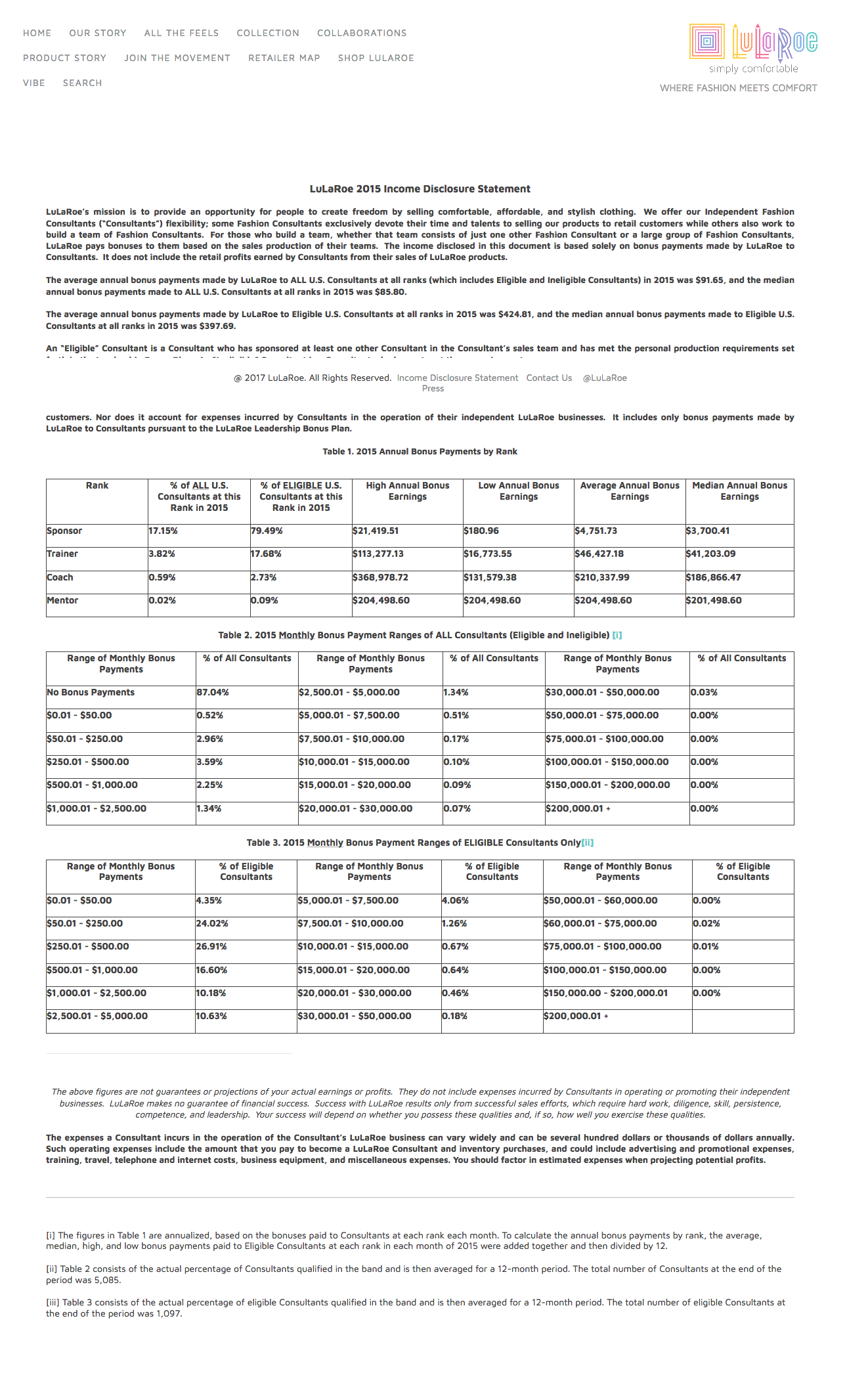
A study conducted by Truth in Advertising (TINA), a Connecticut-based watchdog that analyzes deceptive marketing practices, found that more than 100 LuLaRoe consultants have personally filed for bankruptcy since 2016. This is reportedly partly to do with the company’s strict rules and regulations regarding its pay structure, and with the fact that the earning potential for consultants is far lower than it’s made to seem. Vox reached out to LuLaRoe for comment and did not hear back.
In order to join LuLaRoe, consultants must start by spending about $5,000 for an “initial order kit,” which comes with 248 pieces of clothing. Consultants have to sell these items but must also buy additional monthly items in order to be eligible for potential bonuses. And there are additional costs to running a LuLaRoe business, like paying for clothing racks and hangers, not to mention time spent.
One major issue TINA discovered was that LuLaRoe products have become virtually “unsellable.” Struggling consultants say their market is overcrowded, since LuLaRoe and its army of sellers have been aggressively recruiting more people to join — in the structure of an MLM, sellers who recruit become the “upline” and are able to earn a commission from their recruited sellers’ earnings, called the “downline.” TINA reports that there are too many sellers and not enough buyers. Some consultants, according to TINA, were stuck with as much as $15,000 worth of unsold clothes.
TINA also found that LuLaRoe uses deceptive marketing practices and makes deceptive claims about how sellers can become “social selling entrepreneurs.” LuLaRoe touts financial freedom in its marketing materials, and claims there are thousands of dollars’ worth of bonuses to be made if consultants climb the company’s seller tiers. TINA, however, found that the average annual bonus paid to LulaRoe sellers was actually just $92. It also discovered that many sellers don’t even make enough money to earn back what they originally invested into LuLaRoe. TINA concludes that sellers are more likely to end up bankrupt than to move up LuLaRoe’s seller tiers.
The TINA investigation, which found LuLaRoe seller bankruptcies in 33 states, is hardly the first to illuminate LuLaRoe’s reportedly problematic and often deceptive practices. The company has been labeled “a scam” by Bloomberg and a “pyramid scheme” by disgruntled former consultants. In January, the state of Washington filed a class-action lawsuit against the company for deceptive practices, accusing LuLaRoe of focusing on recruiting instead of actually selling its products.
”LuLaRoe tricked consumers into buying into its pyramid scheme with deceptive claims of high profits and refunds for unsold merchandise,” Washington Attorney General Bob Ferguson told Business Insider. “Instead, many Washingtonians lost money and were left with piles of unsold merchandise and broken promises from LuLaRoe. It’s time to hold LuLaRoe accountable for its deception.”
There are more than a dozen private lawsuits from LuLaRoe sellers still currently pending, according to Bloomberg, and the company has been sued by unpaid suppliers, which claim it’s using shell companies to hide its wealth from creditors (the company has denied these claims).
With all the bad press, many sellers have opted to leave LuLaRoe, in what’s been dubbed a mass exodus. The company is now reportedly down to 35,000 sellers. But these sellers have found that it’s not so easy to just leave: They won’t be refunded the full amount of what they spent, per the company’s return policy. Some have also complained that they’ve been owed refund money for months, even after they followed all the necessary moves to shut down their business.
These are all telltale signs that there’s trouble at LuLaRoe. And even though the company insisted in February that it was turning over a new leaf to appease consultants’ woes, the TINA investigation says plenty of people are still falling prey to LuLaRoe’s false promises, and paying for it dearly.
]]>
Chavie Lieber<![CDATA[People buy millions of unsafe products every year. Here’s why recalls are harder than they should be.]]>https://www.vox.com/the-goods/2019/4/26/18514212/product-recall-explainer-fisher-price-britax-ikea2019-04-30T16:40:30-04:002019-04-26T07:00:00-04:00
Millions of units of products in the US get recalled every year, but advocates say the process is complicated and outdated. | Getty Images
On January 22, 2018, a father living in New York City filed a complaint on SaferProducts.gov, the website of the Consumer Product Safety Commission. It read, in part:
“My 6 month old son was put down for a nap in the Fisher-Price Rock n Play. During the time of his nap, he rolled over in the Rock N Play and silently died. The Rock N Play is sold as a sleeper and is marketed for ‘great overnight sleep’ … Fisher-Price has been notified of infant deaths due to their product and will still not recall it. This product can not be labeled as a sleeper or for “great overnight sleep”. My son was a beautiful, healthy baby and only died because of the Rock N Play and the false sense of security they provide with their false and UNSAFE claims of the Rock N Play being used for safe sleep.”
On April 12, 2019, Mattel, the owner of Fisher-Price, recalled 4.7 million Rock ‘n Plays it had sold, citing safety concerns.
The recall, which essentially forbids any retailer from selling the troubled product, happened more than a year after this complaint of an infant death caused by the Rock ‘n Play was made to the CPSC, and likely only happened because a Consumer Reports article had recently linked 32 infant deaths to its product, causing the American Academy of Pediatrics to urge the CPSC to recall it. As angry Facebook commenters noted, this recall was long overdue.
The CPSC had for many years heard complaints that the Rock ‘n Play was dangerous. The baby sleeper, which came out in 2009, rocked, vibrated, and played music to soothe an infant. Although the sleeper’s snug and angled cocoon-like shape directly violated the AAP’s SIDS prevention guidelines that recommend babies sleep on flat surfaces, the Rock ‘n Play advertised as a safe sleep product. Yet there were dozens of complaints filed to the CPSC about how some infants were developingplagiocephaly, or flat head syndrome, because of the bed’s shape or “respiratory issues” because of the product’s tendency to grow mold. Parents had also labeled the Rock ‘n Play an “asphyxiation hazard” because of the way it laid babies in an upright position.
And yet, the fact that it took years for Fisher-Price to voluntarily recall the Rock ‘n Play speaks to the long and complicated recall process in the US — a process public safety advocates say needs to be improved.
How a product gets recalled
When shoppers spend money on a product, they assume it’s been expertly tested, manufactured, and produced. In reality, though, millions of units get pulled from shelves every year because they are safety hazards: Overly flammable BBQs, lawn mowers that are liable to spit out sharp objects, toys that kids can choke on, scuba diving masks that cause restricted airflow, and cellphones that spontaneously combust.
The Consumer Product Safety Commission, a tiny government agency, is in charge of the recall process. The CPSC researches hazardous products, studies consumer complaints, enforces safety rules in specific product categories, and works with companies to issue recalls.
The CPSC has been around since 1971, when Congress established the Consumer Product Safety Act, establishing the agency as a watchdog that would keep consumers safe from potentially hazardous products. This law was reissued in 2008 as the Consumer Product Safety Improvement Act, giving categories like children’s products specific safety rules for the first time.
The CPSC now monitors categories like baby products; toys; appliances and other home goods; sports and recreational items; and fire and carbon monoxide-emitting items like generators and space heaters, as well as products with lead or mercury. (Vehicle recalls happen through the National Highway Traffic Safety Administration while food recalls are issued by the Food Safety and Inspection Service and by the Food and Drug Administration.)
The CPSC has five commissioners (the majority of the seats go to the sitting president’s political party, but no more than three are allowed to be from the same party to ensure bipartisanship). The agency sifts through complaints filed against roughly 15,000 different types of products and issues about 300 recalls a year.
In order for a product to be recalled, the CPSC first needs to determine if it can “present a significant risk to consumers.” Coming to this determination is not so easy, though, as Joseph Martyak, the director of communications at the CPSC, writes in an email (the CPSC did not make its commissioners available for this story).
“Many of the reports CPSC receives require no corrective action because CPSC staff concludes that the reported issue or product defect does not create a substantial product hazard,” Martyak writes. “In the case of reporting a non-compliance with a CPSC rule or regulation, there are other corrective actions that CPSC staff may consider short of a recall, for example, correcting future production, destroying products, or removing or repairing the non-compliant aspect of the product prior to sale.”
Once a report is issued, the product is investigated by the CPSC staff, which determines if a recall is necessary. Martyak says most product recalls kick off when a brand alerts the CPSC. Legally, all companies have to report when they find a defect in one of their products that could cause harm or risk of death, or if they are aware that they are violating mandatory consumer products safety rules. Martyak says the CPSC’s advice is “when in doubt, report.”
But the CPSC doesn’t just rely on companies to report on themselves; it gathers data about product-related deaths from coroners and hospitals, and studies news reporting. It also fields complaints filed to CPSC’s own website.
If the CPSC does decide something needs to be recalled, it works directly with the company to come up with a game plan, like how it will remove products from stores and what type of refunds customers will get. Most recalls are voluntary, since brands don’t want to face the PR disaster of publicly butting heads with a public safety watchdog agency.
In some rare situations, though, if a company doesn’t agree to pull its products, the CPSC will sue in order to issue a mandatory recall. Last year, the agency sued Britax after the company refused to recall a stroller that had a faulty wheel that kept popping off, injuring children and adults. The Washington Post recently reported that the CPSC agreed to settle with Britax, a decision that was moved along by a commissioner appointed by President Trump. Public safety advocates had previously raised concern that Trump’s picks for the CPSC had close relationships with the business world and might bring their biases with them when faced with holding corporations responsible.
The case for improving the recall system
As Martyak of the CPSC notes, not every death or injury associated with a product results in a recall. In many cases, companies are able to shift the blame onto consumers. In the case of the Fisher-Price Rock ‘n Play, the company said the deaths linked to the sleeper were caused by a product misuse; in an emailed statement to Vox, Fisher-Price VP Chuck Scothon said that there were “reported incidents in which the product was used contrary to the safety warnings and instructions.”
Adam Garber, a consumer watchdog with the United States Public Interest Research Group, says the CPSC should be active instead of reactive; it should tell companies to halt the sale of a product until the investigation is concluded.
“We would argue that when it comes to death being tied to a product, safety should be ensured first,” he says. “At a minimum, the sale of the product should be stopped, especially if there are children involved, and people should be notified that products that they own are being investigated.”
“At a minimum, the sale of the product should be stopped, especially if there are children involved”
Martyak admitted in his email that the agency does not seek out complaints; it does not read negative product reviews on website, where plenty of these product complaints live (the comments section for Rock ‘N Play listings on Amazon were littered with warnings). Instead, it waits for companies to report themselves to the CPSC. This system might have worked a decade ago, but with the surge of manufacturing, cheap labor overseas, and the ability for anyone to sell anything online today, Garber believes the agency needs to be aggressive.
“The current methods of the Consumer Product Safety Commission allows them to stay on top of a market where there are, let’s say, 1,000 new products,” he says. “But in reality, there are tens of thousands of new products hitting the market every year.”
Advocates also take issue with the nature of recalls — specifically, that they are product-focused, as opposed to category-focused. For example, the CPSC has reported that every two weeks, a child dies after a piece of furniture or a TV tips over and falls on them. In 2017, Ikea recalled 29 million Malm dressers after the model was linked to the deaths of at least eight children. Consumer Reports has identified 24 different dressers in 2018 that have the same safety hazards as Ikea’s Malm dressers. None have been recalled. Neither have copycats of the Rock ‘n Play.
“Because a lot of recalls are related to an individual product or a manufacturing flaw, there’s no invitation for a recall on a class of products,” Garber says. “Really, they should all be recalled, and at a minimum, the CPSC could stop the sale of these items until they do further investigation.”
Do recalls even work?
Advocates have issues with the recall itself: How do customers even find out?
When a product is recalled, both the brand and the CPSC spread the news via press releases, social media, and the occasional personal notification if a company has access to a customer’s information. But Nancy Cowles, executive director of Kids in Danger (KID), a nonprofit dedicated to the safety of children’s products, believes the CPSC lets brands off too easily, since they don’t make it mandatory for companies to track down shoppers or ensure that the recalled product disappears completely. KID, in fact, was founded in 1998 by the parents of a baby who died in a recalled portable crib; news about the recall had never reached his parents.
“Getting these products out of people’s homes is the hardest part, and we don’t believe there’s enough emphasis on making sure the recalls are effective,” she says. “Guarantee, in a year from now, we’ll hear about injuries of more children from [the Rock ‘n Play] because there’s no planning to make sure every customer is reached.”
Consumer safety watchdogs note that since recalls aren’t as effective as they should be, the CPSC should really be focused on something that’s crucial: product safety.
“We don’t believe there’s enough emphasis on making sure the recalls are effective”
What it can do, and what advocates want, is for the agency to make product safety mandatory. Currently, there are no laws that make product development teams factor in safety. The CPSC has mandatory safety standards for about 200 products, including electric garage door openers and children’s cribs. Other products, though, are subject to voluntary standards, or considered “industry consensus.” These standards are put together by groups like the American National Standards Institute (ANSI), which works with manufacturers, retailers, and other product experts. But they are suggestions; companies do not have to fully comply by them. According to the US Government Accountability Office, “compliance with voluntary standards is not routinely tracked.”
“Recalls should be the last line of defense in our product safety system, and the first is that dangerous products don’t reach people’s homes in the first place,” Garber says. “Our product safety system has gotten infinitely better, and we’ve made huge strides in getting away from toxics materials, but there’s more room to be done to make sure dangerous products aren’t slipping through the cracks.”
Recalls in general are on the decline — which makes advocates worry
Back in March, KID released its annual Recall Report and it found that under the Trump administration, there has been a 44 percent decrease in recall of children’s products (52 recalls a year, down from 93). The report also found that the number of actual items being pulled as a result of a recall had dropped from 12 million in 2017 to 2 million in 2018.
The CPSC has instead been relying on issuing warnings, according to the New York Times.
Pulling millions of products from shelves can be extremely destructive to a business, so it’s easy to understand why a company would prefer sending a warning instead. But the declining number of recalls concerns public safety advocates.
“Consumers react to product recalls with more urgency and more care and attention than they do for warnings,” Pamela Gilbert, who was the agency’s executive director from 1995 to 2001, told the Times. “When deaths are involved, especially for babies and children, warnings are really not the appropriate remedy.”
In its report, KID urges the CPSC to “invigorate its efforts” to getting more dangerous products off the market. It’s unlikely the agency will decide to take a proactive approach and start combing products on Amazon in search of reviews that hint at danger. The CPSC is notoriously understaffed and has a tiny budget.
“Most parents will say they hear about a product recall once a month or so, but last year, there was one recalled product a week, but they just aren’t hearing about them,” Cowles says. “The product safety system has a long way to go to ensure the safety of our most vulnerable consumers: children.”
]]>
Chavie Lieber<![CDATA[Some delivery apps pocket their workers’ tips. A new bill aims to expose the practice.]]>https://www.vox.com/the-goods/2019/4/24/18513559/tipping-policies-doordash-instacart-amazon-flex-new-york-bill2019-04-24T20:33:41-04:002019-04-24T10:20:00-04:00
An Instacart worker shops for a customer in the Whole Foods Market in Boston’s South End on May 28, 2015. | Lane Turner/The Boston Globe via Getty Images
Apps like Instacart, DoorDash, and AmazonFlex have come under fire for allegedly employing murky tipping practices, where it’s unclear if gig economy workers are actually able to keep their tips or if the companies are taking a cut.
Now, a new piece of legislation in New York City is being introduced to combat shadiness surrounding tipping. Ritchie Torres, a council member from the Bronx, is currently drafting a bill that would legally force apps to tell customers if they are pocketing worker’s tips.
“Customers are less inclined to do business with a company that is systematically exploiting its own workers,” Torres told the New York Daily News. “There’s an underclass of independent contractors who are brutally exploited in our brave new world. There’s a special place in hell for companies that confiscate the tips of low-wage workers. These tips are in fact profits for the companies — dollars the companies should be paying workers out of their own profits.”
Torres’s bill highlights the need for regulation in an economy where there’s little oversight of how gig workers are treated.
There are approximately 57 million workers in the US’s gig economy. They drive cars, run errands, shop for groceries, paint houses, take care of apartment rentals, and walk dogs. But they don’t get access to benefits like health insurance or workers’ comp and aren’t guaranteed regular hours, so many of them rely on tips to balance out their income.
Some companies don’t let these workers keep all of their tips, however. Apps like DoorDash, an on-demand food delivery service, count these tips as money that is applied to workers’ total payment, as opposed to extra. If a DoorDasher accepts a delivery that would pay them $10, for example, and a customer tips $5, the DoorDasher still walks away with $10, not $15. The company promises a minimum payment but counts tips toward that minimum.
DoorDash is transparent about this policy, but in February, several companies that employ a similar type of payment system were accused of “tip theft” after one Instacart receipt went viral. One Instacart shopper noticed on his delivery receipt that Instacart was taking a cut from a $10 tip, and that the worker was actually only netting an 80-cent tip.
Customers were furious and vowed not to use services with such policies. Workers also spoke up on online forums like Reddit, pointing out that some of these companies are purposely deceptive about their tipping practices.
After initially telling reporters that pocketing the tip was a “glitch,” Instacart announced it would change its payment policy in February, so that tips would be separate from payment. Instacart CEO Apoorva Mehta also openly apologized to workers. But companies like DoorDash still have not bowed to public pressure, even as workers are now boycotting companies that employ such tipping practices.
In the bill that Torres is trying to introduce, companies that consider tips to be essentially subsidies for worker pay would have to openly disclose this to customers, either by explicitly stating it in their terms of service or by sending a notification as a transaction is being approved. The idea is to try to expose these types of practices; shoppers might be less inclined to use the service, the thinking goes, and systemic change could come from consumer pressure.
And in the meantime, gig workers who rely on tips and work for companies with deceptive gratuity scales say it’s always best practice to tip in cash.
]]>
Chavie Lieber<![CDATA[Amazon and Walmart are testing a program to accept food stamps online]]>https://www.vox.com/the-goods/2019/4/19/18507813/amazon-walmart-snap-usda-pilot-food-stamps2019-04-19T12:38:09-04:002019-04-19T13:00:00-04:00
Food stamp recipients can now shop on the websites of Amazon and Walmart. | Getty Images
Public advocates have long argued that shopping innovations like e-commerce and cashless stores marginalize low-income shoppers. In order to shop online, customers need credit cards and bank accounts, and per the Federal Deposit Insurance Corporation, 6.5 percent of households in the US weren’t affiliated with a bank in 2017.
Now Amazon and Walmart are piloting a two-year program that will allow low-income shoppers to pay for groceries online using food stamps.
On Thursday, the US Department of Agriculture announced it had teamed up with Amazon and Walmart to allow participants in the Supplemental Nutrition Assistance Program (SNAP, a.k.a. food stamps) to buy groceries on these sites using their government-allotted benefits.
“People who receive SNAP benefits should have the opportunity to shop for food the same way more and more Americans shop for food — by ordering and paying for groceries online,” Agriculture Secretary Sonny Perdue said in a statement. “As technology advances, it is important for SNAP to advance too, so we can ensure the same shopping options are available for both non-SNAP and SNAP recipients.”
There are currently about 38 million food stamp recipients in the US, according to the USDA. In order to qualify, participants need to be at or below the poverty line. (A family of four, according to these guidelines, earns around or below a gross monthly income of $2,665.) Participants in the government-funded program receive benefits on payment cards, which can be used like debit cards to pay for groceries; the average family of four receives $465 a month.
The SNAP program used to only allow payment for groceries on the spot, so this partnership will be the first time low-income shoppers can use their benefits to shop online. SNAP participants will be able to purchase foods like bread, cereal, fruits, vegetables, meats, fish, poultry, and dairy products (the SNAP program does not cover the purchase of beer, wine, pet food, or household supplies). The pilot will not cover delivery charges.
The program is starting in New York, but the USDA said it will soon expand to Alabama, Iowa, Maryland, Nebraska, New Jersey, Oregon, and Washington. The grocery chain ShopRite is also on the list of companies that will allow SNAP participants to shop on its site.
There is, of course, an incentive for participating companies. According to the USDA, $52 billion worth of food stamps in 2017 went to big-box stores and grocery chains; Walmart and Amazon will now gain access to this new stream of revenue. The two companies have long been locked in a battle over shoppers’ wallets, so it makes sense that they’d want to expand their customer bases.
Amazon has set up a website for SNAP participants and already told the Associated Press it would give these shoppers free access to some Prime membership benefits, like AmazonFresh, where shoppers can buy meat, dairy, and vegetables, as well as Prime Pantry, which sells dried goods like cereal and canned food. As Walmart told the AP, “Access to convenience and to quality, fresh groceries shouldn’t be dictated by how you pay. This pilot program is a great step forward.”
]]>
Chavie Lieber<![CDATA[How Harry Potter and emoji became part of Passover]]>https://www.vox.com/the-goods/2019/4/17/18411037/passover-haggadah-comic-book-harry-potter-maxwell-house2019-04-17T15:37:28-04:002019-04-17T09:00:00-04:00
Passover is the most popular Jewish holiday, with 70 percent of American Jews attending a Seder, according to the Pew Research Center. | Getty Images
When former DC Comics editor Jordan Gorfinkel sought to update the Haggadah, the written guide to the traditional Passover meal known as the Seder, he looked to comic books.
Gorfinkel managed the Batman franchise at DC for nearly a decade before starting his own creative branding studio. He believes that Passover’s Exodus story, in which the ancient Jews are enslaved in and then freed from Egypt, is just as exciting as any superhero story.
This year, just in time for the holiday — one of the most important on the Jewish calendar — he published the Passover Haggadah Graphic Novel. In his version, the superhero in question is Moses, Pharaoh is just as scary a villain as the Joker, and the Ten Plagues are drawn in classic comic book style. Illustrated by Israeli artist Erez Zadok, the book offers a fresh take on an old story, intended to engage kids who might be bored at the Seder and superhero-loving adults alike. It’s also an Amazon best-seller (at least among religious graphic novels).
Passover, which spans eight days, is a celebration of freedom. The Seder (which means “order” in Hebrew) is held on the first two nights of the holiday; the ceremonial meal involves the recitation of the Exodus story, a standard set of songs, and plenty of ritualized eating and drinking. The Haggadah, which means “telling,” acts as both a storybook and a guide to the meal’s many traditions. It tells readers when to drink their wine, why they’re supposed to recline while they eat, and the meaning behind all the accoutrements on the Seder plate at the center of the dinner table.
As far as Jewish holidays go, Passover is the great equalizer. According to the Pew Research Center, 70 percent of American Jews say they participate in a Passover Seder, including 42 percent of Jews who don’t consider themselves religious. In fact, Passover ranks the highest for Jewish holiday participation.
“There are few barriers to entry so a Seder can be made very accessible to those with diverse backgrounds,” explains Hadas Fruchter, a clergy member at Beth Sholom Congregation in Potomac, Maryland. “It’s structured around a cool and interesting sensory experience, with foods and songs, that replaces the pews with pillows, and a prayer book with a full plate.”
Another tradition has sprung up around the Seder: the novelty Haggadah. In addition to Gorfinkel’s graphic novel Haggadah, there’s anemoji Haggadah, a sitcom Haggadah, a zombie Haggadah, a baseball Haggadah, and even a “hipster Haggadah,” written by novelists Jonathan Safran Foer and Nathan Englander. Because it’s 2019, there’s also a Trump Haggadah (tagline: “People All The Time They Come Up And Tell Me This Is The Best Haggadah They’ve Ever Read, They Do, Believe Me”).
According to the Jewish Book Council, the Haggadah is the most published Jewish book of all time, with at least 3,000 versions to appeal to Jews of every demographic and interest.
Occasionally, a mainstream publishing house will put out a Haggadah, like when Simon & Schuster debuted the Elie Wiesel Haggadah in 1993, or when Little, Brown published Foer’s New American Haggadah in 2012. But Haggadahs are typically relegated to niche Jewish publishing houses serving a small religious minority.
Typically, Haggadah best-sellers have been more traditional versions with scholarly commentary, like the Jonathan Sacks Haggadah, written by the former chief rabbi of London, or theArtscroll Family Haggadah, a favorite of observant Orthodox Jews. But novelty Haggadahs have become a holiday favorite, especially as people have begun incorporating several versions into their Seders. “A variety of Haggadot [the plural form of Haggadah in Hebrew] can be used at the same Seder,” explains Matthew Miller, CEO of the Israeli publisher Koren. “It’s fun.”
The Haggadah text is a compilation of psalms, benedictions, commentaries, and prayers. Although the core text has received additions over time, the Haggadah’s authorship is largely unknown, says Aaron Koller, a professor of Near Eastern and Jewish studies at Yeshiva University.
“The Haggadah as we have it came together over many centuries,” says Koller. “Some of the most beloved parts at the end are from as late as 1500 CE, but the heart of it comes from roughly the time of the Talmud — 1,500 to 1,800 years or so ago, although some parts may even be older than that.”
After centuries of handwritten texts, the first printed Haggadah was produced in 1480s Venice; Italian Jews began printing Jewish texts shortly after the invention of the printing press. It did not take long for contemporary adaptations to proliferate, says Miller. During the 16th and 17th centuries, the original Hebrew text was kept intact while original commentary and illustrations were included in different versions as additional insight. Things only got more creative from there.
“The Haggadah says that every generation should interpret it to their own circumstances,” says Miller, “and it’s lasted for so many generations because it speaks to so many generations.”
It helps that the story of Exodus itself is particularly universal.
“Folks identify with the experience of being faced with a challenge — personal, spiritual, professional, national, global — that makes them feel like they are in ‘Egypt,’” says Fruchter. “There’s deep joy that comes with the hope that somehow they will find redemption and clarity, and cross the sea to start the journey to the promised land.”
Adds Miller, “It’s the Bible story that everyone has used to describe their liberation, from Martin Luther King and the civil rights movement to the Ethiopian Jews immigrating to Israel.”
Even before the invention of the printing press, the Haggadah had long been used as a way to talk about modern Jewish life. The Birds’ Head Haggadah, for example, was a hand-drawn 14th-century German version depicting human bodies with avian heads. Some scholars believe the birds are in fact griffins, a mythical lion-eagle creature meant to illustrate the conflicted allegiance German Jews felt to their country at a time when some Jews were thriving and others were experiencing religious persecution.
During the 1800s, different Yiddish versions popped up, featuring commentary delivered through parody that mocked everyone from rabbis to politicians to capitalists. The Szyk Haggadah, created by Polish graphic artist Arthur Szyk in 1936, was an anti-fascist work; Szyk drew the ancient Hebrew slaves as European Jews and the Egyptians as Nazis.
“Jews, and especially modern Jews, have always felt that the Seder ought to be a meaningful experience and so they bring themselves into the text as a way of bringing the text back to the next generation,” Koller says. “It’s an ongoing quest for meaning and continuity in an age when both of those seem elusive.”
Over time, versions of the Haggadah began to reflect the American Jewish community’s focus on tikkun olam, or social justice. The Freedom Seder Haggadah from 1969 was created by rabbi and political activist Arthur Waskow, and it juxtaposes the story of Exodus with black persecution in America. The Haggadah for the Liberated Lamb came out in 1988 and centered on vegetarianism and animal rights.
It makes sense that as Passover has become the most mainstream Jewish holiday, contemporary editions of the Haggadah have strived for novelty. As Miller notes, Passover is often “the last vestige for people holding on to their Judaism,” and so the Haggadah needs to be accessible to everyone.
In addition to Gorfinkel’s graphic novel Haggadah, another item on Amazon is the (Unofficial) Hogwarts Haggadah, written two years ago by Moshe Rosenberg, a rabbi at a modern Orthodox day school in New York who runs the school’s Harry Potter club. Rosenberg, who’s sold more than 25,000 copies of his Haggadah, says there are endless parallels between Harry Potter and the Haggadah, like the four sons of the Passover Seder and the four Hogwarts houses, or the trio of Harry, Ron, and Hermione and that of Moses, Aaron, and Miriam.
“Every single year, hundreds of thousands of Jews wonder how they are going to keep people awake at their Seder table with the same ancient text,” says Rosenberg. “My theory was, why not draw from something that already has audiences engaged? My students know the Harry Potter canon inside and out, so it’s criminal not to use it! J.K. has already done all the work — all I have to do is connect the dots.”
He’s not the only one turning to Hollywood for new Passover material. The Maxwell House Haggadah has gone all in on novelty too. The coffee company’s original Haggadah came out in 1932 as part of a marketing campaign to educate consumers that coffee was indeed kosher for Passover; the Haggadahs were, and still are, a free gift with purchase of Maxwell House coffee.
The Maxwell House Haggadah became the most popular Haggadah for American Jews, especially for those who were less observant, since its layout and English translation was approachable enough for those with little knowledge of Hebrew. Naor Danieli, Maxwell House’s brand manager, says the brand has given away more than 50 million copies.
This year, Maxwell House debuted a special edition in honor of The Marvelous Mrs. Maisel, a show about a 1950s Jewish woman in New York City named Midge Maisel who pursues a career in comedy. The show is a time capsule of midcentury American Jewish culture, complete with a classic New York Jewish deli scene and Borscht Belt references.
Midge’s New 1958 Edition Haggadah, the official title of the new Maxwell House edition, comes with illustrations of the Maisel family and a recipe card for Midge’s infamous brisket. The Haggadah’s typical yellow-brown color scheme has been replaced with Midge-approved pink, and fake drops of wine are printed on the pages.
True to its roots, you can only get Midge’s Haggadah with a Maxwell House purchase (and, in this case, only on Amazon). Danieli anticipates the coffee company will give away about 500,000 copies of its traditional Haggadah this year.
“It felt like an organic partnership because the Maxwell House Haggadah is definitely the one the Maisels would be using in their imaginary universe,” Danieli says. “I think there’s been more interest in celebrating Passover since the Obama administration had their Seder in the White House, and we’re looking forward to approaching new audiences by offering the Haggadah exclusively on Amazon. We’re bringing a contemporary approach, but also taking into account the tradition behind the holiday.”
Of course, the Haggadah will never be as popular as the Bible, which sees 100 million copies printed annually. Miller says Koren sells just 120,000 Haggadahs a year, which amounts to a drop in the bucket for the publisher.
Still, new versions continue to proliferate. For Jews celebrating the same holiday every single year, a fresh interpretation can go a long way.
“There are endless amounts of lessons from the Haggadah,” Rosenberg says, “and anyone can have an enchanted Seder if they have new ways to look at the story.”