<?xml version="1.0" encoding="UTF-8"?><feed
	xmlns="http://www.w3.org/2005/Atom"
	xmlns:thr="http://purl.org/syndication/thread/1.0"
	xml:lang="en-US"
	>
	<title type="text">Clayton Aldern | Vox</title>
	<subtitle type="text">Our world has too much noise and too little context. Vox helps you understand what matters.</subtitle>

	<updated>2026-04-03T22:31:04+00:00</updated>

	<link rel="alternate" type="text/html" href="https://www.vox.com/author/clayton-aldern" />
	<id>https://www.vox.com/authors/clayton-aldern/rss</id>
	<link rel="self" type="application/atom+xml" href="https://www.vox.com/authors/clayton-aldern/rss" />

	<icon>https://platform.vox.com/wp-content/uploads/sites/2/2024/08/vox_logo_rss_light_mode.png?w=150&amp;h=100&amp;crop=1</icon>
		<entry>
			
			<author>
				<name>Kate Yoder</name>
			</author>
			
			<author>
				<name>Ayurella Horn-Muller</name>
			</author>
			
			<author>
				<name>Clayton Aldern</name>
			</author>
			
			<title type="html"><![CDATA[How climate science is sneakily getting funded under Trump]]></title>
			<link rel="alternate" type="text/html" href="https://www.vox.com/climate/484670/how-climate-science-is-sneakily-getting-funded-under-trump" />
			<id>https://www.vox.com/?p=484670</id>
			<updated>2026-04-03T18:31:04-04:00</updated>
			<published>2026-04-06T07:00:00-04:00</published>
			<category scheme="https://www.vox.com" term="Climate" /><category scheme="https://www.vox.com" term="Future Perfect" /><category scheme="https://www.vox.com" term="Science" />
							<summary type="html"><![CDATA[This story was originally published by Grist and is reproduced here as part of the&#160;Climate Desk&#160;collaboration. At the Department of Agriculture’s research division, everyone knows there’s one word they should never say, according to Ethan Roberts. “The forbidden C-word” — climate. Roberts, union president at the National Center for Agricultural Utilization Research in Peoria, Illinois, [&#8230;]]]></summary>
			
							<content type="html">
											<![CDATA[

						
<figure>

<img alt="an adult and child sit at the washington mall holding signs saying “you can’t delete climate change.” " data-caption="Protesters during the Stand-Up for Science rally in Washington D.C., March 2025. | Dominic Gwinn/Middle East Images/AFP/Getty Images" data-portal-copyright="Dominic Gwinn/Middle East Images/AFP/Getty Images" data-has-syndication-rights="1" src="https://platform.vox.com/wp-content/uploads/sites/2/2026/04/gettyimages-2203749079.jpg?quality=90&#038;strip=all&#038;crop=0,0,100,100" />
	<figcaption>
	Protesters during the Stand-Up for Science rally in Washington D.C., March 2025. | Dominic Gwinn/Middle East Images/AFP/Getty Images	</figcaption>
</figure>
<p class="has-text-align-none"><em>This story was originally published by <a href="https://grist.org/language/climate-federal-research-grants-national-science-foundation/">Grist</a> and is reproduced here as part of the&nbsp;<a href="https://www.climatedesk.org/about-us/">Climate Desk</a>&nbsp;collaboration.</em></p>

<p class="has-text-align-none">At the Department of Agriculture’s research division, everyone knows there’s one word they should never say, according to Ethan Roberts. “The forbidden C-word” — climate.</p>

<p class="has-text-align-none">Roberts, union president at the National Center for Agricultural Utilization Research in Peoria, Illinois, has worked for the federal government for nearly a decade. In that time, the physical science technician has weathered several political administrations, including President Donald Trump’s first term. None compare to what’s happening now.&nbsp;</p>

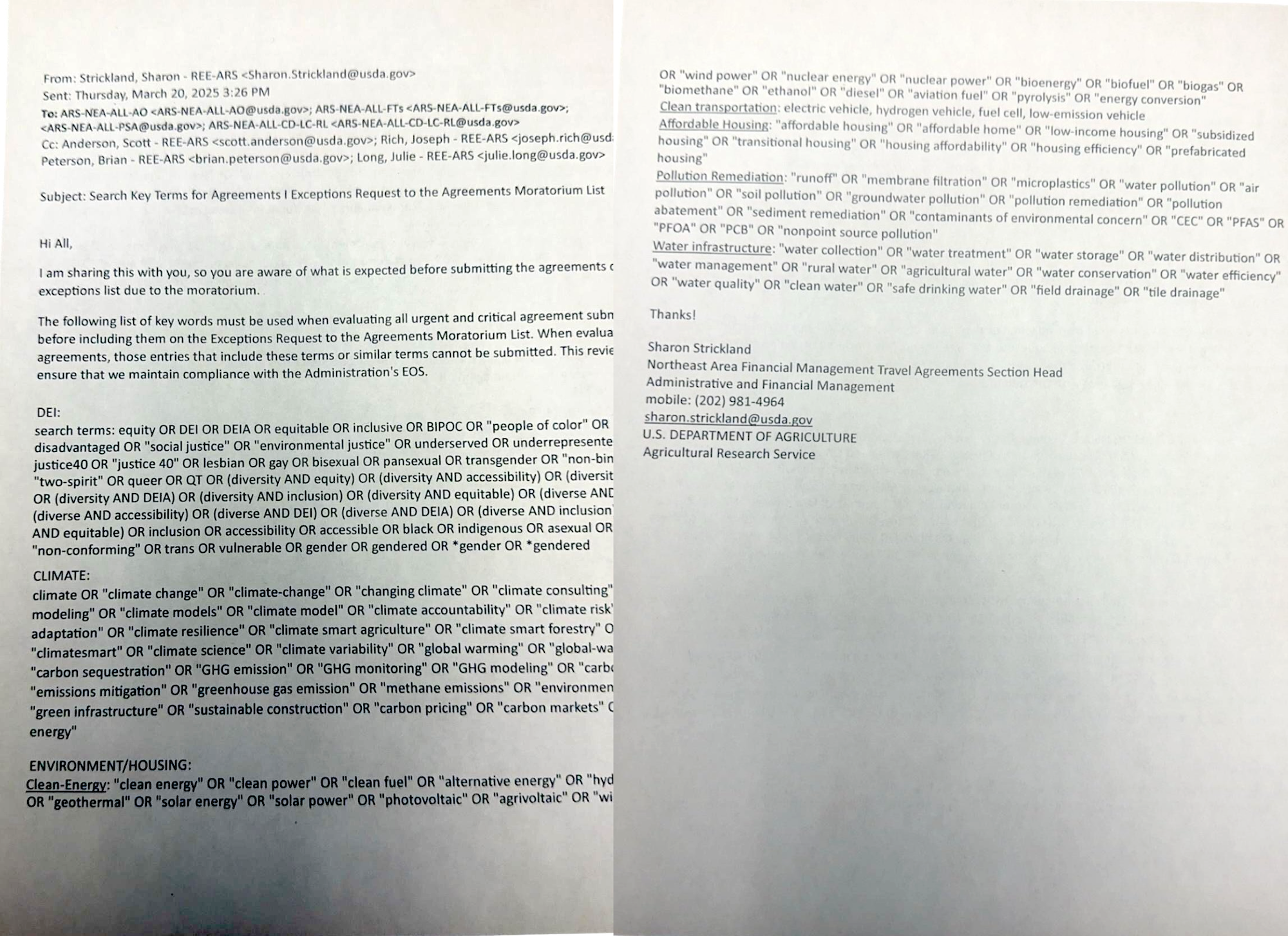
<p class="has-text-align-none">The sweeping transformation became apparent last March, after&nbsp;<a href="https://grist.org/wp-content/uploads/2026/03/more-perfect-banned-words-memo.png">a memo</a>&nbsp;from upper management at the USDA Agricultural Research Service instructed staffers to avoid submitting agreements and other contracts that used any of 100-plus&nbsp;<a href="https://grist.org/food-and-agriculture/usda-unfreezing-clean-energy-money-dei-climate/">newly banned words and phrases</a>. Roughly a third directly&nbsp;<a href="https://sentientmedia.org/phrases-newly-banned-at-usda/" rel="noreferrer noopener" target="_blank">related to</a>&nbsp;climate change, including “global warming,” “climate science,” and “carbon sequestration.”&nbsp;</p>

<p class="has-text-align-none">Roberts met with his union to figure out how to respond to the memo. They concluded that the best course of action was just to avoid the terms and try to get their research published by working around them. Throughout the federal agency, “climate change” was swapped for softer synonyms: “elevated temperatures,” “soil health,” and “extreme weather.”</p>

<p class="has-text-align-none">It’s part of a bigger trend. Across federal agencies and academic institutions, scientists are avoiding words they once used without hesitation. When Trump took office last year — calling coal “clean” and “beautiful” while deriding plans to tackle climate change as a “<a href="https://grist.org/language/strategy-behind-trump-climate-catchphrase-green-new-scam/">green scam</a>” — a so-called climate hushing took hold of the United States, as <a href="https://grist.org/business/companies-climate-plans-trump-earnings-greenhushing/">businesses</a>, <a href="http://grist.org/politics/democrats-arent-talking-about-climate-change-cheap-energy/">politicians</a>, and even <a href="https://grist.org/language/global-heating-climate-news-drought-chaos/">the news media</a> got quieter about global warming. There’s <a href="https://www.nytimes.com/interactive/2025/03/07/us/trump-federal-agencies-websites-words-dei.html" target="_blank" rel="noreferrer noopener">a long list of supposedly “woke” words</a> that agencies have been discouraged from using, many tied to climate change or diversity, equity, and inclusion (DEI) initiatives.</p>

<p class="has-text-align-none">The language changes were accompanied by larger shifts in how the federal government operates. Elon Musk’s Department of Government Efficiency (DOGE), laid off hundreds of thousands of <a href="https://www.washingtonpost.com/politics/2026/03/09/trump-hiring-federal-workers/" target="_blank" rel="noreferrer noopener">federal workers last year</a>. The Trump administration also slashed spending on science, cutting <a href="https://ourpublicservice.org/the-unraveling-of-public-science/" target="_blank" rel="noreferrer noopener">tens of billions of dollars in grants</a> for projects related to the environment and public lands. Researchers are adapting to the new landscape, with some finding creative ways to continue their climate research, from changing their wording to seeking out different sources of funding.   </p>

<p class="has-text-align-none">For federal researchers studying, say, the interplay between weather patterns and soybean diseases, the key is to reframe studies so they don’t clash with the Trump administration’s politics. “Instead of making it about the climate, you would instead just make it about the disease itself, and be like, ‘This disease does these things under these conditions,’ rather than ‘These conditions&nbsp;<em>cause</em>&nbsp;this disease to do this,’” Roberts added. “It’s just changing the focus.”</p>

<p class="has-text-align-none">You can see how federally funded research has changed by looking at the grants approved by the National Science Foundation, or NSF, an agency that provides roughly <a href="https://www.nsf.gov/about" target="_blank" rel="noreferrer noopener">a quarter</a> of the US government’s funding to universities. Grist’s analysis found that the number of NSF grants whose titles or abstracts mentioned “climate change” fell from 889 in 2023 to 148 last year, a 77 percent plunge. Part of that’s a result of NSF staffers approving fewer grants related to climate change under Trump. But researchers self-censoring by omitting the phrase in their proposals also appears to play a role, evidenced by the corresponding rise of “extreme weather” — a synonym that gets around the politicized language.</p>
<img src="https://platform.vox.com/wp-content/uploads/sites/2/2026/04/nsf-climate-interactive-static-vox.png?quality=90&#038;strip=all&#038;crop=0,0,100,100" alt="chart showing the distribution of climate language in NSF grant summaries" title="chart showing the distribution of climate language in NSF grant summaries" data-has-syndication-rights="1" data-caption="" data-portal-copyright="" />
<p class="has-text-align-none">Trent Ford, the state climatologist for Illinois, said he’s started using terms like “weather extremes” and “weather variability” in framing his proposals for grants.&nbsp;</p>

<p class="has-text-align-none">“It’s sort of a weird thing, because on principle, if we’re studying climate change, to not name climate change feels dirty,” said Ford, who’s also a research scientist at the Illinois State Water Survey at the University of Illinois Urbana Champaign. But it’s more of a practical decision than anything else: “We’ve seen where grants that say everything but ‘climate change’ and are obviously studying the impacts of climate change get through with no problem.” He only uses the phrase in grant proposals when he thinks it’s absolutely necessary and when efforts to steer around the term would look too obvious to a reviewer.</p>

<p class="has-text-align-none">Researchers have always had to tailor their framing to align with a funder’s priorities, in this case the federal government. Near the end of President Joe Biden’s term in late 2024, when Ford’s team applied for an NSF grant to study how climate conditions could affect Midwestern agriculture, it made sense to include a line about talking to a&nbsp;<em>diverse</em>&nbsp;group of farmers. But that word became a problem after Trump returned to office.</p>

<p class="has-text-align-none">“By the time the proposal got reviewed by the program manager at NSF, that same language that was required four months ago was now actually a death sentence on it,” Ford said. The NSF liked the proposal, but wanted the researchers to remove the line about reaching a diverse set of agricultural stakeholders and confirm that they would talk to “all American farmers,” Ford said. The team sent it back in, and the NSF approved it last April.</p>

<p class="has-text-align-none">Others weren’t so lucky. Another scientist at the Agricultural Research Service, who asked to remain anonymous out of fear of retaliation, said DOGE eliminated major research programs at the agency and, in the process, wiped out hundreds of thousands of dollars in federal funds for an initiative to grow plants without soil that “really didn’t have anything to do with climate change.” The scientist said it had only been labeled as climate research to “satisfy the previous Biden administration.”<br><br>“Anything, any project, that had ‘CC’ in front of it, was eliminated. Because ‘CC’ stands for climate change,” the staffer said. “So, unfortunately, that came back to bite them during this administration.”   </p>

<p class="has-text-align-none">Though not to this extreme, researchers have&nbsp;<a href="https://www.npr.org/sections/thetwo-way/2017/11/29/564043596/climate-scientists-watch-their-words-hoping-to-stave-off-funding-cuts" rel="noreferrer noopener" target="_blank">found themselves staying away from politically fraught terms</a>&nbsp;like “climate change” before. During the first Trump administration, Austin Becker, a professor at the University of Rhode Island who studies how ports and maritime infrastructure can be made more resilient to hazards like storms and flooding, started avoiding the phrase, even though it’s what motivated his research. “Everything that was ‘climate’ just became ‘coastal resilience,’” he said. “And we’ve kind of just stuck with that ever since.”</p>

<p class="has-text-align-none">Ford initially resisted pressure to stop using the phrase from colleagues he was writing grants with, but he gave in this time around for financial reasons. “Getting a grant could be the difference between a graduate student getting a paycheck and us having to let a graduate student go, or having to let a full-time employee of the university go,” he said.</p>

<p class="has-text-align-none">Some researchers have been looking for grants in new places as federal money dries up. Dana Fisher, a professor at American University and the director of its Center for Environment, Community, and Equity, has procured private funding to research ways to improve and expand communication about climate change in North America. She’s also looking overseas for funding, where she’s had success during past Republican administrations that were hesitant to approve grants for climate research. When George W. Bush was president, Fisher got a grant to study how climate action in US cities and states could influence federal policymaking, an effort funded by the Norwegian Research Council. That fact raised some eyebrows when she mentioned it to people she was interviewing in Congress. “They’re like, ‘Huh?’” Fisher said. “I was like, ‘Well, that’s what happens when there’s a Republican administration.’”</p>

<p class="has-text-align-none">As scarce as funding for anything related to the climate has become under Trump, some topics appear to be even more politically toxic. In Ford’s experience, and from what he’s heard from other researchers, “equity” and “environmental justice” are “actually dirtier words.” The Trump administration has closed the Environmental Protection Agency’s environmental justice offices at its headquarters and in all 10 of its regional offices, and continues to <a href="https://www.eenews.net/articles/trump-epa-lays-off-more-environmental-justice-staff/" target="_blank" rel="noreferrer noopener">lay off EPA staff</a> who helped communities dealing with pollution. Grist’s analysis of grants reveals a similar pattern: Under Trump, mentions of DEI have vanished from NSF grants entirely. Terms like “clean energy” and “pollution” have also declined, but not as sharply as climate change.</p>
<img src="https://platform.vox.com/wp-content/uploads/sites/2/2026/04/nsf-decline-bar-vox.png?quality=90&#038;strip=all&#038;crop=0,0,100,100" alt="" title="" data-has-syndication-rights="1" data-caption="" data-portal-copyright="" />
<p class="has-text-align-none">You could view the federal government’s pressure on scientists to change their language in different ways. Is it Orwellian-style censorship, silencing dissent and policing language? Or simply the right of a funder, whose politics changes with each administration, to ask for research that reflects its concerns? Does it affect what research gets done, or will applicants simply swap in harmless synonyms to ensure the work can continue?&nbsp;</p>

<p class="has-text-align-none">The answer is complicated, according to the USDA’s Roberts. Many of the climate projects at the agency’s research division that have so far avoided cancellation are stuck in funding purgatory, awaiting a fate that could hinge on a politically charged word or two. Scientists are adapting their research to better align with White House priorities, hoping to continue equipping farmers with the knowledge of how to adapt to a warming world — and scrubbing any forbidden language in the meantime.</p>

<p class="has-text-align-none">“Clever word usage, and controlling the scope of how the research is presented, allows for scientists to keep doing the work,” Roberts said. “There’s no one going around hunting these people down, thankfully. Not yet, anyway.”</p>

<hr class="wp-block-separator has-alpha-channel-opacity" />

<p class="has-text-align-none"><strong>A list of words related to climate and the environment included in the leaked USDA ARS banned words memo</strong></p>

<p class="has-text-align-none"><strong>Climate:</strong>&nbsp;climate OR “climate change” OR “climate-change” OR “changing climate” OR “climate consulting” modeling” OR “climate models” OR “climate model” OR “climate accountability” OR “climate risk adaptation” OR “climate resilience” OR “climate smart agriculture” OR “climate smart forestry” O[–] “climatesmart” OR “climate science” OR “climate variability” OR “global warming” OR “global-wa[–] “carbon sequestration” OR “GHG emission” OR “GHG monitoring” OR “GHG modeling” OR “carb[–] “emissions mitigation” OR “greenhouse gas emission” OR “methane&nbsp;emissions” OR “environmen[–] “green infrastructure” OR “sustainable construction” OR “carbon pricing” OR “carbon markets” O[–] energy”</p>

<p class="has-text-align-none"><strong>Clean energy:</strong>&nbsp;“clean energy” OR “clean power” OR “clean fuel” OR “alternative energy” OR “hyd[–] OR “geothermal” OR “solar energy” OR “solar power” OR “photovoltaic” OR “agrivoltaic” OR “wi[–] OR “wind power” OR “nuclear energy” OR “nuclear power” OR “bioenergy” OR “biofuel” OR “biogas” OR “biomethane” OR “ethanol” OR “diesel” OR “aviation fuel” OR “pyrolysis” OR “energy conversion”</p>

<p class="has-text-align-none"><strong>Clean transportation:</strong>&nbsp;electric vehicle, hydrogen vehicle, fuel cell, low-emission vehicle</p>

<p class="has-text-align-none"><strong>Pollution remediation:</strong>&nbsp;“runoff” OR “membrane filtration” OR “microplastics” OR “water pollution” OR “air pollution” OR “soil pollution” OR “groundwater pollution” OR “pollution remediation” OR “pollution abatement” OR “sediment remediation” OR “contaminants of environmental concern” OR “CEC” OR “PFAS” OR “PFOA” OR “PCB” OR “nonpoint source pollution”</p>

<p class="has-text-align-none"><strong>Water infrastructure:</strong>&nbsp;“water collection” OR “water treatment” OR “water storage” OR “water distribution” OR “water management” OR “rural water” OR “agricultural water” OR “water conservation” OR “water efficiency” OR “water quality” OR “clean water” OR “safe drinking water” OR “field drainage” OR “tile drainage”</p>

<p class="has-text-align-none"><em><strong>Note:&nbsp;</strong>The original leaked&nbsp;<a href="https://grist.org/wp-content/uploads/2026/03/more-perfect-banned-words-memo.png">memo screenshot</a>&nbsp;was obtained by More Perfect Union. Cut off words or phrases are marked with [–].</em></p>
						]]>
									</content>
			
					</entry>
			<entry>
			
			<author>
				<name>Clayton Aldern</name>
			</author>
			
			<title type="html"><![CDATA[Dozens of countries still haven’t ratified the Paris climate deal. What’s the holdup?]]></title>
			<link rel="alternate" type="text/html" href="https://www.vox.com/2016/7/2/12085146/paris-climate-ratification" />
			<id>https://www.vox.com/2016/7/2/12085146/paris-climate-ratification</id>
			<updated>2016-07-01T16:26:33-04:00</updated>
			<published>2016-07-02T09:00:02-04:00</published>
			<category scheme="https://www.vox.com" term="Climate" />
							<summary type="html"><![CDATA[Originally published on Grist. In the wake of the UK&#8217;s vote to leave the European Union, environmentalists have been in a bit of a tizzy. The Paris climate deal, negotiated late last year, needs ratification from 55 parties accounting for at least 55 percent of global emissions before it kicks into effect &#8212; and the [&#8230;]]]></summary>
			
							<content type="html">
											<![CDATA[

						
<figure>

<img alt="" data-caption="" data-portal-copyright="(Grist/Shutterstock)" data-has-syndication-rights="1" src="https://platform.vox.com/wp-content/uploads/sites/2/chorus/uploads/chorus_asset/file/6737531/paris-eiffel-tower-2-c-shutterstock.jpg?quality=90&#038;strip=all&#038;crop=0,0,100,100" />
	<figcaption>
		</figcaption>
</figure>
<p><em>Originally published on </em><a href="http://grist.org/living/this-landscape-architect-is-the-bra-burner-of-lawn-design/"><em>Grist</em></a><em>.</em></p>

<p>In the wake of the UK&rsquo;s vote <a href="http://grist.org/article/brexit-could-have-serious-repercussions-for-the-climate/">to leave</a> the European Union, environmentalists have been in a bit of a tizzy. The <a href="http://www.vox.com/2015/12/12/9981020/paris-climate-deal">Paris climate deal</a>, negotiated late last year, needs ratification from 55 parties accounting for at least 55 percent of global emissions before it kicks into effect &mdash; and the 28-member EU, which must ratify as a bloc, makes up the third-largest slice of the emissions pie.</p>

<p>But things are <a href="http://www.politico.eu/article/eu-referendum-european-union-confronts-life-without-the-uk-brexit/">tumultuous</a> in Brussels these days, raising concerns that the EU might not manage the task anytime soon. If the EU doesn&rsquo;t formally join the agreement before the end of the year, further pressure will be placed on the rest of the world to ratify and bring the deal into effect.</p>

<p>&#8220;If you&rsquo;re able to secure India, China, Japan, Canada, Mexico &mdash; all of the rest of the major economies &mdash; there are a lot of pathways that can get you there,&#8221; says Pete Ogden, a senior fellow at the Center for American Progress and former climate adviser to the White House. As of last week, Norway became only the 18th party to formally join the Paris deal, adding to a roster of small emitters like low-lying island states and developing nations. France&rsquo;s <a href="http://grist.org/climate-energy/france-ratifies-u-n-climate-deal-your-move-rest-of-world/">ratification</a> earlier this month depends on the rest of the EU&rsquo;s approval before it counts.</p>

<p>So what, exactly, is everyone else waiting for?</p>

<p>Across the board, &#8220;each country has a unique domestic approval process&#8221; determined by their national constitutions, <a href="http://www.wri.org/blog/2016/04/when-could-paris-agreement-take-effect-interactive-map-sheds-light">explains</a> Eliza Northrop, an associate at the World Resources Institute&rsquo;s International Climate Action Initiative. China, for example, has more bureaucratic hurdles to overcome than the United States. Beijing must gain the approval of the 150-member Standing Committee of the National People&rsquo;s Congress to formally join the agreement.</p>

<p>But once countries have &#8220;gone through that technical process, it all comes down to politics,&#8221; says Northrop. And for countries that have more flexibility around the timing, &#8220;the decision is almost entirely political.&#8221;</p>

<p>In the case of the United States, the climate deal doesn&rsquo;t require the approval of the Senate. Only Obama&rsquo;s okay is needed to formally join, but he&rsquo;s waiting for something &mdash; perhaps for China, experts suggest.</p>

<p>&#8220;The US and China have long established they&rsquo;re going to act jointly and have a common vision,&#8221; says Northrop, so they may want to ratify at the same time. &#8220;There&rsquo;s a nice symmetry there.&#8221;</p>

<p>Ogden also points to leaders wanting to maximize the diplomatic effect with joint announcements as opposed to a steady &#8220;drip, drip, drip&#8221; of ratifications. Momentum is diplomatic currency, and &#8220;countries are trying to optimize the impact of completing what they&rsquo;ve already agreed to.&#8221;</p>

<p>Domestic political considerations can muddy the ratification waters, too. Obama, for example, wouldn&rsquo;t want to do anything that would hamper Hillary Clinton&rsquo;s chances of winning the White House, and Republicans have already grumbled about him acting without the consent of Congress. (Ogden, who also advises the Clinton campaign, dismisses this idea, claiming that the administration likely doesn&rsquo;t &#8220;see any downside&#8221; to ratifying before the election.)</p>

<p>India, too, has its own politics at play. Climate experts hope the country, as the fourth-largest emitter, might formally join the Paris agreement this year, along with the United States and China. A recent US&ndash;India <a href="http://www.thehindu.com/news/international/world/india-us-agree-to-initiate-domestic-processes-to-ratify-paris-agreement-on-climate-change/article8701810.ece">joint announcement</a> confirmed their intentions to ratify the deal before the end of the year. But India could withhold ratification if it&rsquo;s unhappy with other parties. The United States <a href="http://economictimes.indiatimes.com/news/defence/us-committed-to-ensuring-indias-nsg-membership-assures-tom-shannon/articleshow/52975143.cms">supports</a> India&rsquo;s aspirations to join the Nuclear Suppliers Group, but China last Friday blocked discussion on India joining. Now India <a href="http://timesofindia.indiatimes.com/india/As-its-NSG-bid-fails-India-says-Paris-Climate-Agreement-ratification-may-be-delayed/articleshow/52906697.cms">isn&rsquo;t so sure</a> it can ratify the deal just yet.</p>

<p>Here&rsquo;s the thing: It&rsquo;s not clear exactly when is the <em>right</em> time for Paris to enter into effect, because &#8220;right&#8221; means different things for different countries. Many want to see it happen before the end of the year, to reaffirm international commitments and get the implementation balls rolling, especially with political shake-ups underway in the United States and Britain.</p>

<p>But a country can also choose to withhold its ratification as leverage: Some developing countries and the think tank Third World Network, for example, <a href="http://www.twn.my/title2/climate/doc/Introduction%20and%20context%20to%20the%20Note%20on%20the%20signing%20ceremony%20of%20the%20Paris%20Agreement%20in%20New%20York%20on%2022nd%20April.pdf">argue</a> that delaying ratification would <a href="http://www.climatechangenews.com/2016/04/07/ratification-not-signing-is-critical-test-for-paris-climate-deal/">pressure larger polluters</a> into ramping up their ambitions or providing more financial security for those with little clean energy infrastructure.</p>

<p>At the end of the year, countries will meet for the next round of climate negotiations in Marrakech, and many countries are anxious to see the conference announce the beginning of &#8220;the Paris era.&#8221; By kicking the agreement into effect before that meeting, &#8220;then you tee up the conference as a first chapter&#8221; in this era, says Ogden. As the Marrakech talks approach, eyes will be on the biggest polluters to follow through on the grand promises made in Paris.</p>

<p><em>Grist is a nonprofit news site that uses humor to shine a light on big green issues. Get their email newsletter </em><a href="http://grist.org/subscribe/"><em>here</em></a><em>, and follow them on </em><a href="https://www.facebook.com/grist.org"><em>Facebook</em></a><em> and </em><a href="https://twitter.com/grist"><em>Twitter</em></a><em>.</em></p>
						]]>
									</content>
			
					</entry>
			<entry>
			
			<author>
				<name>Clayton Aldern</name>
			</author>
			
			<title type="html"><![CDATA[Meet the scientist connecting the dots between air pollution and dementia]]></title>
			<link rel="alternate" type="text/html" href="https://www.vox.com/2016/2/23/11094686/air-pollution-dementia" />
			<id>https://www.vox.com/2016/2/23/11094686/air-pollution-dementia</id>
			<updated>2019-03-05T22:53:20-05:00</updated>
			<published>2016-02-23T08:30:02-05:00</published>
			<category scheme="https://www.vox.com" term="Air Quality" /><category scheme="https://www.vox.com" term="Climate" /><category scheme="https://www.vox.com" term="Criminal Justice" /><category scheme="https://www.vox.com" term="Policy" />
							<summary type="html"><![CDATA[Originally published as part of Grist&#8216;s &#8220;Climate on the Mind&#8221; series. At first blush, you might not think air quality is related to brain health. But what if the two are connected? Air pollution continues to worsen in the developing world, especially in rapidly developing countries like China and India; at the same time, our [&#8230;]]]></summary>
			
							<content type="html">
											<![CDATA[

						
<figure>

<img alt="" data-caption="" data-portal-copyright="Aaron Reuben/Grist" data-has-syndication-rights="1" src="https://platform.vox.com/wp-content/uploads/sites/2/chorus/uploads/chorus_asset/file/15708240/grist-air-pollution.0.1547423162.jpg?quality=90&#038;strip=all&#038;crop=0,0,100,100" />
	<figcaption>
		</figcaption>
</figure>
<p><em>Originally published as part of </em><a href="http://grist.org/climate-energy/meet-the-scientist-connecting-the-dots-between-air-pollution-and-dementia/"><em>Grist</em></a><em>&#8216;s &#8220;</em><a href="http://grist.org/series/climate-on-the-mind/"><em>Climate on the Mind</em></a><em>&#8221; series.</em></p>

<p>At first blush, you might not think air quality is related to brain health. But what if the two are connected? Air pollution continues to worsen in the developing world, especially in rapidly developing countries like China and India; at the same time, our global population is aging, and dementia rates are expected to rise accordingly. Increasingly, research suggests a link between air pollution exposure and the risk of diseases like Alzheimer&rsquo;s and Parkinson&rsquo;s. How might this relationship be possible, and what might it mean for what the world is &mdash; or isn&rsquo;t &mdash; prepared to handle in the coming decades?</p>
<p><!-- ######## BEGIN SNIPPET ######## --></p><div data-analytics-category="article" data-analytics-action="link:related" class="chorus-snippet s-related"> <span class="s-related__title">Related</span> <!-- Add links here --><a href="http://www.vox.com/2015/2/24/8094597/india-air-pollution-deaths" target="_blank" rel="noopener">India&#8217;s air pollution is so bad it&#8217;s reducing life expectancy by 3.2 years</a><br> </div>
<p>Aaron Reuben is a <a href="http://grist.org/author/aaron-reuben/">science writer</a>, recovering policy wonk, and neuropsychologist in training who&rsquo;s exploring just these questions. He&#8217;s a PhD student at Duke, and his journalistic endeavors include an eye-opening feature for Mother Jones (<a href="http://grist.org/science/does-air-pollution-cause-alzheimers-and-parkinsons/">cross-posted at Grist</a>) that draws attention to the connection between dementia and dirty air.</p>

<p>Driving Reuben&rsquo;s work is the notion that the countries that will see the most aging in the coming years are the same countries that are going to have the most polluted air &mdash; and the same places that have some of the least developed infrastructure for diagnosing and treating brain disease. I caught up with Reuben to chat about the state of the science, the justice issues at stake, and the difficulties of communicating the invisible.</p>
<div data-chorus-asset-id="6088055"><img src="https://platform.vox.com/wp-content/uploads/sites/2/chorus/uploads/chorus_asset/file/6088055/shutterstock_178208156.jpg"></div>
<p><strong>Clayton Aldern: What do we know about the links between air pollution and dementia?</strong></p>

<p>Aaron Reuben: There are two branches of relevant science here. The first body of research studies people in older age brackets and maps their health outcomes onto possible air pollution exposures generated from regional pollution-monitoring data. When you do that, you find that people who are exposed to more air pollution, particularly fine particles, show an increased risk for dementia and pre-dementia, called mild cognitive impairment. A <a href="http://www.ncbi.nlm.nih.gov/pubmed/25310992">study</a> that came out of Taiwan, for example, drew on a cohort of nearly 100,000 people and showed that for every unit increase in exposure to particle pollution, the risk of developing Alzheimer&rsquo;s went up by more than 100 percent.</p>

<p>Of course, before we can say that one causes the other, one of the things that needs to happen is for data to arrive from longitudinal studies in which you follow people from day one, categorize their exposures, follow their outcomes, and control for things you&rsquo;d like to control for, like exposures to other toxins like lead. But every month and every year, more and more studies are coming out, and the fact that they&rsquo;re all finding the same thing is very compelling.</p>

<p>The other kinds of studies that are contributing to the evidence base are animal studies. You can&rsquo;t sit someone down and expose them to air pollution and watch their brains degenerate in real time. But you can do that in mice. There are a lot of studies coming out now on changes in cell dynamics and epigenetics in mice exposed to air pollution, and you see that many of the changes are in the direction of Alzheimer&rsquo;s disease and heavily related to dementia outcomes.</p>

<p>Something that&rsquo;s really sexy that hasn&rsquo;t been published yet is studies using <a href="http://www.ncbi.nlm.nih.gov/pubmed/20101721">transgenic mice</a> that have been engineered to develop Alzheimer&rsquo;s-type pathology. If you expose generations of these mice to air pollution and that changes the development of pathology, then you can make a call that in this particular animal, the exposure to fine particles fostered the disease. So far the mouse studies are pointing in the same direction as the cohort studies.</p>
<div data-chorus-asset-id="6088093"><img src="https://platform.vox.com/wp-content/uploads/sites/2/chorus/uploads/chorus_asset/file/6088093/shutterstock_264060908.jpg"></div>
<p><strong>CA: So are we at &#8220;smoking causes lung cancer&#8221; levels of evidence?</strong></p>

<p>AR: No, we&rsquo;re not there yet. But when people ask me this, I also ask them how long it took to get there for lung cancer. How long did we think cigarettes caused cancer before we were finally willing to say we know? It took decades. I don&rsquo;t think anyone thinks the evidence is going to start weighing against this trend. It&rsquo;s a matter of how long new research needs to pile up before people are willing to make a bold statement.</p>

<p><strong>CA: And what do we know about <em>how</em> pollution might contribute to dementia?</strong></p>

<p>AR: There are a couple ways we think it works. One is by nature of the fact that some of the particles are very small. Your sense of smell is a very potent sense, and there is a direct connection from the nose to the brain via the nasal nerve. That means that once you get something in your nose, if it&rsquo;s small enough, it can pass into the nerve and make its way all the way to the brain.</p>

<p>Keep in mind that pollution particles typically bring in a host of other nasty things with them, including heavy metals &mdash; things that can directly kill neurons. The end result is a disruption of the brain&rsquo;s homegrown immune system. Microglia cells &mdash; which clear waste, trim away dead neurons, improve synaptic connections, and clear pathogens &mdash; end up performing an unsuccessful process. They continue to release oxidative chemicals that are designed to kill pathogens, but instead of killing anything, the chemicals just accumulate and disrupt neural activity. The damage this causes looks a lot like what you see in Alzheimer&rsquo;s and Parkinson&rsquo;s patients.</p>

<p>Another mechanism comes via the lungs. When pollution particles are inhaled into the lungs, they tend to be small enough to make it past the body&rsquo;s defenses and end up in the deepest tissue, where they then pass into the bloodstream. When they do that, they trigger an immune reaction that circulates molecules related to inflammation, cytokines, in the bloodstream &mdash; the kind of thing that seems to cause chronic low-level inflammation wherever the particles go. We&rsquo;re not sure if the particles can enter the brain through the blood directly or if the chemicals they trigger actually reach the brain, but there&rsquo;s evidence that they interact with the blood-brain barrier and damage it somehow.</p>

<p>It&rsquo;s all about low-level inflammation that turns into long-term damage. Particles that enter through the nose will cause neuroinflammation directly, and particles that enter through the lungs will also cause neuroinflammation indirectly.</p>
<div data-chorus-asset-id="6088097"><img src="https://platform.vox.com/wp-content/uploads/sites/2/chorus/uploads/chorus_asset/file/6088097/shutterstock_353924906.jpg"></div>
<p><strong>CA: You&rsquo;ve suggested we&rsquo;re past the tipping point at which this theory is going to be wholly refuted, but you&rsquo;ve also </strong><a href="http://www.motherjones.com/environment/2015/05/air-pollution-dementia-alzheimers-brain"><strong>cited</strong></a><strong> overly cautious scientists who are wary of overstating the evidence. Why do you think this hesitance exists?</strong></p>

<p>AR: I think in all of science there&rsquo;s a tendency to be as precise as possible. It&rsquo;s never unusual for scientists to hedge their bets. But the other thing I think is going on here is that there&rsquo;s been a sort of history of jumping the gun on Alzheimer&rsquo;s. We&rsquo;ve been talking about one cause, but there are many ways to brain disease. The brain is uniquely susceptible to damage. Air pollution isn&rsquo;t causing all the dementia we see around us. There&rsquo;s pesticide exposure, there are concussions &mdash; there&rsquo;s not just one way to get this disease. And it&rsquo;s also a function of your cumulative exposures and your genetic predisposition.</p>

<p>There&rsquo;s a lot to fear when it comes to dementia. It comes out of nowhere, there&rsquo;s no cure, it erases everything about you. If you can point to something that&rsquo;s causing it, people are going to take you seriously. That&rsquo;s what happened with the aluminum scare in the 1980s, which led to sensationalist headlines and people worrying about their pans and the things they were drinking. The studies that found unusually large aluminum deposits in the brains of Alzheimer&rsquo;s patients <a href="http://www.ncbi.nlm.nih.gov/pubmed/21157018">were real</a>, but that didn&rsquo;t mean that your personal exposure to aluminum actually influenced your dementia risk. The field of gerontology remembers this and is going to be slow to embrace air pollution. Especially because it&rsquo;s something that everyone is exposed to, unlike, say, a concussion.</p>
<div data-chorus-asset-id="6088107"><img src="https://platform.vox.com/wp-content/uploads/sites/2/chorus/uploads/chorus_asset/file/6088107/shutterstock_78627838.jpg"></div>
<p><strong>CA: I&rsquo;m interested in what you just said about air pollution being something everyone is exposed to. There are obviously inherent justice questions at stake here given the inequities of air pollution exposure. How does </strong><a href="http://grist.org/cities/what-do-racism-and-poverty-have-to-do-with-pollution-and-climate-change/"><strong>environmental justice</strong></a><strong> enter the conversation for you?</strong></p>

<p>AR: I think there are two things going on, and neither of them are good. The same communities that are reliably exposed to the most air pollution are the same communities that have the fewest resources to defend themselves or compensate for the effects.</p>

<p>Something you see time and again is that high-income, high-resourced individuals not only can buffer themselves against exposure to air pollution &mdash; they live in the nice parts of town, they don&rsquo;t live by busy roads, they live by a lot of greenery, which we know can reduce pollution levels &mdash; but they also have the resources to respond to the kinds of cognitive impairments that we&rsquo;re predicting. Researchers at the University of Southern California have found that air pollution levels are linked to developmental disorders. We know that if your child has a developmental disorder, there are plenty of services and activities to improve their cognitive abilities. These are the kinds of things that aren&rsquo;t always available to low-income communities, who are also at greater risk.</p>

<p>Another thing that people are talking about are the synergistic stressors at play. It&rsquo;s not just that you&rsquo;re living in a neighborhood that has higher levels of air pollution, it&rsquo;s that there might also be more violence in your social environment. You might have an incarcerated family member. These are many forms of adversity that, on their own, modify the way the brain develops and modify a slew of <a href="http://www.cdc.gov/violenceprevention/acestudy/">risk factors</a>. When you put them all together, these effects may be magnified.</p>
<div data-chorus-asset-id="6088075"><img src="https://platform.vox.com/wp-content/uploads/sites/2/chorus/uploads/chorus_asset/file/6088075/shutterstock_105769742.jpg"></div>
<p><strong>CA: What if I buy your story about air pollution and dementia but can&rsquo;t move out of my heavily polluted neighborhood? What are my options?</strong></p>

<p>AR: Something we used to study in my old lab was called <a href="http://www.ncbi.nlm.nih.gov/pmc/articles/PMC3507991/">cognitive reserve</a>. The basic idea is that there are some things you can do that appear to make you more resilient against showing symptoms of disease or brain injury. It&rsquo;s based on old evidence of people who had died and, once an autopsy of their brain was done, appeared to have had Alzheimer&rsquo;s-like pathology &mdash; but there was no evidence they had Alzheimer&rsquo;s when they were alive. And it seems to be the case that they were compensating somehow for the brain damage.</p>

<p>There are certain things we know lead to good cognitive reserve. Yes, a lot of them are associated with your socioeconomic status, but some of them aren&rsquo;t. If you have a higher IQ, it seems you&rsquo;re buffered a bit against insults to your brain. For every year of education you get, your risk of presenting Alzheimer&rsquo;s goes down &mdash; not because you&rsquo;re immune to the disease, but because if you start to get early damage, you&rsquo;re more able to deal with the damage in a way that maintains your cognitive function. More physical activity is another one.</p>

<p>With respect to age, young people and old people are the most vulnerable. Young people&rsquo;s brains are still developing; old people have brains that are less likely to bounce back and repair themselves after injury. As a society, we can choose to design better communities around some of this knowledge. In California, there&rsquo;s <a href="http://leginfo.legislature.ca.gov/faces/billNavClient.xhtml?bill_id=200320040SB352">a law</a> that says you can&rsquo;t put an elementary school on a busy road.</p>

<p>But we can&rsquo;t all move. In Beijing, if you wanted to move, you&rsquo;d have to change your whole life. You can&rsquo;t escape the pollution.</p>

<p><strong>CA: I feel like there&rsquo;s a certain paradox here when you mention a place like Beijing. We&rsquo;re building these factories in the name of progress, but for whom? If people&rsquo;s brains are atrophying because of exposure to air pollution, there&rsquo;s a pretty abysmal vicious circle going on.</strong></p>

<p>AR: It&rsquo;s not just that we&rsquo;re going to die younger or age more poorly. There&rsquo;s lots of evidence that you&rsquo;re stopping people at the start of their lives. Studies have found that kids drop IQ points for every unit of air pollution exposure. Or look at what&rsquo;s happening <a href="http://grist.org/living/black-lives-matters-calls-the-flint-water-crisis-an-act-of-state-violence/">in Flint</a> [Michigan]. There&rsquo;s a whole generation of kids getting set at a disadvantage from day one. We&rsquo;re doing the damage to ourselves.</p>

<p><strong>CA: Something like climate change is already so slow and abstract. Something like air quality isn&rsquo;t always something you can see. When you combine these kinds of things with mental health or brain health &mdash; which are already siloed off from the rest of the health spectrum &mdash; there&rsquo;s a lot of abstraction going on in one place. That must make these effects particularly difficult to communicate. Does this ever leave you frustrated?</strong></p>

<p>AR: This actually reminds me of something I&rsquo;m working on now, which is trying to look at the long-term effects of exposure to positive things like parks and green spaces &mdash; improved environments. I think of it as the flip side of these stressors. Almost everyone you talk to can speak at a personal level to the benefit of green spaces. Trying to find that effect in data and trying to make that data compelling is hard. There are a lot of things that are going to contribute to how well or how poorly you live. Something like your environment is just one of them. Trying to pull out the influence of that one factor is really hard, both scientifically and with respect to communication.</p>

<p>But we do know the places where people are getting older. In a lot of those places, we can reliably say there are going to be greater rates of dementia than there should be. A lot of those places don&rsquo;t have infrastructure yet for diagnosing or treating these things, and I think it&rsquo;s time we started thinking about the resources that need to be put into place in the areas where the air is bad. At some point we&rsquo;re going to have to start paving the way to dealing with the brain health crisis that&rsquo;s coming.</p>

<p>Of course it&rsquo;d be great to clean up the air in these places, and we know how to clean up the air, but we&rsquo;re not going to be able to do it right away. In the meantime, we know who the people are at risk, and we know pretty well what&rsquo;s going to happen. Can we start getting ready for that in a real way?</p>

<p><em>Grist is a nonprofit news site that uses humor to shine a light on big green issues. Get their email newsletter </em><a href="http://grist.org/subscribe/"><em>here</em></a><em>, and follow them on </em><a href="https://www.facebook.com/grist.org"><em>Facebook</em></a><em> and </em><a href="https://twitter.com/grist"><em>Twitter</em></a><em>.</em></p>
						]]>
									</content>
			
					</entry>
			<entry>
			
			<author>
				<name>Clayton Aldern</name>
			</author>
			
			<title type="html"><![CDATA[What’s the best way to protect forests? That’s a big question at the Paris climate talks.]]></title>
			<link rel="alternate" type="text/html" href="https://www.vox.com/2015/12/4/9843134/climate-talks-trees" />
			<id>https://www.vox.com/2015/12/4/9843134/climate-talks-trees</id>
			<updated>2019-03-05T14:57:29-05:00</updated>
			<published>2015-12-04T09:10:02-05:00</published>
			<category scheme="https://www.vox.com" term="Climate" />
							<summary type="html"><![CDATA[Originally published on Grist. PARIS, France &#8212; Outside the UN Climate Conference site on the outskirts of Paris, in a parking lot surrounded by hybrid buses, stands a pair of 33-foot trees one could mistake for an art installation. Their branches, white and gently sloping skyward, have the feel of PVC piping. Each tree has [&#8230;]]]></summary>
			
							<content type="html">
											<![CDATA[

						
<figure>

<img alt="" data-caption="" data-portal-copyright="Rich Carey/Shutterstock.com via Grist" data-has-syndication-rights="1" src="https://platform.vox.com/wp-content/uploads/sites/2/chorus/uploads/chorus_asset/file/15609794/deforestation-c-shutterstock.0.1547423161.jpg?quality=90&#038;strip=all&#038;crop=0,0,100,100" />
	<figcaption>
		</figcaption>
</figure>
<p><em>Originally published on </em><a href="http://grist.org/climate-energy/whats-the-best-way-to-protect-forests-thats-a-big-question-at-the-paris-climate-talks/?utm_source=syndication&amp;utm_medium=rss&amp;utm_campaign=feed"><em>Grist</em></a><em>.</em></p>

<p>PARIS, France &mdash; Outside the UN Climate Conference site on the outskirts of Paris, in a parking lot surrounded by hybrid buses, stands a pair of 33-foot trees one could mistake for an art installation. Their branches, white and gently sloping skyward, have the feel of PVC piping. Each tree has exactly 63 leaves and can produce 2,400 kilowatt-hours of electricity &mdash; enough to power an electric car for more than 10,000 miles annually. That&rsquo;s because each leaf, twirling around a vertical axis, is a miniature wind turbine. These are <a href="http://www.newwind.fr/en/innovations/#vent"><em>les arbres &agrave; vent</em></a>: wind trees.</p>
<div data-chorus-asset-id="4319977"><img src="https://platform.vox.com/wp-content/uploads/sites/2/chorus/uploads/chorus_asset/file/4319977/newwind-trees-2.jpg"></div>
<p>At a <a href="http://grist.org/climate-energy/theres-a-high-stakes-dinner-party-in-paris-and-youre-invited-check-out-our-climate-negotiations-explainer/">climate summit</a> mired in policy debate and finger-pointing, it is easy to forget about the potential of something as simple as a tree. But there are <a href="http://grist.org/news/earth-has-way-more-trees-than-we-thought-but-not-nearly-as-many-as-it-used-to/">3 trillion trees</a> in the world, and they are intimately tied to the climate. Alive, they sequester a massive amount of carbon. Chopped down, they release that carbon into the atmosphere. Burned, their contribution to climate change is even worse. Deforestation accounts for at least 11 percent of global greenhouse gas emissions. The Indonesian forest fires that raged this fall emitted <a href="https://news.vice.com/article/indonesias-fires-are-emitting-more-carbon-pollution-than-the-entire-us-economy">more CO2 pollution</a> on some days than the entire United States. In the climate conversation, trees matter. It is fitting that the renewable future envisioned by a vertical wind farm at the conference site has been molded in their likeness.</p>
<p><!-- ######## BEGIN SNIPPET ######## --></p><div data-analytics-category="article" data-analytics-action="link:related" class="chorus-snippet s-related"> <span class="s-related__title">Related</span> <!-- Add links here --><a href="http://www.vox.com/2015/11/30/9818582/paris-cop21-climate-talks" target="_blank" rel="noopener">The Paris climate talks won&#8217;t solve global warming. Here&#8217;s what they&#8217;ll do instead.</a> </div>
<p>Smokestacks have tended to get much more attention than trees in the climate conversation, but now, thanks to improved scientific understanding of forest carbon sequestration and better technologies for tracking deforestation, that&rsquo;s beginning to change. The first days of the Paris Climate Conference have seen more than a dozen announcements by governments and companies related to protecting and regenerating forests, offering a touch of <a href="http://grist.org/climate-energy/eiffel-tower-turns-green-as-paris-climate-summit-kicks-off/">optimism</a> amid the hand-wringing that dominates the summit. Behind each declaration is, ostensibly, a patch of safe land.</p>

<p>Germany, Norway, and the United Kingdom, for example, pledged a collective $5 billion between 2015 and 2020 to heavily forested countries that can link forest protection efforts to verifiable emissions reductions. Colombia, in conjunction with the aforementioned countries, announced a $300 million deforestation reduction initiative. Norway and Brazil &mdash; the latter which had long been a model of what not to do with one&rsquo;s forests &mdash; announced an extension of a partnership through 2020, in which the Scandinavian country will continue to support Brazil&rsquo;s efforts in curbing deforestation. Brazil has seen a 70 percent drop in Amazonian deforestation over the past decade.</p>

<p>Last year, too, at the Lima Climate Conference, trees received a greater tip of the hat than usual. The Lima-Paris Action Agenda (LPAA) &mdash; a joint initiative of Peru and France, along with the office of the UN secretary general and the UN&rsquo;s climate change arm &mdash; is a platform for countries, states, private sector players, and NGOs to step up and showcase high-profile climate actions and coalitions in the run-up to Paris. One of the LPAA&rsquo;s key themes is forests, and its forestry work was celebrated at the climate summit on Tuesday.</p>

<p>&#8220;There&rsquo;s no climate change solution without forests,&#8221; said former President of Mexico Felipe Calder&oacute;n at the LPAA Forest event in Paris. He emphasized that announcements are not enough. &#8220;We need to move beyond the speeches and declarations to accelerated implementation; but for that we need to have the right incentives in place.&#8221;</p>
<h2 class="wp-block-heading">Seeing REDD+</h2><div data-chorus-asset-id="4320049"> <img src="https://platform.vox.com/wp-content/uploads/sites/2/chorus/uploads/chorus_asset/file/4320049/GettyImages-499413520.jpg"><div class="caption">Protestors demonstrate against COP21 at Le Bourget on December 1, 2015, in Paris, France. The COP21 summit will see negotiators from 195 country try to finalize a new climate treaty over the next two weeks. REDD and Indigenous Leaders said that this United Nations climate agreement is a major part of the &#8216;false solutions&#8217; to climate change.</div> </div>
<p>The UN&rsquo;s main mechanism for protecting forests &mdash; the <a href="http://www.un-redd.org/aboutredd">Reducing Emissions from Deforestation and Forest Degradation</a> program, known as REDD+ &mdash; was adopted in 2007 and is likely to be stitched into the Paris agreement over the next week. Think of it as a carbon market for forests. If you&rsquo;re a country or a company interested in offsetting your emissions, purchase some REDD+ credits and you&rsquo;ll have secured the protection of CO2-sequestering trees for a period of, say, 20 years. Assuming you can trust the host country to actually protect the forest, it&rsquo;s a sweet deal for you.</p>

<p>&#8220;Face it: That&rsquo;s why the private sector is at the table,&#8221; Charles Barber told me over a cluttered lunch table. Barber is a senior manager at the World Resources Institute&rsquo;s (WRI) Forests Program. He spends a lot of time thinking about forests.</p>

<p>The private sector also announced several forest initiatives this week that are unrelated to REDD+. Consumer product giant Unilever and British retailer Marks &amp; Spencer launched a public-private partnership aimed at reducing deforestation, in which the companies pledged to restructure supply chains to prioritize buying wood products from countries with strong forestry policies. Other companies are expected to join the pledge. &#8220;We have learned that working alone in our own supply chains is not enough,&#8221; said Marks &amp; Spencer CEO Marc Bolland at the LPAA Forest event. &#8220;We need partnerships to solve the deforestation crisis at a whole landscape level.&#8221;</p>

<p>It&rsquo;s a nice sentiment, and one that was echoed by the 42 major companies of the We Mean Business coalition that pledged this week to completely eliminate commodity-driven deforestation from their supply chains by 2020.</p>
<h2 class="wp-block-heading">Searching for alternatives</h2><div data-chorus-asset-id="4320047"> <img src="https://platform.vox.com/wp-content/uploads/sites/2/chorus/uploads/chorus_asset/file/4320047/GettyImages-176630387.jpg"><div class="caption">The deforestation area stops at the border of Indio&#8217;s reservation area in Para state, northern Brazil, on August 9, 2013.</div> </div>
<p>But many forest protection advocates and indigenous activists think REDD+ and other market-focused programs are not the best way to go.</p>

<p>One of the problems with REDD+ is that you <em>can&rsquo;t</em> always trust host countries to protect their forests. The most densely forested nations are often plagued by illegal logging and rampant corruption.</p>

<p>More fundamentally, most opponents of REDD+ argue that the mechanism is simply a way for rich countries and private companies to offload their responsibilities to poorer entities: Instead of actually reducing their own emissions, they buy their way to a lower carbon footprint by locking up land in a poorer country.</p>

<p>An equitable deforestation-reduction plan would maintain a domestic, indigenous land rights focus, these activists contend. Don&rsquo;t incentivize deforestation reduction with carbon offsets; just make sure trees are in the hands of communities that care for them.</p>

<p>These criticisms are corroborated by recent <a href="http://www.wri.org/sites/default/files/securingrights-full-report-english.pdf">evidence</a> demonstrating that stronger indigenous land rights are consistently associated with lower carbon emissions from deforestation. In Brazil, for example, indigenous communities with legal forest rights were associated with a 1 percent rate of deforestation, compared with 7 percent in comparable areas outside such communities &mdash; equivalent to a 27-times difference in emissions attributed to deforestation. This week, researchers at Woods Hole Research Center <a href="http://www.tandfonline.com/doi/full/10.1080/17583004.2014.990680">reported</a> that tropical indigenous forest land accounts for about 20 percent of global tropical carbon reserves. But, globally speaking, indigenous peoples lack legal rights to almost <a href="http://www.rightsandresources.org/en/publication/whoownstheland/">three-quarters</a> of their land.</p>

<p>Hindou Oumarou Ibrahim, co-chair of the International Indigenous Peoples&rsquo; Forum on Climate Change, turned to her fellow panelists at an LPAA event on Tuesday and said, &#8220;To protect your home, you need to help us first.&#8221;</p>

<p>The economic case for land rights as a solution to deforestation is easy to make, as well. A recent study <a href="http://www.wri.org/blog/2015/11/community-forests-good-environment-good-economy">showed</a> that it costs only $1.57 per hectare annually to legally secure indigenous forest tenure, while the corresponding emission-reduction benefits are valued between $38 and $230 per hectare annually.</p>

<p>Such links between deforestation rates and emission rates have traditionally been difficult to make, however. That&rsquo;s one of the reasons why, on Tuesday, Barber and collaborators at WRI helped launch <a href="http://www.wri.org/blog/2015/12/new-platform-reveals-how-much-carbon-locked-tropical-forests-%E2%80%93-and-how-much-was-lost">Global Forest Watch Climate</a>, an interactive mapping initiative that rides on a hefty Google Earth backbone. The software allows users to translate deforestation rates to carbon emission benchmarks as a function of time. One of Barber&rsquo;s hopes is that the initiative will help clear up the confusion as to who &mdash; governments? international bodies? third parties? &mdash; is responsible for monitoring and disseminating deforestation emissions data.</p>

<p>&#8220;This kind of technology, as it develops, will make that an irrelevant debate,&#8221; he said. &#8220;There won&rsquo;t be unofficial and official information. There will only be good information and bad information.&#8221;</p>

<p>Good information is unlikely to change the tide in Paris, though. Potential provisions for indigenous land rights in the negotiating text are sparse and tangential, suggesting the likelihood of locking in only a REDD+ mechanism in any agreement. But the distinction between REDD+ and indigenous forest rights might not have to be so stark, argues Barber. He points to an Australian savanna fire-suppression <a href="http://www.unutki.org/default.php?doc_id=248">initiative</a> in which the government allows aboriginal Australians to generate carbon credits by practicing traditional fire management techniques. In turn, they can sell these credits to companies interested in offsetting emissions. It&rsquo;s a simple wedding of a carbon market, sustainable incomes for indigenous peoples, and the preservation and transfer of indigenous traditions and knowledge.</p>

<p>But whereas fire suppression is a service, secure land tenure is a question of justice. Whether or not the Australian model can be adapted to the deforestation arena remains an open question. Now is the time to find out: Even Brazil saw a 16 percent <a href="http://www.theguardian.com/world/2015/nov/27/amazon-deforestation-report-brazil-paris-climate-talks">increase</a> in deforestation rates this past year, a disappointing turnabout after a period of decline.</p>

<p>&#8220;On such a vital subject, there is no room for failure,&#8221; said Prince Charles at the LPAA event. It is very simple, he argued: &#8220;We must save our forests.&#8221;</p>

<p><em>Grist is a nonprofit news site that uses humor to shine a light on big green issues. Get their email newsletter </em><a href="http://grist.org/subscribe/"><em>here</em></a><em>, and follow them on </em><a href="https://www.facebook.com/grist.org"><em>Facebook</em></a><em> and </em><a href="https://twitter.com/grist"><em>Twitter</em></a><em>.</em></p>
						]]>
									</content>
			
					</entry>
	</feed>