<?xml version="1.0" encoding="UTF-8"?><feed
	xmlns="http://www.w3.org/2005/Atom"
	xmlns:thr="http://purl.org/syndication/thread/1.0"
	xml:lang="en-US"
	>
	<title type="text">Gregory Ferenstein | Vox</title>
	<subtitle type="text">Our world has too much noise and too little context. Vox helps you understand what matters.</subtitle>

	<updated>2019-03-06T10:41:39+00:00</updated>

	<link rel="alternate" type="text/html" href="https://www.vox.com/author/gregory-ferenstein-2" />
	<id>https://www.vox.com/authors/gregory-ferenstein-2/rss</id>
	<link rel="self" type="application/atom+xml" href="https://www.vox.com/authors/gregory-ferenstein-2/rss" />

	<icon>https://platform.vox.com/wp-content/uploads/sites/2/2024/08/vox_logo_rss_light_mode.png?w=150&amp;h=100&amp;crop=1</icon>
		<entry>
			
			<author>
				<name>Gregory Ferenstein</name>
			</author>
			
			<title type="html"><![CDATA[I quizzed dozens of Silicon Valley elites about inequality. Here&#8217;s what they told me.]]></title>
			<link rel="alternate" type="text/html" href="https://www.vox.com/2016/1/9/10738910/silicon-valley-elites-quiz" />
			<id>https://www.vox.com/2016/1/9/10738910/silicon-valley-elites-quiz</id>
			<updated>2019-03-05T18:29:21-05:00</updated>
			<published>2016-01-09T11:00:02-05:00</published>
			<category scheme="https://www.vox.com" term="Business &amp; Finance" /><category scheme="https://www.vox.com" term="Money" /><category scheme="https://www.vox.com" term="Technology" />
							<summary type="html"><![CDATA[Inequality is perhaps my favorite interview topic in Silicon Valley: It&#8217;s fascinating to watch ordinarily confident titans of industry squirm in their seats before offering a conspicuously measured response. But occasionally a leader in the community breaks an unspoken rule by being brutally honest in public. The tech world encountered one of these deliciously informative [&#8230;]]]></summary>
			
							<content type="html">
											<![CDATA[

						
<figure>

<img alt="" data-caption="Paul Graham, founder of Y Combinator, started a contentious discussion of inequality with an essay earlier this week. Here he is being interviewed by Charlie Rose in 2011. | Joe Corrigan/Getty Images for AOL" data-portal-copyright="Joe Corrigan/Getty Images for AOL" data-has-syndication-rights="1" src="https://platform.vox.com/wp-content/uploads/sites/2/chorus/uploads/chorus_asset/file/15653469/114575006.0.1452292434.jpg?quality=90&#038;strip=all&#038;crop=0,0,100,100" />
	<figcaption>
	Paul Graham, founder of Y Combinator, started a contentious discussion of inequality with an essay earlier this week. Here he is being interviewed by Charlie Rose in 2011. | Joe Corrigan/Getty Images for AOL	</figcaption>
</figure>
<p>Inequality is perhaps my favorite interview topic in Silicon Valley: It&#8217;s fascinating to watch ordinarily confident titans of industry squirm in their seats before offering a conspicuously measured response. But occasionally a leader in the community breaks an unspoken rule by being brutally honest in public.</p>

<p>The tech world encountered one of these deliciously informative moments earlier this week, when a well-known startup investor and mentor, Paul Graham, <a href="http://www.paulgraham.com/ineq.html">admitted</a> that he was personally (and unabashedly) responsible for rising inequality.</p>

<p>&#8220;I&#8217;ve become an expert on how to increase economic inequality, and I&#8217;ve spent the past decade working hard to do it,&#8221; Graham wrote. &#8220;Eliminating great variations in wealth would mean eliminating startups.&#8221;</p>

<p>In response, friends carefully avoided denouncing Graham or his core beliefs, but disagreed with his approach.</p>

<p>&#8220;Yes, income inequality exists and yes it&rsquo;s a natural consequence of capitalism and other forms of government are decidedly worse than capitalism because they inefficiently create and allocate resources,&#8221; <a href="https://www.linkedin.com/pulse/why-i-dont-celebrate-income-inequality-mark-suster">wrote</a> fellow investor Mark Suster. &#8220;But the celebratory nature of today&rsquo;s conversation felt tone deaf.&#8221;</p>

<p>Of course, it&rsquo;s hard to know whether a handful of blog posts really represent the views of Graham&#8217;s fellow technology moguls. The plural of anecdote is not data. But for the past five years, I&#8217;ve been systematically collecting data on what <a href="http://www.vox.com/2015/9/29/9411117/silicon-valley-politics-charts">Silicon Valley believes</a> through interviews with CEOs, including Graham&#8217;s colleagues in the startup world.</p>

<p>After dozens of interviews with new and big-name tech startup founders, I designed a structured battery of political and philosophical questions and randomly selected people from an exhaustive database of funded companies (more details on the methods <a href="https://medium.com/@ferenstein/methods-for-book-ff7e0d3a1a59">here</a>).</p>

<p>What emerged from my interviews and survey results was a set of views that are somewhat more nuanced than Graham&rsquo;s, but also in agreement with his fundamental view of the world. Founders believe that equality of opportunity is crucial to a fair and healthy economy, while equality of outcome is economically paralyzing.</p>

<p>They believe that a relatively small slice of geniuses advance humanity more than the combined efforts of everyone else, and that economic growth is better at improving the overall quality of life than burdensome redistribution schemes.</p>

<p>And many believe that the best long-term solution to inequality may be a guaranteed basic minimum income, which minimizes regulation on innovation but ensures that the masses are well-off.</p>
<h2 class="wp-block-heading">Tech elites believe that capitalism works</h2><div data-chorus-asset-id="5888459"> <img src="https://platform.vox.com/wp-content/uploads/sites/2/chorus/uploads/chorus_asset/file/5888459/495486464.jpg"><div class="caption">PayPal co-founder and billionaire Peter Thiel.</div> </div>
<p>It&rsquo;s little surprise that a group of people who grew wealthy building successful businesses have a positive view of the economic system that made that success possible. And they see more growth as the solution to broader social problems.</p>

<p>&#8220;If we have 4 percent a year of GDP growth, all these problems would get solved,&#8221; PayPal billionaire Peter Thiel told me when I quizzed him about inequality.</p>

<p>A plurality of founders agree: Among 33 founders I surveyed, 48 percent said that mediocre growth was more problematic than financial inequality, while 42 percent believed the opposite. Among the general population (as represented by 595 people polled on SurveyMonkey), 59 percent of people believe inequality is more important.</p>

<p>Silicon Valley is an optimistic crowd. In my survey, 80 percent of the 129 startup founders I surveyed told me &#8220;almost all change is good over the long run,&#8221; compared with just 48 percent of the general public.</p>
<figure class="wp-block-pullquote alignleft"><blockquote><p>The idea that workers have radically different levels of productivity is commonplace in the Bay Area</p></blockquote></figure>
<p>And it&rsquo;s not as though Valley folks are tone deaf to the problems of inequality. I asked tech founders and members of the public to tell me which of four goals is the best way to improve the world: reducing inequality, addressing threats to national security, reducing government intervention, or getting citizens more active.</p>

<p>Interestingly, founders were more likely than the general public to choose inequality as their top issue (37 percent to 32 percent). They were less likely to say that cutting government (47 percent to 38 percent) or beefing up national security (17 percent to 9 percent) was of paramount importance.</p>

<p>But the biggest difference was on citizen involvement. Twenty-four percent of startup founders saw that as the most important issue, compared with just 11 percent of the general public. Founders have a unique optimism that having an active and informed citizenry can make the world a better place.</p>
<h2 class="wp-block-heading">The talented few and the hidden meaning of &quot;equality of opportunity&quot;</h2>
<p>So far, this might give you the impression that startup founders have garden-variety liberal politics. And it&rsquo;s true that many Silicon Valley moguls lean to the left. But there&rsquo;s one big way that Silicon Valley&rsquo;s elite see the world differently than a lot of others on the political left.</p>

<p>For tech CEOs, the most <a href="https://twitter.com/pmarca/status/524076670647427072">comfortable response to the growing economic gap</a> is to support &#8220;equality of opportunity, not equality of outcome.&#8221; At some point in my research process, I got tired of hearing this response. Who isn&rsquo;t in favor of equal opportunity? But over time I came to realize that Silicon Valley elites view issues of opportunity and accomplishment differently than most people.</p>

<p>Toward the end of my research, I asked tech CEOs to tell me how equal or unequal an economy would be in a perfectly meritocratic society where everyone&#8217;s income was precisely proportional to their productivity. I asked this question of 14 tech founders (including one billionaire), and all <a href="https://medium.com/the-ferenstein-wire/what-silicon-valley-really-thinks-about-politics-an-attempted-measurement-d37ed96a9251#.2mvd3ffi2">predicted</a> that a meritocracy would lead to a very unequal economy. Most said that the top 10 percent of talent would naturally earn more than 50 percent of the nation&#8217;s wealth.</p>

<p>&#8220;An uninspired population is a stagnant population. Inequality breeds creativity, and fosters motivation to change one&#8217;s situation,&#8221; wrote Byron Morgan, founder of the music startup Vinylmint. &#8220;Mass change starts with one person inspiring another.&#8221;</p>

<p>This is perhaps a more artful way to articulate the point Graham was trying to make when he wrote, &#8220;Most people who get rich tend to be fairly driven. Whatever their other flaws, laziness is usually not one of them.&#8221;</p>
<div data-chorus-asset-id="5887999"><img src="https://platform.vox.com/wp-content/uploads/sites/2/chorus/uploads/chorus_asset/file/5887999/2015-11-03%2015.08.22%20HDR.jpg"></div>
<p>The idea that workers have radically different levels of productivity is so commonplace in the Bay Area that Red Bull even referenced it in an ad, cheekily suggesting that drinking its product would transform a 10Xer &mdash; someone who was 10 times as productive as the average programmer &mdash; into a hyperproductive 100Xer.</p>

<p>This also helps explain Silicon Valley&#8217;s continued obsession with Massive Open Online Courses, <a href="https://www.washingtonpost.com/posteverything/wp/2015/04/07/no-online-classes-are-not-going-to-help-americas-poor-kids-bridge-the-achievement-gap/">which have been repeatedly shown</a> to be much worse for low-income students. In a moment of rare honesty, MIT&#8217;s Andrew McAfee told a crowd in San Francisco that MOOCs&#8217; actual promise is to be &#8220;diamond finders&#8221; &mdash; large nets that give opportunity to the rare geniuses born into poor circumstances.</p>

<p>&#8220;Very few are contributing enormous amounts to the greater good, be it by starting important companies or leading important causes,&#8221; one of my survey respondents wrote.</p>
<h2 class="wp-block-heading">A solution</h2>
<p>During a Twitter discussion of Graham&#8217;s essay, one billionaire pointed me toward an essay that Graham&#8217;s colleague, Sam Altman, <a href="http://blog.samaltman.com/technology-and-wealth-inequality">had penned on the same subject</a>. It&#8217;s a more compassionate version of the same arguments, and Altman floats an idea that is increasingly popular among his elite friends: a basic minimum income, paid for by heavily taxing the rich.</p>

<p>If not everyone can contribute to the economy, the best-case scenario is to just subsidize the entire world with a respectable quality of life (what is lovingly known as <a href="http://www.theguardian.com/sustainable-business/2015/mar/18/fully-automated-luxury-communism-robots-employment">&#8220;automated luxury communism&#8221;</a>). In the kind of healthy, fast-growing economy Thiel and others envision, the economic pie would be growing quickly and there would be plenty of wealth to go around.</p>

<p>But fundamentally, Paul Graham is not much of an outlier among Silicon Valley&rsquo;s elites when it comes to the relationship between ability and financial rewards. Most successful technology moguls know better than to be as blunt as Graham, but deep down a lot of them believe that a small minority &mdash; like them &mdash; create a hugely disproportionate share of the world&rsquo;s wealth.</p>
						]]>
									</content>
			
					</entry>
			<entry>
			
			<author>
				<name>Gregory Ferenstein</name>
			</author>
			
			<title type="html"><![CDATA[The unusual politics of Silicon Valley, explained]]></title>
			<link rel="alternate" type="text/html" href="https://www.vox.com/2015/9/29/9411117/silicon-valley-politics-charts" />
			<id>https://www.vox.com/2015/9/29/9411117/silicon-valley-politics-charts</id>
			<updated>2019-03-05T07:52:43-05:00</updated>
			<published>2015-11-06T10:50:00-05:00</published>
			<category scheme="https://www.vox.com" term="Technology" />
							<summary type="html"><![CDATA[This post is part of a series on Silicon Valley&#8217;s political endgame. Of late, the news has been thick with clashes between Democratic politicians and Silicon Valley titans. New York Mayor Bill de Blasio waged a high-profile battle with Uber, only to be soundly defeated by the company. Mark Zuckerberg and Bill Gates have spent [&#8230;]]]></summary>
			
							<content type="html">
											<![CDATA[

						
<figure>

<img alt="" data-caption="David Plouffe, Uber chief adviser. | Warren Little/Getty Images" data-portal-copyright="Warren Little/Getty Images" data-has-syndication-rights="1" src="https://platform.vox.com/wp-content/uploads/sites/2/chorus/uploads/chorus_asset/file/15517386/GettyImages-470780276.0.1498584007.jpg?quality=90&#038;strip=all&#038;crop=0,0,100,100" />
	<figcaption>
	David Plouffe, Uber chief adviser. | Warren Little/Getty Images	</figcaption>
</figure>
<p><em>This post is part of a </em><a href="https://medium.com/@ferenstein/1f395785f3c1"><em>series</em></a><em> on Silicon Valley&#8217;s political endgame. </em></p>

<p>Of late, the news has been thick with clashes between Democratic politicians and Silicon Valley titans.</p>

<p>New York Mayor Bill de Blasio waged a high-profile <a href="http://www.vox.com/2015/7/22/9015443/bill-de-blasio-uber">battle with Uber</a>, only to be soundly defeated by the company. Mark Zuckerberg and Bill Gates have spent millions of dollars funding the controversial public charter school movement and have become villains in the eyes of many liberals.</p>

<p>Meanwhile, Republicans are <a href="http://www.vox.com/2015/7/24/9026455/republicans-love-uber">falling over themselves</a> to embrace the technology industry. Republican presidential candidate Jeb Bush took an Uber as a campaign gimmick during a trip to San Francisco to tout his tech credentials. His competitor and libertarian icon Rand Paul opened up an operations office in the Valley to court young, anti-authoritarian techies.</p>

<p>Yet Silicon Valley loves the Democratic Party: <a href="https://medium.com/r/?url=http%3A%2F%2Ffivethirtyeight.blogs.nytimes.com%2F2012%2F11%2F28%2Fin-silicon-valley-technology-talent-gap-threatens-g-o-p-campaigns%2F">In the 2012 presidential election, 83 percent of top tech firms&rsquo; contributions went to Obama&rsquo;s election campaign</a>.</p>

<p>But old-guard Democrats may come to regret this love affair. Tech elites love the Democratic Party in the same way they love the health care, transportation, and education industries &mdash; as a hodgepodge of aging leaders ripe for disruption.</p>

<p>For two years, a leading tech blog in the Valley, TechCrunch, charged me with covering the political interests of startup founders and the tech elite. I found that Silicon Valley&rsquo;s denizens loved government, at least in theory &mdash; they saw it as a kind of alpha venture capitalist, funding citizens to be as healthy, civic, and entrepreneurial as possible. What they didn&rsquo;t like was the liberal idea that government uses regulations to protect workers from the whims of capitalism. To them, the mechanisms of protection often act as an impediment to innovation. And when Silicon Valley leaders don&#8217;t like something, they use their money to change it.</p>

<p>So I began collecting data on what startup founders believed and how they might use their influence and cash to change American politics. Among other new data sets, I conducted the first representative political psychology study of the tech industry, with the help of an exhaustive database of Silicon Valley founders called CrunchBase (which was created by TechCrunch).</p>

<p>I then compared the answers from those data sets with a SurveyMonkey panel of US population to see how and where Silicon Valley founders differed in their ideology from most Americans. Here&rsquo;s what I found:</p>
<h2 class="wp-block-heading">Only 3 percent of startup founders identify as Republican</h2><img src="https://platform.vox.com/wp-content/uploads/sites/2/chorus/uploads/chorus_asset/file/4238305/nonbinary-tech-party.0.png?quality=90&#038;strip=all&#038;crop=0,0,100,100" alt="" title="" data-has-syndication-rights="1" data-caption="" data-portal-copyright="" />
<p><em>&#8220;Most of Silicon Valley, most of the executives, tend to be Democrats&#8221; &mdash;</em>PayPal co-founder Peter Thiel</p>

<p><em>&#8220;Libertarians are good, but they don&#8217;t stop Nazis or build roads&#8221; &mdash;</em>Startup founder survey respondent</p>
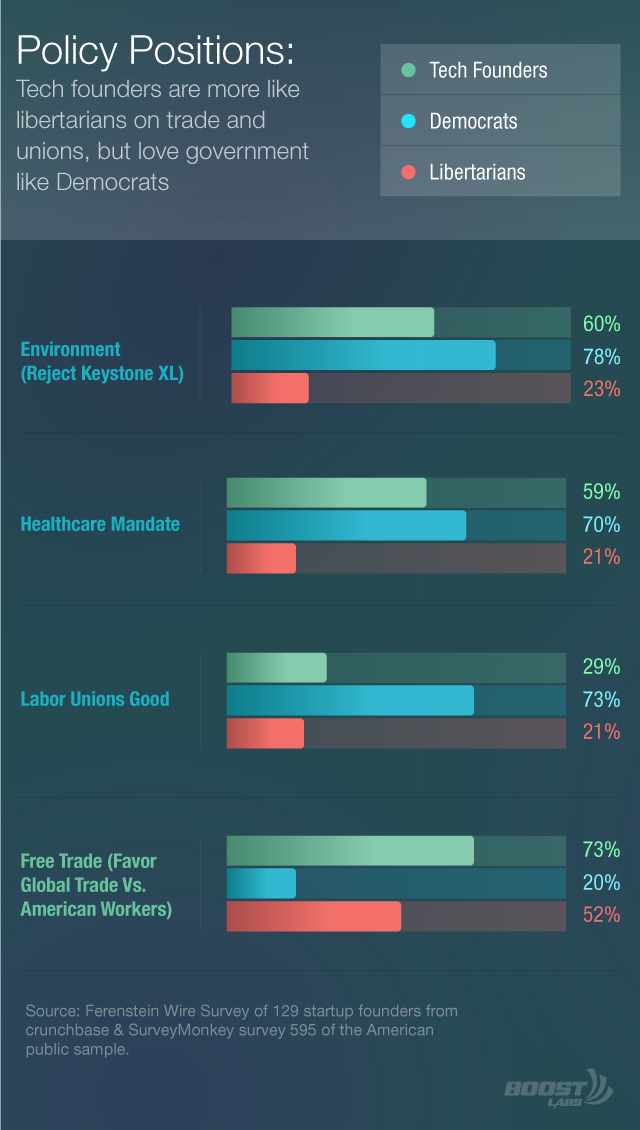
<h2 class="wp-block-heading">Tech founders are like libertarians on some issues, like liberals on others</h2><p><span><span><img src="https://lh3.googleusercontent.com/BVsniJhfbzjzjB_Fe-bzm9fDHmN4jaotOQ34P1hNVKLsS9ThzhVf3TUTTAWhv8gGpe_BWdyoUUV7guq_xna_-q2a4KtIcV-afRlL1TD3NpTQk_YQD4UWHYnro8I0lwJ80NdlnG8" width="624px;" height="1101px;"></span></span></p><h2 class="wp-block-heading">Founders believe that everyone can benefit from, and contribute to, change</h2>
<p>The core philosophy of Silicon Valley is that nearly all change, over the long run, is progressive, and that there&#8217;s no inherent conflict between citizens, corporations, and the government. This helps explain why the tech community eschews traditional political tribalism, such as labor unions, sovereignty, militarism, or small government advocates. All these traditions assume some conflict of interest between major groups.</p>
<img src="https://platform.vox.com/wp-content/uploads/sites/2/chorus/uploads/chorus_asset/file/4238299/nonbinary-tech-conflict-change.0.png?quality=90&#038;strip=all&#038;crop=0,0,100,100" alt="" title="" data-has-syndication-rights="1" data-caption="" data-portal-copyright="" />
<p><em>&#8220;I tend to believe that most Silicon Valley people are very much long-term optimists. &#8230; Could we have a bad 20 years? Absolutely. But if you&rsquo;re working toward progress, your future will be better than your present.&#8221;</em> &mdash;LinkedIn founder Reid Hoffman</p>

<p><em>&#8220;Wanting to connect people is a pretty deep thing to me. It&rsquo;s something that I&rsquo;ve cared about since I was a kid. My mom told me these stories that a lot of boys when they&rsquo;re younger have, like, Ninja Turtles or some toys, and they&rsquo;re fighting. I just wanted them to make them connect and form villages and be peaceful and communicate.&#8221;</em> &mdash;Mark Zuckerberg, recalling stories his mother told him on the unique way he played with action figures as a child</p>

<p>As a result, Silicon Valley believes the government services themselves can be run like competitive, innovative organizations. The state also has a role in encouraging personal decisions that help maximize contributions to society.</p>

<p>That is, a belief in the free market and competition isn&#8217;t wedded to libertarian individualism. Silicon Valley has found a way to be both radically free market and aggressively collectivist.</p>
<img src="https://platform.vox.com/wp-content/uploads/sites/2/chorus/uploads/chorus_asset/file/4238291/nonbinary-intervention-competition2-_Recovered_.0.png?quality=90&#038;strip=all&#038;crop=0,0,100,100" alt="" title="" data-has-syndication-rights="1" data-caption="" data-portal-copyright="" />
<p><em>&#8220;Competition is healthy in all industries, profitable or not.&#8221; </em>&mdash;Internet Founder Survey respondent</p>

<p>Silicon Valley&#8217;s support for government involvement in everyday decisions often shocks politicians who expect a more libertarian approach to the world. Last May, when Sen. Rand Paul held a <a href="http://www.sfgate.com/politics/article/GOP-s-Rand-Paul-ventures-into-S-F-6253636.php">public talk</a> in Silicon Valley, he opened up his speech with a familiar question: &#8220;Who&#8217;s a part of the leave-me-alone coalition?&#8221; No one clapped.</p>
<p><iframe width="560" height="315" src="https://www.youtube.com/embed/NZDN7qw6mHE" frameborder="0"></iframe></p>
<p>On the other hand, Silicon Valley types share libertarians&rsquo; love of competition and the market. Indeed, Silicon Valley types have an unusual faith in citizens&#8217; ability to solve their own problems. They are the only group I&#8217;ve found that believes having an active and informed citizenry is as important for society as reducing government regulation, reducing income inequality, or beefing up national security.</p>
<img src="https://platform.vox.com/wp-content/uploads/sites/2/chorus/uploads/chorus_asset/file/4226869/surv-graph-4-issues.0.png?quality=90&#038;strip=all&#038;crop=0,0,100,100" alt="" title="" data-has-syndication-rights="1" data-caption="" data-portal-copyright="" />
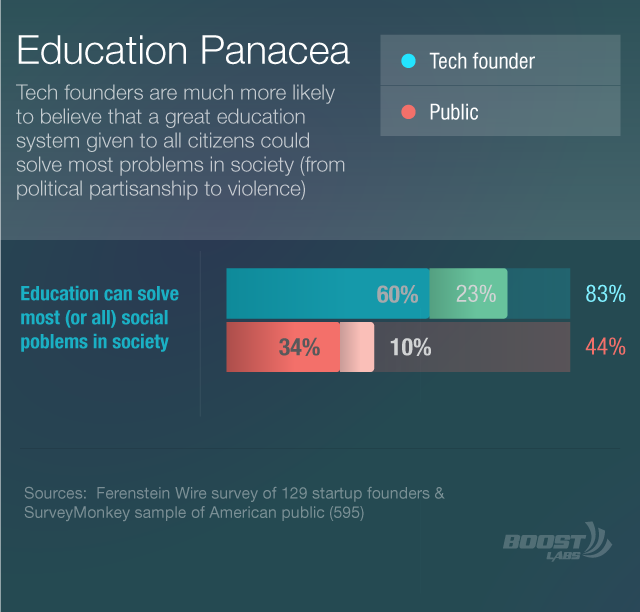
<p>At their absolute core, Silicon Valley types are extreme idealists: They believe there is always a better solution that is great for nearly everyone. Life is just a matter of discovering great ideas through conversation, innovation, and education.</p>
<p><span><span><img src="https://lh6.googleusercontent.com/Q9jnhUisvycCwDsXR9CKMnO3n5_4gs7PZGDbTM613KRNOb3NrThFJpl75rXwXWcix8kEyxRv5qTjbYlkqRVTVeUE56hfIgoA4KpxkJSRF6WdhPL1XlrzkII-oKG8erZGkSfzEYo" width="624px;" height="597px;"></span></span></p>
<p><em>&#8220;It&rsquo;s the hacker ethic that a lot of problems in the world are information inefficiencies&#8221; </em>&mdash;Facebook founding president Sean Parker (personal communication)</p>

<p>The conclusion I&#8217;ve come away with is that Silicon Valley represents an entirely new political category. It is a libertarian-like ideology within the Democratic Party. It loves competition and capitalism but believes the government has an essential role in empowering every person to give their best to society. People and organizations that can contribute more deserve more resources.</p>

<p>Traditional Democrats tend to see the government as a protector from the whims of capitalism, while Silicon Valley liberals see the government as an investor. The government competitively funds citizens to solve problems in a way that an agency never could have imagined. This helps explain the Silicon Valley elites&#8217; obsession with charters: publicly funded, unionless, and highly experimental schools.</p>

<p>This belief is closest to what political scientists call communitarianism, the theory that active communities can solve problems better than either the market or the government alone. For instance, a communitarian might choose a neighborhood watch over more police or a carpool system over public transit.</p>

<p>And, indeed, this is not unlike what the ride-hailing industry has done by adding a carpool component to its smartphone apps, part of a long-held dream of Lyft&#8217;s executives to reduce cars on the road through mass carpooling.</p>

<p>In essence, it is a civil society completely oriented toward innovation. They don&#8217;t see conflicts between citizens, the government, big corporations, and other countries &mdash; just one big mass of people coming up with mutually beneficial solutions as fast as possible.</p>

<p>These utopian ideas are not entirely new. They&#8217;ve been around for a long time. But the economy is empowering these idealists like never before, and the Democratic Party is evidently the political vessel they&#8217;ve chosen to make it a reality. And given the amount of money they have to spend, and the kind of Democratic talent they are now buying &mdash; David Plouffe now works for Uber, and Jay Carney works for Amazon &mdash; traditional Democrats may soon find themselves on the wrong side of the disruption.</p>

<p><em>Read more details about the survey </em><a href="https://medium.com/@ferenstein/d37ed96a9251"><em>here</em></a><em> (including methodological details). Some quotes have been edited for clarity.</em></p>
						]]>
									</content>
			
					</entry>
			<entry>
			
			<author>
				<name>Gregory Ferenstein</name>
			</author>
			
			<title type="html"><![CDATA[Silicon Valley&#8217;s Unique Politics Explained, in Six Charts]]></title>
			<link rel="alternate" type="text/html" href="https://www.vox.com/2015/9/29/11619010/silicon-valleys-unique-politics-explained-in-six-charts" />
			<id>https://www.vox.com/2015/9/29/11619010/silicon-valleys-unique-politics-explained-in-six-charts</id>
			<updated>2019-03-06T05:41:39-05:00</updated>
			<published>2015-09-29T11:10:36-04:00</published>
			<category scheme="https://www.vox.com" term="Technology" />
							<summary type="html"><![CDATA[Of late, the news has been thick with clashes between Democratic politicians and Silicon Valley titans. New York Mayor Bill de Blasio waged a high-profile battle with Uber, only to be soundly defeated by the company. Mark Zuckerberg and Bill Gates have spent millions of dollars funding the controversial public charter school movement and have [&#8230;]]]></summary>
			
							<content type="html">
											<![CDATA[

						
<figure>

<img alt="" data-caption="" data-portal-copyright="Warren Little / Getty Images" data-has-syndication-rights="1" src="https://platform.vox.com/wp-content/uploads/sites/2/chorus/uploads/chorus_asset/file/15799560/20150929-david-plouffe-uber.0.1547413824.jpg?quality=90&#038;strip=all&#038;crop=0,0,100,100" />
	<figcaption>
		</figcaption>
</figure>
<p>Of late, the news has been thick with clashes between Democratic politicians and Silicon Valley titans.</p>

<p>New York Mayor Bill de Blasio waged a high-profile battle with Uber, only to be soundly defeated by the company. Mark Zuckerberg and Bill Gates have spent millions of dollars funding the controversial public charter school movement and have become villains in the eyes of many liberals.</p>

<p>And yet, Silicon Valley loves the Democratic Party: In the 2012 presidential election, 83 percent of top tech firms&rsquo; contributions went to President Obama&rsquo;s election campaign.</p>

<p>But old-guard Democrats may come to regret this love affair. The tech elite love the Democratic Party in the same way they love the health care, transportation and education industries &mdash; as a hodgepodge of aging leaders ripe for disruption.</p>

<p><a href="http://www.vox.com/2015/9/29/9411117/silicon-valley-politics-charts">Read the rest of this post on the original site &raquo;</a></p>

<p><small><em>This article originally appeared on Recode.net.</em></small></p>
						]]>
									</content>
			
					</entry>
			<entry>
			
			<author>
				<name>Gregory Ferenstein</name>
			</author>
			
			<title type="html"><![CDATA[I lost weight by eating lots of bacon and cream. Here&#8217;s a scientific explanation for why.]]></title>
			<link rel="alternate" type="text/html" href="https://www.vox.com/2015/1/6/7481067/high-fat-diet" />
			<id>https://www.vox.com/2015/1/6/7481067/high-fat-diet</id>
			<updated>2018-09-14T15:03:14-04:00</updated>
			<published>2015-01-06T09:00:02-05:00</published>
			<category scheme="https://www.vox.com" term="Climate" /><category scheme="https://www.vox.com" term="Features" /><category scheme="https://www.vox.com" term="Health Care" /><category scheme="https://www.vox.com" term="Policy" /><category scheme="https://www.vox.com" term="Science" />
							<summary type="html"><![CDATA[I recently gained 16 pounds of body fat and I felt terribly uncomfortable in my clothes. I wanted to slim down, so I decided to dramatically ramp up the fat in my diet. Every day for about a month, I slammed as much bacon or heavy whipping cream as I could stomach. I lost weight [&#8230;]]]></summary>
			
							<content type="html">
											<![CDATA[

						
<figure>

<img alt="" data-caption="" data-portal-copyright="" data-has-syndication-rights="1" src="https://platform.vox.com/wp-content/uploads/sites/2/chorus/uploads/chorus_asset/file/13072551/Screen_Shot_2015-01-02_at_10.50.18_AM.0.0.1484290904.png?quality=90&#038;strip=all&#038;crop=0,0,100,100" />
	<figcaption>
		</figcaption>
</figure>
<div class="chorus-snippet center"> <p>I recently gained 16 pounds of body fat and I felt terribly uncomfortable in my clothes. I wanted to slim down, so I decided to dramatically ramp up the fat in my diet. Every day for about a month, I slammed as much bacon or heavy whipping cream as I could stomach. I lost weight (about seven pounds). My cholesterol dropped 10 points. My afternoon drowsiness faded and, overall, I felt pretty good.</p> <p>To be sure, there was a purpose to my bacon vacation. I wanted to test the limits of a growing divide between nutritionists on the benefits of fatty foods. Since the 1960s, conventional diet lore has demonized cream and fat as the culprit in America&#8217;s obesity epidemic. Yet in recent years, a counter-revolution in the top rungs of the medical establishment, including the Harvard School of Public Health, have begged Americans to return to the naturally fatty diets of our ancient ancestors, who did not suffer from modern heart disease.</p> <p>So, as Vox&#8217;s eager health guinea pig, I decided to put it to the test in the most extreme way possible and get results just in time for the New Year&#8217;s diet rush.</p> <h3>Greg, this sounds crazy. Do any doctors actually think this super-fat diet is *not* a terrible idea?</h3> <p>I spoke to a few experts and I got radically different opinions. Some doctors thought I was putting one foot in the grave; others thought I&#8217;d be just fine. Specifically, I asked medical experts what they thought would be the outcome of diet of mainly bacon, cream, and vegetables.</p> <div class="float-right s-sidebar"> <img src="https://platform.vox.com/wp-content/uploads/sites/2/chorus/uploads/chorus_asset/file/2898058/diet_snacks_group.0.0.jpg" alt="diet_snacks_group.0.0.jpg" data-chorus-asset-id="2898058"><h4>More on healthy eating</h4> <p><a href="http://www.vox.com/a/new-years-diet" target="new" rel="noopener">The anti-detox diet: eat better this new year without cleansing, juicing, or cutting gluten</a></p> </div> <p>&#8220;This sounds like a very bad idea,&#8221; Tufts University&#8217;s Dariush Mozaffarian wrote to me. Likewise, Suzanne Steinbaum, a spokesperson for the <a href="http://www.wsj.com/articles/SB10001424052702303678404579533760760481486">generally anti-fat American Heart Association</a>, told me that my cholesterol would surely increase &mdash; a lot. &#8220;LDL should go up,&#8221; she predicted.</p> <p>On the other side, University of California &ndash; San Francisco&#8217;s Rob Lustig, an anti-sugar crusader, didn&#8217;t see a problem. &#8220;The foods you list are saturated or monounsaturated fats. These are fine,&#8221; he shrugged. Lustig told me he&#8217;s only worried about the chemically altered franken-fats, <a href="https://en.wikipedia.org/wiki/Trans_fat">such as trans fat</a>, which have invaded snack and fast foods.</p> <p>When I posed a question on <a href="https://www.healthtap.com/" target="_blank" rel="noopener">HealthTap</a>, a large online community of medical doctors, the immediate <a href="https://www.healthtap.com/user_questions/1581057?referrer=ht_email_member_question_asked_answered">response</a> from Scott Carollo, a cardiologist, was, &#8220;If you maintain this diet and seriously curb carbohydrates, you will likely see a notable weight loss.&#8221;</p> <p>The upshot is that gorging on a diet of bacon, cream, and vegetables is not universally condemned.</p> <h3>Ok, so what did you eat?</h3> <p>I tried to eat a diet where more than 70 percent of my calories came from fat. I regularly indulged in a wide variety of pure fats. I spoon-fed coconut oil, diced up fresh avocado, and poured on olive oil.</p> <p>Even the foods I regularly ate got a fat supercharge: I coated steak in thick coat of grass-fed butter, salads were drowned in olive oil, and my morning green tea got a big dollop of coconut oil.</p> <p><img data-chorus-asset-id="2897950" alt="Screen_Shot_2015-01-02_at_1.53.39_PM.0.png" src="https://platform.vox.com/wp-content/uploads/sites/2/chorus/uploads/chorus_asset/file/2897950/Screen_Shot_2015-01-02_at_1.53.39_PM.0.png"></p> <p class="caption">Yup, that&#8217;s steak with butter on it. (Gregory Ferenstein)</p> <p> </p> <p>Because I live in San Francisco, of course there&#8217;s a startup at arm&#8217;s length that&#8217;s trying to solve my particular yuppie problem. A five-minute walk from my apartment in the Mission, I found an engineer, <a target="_blank" href="http://www.sfyogurtco.com/about/" rel="noopener">Evan Sims</a>, who had quit his job for a high-fat yogurt startup. (Of course, I met him at a paleo food-themed brunch.) His cream-infused Greek yogurt has more than twice the calories of regular &#8220;full fat&#8221; yogurt &mdash; and I consumed a tub of it weekly.</p> <p>But the real key to my diet was pork fat. A bespoke charcuterie, <a target="_blank" href="http://www.boccalone.com/" rel="noopener">Boccalone</a>, in San Francisco&#8217;s historic Ferry Building imports Italian pigs. Boccalone slices the fattiest cuts of pork I&#8217;ve ever seen. I tried to consume at least a third of a pound of their delicious bacon per week.</p> <p>I almost completely cut out carbs: very little fruit and no grains.</p> <p>During the last week of my experiment, I kept losing weight, so I upped my fat count even higher. Every morning, I&#8217;d consume a fistful of fatty bacon and wash it down with at least a cup of cream. My salads got smaller during this period to make room for all the pork goodness.</p> <h3>Were you consuming more calories?</h3> <p>No. Carbs awaken my appetite, and fat beds it back down to rest.</p> <div class="float-right"> <img src="https://platform.vox.com/wp-content/uploads/sites/2/chorus/uploads/chorus_asset/file/2897988/Screen_Shot_2015-01-02_at_2.04.40_PM.0.png" alt="Screen_Shot_2015-01-02_at_2.04.40_PM.0.png" data-chorus-asset-id="2897988"><p class="caption">Breakfast ice cream (Gregory Ferenstein)</p> </div> <p>I purposely allowed myself to eat as much as I wanted two weeks prior and during the super-fat experiment. When I switched to fat, I ended up eating fewer calories. Fat is more satiating, per calorie, than carbs, and it curbed my otherwise ravenous appetite. I didn&#8217;t even count calories; I just went with my hunger pangs.</p> <p>I ended up learning a very important lesson: that carbs trick my body into consuming far more food than necessary.</p> <p>The one time I gained weight over the course of my experiment is when I tested out a breakfast ice cream recipe, made with cream and the naturally no-calorie <a href="https://en.wikipedia.org/wiki/Stevia">stevia leaf</a>. My concoction was delicious: just these two ingredients form a kind of tart <a href="https://en.wikipedia.org/wiki/Green_tea_ice_cream">matcha</a><a href="https://en.wikipedia.org/wiki/Green_tea_ice_cream">-flavored</a> ice-cream. However, compared to just drinking it from a carton, I consumed twice as much cream when it was frozen and sweetened with stevia.</p> <p>This appears to be why diet soda is <a href="http://www.theatlantic.com/health/archive/2014/08/artificial-sweeteners-probably-okay/378937/">associated with weight gain</a>. Sweeteners trigger hunger hormones, and all those diet soda fanatics end up consuming more calories.</p> <h3>What were the results?</h3> <p><strong>I dropped about seven pounds</strong> and 1 percent of body fat over the month. Prior to the fat diet, I had gained 16 pounds eating whatever I wanted (which included lots of carbs). As soon as I cut carbs and loaded up on fat, the my widening waistline halted.</p> <p><strong>My cholesterol also dropped 10 points</strong>. I actually expected this result. For the last year, fat has always decreased my cholesterol. In a previous experiment, I tested <a href="http://www.vox.com/2014/12/22/7403247/wolverine-diet-hugh-jackman">a cult bodybuilding diet</a> that involved several hours of dessert binging every night. The sugar caused a dangerous 31 percent spike in total cholesterol. Immediately afterwards I put myself on a steady diet of no-nitrate bacon to help repair my arteries. Over the course a few months, thanks to a high-fat, low-carb protocol, my cholesterol returned to safe levels.</p> <h4>My cholesterol on various diets</h4> <p><img src="https://platform.vox.com/wp-content/uploads/sites/2/chorus/uploads/chorus_asset/file/2898006/Screen_Shot_2015-01-02_at_2.14.10_PM.0.png" alt="Screen_Shot_2015-01-02_at_2.14.10_PM.0.png" data-chorus-asset-id="2898006"></p> <p class="caption">(<a href="http://www.wellnessfx.com/" target="new" rel="noopener">WellnessFX</a>) </p> <p>The same happened on last month&#8217;s super-fat experiment. As soon as I slammed fat and ditched carbs, my cholesterol went down. It is also notable that my so-called &#8220;bad cholesterol,&#8221; or LDL, maintained low levels. It normally fluctuates between 99 and 85. A sugary diet spiked it to 129. After the super-fat diet, it was 97.</p> <h3>Wait, so why does everyone think fat is bad for people?</h3> <p>The roller coaster of recommendations started with a 1961 <a target="_blank" href="http://content.time.com/time/covers/0,16641,19610113,00.html" rel="noopener">Time magazine cover story</a> about Dr. Ancel Keys. Keys had made a name for himself as a World War II nutritionist and achieved medical superstardom for a study of cardiovascular disease around the world. Keys found an <em>association</em> between low-fat diet cultures and low rates of cardiovascular disease, and he concluded that fat was killing the rest of the population.</p> <p>&#8220;The high frequency of coronary heart disease among American men, especially in middle age, is not found among many other populations, notably among Japanese in Japan and Bantu in South Africa,&#8221; Keys <a href="http://www.ncbi.nlm.nih.gov/pmc/articles/PMC1551415/?page=10">wrote</a> in a 1953 <em>American Journal of Public Health</em> article that would echo in hospitals around the country a decade later. &#8220;Evidence implicates the diet, and especially the fats in the diet, in these differences.&#8221;</p> <p>As tends to happen, a few interesting medical findings got overblown by a media frenzy, which eventually led to a mass public over-correction and a stampede away from fat and into straight into carbs.</p> <p>&#8220;It was one big, happy, fat-free feeding frenzy &mdash; and a public health disaster,&#8221; Barbara Moran <a href="http://www.hsph.harvard.edu/magazine-features/is-butter-really-back/">wrote</a> for the Harvard School of Public Health magazine.</p> <div class="float-right s-sidebar"> <img data-chorus-asset-id="2450702" alt="FitnessAtTheOffice-05.0.png" src="https://platform.vox.com/wp-content/uploads/sites/2/chorus/uploads/chorus_asset/file/2450702/FitnessAtTheOffice-05.0.png"><h4>How is this article different from all other articles?</h4> <p>This is part of a Vox series on better living through technology and science. I, your humble guinea pig, will subject myself to all sorts of experiments to discover what practical tips readers can apply to their lives immediately.</p> <p>What makes this series different from traditional health writing is its emphasis on the techniques of &#8220;quantified self&#8221;: the science of self-improvement. No single study can tell you, exactly, how a diet or exercise regimen will impact your particular body. When it comes to health, we&#8217;re all individual snowflakes.</p> </div> <p>The stampede from steak, butter, and cream steered the masses into the hands of Big Carbohydrate, especially bread manufacturers. Instead of decreasing, heart disease and obesity ballooned.</p> <p>&#8220;One problem with a generic lower fat diet is that it prompts most people to stop eating fats that are good for the heart along with those that are bad for it,&#8221; a Harvard School of Public Health fact sheet on fats and cholesterol <a href="http://www.hsph.harvard.edu/nutritionsource/fats-full-story/">said</a>.</p> <p>After decades of criticism, the medical community settled on a compromise that <em>some fats</em><span> (monounsaturated), such as olive oil and avocado, do a body good.</span></p> <p>The latest debate now focuses on whether any of the natural fats are harmful, as opposed to<a href="http://www.mayoclinic.org/diseases-conditions/high-blood-cholesterol/in-depth/trans-fat/art-20046114"> trans fats which are often chemically altered vegetable oils</a> common in snack foods . A New York Times op-ed called &#8220;<a href="http://www.nytimes.com/2014/03/26/opinion/bittman-butter-is-back.html">Butter is back</a>&#8221; brought national attention to a new meta-analysis that could not find any credible link between saturated fat consumption and cardiovascular disease.</p> <p>A 2014 article in the peer-reviewed British Medical Journal went a bit farther, in an article titled &#8220;<a href="http://www.bmj.com/content/349/bmj.g7654">Are some diets &#8216;mass murder</a>,&#8221; criticizing the anti-fat craze for lack of scientific evidence.</p> <p>&#8220;The successful attempt to reduce fat in the diet of Americans and others around the world has been a global, uncontrolled experiment, which like all experiments may well have led to bad outcomes,&#8221; author Richard Smith argued. &#8220;It&#8217;s surely time for better science and for humility among experts.&#8221;</p> <p>There are just too many factors that go into heart disease on a global scale; pin-pointing a few dietary components is suspect. We don&#8217;t have good data. And hence we&#8217;re now in scientific limbo where no one can give us a good idea if you should banish bacon or bathe in it.</p> <h3>What&#8217;s the scientific explanation for what happened to you?</h3> <p>The traditional explanation for why fat was killing people was that it increased the proteins responsible for arterial plaque buildup, which can eventually weaken the heart. All foods have some fat in them, but for the same reason oil and water don&#8217;t mix, the body can&#8217;t readily absorb fat into the bloodstream.</p> <p>In response to fat, the liver produces various sizes of particles, lipoproteins, to utilize fat&#8217;s nutrient goodness. Low-density lipoproteins (LDL) are dubbed bad cholesterol because these little critters bind more easily to arterial walls.</p> <p>Lustig argues that the medical literature misunderstood the link between saturated fat, sugar, and cardiovascular disease. His wonky explanation:</p> <p>&#8220;If you are eating a lot of dietary fat, then the liver will package it as LDL, but the large buoyant (Type A) kind; the kind that does not promote [cardiovascular] disease,&#8221; he wrote an in email. &#8220;But if you&#8217;re eating a lot of sugar, then your liver is turning that into liver fat, which is packaged as VLDL, which raises your [triglyceride] level. Also, dietary sugar will make your liver insulin-resistant; then your liver makes small dense (Type B) LDL instead, which does promote cardiovascular disease.&#8221;</p> <p>This is one explanation for why saturated fat lowered my cholesterol, but sugar increased it.</p> <h3>But why does research show that fat increases heart disease in some populations?</h3> <p>Two reasons:</p> <div class="float-right s-sidebar"> <img src="https://platform.vox.com/wp-content/uploads/sites/2/chorus/uploads/chorus_asset/file/2898128/168745524.0.jpg" alt="168745524.0.jpg" data-chorus-asset-id="2898128"><h4>More in this series</h4> <p><a href="http://www.vox.com/2014/11/12/7186667/office-fitness-exercises-stretches" target="new" rel="noopener">The cubicle gym: How I used science to make my work day freakishly healthy</a></p> <p><a href="http://www.vox.com/2014/12/22/7403247/wolverine-diet-hugh-jackman" target="new" rel="noopener">The Wolverine Diet: I gorged on bacon without gaining weight (but maybe hurt my kidneys)</a></p> </div> <p>The original fat studies were <a href="http://www.vox.com/cards/savvy-science-reader/scientific-evidence-intro-card" target="_blank" rel="noopener">observational, not experimental</a>. When looking at a mass of people, its nearly impossible to distinguish all the different types of eating habits. If people who eat fatty foods also eat more transfats and exercise less, we&#8217;d see a correlation between high fat and heart disease. This is why more granular follow-up studies failed to find the same association, once researches started looking at the link in greater detail.</p> <p>Second, genetics. &#8220;One of the problems with dietary recommendations is that it does not take into consideration the individual,&#8221; <span>said the American Heart Association&#8217;s Suzanne Steinberg. &#8220;</span><span>Everyone metabolizes food differently. For those people who have a family history of heart disease at a young age, very often they can&#8217;t metabolize fats.&#8221; </span></p> <p>Steinberg suspected that I didn&#8217;t have <span>a genetic abnormality that causes people to metabolize fat poorly</span><span>. But I checked my 23andMe and, indeed, I do have the allele that she said causes the abnormality. It&#8217;s still possible that my unique genetic code is a factor in why I can bathe in fat, but, for the moment, I have no clue where to look. </span></p> <h3>Are there benefits to eating fat?</h3> <p>Fat is an essential ingredient for absorbing nutrients. <a href="http://www.ncbi.nlm.nih.gov/pubmed/15277161">An experimental study</a> from Iowa State University found that blood samples of students who ate fat-free salads were devoid of many of the healthy vitamins they were consuming.</p> <p>&#8220;A substantially greater absorption of carotenoids was observed when salads were consumed with full-fat than with reduced-fat salad dressing,&#8221; the study concluded.</p> <p>And fat just isn&#8217;t an empty vitamin taxi. <a href="http://www.marksdailyapple.com/high-fat-diet-healthy-safe/#axzz3MwbCFC9S">Its&#8217;s often loaded</a> with vitamins E, K2, and D, plus a whole host of other nutrients.</p> <h3>But don&#8217;t you feel awful eating all that fat?</h3> <p>Actually, I felt great, especially after polishing off a few rows of bacon. Fat is a slow-burning energy source, which I find gets me through the afternoon sleepiness. One military study found that high-fat meals improved pilot simulator performance more than <a href="http://www.huffingtonpost.com/2009/10/06/study-pilots-on-fattiest-_n_311761.html">either a high-carb or high-protein meal</a>.</p> <p>To test the effects of a super high-fat meal, I ate a home brewed zero-sugar ice cream and measured my mental performance on a series of reaction time tests on the cognitive testing websites <a href="http://www.quantified-mind.com/" target="_blank" rel="noopener">quantified-mind.com</a> and <a href="http://humanbenchmark.com/" target="_blank" rel="noopener">humanbenchmark.com</a>.</p> <p>In previous experiments, I found that <a href="http://www.thedailybeast.com/articles/2014/04/23/how-to-use-your-lunch-hour-for-better-productivity-without-ever-taking-a-bite.html">lunch</a> gives me the yawns and my reaction time drops 13 percent. However, on the super-fat diet, ice cream boosted performance about 28 percent. These tests lend some nice quantitative evidence that eating fat did make me feel a-OK.</p> <h3>So, when you&#8217;re on a normal diet, how do you incorporate fat?</h3> <p>I add fat to my diet in in two strategic ways</p> <p>1) If I want to slim down, I enter ketosis, eating fewer than 50 grams of carbohydrates per day. I find that this helps me drop fat for about two weeks. Afterwards, ketosis stops working.</p> <p>2) On my normal diet, I never avoid fat. I eat marbled slices of steak, pour olive oil on salads, and never eat anything that says &#8220;low fat.&#8221; I try to eat food as close to its natural state as possible, and that often means a lot of delicious, juicy fat.</p> <p>When I want to lose weight, I pack on the bacon. Even if I just want to remain healthy, I make sure to love me some butter.</p> </div>
						]]>
									</content>
			
					</entry>
			<entry>
			
			<author>
				<name>Gregory Ferenstein</name>
			</author>
			
			<title type="html"><![CDATA[The Wolverine Diet]]></title>
			<link rel="alternate" type="text/html" href="https://www.vox.com/2014/12/22/7403247/wolverine-diet-hugh-jackman" />
			<id>https://www.vox.com/2014/12/22/7403247/wolverine-diet-hugh-jackman</id>
			<updated>2018-09-14T14:58:07-04:00</updated>
			<published>2014-12-22T11:30:01-05:00</published>
			<category scheme="https://www.vox.com" term="Comic Books" /><category scheme="https://www.vox.com" term="Culture" /><category scheme="https://www.vox.com" term="Health Care" /><category scheme="https://www.vox.com" term="Policy" />
							<summary type="html"><![CDATA[For an entire week I splurged on cookies, ice cream, and bacon. My weight, of course, normally balloons on such a diet. But I did not put on a pound during this delicious week. These two simple strategies made all the difference: when I ate and the workouts I did prior to binging. To be [&#8230;]]]></summary>
			
							<content type="html">
											<![CDATA[

						
<figure>

<img alt="" data-caption="" data-portal-copyright="" data-has-syndication-rights="1" src="https://platform.vox.com/wp-content/uploads/sites/2/chorus/uploads/chorus_asset/file/13072355/168745524.0.0.1488777036.jpg?quality=90&#038;strip=all&#038;crop=0,0,100,100" />
	<figcaption>
		</figcaption>
</figure>
<div class="chorus-snippet center"> <p class="s-ecnt-intro">For an entire week I splurged on cookies, ice cream, and bacon. My weight, of course, normally balloons on such a diet. But I did not put on a pound during this delicious week. These two simple strategies made all the difference: when I ate and the workouts I did prior to binging.</p> <p>To be sure, there was a purpose to this seemingly hedonistic act of self-destruction. I wasn&#8217;t just stressing the limits of my Obamacare insurance; I was testing out a <a href="http://www.bodybuilding.com/fun/mutant-strength-hugh-jackmans-wolverine-workout-plan.html">cult bodybuilding theory</a> that exercise and timing matter more in cultivating a swimsuit body than the total amount of food consumed. In other words, all calories are not equal.</p> <p>The holiday season provided a perfect opportunity to test such a theory, as thousands of partygoers indulge in piles of sweets, lamenting the unsightly bulge that will inevitably result from their lapse in willpower. Thanks to this experiment, if I know I won&#8217;t be able to control my hair-trigger impulse to chow down on gingerbread cookies at a party, I can change up my workout routine to buffer the damage.</p> <h3>Greg, that&#8217;s crazy. No one in their right mind would ever do that.</h3> <p>This was not my idea. I was inspired by the world&#8217;s great action stars.</p> <p>&#8220;I used to go to The House of Pies and eat pies at night,&#8221; <a href="http://www.schwarzenegger.com/fitness/post/carb-back-loading-whats-old-is-new">recalls</a> seven-time Mr. Universe winner and former California governor, Arnold Schwarzenegger. Though he and his workout partner didn&#8217;t understand the science at time, back in the 1970s, &#8220;Instinctively, we just felt like we needed the pie.&#8221;</p> <p>Bare chest-enthusiast and professional comic book hero Hugh Jackman <a href="http://www.bodybuilding.com/fun/mutant-strength-hugh-jackmans-wolverine-workout-plan.html">is also a fan of calorie</a>&#8211; and carb-heavy diets after a prolonged period of fasting. He told Oprah that to get in shape for Wolverine, he ate an <a href="https://www.youtube.com/watch?v=SuFQy68QIRM">astounding</a> 6,000 calories per day. In another interview, he spoke at length about his 8:16 fasting regimen (8 hours of eating after 16 hours of fasting):</p> <p><iframe width="560" height="315" src="//www.youtube.com/embed/yDwwuXBDMOA" frameborder="0"></iframe></p> <p>This is, in fact, the <a href="http://techcrunch.com/2012/12/30/extreme-diet-hacking-how-cheesecake-made-me-leaner-and-stronger-with-carb-backloading/">second time in two years</a> I&#8217;ve successfully replicated a carb-heavy body-building routine. The first time could have been a fluke, so I decided to test a slightly different version during the holiday season. Even though I expected the positive result this time around, it&#8217;s still kind of amazing to look in the mirror every day after stuffing fist-fulls of ice-cream sandwiches in your mouth and see no difference.</p> <h3>So, what&#8217;s the protocol?</h3> <p>The so-called &#8220;Wolverine Diet&#8221;, named after Hugh Jackman&#8217;s on-screen <a href="http://www.vox.com/2014/5/22/5738434/what-you-need-to-know-about-x-men-days-of-future-past">X-Men</a> character, is just a general prescription for fasted resistance training. Because I wanted some structure to the routine, I adapted the protocol of &#8220;<a href="http://www.leangains.com/2010/04/leangains-guide.html">Lean Gains</a>,&#8221; which developed a moderately size fan base for its thorough instructions.</p> <p>There are four big elements of the strategy:</p> <p>1) Intermittent fasting: 18 hours of fasting and 6 hours eating at night.</p> <p>2) Olympic lifting every other day, followed by a low-fat, carb- and protein-heavy binge</p> <p>3) On rest days, I eat a high-fat, low-carb diet</p> <p>4) My training is heavy resistance training of low-rep work to failure (meaning I can&#8217;t physically do the last rep). I chose mainly Crossfit-style resistance workouts, with Olympic barbells and weighted calisthenics.</p> <div class="chorus-snippet m-fishtank no-responsive-video"><div data-ad-slot="athena_features"></div></div> <!-- ######## END SNIPPET ######## --><h3>What were the results?</h3> <p>For seven days, I fluctuated around 144 pounds and 17 percent body fat. Every night I&#8217;d gain about two pounds from stuffing my face, then burn it off by the next day&#8217;s weigh-in.</p> <p>During the Wolverine Diet, there was one day where I gained a bit of weight and fat. While I can&#8217;t say for certain what made me gain fat, I <a href="https://twitter.com/ferenstein/status/525051016925155328">suspect</a> it was because I made the mistake of drinking a juice during my binge.</p> <h4>My weight every day I was on the Wolverine Diet</h4> <img src="https://platform.vox.com/wp-content/uploads/sites/2/chorus/uploads/chorus_asset/file/2870352/Screen_Shot_2014-12-22_at_9.32.02_AM.0.png" alt="Screen_Shot_2014-12-22_at_9.32.02_AM.0.png" data-chorus-asset-id="2870352"><p>OJ and other juices <a href="http://www.theatlantic.com/health/archive/2014/02/misunderstanding-orange-juice-as-a-health-drink/283579/">are </a><a href="http://www.theatlantic.com/health/archive/2014/02/misunderstanding-orange-juice-as-a-health-drink/283579/">deceitful </a>mountains of sugar masquerading as health drinks. They cause a blood sugar spike unlike any other carb I eat. If I had to choose, I&#8217;d go with a milkshake over juices any day (on or off the Wolverine Diet).</p> <h3>You must have been blessed with the genetics of a Greek god. This isn&#8217;t normal.</h3> <p>Let&#8217;s be clear: I have the metabolism of a catatonic gerbil. Normally, I get fat just looking at ice cream. In preparation for another diet I experimented this December, I allowed myself to eat the same foods, but without a complicated fitness protocol. My weight ballooned 14 pounds in two weeks.</p> <h4>My weight every day I tried the Wolverine Diet without the fitness protocol</h4> <img src="https://platform.vox.com/wp-content/uploads/sites/2/chorus/uploads/chorus_asset/file/2870346/Screen_Shot_2014-12-22_at_9.28.28_AM.0.png" alt="Screen_Shot_2014-12-22_at_9.28.28_AM.0.png" data-chorus-asset-id="2870346"><h3>Ok, give me more specifics about the diet and exercise routine</h3> <p>My days were split between workout days and rest days.</p> <p><strong><em>On workout days</em></strong>, I&#8217;d chowed down like a college stoner in Willy Wonka&#8217;s Chocolate Factory.</p> <p>After a full day of fasting, I&#8217;d head off to the gym around 6 pm. Right before, I&#8217;d dose 5 mg of branch-chain amino-acids (BCAAs), which are believed to spike hormones responsible for translating carbs into muscle. I&#8217;d do six bouts of high-intensity intervals in three sets. For two minutes, I&#8217;d go all-out in a sprint, jump rope, or rowing machine &mdash; 30 seconds of regular intensity and 30 seconds of 100 percent.</p> <div class="float-left s-sidebar"> <h4>How is this article different from all other articles?</h4> <p>This is second in a regular Vox series on better living through technology and science. I, your humble guinea pig, subject myself to all sorts of experiments to discover what practical tips readers can apply to their lives immediately.</p> <p>What makes this series different from traditional health writing is its emphasis on the techniques of &#8220;quantified self&#8221;: the science of self-improvement. No single study can tell you, exactly, how a diet or exercise regimen will impact your particular body. When it comes to health, we&#8217;re all individual snowflakes.</p> </div> <p>Between sets, I would do three of the following: weighted pull ups, Olympic barbell squats, weighted ring dips, Olympic barbell deadlifts, and weighted lunge. Every time, I&#8217;d end with a weighted ab exercise (my favorite is hanging <a href="http://gymnasticswod.com/content/kipping-toes-bar-progression-pt1">feet-to-bar</a>, but I&#8217;ve also done weighted crunches). All told, I&#8217;d spend about an hour at the gym.</p> <p>After the workout, I&#8217;d hold a fat kid circus. I tried to keep my carb days free of fat. So, if I indulged in ice cream, I&#8217;d pair it with some (relatively) less fattening cookies. Normally, fat is great at <a href="http://www.hsph.harvard.edu/nutritionsource/carbohydrates/carbohydrates-and-blood-sugar/">dampening the damaging spike in blood sugar</a> from carbs. But, in this case, I wanted a spike. Later on in the night, I&#8217;d make sure to get plenty of local seasonal veggies and lean meats.</p> <p>I&#8217;d go nuts for about six hours, taking multiple trips to dessert places near my apartment, and pass out sometime at night after the binge.</p> <p><strong><em>Binge days were followed by a rest day</em></strong>. I still fasted during the day, but didn&#8217;t work out. When I broke the fast on rest days, I&#8217;d go super-high fat: pig fat, cheese, or really fatty cuts of beef. Meatballs are positively divine. I even tried with some low-carb &#8220;raw&#8221; chocolate, made from coconut butter and stevia. I would dream peacefully of the coming binge fest to come the next day.</p> <h3>I don&#8217;t have time to go the gym. Can I work out at home?</h3> <p>I&#8217;d like to say yes, but I wasn&#8217;t successful with at-home workouts. I tried continuing the diet for a few days while traveling. I did short 15-minute Crossfit workouts in my hotel room. It did not work. I gained (a lot) of weight.</p> <p>It might work, though, if you have access to heavy lifting equipment at home. <a href="http://athlete.io/">John Kiefer,</a> a fitness trainer who popularized the recent carb-backloading craze, seems to think that circuit-training style workouts don&#8217;t provide the kind of hormonal changes necessary to change how the body converts carbs to fuel. It&#8217;s gotta be low-rep resistance training and that means heavy weights.</p> <p>Potentially, high-intensity interval training alone (like sprints) might work, but I didn&#8217;t try it.</p> <h3>Are there downsides?</h3> <p>Holy cannoli, yes! Previously, when I did a Wolverine-style diet, my cholesterol jumped 31 percent. This is one major reason why I haven&#8217;t experimented with the diet in two years. It took a while to get my cholesterol back to normal levels. This time around, I binged half as much for one third the time. So, when I checked my cholesterol a few weeks later, it was not unusually high. But, I still wouldn&#8217;t do this on a regular basis, as the sugar is probably bad for cholesterol and <a href="http://www.huffingtonpost.com/leslie-spry-md-facp/national-kidney-month_b_2949750.html">damaging to my kidneys</a>.</p> <p>Jackman says he does a much cleaner version of the diet. In the future, I may try a Wolverine Diet with sweet potatoes and raw honey instead of cake and ice cream.</p> <h3>What&#8217;s the science behind this?</h3> <p>The body transfers energy from food, via insulin, into both <a href="http://www.ncbi.nlm.nih.gov/pubmed/20484484">muscle</a> and <a href="https://www.youtube.com/watch?v=CUvwyugEfNk">fat</a>. After a workout, especially a fasted workout with heavy weights, nutrients are more likely to be used for muscle.</p> <p>&#8220;This is a pretty straightforward process. If you fast, or restrict calories, then also do bodybuilding training (typically glycogen depleting to a degree), you will then be in a glycogen-depleted state,&#8221; said fitness researcher Eric Helms, who recently <a href="http://www.jissn.com/content/11/1/20">conducted an exhaustive review</a> of bodybuilding studies. &#8220;Thus, when you eat, you will have a larger capacity to store energy as glycogen, and you will be less likely to store calories as fat. Of course, this also depends on the composition of what you eat.&#8221;</p> <p>The denser the carbs, like sugar without fat, the better for muscle growth. &#8220;The quality of the carbs still is fairly important. I would suggest some fast-acting carbs and also some lower-glycemic index carbs also with protein included too,&#8221; wrote Kingsbury.</p> <img src="https://platform.vox.com/wp-content/uploads/sites/2/chorus/uploads/chorus_asset/file/2870406/143282156.0.jpg" alt="143282156.0.jpg" data-chorus-asset-id="2870406"><p class="caption">Arnold Schwarzenegger, unknowing proponent of the high-fat, intense-exercise dieting strategy (Michael Ochs Archives/Getty Images)</p> <p>The scientific literature is less than conclusive. Brad Schoenfeld, assistant professor in exercise science at the City University of New York and <a href="http://www.jissn.com/content/10/1/5">a researcher on postexercise nutrient intake</a> said, &#8220;No evidence I&#8217;ve seen shows alterations in body fat percentage from nutrient timing in any capacity &mdash; it is a function of energy balance.&#8221;</p> <p>Unfortunately, the studies haven&#8217;t exactly looked at the Wolverine Diet. The typical study looks at a small protein shake after a workout, not the kind of super-intense fasted resistance training coupled with a large high-sugar energy spike.</p> <p>I was most definitely eating more calories than I normally do &mdash; about 1,500 calories a day more. Jackman eats 6,000. It would be difficult for any professor to gain approval to run a normal population of participants through the daily routine of Jackman or Schwarzenegger.</p> <p><a href="http://www.marksdailyapple.com/monday-musings-thoughts-on-fasted-training/#axzz3L4I09fVZ">Advocates of these diets</a> point to <a href="http://www.marksdailyapple.com/monday-musings-thoughts-on-fasted-training/#axzz3L4I09fVZ">preliminary academic research</a> showing that fasted resistance training does have a measurable and predicted impact on muscle building and that fasted training<a href="http://www.sciencedaily.com/releases/2013/01/130124091425.htm"> burns up to 20 percent more body fat</a>.</p> <h3>Is there a moral to this story or are you just crazy?</h3> <p>Unless you&#8217;re training for an action movie, the Wolverine Diet probably isn&#8217;t advisable. But it is instructive to think about what it means for dieting.</p> <p>If the conventional wisdom about calories were true, I should have had to buy a wider pair of jeans after this experiment. But, calories are simply a form of energy and the body converts energy differently depending on how its being stressed.</p> <p>I used to eat to &#8220;lose weight.&#8221; Now, I eat to accomplish my goals, whether it&#8217;s to sleep more deeply, lift heavier weights, focus better at work, or run faster. Seeing food as functional has brought sanity to the once antagonistic relationship I had with eating.</p> </div>
						]]>
									</content>
			
					</entry>
			<entry>
			
			<author>
				<name>Gregory Ferenstein</name>
			</author>
			
			<title type="html"><![CDATA[The cubicle gym]]></title>
			<link rel="alternate" type="text/html" href="https://www.vox.com/2014/11/12/7186667/office-fitness-exercises-stretches" />
			<id>https://www.vox.com/2014/11/12/7186667/office-fitness-exercises-stretches</id>
			<updated>2018-09-14T14:53:55-04:00</updated>
			<published>2014-11-12T10:25:02-05:00</published>
			<category scheme="https://www.vox.com" term="Culture" /><category scheme="https://www.vox.com" term="Fitness" /><category scheme="https://www.vox.com" term="Life" /><category scheme="https://www.vox.com" term="TV" />
							<summary type="html"><![CDATA[I was 20 pounds overweight. I was tired all the time. I had stinging back pain. Even though I worked out three days a week, a few hours of spotty exercise couldn&#8217;t undo the other 10 hours a day I spent hunched over at a laptop. My body was at the breaking point, and so [&#8230;]]]></summary>
			
							<content type="html">
											<![CDATA[

						
<figure>

<img alt="" data-caption="" data-portal-copyright="" data-has-syndication-rights="1" src="https://platform.vox.com/wp-content/uploads/sites/2/chorus/uploads/chorus_asset/file/13071925/FitnessAtTheOffice-02.0.0.1491123041.png?quality=90&#038;strip=all&#038;crop=0,0,100,100" />
	<figcaption>
		</figcaption>
</figure>
<div class="chorus-snippet center"> <p class="s-ecnt-intro">I was 20 pounds overweight. I was tired all the time. I had stinging back pain. Even though I worked out three days a week, a few hours of spotty exercise couldn&#8217;t undo the other 10 hours a day I spent hunched over at a laptop.</p> <p>My body was at the breaking point, and so like many of my desk-chained brethren, I dabbled with popular alternatives. They all failed: <a href="http://www.vox.com/2014/5/20/5731692/the-surprising-history-of-the-cubicle-and-the-rest-of-the-modern" target="_blank" rel="noopener">standing desks</a> smoked my lower back, <a href="http://www.vox.com/2014/9/3/6098671/how-to-lose-weight-diet-studies-low-carb-low-fat" target="_blank" rel="noopener">dieting</a> was a recipe for <a href="http://www.vox.com/2014/9/12/6139867/how-many-people-who-start-weight-watchers-maintain-their-goal-weight-obesity" target="_blank" rel="noopener">yo-yo weight loss</a>, and occasional walking breaks ended up as an ironic trip to the office snack room.</p> <p>I&#8217;ve come to realize most conventional solutions to office-induced poor health are entirely too pessimistic. They all assume that the best we can do is mildly reduce the <a href="http://www.vox.com/2014/7/2/5862026/sitting-vs-standing-health-risks-dangers" target="_blank" rel="noopener">inevitable self-destruction</a> of our jobs.</p> <p>I was convinced this pessimism was misguided; desk jobs don&#8217;t have to make us fatter, sicker, and duller. It&#8217;s possible to transform nearly any office into a place that leaves us fitter and more energized than when we stumble in with a morning Starbucks. Here&#8217;s what I did &mdash; and what you can do:</p> <div class="float-left s-sidebar"> <img src="https://platform.vox.com/wp-content/uploads/sites/2/chorus/uploads/chorus_asset/file/2450702/FitnessAtTheOffice-05.0.png" alt="FitnessAtTheOffice-05.0.png" data-chorus-asset-id="2450702"><h4>How is this article different from all other articles?</h4> <p>This is first in a regular Vox series on better living through technology and science. I, your humble guinea pig, will subject myself to all sorts of experiments to discover what practical tips readers can apply to their lives immediately.</p> <p>What makes this series different from traditional health writing is its emphasis on the techniques of &#8220;quantified self&#8221;: the science of self-improvement. No single study can tell you, exactly, how a diet or exercise regimen will impact your particular body. When it comes to health, we&#8217;re all individual snowflakes.</p> <p>For instance, within a study that finds that low-carb diets help participants lose weight, some may have lost none at all. Quantified self helps us figure out how to apply research to ourselves, by carefully measuring our progress with available consumer tools.</p> <p>All of the techniques in this post worked for me. If they also work for you, it most certainly won&#8217;t be the exact same amount, but I will show you how to measure it yourself.</p> </div> <h3>1) I replaced lunch and morning coffee with brief exercise</h3> <p>The body and mind share a love of exercise, which is why when I&#8217;m feeling sluggish, I perform a brief but strenuous workout to kick my brain back into gear. Research has <a href="http://dericbownds.net/uploaded_images/exercise_hillman.pdf">consistently</a> shown the fitness nuts exhibit brain wave patterns associated with sustained attention; this is precisely <a href="http://online.wsj.com/articles/exercise-helps-children-with-adhd-in-study-1410216881">why schools</a> are turning to gym class as the treatment to spacey children who would otherwise be drugged with Adderall into attentive submission.</p> <p>Now, exercise has helped me overcome drowsiness during the two parts of my day when I used to turn to food: in the morning, and at midday.</p> <p><span><strong>In the morning:</strong> Instead of standing 20 minutes in line with the early morning drones to shell out $4 for a cup of legal stimulants, I discovered that I could get most of the benefits of caffeine with just 30 seconds of exercise.</span></p> <p>Right when I wake up (or anytime I feel sleepy), I jumpstart my heart to about 165 beats per minute with 30 seconds of jumping-jack pushups (a &#8220;burpee&#8221;) or mountain climbers. Immediately, I feel a surge of energy that boosts my cognitive state more than caffeine.</p> <p>To objectively test my intuition, I compared 30 seconds of exercise to 250 mg of caffeine &mdash; the equivalent of a cup of drip coffee &mdash; on a series of complex reaction time tests, a common metric for cognitive performance.</p> <p>Compared to caffeine, my reaction times post-exercise were about double (12 percent vs. six percent over a baseline test). My short-term memory got an even bigger boost (26 percent vs. 16 percent). My own experience jibes <a href="http://www.ncbi.nlm.nih.gov/pubmed/22480735">with a 2012 meta-analysis</a> that found that high-intensity exercise tended to have the largest impact on cognitive function, compared to lower-intensity exercises.</p> <p>Most importantly, the research found that exercises that add muscle-building resistance training are the most effective overall. Not only am I making my brain sharper, but my abs more chiseled.</p> <p>30-second breaks are stellar for an early-morning pickup, but they aren&#8217;t sufficient to get me through my productivity arch nemesis: the post-lunch afternoon lull.</p> <p><strong>At lunchtime: </strong>Afternoon meals are a productivity ball-and-chain. About an hour after a hearty lunch, I&#8217;m a work zombie. Nutritional neuroscientists have come to expect this crash: &#8220;consumption of lunch has been most often reported to impair mental performance and negatively alter mood state,&#8221; wrote Tufts University&#8217;s Caroline R. Mahoney and her research team in a comprehensive review of food&#8217;s effect on cognitive performance [<a href="http://www.cs.helsinki.fi/u/strommer/Nutritional%20Neuroscience/TF1702_Ch06.pdf">PDF</a>].</p> <p>Scientists don&#8217;t actually know why a meal makes us drowsy; the <a href="http://www.huffingtonpost.com/2012/11/22/sleepy-after-eating-a-big-meal-why_n_2171058.html">current theory</a> hypothesizes that the hormonal response to digesting food (blood glucose) also switches off so-called &#8220;orexin&#8221; neurons meant to keep us awake during the hunting process. In other words, after we feed, our body thinks it has done its job and wants to spend the remaining energy absorbing the nutrient goodness in sleepy peace.</p> <q>Lunch made me, literally, slower: my reaction times sank, as did my short-term memory performance</q><p>So, instead of wasting my lunch period waiting in line for what is essentially a glorified sleeping pill, I do my afternoon workout. Sweaty exercise gets the blood pumping and I feel refreshed enough to crush the second half of the day, all while surrounded by colleagues that would trade their next of kin for a nap.</p> <p>But, like all scientific research, the results tend to be mixed. <a href="http://link.springer.com/article/10.1007/BF00409386#page-1">Older research</a> on lunch finds that people who regularly eat a big meal don&#8217;t experience the same crash. So, I conducted a self-experiment measuring my cognitive prowess two hours after either a nice long run on an empty stomach or a super-healthy lunch from the San Francisco Farmer&#8217;s Market.</p> <p>My intuition was confirmed. Compared to eating a sizable portion of salad and and salmon, exercise increased my short-term working memory by seven percent and my complex reaction time test by 13 percent . Lunch made me, literally, slower: my reaction times sank by 12 percent, as did my short-term memory performance (11 percent).</p> <p>For those who can&#8217;t leave the office for a run, <a href="http://well.blogs.nytimes.com/2013/05/09/the-scientific-7-minute-workout/?_php=true&amp;_type=blogs&amp;_r=0">the scientific seven-minute workout</a> is a great body-weight all-round routine that also leaves me refreshed. It combines a series of body-weight exercises in rapid succession and builds many of the same muscles as a typical gym session.</p> <p>I still eat lunch, but it tends to be very light. I&#8217;ll munch on a small salad with loads of dense healthy fats (olive oil) &mdash; this keeps me filled and primed for work.</p> <h4>How to do these experiments yourself</h4> <p><strong>Essential technology: </strong><span>I find that I get the most bang for my workout buck if I can feel my heart thumping through my chest. For me, that&#8217;s about 168 beats per minute, or what is known as my anaerobic </span><a href="https://en.wikipedia.org/wiki/Lactate_threshold">threshold</a><span>, the point at which the body consumes more energy than it can reproduce.</span></p> <p>Here&#8217;s how I use the tech: I strap on an exercise-grade heart rate monitor &mdash; any device that&#8217;s not specifically designed for resting heart-rate only. I used a Polar chest strap, but the upcoming Microsoft Health band, which doesn&#8217;t require a chest strap, is probably a more convenient solution. Then, I perform some high-intensity exercise until I reach my desired beats per minute.</p> <p>Once I intuit what it takes to feel my heart thumping in various exercises, I no longer need the heart-rate monitor for short bouts of exercise. For longer workouts, like those that replace my lunch, I nearly <em>always</em> use a heart-rate monitor. It&#8217;s the only thing that keeps me honest about how hard I need to work.</p> <p><strong>Measuring results: </strong><span>I want exercise to make me sharper, so I record my mental state before and after each experiment.</span></p> <p>The simplest way to measure cognitive focus is with a simple reaction time test. <a href="http://humanbenchmark.com/" target="_blank" rel="noopener">HumanBenchmark.com</a> has super-simple &#8216;red light-green light&#8217; game on the front page and only takes about 20 seconds to complete.</p> <p>For more advanced work, I used the website <a href="http://www.quantified-mind.com/">quantified-mind.com</a>, which has every imaginable psychometric test, from complex reaction times to short-term memory. I designed my own six-minute evaluation system, called the &#8220;Ferenstein short&#8221; test, which is free to the public.</p> <q>A heart-rate monitor is the only thing that keeps me honest about how hard I need to work</q><p>The simplest way to track progress on a self-experiment is with a smartphone. I type in my pre-test scores on a notepad or to-do list, perform an exercise, and then record my post-test scores, noting the time and day. Your notes should have everything you need to measure the percent improvement.</p> <p>Pre- and post-tests are key to doing self-experimentation with scientific rigor. Each day, I will have generally better or worse focus, depending on how well I sleep, my level of stress, or a million other factors. I do a pre-test right before I exercise and then perform my post-test about an hour after<strong> </strong>exercise &mdash; or at whatever time of day I usually start to nod off. Doing this <em>right</em> after exercise will give you false results, since your heart rate will still be much higher than usual and the test won&#8217;t tell you how the treatment lingers.</p> <p>You&#8217;ll have to play with the timing, too. For me, the effects of high-intensity exercise only last about 90 minutes; the research suggests that it may not be so effective at all for couch potatoes, whose bodies aren&#8217;t used to intense workouts.</p> <p>Self-experimentation requires a bit of intuition to understand your own state of mind and then begin systematic measurement after you suspect a pattern emerging.</p> <h3>2) I started stretching during phone calls</h3> <p>I used to just accept chronic joint pain as an unfortunate fact of modern life, like traffic congestion and Hillary Clinton presidential speculation. It never occurred to me that the inability to touch my toes could be the reason for my achy back. I should have known I wasn&#8217;t alone: research finds that people with tight hamstrings <a href="http://www.scopemed.org/?mno=160180">complain</a> of lower back pain more often, because the body strains torso muscles to make up for the inflexibility.</p> <p>I never bothered to put much time into stretching because I naively ignored how important it was to both my performance during exercise and being less injury-prone throughout the day.</p> <p>&#8220;Flexibility is the third pillar of fitness, next to cardiovascular conditioning and strength training,&#8221; <a href="http://www.cnn.com/2010/HEALTH/08/21/increase.flexibility.realsimple/">said</a> David Geier, the director of sports medicine at the Medical University of South Carolina.</p> <div class="float-right"><img src="https://platform.vox.com/wp-content/uploads/sites/2/chorus/uploads/chorus_asset/file/2450708/FitnessAtTheOffice-04.0.png" alt="FitnessAtTheOffice-04.0.png" data-chorus-asset-id="2450708"></div> <p>Fortunately, there&#8217;s a delightful opportunity for stretching in the bureaucratic space-time continuum: conference calls. Audio communication provides the perfect blind spot to perform all the awkward contortions of a mobility routine without interrupting the conversation.</p> <p>Stretching is intellectually effortless; it occupies the body and leaves the mind free to chime in with an occasional &#8220;Uh huh, good idea, Ted. I&#8217;ll circle back after this call.&#8221;</p> <p><strong>For the pros &mdash; myofascial release:</strong> <span>Some light passive stretching is always a nice way relieve a sore back or add injury-resistant slack to tight muscles. But, the traditional type stretching, known as </span><em>passive stretching</em><span>, never seemed to increase my range of motion much. I just used to believe that I wasn&#8217;t capable of much flexibility.</span></p> <p>Then I learned about a more advanced strategy that<strong> </strong>would radically improve my range of motion and decrease pain: <a href="http://en.wikipedia.org/wiki/Myofascial_release">myofascial release</a>, self-administered deep-tissue massage.</p> <p>Myofascial release (&#8220;rolling out&#8221;) is a <a href="http://health.usnews.com/health-news/blogs/eat-run/2013/10/25/a-guide-to-foam-rolling">common physical therapy technique</a>, which has ballooned into a cottage industry of foam rollers for at-home use. Myofascial release is the equivalent of paying a professional bodyworker to dig their thumb through tightened muscles.</p> <p>Instead of paying a professional once a week, I strategically roll on a lacrosse ball or spikey foam roller for about 15 minutes a day. I find that myofascial release is the prerequisite to for stretching to be effective, otherwise I can stretch all I want and I don&#8217;t see much improvement.</p> <p>A fair bit of warning: myofascial release can hurt. For beginners, it&#8217;s difficult to distinguish between the productive pain of breaking up scar tissue and the destructive pain of wrongly grinding a ball into your joints. I started myofascial release after a thorough consultation with a professional.</p> <p>But now I look forward phone calls. Whether it&#8217;s poor posture, sore feet, or achy shoulders, I use this time to get more limber than Gumby at a circus academy.</p> <h4>How to do these experiments yourself</h4> <p><strong>Essential technology: </strong><a href="http://www.mobilitywod.com/episodes/">MobilityWOD</a><span> is my go-to encyclopedia for stretching and mobility. Depending on what ails you, a medical professional will let you know where you need to work. It&#8217;s important to keep in mind that the site of pain is not always the source. For me, inflexible legs and hips were destroying my lower back. So, now I work through all of MobilityWODs videos on how to loosen up my legs. Here&#8217;s an example of one of Kelly Starrett&#8217;s colorful mobility videos:</span></p> <p> </p> <iframe width="560" height="315" src="//www.youtube.com/embed/KCEpe4hqyEI" frameborder="0"></iframe> <p> </p> <p>His (somewhat technical) video can be boiled down to a few points: <span>anyone can do mobility work/myofascial release on their own.</span><span> If a site is painful to pressure from a roller or ball, it&#8217;s a good sign that it&#8217;s a part of the body that&#8217;s causing pain and stiffness.</span><span> Roll on a site for at least two minutes, then check to see if things feel better and if range of motion has increased.</span></p> <p>The basic gear you need<strong> </strong>to do these exercises is pretty inexpensive. I don&#8217;t mind the pain, so I roll out my muscles with a standard lacrosse ball (<a href="http://www.amazon.com/b?ie=UTF8&amp;node=3414531">$3 on Amazon</a>) and the <a href="http://www.amazon.com/s/ref=nb_sb_noss_1?url=search-alias%3Daps&amp;field-keywords=rumble+roller&amp;rh=i%3Aaps%2Ck%3Arumble+roller&amp;ajr=0">Rumble Roller</a> ($40). I find rolling on on a tennis ball is less painful, but the progress is slower. There&#8217;s an <a href="http://www.amazon.com/TriggerPoint">entire cottage industry</a> of at-home physical therapy tools, which a professional can advise.</p> <p><strong>Measuring results: </strong><span>Measuring is the easiest for flexibility, but there&#8217;s nothing universal. I expect immediate results from myofascial release. If I intend to smash my calves so that I can bend over farther, I pre-test my range of motion by seeing how much farther I can reach beyond my toes. Then, I smash my muscles for the medically advisable amount of time and see if I can reach farther. If I make no progress, I look for another solution or another site that could be the culprit behind my pain and stiffness.</span></p> <p>Each of MobilityWOD&#8217;s videos will give advice on the amount of time and ways to test for improvement on the different muscle sites.</p> <h3><span>3) I ditched my sitting and standing standing desks for a treadmill</span></h3> <p>It&#8217;s pretty much accepted dogma among health professionals that any prolonged posture is a killer for both body and mind. Sitting is associated with fatigue, joint pain, and early death. The current trend sweeping the health community is the standing desk, but there&#8217;s little evidence they are much better.</p> <p>Standing desks are a &#8220;creative idea, but it&#8217;s not been scientifically proven,&#8221; Pennington Biomedical Research Professor, Marc Hamilton, told ABC News. &#8220;As of now, there&#8217;s really no research to show they do any good.&#8221;</p> <p>I found standing desks just replaced upper back pain with lower back pain &mdash; and my legs were constantly tired. Standing desks also have all <a href="https://en.wikipedia.org/wiki/Standing_desk#Purported_health_benefits_and_risks">nasty side effects of standing retail jobs, such as varicose veins and knee pain</a>.</p> <p>So, to keep my body moving, I transitioned to a walking desk, a flatbed treadmill attached underneath a standing desk. Walking at an average pace of 1.0 mph, I burned 3.5 calories per minute, compared to 1.2 calories per minute standing, and 1 calorie per minute sitting. Over the course of a morning, I&#8217;ll burn more than 650 calories, or the equivalent of my entire lunch.</p> <p>In total, on days when I sit (or travel), I burn roughly 2,400 calories per day, compared to 3,500 when I walk at my desk.</p> <q>My desk has become the place where I burn the most calories, where I exercise to keep my mind refreshed</q><p>Is it hard to walk and think at the same time? No more than walking and talking. In fact, the <a href="http://techcrunch.com/2014/03/07/study-shows-why-its-worth-your-employers-money-to-buy-everyone-walking-desks/">two studies to test the cognitive impact</a> of treadmill desks find that they <em>increase</em> productivity. Compared to sitting, doctors who walked at 1MPH were significantly more accurate at diagnosing CAT scan images (89 percent vs. 99 percent accuracy).</p> <p>A second study found that when a treadmill desk was introduced into an office, those who regularly walked while working enjoyed 10 percent higher employer satisfaction ratings.</p> <p>I initially doubted these results until I began using a treadmill regularly. At first, walking and working was difficult: I could muster only 90 minutes a day. Now, after a year, it&#8217;s the reverse: I sit only 90 minutes a day.</p> <p>An important step I had to take to make this happen: I threw out all my chairs. <a href="http://techcrunch.com/2014/03/07/study-shows-why-its-worth-your-employers-money-to-buy-everyone-walking-desks/">In academic studies</a>, workplaces that introduce walking desks see about 75 minutes per day of use per employee. <a href="https://i.imgur.com/aUyraGC.jpg">That&#8217;s the calorie equivalent of half a bagel</a>.</p> <p>However, physiologically speaking, humans were not meant to sit much at all. The nasty office temptress that prevented me from walking as much as my mailman was the humble office chair. A brief rest from walking would turn into 2 hours of hunchback lounging.</p> <p>So, I purged my office of all chairs. Tossed. Every. Single. Chair.</p> <p>I replaced them with the Japanese Zafu , a two-foot diameter bean bag raised 10 inches off the the ground with no back. Zafus are designed to naturally orient the body into a pristine, upright meditation pose, since leaning back on a raised surface is as uncomfortable as biking on a bumpy road wearing a thong.</p> <p>With a Zafu, there&#8217;s no temptation to drift off into the productivity black hole of a slouched position watching YouTube. No I office I have will ever have any chair ever again.</p> <h4><span>How to do these experiments yourself</span></h4> <p><strong>Essential technology:</strong> <span>When I&#8217;m on the road, </span><a href="http://www.amazon.com/Connect-A-Desk-Mobile-Laptop-Harness-Desk/dp/B001G713NO">I obviously can&#8217;t fold up a treadmill desk into luggage</a><span>. So, I travel with a laptop harness, the Connect-A-Desk. It&#8217;s an imperfect, awkward solution that allows me to walk around while working at the same time. I&#8217;m often too embarrassed to bring the connect-a-desk outside, but I find it&#8217;s great for walking around a hotel room.</span></p> <p>It also helps to keep a pedometer; when I first started walking out, I walked three to six miles a day, and a pedometer keeps me honest about how much I&#8217;m actually moving around. There are only two popular pedometers on the market that can track steps while at a walking desk: the <a href="http://www.theverge.com/2014/9/16/6219935/misfit-flash-fitness-tracker-announcement-pricing-release-date">Misfit flash</a> and the Fitbit One.</p> <p>Wrist-worn activity trackers, like the Jawbone and Fitbit Flex, can&#8217;t recognize steps while my hands are typing on a keyboard. The Misfit is my favorite because it doesn&#8217;t need charging, has pretty smartphone integration, and can recognize other types of exercise, should I do them throughout the day. It&#8217;s also half the cost of the Fitbit.</p> <p>For sitting, a Zafu runs about $40 on Amazon. I also like the <a href="http://www.amazon.com/BackJoy-BJCAM001-Core-Black/dp/B004WO5UXC">BackJoy</a> floor chair, which swivels to orient the pelvis into an upright position. I don&#8217;t like stability balls for chairs. <a href="http://www.ncbi.nlm.nih.gov/pubmed/16410033">The research</a> on their benefits is mixed and its still a chair &mdash; and chairs are evil.</p> <p><strong>Measuring results: </strong><span>The goal here is just to maximize movement. I measure it two different ways.</span></p> <div class="float-right"><img src="https://platform.vox.com/wp-content/uploads/sites/2/chorus/uploads/chorus_asset/file/2450714/FitnessAtTheOffice-03.0.png" alt="FitnessAtTheOffice-03.0.png" data-chorus-asset-id="2450714"></div> <p>First, sitting for any extended amount of time for <em>any</em> reason can cause muscle stiffness. The Basis watch has a feature that allows me to track sitting for a specified amount of time. My daily target is 30 minutes. I try to minimize the number of times per day I sit longer than 30 minutes, and Basis will reward me if I haven&#8217;t sat longer than that amount of time.</p> <p>Second, my goal for steps and calories burned is simply the maximum I can tolerate. On a monthly basis, I try to exceed my previous goals. Over the last year, I&#8217;ve worked my way up to a comfortable 10 to 12 miles per day, so 10 miles is my current goal with my Misfit app. If my feet hurt or legs hurt the next day, I scale back. And, If I&#8217;m trying to lose fat, I&#8217;ll move my goal up to my upper limit until I get to my desired body fat percentage.<strong></strong></p> <p><strong>For the pros: crank up the MPH, walk a half-marathon, and get some vaseline: </strong><span>To fight off afternoon drowsiness and fuel the fat burning, I crank up my treadmill to speeds somewhere between two and 3.5 miles per hour. That&#8217;s about the speed at which movie super villains move through crowds when they don&#8217;t want to break into a conspicuous run. At an average of 2.5 miles per hour, four hours a day. That&#8217;s an extra six miles a day.</span></p> <p>My record so far is a near full marathon: 18.5 miles walked in a single day, with zero loss in productivity. Now, I typically walk between 10 and 14 miles per day. In addition to great cardio, I burn an extra 1,000 to 2,000 calories a day.</p> <p><strong>Essential technology: </strong><span>The cognitive benefits are wonderful and it&#8217;s great to shed fat while working, but there are a few downsides. One, I need running shoes. At more than 2.0 mph, fancy work shoes won&#8217;t cut it and neither will bare feet.</span></p> <p>Additionally, since I&#8217;m essentially walking a half-marathon, I have to prep my body for one &mdash; that means lubricant or long sports underwear. Without a generous amount of vaseline on my inner thighs. I develop chaff sores the size of genetically enhanced strawberries.</p> <p>Finally, walking several miles a day can do a number on your feet. If I don&#8217;t walk correctly, I&#8217;m in pain for the next few days. The upcoming <a href="http://www.theverge.com/2014/10/9/6951929/sensoria-running-fitness-tracker">Sensoria smart sock</a> can sense how feet strike the ground. I tend to pigeon-toe when I walk, and Sensoria has a built-in robotic coach to let me know when my form is failing.</p> <h3>4)I started going outside to answer email</h3> <p>The body is a nutritional sponge; the mouth is just one sensory organ designed to convert nature into fuel for the body. But, as a desk-chained worker, my body was losing out on one of nature&#8217;s most powerful ingredients: sunlight.</p> <p>Skin <a href="http://www.health.harvard.edu/newsweek/vitamin-d-and-your-health.htm">soaks up ultraviolet light</a> (UVB) and converts it to Vitamin D, an essential nutrient in bone health and for absorbing other nutrients. The CDC <a href="http://www.cdc.gov/media/releases/2012/p0402_vitamins_nutrients.html">estimates</a> that roughly three percent of whites and 30 percent of African Americans are deficient in this essential vitamin. As someone who got little to no sunlight, I wasn&#8217;t surprised when my WellnessFX blood panel alerted me that I was one of the millions Americans with a D deficiency.</p> <p>I could take vitamin pills, but a <a href="http://annals.org/article.aspx?articleid=1789253">recent panel of respected doctors</a> has issued a stern warning against most popular supplements, so I didn&#8217;t want a solution<strong> </strong>to potentially cause a much more dangerous problem.</p> <p>Then I discovered a ready-made solution to boost my nutrition levels, increase my productivity, and boost cognitive function: sending emails while walking outside.</p> <p>Just in terms of productivity, emailing on my smartphone forces me to be super efficient. Emails are necessarily kept short and I&#8217;ve learned that I (very) rarely ever need to send a long email. Even better, it&#8217;s damn near impossible to multi-task on a phone, so there&#8217;s no temptation to drift off to viral-video land in between messages. The limited functionality of a phone keeps me delightfully on task.</p> <q>Emailing on my smartphone forces me to be super efficient. Emails are necessarily kept short.</q><p>Even better, the signature orange tint of natural light triggers the brain to focus. Orange light is like a natural clock that tells the body it shouldn&#8217;t prepare for rest. In controlled studies, subjects <a href="http://www.newscientist.com/article/dn25195-a-burst-of-orange-light-wakes-up-our-circadian-eye.html#.VD2x_yldV3o">exposed</a> to artificial orange light boosts performed better on a memory test compared to a control group.</p> <p>&#8220;Light therapy is great but can be replaced/complemented by outside exposures if it&#8217;s relatively bright, i.e. not gray and dull (and wet),&#8221; the studies co-author, Giles Vandewalle, wrote to me in an email.</p> <p>So, to test the effects, I took a stroll outside during San Francisco&#8217;s blazing heat wave to see how sun affected my brain after a reading task in the afternoon, when I normally start nodding off.</p> <p>On simple reaction-time test, a solid measure of drowsiness, I experienced no dip in performance compared to a slight decrease (4 percent) when I walked on a treadmill indoors. Four percent may not sound like a lot, but I experience a 14-percent dip on the same test when I&#8217;m extremely tired. So, at least for my short test, getting some sunlight was important for keeping me alert.</p> <h4><span>How to do these experiments yourself</span></h4> <p><strong>Essential tech: </strong><span>My absolute favorite smartphone mail application is Mailbox. It&#8217;s gotten rave </span><a href="http://www.theverge.com/2014/4/9/5594996/inbox-hero-inside-mailboxs-master-plan-to-make-email-suck-less">reviews</a><span> from just about every tech outlet for its swiping-centric interface, which allows users to quickly archive and set unanswered emails to return to the inbox. With MailBox, I burn through emails.</span></p> <p><strong>Measuring results: </strong>The goal here is cognitive enhancement, so either <a href="http://humanbenchmark.com/" target="_blank" rel="noopener">HumanBenchmark.com</a> or <a href="http://www.quantified-mind.com/" target="_blank" rel="noopener">quantified-mind.com</a> will work. As with the previous instructions on these sites, I write down my pre- and post-test results in my smartphone, with date and time recorded, so that I can detect the percent difference compared to a baseline.</p> <hr> <p>Now, when I want to drop weight on a new diet, I prefer to be at my desk; it&#8217;s become the place where I burn the most calories. It&#8217;s also where I stretch to reduce pain and exercise to keep my mind refreshed all day long.</p> <p>For most decisions in life, we must make hard choices between difficult trade-offs. But, when it comes to transforming our offices into an oasis of super-fitness, it&#8217;s pretty much all win-win.</p> <p>I feel better when I&#8217;m walking instead of sitting. I enjoy the feeling of stretching during calls and the rush of energy I feel after 30 seconds of exercise. It&#8217;s natural for our bodies to move all day. The only thing that has been holding our offices back is pessimism &mdash; a pessimism that puts us on a spiraling path toward fatigue, depression, and pain.</p> <hr> <div> <span class="credit"> Editor: <a href="http://twitter.com/eleanorbarkhorn">Eleanor Barkhorn</a></span> <br> Designer: <a href="https://twitter.com/komickiller">Tyson Whiting</a><br> </div> </div>
						]]>
									</content>
			
					</entry>
			<entry>
			
			<author>
				<name>Gregory Ferenstein</name>
			</author>
			
			<title type="html"><![CDATA[Why Silicon Valley billionaires are obsessed with Burning Man]]></title>
			<link rel="alternate" type="text/html" href="https://www.vox.com/2014/8/22/6050625/why-silicon-valley-billionaires-are-obsessed-with-burning-man" />
			<id>https://www.vox.com/2014/8/22/6050625/why-silicon-valley-billionaires-are-obsessed-with-burning-man</id>
			<updated>2019-02-28T10:09:24-05:00</updated>
			<published>2014-08-22T07:00:02-04:00</published>
			<category scheme="https://www.vox.com" term="archives" />
							<summary type="html"><![CDATA[It&#8217;s a special time of year in San Francisco, when neighborhoods empty, and executives from major internet giants join 70,000 people in pilgrimage to the experimental mecca of Burning Man. Burning Man is located in a temporary 5-square-mile city erected in the bare flatland of the Nevada desert. Facebook&#8217;s Mark Zuckerberg, Google&#8217;s Larry Page, and [&#8230;]]]></summary>
			
							<content type="html">
											<![CDATA[

						
<figure>

<img alt="" data-caption="" data-portal-copyright="" data-has-syndication-rights="1" src="https://platform.vox.com/wp-content/uploads/sites/2/chorus/uploads/chorus_asset/file/14814279/4987742569_a7bdb530b9_b.0.0.0.1505101794.jpg?quality=90&#038;strip=all&#038;crop=0,0,100,100" />
	<figcaption>
		</figcaption>
</figure>
<p>It&#8217;s a special time of year in San Francisco, when neighborhoods empty, and executives from major internet giants join 70,000 people in pilgrimage to the experimental mecca of Burning Man.</p>
<p>Burning Man is located in a temporary 5-square-mile city erected <span class="GINGER_SOFTWARE_mark">in</span> the bare <span class="GINGER_SOFTWARE_mark">flatland</span> of the Nevada desert. Facebook&#8217;s Mark Zuckerberg, Google&#8217;s Larry Page, and Tesla&#8217;s Elon Musk have all joined their fellow burners in years past, weathering <span class="GINGER_SOFTWARE_mark">blistering heat</span> and unpredictable sandstorms to enjoy a week of dancing and interactive art.</p><p>Burning Man has since become a totem for the Internet industry&#8217;s unique culture. Indeed, when Tesla&#8217;s Elon Musk was asked about <em>Silicon Valley</em>, HBO&#8217;s satirical series on tech culture, <a href="http://recode.net/2014/04/03/at-hbos-silicon-valley-premiere-elon-musk-is-pissed/">he reportedly said</a>, &#8220;I really feel like [Director] Mike Judge has never been to Burning Man, which is Silicon Valley<span class="GINGER_SOFTWARE_mark"> &#8230;</span> If you haven&rsquo;t been, you just don&rsquo;t get it.&#8221;</p>
<p>Silicon Valley billionaires could vacation anywhere in the world. Yet they volunteer to be part of a crazy social experiment with thousands of strangers in the blistering desert.</p>

<p>When I asked Burning Man founder Larry Harvey why the tech elite would vacation in the desert, he rephrased the question. &#8220;Why Silicon Valley would be smitten with the idea of an unlimited blank slate to do things that have never been done?&#8221;, he laughed, &#8220;It doesn&#8217;t seem like much of a mystery.&#8221;</p>
<h2 class="wp-block-heading">What does Burning Man’s culture have in common with Silicon Valley?</h2><p> <img alt="Black rock city" class="small" src="https://platform.vox.com/wp-content/uploads/sites/2/chorus/uploads/chorus_asset/file/664932/4987742569_a7bdb530b9_b.0.jpg"> </p><p class="caption">(Flickr user <a href="https://www.flickr.com/photos/dcmatt/4987742569/in/set-72157624918202516">DCMatt</a>)</p><p>Burning Man is an experiment in what a city would look like if it were <span class="GINGER_SOFTWARE_mark">architected</span> for wild creativity and innovation. The goal is to be expressive and experimental &mdash; scientifically, artistically, sexually, or spiritually. <span>For techies, it&#8217;s a chance to try out untested gadgets and go nuts with the oddest social experiences imaginable.</span></p>
<p>For example, Harvey pointed to Google&#8217;s famous &#8220;20 percent time&#8221; management strategy, where employees are allowed 20 percent of their time to do anything they want: build a new product, learn a new skill, or try out a new experience.</p>

<p>&#8220;They&#8217;ve tried to institutionalize the kind of behavior that brought their business into being &mdash; a certain amount of risk-taking, a frontier mentality, a willingness to try things to see if they work, regardless of whether they fit institutional norms. Well, that&#8217;s the kind of can-do<strong> </strong>attitude that Burning Man is famous for.&#8221;</p>
<h2 class="wp-block-heading">Do rich technologists really want the world to be more like Burning Man?</h2><p><strong></strong>Indeed. Google <span class="GINGER_SOFTWARE_mark">Co-founder</span> Larry Page once floated the idea of Burning <span class="GINGER_SOFTWARE_mark">Man-like</span> zones where entrepreneurs could be free to try out new products in a regulation-free area. During Google&#8217;s annual developers meeting in 2013, <a href="http://www.businessinsider.com/google-ceo-larry-page-wants-a-place-for-experiments-2013-5">he noted</a>:</p><blockquote>&#8220;We don&rsquo;t want our world to change too fast. But maybe we could set apart a piece of the world<span class="GINGER_SOFTWARE_mark"> .</span>&hellip; I like going to Burning Man, for example. An environment where people can try new things. I think as technologists, we should have some safe places where we can try out new things and figure out the effect on society. What&rsquo;s the effect on people, without having to deploy it to the whole world.&#8221;</blockquote><h2 class="wp-block-heading">What have engineers built there?</h2><p>Black Rock City is a fantastic opportunity to go nuts with untested gadgets in the most extreme environment imaginable and with the participation of unusually thoughtful beta users. Burning Man was reportedly the <span class="GINGER_SOFTWARE_mark">testbed</span> for both an early version of Google Maps and the <a href="http://www.teslamotors.com/de_CH/node/3808">first Tesla cars</a>.</p><p> <img alt="burning man tesla" class="small" src="https://platform.vox.com/wp-content/uploads/sites/2/chorus/uploads/chorus_asset/file/664934/tesla-prototype-2007__2_.0.jpg"> </p><p class="caption">This photo from the 2007 Burning Man was rumored to be a mockup of the first Tesla car. (Tesla Motors Club user <a href="http://www.teslamotorsclub.com/showthread.php/535-Tesla-mockup-at-Burning-Man-!">TEG</a>)</p>
<p>According to Stanford Professor Fred Turner [<a href="http://web.stanford.edu/~fturner/Turner%20Burning%20Man%20at%20Google%20NMS.pdf">PDF</a>], Google sent a plane to take aerial photos of the campground in an early pilot of what eventually became Maps.</p>

<p>Engineer Michael Favor, who worked with Google on the project in 2006, explained that &#8220;the power of Google is that they don&rsquo;t do all the work. People posting content do. The same is true here at Burning Man. Citizens create the vast majority of things.&#8221;</p>

<p>More recently, Harvey points out, experiments with drones have become increasingly popular.</p>
<h2 class="wp-block-heading">So is Burning Man an elaborate libertarian utopia (or dystopia)?</h2><p>One of the biggest myths about Burning Man, and, perhaps, Silicon Valley, is that it&rsquo;s founded on libertarian ideals. While Burning Man embraces the <span class="GINGER_SOFTWARE_mark">free-wheeling</span> spirit of libertarianism, it is also fiercely collectivist. Indeed, a fight between libertarians and the more community-oriented founder was the organization&#8217;s first big culture war.</p>
<p>In the early days of Burning Man, Black Rock City was a liberty haven.</p>
<p>&#8220;Those early years in the desert were <span class="GINGER_SOFTWARE_mark">free-wheeling</span>. Anything went. Guns were common. Shooting at stuff from moving cars was a big thing,&#8221; wrote technologist Peter Hirsberg, in his upcoming history of Burning Man.</p>
<p>Then, on the night of August 16th, 1996, a car plowed through two unmarked tents, nearly killing the occupants. It was then that Harvey decided to build out the bureaucratic safety structure of the festival, complete with a police force.</p>

<p>&#8220;There&#8217;s nothing wrong with libertarianism that a huge dose of community and culture wouldn&#8217;t fix,&#8221; argues Harvey. After the accident, Harvey explains that he &#8220;designed it to promote social interaction,&#8221; including giant interactive art at the center of the city.</p>
<p>It should be noted that there is, in fact, a &#8220;libertarian Burning Man&#8221;, called the Porcupine Freedom Festival, which is a haven for gun-toting <span class="GINGER_SOFTWARE_mark">constitutionalists</span>. It is likely what Burning Man would have become had Harvey not intervened.</p><h2 class="wp-block-heading"><strong>So, if it&#039;s not libertarian, is it anti-capitalist?</strong></h2>
<p>&#8220;I&#8217;ve tried to disabuse the world that we&#8217;re anti-capitalist,&#8221; Harvey told me. However, &#8220;we&#8217;re very critical of consumerism.&#8221;</p>

<p>Burning Man culture discourages money or bartering; the entire economy is a gift economy.</p>
<h2 class="wp-block-heading">How does an economy work without money or barter?</h2><p> <img alt="shady waffle" class="small" src="https://platform.vox.com/wp-content/uploads/sites/2/chorus/uploads/chorus_asset/file/664946/0-lqfh6LCBI6L9sReE.0.jpeg"> </p><p class="caption">Facebook Co-founder&#8217;s camp, The Shady Waffle. (Dustin Moskovitz)</p>
<p>A gift economy is an economy mostly built on unsolicited giving. Throughout the festival, it&#8217;s expected that everyone brings something to hand out for free: art, food, or a service. With enough generosity, it&#8217;s presumed that everyone will have their needs met &mdash; and then some.</p>
<p>Up until last year, billionaire Facebook co-founder Dustin Moskovitz ran a grilled cheese camp that dished out hundreds of delicious sandwiches. Mark Zuckerberg joined him in the <span class="GINGER_SOFTWARE_mark">melty</span> <span class="GINGER_SOFTWARE_mark">give-away</span> two years ago.</p>
<p>In anticipation of the fun last year, Moskowitz held an open party in San Francisco&#8217;s famous Dolores Park, handing out a near endless supply of his signature sandwiches.</p>
<h2 class="wp-block-heading">Wait, why did Mark Zuckerberg give away grilled cheese at Burning Man?</h2>
<p>&#8220;I wanted him to experience the city and to experience gifting because I thought it would make him grow as a person and make the world better off as a result,&#8221; Moskovitz wrote, in a <a href="https://medium.com/i-m-h-o/radical-inclusion-vs-radical-self-reliance-at-burning-man-b6ab7a2a8321">blog post</a> defending the influx of rich entrepreneurs. &#8220;Without exception, they come back from their first year with a decreased interest in zero-sum competition and a deep appreciation of the fully connected and mutually supportive community.&#8221;</p>
<p>The Internet industry, generally, is built on a premise that the more people share, the more they receive over the long run. Wikipedia, Facebook, Google, Twitter, and the <span class="GINGER_SOFTWARE_mark">free open</span>-source software that runs much of the Internet, Linux, is all built on the voluntary contributions of millions of people.</p>
<p>Indeed, when the Atlantic&#8217;s James Bennett asked Mark Zuckerberg to give himself a political label, he told the audience, that he was &#8220;pro-knowledge economy&#8221;. &#8220;Knowledge has the productive property, which is that me knowing something doesn&#8217;t prevent you from knowing it. &#8230; It ends up being positive sum.&#8221;</p>
<p>More recently, a growing cottage industry of so-called &#8220;sharing economy&#8221; startups are also piggy backing <span class="GINGER_SOFTWARE_mark">off</span> this philosophy. <span class="GINGER_SOFTWARE_mark">Airbnb</span> executive Chip Conley, <a href="http://www.bizjournals.com/sanfrancisco/blog/2014/08/airbnb-chip-conley-hospitality-travel-hotels.html?page=all">sits on the board of Burning Man</a>, and its founder, Brian Chesky, <a href="http://venturebeat.com/2014/07/02/airbnb-ceo-spells-out-the-end-game-for-the-sharing-economy-in-7-quotes/">has claimed</a> that sharing services can help <span class="GINGER_SOFTWARE_mark">cities solve</span> unemployment, cost-of-living, and even isolation between neighbors.</p>
<p>At Burning Man, sharing <em>is</em> the economy. It&#8217;s rather appealing to the Silicon Valley elite to see an entire city function on an economic idea that is at the heart of the knowledge economy. It&#8217;s an important glimpse of why the founders are so optimistic that a loosely regulated field of tech startups can outweigh the potential downsides of unregulated sharing.</p>
<h3>Isn&#8217;t Burning Man <span class="GINGER_SOFTWARE_mark">becoming</span> divided between haves and have-nots?</h3><p> <img src="https://platform.vox.com/wp-content/uploads/sites/2/chorus/uploads/chorus_asset/file/665504/3016397-inline-burning-man-camp.0.jpg" class="small" alt="turn key camp"> </p><p class="caption">Inside the dining hall of a &#8220;turn key&#8221; camp, complete <span class="GINGER_SOFTWARE_mark">with Buddha statue</span>. (Photo provided by a burner who was in the camp)</p>
<p>Recently, there&#8217;s been a series of critical reports, <a href="http://www.theverge.com/2013/8/21/4643668/startups-are-invading-burning-man">including this year from the New York Times&#8217; Nick Bilton</a>, about wealthy technologists spending tens of thousands of dollars for a pampered experience at Burning Man.</p>
<p>Having <a href="http://www.fastcompany.com/3016397/how-ceos-do-burning-man">profiled one of these so-called &#8220;turn-key&#8221; camps for CEOs last year</a>, I know that the experience really isn&#8217;t much different for rich and regular participants. Since no one can actually buy anything at Burning Man, and pricey-looking goods are frowned upon, money doesn&#8217;t go very far. Everyone stays in crappy RV campers, <span class="GINGER_SOFTWARE_mark">rides cheap</span> bikes around the city, and attends the same free art and dance parties.</p><p>The pricey entrance fee bundles a few luxuries that many cheaper camps already have: professionally decorated camps, an RV to sleep in, a plane flight into the city, and prepared food. I&#8217;ll admit, eating professionally prepared foods inside of <span class="GINGER_SOFTWARE_mark">a</span> immaculately decorated and air-conditioned <span class="GINGER_SOFTWARE_mark">bedouin</span>-style tent has its perks.</p>
<p>But, I&#8217;ve also experienced camps that were less than $400, which had healthy prepared meals, decorated tents, and RVs.</p>
<p>The thousands of dollars buys one unique thing: a professional tour guide. Burning Man can be overwhelming, and first-time burners often miss out on the best experiences. The turn-key camps provide itineraries for CEOs in mild existential crises who want to experience all the social and spiritual revelations that <span class="GINGER_SOFTWARE_mark">the luckiest</span> participants find at Burning Man.</p><h2 class="wp-block-heading">I thought Burning Man was a giant rave&#8230;</h2><p>  <img alt="art car 2" class="small" src="https://platform.vox.com/wp-content/uploads/sites/2/chorus/uploads/chorus_asset/file/664958/8001587421_7fa58c2767_b.0.jpg">  </p><p class="caption">An Art Car/Dance Club. (Flickr User <a href="https://www.flickr.com/photos/imnotquitejack/8001587421/in/set-72157631570767241">ImNotQuiteJack</a>)</p><p><strong></strong>Burning Man is a smorgasbord of every imaginable social experience: people <span class="GINGER_SOFTWARE_mark">facepaint</span>, attend lectures, dress up in elaborate costumes, dance, go on naked bike-rides, get married, mourn the death of a loved one, have sex, drop ecstasy, create software programs, hold a BBQ tail gate<span class="GINGER_SOFTWARE_mark"> &#8230;</span> and the list goes on (yes, there are a lot of weddings at Burning Man).</p><p>Past sundown, all Burners <span class="GINGER_SOFTWARE_mark">are encouraged</span> to wear <span class="GINGER_SOFTWARE_mark">blinky</span> lights to avoid getting run over by the dozens of mobile dance-club cars that roam the campus. <span class="GINGER_SOFTWARE_mark">In</span> a typical night, I might hop on the back of a two-story art car in the shape of a giant neon chicken, dance my face off for an hour, then hop off the still-moving car as it rolls by one of the campus&#8217;s giant geodesic DJ domes. If I&#8217;m still awake, I&#8217;ll enjoy <span class="GINGER_SOFTWARE_mark">sunrise</span> with friends or wash off the dust in a rave group shower, which soaks down burners crammed shoulder-to-shoulder in a car-wash like apparatus, while countless anonymous hands clean every inch of my body to the sounds of European techno.</p>
<p>Harvey told me last year me that <a href="http://techcrunch.com/2013/09/03/burning-man-founder-is-cool-with-capitalism-and-silicon-valley-billionaire/">the wild fun of Burning Man</a> may be what attracts wealthy folks for their first year, but they get hooked on the philosophy upon return &#8220;A typical pattern is that they might stay for a day or two, and then it dawns on them that there&rsquo;s a manifold of profound things to be gained.&#8221;</p>

<p>Celebrities and business magnates come for the rave, but return for the social experiment.</p>
<h2 class="wp-block-heading">With all these rich friends, how does Burning Man hope to spread its influence?</h2><p> <img src="https://platform.vox.com/wp-content/uploads/sites/2/chorus/uploads/chorus_asset/file/666516/13007316504_1c8cf34d4a_b.0.jpg" class="small" alt="Life Cube"> </p><p><span>The Life Cube in Downtown Vegas (</span><a href="https://www.flickr.com/photos/tydence/13007316504/sizes/l">Tydence</a><span>)</span></p><p>With the expanding bank account of Burning Man&#8217;s umbrella company, Black Rock City LLC, Harvey wants to cover the world in more Burning <span class="GINGER_SOFTWARE_mark">Man-like</span> events and art installations. He thinks he can inspire more community and experimental attitudes through pop-up events.</p><p>Harvey&#8217;s vision has already found influential friends to carry the torch. Zappos CEO Tony Hsieh is building an interactive <span class="GINGER_SOFTWARE_mark">acts</span> experience within his $300 million project to turn Downtown Las Vegas into an innovation hub. The Downtown Project&#8217;s &#8220;Life Cube&#8221; (above) was a Temple-like art structure, covered in personal, emotional writing and burned in effigy, that was created earlier this Summer.</p>
<p>&#8220;The hive switch got turned on by raves. It was a feeling of unity with the other people in the space, unity with the music and with one another,&#8221; Hsieh <a href="http://burners.me/2014/04/20/ted-meet-burning-man-meet-sxsw-tony-hsiehs-playboy-vision/">explained</a> to Playboy Magazine &#8220;That&rsquo;s why I go to Burning Man. The art, especially at night, just puts you in a state of awe.&#8221;</p>

<p>Perhaps the goal was best summed by Harvey when he told me, &#8220;Burning Man is a place where you wash your own brain.&#8221;</p>
						]]>
									</content>
			
					</entry>
			<entry>
			
			<author>
				<name>Gregory Ferenstein</name>
			</author>
			
			<title type="html"><![CDATA[Zappos just abolished bosses. Inside tech&#8217;s latest management craze.]]></title>
			<link rel="alternate" type="text/html" href="https://www.vox.com/2014/7/11/5876235/silicon-valleys-latest-management-craze-holacracy-explained" />
			<id>https://www.vox.com/2014/7/11/5876235/silicon-valleys-latest-management-craze-holacracy-explained</id>
			<updated>2019-02-27T22:46:30-05:00</updated>
			<published>2014-07-11T09:00:03-04:00</published>
			<category scheme="https://www.vox.com" term="archives" />
							<summary type="html"><![CDATA[The latest management trend to sweep Silicon Valley requires CEOs to formally relinquish their authority and grants special protection for every employee to experiment with ideas. It&#8217;s called holacracy and big name tech leaders have jumped on the bandwagon. Twitter co-founder Evan Williams adopted it for his new blogging platform startup, Medium. The management movement [&#8230;]]]></summary>
			
							<content type="html">
											<![CDATA[

						
<figure>

<img alt="" data-caption="Zappos CEO Tony Hsieh | &lt;a href=&quot;https://www.flickr.com/photos/siliconprairienews/4637027240/in/photolist-7nZeAw-84KYDw-4N3pLa-84KYzj-84KYhj-84GRhr-83k7o5-84KYdW-84KYHN-84KYvy-84KY9m-5zMeqs-4LKBHp-6TzBos-89fupv-6TzBh5-5zMepw-67q3n4-bkwaYd-gTGyHn-gTFQhd-gTFS4P-gTFQuh-67ugqL-6YCQBq-6YCQAf-6YyPxg-6YCQAE-5zGX68-5zMem7-5zMeoL-5A8jFi-5zGX76-9sSeU3-9pHdWQ-67q3E6-67ug1J-68ufWz-67q3St-68ytuq-aBExA1-83q7jY-6xpehJ-83ERLr-5p3NLG-5p3Rh7-5p3QK1-5oYy9i-67WRwF-68gh5r&quot;&gt;Silicon Prairie News&lt;/a&gt;" data-portal-copyright="&lt;a href=&quot;https://www.flickr.com/photos/siliconprairienews/4637027240/in/photolist-7nZeAw-84KYDw-4N3pLa-84KYzj-84KYhj-84GRhr-83k7o5-84KYdW-84KYHN-84KYvy-84KY9m-5zMeqs-4LKBHp-6TzBos-89fupv-6TzBh5-5zMepw-67q3n4-bkwaYd-gTGyHn-gTFQhd-gTFS4P-gTFQuh-67ugqL-6YCQBq-6YCQAf-6YyPxg-6YCQAE-5zGX68-5zMem7-5zMeoL-5A8jFi-5zGX76-9sSeU3-9pHdWQ-67q3E6-67ug1J-68ufWz-67q3St-68ytuq-aBExA1-83q7jY-6xpehJ-83ERLr-5p3NLG-5p3Rh7-5p3QK1-5oYy9i-67WRwF-68gh5r&quot;&gt;Silicon Prairie News&lt;/a&gt;" data-has-syndication-rights="1" src="https://platform.vox.com/wp-content/uploads/sites/2/chorus/uploads/chorus_asset/file/14769454/4637027240_8a32155c53_o.0.1514074457.jpg?quality=90&#038;strip=all&#038;crop=0,0,100,100" />
	<figcaption>
	Zappos CEO Tony Hsieh | <a href="https://www.flickr.com/photos/siliconprairienews/4637027240/in/photolist-7nZeAw-84KYDw-4N3pLa-84KYzj-84KYhj-84GRhr-83k7o5-84KYdW-84KYHN-84KYvy-84KY9m-5zMeqs-4LKBHp-6TzBos-89fupv-6TzBh5-5zMepw-67q3n4-bkwaYd-gTGyHn-gTFQhd-gTFS4P-gTFQuh-67ugqL-6YCQBq-6YCQAf-6YyPxg-6YCQAE-5zGX68-5zMem7-5zMeoL-5A8jFi-5zGX76-9sSeU3-9pHdWQ-67q3E6-67ug1J-68ufWz-67q3St-68ytuq-aBExA1-83q7jY-6xpehJ-83ERLr-5p3NLG-5p3Rh7-5p3QK1-5oYy9i-67WRwF-68gh5r">Silicon Prairie News</a>	</figcaption>
</figure>
<p>The latest management trend to sweep Silicon Valley requires CEOs to formally relinquish their authority and grants special protection for every employee to experiment with ideas. It&#8217;s called holacracy and big name tech leaders have jumped on the bandwagon.</p>

<p>Twitter co-founder Evan Williams <a href="http://holacracy.org/blog/evan-williams-on-building-a-mindful-company">adopted it</a> for his new blogging platform startup, Medium. The management movement started making headlines when Zappos CEO Tony Hsieh <a href="http://qz.com/161210/zappos-is-going-holacratic-no-job-titles-no-managers-no-hierarchy/">announced</a> that he will transition his entire Las Vegas company &mdash; with a billion dollars of revenue and 1500 workers &mdash; to holacracy by the end of 2014.</p>
<p><q aria-hidden="true" class="right"><span>Holacracy advocates argue that centralization of power suffocates innovation</span></q></p>
<p>Can this unconventional management scheme actually work? To explore whether Zappos&#8217;s plan was crazy or brilliant, I recently traveled to the company&rsquo;s Las Vegas headquarters. I spent a week with Hsieh, his executive team, and Zappos departments that are currently transitioning to the new system. In daytime interviews and drinks after work, I got a first-hand look at both the anxiety and hope that an overhaul inspires in an established tech giant.</p>

<p>The experience convinced me that something like holacracy is the future of management. For years, Silicon Valley&#8217;s famously collaborative management style has seemed like a haphazard extension of the anti-authoritarian, novelty-seeking personality of first-time tech CEOs. It was only a matter of time before someone came up with a system that codifies these values and practices. Read on to learn how holacracy works and why it could transform how America does business.</p>
<h2 class="wp-block-heading">What is holacracy?</h2>
<p>Holacracy is management by committee with an emphasis on experimentation. The CEO formally relinquishes authority to a constitution and re-organizes everyone into decentralized teams that choose their own roles roles and goals.</p>
<h2 class="wp-block-heading">Why would any boss willingly do that?</h2>
<p>Advocates for holacracy argue that centralization of power suffocates innovation. &#8220;Especially in today&rsquo;s world, where everything is changing much faster than it was 10 years ago, I think flexibility and adaptability is what&rsquo;s actually going to be the competitive advantage. And holacracy allows for faster flexibility and adaptability,&#8221; Hsieh told me as we rode to a startup party in a warehouse on the outskirts of Downtown Vegas.</p>
<div class="align-right"> <p><img src="https://platform.vox.com/wp-content/uploads/sites/2/chorus/assets/4738602/2118601809_4fb4b88e70_b.jpg" class="photo" alt="2118601809_4fb4b88e70_b"></p> <p class="caption">Evan Williams, co-founder of Blogger, Twitter, and Medium (<a href="https://www.flickr.com/photos/joi/2118601809/in/photolist-hxUdrk-5EdFaf-4edovp-9ttJiE-ftzPnb-Wzt7d-eka82X-8Uihy4-bEajJi-95uD9Q-8yStSK-74ry3e-aYYyWg-ftzNBs-7CW9rP-7TtkB6-3bFjVe-6UP42W-e1fott-e1eMhv">Joi Ito</a>)</p> </div>
<p>Holacracy is part of a broader trend towards managerless decision making, according to Texas A&amp;M management professor Stephen Courtright. &#8220;Based on longitudinal surveys, less than 20% of Fortune 1,000 companies had team-based structures in 1980,&#8221; he told me in an email, &#8220;compared with 50% in 1990 and 80% in 2000.&#8221;</p>

<p>Especially in chaotic industries, it pays for the CEO to delegate as much authority as possible in order to encourage experimentation.</p>

<p>&#8220;It&#8217;s a management methodology and set of practices that is all about adaptation,&#8221; Medium&rsquo;s Evan Williams told me. &#8220;It&#8217;s a great system, it&#8217;s a great way to run meetings; you tap into the intelligent perspective of everybody in the room and it&#8217;s more efficient.&#8221;</p>
<h2 class="wp-block-heading">But, the boss is still in charge, right?</h2>
<p>Kind of. A CEO could unilaterally decide who leads each team, but it would undermine the trust of the company and the entire committee structure built on top of it. The constitution in holacracy works like the constitution in some fledgling democracies. The president could declare martial law and rule by fiat, but things work better for everyone if he abides by self-imposed limitations.</p>
<p><q aria-hidden="true" class="left"><span>Authority is doled out in occasional &#8216;governance&#8217; meetings</span></q></p>
<p>So that&#8217;s the only unilateral decision he&#8217;s allowed to make: dictatorship or self-governance.</p>
<h2 class="wp-block-heading">How is holacracy different than normal team-based management?</h2>
<p>In a traditional business, most workers take on roles that are way beyond their job description: they organize social events, help with hiring, or design a new marketing strategy. Holacracy tries to make all these miscellaneous roles explicit, creating teams (&#8220;circles&#8221;) around every possible thing a worker could do for a company.</p>

<p>&#8220;What happens in a traditional organizational hierarchy structure is that most people play a lot of different roles but those roles aren&rsquo;t defined,&#8221; explained Zappos executive Fred Mossler. &#8220;Holacracy forces you to define the work that you do and it forces you to define your roles and accountabilities.&#8221;</p>

<p>In Zappos&#8217;s holacracy, a typical call center worker could hold additional official duties in planning social events, corporate social responsibility, designing the lunch menu, or on an advertising campaign.</p>
<h2 class="wp-block-heading">What does this have to do with being more innovative?</h2>
<p>No one at Zappos, not even the CEO, can shoot down an employee&#8217;s idea unless it will obviously hurt the company. In holacracy&#8217;s legalistic terms, &#8220;a valid objection&#8221; must &#8220;arise from known data, or, if predictive, there would not be an opportunity to adapt before significant harm could be done.&#8221;</p>
<p><q aria-hidden="true" class="right"><span>Employees can be both a superior and subordinate to the exact same person</span></q></p>
<p>In other words, if someone has been assigned a role, they can fulfill it however they like unless their plan involves something that is already known to end in disaster.</p>

<p>The justification is that traditional businesses tend to litigate novel ideas into oblivion &mdash; through the well-intentioned road of improvement. &#8220;If you just have a better idea, that&rsquo;s not a valid objection,&#8221; explained human relations associate Kelly Wolske, over lunch with a group of her colleagues that had been early Holacracy adopters. &#8220;We don&rsquo;t want this governing by consensus and governing by committee. If it&rsquo;s safe to try, if it&rsquo;s not going to move us backwards or cause us harm, okay then.&#8221;</p>
<h2 class="wp-block-heading">How do workers decide who&#039;s in charge?</h2>
<p>Authority is doled out in occasional &#8220;governance&#8221; meetings, where roles and their responsibilities are outlined. The &#8220;leadlink&#8221; (a.k.a manager) for a circle starts out by appointing someone to facilitate the conversation, and everyone, in clockwise sequence, is allowed to give an opinion, become a candidate for a role, and discuss what everyone&#8217;s goals should be.</p>

<p>You can watch a simulation of a governance meeting below. If bureaucratic meetings are your idea of fun, this video is like Transformers on crack. For the rest of us, it&#8217;s like Ambien, but deadlier.</p>
<p><iframe loading="lazy" frameborder="0" src="//www.youtube.com/embed/GoQU9FcE2NI" height="315" width="560"></iframe></p><h2 class="wp-block-heading">This still sounds like hierarchy.</h2><p><img src="https://platform.vox.com/wp-content/uploads/sites/2/chorus/assets/4716704/214286.strip.gif" class="photo" alt="214286.strip"></p><p class="caption">(<a href="http://www.dilbert.com/strips/comic/2014-03-03/">Scott Adams</a>)</p>
<p>In function, committees (&#8220;circles&#8221;) are often identical to the layers of hierarchy holacracy claims to replace. A general &#8220;super circle&#8221; is composed of the major business divisions, like marketing and human relations, with each department vice president appointed as the manager of a sub-circle committee, neatly delineating a chain of authority down to more detailed circles.</p>

<p>In this way, holacracy is a traditional hierarchy, with one very important exception: employees can be both a superior and subordinate to the exact same person.</p>
 <div class="diagram"> <img src="https://platform.vox.com/wp-content/uploads/sites/2/chorus/assets/4735514/hol1-use-03.png"><p>Delaney and Bailen are part of a pool of employees.</p> </div> <div class="diagram"> <img src="https://platform.vox.com/wp-content/uploads/sites/2/chorus/assets/4735460/hol-bg-05-05.png"><p>Based on skills, these employees are in circles with different goals. Each circle can have subcircles.</p> </div> <div class="diagram"> <img src="https://platform.vox.com/wp-content/uploads/sites/2/chorus/assets/4735474/hol-bg-04.png"><p>Delaney is leader of one circle. Bailen is leader of a circle within that. If Bailen removes Delaney from the subcircle, Delaney is still his leader in the larger group.</p> </div> <p></p>
<p>Here is how Zappos&#8217;s human relations (&#8220;people ops&#8221;) director, Hollie Delaney, explained a situation where she is both superior and subordinate to the same person:</p>
<p><q aria-hidden="true" class="right"><span>Holacracy would rather govern through forgiveness than permission</span></q></p><blockquote><p>People Ops is our super circle. I am the Lead Link of People Ops. People is a circle below People Ops. Michael Bailen is the Lead Link of People. Then we have Employee Relations as a sub circle of People. I am the Lead Link of Employee Relations. I also hold roles in People and Employee Relations. So in this example, I am Mike&#8217;s boss in some cases, but Mike is my boss in others.</p></blockquote>
<p>Bailen, as the leadlink of employee relations, could fire Delaney from her position in the circle, yet remain her subordinate in people ops.</p>
<h2 class="wp-block-heading">If holacracy is about democratic decisions, why not vote to approve experiments?</h2>
<p>Holacracy is not democracy. &#8220;Pure democracy is one of the least efficient ways of governing,&#8221; human relations associate Kelly Wolske told me. &#8220;The fact remains that consensus building is a waste of time because If we&rsquo;re gonna vote, what are we gonna do? We&rsquo;re going to have to say that it has to be 12 out of 20 and are we going to expect a quorum?&#8221;</p>

<p>Holacracy would rather govern through forgiveness than permission, and lets people act without the need to lobby colleagues for support. But, if someone screws up, then it requires hauling everyone back to a meeting.</p>

<p>Holacracy is closer to what political scientists call epistemic democracy, where decisions are based more on persuasion and expertise than majority rule. There&#8217;s lots (and lots) of discussions in holacracy, but elected individuals are given permission to act how they please until they screw up.</p>
<h2 class="wp-block-heading">Has holacracy produced any breakthrough successes for Zappos?</h2>
<p>It&rsquo;s too soon to say. Hsieh introduced me to one bubbly 20-something employee who we met for a late-night beer at a local bar. She was hired to manage Zappos&#8217;s popular &#8220;Prom&#8221; page of glistening high school models dressed in fairy tale gowns. It turns out this employee was also a closet computer geek who retrofitted circuit boards to video game consoles in her spare time.</p>
<p><q aria-hidden="true" class="right"><span>Holacracy is designed for risk-happy entrepreneurs</span></q></p>
<p>&#8220;Fashion is my number one thing, but technology is what I do on my weekends &#8230; I have pages and pages of things that I think should be better, but I was told that wasn&#8217;t my job,&#8221; she told me. When holacracy eventually comes to her department, Hsieh believes that unexpected talents like hers will ultimately prove more valuable than pre-defined responsibilities.</p>

<p>Holacracy is designed for risk-happy entrepreneurs. &#8220;Humans are terrible at planning,&#8221; Twitter co-founder Evan Williams explained to me. &#8220;We&rsquo;re terrible at predicting, and if you set up a system in which you have to follow the plan, and your predictions have to be right, you&rsquo;re much more likely to fail than if you set up a system where you only really plan a little bit at a time and you predict, but are open to being wrong and in fact looking for where you&rsquo;re wrong.&#8221;</p>

<p>Williams believes a lot of failed dotcom startups in the 1990s suffered from overconfidence and excessive planning. &#8220;I think a lot of their fatal errors were assuming they had it all figured out,&#8221; he says. When the bubble popped, they learned &mdash; too late &mdash; that they were wrong.</p>

<p>Holacracy assumes the best of each employee. Wolske explained to me that holacracy assumes that people &#8220;are not jerks, they&rsquo;re not stupid and they&rsquo;re not evil.&#8221; So, the whole company can &#8220;trust that it is safe for them to energize those roles in the best way they see fit until we get data that says otherwise.&#8221; In other words, if you think employees need constant oversight, holacracy is your own personal bureaucratic nightmare.</p>
<h2 class="wp-block-heading">How long does it take to transition to holacracy?</h2>
<p>I surveyed a few departments to see how much time the transition takes away from them doing their actual jobs. In a small, windowless meeting room tucked away in the fourth floor of Zappos HQ, engineering manager Ryan Quinn told me that it took his understaffed IT group &#8220;five days total time, plus watching videos&#8221; for each employee.</p>
<p><q aria-hidden="true" class="left"><span>After hearing about their meeting-happy fate, a young women breathed &#8216;Yikes&#8217; behind me</span></q></p>
<p>Though the team barely has any flexible time, Quinn&#8217;s hopeful that the added transparency of Holacracy circles will finally reveal just how much extra work his team does.</p>

<p>Larger teams can take much longer. Transitioning a 100-plus person department can take &#8220;a good six to nine months to get everyone practicing in a circle,&#8221; says call center manager Moria Daily, after a big town-hall meeting with a captive audience of Zappos&#8217;s largest department.</p>
<h2 class="wp-block-heading">This still sounds awkward and disagreeable.</h2>
<p>For many workers, yes, it is. &#8220;When you first go into a meeting, it&#8217;s going to feel weird,&#8221; said call center director Rob Siefger to a large crowd gathered to learn about holacracy. After hearing about their meeting-happy fate, a young women breathed &#8220;Yikes&#8221; behind me.</p>

<p>Holacracy isn&#8217;t for everyone and some find the transition very awkward. The true test of Zappos&#8217;s experiment will be revealed when holacracy is expanded beyond the enthusiastic early adopters.</p>
<h2 class="wp-block-heading">How do you fire people?</h2><p><q aria-hidden="true" class="right"><span>Hsieh says he&rsquo;s confident that the more control he gives up, the better off his baby will be</span></q></p>
<p>You have to royally screw up in one of your positions, or underperform in many of them to be fired. &#8220;If I&rsquo;m not energizing anything really well,&#8221; Delaney explained &#8220;then, yes, that would be where we would discuss discipline and termination.&#8221;</p>
<h2 class="wp-block-heading">How does everyone keep track of all this?</h2><p><img alt="Holacracy" class="photo" src="https://platform.vox.com/wp-content/uploads/sites/2/chorus/assets/4716744/holacracy.png"></p><p class="caption">(<a href="https://glassfrog.holacracy.org/organizations/5">Glass Frog</a>)</p>
<p>There&#8217;s software. Holacratic organizations streamline the committee madness through GlassFrog software, an online database of employee roles and a dynamic checklist for sequencing meetings.</p>
<h2 class="wp-block-heading">What&#039;s next for Zappos?</h2>
<p>By the end of the year, Zappos will become the largest company to have adopted holacracy. The big unknown is how people will be paid. Right now, they&#8217;re given a salary based on their old roles, but once the company is organized into committees it will need a way to compensate employees for every role they take.</p>

<p>However Zappos sorts out these details, Hsieh says he&rsquo;s confident that the more control he gives up, the better off his baby will be: &#8220;How do we restructure Zappos so it functions more like a city and less like a bureaucratic organization as we add more employees? By distributing more authority, more control, it may seem counter-intuitive, but you actually increase the productivity and innovation of the organization.&#8221;</p>

<p>&#8220;I&#8217;m hoping that [holacracy] will require me to make fewer decisions, because that doesn&#8217;t scale, if every decision has to come from me,&#8221; Hsieh says. &#8220;The mayor of a city doesn&#8217;t tell its citizens what to do.&#8221;</p>
						]]>
									</content>
			
					</entry>
	</feed>