<?xml version="1.0" encoding="UTF-8"?><feed
	xmlns="http://www.w3.org/2005/Atom"
	xmlns:thr="http://purl.org/syndication/thread/1.0"
	xml:lang="en-US"
	>
	<title type="text">Haleema Shah | Vox</title>
	<subtitle type="text">Our world has too much noise and too little context. Vox helps you understand what matters.</subtitle>

	<updated>2024-12-12T15:57:23+00:00</updated>

	<link rel="alternate" type="text/html" href="https://www.vox.com/author/haleema-shah" />
	<id>https://www.vox.com/authors/haleema-shah/rss</id>
	<link rel="self" type="application/atom+xml" href="https://www.vox.com/authors/haleema-shah/rss" />

	<icon>https://platform.vox.com/wp-content/uploads/sites/2/2024/08/vox_logo_rss_light_mode.png?w=150&amp;h=100&amp;crop=1</icon>
		<entry>
			
			<author>
				<name>Haleema Shah</name>
			</author>
			
			<title type="html"><![CDATA[Drug overdose deaths have declined. No one knows why.]]></title>
			<link rel="alternate" type="text/html" href="https://www.vox.com/health/390840/drug-overdose-deaths-decline-fentanyl-opioids" />
			<id>https://www.vox.com/?p=390840</id>
			<updated>2024-12-12T10:57:23-05:00</updated>
			<published>2024-12-12T06:45:00-05:00</published>
			<category scheme="https://www.vox.com" term="Criminal Justice" /><category scheme="https://www.vox.com" term="Health" /><category scheme="https://www.vox.com" term="Policy" /><category scheme="https://www.vox.com" term="War on Drugs" />
							<summary type="html"><![CDATA[In 2022, the US reached a grim peak in drug overdose deaths: Nearly 108,000 people died that year, more than twice the number who died in 2015, and more than four times the number in 2002.&#160; Now, in what experts hope is more than a blip, the overdose epidemic that has affected every state in [&#8230;]]]></summary>
			
							<content type="html">
											<![CDATA[

						
<figure>

<img alt="Back of Portland police offer wearing bulletproof vest" data-caption="A Portland police officer looks on as paramedics transport a patient administered naloxone in January. | Patrick T. Fallon/AFP via Getty Images" data-portal-copyright="Patrick T. Fallon/AFP via Getty Images" data-has-syndication-rights="1" src="https://platform.vox.com/wp-content/uploads/sites/2/2024/12/GettyImages-2056540407.jpg?quality=90&#038;strip=all&#038;crop=0,0,100,100" />
	<figcaption>
	A Portland police officer looks on as paramedics transport a patient administered naloxone in January. | Patrick T. Fallon/AFP via Getty Images	</figcaption>
</figure>
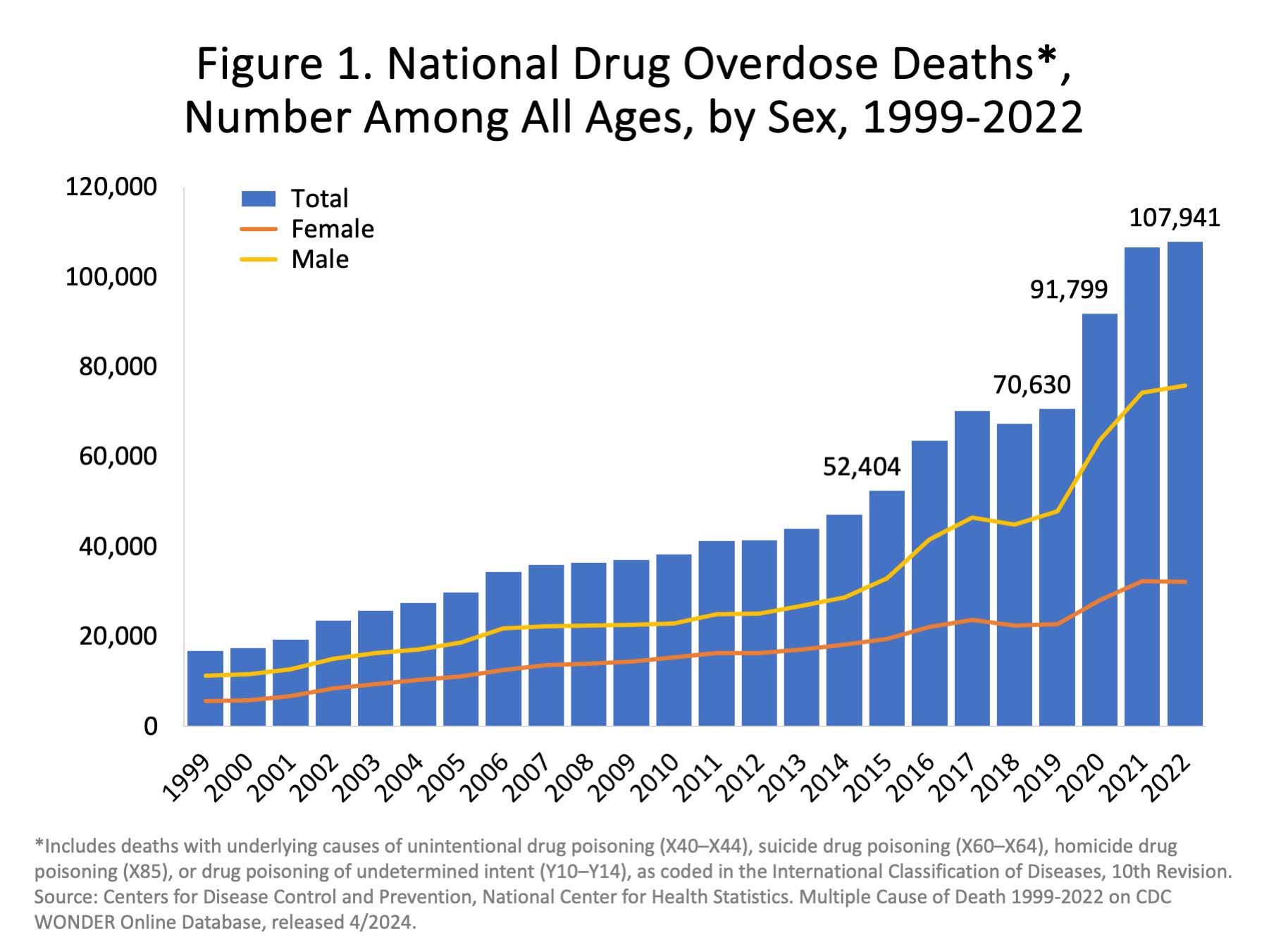
<p class="has-text-align-none">In 2022, the US reached <a href="https://nida.nih.gov/sites/default/files/images/fig1-2024.jpg">a grim peak</a> in drug overdose deaths: Nearly 108,000 people died that year, more than twice the number who died in 2015, and more than four times the number in 2002.&nbsp;</p>

<p class="has-text-align-none">Now, in what experts hope is more than a blip, the overdose epidemic that has affected every state in the nation might be showing some signs of abating.&nbsp;&nbsp;</p>

<p class="has-text-align-none">The Centers for Disease Control and Prevention’s preliminary data on the <a href="https://www.cdc.gov/nchs/nvss/vsrr/drug-overdose-data.htm">12-month period ending in June</a> showed that <a href="https://www.cdc.gov/nchs/nvss/vsrr/drug-overdose-data.htm">overdoses dropped about 15 percentage points</a> from the previous period. There were still roughly 94,000 overdose deaths, signaling that the public health crisis is far from over, though a positive change could be on the horizon.&nbsp;</p>

<div class="wp-block-vox-media-highlight vox-media-highlight">
<h2 class="wp-block-heading">This story was first featured in the Today, Explained newsletter</h2>


<p class="has-text-align-none">Understand the world with a daily explainer plus the most compelling stories of the day. Sign up <a href="https://www.vox.com/pages/today-explained-newsletter-signup">here</a>.</p>
</div>

<p class="has-text-align-none">America’s overdose crisis was exacerbated decades ago by the increasing use of and addiction to synthetic opioids, such as fentanyl, that have proliferated through the nation’s drug supply.&nbsp;</p>

<p class="has-text-align-none">Fentanyl was first produced in the 1960s and prescribed by doctors to people seeking relief from severe pain, such as cancer patients. A cheaper, more potent cousin of heroin, the drug soon became a favored commodity of traffickers, who began cutting other drugs with fentanyl and drawing people addicted to prescription painkillers such as oxycodone that have become increasingly more difficult to access. <a href="https://www.vox.com/science-and-health/2017/5/8/15454832/fentanyl-carfentanil-opioid-epidemic-overdose">As my colleague German Lopez wrote in 2017</a>, fentanyl made America’s opioid crisis — already the deadliest drug crisis in US history — even deadlier.</p>

<p class="has-text-align-none">So what might have turned the trend around? In the latest episode of Vox’s <em>Today, Explained</em> podcast, we asked Lev Facher, a reporter covering addiction at STAT News.&nbsp;</p>
<div class="spotify-embed"><iframe src="https://open.spotify.com/embed/episode/7yHMPanonmNvF8HyYDymZr?utm_source=generator" width="100%" height="152" frameborder="0" allowfullscreen="" allow="autoplay; clipboard-write; encrypted-media; fullscreen; picture-in-picture" loading="lazy"></iframe></div>
<p class="has-text-align-none">“There&#8217;s no one event that happened about a year and a half ago that would explain this sudden significant decrease in drug overdose deaths,” says Facher. “While there&#8217;s a lot of optimism in the harm reduction and addiction medicine and recovery world, it&#8217;s cautious optimism because people don&#8217;t really know what&#8217;s happening.”</p>

<p class="has-text-align-none">Despite that, Facher says, experts and advocates do have a few potential explanations:&nbsp;</p>

<h2 class="wp-block-heading"><strong>Explanation 1: The drug supply is changing</strong></h2>

<p class="has-text-align-none">The simplest explanation for the drop in overdoses could be the nature of the drugs themselves; they simply may have become less toxic and less potent. Last month, DEA administrator Anne Milgram suggested <a href="https://www.dea.gov/press-releases/2024/11/15/deas-third-annual-national-family-summit-fentanyl-highlights-progress">that the agency’s crackdowns</a> were having a direct impact on the drug supply.  </p>

<p class="has-text-align-none">“The cartels have reduced the amount of fentanyl they put into pills because of the pressure we are putting on them,” she said at the National Family Summit on Fentanyl, which gathers people who’ve had loved ones die from drug use.</p>

<p class="has-text-align-none">Customs and Border Protection (CBP) data can’t give us the full picture of the effectiveness of cartel crackdowns, but it shows that the <a href="https://www.cbp.gov/newsroom/stats/cbp-drugs-dosage-value-and-weight">rate of fentanyl confiscation at the border</a> is hardly consistent. In January, CBP confiscated 1.3 million doses of the drug. The number of confiscations dropped significantly in June before rising back to about 1.3 million doses again in August.</p>

<p class="has-text-align-none">And data on the potency of illicit drugs is limited, given that drug-tracking systems vary from one community to another, Facher told Vox.&nbsp;</p>

<p class="has-text-align-none">“The places that do have really good drug checking, there have been some changes detected in terms of the drugs people are using, but nothing that would explain this sudden drop,” he said.</p>

<h2 class="wp-block-heading"><strong>Explanation 2: Drugs are being used more safely</strong></h2>

<p class="has-text-align-none">Another explanation could be that harm-reduction efforts are working. Access to <a href="https://www.vox.com/even-better/353129/you-can-help-reverse-the-overdose-epidemic">naloxone</a>, the lifesaving, overdose-reversing drug, expanded significantly in cities across the United States in the last few years. Local governments such as <a href="https://laist.com/news/health/los-angeles-naloxone-overdose-deaths">Los Angeles County</a> made the drug available at schools, churches, libraries, and jails, and <a href="https://health.ucdavis.edu/blog/cultivating-health/why-you-should-carry-naloxone-narcan-to-combat-opioid-overdoses/2023/08">everyday</a> Americans are increasingly encouraged to carry naloxone.&nbsp;</p>

<p class="has-text-align-none">Harm-reduction campaigns may have also had an impact on those who use recreational “party” drugs, who might favor stimulants but could find themselves unknowingly ingesting fentanyl if a dealer has mixed it into cocaine or MDMA. <a href="https://www.amazon.com/Fentanyl-Overdrive-Substances-Detection-Sensitive/dp/B0D936KTKM">Drug testing kits like Overdrive</a> are available for less than $15 from retailers like Amazon and provide people with step-by-step directions on testing drugs for fentanyl.&nbsp;</p>

<p class="has-text-align-none">Data also suggests that the way people consume drugs might reduce the likelihood of death by overdose. Smoking fentanyl is becoming increasingly more popular than injecting it, and the former is linked to <a href="https://www.sciencedirect.com/science/article/abs/pii/S0376871623012917?via%3Dihub">fewer fatal overdoses and blood-borne infections</a>.</p>

<h2 class="wp-block-heading"><strong>Explanation 3: The crisis has already taken the most vulnerable lives</strong></h2>

<p class="has-text-align-none">The third explanation, floated by some epidemiologists, is the most bleak, and suggests that after hundreds of thousands of people were killed by drug overdoses in a relatively short time span, the <a href="https://www.nejm.org/doi/full/10.1056/NEJMe2406359">epidemic is essentially burning itself out</a>.&nbsp;</p>

<p class="has-text-align-none">“It&#8217;s a concept called the ‘depletion of susceptibles,’” Facher said. “And that&#8217;s just to say that so many people have already died of drug overdoses that there aren&#8217;t as many drug users left to die. That&#8217;s not necessarily a mainstream theory. And even if it were accepted, it probably wouldn&#8217;t explain the full significant sudden decrease in drug deaths.”</p>

<p class="has-text-align-none">The staggering number of deaths from the opioid epidemic, however, could be a contributing factor to declining youth drug misuse. <a href="https://www.kff.org/mental-health/issue-brief/teens-drugs-and-overdose-contrasting-pre-pandemic-and-current-trends/#:~:text=In%202023%2C%2010%25%20of%20high,alcohol%20use%20(30%25%20vs.">An analysis from KFF</a> showed a small drop in opioid misuse among high school students from 2017 to 2023. As <a href="https://www.nytimes.com/2024/12/02/opinion/drug-overdose-deaths-decline.html">Maia Szalavitz writes for the New York Times</a>, “Drug epidemics are often cyclical. Younger generations witness the harm specific drugs have caused their older siblings or parents, leading them to avoid those substances.”</p>

<h2 class="wp-block-heading">Can the decline be sustained? </h2>

<p class="has-text-align-none">The latest data on overdose deaths comes amid a pivotal presidential transition. While the addiction crisis is a marquee issue for both Republicans and Democrats, the incoming Trump administration includes high-level officials who’ve been intimately impacted by it.&nbsp;</p>

<p class="has-text-align-none">The vice president-elect, JD Vance, has spoken extensively about how opioid addiction affected his mother and his community of Middletown, Ohio. Trump’s nominee for secretary of the Department of Health and Human Services, Robert F. Kennedy Jr., is in addiction recovery himself and his policy proposals include a network of “<a href="https://www.youtube.com/watch?v=liZq31HLnyA&amp;t=1778s">wellness farms</a>” to serve <a href="https://www.statnews.com/2024/12/11/rfk-jr-opioid-epidemic-addiction-policy-tough-love/">as treatment facilities.</a> It remains to be seen whether the administration will focus its efforts on addiction recovery or if it will devote more attention <a href="https://www.youtube.com/watch?v=NUClE1P8ApI">to law enforcement</a> and <a href="https://www.npr.org/2024/11/18/nx-s1-5187973/fentanyl-trump-cartels-addiction">the US-Mexico border</a>. </p>

<p class="has-text-align-none">“There is trepidation about a potential shift toward law enforcement and away from treatment,” Facher said.&nbsp;“Most of my sources talk about harm reduction, treatment prevention, and really just keeping people alive [by] meeting them where they are and getting them the services they need to live healthier lives as the cornerstone of ending this drug crisis.”</p>
						]]>
									</content>
			
					</entry>
			<entry>
			
			<author>
				<name>Haleema Shah</name>
			</author>
			
			<author>
				<name>Noel King</name>
			</author>
			
			<title type="html"><![CDATA[Trump loves tariffs. Will the rest of America?]]></title>
			<link rel="alternate" type="text/html" href="https://www.vox.com/policy/386042/trump-tariffs-economy-global-trade" />
			<id>https://www.vox.com/?p=386042</id>
			<updated>2024-11-19T18:37:30-05:00</updated>
			<published>2024-11-20T06:45:00-05:00</published>
			<category scheme="https://www.vox.com" term="Business &amp; Finance" /><category scheme="https://www.vox.com" term="Donald Trump" /><category scheme="https://www.vox.com" term="Economy" /><category scheme="https://www.vox.com" term="Money" /><category scheme="https://www.vox.com" term="Policy" /><category scheme="https://www.vox.com" term="Politics" /><category scheme="https://www.vox.com" term="World Politics" />
							<summary type="html"><![CDATA[Long before he officially pursued the presidency, Donald Trump railed against US trade deals. In interviews dating back to the 1980s, he told journalists that deals that benefited Asian and Middle Eastern trading partners consistently “ripped off” the US.&#160; Over decades, that charge may have turned into a winning election strategy. As a first-term president [&#8230;]]]></summary>
			
							<content type="html">
											<![CDATA[

						
<figure>

<img alt="Trump sitting and gesticulating while he speaks." data-caption="Donald Trump visits the Economic Club of Chicago in Chicago, Illinois, last month. Some business leaders  worry his economic plans will fuel inflation. | Christopher Dilts/Bloomberg via Getty Images" data-portal-copyright="Christopher Dilts/Bloomberg via Getty Images" data-has-syndication-rights="1" src="https://platform.vox.com/wp-content/uploads/sites/2/2024/11/GettyImages-2177862753-1.jpg?quality=90&#038;strip=all&#038;crop=0,0,100,100" />
	<figcaption>
	Donald Trump visits the Economic Club of Chicago in Chicago, Illinois, last month. Some business leaders  worry his economic plans will fuel inflation. | Christopher Dilts/Bloomberg via Getty Images	</figcaption>
</figure>
<p class="has-text-align-none">Long before he officially pursued the presidency, Donald Trump railed against US trade deals. In <a href="https://www.npr.org/2017/01/20/510680463/donald-trumps-been-saying-the-same-thing-for-30-years">interviews dating back to the 1980s</a>, he told journalists that deals that benefited Asian and Middle Eastern trading partners consistently “ripped off” the US.&nbsp;</p>

<p class="has-text-align-none">Over decades, that charge may have turned into <a href="https://www.usatoday.com/story/news/politics/elections/2024/11/07/trump-inroads-union-workers-pennsylvania/75962349007/">a winning election strategy</a>. As a first-term president and in his  2024 campaign, <a href="https://www.cfr.org/election2024/candidate-tracker/donald-trump">Trump argued that a lopsided global trading system</a> is not only responsible for a deficit between the US and China, but also behind a decline in American manufacturing and jobs.&nbsp;</p>

<p class="has-text-align-none">Now, Trump has made a second-term promise to <a href="https://www.bloomberg.com/news/articles/2024-11-12/trump-tariff-plan-explained-expect-high-drama-and-a-slow-rollout">raise tariffs</a> — the taxes on imported goods that must be paid when they enter the US — even higher on China and other countries, while resurrecting those jobs.&nbsp;</p>

<div class="wp-block-vox-media-highlight vox-media-highlight">
<h2 class="wp-block-heading">This story was first featured in the Today, Explained newsletter</h2>


<p class="has-text-align-none">Understand the world with a daily explainer plus the most compelling stories of the day. Sign up <a href="https://www.vox.com/pages/today-explained-newsletter-signup">here</a>.</p>
</div>

<p class="has-text-align-none">But <a href="https://www.washingtonpost.com/business/2024/10/30/companies-tariffs-trump-prices/">footwear, apparel, and auto-part companies</a> say they expect to pass the cost of such tariffs on to American consumers. <a href="https://budgetlab.yale.edu/research/fiscal-macroeconomic-and-price-estimates-tariffs-under-both-non-retaliation-and-retaliation">Yale University’s Budget Lab</a> projects that Trump’s proposed tariffs would cost the average American household up to $7,600 a year with initial price hikes as high as 5 percent. Those higher costs could potentially backfire on the president-elect’s <a href="https://www.washingtonpost.com/business/2024/10/30/companies-tariffs-trump-prices/">campaign promise to make inflation “vanish completely.”</a></p>

<p class="has-text-align-none">Trump’s trade strategy is one that Greg Ip, chief economics commentator at the Wall Street Journal, says is a major departure from almost 80 years of US policy. In a conversation with Noel King, co-host of the <em>Today, Explained </em>podcast, Ip described how it might play out and have massive implications for the global economy.&nbsp;</p>

<p class="has-text-align-none">Below is an excerpt of their conversation, edited for length and clarity. There’s much more in the full podcast, so listen to <em>Today, Explained</em> wherever you get your podcasts, including <a href="https://podcasts.apple.com/us/podcast/today-explained/id1346207297">Apple Podcasts</a>, <a href="https://open.spotify.com/show/3pXx5SXzXwJxnf4A5pWN2A">Spotify</a>, and <a href="https://www.pandora.com/podcast/today-explained/PC:140">Pandora</a>.</p>
<div class="spotify-embed"><iframe src="https://open.spotify.com/embed/episode/56vB6gV4ZDpNTnuMVD6KxV" width="100%" height="152" frameborder="0" allowfullscreen="" allow="autoplay; clipboard-write; encrypted-media; fullscreen; picture-in-picture" loading="lazy"></iframe></div>
<h2 class="wp-block-heading has-text-align-none">Noel King</h2>

<p class="has-text-align-none">Trade is a reality of economic life these days. What is Trump’s theory on it and how does it differ from his predecessors?&nbsp;</p>

<h2 class="wp-block-heading has-text-align-none">Greg Ip</h2>

<p class="has-text-align-none">In the United States, since the 1940s at least, there&#8217;s been a bipartisan consensus that more trade is good. And this came from a bipartisan view that this made our workers more productive, because they had bigger markets to sell into. It benefited our consumers because they got cheaper goods and a greater variety of goods. And it was also good for the US geopolitically because it helped us increase our economic bonds to countries that thought the same way we did, politically.&nbsp;</p>

<p class="has-text-align-none">Trump comes along and he argues: This entire regime has been much more to the advantage of other countries than it has been to the United States. Countries like Japan and then Germany and now China have taken advantage of the United States’s fixation on free trade to increase their trade surplus with the US, sell us lots of manufactured goods, and not buy very much from the United States. So his entire mission, from his first term, and now into this one, is to reverse that relationship and, he hopes, force those countries to buy more from the US, and Americans to buy more from each other instead of from importers. That&#8217;s the theory, anyway.&nbsp;</p>

<h2 class="wp-block-heading has-text-align-none">Noel King</h2>

<p class="has-text-align-none"> Donald Trump had a chance to do all of this from 2016 to 2020 when he was in office. What did he do?&nbsp;</p>

<h2 class="wp-block-heading has-text-align-none">Greg Ip </h2>

<p class="has-text-align-none">He did raise tariffs, for example, in a series of rounds of tariff increases. He imposed tariffs on a wide range of products from China. And this was pursuant to a long-running case that complained that China was just systematically unfair to the United States, stealing our technology and putting up barriers to US exports to China. Then he imposed a variety of more bespoke tariffs on particular products.</p>

<h2 class="wp-block-heading has-text-align-none">Noel King</h2>

<p class="has-text-align-none">So at the end of that first term … had Donald Trump gotten what he wanted? Had his plan worked?&nbsp;</p>

<h2 class="wp-block-heading has-text-align-none">Greg Ip </h2>

<p class="has-text-align-none">If the test of Donald Trump&#8217;s trade policy was a smaller trade deficit, then no, he didn&#8217;t really achieve what he wanted. The trade deficit when he left office was larger in dollar terms than when he entered office.&nbsp;</p>

<p class="has-text-align-none">Did some manufacturing jobs come back? Possibly. But there also appear to have been some costs. There were industries that had to pay more for their inputs because of tariffs, and they lost sales and possibly jobs. And some of our trading partners retaliated.&nbsp;</p>

<p class="has-text-align-none">Our trade deficit with China did begin to shrink. At the same time, though, you saw our trade deficit with Mexico and Vietnam grow. And what that told us is that some businesses responded to Trump&#8217;s tariffs not necessarily by bringing production back to the United States, but by moving it to another country — out of China, into Vietnam, into Mexico — that were not quite as affected by the tariffs.&nbsp;</p>

<h2 class="wp-block-heading has-text-align-none">Noel King</h2>

<p class="has-text-align-none">What are Donald Trump&#8217;s plans for a second term?&nbsp;</p>

<h2 class="wp-block-heading has-text-align-none">Greg Ip </h2>

<p class="has-text-align-none">He wants to, number one, come down even harder on China. Instead of just putting tariffs on about half of China&#8217;s imports, he&#8217;s talked about a tariff on all Chinese imports of as much as 60 percent. And instead of sparing traditional US allies, he wants to impose an across-the-board tariff on everybody, of say, 10 to 20 percent.&nbsp;</p>

<p class="has-text-align-none">But there&#8217;s a very big caveat to this, which is that we don&#8217;t really know if Trump will end up doing exactly what he&#8217;s talked about.&nbsp;</p>

<p class="has-text-align-none">We know that Trump likes tariffs, but we also know that Trump likes to make deals. So, as in his first term, we might see that the threat of tariffs is primarily a leverage instrument —&nbsp;you know, a negotiating chip — in which he goes to countries that he thinks treat the United States unfairly and says, “Here are some things we want you to do differently. And if you do as we ask, then we won&#8217;t hit you with the tariffs that I&#8217;ve talked about.”</p>

<h2 class="wp-block-heading has-text-align-none">Noel King</h2>

<p class="has-text-align-none">How close can Donald Trump come to really and truly changing the way the world does trade?</p>

<h2 class="wp-block-heading has-text-align-none">Greg Ip </h2>

<p class="has-text-align-none">It&#8217;s possible that Trump presses ahead with exactly what he said, raises tariffs on everybody, and then all those countries retaliate. They export less to us, we export less to them, trade shrinks, and everybody is worse off.</p>

<p class="has-text-align-none">There&#8217;s another possibility here, which is that a lot of folks in the United States and in other countries say, “You know, he&#8217;s right. The trading system was fundamentally good, but it went off the rails at some point. We need to get together. We need to remake that thing.” So I think another possibility is that we end up a few years from now with a different trading system, and perhaps a more realistic view of how China, above all — but some other countries, [too] — have not been playing by the rules.</p>

<p class="has-text-align-none">But I think, as we learned from his first term, one thing with Donald Trump — you can be sure of this — is that you should expect the unexpected.<br><br></p>
						]]>
									</content>
			
					</entry>
			<entry>
			
			<author>
				<name>Haleema Shah</name>
			</author>
			
			<author>
				<name>Noel King</name>
			</author>
			
			<title type="html"><![CDATA[The anatomy of a smear: How a lie about Haitian immigrants went viral]]></title>
			<link rel="alternate" type="text/html" href="https://www.vox.com/podcasts/372206/springfield-ohio-pets-haitian-immigrants-conspiracy" />
			<id>https://www.vox.com/?p=372206</id>
			<updated>2024-09-16T18:29:24-04:00</updated>
			<published>2024-09-17T06:30:00-04:00</published>
			<category scheme="https://www.vox.com" term="2024 Elections" /><category scheme="https://www.vox.com" term="Immigration" /><category scheme="https://www.vox.com" term="Podcasts" /><category scheme="https://www.vox.com" term="Policy" /><category scheme="https://www.vox.com" term="Politics" /><category scheme="https://www.vox.com" term="Today, Explained podcast" />
							<summary type="html"><![CDATA[When former President Donald Trump told 67 million Americans last week that immigrants in Springfield, Ohio, were eating people’s pets, he was repeating a racist conspiracy theory that was years in the making — if not even longer. Since 2020, thousands of Haitian immigrants moved to the Rust Belt town in southwestern Ohio to take [&#8230;]]]></summary>
			
							<content type="html">
											<![CDATA[

						
<figure>

<img alt="A mural on a wall reads “Greetings from Springfield, Ohio.” " data-caption="A mural is displayed in an alley downtown on September 16, 2024, in Springfield, Ohio. | Luke Sharrett/Getty Images" data-portal-copyright="Luke Sharrett/Getty Images" data-has-syndication-rights="1" src="https://platform.vox.com/wp-content/uploads/sites/2/2024/09/gettyimages-2171699459.jpg?quality=90&#038;strip=all&#038;crop=0,0,100,100" />
	<figcaption>
	A mural is displayed in an alley downtown on September 16, 2024, in Springfield, Ohio. | Luke Sharrett/Getty Images	</figcaption>
</figure>
<p class="has-text-align-none">When former President Donald Trump told <a href="https://www.nielsen.com/news-center/2024/over-67-million-viewers-tune-in-for-abc-news-harris-trump-debate/">67 million Americans</a> last week that immigrants in Springfield, Ohio, were eating people’s pets, he was repeating a racist conspiracy theory that was years in the making — <a href="https://www.vox.com/politics/371855/trump-vance-springfield-ohio-racist-conspiracy-theories-haitian-immigrants">if not even longer</a>.</p>

<p class="has-text-align-none">Since 2020, thousands of Haitian immigrants moved to the Rust Belt town in southwestern Ohio to take advantage of new manufacturing jobs there. <a href="https://www.vox.com/politics/371855/trump-vance-springfield-ohio-racist-conspiracy-theories-haitian-immigrants">As Vox’s Li Zhou has reported</a>, “while the growth in population has helped rejuvenate the town, it’s also put pressure on social services in the form of longer wait times at medical clinics and more competition for affordable housing, fueling some animosity toward the newcomers.”</p>

<p class="has-text-align-none">That animosity morphed into something entirely different in the days leading up to a presidential debate thanks to right-wing social media accounts, which seized on <a href="https://www.nbcnews.com/news/us-news/-just-exploded-springfield-woman-says-never-meant-spark-rumors-haitian-rcna171099">baseless rumors about immigrants in Springfield</a> — conflated with a story about a Canton, Ohio, woman, who is not Haitian and was accused of killing and eating a cat — to create an online frenzy. Since then, members of Springfield’s Haitian community <a href="https://haitiantimes.com/2024/09/11/haitian-immigrants-in-ohio-under-racist-attacks/">tell reporters they are nervous about leaving their homes</a> as the town remains on high alert after a series of bomb threats, while Republican vice presidential nominee JD Vance and others <a href="https://www.nytimes.com/2024/09/15/us/politics/jd-vance-springfield-pets.html">continue to double down on the made-up story</a>.</p>

<p class="has-text-align-none">Gaby Del Valle, a reporter for <em>The Verge</em>,<em> </em>talked with <em>Today, Explained</em> host Noel King about an ecosystem of right-wing influencers that turned a lie about immigrants in a small town into a Republican campaign talking point.</p>

<p class="has-text-align-none">Below is an excerpt of their conversation, edited for length and clarity. There’s much more in the full podcast, so listen to <em>Today, Explained</em> wherever you get your podcasts, including <a href="https://podcasts.apple.com/us/podcast/today-explained/id1346207297">Apple Podcasts</a>, <a href="https://podcasts.google.com/feed/aHR0cHM6Ly9yc3MuYXJ0MTkuY29tL3RvZGF5LWV4cGxhaW5lZA==">Google Podcasts</a>, <a href="https://open.spotify.com/show/3pXx5SXzXwJxnf4A5pWN2A">Spotify</a>, and <a href="https://www.stitcher.com/podcast/vox/today-explained">Stitcher</a>.</p>

<iframe frameBorder="0" height="200" src="https://playlist.megaphone.fm/?e=VMP8062552285" width="100%"></iframe>

<h4 class="wp-block-heading has-text-align-none">Noel King</h4>

<p class="has-text-align-none">Let’s look back in time to when this was just an online rumor. Where does it start?&nbsp;</p>

<h4 class="wp-block-heading has-text-align-none">Gaby Del Valle</h4>

<p class="has-text-align-none">One of the earliest tweets that I saw was from an account called End Wokeness, which posted on September 6 a screenshot of that Facebook post that was like, my friend’s neighbor’s sister’s cousin or whatever got her cat kidnapped and she found it outside a house where Haitians live. And also posted a picture of a man holding a goose, and said that ducks and pets are disappearing in Springfield, Ohio, a place where there are a lot of Haitian migrants. And then on September 8, Charlie Kirk posted the same screenshot from Facebook and Elon Musk replied to it, saying, apparently people’s cats are being eaten. The original End Wokeness post right now has 4.9 million views. Musk’s reply to Charlie Kirk has 1.6 million views. Charlie Kirk’s post was viewed at least 4 million times. This kind of left the ecosystem of right-wing Twitter partially because Elon Musk got involved. </p>

<h4 class="wp-block-heading has-text-align-none">Noel King</h4>

<p class="has-text-align-none">What happens, generally and in this case, when Elon Musk gets involved? Why does he matter?&nbsp;</p>

<h4 class="wp-block-heading has-text-align-none">Gaby Del Valle</h4>

<p class="has-text-align-none">In addition to owning Twitter and letting go of the content moderation team, the Trust and Safety Council… I can’t speak with certainty here, but I will say that Elon Musk has several pet causes that he posts about a lot. One of which is immigration, another one of which is quote-unquote “wokeness.” And there is a sense that what Elon cares about gets pushed out to users on the app. And even if there’s not an algorithmic change that is putting content that Elon cares about in front of everybody, he has a lot of influence, a lot of followers, and a lot of power.</p>

<h4 class="wp-block-heading has-text-align-none">Noel King</h4>

<p class="has-text-align-none">All right. So this is not true. It is not true in Springfield. It is not true in the way it’s being presented. And then we hear it again on the debate stage. Again, there’s a round of debunking, this isn’t true. Has the debunking had any impact on this rumor’s staying power? </p>

<h4 class="wp-block-heading has-text-align-none">Gaby Del Valle</h4>

<p class="has-text-align-none">The debunking has done absolutely nothing in terms of the rumor’s staying power. In some senses, it actually kind of fueled the narrative because the narrative on the right is not just, like, people are eating cats in Springfield. It’s well, you know, maybe actually this isn’t happening. But even if it’s not happening, why is the media so focused on debunking whether people are eating cats in Springfield? And why are they not talking about the Haitian immigrant invasion of Springfield? Why are they not looking at that? On Truth Social, Trump has posted a bunch of different images of him saving cats, of cats and ducks watching the presidential debate. The Republican Party of Arizona put out 12 billboards in the Phoenix area that say “<a href="https://www.washingtonpost.com/politics/2024/09/11/arizona-gop-eat-cats-billboards/">Eat less kittens, vote Republican</a>.” This has become the new Republican Party rallying cry. </p>

<p class="has-text-align-none">The cat memes are almost like a shorthand for this overall belief about not only Springfield, but communities across America supposedly being taken over by migrants. It’s like a visual representation of what is called the Great Replacement Theory, which is this conspiracy theory that there is an outside force replacing local, often white populations with imported migrants of color. Sometimes the proponents of that theory claim that Democrats are turning a blind eye to illegal immigration and allowing undocumented people to vote so that they have staying power. Sometimes a conspiracy theory is about how Democrats or other elites want to foment demographic change. But the underlying premise is always local American populations, which almost always means white populations, are being replaced by nonwhite immigrants. </p>

<h4 class="wp-block-heading has-text-align-none">Noel King</h4>

<p class="has-text-align-none">Anti-immigrant rhetoric and the kind of, at times, really outlandish lies that accompany it are part of a pretty familiar playbook for Donald Trump. Does 2024 feel different to you than, for example, 2020 or 2016?&nbsp;</p>

<h4 class="wp-block-heading has-text-align-none">Gaby Del Valle</h4>

<p class="has-text-align-none">I would say yes and no. Like, Trump’s 2016 campaign famously began with these racist claims about Mexican immigrants being rapists and murderers, very bad people, etc., etc. So I think that this is kind of the logical outcome of that. It’s pure, unvarnished racism. And the point is to dehumanize Haitians. But it’s definitely escalated. It’s gone further than before. [In] some circles of right-wing Twitter, people are talking about, like, the links between race and IQ. And there’s this implication and sometimes just outright statements that migrants from Haiti and elsewhere are not intelligent enough to be assimilated into American society. And for them, it’s about more than culture. It’s about more than even skin color. It’s this kind of biological hatred. And that’s the extreme rhetoric that has not only gone unchallenged, but has gotten more and more extreme as the years have gone on.</p>
						]]>
									</content>
			
					</entry>
			<entry>
			
			<author>
				<name>Haleema Shah</name>
			</author>
			
			<title type="html"><![CDATA[MDMA’s 40-year fight for medical approval continues]]></title>
			<link rel="alternate" type="text/html" href="https://www.vox.com/today-explained-podcast/363903/mdma-medicine-ptsd-fda" />
			<id>https://www.vox.com/?p=363903</id>
			<updated>2024-08-13T15:13:52-04:00</updated>
			<published>2024-08-13T15:13:51-04:00</published>
			<category scheme="https://www.vox.com" term="Future Perfect" /><category scheme="https://www.vox.com" term="Podcasts" /><category scheme="https://www.vox.com" term="The Future of the Mind" /><category scheme="https://www.vox.com" term="Today, Explained podcast" />
							<summary type="html"><![CDATA[2024 was supposed to be the year MDMA, better known by its street variations, “ecstasy” or “molly,” shed its reputation as a mere party drug. Advocates touted its potential to treat mental illness, but MDMA research was long stymied by its status as an illicit drug with no medical use.&#160; This year, the FDA reviewed [&#8230;]]]></summary>
			
							<content type="html">
											<![CDATA[

						
<figure>

<img alt="A colorful blurred image of an open mouth with a heart-shaped pill on the tongue." data-caption="" data-portal-copyright="Jun/Getty Images" data-has-syndication-rights="1" src="https://platform.vox.com/wp-content/uploads/sites/2/2024/07/GettyImages-1383502875.jpg?quality=90&#038;strip=all&#038;crop=0,0,100,100" />
	<figcaption>
		</figcaption>
</figure>
<p class="has-text-align-none">2024 was supposed to be the year MDMA, better known by its street variations, “ecstasy” or “molly,” shed its reputation as a mere party drug. Advocates touted its potential to treat mental illness, but MDMA research was long stymied by its status as an illicit drug with no medical use.&nbsp;</p>

<p class="has-text-align-none">This year, the FDA reviewed Lykos Therapeutics’s late-stage clinical trials, which paired MDMA with psychotherapy to treat post-traumatic stress disorder. But on Friday, what was expected to be a landmark moment for the use of psychedelics in medicine ended in a rejection from the agency. </p>

<div class="wp-block-vox-media-highlight vox-media-highlight">
<h2 class="wp-block-heading">Read more about the mystery of psychedelics</h2>


<ul class="wp-block-list">
<li><a href="https://www.vox.com/future-perfect/355687/fda-mdma-therapy-maps-lykos-cult" data-type="link" data-id="https://www.vox.com/future-perfect/355687/fda-mdma-therapy-maps-lykos-cult">The biggest unknown in psychedelic therapy is not the psychedelics</a><br></li>


<li><a href="https://www.vox.com/future-perfect/23972716/psychedelics-meaning-science-psychedelic-mushrooms-ketamine-psilocybin-mysticism" data-type="link" data-id="https://www.vox.com/future-perfect/23972716/psychedelics-meaning-science-psychedelic-mushrooms-ketamine-psilocybin-mysticism">Why psychedelics produce some of the most meaningful experiences in people’s lives</a><br></li>


<li><a href="https://www.vox.com/future-perfect/2024/5/15/24156372/psychedelics-chronic-pain-cluster-headache-medicine-lsd-psilocybin">Psychedelics could treat some of the worst chronic pain in the world</a></li>
</ul>


<p class="has-text-align-none"><strong>Have questions, comments, or ideas? </strong>Email me: haleema.shah@voxmedia.com. </p>
</div>

<p class="has-text-align-none">It was a far cry from what most observers expected when I began reporting on MDMA-assisted therapy at the beginning of the year. Clinicians and patients were (and remain) overwhelmingly supportive of researching psychedelics for psychiatric use. In the absence of novel treatments for PTSD, MDMA received surprising bipartisan support in Congress and the Department of Veterans Affairs was instructed to prepare a rollout of the treatment.&nbsp;</p>

<p class="has-text-align-none">But even before the FDA’s rejection, its advisers were concerned about research bias, trial misconduct, and data integrity. While the rejection does not fully quash hopes of the drug’s future in medicine, it will delay it. <a href="https://news.lykospbc.com/2024-08-09-Lykos-Therapeutics-Announces-Complete-Response-Letter-for-Midomafetamine-Capsules-for-PTSD">Lykos Therapeutics announced</a> that the FDA requested an additional phase 3 trial to further study safety and efficacy of the treatment, something that the company CEO said would take several years to complete.&nbsp;</p>

<p class="has-text-align-none">The delay is a critical blow to psychedelic advocates who expected that MDMA would finally find therapeutic use after four decades of advocacy. Here&#8217;s how they got MDMA this far — and what they&#8217;re planning next.&nbsp;</p>

<h2 class="wp-block-heading has-text-align-none"><strong>The roots of therapeutic MDMA</strong></h2>

<p class="has-text-align-none">When I began reporting on MDMA’s roots in therapy for Vox’s podcast <em><a href="https://www.vox.com/today-explained-podcast" data-type="link" data-id="https://www.vox.com/today-explained-podcast">Today, Explained</a>, </em><a href="https://open.spotify.com/episode/13mTTBlwOkibgRgLgJnIZi?si=CM-pxT6lRmG1F1N9LFZUuQ">I visited Shulgin Farm</a>, the Bay Area home of the late chemist Alexander “Sasha” Shulgin, who synthesized the drug in 1976. Though his lab — a converted tool shed — looked more like a Hollywood rendition of a meth lab than the sterile laboratories of my college chemistry class, it was historically significant, because Shulgin is said to have synthesized hundreds of psychoactive substances, some of which he tested on himself, including MDMA.&nbsp;</p>

<p class="has-text-align-none">Shulgin would admit he found MDMA enjoyable, calling it a “low-calorie martini.” But he didn’t set out to design recreational drugs.&nbsp;</p>

<p class="has-text-align-none">“I’m looking for tools that can be used for studying the mind,” and he believed his peers could then use those tools in neuroscience or psychology, he said in a 1996 interview.&nbsp;</p>

<p class="has-text-align-none">His wife, Ann Shulgin, who died in 2022 and is sometimes referred to as “a lay therapist,” was even more ardent about her view of&nbsp; psychedelics as “spiritual tools.” In the early 1980s, she and countercultural psychotherapists believed that MDMA, with its ability to flood people with feelings of love and empathy, could relieve clients of shame and allow them to process trauma or face challenging emotions.</p>

<p class="has-text-align-none">“This chemical has already accomplished enough so that many psychiatrists who have used it, and are using it, have spoken of a possible need to substantially restructure the classical psychotherapeutic 50-minute hour concept,” Ann wrote in a letter to President Ronald Reagan, arguing for the drug’s legal use.</p>

<p class="has-text-align-none">That description bears striking resemblance to what some trial participants say today: An 18-week treatment regimen with MDMA and psychotherapy can relieve PTSD symptoms that years of therapy and SSRI prescriptions couldn’t. But MDMA’s development as a therapeutic drug was hindered by its reputation as a medically useless street drug.&nbsp;</p>

<h2 class="wp-block-heading has-text-align-none"><strong>MDMA’s descent deeper into the underground</strong></h2>

<p class="has-text-align-none">Despite underground therapists’ belief in MDMA’s therapeutic potential in the early 1980s, the euphoric experiences the drug induced could not be contained for long. MDMA escaped the therapeutic space, was produced in clandestine labs, and found a home in nightclubs as “ecstasy” or “X.”&nbsp;</p>

<p class="has-text-align-none">And it happened during a drug war that already banned psychedelics like LSD. By 1985, MDMA was quickly placed under <a href="https://www.nytimes.com/1985/06/01/us/us-will-ban-ecstasy-a-hallucinogenic-drug.html">emergency ban</a> after the DEA said it posed a public health risk.&nbsp;</p>

<p class="has-text-align-none">“There was a lot of lurid press about MDMA,” Paul Daley, a friend of the Shulgins and chief science officer at the Alexander Shulgin Research Institute, told me. “Brain scans were showing ‘Oh, there are holes in people’s brains who are taking MDMA.’ Of course, it’s all hogwash.”&nbsp;</p>

<p class="has-text-align-none">The most damning study of MDMA was in the early aughts, and suggested it caused Parkinson’s-like brain damage, but the study was <a href="https://www.wired.com/2003/09/ecstasy-study-botched-retracted/">retracted after a major experimental error was discovered</a>. Evidence, however, supports that MDMA can cause rapid heart rate, cardiovascular events, and bad trips.</p>

<p class="has-text-align-none">As DARE programs and news reports warned of the dangers of ecstasy, a community of evangelists remained committed to bringing MDMA into respectability through medicine.</p>

<h2 class="wp-block-heading has-text-align-none"><strong>MDMA’s makeover and foray into medicine</strong></h2>

<p class="has-text-align-none">Shortly after MDMA was banned, a friend of the Shulgins by the name of Rick Doblin sprung into action. With the goals of “mass mental health” and “spiritualized humanity,” Doblin founded the Multidisciplinary Association for Psychedelic Studies (MAPS), an organization he still leads, and is regarded as one of the most successful psychedelic advocates.&nbsp;</p>

<p class="has-text-align-none">“To bring psychedelics back from the underground, it was necessary to, first off, have a patient population that the general public is sympathetic with and for which Big Pharma’s drugs are not really working,” Doblin said in a 2021 interview with self-help guru (and former presidential candidate) Marianne Williamson.&nbsp;</p>

<p class="has-text-align-none">The sympathetic population he described are <a href="https://open.spotify.com/episode/3HQLg8gtXUWZcM1BC5hYe8?si=de552c21ef3042ca">military veterans</a>, who face high rates of PTSD and for whom first-line treatments are decades-old SSRIs that are partially effective.</p>

<p class="has-text-align-none">Doblin’s organization and pharmaceutical spinoff, Lykos Therapeutics, are responsible for the clinical trials that the FDA reviewed this month. But months before the agency announced its decision, the trial design was criticized for not meeting the gold standard of clinical trials, which is to be double-blinded. Participants were usually able to determine whether they received the drug or placebo because of MDMA’s obvious psychedelic effects. Moreover, some who received the drug <a href="https://open.spotify.com/episode/41FjzMR0uPIW7nMuLlP4f5?si=2bfc25de44b74500">said they felt pressured to report positive results</a> because their participation was framed as “making history” and “part of a movement” to end psychedelic prohibition.&nbsp;</p>

<p class="has-text-align-none">Friday’s FDA decision is a blow to the decades-long efforts to medicalize MDMA, but psychedelics are now more mainstream than ever — they’re a subject of discussion at the VA, on wellness podcasts, and studied in academic institutions around the world.&nbsp;</p>

<p class="has-text-align-none">And in a statement, Doblin showed no signs of quitting his 40-year odyssey of mainstreaming psychedelics: “Our collective commitment to MDMA-assisted therapy remains unwavering.”&nbsp;</p>

<p class="has-text-align-none"><strong>Listen to all three episodes of <em>Today, Explained’s</em> series on the promise and precarity of MDMA below or <a href="https://link.chtbl.com/todayexplainedpod" data-type="link" data-id="https://link.chtbl.com/todayexplainedpod">wherever you find podcasts</a>.</strong></p>

<iframe frameborder="0" height="200" src="https://playlist.megaphone.fm/?e=VMP5927100160" width="100%"></iframe>

<p class="has-text-align-none"></p>

<iframe frameborder="0" height="200" src="https://playlist.megaphone.fm/?e=VMP7485344437" width="100%"></iframe>

<p class="has-text-align-none"></p>

<iframe loading="lazy" frameborder="0" height="200" src="https://playlist.megaphone.fm/?e=VMP9852302001" width="100%"></iframe>
						]]>
									</content>
			
					</entry>
			<entry>
			
			<author>
				<name>Haleema Shah</name>
			</author>
			
			<author>
				<name>Sean Rameswaram</name>
			</author>
			
			<title type="html"><![CDATA[Eurovision says it’s “apolitical.” History says otherwise.]]></title>
			<link rel="alternate" type="text/html" href="https://www.vox.com/world-politics/24151274/eurovision-song-contest-politics-russia-ukraine-gaza-israel-palestine" />
			<id>https://www.vox.com/world-politics/24151274/eurovision-song-contest-politics-russia-ukraine-gaza-israel-palestine</id>
			<updated>2024-05-08T10:52:40-04:00</updated>
			<published>2024-05-08T11:00:00-04:00</published>
			<category scheme="https://www.vox.com" term="Culture" /><category scheme="https://www.vox.com" term="European Union" /><category scheme="https://www.vox.com" term="Future Perfect podcast" /><category scheme="https://www.vox.com" term="Israel" /><category scheme="https://www.vox.com" term="Music" /><category scheme="https://www.vox.com" term="Palestine" /><category scheme="https://www.vox.com" term="Podcasts" /><category scheme="https://www.vox.com" term="Politics" /><category scheme="https://www.vox.com" term="TV" /><category scheme="https://www.vox.com" term="World Politics" />
							<summary type="html"><![CDATA[The annual Eurovision Song Contest kicked off yesterday and is bracing for protests and audience disruptions over Israel&#8217;s inclusion in the event as its war in Gaza in response to Hamas&#8217;s October 7 attack rages on. The song contest will be thousands of miles away &#8212; in Malmo, Sweden &#8212; but fury over the war [&#8230;]]]></summary>
			
							<content type="html">
											<![CDATA[

						
<figure>

<img alt="" data-caption="" data-portal-copyright="Jessica Gow/TT News Agency/AFP via Getty Images" data-has-syndication-rights="1" src="https://platform.vox.com/wp-content/uploads/sites/2/chorus/uploads/chorus_asset/file/25437393/2151203720.jpg?quality=90&#038;strip=all&#038;crop=0,0,100,100" />
	<figcaption>
		</figcaption>
</figure>
<p>The annual <a href="https://www.vox.com/culture/24151092/eurovision-2024-israel-ban">Eurovision Song Contest</a> kicked off yesterday and is bracing for protests and audience disruptions over <a href="https://www.vox.com/israel" data-source="encore">Israel</a>&rsquo;s inclusion in the event as its war in <a href="https://www.vox.com/2018/11/20/18080046/gaza-palestine-israel" data-source="encore">Gaza</a> in response to <a href="https://www.vox.com/politics/2023/10/10/23911661/hamas-israel-war-gaza-palestine-explainer" data-source="encore">Hamas</a>&rsquo;s <a href="https://www.vox.com/2023/10/7/23907683/israel-hamas-war-news-updates-october-2023" data-source="encore">October 7 attack</a> rages on.</p>

<p>The song contest will be thousands of miles away &mdash; in Malmo, Sweden &mdash; but fury over the war is expected to be palpable in the small Scandinavian city, whose population will swell with both Eurovision fans and protesters. Over 1,000 artists in the host country signed a letter calling for Israel&rsquo;s disqualification for its &ldquo;brutal warfare in Gaza,&rdquo; according to <a href="https://www.theguardian.com/tv-and-radio/2024/jan/29/swedish-music-stars-call-for-israel-eurovision-ban-over-gaza">the Guardian</a>, and pro-<a href="https://www.vox.com/palestine" data-source="encore">Palestinian</a> groups are <a href="https://www.irishtimes.com/ireland/2024/05/02/protesters-call-for-rte-to-boycott-eurovision-during-demonstration-outside-studios/">lobbying state broadcasters not to air the event</a> and <a href="https://www.them.us/story/lgbtq-organizations-eurovision-boycott-israel-palestine">calling on artists to refuse to participate</a>.&nbsp;</p>

<p>Already, Swedish pop star Eric Saade appeared wearing a <a href="https://www.vox.com/2023/12/6/23990673/keffiyeh-symbolism-palestinian-history">keffiyeh</a> &mdash; a traditional scarf that has come to symbolize resistance to Israel&rsquo;s incursion into Gaza &mdash; around his wrist during a performance on Tuesday night. A spokesperson for European Broadcasting Union (EBU) &mdash; which organizes the event &mdash; issued their &ldquo;regrets&rdquo; over the decision, <a href="https://www.bbc.com/news/articles/cw4r2ddkj7mo">according to the BBC</a>.<strong> </strong>Saade has appeared as a Eurovision competitor before but was a guest performer last night.</p>

<p>Politics intruding on Eurovision isn&rsquo;t new, despite its stated desire to stay above the fray.&nbsp;</p>

<p>In 2022, the contest disqualified <a href="https://www.vox.com/russia" data-source="encore">Russia</a> over its&nbsp;invasion of Ukraine.&nbsp;</p>

<p>Nonetheless, the EBU has rejected demands from pro-Palestinian activists, maintaining that it is a music event that keeps political messages away from the stage. <a href="https://www.bbc.com/news/world-europe-68950907">Sweden will bring additional police</a> from Denmark and Norway to Malmo, and the Eurovision Song Contest is expected to continue with the usual participants, including Israel, which has won Eurovision four times since joining the contest in 1973.&nbsp;</p>

<p>The EBU did require Israel<a href="https://www.aljazeera.com/news/2024/3/13/why-was-israel-forced-to-change-its-song-entry-for-eurovision"> </a>to <a href="https://www.aljazeera.com/news/2024/3/13/why-was-israel-forced-to-change-its-song-entry-for-eurovision">revise its entry this year</a>, though, which was a song initially called &ldquo;October Rain,&rdquo; featuring the lyrics &ldquo;those that write history, stand with me.&rdquo; The song appeared to be a reference to Hamas&rsquo;s October 7 attack on southern Israel that killed more than 1,100 people and led to the kidnapping of some 240, dozens of whom are still held hostage.&nbsp;</p>

<p>The reference to the attack was deemed too political by the EBU, and thus ineligible for the competition. Israel initially refused to sanitize its entry, even threatening to pull out of the competition, but revised it after involvement from President Isaac Herzog. The new song, which will be performed by Eden Golan, is now a romantic ballad entitled &ldquo;Hurricane,&rdquo; and the opening line was changed to &ldquo;writer of my symphony, play with me.&rdquo;</p>

<p>The controversy over Israel&rsquo;s song and the protests looming over this year&rsquo;s event underscore how much politics encroaches on an event that seeks to promote a utopian vision of global comity. But as Tess Megginson, a PhD candidate studying European history at the University of North Carolina-Chapel Hill, argues, the song contest, founded during the Cold War with seven European countries and initially excluding the Soviet Union, has <a href="https://www.washingtonpost.com/outlook/2022/05/19/eurovision-has-always-been-forum-political-performance/">always been a space for political performance</a>. In an interview with <em><a href="https://www.vox.com/today-explained-podcast" data-source="encore">Today, Explained</a> </em>host Sean Rameswaram, she explained that while some of today&rsquo;s controversy is unique, the contest had some of its most contentious political moments after the dissolution of the Soviet Union.&nbsp;</p>

<p><em>This conversation has been edited for length and clarity. You can listen to a longer version of Megginson&rsquo;s interview and highlights from Eurovision on </em>Today, Explained. &mdash;<em>Haleema Shah, producer</em></p>
<iframe loading="lazy" frameborder="0" height="200" src="https://playlist.megaphone.fm/?e=%20VMP3223606607" width="100%"></iframe><h3 class="wp-block-heading">Sean Rameswaram</h3>
<p>You wrote in the Washington Post that politics at Eurovision is nothing new, using the &rsquo;90s as an example.</p>
<h3 class="wp-block-heading">Tess Megginson</h3>
<p>I would argue the 1990s are actually some of the most political years of the contest, and this actually isn&rsquo;t always a bad thing.&nbsp;</p>

<p>As soon as you have the Eastern European countries start joining, hosts are talking about welcome to the rest of Europe, and now we&rsquo;re finally unified. And you have all these songs about peace and unity and breaking down walls. Some of these do quite well in the contest, some of them don&rsquo;t. In 1990, the first competition held in Eastern Europe, in Zagreb, the winning entry was Italy with &ldquo;Insieme: 1992.&rdquo; The hook in the chorus is &ldquo;unite, unite Europe,&rdquo; and it got a very good reception and won the competition.&nbsp;</p>
<div class="youtube-embed"><iframe title="Toto Cutugno - Insieme: 1992 - Italy 🇮🇹 - Grand Final - Winner of Eurovision 1990" src="https://www.youtube.com/embed/JiRppGSF-tI?rel=0" allowfullscreen allow="accelerometer *; clipboard-write *; encrypted-media *; gyroscope *; picture-in-picture *; web-share *;"></iframe></div>
<p>It is a really beautiful time in the contest, but also in the &rsquo;90s you have the Yugoslav wars. And this is the first time that we actually see a country banned from the competition. Yugoslavia was banned from the contest shortly after the 1992 competition because of the siege of Sarajevo. UN sanctions are imposed against Yugoslavia, and Bosnia is able to participate in the competition, but Yugoslavia cannot. Even though Bosnia is not participating with a song entry, they&rsquo;re still able to vote in the contest [and] call into the contest while under siege.&nbsp;</p>
<h3 class="wp-block-heading">Sean Rameswaram</h3>
<p>Wow.&nbsp;</p>
<h3 class="wp-block-heading">Tess Megginson</h3>
<p>The phone line initially disconnects and it goes dead. And there&rsquo;s just this silence that falls over the audience. Soon they&rsquo;re able to reconnect, and there&rsquo;s a loud applause and cheering from the audience as they&rsquo;re able to give their points for the contest. It&rsquo;s a really beautiful moment of solidarity for people who were at war and under occupation. And it&rsquo;s something that, even though it&rsquo;s a very political moment, it&rsquo;s quite a beautiful moment in the contest&rsquo;s history.&nbsp;</p>
<div class="youtube-embed"><iframe title="Sva bol svijeta - Bosnia &amp; Herzegovina 1993 - Eurovision songs with live music" src="https://www.youtube.com/embed/DREeDXs9ijc?rel=0" allowfullscreen allow="accelerometer *; clipboard-write *; encrypted-media *; gyroscope *; picture-in-picture *; web-share *;"></iframe></div><h3 class="wp-block-heading">Sean Rameswaram</h3>
<p>These political moments we&rsquo;re talking about &mdash; the fall of the Berlin Wall, the fall of communism, the genocide in Bosnia &mdash; they all happened on the continent of Europe. But here, now, in 2024, we&rsquo;ve got this controversy and calls for a boycott that relate to something happening in the Middle East. Is there a precedent for that at Eurovision?&nbsp;</p>
<h3 class="wp-block-heading">Tess Megginson</h3>
<p>Yeah. Boycotts in Eurovision are almost as old as the contest itself, starting in the 1970s. In 1975, <a href="https://www.vox.com/turkey" data-source="encore">Turkey</a> invaded Cyprus, and Greece boycotted the contest. The following year, Greece submits a song that is a very anti-war song and clearly referencing Turkey&rsquo;s presence in Cyprus, and Turkey boycotts the contest. So that&rsquo;s kind of the first example we see of these big boycotts.</p>
<div class="youtube-embed"><iframe title="Eurovision 1976 – Greece – Mariza Koch – Panagia mou, Panagia mou" src="https://www.youtube.com/embed/HiHObibSvmc?rel=0" allowfullscreen allow="accelerometer *; clipboard-write *; encrypted-media *; gyroscope *; picture-in-picture *; web-share *;"></iframe></div>
<p>More recently [there have] been calls to boycott Azerbaijan because of their treatment of their viewers who vote for Armenia. They&rsquo;ve threatened to block the Armenian broadcast before. And of course, when they hosted the contest in 2012, there was a big outcry because they displaced a lot of people living in a community in Baku because they were building a stadium just to host the Eurovision Song Contest.&nbsp;</p>
<h3 class="wp-block-heading">Sean Rameswaram</h3>
<p>Wow.&nbsp;</p>
<h3 class="wp-block-heading">Tess Megginson</h3>
<p>And then of course, Russia&rsquo;s the big one that you see a lot in the conversation because of its invasion of Ukraine, finally banned from the competition in 2022.&nbsp;</p>
<h3 class="wp-block-heading">Sean Rameswaram</h3>
<p>It sounds like it&rsquo;s par for the course to have this level of controversy and calls for boycotts and tensions between nations at Eurovision. Does that make this current controversy less exceptional?&nbsp;</p>
<h3 class="wp-block-heading">Tess Megginson</h3>
<p>Not necessarily. I think there&rsquo;s also been a long and&nbsp;unique history with Israel&rsquo;s participation in the contest. As the first non-European country to participate, it&rsquo;s also had relative success since it joined.&nbsp;</p>

<p>It&rsquo;s won the contest four times and hosted it three times. All the way back in 1978, we started seeing these controversies arise with Israel&rsquo;s participation. In 1978, they actually won the competition, but in Jordan, which was a member of the EBU, although not participating in the contest, they didn&rsquo;t air the Israel entry. And when it became clear that Israel was going to win the contest, they cut the broadcast short and announced Belgium as the winner in Jordan.&nbsp;</p>
<h3 class="wp-block-heading">Sean Rameswaram</h3>
<p>What? They just lied?!</p>
<h3 class="wp-block-heading">Tess Megginson</h3>
<p>Yep, they lied to people in Jordan and said Belgium had won the contest. I don&rsquo;t know when they found out that wasn&rsquo;t true.&nbsp;</p>
<h3 class="wp-block-heading">Sean Rameswaram</h3>
<p>When they got Wikipedia.</p>
<h3 class="wp-block-heading">Tess Megginson</h3>
<p>Yeah. Pre-Internet, it was a lot easier to get away with that sort of thing.&nbsp;</p>
<div class="youtube-embed"><iframe title="Abanibi -  א-ב-ני-בי - Israel 1978 - Eurovision songs with live orchestra" src="https://www.youtube.com/embed/pOH-sojmLJY?rel=0" allowfullscreen allow="accelerometer *; clipboard-write *; encrypted-media *; gyroscope *; picture-in-picture *; web-share *;"></iframe></div><h3 class="wp-block-heading">Sean Rameswaram</h3>
<p>How does Eurovision typically handle the boycotts and the tensions between these nations?&nbsp;</p>
<h3 class="wp-block-heading">Tess Megginson</h3>
<p>Not very well. They officially market themselves as an apolitical contest. So when politics enter the contest, they are not happy about it. One kind of fun example is in 2015, they introduced what they called &ldquo;anti-booing technology.&rdquo;&nbsp;</p>

<p>You couldn&rsquo;t hear the crowd booing the Russian entry during the contest. I don&rsquo;t think it&rsquo;s been used since then, but I wouldn&rsquo;t be surprised if they use a similar thing this year.&nbsp;</p>

<p>And another thing is fines &mdash; they do really like to fine their members. In 2019, when Israel hosted the contest, there were calls to boycott and move the contest out of Israel. Icelandic performers held up Palestinian flags and the Icelandic broadcaster ended up getting a huge fine from the EBU for doing that.&nbsp;</p>
<div class="youtube-embed"><iframe title="Palestine flag Hatari Iceland Eurovision Song festival Tel Aviv Israel 2019" src="https://www.youtube.com/embed/Y42o0sEbLqw?rel=0" allowfullscreen allow="accelerometer *; clipboard-write *; encrypted-media *; gyroscope *; picture-in-picture *; web-share *;"></iframe></div><h3 class="wp-block-heading">Sean Rameswaram</h3>
<p>Do you think Eurovision this year will end up transcending our current geopolitical situation?&nbsp;</p>
<h3 class="wp-block-heading">Tess Megginson</h3>
<p>There are a couple signs we can look for to see how Europeans are reacting to Israel&rsquo;s participation. The first is going to be the live audience reaction. This is going to be more difficult for us to see as viewers; we&rsquo;re probably going to have to rely on things like social media and journalists on the ground to hear how the audience is reacting to Israel participating.&nbsp;</p>

<p>But we&rsquo;re also going to see this maybe with the other performers, if they, say, wave Palestinian flags like we saw in 2019. Also, when the votes are given out at the end of the competition, are people going to boo countries that give Israel top votes? We&rsquo;ll have to see.&nbsp;</p>

<p>A second thing, of course, is the popular vote. Will people vote for Israel or will this be a protest vote against them? If there&rsquo;s a big difference between the jury vote for Israel and the popular vote, that&rsquo;s probably a sign that people are not voting for Israel because they don&rsquo;t agree with what they&rsquo;re doing in Gaza.&nbsp;</p>

<p>The third thing to see is viewership. If the boycott is effective, there&rsquo;ll probably be a stark decline in viewership in certain countries. Obviously, there are other factors at play here. So if a country, a participant, doesn&rsquo;t make the finals, there could be a decline in viewership because of that, but if we see a significant decline, I would probably argue that it&rsquo;s the boycott.&nbsp;</p>

<p><em>Be sure to follow </em><a href="https://www.vox.com/today-explained-podcast">Today, Explained</a><em> on</em><a href="https://podcasts.apple.com/us/podcast/today-explained/id1346207297"><em> Apple Podcasts</em></a><em>,</em><a href="https://open.spotify.com/show/3pXx5SXzXwJxnf4A5pWN2A?si=a1fa661b939f4e48"><em> Spotify</em></a><em>,</em><a href="https://www.pandora.com/podcast/today-explained/PC:140"><em> Pandora</em></a><em>, or wherever you listen to podcasts.</em></p>
						]]>
									</content>
			
					</entry>
			<entry>
			
			<author>
				<name>Haleema Shah</name>
			</author>
			
			<title type="html"><![CDATA[Is Israel a “settler-colonial” state? The debate, explained.]]></title>
			<link rel="alternate" type="text/html" href="https://www.vox.com/world-politics/24128715/israel-palestine-conflict-settler-colonialism-zionism-history-debate" />
			<id>https://www.vox.com/world-politics/24128715/israel-palestine-conflict-settler-colonialism-zionism-history-debate</id>
			<updated>2024-04-17T16:01:04-04:00</updated>
			<published>2024-04-17T12:00:00-04:00</published>
			<category scheme="https://www.vox.com" term="Israel" /><category scheme="https://www.vox.com" term="Podcasts" /><category scheme="https://www.vox.com" term="Politics" /><category scheme="https://www.vox.com" term="Today, Explained podcast" /><category scheme="https://www.vox.com" term="World Politics" />
							<summary type="html"><![CDATA[Is Israel a &#8220;settler colonial&#8221; state?&#160; That charge has been the subject of fierce debate in recent months amid the continuing Israeli assault on Gaza after the October 7 attacks by Hamas.&#160; Colonialism is a system in which one people dominates another and uses the subjugated group&#8217;s resources for its own benefit (the British Raj [&#8230;]]]></summary>
			
							<content type="html">
											<![CDATA[

						
<figure>

<img alt="" data-caption="At a protest in Rome in October 2023 calling for a ceasefire and aid into Gaza, a protester holds a sign calling for an end to “colonialism and displacement” in Palestine. | Simona Granati/Corbis via Getty Images" data-portal-copyright="Simona Granati/Corbis via Getty Images" data-has-syndication-rights="1" src="https://platform.vox.com/wp-content/uploads/sites/2/chorus/uploads/chorus_asset/file/25392725/GettyImages_1749827981.jpg?quality=90&#038;strip=all&#038;crop=0,0,100,100" />
	<figcaption>
	At a protest in Rome in October 2023 calling for a ceasefire and aid into Gaza, a protester holds a sign calling for an end to “colonialism and displacement” in Palestine. | Simona Granati/Corbis via Getty Images	</figcaption>
</figure>
<p>Is <a href="https://www.vox.com/israel" data-source="encore">Israel</a> a &ldquo;settler colonial&rdquo; state?&nbsp;</p>

<p>That charge has been the subject of fierce debate in recent months amid the continuing Israeli assault on <a href="https://www.vox.com/2018/11/20/18080046/gaza-palestine-israel" data-source="encore">Gaza</a> after the October 7 attacks by <a href="https://www.vox.com/politics/2023/10/10/23911661/hamas-israel-war-gaza-palestine-explainer" data-source="encore">Hamas</a>.&nbsp;</p>

<p>Colonialism is a system in which one people dominates another and uses the subjugated group&rsquo;s resources for its own benefit (the British Raj in <a href="https://www.vox.com/india" data-source="encore">India</a> is a classic example). Colonial projects <a href="https://www.historians.org/research-and-publications/perspectives-on-history/october-2015/a-typology-of-colonialism">take many forms</a>, but Israel is accused of being the result of a specific variety: <em>settler </em>colonialism.&nbsp;</p>

<p>According to <a href="https://www.law.cornell.edu/wex/settler_colonialism">the Cornell Law School Legal Information Institute</a>, settler colonialism has &ldquo;an additional criterion that is the complete destruction and replacement of indigenous people and their cultures by the settler&rsquo;s own in order to establish themselves as the rightful inhabitants.&rdquo;&nbsp;</p>

<p>Settler colonialism does not have a definition under international humanitarian law (unlike <a href="https://www.vox.com/world-politics/2023/10/24/23930269/israel-hamas-gaza-palestine-occupation-zionism-displacement">many other terms used during this latest war</a>), although Article 49 of the Geneva Convention prohibits certain actions often associated with that term; it is instead a concept that historians use to describe the <a href="https://www.tandfonline.com/doi/full/10.1080/14623520601056240">system of replacing an existing population</a> with a new one through land theft and exploitation, which is enabled by occupation, apartheid, forced assimilation, or genocide.</p>

<p>Historians often apply the term<strong> </strong>to the projects that founded the United States, Canada, South Africa, and others.</p>

<p>Within that cohort, there are scholars who <a href="https://www.theguardian.com/books/2020/may/07/the-hundred-years-war-on-palestine-by-rashid-khalidi-review-conquest-and-resistance">apply the term to Israel&rsquo;s founding</a>, too. The argument begins with the 30-year period during which the British Empire controlled historic <a href="https://www.vox.com/palestine" data-source="encore">Palestine</a> and facilitated the mass migration of Jews, particularly those persecuted in Europe before the Holocaust and in the wake of it. That migration, <a href="https://read.dukeupress.edu/south-atlantic-quarterly/article/107/4/611/3404/Zionism-as-Colonialism-A-Comparative-View-of">they argue</a>, displaced the existing Arab population and <a href="https://www.un.org/unispal/wp-content/uploads/2017/10/Lecture-by-Prof.-Rashid-Khalidi-100-years-since-Balfour-Decl-UN-2Nov2017.pdf">launched a conflict that continues to this day</a>.</p>

<p>But critics of the argument view <a href="https://jewishstudies.washington.edu/israel-hebrew/why-israel-isnt-a-settler-colonial-state/">accusing Israel of settler colonialism as a distortion</a> of the term, in large part because of Judaism&rsquo;s deep historical ties to present-day Israel. Many Jewish people who migrated from around the world and became citizens of Israel <a href="https://www.jewishvirtuallibrary.org/aliyah">use the word &ldquo;return&rdquo;</a> to describe making their home there.</p>

<p>The debate has echoed from college campuses to the halls of Congress. In the United States, &ldquo;colonialism&rdquo; is, at times, viewed as a popular <a href="https://www.theatlantic.com/ideas/archive/2024/01/curious-rise-settler-colonialism-and-turtle-island/677005/">buzzword used to vilify the Jewish state</a> and a means of casting Jewish refugees as agents of empire. Among pro-Palestinian activists and in many formerly colonized communities, the term is <a href="https://www.middleeasteye.net/opinion/israel-war-on-gaza-encapsulates-entire-history-european-colonialism">a historical prism linking much of the Global South</a> and <a href="https://www.aljazeera.com/news/2023/11/9/why-latin-americas-pink-tide-is-taking-a-stand-against-israel">through which</a> the Palestinian struggle <a href="https://www.axios.com/2023/11/07/israel-hamas-war-puerto-rico-pro-palestine-protests">can be understood</a>.&nbsp;</p>

<p>The argument might seem academic. But it is important for understanding pro-Palestinian groups&rsquo; <a href="https://www.theguardian.com/world/video/2024/jan/11/world-has-failed-gaza-in-livestreamed-genocide-south-africas-delegation-says-at-icj-video">grievances with the international community</a> &mdash; for failing to prevent Israel from engaging in what they view as an <a href="https://www.aljazeera.com/opinions/2020/7/7/israel-is-a-settler-colony-annexing-native-land-is-what-it-does">established settler colonial pattern</a> of eliminating a native population through expulsion and genocide to annex Palestinian land.&nbsp;</p>
<h2 class="wp-block-heading">Palestine’s short but critical history as a British colony, briefly explained</h2>
<p>Both the United States and Canada, widely viewed by historians as states founded as settler colonial projects, relied heavily on British patronage. Israel&rsquo;s foundations are similar, some scholars argue.</p>

<p>In 1917, the British colonial period, or British Mandate, began in historic Palestine. <a href="https://www.vox.com/2018/11/20/18080010/zionism-israel-palestine">Zionism</a>, the ideology that Jews are both a religious group and nation whose spiritual homeland is Israel, was <a href="https://theconversation.com/israel-hamas-war-what-is-zionism-a-history-of-the-political-movement-that-created-israel-as-we-know-it-217788">extant for decades</a> before then, driven in large part by <a href="https://yivoencyclopedia.org/article.aspx/pogroms">violent</a> <a href="https://encyclopedia.ushmm.org/content/en/article/antisemitism-in-history-the-era-of-nationalism-1800-1918">antisemitism in Europe</a>.&nbsp;</p>
<img src="https://platform.vox.com/wp-content/uploads/sites/2/chorus/uploads/chorus_asset/file/25392727/GettyImages_1458790219.jpg?quality=90&#038;strip=all&#038;crop=0,0,100,100" alt="A black-and-white photograph of men in military uniforms and brimmed hats standing in front of shops bearing Hebrew signage." title="A black-and-white photograph of men in military uniforms and brimmed hats standing in front of shops bearing Hebrew signage." data-has-syndication-rights="1" data-caption="British Mandate forces in Jerusalem in October 1937. | Daily Express/Hulton Archive/Getty Images" data-portal-copyright="Daily Express/Hulton Archive/Getty Images" />
<p>But that year, British Foreign Secretary Arthur James Balfour wrote what he considered a declaration of sympathy with the aspirations of Zionism.</p>

<p>&ldquo;His Majesty&rsquo;s Government view with favour the establishment in Palestine of a national home for the Jewish people,&rdquo; he wrote in what came to be known as the Balfour Declaration. The declaration also stated, &ldquo;nothing shall be done which may prejudice the civil and religious rights of existing non-Jewish communities in Palestine&rdquo; &mdash; though, as my colleague Nicole Narea <a href="https://www.vox.com/world-politics/23921529/israel-palestine-timeline-gaza-hamas-war-conflict">wrote</a>, there was no specification of what those protections would be or who they would apply to.&nbsp;</p>

<p>The letter was a powerful endorsement of the establishment of a Jewish home where the biblical kingdoms of David and Solomon once were. Priya Satia, a historian of the British Empire and professor at Stanford University, said it also marked another British foray into colonial enterprise.</p>

<p>&ldquo;You&rsquo;ve got to remember, this is against the backdrop of ongoing British settler movement into Rhodesia, into Kenya, into South Africa,&rdquo; she said. &ldquo;That is what the architects thought they were doing when they started this process.&rdquo;</p>

<p>Historians argue that the British Empire backed the Zionist movement for myriad reasons, including anxieties about <a href="https://www.haaretz.com/jewish/2016-08-11/ty-article/.premium/1905-as-eastern-european-jews-pour-in-u-k-enacts-aliens-act/0000017f-df08-d856-a37f-ffc854730000">Jewish migration to Britain</a>, the search for <a href="https://foreignpolicy.com/2010/09/08/how-anti-semitism-helped-create-israel-2/">new allies in World War I</a>, and to maintain control of <a href="https://www.jstor.org/stable/259910?read-now=1&amp;seq=17#page_scan_tab_contents">the nearby Suez Canal</a>.</p>

<p>&ldquo;The British, before they decided to take Zionism under their wing with the Balfour Declaration in 1917, for more than a decade had decided for strategic reasons that they must control Palestine,&rdquo; Rashid Khalidi, a professor at Columbia University and author of <em>The Hundred Years&rsquo; War on Palestine</em>, told Vox. &ldquo;They needed it to defend the eastern frontiers of Egypt. They needed it because it constituted the Mediterranean terminus of the shortest land route between the Mediterranean and the Gulf.&rdquo;</p>

<p>After the Balfour Declaration, the British <a href="https://www.aljazeera.com/features/2018/11/2/more-than-a-century-on-the-balfour-declaration-explained">facilitated the mass immigration</a> of European Jews to historic Palestine. Per a League of Nations mandate, the British would maintain economic, political, and administrative authority of the region <a href="https://www.loc.gov/item/2021666887/#:~:text=The%20mandate%20provided%20for%20the,in%20the%20preamble%2C%20and%20the">until a Jewish &ldquo;national home&rdquo; was established.</a>&nbsp;&nbsp;</p>
<h2 class="wp-block-heading">Were Zionism and the founding of Israel inherently colonial projects? The debate, explained.</h2>
<p>That long, tangled history planted the seeds for today&rsquo;s strife &mdash; and the debate over what to call the Israeli project.&nbsp;</p>

<p>&ldquo;Zionism, of course, has a national aspect, but as early Zionists all understood and accepted and were not ashamed of, it was a colonial project,&rdquo; Khalidi said. &ldquo;It was a settler-colonial movement to bring persecuted Jews from Europe to Palestine, where they would establish a Jewish majority state.&rdquo;</p>
<iframe loading="lazy" frameborder="0" height="200" src="https://playlist.megaphone.fm/?e=VMP7675203676" width="100%"></iframe>
<p>But others dispute that view. That includes scholars like Benny Morris, a member of the Israeli New Historian movement that challenges official Israeli history, who argues that Zionism is <a href="https://jewishreviewofbooks.com/articles/7210/the-war-on-history/#">rooted in the aspirations and ideals of a persecuted group</a>, instead of the interests of a mother country. &ldquo;Colonialism is commonly defined as the policy and practice of an imperial power acquiring political control over another country, settling it with its sons, and exploiting it economically,&rdquo; Morris writes. &ldquo;By any objective standard, Zionism fails to fit this definition.&rdquo;</p>

<p>Derek Penslar, a history professor at Harvard University, writes in his book <em>Zionism: An Emotional State</em> about the various taxonomies of Zionism and that some of its early visionaries were critical of political Zionism&rsquo;s aims.</p>

<p>&ldquo;The most famous Zionist intellectual of the early 20th century, Asher Ginsberg, who went under the pen name of Ahad Ha-am, was against the establishment of a Jewish state,&rdquo; Penslar told Vox. &ldquo;He was very well aware of the Arab population of Palestine, and he said, &lsquo;look, you know, we basically can&rsquo;t get these people against us. We can&rsquo;t anger them, we have to live with these people.&rsquo; And so he advocated forming much smaller communities that would not antagonize the Arab populations.&rdquo;</p>

<p>The man who came to be known as the ideological father of Israel, however, was the political Zionist Theodor Herzl. A journalist from Vienna in the late 1800s, he witnessed the rise of populist, antisemitic politicians in his city and remarked on the <a href="https://www.jstor.org/stable/4466575?read-now=1&amp;seq=6#page_scan_tab_contents">pervasiveness of antisemitism in Europe</a> in a play and later his pamphlet,<em> The Jewish State</em>.&nbsp;</p>
<img src="https://platform.vox.com/wp-content/uploads/sites/2/chorus/uploads/chorus_asset/file/25392731/GettyImages_56465237.jpg?quality=90&#038;strip=all&#038;crop=0,0,100,100" alt="A black-and-white photo of a man standing outside, with low, flat-roofed buildings visible in the background. He wears a suit and has a large beard." title="A black-and-white photo of a man standing outside, with low, flat-roofed buildings visible in the background. He wears a suit and has a large beard." data-has-syndication-rights="1" data-caption="Theodor Herzl in Palestine in November 1898. | Imagno/Getty Images" data-portal-copyright="Imagno/Getty Images" />
<p>Credited for galvanizing an international movement for Jewish statehood in Palestine, Herzl sought a more dignified existence for European Jews like himself and espoused a vision of the Jewish state that included universal suffrage and equal rights for the Arab population. But in private, he <a href="https://www.academia.edu/44292882/Derek_J_Penslar_Theodor_Herzl_and_the_Palestinian_Arabs_Myth_and_Counter_Myth_Journal_of_Israeli_History_vol_24_no_1_2005_65_77">wrote of Arab expropriation</a>, and in public, he placed Zionists like himself <a href="https://www.bostonreview.net/articles/false-messiahs/">within the colonial order of the time</a>.&nbsp;</p>

<p>&ldquo;We should there form a portion of a rampart of Europe against Asia, an outpost of civilization as opposed to barbarism,&rdquo; <a href="https://www.gutenberg.org/files/25282/25282-h/25282-h.htm">he wrote</a>. &ldquo;We should as a neutral State remain in contact with all Europe, which would have to guarantee our existence.&rdquo;</p>

<p>While under British control, Palestine saw <a href="https://api.parliament.uk/historic-hansard/lords/1921/jun/08/situation-in-palestine">violent clashes between Zionists and Arabs</a>, and its demography changed rapidly, with the <a href="https://www.aljazeera.com/news/2023/11/27/palestine-and-israel-brief-history-maps-and-charts">Jewish population increasing from 6 percent to 33 percent</a>. <a href="https://users.ox.ac.uk/~ssfc0005/The%20Balfour%20Declaration%20and%20its%20consequences.html#_edn10">In the eyes of Arab nationalists</a>, the argument was a simple one: A foreign power <a href="https://www.aljazeera.com/news/2023/11/27/palestine-and-israel-brief-history-maps-and-charts">took control of Arab land</a> and promised it to another foreign group.</p>

<p>&ldquo;For the Zionists and for Israel, it&rsquo;s a lot more complicated,&rdquo; said Penslar, whose work links <a href="https://brandeisuniversitypress.com/title/unacknowledged-kinships-postcolonial-studies-and-the-historiography-of-zionism/">post-colonial studies with the history of Zionism</a>.&nbsp;&ldquo;They wanted to be free, they wanted self-determination, and they wanted the kinds of things that colonized people in the world wanted. And the consensus was that they would realize their freedom in the Jews&rsquo; historic, biblical, and spiritual homeland in the land of Israel, which is the same thing as historic Palestine.&rdquo;</p>

<p>(In a sign of how contentious the discussion over Zionism and antisemitism is, as part of a broader <a href="https://nymag.com/intelligencer/article/bill-ackman-war-harvard-mit-dei-claudine-gay.html">criticism of Harvard&rsquo;s handling of antisemitism on campus</a>, critics also <a href="https://www.thenation.com/article/society/derek-penslar-harvard-antisemitism/">protested</a> Penslar&rsquo;s heading of a university task force to combat antisemitism, pointing to his criticism of Israel as disqualifying &mdash; this despite Penslar&rsquo;s own critiques of Harvard&rsquo;s handling of antisemitism and his distinguished academic reputation.)&nbsp;</p>

<p>Judaism&rsquo;s ties to the Middle East, mentioned in both the Bible and the Quran, <a href="https://www.britannica.com/topic/Hebrew-language">the Hebrew language&rsquo;s</a> origins in ancient Palestine, and the Jewish ties to the region as a motherland motivate arguments that Jews are a native group in present-day Israel. It&rsquo;s why groups supportive of Israel argue that it <a href="https://www.adl.org/resources/backgrounder/allegation-israel-settler-colonialist-enterprise">does not fit into the settler colonialism framework</a>.</p>
<img src="https://platform.vox.com/wp-content/uploads/sites/2/chorus/uploads/chorus_asset/file/25392758/GettyImages_566460077.jpg?quality=90&#038;strip=all&#038;crop=0,0,100,100" alt="A black-and-white photo of a crowd of people aboard a ship’s deck. A large banner hanging over the side of the ship reads: “The germans destroyed our families ... don’t you destroy our hope.”" title="A black-and-white photo of a crowd of people aboard a ship’s deck. A large banner hanging over the side of the ship reads: “The germans destroyed our families ... don’t you destroy our hope.”" data-has-syndication-rights="1" data-caption="Jewish refugees aboard a ship. | Universal Images Group via Getty" data-portal-copyright="Universal Images Group via Getty" />
<p>&ldquo;Jews, like Palestinians, are native and indigenous to the land,&rdquo; <a href="https://www.adl.org/resources/backgrounder/allegation-israel-settler-colonialist-enterprise">writes the Anti-Defamation League,</a> a mainstream Jewish pro-Israel group and also one of the US&rsquo;s leading anti-extremism organizations. &ldquo;The Land of Israel is integral to the Jewish religion and culture, the connection between Jews and the land is a constant in the Bible, and is embedded throughout Jewish rituals and texts. The Europeans who settled in colonies in the Middle East and North Africa were not indigenous or native to the land in any way.&rdquo;</p>

<p>To scholars like Khalidi, who comes from a family of Palestinian civil servants dating back to the 17th century, the connection doesn&rsquo;t justify the creation of a majority Jewish state under international law.</p>

<p>&ldquo;Does that mean that the people who arrive from Eastern Europe are indigenous to the land? No, they&rsquo;re not indigenous. Their religion comes from there. Maybe or maybe not their ancestors came from there,&rdquo; said Khalidi. &ldquo;That doesn&rsquo;t give you a 20th-century right &mdash; that&rsquo;s a biblical land deed that nobody believes except people who are religious. And in modern international law, that just doesn&rsquo;t hold.&rdquo;&nbsp;</p>

<p>By the mid-20th century, the British, recovering from World War II and facing <a href="https://www.britannica.com/topic/Irgun-Zvai-Leumi">anti-colonial agitation from Zionists</a> and <a href="https://www.middleeasteye.net/news/palestine-strike-history-explained-revolt">Arabs in Palestine</a> &mdash;&nbsp;not to mention from other corners of their empire&nbsp;&mdash; handed control of Palestine to the United Nations. In 1947, <a href="https://www.un.org/unispal/history/">the General Assembly passed Resolution 181</a> to partition Palestine.</p>

<p>&ldquo;Even though Arabs constituted a two-thirds majority of the country, more than 56 percent of it was to be given to the Jewish state and the rest was to be given to an Arab state,&rdquo; said Khalidi.</p>

<p>For Israel, the birth of a Jewish state was a triumphant <a href="https://forward.com/culture/546434/israel-independence-palestine-anniversary-israeli-1948/">defiance of odds in the face of the Holocaust, and victory against</a> military units from Transjordan, Iraq, Syria, and Egypt who were <a href="https://www.britannica.com/place/Palestine/The-Arab-Revolt#ref478994">defeated the following year</a>. It also occasioned <a href="https://www.vox.com/world-politics/24122304/israel-hamas-war-gaza-palestine-arab-jews-mizrahi-solidarity">the expulsion or voluntary exodus of hundreds of thousands of Jews from Arab countries</a>. Israel soon established a <a href="https://www.cfr.org/backgrounder/what-know-about-arab-citizens-israel#:~:text=The%201950%20Law%20of%20Return,Israel%20and%20automatically%20gain%20citizenship.">Law of Return</a> that would grant any Jew from any country the right to move to Israel and gain citizenship.</p>

<p>In Palestinian memory, the establishment of Israel entailed an ethnic cleansing campaign known as <a href="https://www.washingtonpost.com/history/2023/11/03/israel-nakba-history-1948/">the Nakba, or &ldquo;catastrophe&rdquo; in Arabic</a>. Fearing violence by Zionist forces or actively expelled by them, an estimated 750,000 Palestinians were displaced from their homes in present-day Israel. According to a <a href="https://www.akevot.org.il/wp-content/uploads/2019/07/1948ISReport-Eng.pdf">1948 Israeli Defense Forces intelligence report</a>, &ldquo;without a doubt, hostilities were the main factor in the population movement.&rdquo; No Law of Return exists for Palestinians who were displaced by the Nakba.</p>
<img src="https://platform.vox.com/wp-content/uploads/sites/2/chorus/uploads/chorus_asset/file/25392807/GettyImages_1354487454.jpg?quality=90&#038;strip=all&#038;crop=0,0,100,100" alt="A black-and-white photo of large crowds wading into water carrying large suitcases on their heads and shoulders. One man carries another man on his shoulders. " title="A black-and-white photo of large crowds wading into water carrying large suitcases on their heads and shoulders. One man carries another man on his shoulders. " data-has-syndication-rights="1" data-caption="Palestinians driven from their homes and fleeing via the sea at Acre by Israeli forces, 1948. | History/Universal Images Group via Getty Images" data-portal-copyright="History/Universal Images Group via Getty Images" />
<p>The Nakba took place as independence movements in Africa, Asia, and the Caribbean gained traction. To scholars like Satia, who studies the empire that once colonized a quarter of the world, Palestine became a global touchpoint in an era of decolonization.</p>

<p>&ldquo;All these other places do eventually get some kind of decolonization process. And in Palestine, there isn&rsquo;t one,&rdquo; she said. &ldquo;It becomes the last bastion along with South Africa.&rdquo;</p>
<h2 class="wp-block-heading">The present-day charges of settler colonialism and demands to decolonize</h2>
<p>Settler colonialism is hardly a thing of the past <a href="https://aeon.co/essays/settler-colonialism-is-not-distinctly-western-or-european">nor is it an exclusively Western enterprise</a>. <a href="https://www.vox.com/china" data-source="encore">China</a> is arguably practicing it by incentivizing Han Chinese migration to <a href="https://theconversation.com/settler-colonialism-helps-explain-current-events-in-xinjiang-and-ukraine-and-the-history-of-australia-and-us-too-176975#:~:text=Settler%20colonies%20were%20used%20to,today%20in%20Tibet%20and%20Xinjiang.">Xinjiang</a> and <a href="https://muse.jhu.edu/pub/315/oa_edited_volume/chapter/2657741">Tibet</a>. India&rsquo;s revocation of Kashmir&rsquo;s autonomous status is criticized as a Hindu nationalist effort to <a href="https://www.washingtonpost.com/opinions/2019/08/05/indias-settler-colonial-project-kashmir-takes-disturbing-turn/">transform the demographics of its only majority Muslim state</a>.&nbsp;</p>

<p>And Israel&rsquo;s continued occupation of Palestinian territories motivates charges of present-day colonialism. This includes continued settlement construction in the <a href="https://www.vox.com/2018/11/20/18080034/west-bank-israel-palestinians" data-source="encore">West Bank</a> and control of the ingress and egress of people and goods (most notably humanitarian aid) into the Gaza Strip.&nbsp;</p>

<p>In the West Bank, almost <a href="https://www.vox.com/2018/11/20/18080052/israel-settlements-west-bank">700,000 Israelis are living in settlements</a> scattered throughout the territory, which are protected by the Israeli military and often subsidized by the government.&nbsp;</p>

<p>&ldquo;It&rsquo;s pretty fair to say that the Palestinians are an occupied people. And there&rsquo;s no question that the settlements that Israel has set up in the West Bank since 1967 are a kind of colonialism,&rdquo; said Penslar.&nbsp;</p>

<p>As <a href="https://www.vox.com/2018/11/20/18080052/israel-settlements-west-bank">Vox&rsquo;s Zack Beauchamp explained</a>, &ldquo;Most international lawyers (including one <a href="http://www.lrb.co.uk/v30/n07/henry-siegman/grab-more-hills-expand-the-territory">asked</a> by Israel to review them in 1967) believe settlements violate the <a href="https://www.tau.ac.il/law/barakerez/articals/barrier.pdf">Fourth Geneva Convention</a>, which prohibits the transfer of population into occupied territories.&rdquo; Israel&rsquo;s government <a href="https://www.vox.com/2018/11/20/18080086/israel-palestine-global-opinion">disputes</a> that its settlements violate any international law.&nbsp;</p>

<p>The settlements obstruct the contiguity of Palestinian land and movement. Palestinians are <a href="https://www.btselem.org/publications/summaries/200408_forbidden_roads">barred from certain Israeli-only roads</a> and forced to navigate a network of checkpoints, which invokes <a href="https://www.nybooks.com/online/2021/11/05/what-apartheid-means-for-israel/">comparisons to apartheid South Africa</a>.&nbsp;</p>

<p>&ldquo;The contiguity of the territory of the West Bank has been completely broken up,&rdquo; said Satia. &ldquo;You can use analogies like &lsquo;Bantustans,&rsquo; which comes from the South African context.&rdquo;&nbsp;&nbsp;</p>
<img src="https://platform.vox.com/wp-content/uploads/sites/2/chorus/uploads/chorus_asset/file/25392810/GettyImages_2039976943.jpg?quality=90&#038;strip=all&#038;crop=0,0,100,100" alt="Men in orange vests at work in a dusty construction site. Multistory urban buildings made of tan concrete stand in the background." title="Men in orange vests at work in a dusty construction site. Multistory urban buildings made of tan concrete stand in the background." data-has-syndication-rights="1" data-caption="Palestinian laborers work at a construction site in the Israeli settlement of Ma’ale Adumim, in the occupied West Bank, on February 29, 2024. | Menahem Khana/AFP via Getty Images" data-portal-copyright="Menahem Khana/AFP via Getty Images" />
<p>South African politicians, including its first post-apartheid president, Nelson Mandela, argued that Palestinians were <a href="https://www.middleeasteye.net/news/nelson-mandela-30-years-palestine">engaged in a parallel struggle</a>. In the wake of Hamas&rsquo;s <a href="https://www.vox.com/2023/10/7/23907683/israel-hamas-war-news-updates-october-2023" data-source="encore">October 7 attack on Israel</a> and Israel&rsquo;s subsequent siege of Gaza, South Africa is accusing <a href="https://www.vox.com/world-politics/24019720/south-africa-israel-genocide-case-gaza-hamas-palestinians">Israel of committing genocide in the International Court of Justice</a>. Israel vehemently denies the charge, calling it &ldquo;blood libel,&rdquo; and says it has a duty to protect its citizens from Hamas.&nbsp;</p>

<p>As the world watches the <a href="https://apnews.com/article/israel-hamas-war-death-toll-numbers-injured-5c9dc40bec95a8408c83f3c2fb759da0">deadliest war in the history of the Palestinian-Israeli conflict</a> unfold on their screens, activists and academics rely on the term &ldquo;settler colonialism&rdquo; to explain a decades-long cycle of violence that has killed over 30,000 Palestinians and over 1,400 Israelis in the last six months.</p>

<p>To Penslar, who lived in Israel through <a href="https://www.vox.com/world-politics/23921529/israel-palestine-timeline-gaza-hamas-war-conflict">two intifadas</a>, today&rsquo;s cycle of violence won&rsquo;t change by identifying Israel as a settler-colonial state.</p>

<p>&ldquo;Even if we do go through all of this and decide Israel is a settler-colonial state, it doesn&rsquo;t really mean very much, because at the end of the day we have to come up with a solution which involves either Israeli Jews dominating Arabs, or Arabs dominating Jews, or the two people sharing the land or two states,&rdquo; he said. &ldquo;And whether you call Israel a settler-colonial state or not, it doesn&rsquo;t really help us a whole lot.&rdquo;</p>

<p>The call for decolonization is criticized by some for lacking <a href="https://newrepublic.com/article/177306/israel-colonialist-state-history-today">achievable goals</a> and denounced by others as <a href="https://www.theatlantic.com/ideas/archive/2023/10/decolonization-narrative-dangerous-and-false/675799/">a euphemism for expelling or killing Israelis</a> in the name of anti-colonial resistance. Immediately after the October 7 attacks, Hamas leader Ismail Haniyeh said, &ldquo;the enemy has had a political, military, intelligence, security and moral defeat inflicted upon it, and we shall crown it, with the grace of God, with a crushing defeat that will expel it from our lands.&rdquo;&nbsp;</p>

<p>But academic proponents of the settler-colonial thesis say that expulsion is not a natural consequence of accepting that settler colonialism is foundational to a country.&nbsp;</p>

<p>&ldquo;You can have that conversation and acknowledge that historical reality without implying that everyone needs to leave,&rdquo; said Satia, citing <a href="https://www.pbs.org/newshour/world/australia-adds-300-million-in-funding-for-indigenous-pledge">Australia</a>, <a href="https://www.vox.com/the-highlight/23518642/new-zealand-reparations-maori-settlements">New Zealand</a>, and <a href="https://www.nytimes.com/2023/01/21/canada-indigenous-settlement.html#:~:text=OTTAWA%20%E2%80%94%20Canada%20said%20on%20Saturday,commission%20called%20%E2%80%9Ccultural%20genocide.%E2%80%9D">Canada</a> &mdash; countries that have formally apologized to their indigenous peoples for colonial atrocities and pledged reparations to certain groups.&nbsp;</p>

<p>If the First Aliyah, or migration of the Jewish diaspora to historic Palestine, began in the late 19th century, then the descendants of those people living in Israel today are tied to the land not only because of Judaism&rsquo;s history but also because of several generations living there in recent memory.&nbsp;</p>

<p>&ldquo;Those are people who now have not just a presence but certain rights,&rdquo; said Khalidi, adding that Israel fits into a pattern seen in other settler-colonial enterprises.&nbsp;</p>

<p>&ldquo;You look at South Africa, or you look at Ireland, or you look at Kenya, or you look at what is now Zimbabwe &mdash; a very large proportion of the populations that were settled there by colonial powers &hellip; are now part of those populations. They have rights there. They should live there,&rdquo; he said. &ldquo;Now, how the relationship between them is to be worked out. That&rsquo;s a question that&rsquo;s not going to be easy to solve.&rdquo;</p>
						]]>
									</content>
			
					</entry>
			<entry>
			
			<author>
				<name>Haleema Shah</name>
			</author>
			
			<title type="html"><![CDATA[Mexico’s top cop is on trial along with the war on drugs]]></title>
			<link rel="alternate" type="text/html" href="https://www.vox.com/podcasts/2023/1/27/23574259/mexico-police-government-el-chapo-trial" />
			<id>https://www.vox.com/podcasts/2023/1/27/23574259/mexico-police-government-el-chapo-trial</id>
			<updated>2023-02-22T10:11:12-05:00</updated>
			<published>2023-02-22T10:11:11-05:00</published>
			<category scheme="https://www.vox.com" term="Criminal Justice" /><category scheme="https://www.vox.com" term="Podcasts" /><category scheme="https://www.vox.com" term="Policy" /><category scheme="https://www.vox.com" term="Today, Explained podcast" /><category scheme="https://www.vox.com" term="War on Drugs" />
							<summary type="html"><![CDATA[Editor&#8217;s note, February 22, 10:10 am: Mexico&#8217;s former top cop, Genaro Garc&#237;a Luna, was convicted Tuesday on five counts related to taking bribes and helping the Sinaloa cartel smuggle drugs into the US. The original story explaining Garc&#237;a Luna&#8217;s history and trial, published January 27, is below. This week, a federal drug trial got underway [&#8230;]]]></summary>
			
							<content type="html">
											<![CDATA[

						
<figure>

<img alt="" data-caption="Mexican President Felipe Calderon, right, and Secretary of the Mexican Federal Police Genaro Garcia Luna, left, prepare to inaugurate a new police intelligence center, in Mexico City, on November 24, 2009. | Alfredo Estrella/AFP via Getty Images" data-portal-copyright="Alfredo Estrella/AFP via Getty Images" data-has-syndication-rights="1" src="https://platform.vox.com/wp-content/uploads/sites/2/chorus/uploads/chorus_asset/file/24390155/93355375.jpg?quality=90&#038;strip=all&#038;crop=0,0,100,100" />
	<figcaption>
	Mexican President Felipe Calderon, right, and Secretary of the Mexican Federal Police Genaro Garcia Luna, left, prepare to inaugurate a new police intelligence center, in Mexico City, on November 24, 2009. | Alfredo Estrella/AFP via Getty Images	</figcaption>
</figure>
<p><em><strong>Editor&rsquo;s note, February 22, 10:10 am: </strong>Mexico&rsquo;s former top cop, Genaro Garc&iacute;a Luna, was convicted Tuesday on </em><a href="https://www.cnn.com/2023/02/21/us/genaro-garcia-luna-drug-trafficking/index.html"><em>five counts related to taking bribes</em></a><em> and </em><a href="https://www.wsj.com/articles/u-s-jury-convicts-mexicos-former-top-cop-of-drug-trafficking-eff4599d"><em>helping the Sinaloa cartel smuggle drugs into the US</em></a><em>. The original story explaining Garc&iacute;a Luna&rsquo;s history and trial, published January 27, is below.</em></p>

<p>This week, a federal drug trial got underway in Brooklyn that, in some ways, is an indictment against the war on drugs itself.&nbsp;</p>

<p>The Eastern District Court of New York trial is<strong> </strong>of Mexico&rsquo;s former top cop, Genaro Garc&iacute;a Luna. Prosecutors say Garc&iacute;a Luna, who led Mexico&rsquo;s version of the FBI and served as public security secretary &mdash; a powerful Cabinet-level position under President Felipe Calderon &mdash; was playing a double game throughout the US and Mexico&rsquo;s war on drugs.&nbsp;</p>

<p>Garc&iacute;a Luna spent much of the 2000s being the <a href="https://www.nytimes.com/2008/07/13/magazine/13officer-t.html">face of a heroic crackdown on a brutal drug trade</a>. But all that changed during cartel leader Joaquin &ldquo;El Chapo&rdquo; Guzman&rsquo;s 2018 trial in New York City, which was a hotspot for the drugs his Sinaloa cartel smuggled into the United States. At the trial, a former cartel lieutenant told the jury that he personally met with Garc&iacute;a Luna twice in a restaurant, each time delivering a briefcase stuffed with at least $3 million in cash.&nbsp;</p>

<p>Now Garc&iacute;a Luna is charged with <a href="https://www.justice.gov/usao-edny/pr/former-mexican-secretary-public-security-genaro-garcia-luna-charged-engaging-continuing">engaging in a continuing criminal enterprise</a>, among <a href="https://www.reuters.com/legal/former-mexican-drug-czar-heads-trial-accused-aiding-el-chapo-2023-01-23/">other charges</a>. His defense has told jurors that the government&rsquo;s case rested on &ldquo;rumors, speculation and the words of some of the biggest criminals in the world,&rdquo; who were apprehended by Garc&iacute;a Luna.</p>

<p>The revelations were a major scandal in Mexico, said Peniley Ram&iacute;rez, a former investigative journalist at Univision and now co-host of Futuro Media&rsquo;s podcast <em>USA v. Garc&iacute;a Luna. </em>But it was less surprising to Mexican journalists who&rsquo;d been questioning how a civil servant became wealthy enough to own several luxury properties.</p>

<p>&ldquo;There were a few people, a few journalists in Mexico that were asking too many accountability questions about him and the money that he had and the businesses that he was doing,&rdquo; said Ram&iacute;rez. &ldquo;And those people were facing a lot of retaliation. Some of them left the country, some of them received death threats. And some of them are here [in New York] now covering the trial.&rdquo;</p>
<iframe loading="lazy" frameborder="0" height="200" src="https://playlist.megaphone.fm/?e=VMP4206299960" width="100%"></iframe>
<p><em>Below is an excerpt of the conversation between Ram&iacute;rez and </em><a href="https://vox.com/todayexplained">Today, Explained</a><em> host Sean Rameswaram, edited for length and clarity. There&rsquo;s much more in the full podcast, so find </em>Today, Explained<em> on </em><a href="https://podcasts.apple.com/us/podcast/today-explained/id1346207297"><em>Apple Podcasts</em></a><em>, </em><a href="https://open.spotify.com/show/3pXx5SXzXwJxnf4A5pWN2A"><em>Spotify</em></a><em>, </em><a href="https://www.stitcher.com/podcast/vox/today-explained"><em>Stitcher</em></a><em>, or wherever you listen.</em></p>
<hr class="wp-block-separator" /><h3 class="wp-block-heading">Sean Rameswaram</h3>
<p>Help us understand how this guy who&rsquo;s close to the DEA and working with the US government is now on trial in New York City for being a part of the drug trade.&nbsp;</p>
<h3 class="wp-block-heading">Peniley Ramírez</h3>
<p>One of the leaders of the Sinaloa cartel said [in a US federal court trial] that, &ldquo;Yeah, I was working with El Chapo&rdquo; &mdash; he was the leader of the Sinaloa cartel &mdash;&nbsp;&ldquo;but guess what? We were bribing top Mexican officers to smuggle drugs here.&rdquo; And in the middle of that, he drops Garc&iacute;a Luna&rsquo;s name.&nbsp;</p>

<p>You can imagine that was a huge scandal in Mexico. So Garc&iacute;a Luna, who by then was living in Miami, took the first flight back to Mexico, and he gave a bunch of interviews saying &ldquo;No! Oh, my God, I&rsquo;m going to sue this person. How can he say that? He&rsquo;s a criminal. I was the leader of the government trying to capture these people and extradite them.&rdquo;&nbsp;</p>

<p>But less than one year after that, so December of 2019, he was arrested here in the US. And now he is going to be on trial before the same judge, Brian Cogan, and in the same place where El Chapo was on trial. So it&rsquo;s the most important case derived so far from this big trial that was in the news a lot here in the US in 2018 and 2019.</p>
<h3 class="wp-block-heading">Sean Rameswaram</h3>
<p>And tell us his story. Where does it begin?&nbsp;</p>
<h3 class="wp-block-heading">Peniley Ramírez</h3>
<p>Well, he was born in Mexico City in 1968. It was a working-class neighborhood, his father had a moving business. [Garc&iacute;a Luna] wanted to be a soccer player, so he tried to become a professional soccer player but he couldn&rsquo;t make it because he was not good enough. But then he moved to another career and he started studying engineering, and in the middle of that, he became a low-ranking spy. He entered the equivalent, in Mexico, to the CIA.&nbsp;</p>

<p>This is like the late &rsquo;80s, and really soon, just in about a decade, the guy becomes the head of the Mexican equivalent to the FBI. And then after that, just in six years, he becomes the head of the Mexican equivalent to the DHS, plus the NSA, plus the CIA. So he became [one of] the most powerful people in the civilian government of Mexico. And also he became one of the closest people in Mexico to the US government &mdash; especially to the DEA and to the FBI.</p>
<h3 class="wp-block-heading">Sean Rameswaram</h3>
<p>Was he good at his job?&nbsp;</p>
<h3 class="wp-block-heading">Peniley Ramírez</h3>
<p>Well, he was good at selling himself, that we can tell. He advanced really fast in his career, and he became this person that was, at some point, managing millions of dollars from US taxpayers that were sent to Mexico to fight the war on drugs. From 2001 to 2012, he was a top officer. So the guy was all the time in the news in Mexico. He was meeting with really important people from the US. He has pictures with Hillary Clinton, with Joe Biden. He was like a top, top officer. He was in a lot of bilateral meetings. He was receiving awards from the CIA, saying, &ldquo;Thank you for helping us.&rdquo; But the crazy thing is that now he&rsquo;s being accused, here in New York, in the US Eastern District Court in Brooklyn, of helping El Chapo Guzman and the Sinaloa cartel smuggle the drugs to the US while working with the DEA and the Mexican government.&nbsp;</p>

<p>And at the same time, he was seeing himself as a top spy. So this guy was obsessed, for example, with James Bond. When he turned 50 years old, he organized a party with a James Bond theme. And for example, his work email was <em>AFI01</em>, so he was &ldquo;agent number one&rdquo; of the agency that he was leading. And he was also obsessed with a lot of things American. For example, he had a secret basement in his house with a lot of records from Donna Summer and he was also obsessed with <em>CSI</em>. So he received part of the money from the US and he created a show, a TV show that was called <em>The Team</em>.</p>
<h3 class="wp-block-heading">Sean Rameswaram</h3>
<p>Wait, he had his own TV show in Mexico?!</p>
<h3 class="wp-block-heading">Peniley Ramírez</h3>
<p>Yeah, yeah. They paid up to $11 million to create a TV show, and one of the helicopters that was donated by the United States to Mexico to fight the war on drugs was in the trailer of the TV show saying &ldquo;Oh, these are the good cops from Mexico that are fighting the war on drugs.&rdquo; And then in 2012, the guy left office, left the Mexican government, and he moved to Miami to a $3 million house. It was like a super luxury lifestyle. It&rsquo;s hard to believe that you can pay all of that with just, you know, your salary as a public servant. The salary of a public servant in Mexico is less than the middle-class salary in any part of the US. So I think it&rsquo;s hard to believe that you can afford that. So he was living in Miami all that time after he left office until he was arrested in 2019. So he got a pretty cool life. But now he&rsquo;s in jail in Brooklyn.</p>
<h3 class="wp-block-heading">Sean Rameswaram</h3>
<p>What charges is Garc&iacute;a Luna facing?&nbsp;</p>
<h3 class="wp-block-heading">Peniley Ramírez</h3>
<p>Well, he&rsquo;s facing several charges. Most of them are for conspiring with a cartel to bring the drugs. They&rsquo;re also charging him with lying to the DHS, because as he moved to Miami when he left office in Mexico, he became a resident and then he was seeking American citizenship. And as you know, when you are trying to become a citizen, you need to respond to a questionnaire. One of the questions is, &ldquo;Have you ever committed a crime?&rdquo; And he said no. Now they&rsquo;re accusing him of lying, saying, &ldquo;Oh, yeah, you did.&rdquo; So let&rsquo;s see if they prove it.</p>
<h3 class="wp-block-heading">Sean Rameswaram</h3>
<p>You&rsquo;ve been in the courtroom. What&rsquo;s it like in there?&nbsp;</p>
<h3 class="wp-block-heading">Peniley Ramírez</h3>
<p>First, it&rsquo;s a high-security case. So reporters during the jury selection weren&rsquo;t allowed to be in the same room where the jury was being selected. The jury will remain anonymous. So we know their numbers, but we don&rsquo;t know their names and they&rsquo;re partially sequestered.&nbsp;</p>
<h3 class="wp-block-heading">Sean Rameswaram</h3>
<p>How is Garc&iacute;a Luna&rsquo;s team defending him?&nbsp;</p>
<h3 class="wp-block-heading">Peniley Ramírez</h3>
<p>The narrative is &hellip; he was a Mexican &ldquo;good cop,&rdquo; [the] top good cop, the guy who was saving Mexico. So the defense right now is playing this card of saying, first, that most of the potential witnesses against him are people that are taking revenge because he apprehended them and he extradited them, and now they&rsquo;re just coming back for him. And the second thing [they&rsquo;re saying is] &ldquo;He couldn&rsquo;t be corrupt because he was working with the US. He was working with the American government.&rdquo;</p>
<h3 class="wp-block-heading">Sean Rameswaram</h3>
<p>What&rsquo;s the prosecution saying so far?&nbsp;</p>
<h3 class="wp-block-heading">Peniley Ramírez</h3>
<p>They&rsquo;re saying so far that they will have more than 70 witnesses. So that&rsquo;s huge. That&rsquo;s way more than a typical trial. They have been delivering more than a million pages of documents related to the case to the defense. So the defense has been trying to go over all these documents to try to find out, what&rsquo;s the prosecution&rsquo;s smoking gun, if they have it. We know that a lot of the witnesses are going to be cooperating witnesses &mdash; people that were with the Sinaloa cartel or with other cartels, and they allegedly knew something about Garc&iacute;a Luna. And now they are able to testify what they know and try to get some good treatment from the prosecution in exchange for saying what they know. So we are expecting big, big names in the narco industry and people that were really crucial to understand why this so-called war on drugs has been mostly a failure so far.&nbsp;</p>

<p>And I think this is the important part for the US audience, because I think it is important to say that this is not just a trial of a wild Mexican politician that liked Donna Summer and James Bond and <em>CSI</em>. It&rsquo;s something really American, because most of the money that is involved, it&rsquo;s money from the US taxpayers that went to Mexico to help fight the war on drugs. Most of the victims of the violence are in Mexico. But the victims of these drugs, the hundreds of thousands of people dying from overdoses, are here in the United States. They are not in Mexico. So that&rsquo;s why I think it&rsquo;s important to tell the story here, because it&rsquo;s not just a story about Mexican politics.&nbsp;</p>
<h3 class="wp-block-heading">Sean Rameswaram</h3>
<p>It sounds like the outcome of this trial will mostly just affect Garc&iacute;a Luna. But has the American government addressed how embarrassing these revelations so far have been?</p>
<h3 class="wp-block-heading">Peniley Ramírez</h3>
<p>Oh, of course not. They have not addressed it at all.&nbsp;</p>

<p>[In fact],<strong> </strong>they have been trying to prevent the defense from presenting any evidence that Garc&iacute;a Luna was close to the United States. For example, the prosecution asked Judge Cogan to prohibit the defense from presenting any evidence [like] &ldquo;Here is a picture of him with Hillary Clinton&hellip; here is the award that he received from the CIA,&rdquo; because as you said, it is embarrassing. Garc&iacute;a Luna is accused of helping the Sinaloa cartel since 2001. So in 2012, 11 years after that, he received this fancy award from the head of the CIA, David Petraeus, saying, &ldquo;Thank you in recognition for your effort and your help to the United States.&rdquo; And you know, I think that you used the correct word, which is: it&rsquo;s embarrassing.&nbsp;</p>
<h3 class="wp-block-heading">Sean Rameswaram</h3>
<p>When the trial is over, this war on drugs will not be over. But is there a way it could be conducted better in a way to avoid embarrassing incidents like this with Garc&iacute;a Luna?&nbsp;</p>
<h3 class="wp-block-heading">Peniley Ramírez</h3>
<p>I would truly expect that after this trial, especially if he&rsquo;s declared guilty, that the United States does a deep revision of their international allies. So how many other Garc&iacute;a Lunas are out there? If he is declared guilty, how many other people that the US government is trusting right now with money, with information &hellip; are receiving awards from the US government and nothing is actually happening? Because the numbers are really clear, you keep seeing drugs coming into the border every day. You keep seeing people dying from overdoses of fentanyl, of cocaine, every day. So the war is not over, because people are still dying from overdoses in the United States. People are still dying from the violence in Mexico. So I would love to see some accountability regarding not just this guy. What other people are out there that, right now, should be fighting the drugs [coming] in and they are not doing it?&nbsp;</p>
						]]>
									</content>
			
					</entry>
			<entry>
			
			<author>
				<name>Haleema Shah</name>
			</author>
			
			<title type="html"><![CDATA[Can art destruction save us from climate destruction?]]></title>
			<link rel="alternate" type="text/html" href="https://www.vox.com/podcasts/2022/12/22/23522831/just-stop-oil-uk-climate-protests-sunflowers-van-gogh" />
			<id>https://www.vox.com/podcasts/2022/12/22/23522831/just-stop-oil-uk-climate-protests-sunflowers-van-gogh</id>
			<updated>2022-12-22T14:08:15-05:00</updated>
			<published>2022-12-22T14:15:00-05:00</published>
			<category scheme="https://www.vox.com" term="Culture" /><category scheme="https://www.vox.com" term="Podcasts" /><category scheme="https://www.vox.com" term="Politics" /><category scheme="https://www.vox.com" term="Today, Explained podcast" /><category scheme="https://www.vox.com" term="World Politics" />
							<summary type="html"><![CDATA[In the lead-up to Christmas, the climate action group Just Stop Oil is expected to disrupt life in London to draw attention to their cause. Their tactics range from scaling bridges to gluing themselves to busy roads to defacing famous paintings. It&#8217;s a form of nonviolent protest that&#8217;s heavily reliant on shock value and has [&#8230;]]]></summary>
			
							<content type="html">
											<![CDATA[

						
<figure>

<img alt="" data-caption="Members of Just Stop Oil moments after throwing soup on Vincent van Gogh’s Sunflowers. | Just Stop Oil/Handout/Anadolu Agency/Getty Images" data-portal-copyright="Just Stop Oil/Handout/Anadolu Agency/Getty Images" data-has-syndication-rights="1" src="https://platform.vox.com/wp-content/uploads/sites/2/chorus/uploads/chorus_asset/file/24311545/GettyImages_1243970418.jpg?quality=90&#038;strip=all&#038;crop=0,0,100,100" />
	<figcaption>
	Members of Just Stop Oil moments after throwing soup on Vincent van Gogh’s Sunflowers. | Just Stop Oil/Handout/Anadolu Agency/Getty Images	</figcaption>
</figure>
<p>In the lead-up to Christmas, the climate action group Just Stop Oil is expected to disrupt life in London to draw attention to their cause. Their tactics range from scaling bridges to gluing themselves to busy roads to defacing famous paintings.</p>

<p>It&rsquo;s a form of nonviolent protest that&rsquo;s heavily reliant on shock value and has <a href="https://www.theguardian.com/environment/2022/nov/27/just-stop-oil-expected-to-begin-two-weeks-of-action-in-london-from-monday">drawn the ire of UK Prime Minister Rishi Sunak and his government</a>, who have vowed to crack down on disruptive climate protests. While most protesters who&rsquo;ve been arrested have been released on bail after a relatively short period, the sharpest legal response has come in the form of a new Public Order Bill, which would punish the act of gluing oneself to objects or buildings, or blocking transport by six months in prison.&nbsp;</p>

<p>Rights groups have regarded the bill as authoritarian and regressive, but a UK government spokesperson told Vox that it served the interests of the public. &ldquo;The right to protest is a fundamental principle of our democracy,&rdquo; the spokesperson said, &ldquo;but those protesters that disrupt public life, delay our emergency services, and drain police resources cost the taxpayer millions and must face proper penalties.&rdquo;</p>
<img src="https://platform.vox.com/wp-content/uploads/sites/2/chorus/uploads/chorus_asset/file/24311556/GettyImages_1436989329.jpg?quality=90&#038;strip=all&#038;crop=0,0,100,100" alt="Middle aged protesters, in neon orange vests, lie on their backs in the middle of a street. They are being handcuffed by a gaggle of officers in neon yellow jackets." title="Middle aged protesters, in neon orange vests, lie on their backs in the middle of a street. They are being handcuffed by a gaggle of officers in neon yellow jackets." data-has-syndication-rights="1" data-caption="Just Stop Oil protesters being detained by London police in October 2022. | Jeff J. Mitchell/Getty Images" data-portal-copyright="Jeff J. Mitchell/Getty Images" />
<p><a href="https://www.vox.com/culture/23414590/just-stop-oil-van-gogh-sunflowers-protest-climate-change">Just Stop Oil came on the world&rsquo;s radar last fall</a> when two activists, Phoebe Plummer and Anna Holland, threw tomato soup at van Gogh&rsquo;s <em>Sunflowers</em> in London&rsquo;s National Gallery of Art.&nbsp;</p>

<p>The painting, which is encased in glass, wasn&rsquo;t harmed, but the gallery said the frame suffered minor damage. The use of tomato soup might seem absurd &mdash; after all, the group is trying to make a point about the harmful effects of oil on the climate, so why not deface the painting with fuel or even petroleum jelly? But the group&rsquo;s spokesperson, Emma Brown, told Vox&rsquo;s <em>Today, Explained</em> that the soup was a nod to Britain&rsquo;s cost-of-living crisis, which has resulted in the proliferation of food banks around the country, where tomato soup is a staple product but often too expensive to heat up.&nbsp;</p>

<p>&ldquo;We wanted that dramatic, slightly bizarre protest,&rdquo; Brown said of throwing soup on van Gogh&rsquo;s beloved painting. &ldquo;Because by targeting something that is precious and valuable, the people feel a sense of shock and discomfort when they see that being threatened. That is really the emotion that we need to be feeling when we are seeing the decisions our governments are making and the devastation being wreaked by the climate catastrophe.&rdquo;</p>
<div class="youtube-embed"><iframe title="Just Stop Oil activists throw tomato soup on Van Gogh’s Sunflowers painting at National Gallery" src="https://www.youtube.com/embed/LTdquzu-BXg?rel=0" allowfullscreen allow="accelerometer *; clipboard-write *; encrypted-media *; gyroscope *; picture-in-picture *; web-share *;"></iframe></div>
<p>Time will tell whether Just Stop Oil&rsquo;s protests will help save the planet, but their tactics are not new. Art destruction in the name of political or social change can be traced back to the dawn of time, according to David Freedberg, who wrote the 1989 book <em>The Power of Images,</em> which is often cited by art historians studying the use of images for propaganda, pleasure, and destruction.&nbsp;</p>

<p>&ldquo;Obviously, they will draw attention to the cause. They may make some people reflect more on the problem of oil and fossil fuels,&rdquo; said Freedberg in an interview with <em>Today, Explained</em> host Noel King. &ldquo;But it&rsquo;s really not clear to me that it&rsquo;s going to achieve very much.&rdquo;</p>

<p><em>Below is an excerpt of the conversation between Freedberg and King, edited for length and clarity. There&rsquo;s much more in the full podcast, so listen to </em>Today, Explained<em> wherever you get your podcasts, including </em><a href="https://podcasts.apple.com/us/podcast/today-explained/id1346207297"><em>Apple Podcasts</em></a><em>, </em><a href="https://podcasts.google.com/feed/aHR0cHM6Ly9yc3MuYXJ0MTkuY29tL3RvZGF5LWV4cGxhaW5lZA=="><em>Google Podcasts</em></a><em>, </em><a href="https://open.spotify.com/show/3pXx5SXzXwJxnf4A5pWN2A"><em>Spotify</em></a><em>, and </em><a href="https://www.stitcher.com/podcast/vox/today-explained"><em>Stitcher</em></a><em>.</em></p>
<h3 class="wp-block-heading">Noel King</h3>
<p>How effective is the destruction of art in the advancement of a political or social cause?</p>
<h3 class="wp-block-heading">David Freedberg</h3>
<p>Well, I am afraid to say it&rsquo;s usually very effective &#8230; acts of rebellion against power or acts of insults to power are effective at the start. Whether they actually end up effecting regime change is another matter.</p>
<h3 class="wp-block-heading">Noel King</h3>
<p>I wonder if you could give me a brief history of people destroying art to make a point.&nbsp;</p>
<h3 class="wp-block-heading">David Freedberg</h3>
<p>It&rsquo;s there from the beginning of time. We have the destruction of images of hated rulers in ancient Babylon, we&rsquo;ve had image destruction in the late Roman Empire when Christianity came on the scene. And we shouldn&rsquo;t forget that some acts of destruction are simply ways of replacing the symbols of a hated past of the ancient regime, of old regimes, as took place in the French Revolution, the Russian Revolution, with the fall of the Iron Curtain. People pulled down images of hated leaders because they never wanted to see them again. That actually fell into an old class of image destruction, which was the so-called damnatio memoriae, the damnation of memory.</p>

<p>The instances can go on and on: When the Shah of Persia was replaced, images in Tehran came down. There was the famous removal of the statue of Saddam Hussein in 2003. It was supposed to be an outbreak of popular resistance to Saddam, but actually we discovered later that it was orchestrated by the American troops. And then, of course, the Islamic State was radically Islamist. The Islamic State took this to its extreme by its actual performances of image destruction. When you saw these acts of destruction, you shook in your bones; you realize that these were accompanied by assaults on real human bodies.&nbsp;</p>

<p>Let me say something about what is the history of attacking images for the sake of publicity, into which class obviously the actions by Just Stop Oil falls: People have always attempted to break images for the sake of publicity, either personal publicity or for a political cause. The Irish Republican Army, from its beginnings, pulled down images or defaced images of English heroes. This is a well-known strategy. This is not a new thing at all.&nbsp;</p>
<h3 class="wp-block-heading">Noel King</h3>
<p>We talked to a spokeswoman from Just Stop Oil. Her name is Emma Brown, and she told us that the group did not get much attention from blockading oil terminals, which is an action that is explicitly tied to their goals. But they got a lot of attention when they threw tomato soup on a painting, a thing that is not explicitly tied to their goals. Why do you think that is?&nbsp;</p>
<h3 class="wp-block-heading">David Freedberg</h3>
<p>Any assault on a loved object gains attention. One of the interesting things about great paintings is that they&rsquo;re housed in museums, which are the equivalent of the ancient temples &mdash; people go and stand in front of them in hushed silence. And there&rsquo;s another issue: People don&rsquo;t love oil terminals. I think what you don&rsquo;t want to forget is that most people have some kind of aesthetic sense. People like <em>Sunflowers</em> not only because it&rsquo;s a famous picture, but because they are moved by the painting. It means a great deal to them.</p>
<h3 class="wp-block-heading">Noel King</h3>
<p>When you ask Just Stop Oil members, why are you doing this? They will say very openly, it is ridiculous to protect art and museums and not protect the earth. What do you think about that?&nbsp;</p>
<h3 class="wp-block-heading">David Freedberg</h3>
<p>I would respond by saying it&rsquo;s ridiculous to invest so much in oil. We should stop oil. But what&rsquo;s the connection with allowing people to go on enjoying works of art that they love, which means something to them? There&rsquo;s no conceivable connection between the two claims. It&rsquo;s a kind of logical absurdity, you know, to do away with one great salvation of civilization for the sake of saving civilization from climate change. Seems to me a confusion of aims.&nbsp;</p>
<h3 class="wp-block-heading">Noel King</h3>
<p>One gets the impression that Just Stop Oil is betting that artists would understand their actions in some sense, or that at least artists would work to try to interpret what they are doing. She [Brown] said the group picked tomato soup specifically because it&rsquo;s an allusion to Britain&rsquo;s high cost of living &mdash; people cooking soup in cans. Is there any way to look at these protests as art themselves, or is that a bridge too far for you?&nbsp;</p>
<h3 class="wp-block-heading">David Freedberg</h3>
<p>There&rsquo;s no doubt that many artists are radical; artists are supposed to be radical. Thank god they are radical. And I&rsquo;m sure there are plenty of artists who are not especially opposed to the throwing of tomato soup on <em>Sunflowers</em> by van Gogh. I do think that the question of bringing in sympathizers from a group in our society who are reduced to having to make meals that consist of tomato soup &hellip; I think that&rsquo;s the most ridiculous idea I&rsquo;ve ever heard. Because these are people who are reduced to such straits that they are really not going to be worried about van Gogh or anything at all in the context of such an attack. I think that&rsquo;s one of the most spurious connections you could imagine. It appeals to intellectuals and artists, maybe, but that&rsquo;s a small section of our society.&nbsp;</p>

<p>I think we should leave things in our museums alone for the most part. Britain, after all, is a society which until very recently had museums that were free for everybody to attend, and that was one of the great things about Britain, because it made it clear that art was available for all.&nbsp;</p>

<p>As I speak, I&rsquo;m becoming stronger in my feelings about this that I anticipated &mdash; to deprive people of pleasures which now have become increasingly only available to the rich would be a great shame.&nbsp;</p>
						]]>
									</content>
			
					</entry>
			<entry>
			
			<author>
				<name>Ellen Ioanes</name>
			</author>
			
			<author>
				<name>Haleema Shah</name>
			</author>
			
			<title type="html"><![CDATA[DeSantis’s Martha’s Vineyard flights escalate GOP immigration stunts]]></title>
			<link rel="alternate" type="text/html" href="https://www.vox.com/policy-and-politics/2022/9/17/23357832/desantis-marthas-vineyard-flights-gop-immigration-stunts" />
			<id>https://www.vox.com/policy-and-politics/2022/9/17/23357832/desantis-marthas-vineyard-flights-gop-immigration-stunts</id>
			<updated>2022-09-19T15:10:16-04:00</updated>
			<published>2022-09-17T18:07:26-04:00</published>
			<category scheme="https://www.vox.com" term="Immigration" /><category scheme="https://www.vox.com" term="Midterm Elections 2022" /><category scheme="https://www.vox.com" term="Policy" /><category scheme="https://www.vox.com" term="Politics" />
							<summary type="html"><![CDATA[Dozens of migrants to the US, most of them traveling from Venezuela, were transported via private jet from San Antonio, Texas, to Martha&#8217;s Vineyard, Massachusetts, by Florida Gov. Ron DeSantis, who vowed on Friday to send even more people from states like Florida and Texas to sanctuary cities and states. Fifty people arrived via two [&#8230;]]]></summary>
			
							<content type="html">
											<![CDATA[

						
<figure>

<img alt="" data-caption="" data-portal-copyright="Joe Raedle/Getty Images" data-has-syndication-rights="1" src="https://platform.vox.com/wp-content/uploads/sites/2/chorus/uploads/chorus_asset/file/24031683/1410363161.jpg?quality=90&#038;strip=all&#038;crop=0,0,100,100" />
	<figcaption>
		</figcaption>
</figure>
<p>Dozens of migrants to the US, most of them traveling from Venezuela, were transported via private jet from San Antonio, Texas, to Martha&rsquo;s Vineyard, Massachusetts, by Florida Gov. Ron DeSantis, <a href="https://www.cnn.com/2022/09/16/politics/desantis-marthas-vineyard-migrants/index.html">who vowed on Friday</a> to send even more people from states like Florida and Texas to sanctuary cities and states.</p>

<p>Fifty people arrived via two chartered planes in Martha&rsquo;s Vineyard, a wealthy coastal enclave, on Wednesday after many reported <a href="https://www.texastribune.org/2022/09/16/migrants-texas-massachusetts-ron-desantis/">being lured into the trip with promises of jobs and assistance with rent</a>. The migrants were led to believe that they were headed to Boston; instead, they arrived at the end of the tourist season in a community, which often hosts the vacationing rich and powerful &mdash;&nbsp;including politicians and presidents.</p>
<div class="wp-block-vox-media-highlight vox-media-highlight"></div>
<p>California Gov. Gavin Newsom (D) <a href="https://thehill.com/homenews/state-watch/3645415-newsom-urges-doj-to-probe-alleged-fraudulent-scheme-to-send-migrants-to-marthas-vineyard/">has called for a DOJ investigation into DeSantis&rsquo;s plan</a>, and <a href="https://www.foxnews.com/politics/migrants-bused-marthas-vineyard-us-military-base-us-attorney-seeks-doj-input-response">US Attorney for Massachusetts Rachael Rollins</a> said in a press conference that her office is seeking the DOJ&rsquo;s input on the matter. According to Rachel Self, an attorney assisting the newly arrived migrants, a representative for the Department of Justice is at Joint Base Cape Cod, where the migrants are being sheltered; the DOJ declined to comment on the matter.</p>

<p>In a press conference in Daytona Beach Friday, <a href="https://www.cnn.com/2022/09/16/politics/desantis-marthas-vineyard-migrants/index.html">as CNN reported</a>, DeSantis defended <a href="https://www.cbs8.com/article/news/verify/immigration/florida-governor-desantis-12-million-program-transport-migrants-fact-check/536-7cb8159b-79c4-4f43-9c78-0fa009d9d2f5">his plan</a>, telling reporters that profilers have &ldquo;been in Texas, identifying people that are trying to come to Florida and then offering them free transportation to sanctuary jurisdictions. And so they went from Texas to Florida to Martha&rsquo;s Vineyard in the flight.&rdquo; DeSantis also defended approaching migrants in Texas and moving them elsewhere because he claimed &ldquo;40 percent of them say they want to go to Florida.&rdquo; However, the $12 million program within the Florida Department of Transportation, approved with bipartisan support by the state legislature, is supposed to be used to move people <a href="https://www.cnn.com/2022/09/16/us/marthas-vineyard-migrants-florida-budget-language/index.html">specifically from the state of Florida</a> &mdash; unlike the migrants who were in San Antonio, Texas, before landing in Massachusetts.</p>

<p><a href="https://www.cbs8.com/article/news/verify/immigration/florida-governor-desantis-12-million-program-transport-migrants-fact-check/536-7cb8159b-79c4-4f43-9c78-0fa009d9d2f5">Florida CBS affiliate CBS 8 </a>found records showing that <a href="http://www.transparencyflorida.gov/Searches/SearchVendors_Warrant.aspx?FY=23&amp;VID=2910978&amp;BE=55150200&amp;LI=*****&amp;AC=108845&amp;Fund=1000&amp;ST=vertol&amp;ID=&amp;OVID=2910978&amp;SC=F">on September 8</a>, the Department of Transportation paid $615,000 to an Oregon aviation vendor operating in Destin, Florida, under the line item &ldquo;Grants and aids &mdash; Relocation program of unauthorized aliens.&rdquo; DeSantis&rsquo;s communications director Taryn Fenske did not answer Vox&rsquo;s emailed question regarding the cost of the flights.</p>

<p>DeSantis&rsquo;s decision to charter the flights is a high-profile addition to the series of stunts politicians like <a href="https://www.reuters.com/world/americas/texas-governor-sends-migrants-new-york-city-immigration-standoff-accelerates-2022-08-05/">Texas Gov. Greg Abbott (R)</a> have pulled using migrant populations since April. Arizona Gov. Doug Ducey (R) and Abbott, using taxpayer funds, sent more than 7,000 migrants from Texas and Arizona to New York City and Washington, DC, as of August, <a href="https://www.reuters.com/world/us/white-house-frustrated-washington-mayor-seeks-troops-help-handle-migrants-2022-08-03/">Reuters reported at the time</a>.</p>

<p>Not to be outdone, Abbott on Thursday sent buses carrying as many as 100 people to the Naval Observatory, Vice President Kamala Harris&rsquo; residence, apparently in retaliation for her claims on NBC&rsquo;s <em>Meet the Press </em>that the southern border is secure. &ldquo;She&rsquo;s the border czar,&rdquo; Abbott told Lubbock, Texas, radio station KFYO <a href="https://www.texastribune.org/2022/09/15/greg-abbott-texas-kamala-harris-migrant-bus/">in an interview</a>. &ldquo;And we felt that if she won&rsquo;t come down to see the border, if President [Joe] Biden will not come down and see the border, we will make sure they see it firsthand. &hellip; And listen, there&rsquo;s more where that came from.&rdquo;</p>
<iframe src="https://embed.podcasts.apple.com/us/podcast/bringing-the-border-to-biden/id1346207297?i=1000579231149&amp;itsct=podcast_box_player&amp;itscg=30200&amp;ls=1&amp;theme=auto" height="175px" frameborder="0" allow="autoplay *; encrypted-media *; clipboard-write"></iframe><h2 class="wp-block-heading">Wednesday’s planes and Thursday’s buses are part of a pattern</h2>
<p>This week&rsquo;s actions by DeSantis and Abbott are highly visible escalations in a pattern of Republican politicians moving large numbers of migrants to Democrat-run cities and states identifying as sanctuary jurisdictions &mdash;&nbsp;generally speaking, places where undocumented immigrants will be protected from deportation if they have not committed a serious crime.</p>

<p>Many of the migrants are technically traveling of their own volition, immigration attorney Camille Mackler told Vox. &ldquo;From what we&rsquo;re hearing, they&rsquo;re choosing to get on the bus,&rdquo; she said. &ldquo;Whether they understand that they have other options, that&rsquo;s one of the questions that we&rsquo;ve been wondering. It depends on the individual as much as anything else, but they&rsquo;re not getting rounded up by law enforcement on the street and put onto transport.&rdquo;</p>

<p>Vox <a href="https://podcasts.apple.com/us/podcast/bringing-the-border-to-biden/id1346207297?i=1000579231149">met a busload of migrants in Washington, DC</a>, earlier in September and spoke to volunteers assisting them as they disembarked near the Capitol. According to one volunteer named Jessica, &ldquo;We never know exactly how many people will come because they&rsquo;re allowed to get off once they leave the state of Texas and so they can get off at different spots,&rdquo; making it a challenge to coordinate supplies and hot meals for new arrivals. &ldquo;The frustrating thing is, it&rsquo;s like the design of this is that they won&rsquo;t tell us officially. And so that is not an accident. They&rsquo;re trying to create chaos here to prove a political point. So we get a little bit of information fed to us, but not through official channels.&rdquo;</p>

<p>In the case of DeSantis&rsquo;s flights from Texas to Massachusetts though, it&rsquo;s not clear that the people on board were told the truth about where they were going and what to expect when they arrived. According to reporting from <a href="https://www.texastribune.org/2022/09/16/migrants-texas-massachusetts-ron-desantis/">the Texas Tribune</a>, corroborated elsewhere,  the people who arrived in Martha&rsquo;s Vineyard this week were approached in San Antonio by a woman offering them a free trip to Boston, where they would be provided with jobs and rent assistance. The woman gave the migrants a folder with a rudimentary map of Martha&rsquo;s Vineyard showing the location of the airport, a pamphlet with information about refugee services, and a piece of paper with their name on it, Elizabeth Folcarelli, the head of local charity Martha&rsquo;s Vineyard Community Services, <a href="https://apnews.com/article/florida-immigration-ron-desantis-charlie-baker-massachusetts-7e97720aceae5d70f137ece06851f3fc">told the Associated Press.</a> Vox asked Fenske whether the person who approached the migrants in San Antonio worked for the state of Florida, but Fenske deferred to statements previously sent by her office.</p>

<p>&ldquo;These are individuals who are crossing the border who are in deep, rural, desert Texas, and they&rsquo;re left alone, to their own devices,&rdquo; Mackler said. &ldquo;They get brought to these respite centers that are set up by nonprofits, that aren&rsquo;t places that you can even sleep &mdash;&nbsp;they just have the very, very basics.&rdquo; In these kinds of conditions, especially for people who arrive without connections in the US, &ldquo;you&rsquo;re presenting them with an option to go somewhere.&rdquo;</p>

<p>Fenske also did not answer emailed questions about whether DeSantis&rsquo;s office coordinated with anyone in Massachusetts or Martha&rsquo;s Vineyard, in particular, to send the migrants there. However, as attorney Rachel Self told Vox in an emailed statement Friday, &ldquo;Volunteers reported to the church at 7 o&rsquo;clock in the morning with coffee and breakfast to resume doing whatever they could to help,&rdquo; and authorities coordinated transportation from the island to Joint Base Cape Cod. Self told Vox that attorneys from Lawyers for Civil Rights Boston, South Coastal Counties Legal Services, and Massachusetts Law Reform Institute are providing legal services for the recent arrivals, and &ldquo;all the migrants were provided phones loaded with WhatsApp so they could communicate effectively and stay in touch with their lawyers.&rdquo;</p>
<h2 class="wp-block-heading">What will happen to the migrants shuttled to Massachusetts?</h2>
<p>The migrants, many of whom come from Venezuela and Colombia, according to Mackler, but also Cuba, Haiti, elsewhere in the Caribbean, and, to a lesser extent, Africa and Afghanistan, make the punishing journey through South and Central America with precious few resources, with many fleeing specific threats to their lives or safety. One man from Colombia, who gave his name as Carlos, told Vox that he and his family came to the US because they were threatened by an armed group in their home country.</p>

<p>&ldquo;There are far more individuals displaced by force &mdash; whether it&rsquo;s climate or civil conflict or corruption, whatever dangers that could happen &mdash;&nbsp;those numbers globally have risen dramatically in the past 30-plus years,&rdquo; Mackler said. &ldquo;So you have more people seeking protection through the asylum laws, and that has created these crushing backlogs.&rdquo;</p>

<p>Migrants who are applying for asylum are here lawfully, and Mackler told Vox that many people arriving now have specific, viable claims that could be upheld by immigration court. But, according to the 1996 immigration statutes signed into law by President Bill Clinton, people making asylum claims can&rsquo;t get work authorization until they&rsquo;ve been proven to be eligible for asylum.</p>

<p>With the immigration system as backlogged as it is, there&rsquo;s simply no way that recent arrivals could be far enough along in the asylum process to receive work authorization. So the jobs that DeSantis and Abbott have promised to entice migrants away from border areas, if they exist at all, would be unofficial &mdash;&nbsp;under the table.</p>

<p>In an email to Vox, Self explained that many of the migrants have connections elsewhere in the US, where they would have preferred to travel &ldquo;before being lured onto planes under false pretenses.&rdquo; However, Mackler said there were some reports among people working with recently arrived immigrants that there has been an uptick in people arriving with no connection to the US.</p>

<p>That&rsquo;s a situation that Self alleged DHS and the politicians sending migrants away from their states are exploiting. <a href="https://twitter.com/jsrailton/status/1570803548501446661">In a press conference the Miami Herald captured on video</a>, Self said that the agents who processed the migrants listed on their paperwork the addresses of &ldquo;random homeless shelters all across the country&rdquo; as their mailing address &mdash;&nbsp;even though the migrants told agents they didn&rsquo;t have US addresseses.</p>
<div class="twitter-embed"><a href="https://twitter.com/jsrailton/status/1570803548501446661" target="_blank" rel="noopener noreferrer">View Link</a></div>
<p>&ldquo;According to the paperwork they were given, the migrants are required to check in with the ICE [Immigration and Customs Enforcement] office nearest to the fake address chosen for them by DHS or be permanently removed from the United States, with some required to check in as early as this coming Monday,&rdquo; Self said. Some of the mailing addresses were as far away as Washington and Florida.</p>

<p>&ldquo;Because these individuals are coming here without an address, I guess, somehow &mdash;&nbsp;I don&rsquo;t know how &mdash;&nbsp;CBP [Customs and Border Patrol] has taken it upon itself to start looking up the addresses of organizations and putting those addresses there,&rdquo; Mackler told Vox, recounting recent situations at <a href="https://www.curbed.com/2022/09/migrants-bus-texas-catholic-charities-brooklyn-heights-office.html">New York City</a> organizations that &ldquo;started receiving paperwork for people they had never heard of and obviously have no ability to get in touch with because it was their information that was on the contact line.&rdquo;</p>

<p>In terms of what happens next for the people at Joint Base Cape Cod and others who have been bussed or otherwise transported out of border states, they&rsquo;ve got a long, complex, and arduous road ahead to gain legal status, work authorization, housing, and a life in the US. In her email to Vox, Self promised that &ldquo;once the migrants have been able to receive legal counsel and other services, those who wish to return to the island will, of course, be able to do so,&rdquo; adding that a number of people on Martha&rsquo;s Vineyard &ldquo;have volunteered their homes to anyone in need.&rdquo;</p>

<p>The question of the immigration system and political stunts that are putting thousands of migrants in this precarious situation is similarly vexing. &ldquo;We thought it was chaos years ago,&rdquo; Mackler said. &ldquo;It just keeps getting worse. It&rsquo;s so hard to predict where it will go because never in my life did I think we&rsquo;d end up here.&rdquo;</p>

<p><em>Listen to </em><a href="https://www.vox.com/today-explained">Today, Explained</a><em> &mdash; Vox&rsquo;s daily news explainer podcast &mdash; wherever you get podcasts, including&nbsp;</em><a href="https://podcasts.apple.com/us/podcast/today-explained/id1346207297"><em>Apple Podcast</em></a><em>,&nbsp;</em><a href="https://podcasts.google.com/feed/aHR0cHM6Ly9yc3MuYXJ0MTkuY29tL3RvZGF5LWV4cGxhaW5lZA=="><em>Google Podcasts</em></a><em>,&nbsp;</em><a href="https://open.spotify.com/show/3pXx5SXzXwJxnf4A5pWN2A"><em>Spotify</em></a><em>, and&nbsp;</em><a href="https://www.stitcher.com/podcast/vox/today-explained"><em>Stitcher</em></a><em>.</em></p>
						]]>
									</content>
			
					</entry>
			<entry>
			
			<author>
				<name>Haleema Shah</name>
			</author>
			
			<author>
				<name>Ezra Klein</name>
			</author>
			
			<author>
				<name>Allegra Frank</name>
			</author>
			
			<author>
				<name>Jillian Weinberger</name>
			</author>
			
			<author>
				<name>Terry Nguyen</name>
			</author>
			
			<author>
				<name>Nisha Chittal</name>
			</author>
			
			<author>
				<name>Lauren Katz</name>
			</author>
			
			<author>
				<name>Jen Kirby</name>
			</author>
			
			<author>
				<name>Alissa Wilkinson</name>
			</author>
			
			<author>
				<name>Meredith Haggerty</name>
			</author>
			
			<author>
				<name>Andrew Prokop</name>
			</author>
			
			<author>
				<name>Aja Romano</name>
			</author>
			
			<author>
				<name>Byrd Pinkerton</name>
			</author>
			
			<author>
				<name>Constance Grady</name>
			</author>
			
			<author>
				<name>Emily St. James</name>
			</author>
			
			<author>
				<name>Li Zhou</name>
			</author>
			
			<author>
				<name>Julia Rubin</name>
			</author>
			
			<author>
				<name>Brian Resnick</name>
			</author>
			
			<author>
				<name>Rebecca Jennings</name>
			</author>
			
			<title type="html"><![CDATA[19 books from the 2010s we can’t stop thinking about]]></title>
			<link rel="alternate" type="text/html" href="https://www.vox.com/culture/2019/12/13/21003134/best-books-of-the-decade-2010s" />
			<id>https://www.vox.com/culture/2019/12/13/21003134/best-books-of-the-decade-2010s</id>
			<updated>2020-01-06T09:05:44-05:00</updated>
			<published>2019-12-13T11:30:00-05:00</published>
			<category scheme="https://www.vox.com" term="Books" /><category scheme="https://www.vox.com" term="Culture" />
							<summary type="html"><![CDATA[The books that stay with you are weird. I (Vox book critic Constance Grady) have read countless books in my life, and some of them were great books and some of them were terrible, but do I remember, say, The Sun Also Rises in as much detail as I remember the third volume in the [&#8230;]]]></summary>
			
							<content type="html">
											<![CDATA[

						
<figure>

<img alt="" data-caption="A woman chooses a book at the Russian State Children’s Library, Moscow, 2019. | Valery Sharifulin/TASS/Getty Images" data-portal-copyright="Valery Sharifulin/TASS/Getty Images" data-has-syndication-rights="1" src="https://platform.vox.com/wp-content/uploads/sites/2/chorus/uploads/chorus_asset/file/19526861/1186494237.jpg.jpg?quality=90&#038;strip=all&#038;crop=0,0,100,100" />
	<figcaption>
	A woman chooses a book at the Russian State Children’s Library, Moscow, 2019. | Valery Sharifulin/TASS/Getty Images	</figcaption>
</figure>
<p>The books that stay with you are weird. I (Vox book critic Constance Grady) have read countless books in my life, and some of them were great books and some of them were terrible, but do I remember, say, <em>The Sun Also Rises</em> in as much detail as I remember the third volume in the Baby-Sitters Club series, <em>The Truth About Stacey</em>, where<strong> </strong>the truth is that she has diabetes? I do not.</p>

<p>The books that are most important to you personally are books that hit you at just the right moment, that manage to change your mind about something, that get you through a hard time, that give you something you can use to help you make your way through the world. (For instance, <em>The Truth about Stacey</em> taught me all about diabetes, which, no offense Ernest, but Hemingway has never done anything nearly that useful for me.)</p>

<p>So looking back at the books that were most important to you during a certain period of time is like looking at a map of your own mental development: Here&rsquo;s where I went through my unfortunate Ayn Rand phase and used the word &ldquo;objectively&rdquo; a lot; here&rsquo;s where I was very depressed and read a lot of essays about food to try to comfort myself; here&rsquo;s where I needed something absolutely beautiful in my life and found the perfect book to provide it.</p>

<p>The 2010s were a decade in which the world fundamentally changed, in which America<strong> </strong>said goodbye to its first black president and brought Donald Trump into the White House, in which the climate change apocalypse began, in which pop culture became increasingly fragmented and also TV got really good. Most days, I felt I absolutely needed a book that would either make the world more understandable or at least make it easier to deal with.</p>

<p>So as the 2010s draw to a close, I&rsquo;ve asked members of Vox staff to name a single book that came out<strong> </strong>this decade that was the most important to them personally: one that changed their life or how they saw the world, or stuck with them in odd or unusual ways. Here, in chronological order by publication date, are the books from the past 10 years that were absolutely perfect for Vox staffers at the moment when we read them. We hope that they might be perfect for you, too, right now.</p>
<h2 class="wp-block-heading">Nonfiction</h2><h3 class="wp-block-heading"><a href="https://www.amazon.com/Love-Dogs-Pigs-Wear-Cows/dp/1573245054"><em>Why We Love Dogs, Eat Pigs, and Wear Cows</em></a> by Melanie Joy, 2009</h3>
<p>The single largest shift in my worldview over the past decade came when I started taking the scale and severity of animal suffering seriously. That process didn&rsquo;t begin for me with Melanie Joy&rsquo;s <em>Why We Love Dogs, Eat Pigs, and Wear Cows</em>, but her book is the one that helped me think through the awful question I was left with: Why did it take me so long to admit what I always knew was true? Why is it so easy to disconnect from our moral intuitions?</p>

<p>Joy&rsquo;s book left me with more than a framework for thinking about how we treat animals. It left me with a framework for thinking about how dominant ideologies disguise, protect, and conserve themselves. And that&rsquo;s helped me see the world a lot more clearly, in contexts far beyond the animal suffering issues Joy is addressing.&nbsp;</p>

<p><em>&mdash;Ezra Klein, editor at large</em></p>
<h3 class="wp-block-heading"><a href="https://www.amazon.com/Warmth-Other-Suns-Americas-Migration/dp/0679763880"><em>The Warmth of Other Suns: The Epic Story of America’s Great Migration</em></a> by Isabel Wilkerson, 2010</h3>
<p>This book reframed my understanding of American history, particularly the United States in the 20th century, with some of the best storytelling I have ever read. As a work of narrative nonfiction, it&rsquo;s a brilliant example, with detail-rich prose and three vibrant, deftly drawn characters. As a work of history, it shines a much-needed light on the courageous people who protested Jim Crow by leaving the South.</p>

<p>It wasn&rsquo;t until I read <em>The Warmth of Other Suns</em> that I thought of migration as a radical act, but now I wonder how I ever learned history without encountering the concept. Wilkerson&rsquo;s portrayal of the Great Migration changed the way I think of all immigrants, whether from Europe or Central America or the Southern United States.</p>

<p><em>&mdash;Jillian Weinberger, senior audio producer</em></p>
<h3 class="wp-block-heading"><a href="https://www.amazon.com/Pulphead-Essays-John-Jeremiah-Sullivan/dp/0374532907"><em>Pulphead</em></a> by John Jeremiah Sullivan, 2011</h3>
<p>I don&rsquo;t remember why I picked up John Jeremiah Sullivan&rsquo;s 2011 essay collection <em>Pulphead</em>. It&rsquo;s an unassuming book, squat and squarish, and the title isn&rsquo;t particularly evocative. In 2011, I&rsquo;m not even sure I knew who Sullivan was.</p>

<p>But over the past decade it&rsquo;s become the essay collection I&rsquo;ve most often recommended to others, and one of the works that&rsquo;s most influenced my own writing. That&rsquo;s largely due to its opening essay, &ldquo;Upon This Rock,&rdquo; which <a href="https://www.gq.com/story/rock-music-jesus">first appeared in GQ in 2004</a>. Sullivan writes cheekily of attending Creation, a major Christian musical festival. He arrives expecting to file an essay about how weird a Christian musical festival is, collect his check, and go home.</p>

<p>Instead, he meets a group of pot-smoking West Virginian Christians who take him under their wing. They end up reminding him of his own past as an earnest Christian teen, and he feels a wistful longing to return to a time when he found it possible to believe. It&rsquo;s a perfect essay, the best in the book, and as I&rsquo;ve taught it to college students and re-read it over the years I&rsquo;ve found it reminds me how to write about faith and doubt in a generous and hilarious way. All of Sullivan&rsquo;s writing is wonderful, but <em>Pulphead</em> and &ldquo;Upon This Rock&rdquo; will always hold a beloved spot in my heart.&nbsp;</p>

<p><em>&mdash;Alissa Wilkinson, film critic</em></p>
<h3 class="wp-block-heading"><a href="https://www.amazon.com/Quiet-Power-Introverts-World-Talking/dp/0307352145/"><em>Quiet: The Power of Introverts in a World That Can’t Stop Talking</em></a> by Susan Cain, 2012</h3>
<p>I&rsquo;ve always been an introvert. But I didn&rsquo;t discover that until I read <em>Quiet</em>. Susan Cain&rsquo;s book completely changed how I think about everything from my friendships to my learning style. I adjusted my work habits to align with what would make me more productive. I embraced my recharge strategies, like spending a night in or traveling solo.</p>

<p><em>Quiet</em> uses anecdotes and scientific research to explore what drives extroverts and introverts. Cain explains why a mix of personalities is beneficial for everyone to have, and how most people will find themselves somewhere on a spectrum. But she also makes a case for the importance of valuing the softer voices in the room, pointing to famous introverts like Rosa Parks, Dr. Seuss, and Steve Wozniak as evidence.</p>

<p>You might find pieces of yourself in these stories about those who struggle to fit into a world that emphasizes extroversion. Or maybe you&rsquo;ll recognize the tendencies of someone you know. Either way, <em>Quiet</em> will give you a language you didn&rsquo;t know you needed.&nbsp;</p>

<p><em>&mdash;Lauren Katz, senior engagement manager</em></p>
<h3 class="wp-block-heading"><a href="https://www.amazon.com/Evicted-Poverty-Profit-American-City/dp/0553447459"><em>Evicted: Poverty and Profit in the American City</em></a> by Matthew Desmond, 2016</h3>
<p>In <em>Evicted</em>, sociologist Matthew Desmond embeds himself into the lives of eight struggling Wisconsin families in the aftermath of the Great Recession. Some of the families live in a trailer park and others occupy small apartments in one of Milwaukee&rsquo;s poorest neighborhoods, but they all exist on the cusp of eviction and are chronically indebted to their landlords. Some qualify for housing assistance or welfare, but with how much rent costs, it&rsquo;s still not enough to live on.</p>

<p>At its heart, <em>Evicted</em> is a story of economic exploitation. It&rsquo;s also an incredibly empathetic and detailed case study fittingly published in 2016 &mdash; a year of hyper-partisanship and heightening social and economic anxieties. It made me cry and feel incredibly helpless about the nature of American poverty; while the conditions that trap people in poverty are often painted in broad strokes, Desmond humanizes and brings dignity to their lives.&nbsp;</p>

<p><em>&mdash;Terry Nguyen, reporter for The Goods</em></p>
<h3 class="wp-block-heading"><a href="https://www.amazon.com/We-Have-No-Idea-Universe/dp/0735211515"><em>We Have No Idea: A Guide to the Unknown Universe</em></a> by Jorge Cham and Daniel Whiteson, 2017</h3>
<p><em>We Have No Idea</em> is a cartoon-illustrated, pop-science book with a surprising number of jokes about ferrets. But I found its premise<strong> </strong>revelatory. The book is about unknowns: The basic aspects of the universe that humans barely understand, or don&rsquo;t understand at all. An example: We have no idea what 95 percent of the universe is made out of. Normal matter and energy &mdash; everything we can see or interact with &mdash; only makes up five percent. Whoa.</p>

<p>I loved <em>We Have No Idea</em> for its clear descriptions of physics that were neither watered down nor straining to prove how smart the book&rsquo;s authors are. But moreover, it inspired me to think about the power of humility.</p>

<p>That concept has since<strong> </strong>infected my life, <a href="https://www.vox.com/science-and-health/2019/1/4/17989224/intellectual-humility-explained-psychology-replication">and my work</a>. Intellectual humility is an essential tool for learning. When we face the grand chasm of our ignorance, we should be in fearsome awe of it. But, also, we should feel excited for humanity&rsquo;s potential to fill it in, one tiny frustrating bit at a time.&nbsp;</p>

<p><em>&mdash;Brian Resnick, senior science reporter</em></p>
<h3 class="wp-block-heading"><a href="https://www.amazon.com/Ends-World-Apocalypses-Understand-Extinctions/dp/0062364804"><em>The Ends of the World: Volcanic Apocalypses, Lethal Oceans, and Our Quest to Understand Earth’s Past Mass Extinctions</em></a> by Peter Brannen, 2017</h3>
<p>I finished reading <em>The End of the World</em> and immediately went fossil panning, because the book is full of vivid descriptions of creatures that crawled across the planet millions of years ago. Like Opabinia, a lifeform with five eyes and an arm-like proboscis, or Hallucigenia, fittingly named because it looks like something out of a horrible fever dream. <em>The End of the World</em> makes you want to go out and see some of these creatures for yourself, even if they&rsquo;re only traces left over in rocks.</p>

<p>But the book also details the dramatic climate change events that wiped out these creatures in the first place. It blends science and narrative so that you can picture acidifying oceans or volcanic eruptions, while understanding the role that greenhouse gases played in eliminating huge percentages of life-as-we&rsquo;ll-never-know-it.</p>

<p>Author Peter Brannen is careful to emphasize that we can&rsquo;t use past climate change events to make perfect predictions about our future. But he offers a firm understanding of what&rsquo;s happened before when the chemical balance of our atmosphere changed quickly. And it&rsquo;s scary.</p>

<p><em>&mdash;Byrd Pinkerton, podcast producer</em></p>

<p><em> </em></p>
<h2 class="wp-block-heading">Fiction</h2><h3 class="wp-block-heading"><a href="https://www.amazon.com/Visit-Goon-Squad-Jennifer-Egan/dp/0307477479"><em>A Visit from the Goon Squad</em></a> by Jennifer Egan, 2010</h3>
<p>When I was a kid, I read all the time. So many books! Most of them novels! Then I got to high school and required reading totally deflated me. The books were old, and largely written by dead men, and I didn&rsquo;t like them very much. College didn&rsquo;t help. It wasn&rsquo;t until I read Jennifer Egan&rsquo;s <em>A Visit From the Goon Squad</em>, published the month after I graduated, that my love of fiction was reignited.</p>

<p>The book felt so fresh, with each of the 13 chapters offering a different intersecting story. They span time and place, sending the reader on a Kenyan safari in 1973, and to the New York suburbs of the 1990s, and through a near-future California desert famously rendered in Powerpoint.</p>

<p><em>A Visit From the Goon Squad</em> completely exploded what a book could be to me, and firmly got me back into contemporary lit. I also loved that it was written by a woman in her 40s, who would go on to win the Pulitzer Prize for her astonishing achievement. It even led to my second-most mind-expanding reading experience of the 2010s: Egan&rsquo;s incredible 2012 short story &ldquo;<a href="https://www.newyorker.com/magazine/2012/06/04/black-box-2">Black Box</a>,&rdquo; which was serialized on the New Yorker&rsquo;s Twitter account over the course of nine nights.</p>

<p><em>&mdash;Julia Rubin, editor for The Goods</em></p>
<h3 class="wp-block-heading"><a href="https://www.amazon.com/Super-Sad-True-Love-Story/dp/0812977866"><em>Super Sad True Love Story</em></a> by Gary Shteyngart, 2010</h3>
<p>When I first read Gary Shteyngart&rsquo;s <em>Super Sad True Love Story</em>, it made me frankly, very mad. In the extremely near future, an expressly schlubby man named Lenny falls in love with the gorgeous Eunice, 15 years his junior, seemingly mostly because she wears effectively see-through jeans. Romance, so beautiful.</p>

<p>I&rsquo;d picked it up because &ldquo;love story&rdquo; was right there in the title &mdash; I&rsquo;m a simple woman &mdash; but nine years later it&rsquo;s the near-future that sticks with me, because at the time, I didn&rsquo;t see how close it was. In the novel, everyone everywhere is glued to their &auml;pp&auml;r&auml;t, a device just far enough removed from our 2010 iPhone that it took me years to see that there was effectively no daylight between them (again, I&rsquo;m simple). The US economy is in collapse (and the country&rsquo;s international standing is trash), but the national pastime is shopping. Social media &mdash; heavily favoring pictures over words &mdash; controls our relative value in the world. At the beginning of the decade, this all still seemed a little ways away. A little ways was all it was.</p>

<p>I still wonder if there wasn&rsquo;t, say, a woman who wasn&rsquo;t physically perfect that might have been a nice match for Lenny, but Shteyngart&rsquo;s vision of our world dogs me; super sad and super true.&nbsp;</p>

<p><em>&mdash;Meredith Haggerty, deputy editor for The Goods</em></p>
<h3 class="wp-block-heading"><a href="https://www.amazon.com/Fifty-Shades-Grey-Book-Trilogy/dp/0345803485"><em>Fifty Shades of Grey</em></a> by E.L. James, 2011</h3>
<p>No single creative work has more directly changed my life than <em>Fifty Shades of Grey</em>. I haven&rsquo;t read its commercial publication under the <em>Fifty Shades</em> title, but I have read its original incarnation &mdash; the <em>Twilight</em> fanfic known as <em>Master of the Universe</em>, which underwent only a few find-and-replace tweaks before Bella and Edward were unleashed on the masses in 2012 in their new, original forms &mdash; doe-eyed corporate underling Anastasia and de-fanged Christian, a moody billionaire with a domination kink.</p>

<p><em>Fifty Shades of Grey</em> became one of the best-selling books of all time, spawned a billion-dollar movie franchise, and inspired the creation of an entire new publishing subgenre: &ldquo;new adult,&rdquo; catering to <em>Fifty Shades</em> fans who craved more unapologetically scandalous fanfic-esque romances with emphasis on character over plot. And they got exactly what they wanted; in fact, <em>Fifty Shades </em>itself was part of an entire cottage industry of &ldquo;pull-to-publish&rdquo; <em>Twilight</em> fanfics.</p>

<p>Before <em>Fifty Shades</em>, most publishers didn&rsquo;t know fanfiction existed; after, publishers targeted fanfic fans directly in books like <em>After</em> and <em>Fangirl</em>. Before <em>Fifty Shades</em>, few people outside of fanfic culture took fandom seriously; after, interest was so high that just a few months after the book&rsquo;s release, I landed a job reporting exclusively on fandom culture &mdash; and I never had to justify my interest in fandom again.</p>

<p>&mdash;<em>Aja Romano, culture reporter</em></p>
<h3 class="wp-block-heading"><a href="https://www.amazon.com/Gone-Girl-Gillian-Flynn/dp/0307588378"><em>Gone Girl</em></a> by Gillian Flynn, 2012</h3>
<p>I&rsquo;m cheating a little bit here, because I already named my official Most Influential Book of the Decade. (<a href="https://www.vox.com/culture/2019/12/6/20995542/love-affairs-of-nathaniel-p-adelle-waldman">It&rsquo;s <em>The Love Affairs of Nathaniel P.</em></a>, because no other book makes me aware of systemic misogyny quite as strongly as it does, except for the anthology titled &ldquo;my news push alerts circa the 2010s.&rdquo;) But as Vox&rsquo;s book critic, I&rsquo;m abusing my power to give myself a runner-up pick. And I like to think that Amy Dunne, the titular Girl who is Gone, would be proud of me for it.</p>

<p><em>Gone Girl</em> changed the cultural vocabulary of the 2010s. It helped birth <a href="https://www.newyorker.com/magazine/2018/02/26/the-domestic-thriller-is-having-a-moment">the dominance of the domestic thriller</a>, dark and psychologically twisted novels about marriage and children and the home. It helped launch <a href="https://www.theguardian.com/books/2015/jan/03/gone-girl-effect">the rise of the antiheroine</a>. It gave us <a href="https://genius.com/Gillian-flynn-gone-girl-cool-girl-monologue-book-annotated">the iconic Cool Girl speech</a> and allowed us to put a name on a rising and insidiously creepy archetype.</p>

<p>But beyond all that, <em>Gone Girl</em> is also a genuinely good book. You could read it for the first time in 2012 and not know anything about the famous twist and be shocked; you can read it today in 2019 having been thoroughly spoiled, and you will still have a fantastic time. Seven years after its first publication, <em>Gone Girl</em>&rsquo;s analysis of the power dynamics of gender and marriage is just as scathing and ferocious as ever &mdash;&nbsp;and it&rsquo;s also weirdly, darkly romantic.</p>

<p>Toward the end of the book, Amy is thinking about her marriage to the doltish Nick, and realizing that despite their unhappiness, they are perfect for each other. She thinks: &ldquo;I am a thornbush, bristling from the overattention of my parents, and he is a man of a million little fatherly stab wounds, and my&nbsp;thorns&nbsp;fit perfectly into them.&rdquo; Aww?</p>

<p><em>&mdash;Constance Grady, book critic</em></p>
<h3 class="wp-block-heading"><a href="https://www.amazon.com/My-Brilliant-Friend-Neapolitan-Novels/dp/1609450787"><em>My Brilliant Friend</em></a> by Elena Ferrante, 2012</h3>
<p>I lent someone my copy of <em>My Brilliant Friend</em>, the first of Elena Ferrante&rsquo;s four-book series known as the Neapolitan novels. For the entire time the book was gone, its absence made me feel anxious.</p>

<p>The story of Lila and Len&ugrave;, two girls growing up in poverty in 1950s Naples, felt personal to me, not so much for the plot but of all the things it reminded me of as I read it. Everyone has had a best friend, but Ferrante admits all the messiness that goes into that friendship: not just the love, or the shared secrets, but the competitiveness, the envy, the urgency to impress.</p>

<p>And all the insecurities, which are amplified when you compare yourself to someone you both admire and trust. Len&ugrave;, who is the narrator, worries about her exams, and whether she&rsquo;s smart enough. She stares in the mirror and stresses over her zits. But Ferrante also doesn&rsquo;t avoid the moments when Len&ugrave; realizes that she&rsquo;s triumphed, is maybe luckier than Lila, and experiences a mix of regret and sadness and satisfaction. It was startling to see all this on Ferrante&rsquo;s pages, an entire novel that is a diary entry few would have the courage to write.</p>

<p>Ferrante&rsquo;s entire tetralogy felt like that to me, but it all starts with <em>My Brilliant Friend</em>. She creates such a precise world, and keeps you there, bound to her characters &mdash; Lila and Len&ugrave; and everyone they encounter. Each of the four novels breaks this in some way, but all their force comes from what Ferrante builds in book one. That&rsquo;s why it felt as if something was missing from my bookshelf, for as long as it was gone.&nbsp;</p>

<p><em>&mdash;Jen Kirby, foreign and national security reporter</em></p>
<h3 class="wp-block-heading"><a href="https://www.amazon.com/Americanah-Chimamanda-Ngozi-Adichie/dp/0307455920"><em>Americanah</em></a> by Chimamanda Ngozi Adichie, 2013</h3>
<p><em>Americanah</em> is a love story. It&rsquo;s a meditation on racism in America. And it&rsquo;s a reflection on the balancing act immigrants face, as they seek to reconcile different aspects of their identities.</p>

<p>Since I first picked it up more than five years ago, <em>Americanah</em> remains one of the most electrifying works I&rsquo;ve ever read because of its ability to capture how all of these things are inextricably linked. Through biting, gorgeous prose, Chimamanda Ngozi Adichie deftly illustrates the complexity of America&rsquo;s relationship with race, and how it informs every moment and interaction.</p>

<p>Adichie does this both within the narrative itself and how the narrative is framed. Ifemulu, the Nigerian-born protagonist of <em>Americanah</em>, describes her perspective as an academic fellow who moves to the United States eager for a new experience and homesick for her old life, and intersperses this telling with posts about race that she publishes on a blog.</p>

<p>Across both mediums, Adichie masterfully cuts to the root of existing inequities, and the euphemisms we use when we talk about race and gender. In one passage, she describes fraught discussions of racism between people of color and their white partners and friends:</p>

<p>&ldquo;We don&rsquo;t want them to say, Look how far we&rsquo;ve come, just forty years ago it would have been illegal for us to even be a couple blah blah blah, because you know what we&rsquo;re thinking when they say that? We&rsquo;re thinking why the fuck should it ever have been illegal anyway?&rdquo;</p>

<p><em>&mdash;Li Zhou, Capitol Hill reporter</em></p>
<h3 class="wp-block-heading"><a href="https://www.amazon.com/Those-Who-Leave-Stay-Neapolitan/dp/160945233X"><em>Those Who Leave and Those Who Stay</em></a> by Elena Ferrante, 2014</h3>
<p>For me, Elena Ferrante&rsquo;s Neapolitan Quartet was an electrifying, consuming experience unlike any other fiction I encountered this decade. The four-book series tells the story of Elena &ldquo;Len&ugrave;&rdquo; Greco and Lina &ldquo;Lila&rdquo; Cerullo of Naples, and their complicated friendship, with the scope of an epic &mdash; gripping plotting, vivid personalities, and ruthlessly intelligent explorations of class, gender, family, and violence.</p>

<p>But years later, the installment I think about the most is the least characteristic of the four: volume 3, <em>Those Who Leave and Those Who Stay</em>. As far as the larger plot goes, it seems at first like a transitional book, characterized mainly by the separation of the central pair of characters as Len&ugrave; moves away from her dysfunctional Naples neighborhood, for married life and a career as a writer.</p>

<p>Yet it&rsquo;s that separation that allows for both the stunning condensed sequence on Lila&rsquo;s life-or-death struggle to reform the factory where she works, and for Len&ugrave;&rsquo;s isolation and dissatisfaction with married life and motherhood, to truly creep in. Ferrante&rsquo;s grand design finally becomes clear when Len&ugrave; returns to her neighborhood for a supremely uncomfortable dinner, and realizes that everything&rsquo;s changed. She&rsquo;ll spend the rest of the series trying haphazardly to go home again, but she can&rsquo;t, not really.</p>

<p><em>&mdash;Andrew Prokop, senior politics correspondent</em></p>
<h3 class="wp-block-heading"><a href="https://www.amazon.com/Modern-Lovers-Emma-Straub/dp/1594634688"><em>Modern Lovers</em></a> by Emma Straub, 2016</h3>
<p>I love a midlife crisis book. You could say I have a type: I love stories about groups of friends in their thirties and forties living in cities and trying to sort out what they want out of their marriages, their careers, and their lives (see also: <em>The Emperor&rsquo;s Children</em>, <a href="https://www.vox.com/culture/2019/7/10/20680910/fleishman-is-in-trouble-taffy-brodesser-akner-roundtable"><em>Fleishman Is In Trouble</em></a>, <em>The Interestings</em>). So when I read Emma Straub&rsquo;s <em>Modern Lovers</em> in 2016, I could tell from the first few pages that it would stay with me for a long time.</p>

<p>The book follows two families living in Ditmas Park, Brooklyn: Elizabeth and Andrew and their teenage son Harry, and Zoe and Jane and their teenage daughter Ruby. Elizabeth, Andrew, and Zoe have been friends since college, and now they&rsquo;re all married with kids, living near each other in the same Brooklyn neighborhood and hanging out all the time &mdash; what should be the perfect life, except all of them are unsatisfied in different ways. Zoe and Jane run a celebrated, quintessential Brooklyn farm-to-table restaurant, but they&rsquo;re miserable in their marriage. Elizabeth is creatively stifled by<strong> </strong>her job as a realtor, while Andrew is aimless, living off of family money with no real career and no sense of what he wants to do.</p>

<p><em>Modern Lovers</em> reminds you that being a grown-up doesn&rsquo;t mean you have all the answers, and that everyone is just trying to figure it out. The book&rsquo;s four adults make lots of mistakes, and sometimes it seems like the two teenage kids are the ones who have it together the most. I&rsquo;ve re-read it twice since it first came out, and it&rsquo;s been a delight every time.<strong>&nbsp;</strong></p>

<p><em>&mdash;Nisha Chittal, engagement editor</em></p>
<h3 class="wp-block-heading"><a href="https://www.amazon.com/Exit-West-Novel-Mohsin-Hamid/dp/0735212171"><em>Exit West</em></a> by Mohsin Hamid, 2017</h3>
<p><a href="https://www.vox.com/culture/2017/3/17/14948598/mohsin-hamid-exit-west-review"><em>Exit West</em></a> was published in 2017, the same year President Trump signed the Muslim ban, Brexit was being fiercely debated, and I had lost track of how much time had passed since I read anything that wasn&rsquo;t about current events or policy.</p>

<p>It was the perfect book to gradually move me out of my fiction funk. <em>Exit West</em> uses a love story and magical realism to depict the global refugee crisis of our era. It is the story of two young adults who fall in love during simpler times in an unnamed, picturesque city that is home to both tradition and modernity.</p>

<p>The couple&rsquo;s lives are grossly interrupted when the city that serves as the backdrop to their romance descends into chaos and conflict. As the couple&rsquo;s relationship grows more intimate during desperate times, author Mohsin Hamid paints a vivid picture of a city&rsquo;s transformation from home to a place that is better off left behind. Through the young couple&rsquo;s evolving relationship and descriptions of magical gates that transport people to other corners of the world, Hamid allows his reader to engage with the emotional experience of becoming a refugee.</p>

<p><em>&mdash;Haleema Shah, producer for Today, Explained</em></p>
<h3 class="wp-block-heading"><a href="https://www.amazon.com/Lesbian-Experience-Loneliness-Nagata-Kabi/dp/1626926034"><em>My Lesbian Experience with Loneliness</em></a> by Kabi Nagata, 2017</h3>
<p>Among the many things I shed post-college, good and bad, were novels. Years of studying English and reading dozens of books a year left me feeling shamefully burned out, a feeling that was amplified by a job that involved reading and writing. I collected books I wouldn&rsquo;t read, and I knew I wouldn&rsquo;t read them.</p>

<p>That&rsquo;s when I turned to graphic novels. The shorter, stylish, gripping works of illustrated fiction lent themselves to easy reading with the same lasting impact of many picture-free works. The ones that resonated most were personal works by marginalized authors, the same kind I was drawn to in the traditional fiction category; the characters&rsquo; journeys of self-discovery were typically mirrored by evocative artwork that did some of the heavy-lifting for me, filling in the visuals that prose required me to render in my mind.</p>

<p>Perhaps no graphic novel solidified the medium&rsquo;s importance to me as <em>My Lesbian Experience with Loneliness</em>, an English translation of a Japanese series of webcomics that were later printed and bound. Author-illustrator Kabi Nagata tells a vulnerable, autobiographical tale of the period of depression she suffered in her late 20s, accompanied by a sexual awakening that only complicated matters.</p>

<p>Centered on a repressive element of Japanese society, the book can be at times heart-wrenching and difficult. Nagata holds nothing back in discussing the mental health struggles that left her penniless and home-bound for months on end. But having the beautifully written and illustrated finished product in my hands gave me comfort to know that Nagata eventually found some drive, even if she hadn&rsquo;t quite beaten her depression. It&rsquo;s the kind of fiction that I find empowering, bolstered by a unique cartoon style that is only possible in a visual medium. <em>My Lesbian Experience with Loneliness</em> has the same punch as the harshest memoirs, tempered by a digestible form I couldn&rsquo;t stop consuming.</p>

<p><em>&mdash;Allegra Frank, associate culture editor</em></p>
<h3 class="wp-block-heading"><a href="https://www.amazon.com/Power-Naomi-Alderman/dp/0316547611"><em>The Power</em></a> by Naomi Alderman, 2017</h3>
<p>For much of my childhood, reading was my greatest pleasure. I devoured books, great heaps of them. But the further I got into adulthood, the less I read. I couldn&rsquo;t focus.</p>

<p>The books I <em>was</em> able to stick with deeply considered the balance between gender as a social construct and gender as something innate, lurking somewhere in our brains. Enter Naomi Alderman&rsquo;s <em>The Power</em>, in which women the world over are suddenly gifted with a stark and literally shocking ability that lets them send great jolts of electricity into attackers. The long-accepted power imbalance &mdash; men have more raw physical strength, and women must learn to navigate that truth &mdash; is upended overnight. But despite the book&rsquo;s provocative premise, it isn&rsquo;t a work of rah-rah pop feminism. It&rsquo;s a story about how difficult it is to possess any amount of power and not end up abusing it.</p>

<p>I read <em>The Power</em> in late January 2018, around two months before I realized there was a very good reason I was so drawn to stories like it. I spent most of the book wondering what happened to trans women in its world, which isn&rsquo;t addressed. (One character, assigned female at birth, is definitely trans-adjacent, but Alderman doesn&rsquo;t attempt to pin them down with any specificity.) In retrospect, it&rsquo;s a little embarrassing that I spent so much time thinking about this particular question without realizing why. I also spent a lot of time thinking about how much more likely I would be to transition if it meant <em>gaining</em> societal power.</p>

<p>Now, 13 months into hormone replacement therapy, doors are heavier, grocery bags take more effort to manage, and men sometimes yell crude things at me on the train. But I&rsquo;m also happier and better and more myself. I&rsquo;m reading again. Power doesn&rsquo;t always mean raw strength. Sometimes, power means finding the place you call home.</p>

<p><em>&mdash;Emily VanDerWerff, critic at large</em></p>
<h3 class="wp-block-heading"><a href="https://www.amazon.com/New-Me-Halle-Butler/dp/0143133608"><em>The New Me</em></a> by Halle Butler, 2019</h3>
<p>The protagonist of Halle Butler&rsquo;s <em>The New Me</em> is a single 30-year-old temp worker who goes home to watch <em>Forensic Files</em> every night, and from the first page onward you are basically allowed to hate her.</p>

<p>Millie is the sort of millennial mess whose misery is mostly her own fault: She finds the women in her nondescript Chicago office and the rest of humanity worthy of disgust, even the people she chooses to befriend. She drinks too much and possibly also smells bad, all the while telling herself that tomorrow will be different.</p>

<p>When I read <em>The New Me</em> this summer, having just turned the corner into my late 20s, I realized that Millie was the amalgam of a series of looming fears I&rsquo;d held onto for the entire decade: A lonely, embittered woman, Millie is what happens to women who rely on alcohol and junk food to feel their feelings and spend the rest of their time dissociating in a kind of static emotional winter to avoid the horrors of modern urban life. The worst part about her, though, is that she&rsquo;s relatable. Because in the late 2010s, who&rsquo;s really all that happy anyway?</p>

<p><em>&mdash;Rebecca Jennings, culture reporter for The Goods</em></p>

<p>The only thing we can say for sure about the 2020s is that (a) if they do not roar as much as the 1920s did, that&rsquo;s on us and we have only ourselves to blame, and (b) the world will keep changing and getting ever weirder and more confusing, and we will need books to help us make our way through it. The titles we&rsquo;ve listed here can help get you started as we embark on the next 10 years, and in the meantime, we&rsquo;ll begin looking for the next books we&rsquo;ll need to make sense of the decade ahead.</p>
						]]>
									</content>
			
					</entry>
	</feed>