Joseph Stromberg | VoxOur world has too much noise and too little context. Vox helps you understand what matters.2024-01-24T05:26:46+00:00https://www.vox.com/authors/joseph-stromberg/rsshttps://platform.vox.com/wp-content/uploads/sites/2/2024/08/vox_logo_rss_light_mode.png?w=150&h=100&crop=1Joseph Stromberg<![CDATA[People are now using coffee grounds as a substitute for chewing tobacco]]>https://www.vox.com/xpress/2014/8/27/6071755/coffee-grounds-chewing-tobacco-dip2024-01-24T00:26:46-05:002021-01-27T13:16:51-05:00
When people talk about new tobacco substitutes, the conversation revolves around e-cigarettes.
But for people who use dipping tobacco instead of cigarettes, there’s a weird new substitute available: small pouches of ground coffee, made by a company called Grinds, that you just stick directly into your mouth.
Grinds brand coffee pouches, with the contents of an opened pouch shown. (Snubie.com)
The idea is that the caffeine gets absorbed through the blood vessels on the surface of your gums, just like nicotine would if you used tobacco. The benefit is substituting a relatively harmless drug (caffeine) for a worse one (nicotine), while still getting a burst of energy and a nice buzz.
The product is clearly aimed at regular users of dipping tobacco who are looking to quit: it comes in a tin and pouches that closely resemble chew, and the website features tons of testimonials from baseball players (the group that stereotypically uses the most dipping tobacco). At least among pro athletes, it appears to be catching on: football writer Peter King recently noticed several players on the San Diego Chargers using it.
But maybe it could even take off among non-dippers. Sure, you might be turned off by the idea of packing coffee straight into your mouth. But to a coffee lover, there’s something strangely appealing about the purity (and convenience) of it.
]]>
Joseph Stromberg<![CDATA[Focus groups shape what we buy. But how much do they really say about us?]]>https://www.vox.com/the-goods/2019/1/22/18187443/focus-groups-brand-market-research2019-01-19T11:09:09-05:002019-01-22T08:30:00-05:00
Think about the items you put in your cart during your last trip to the grocery store. Recall the new fast-food value meal you saw in a commercial, or the app you use to check your bank account balance, or the packaging of the shampoo you purchase for your dog. It’s extremely likely that sometime before any of these products saw the light of day, a half-dozen or so strangers got together, sat down in a conference room with a one-way mirror, and debated their merits in exchange for a couple hundred dollars each.
We now live firmly in the age of big data. Every link we click is tracked and cataloged. We rate our Uber drivers and the things we buy on Amazon and the cleanliness of airport bathrooms. The movies and TV shows we’re prompted to stream on Netflix are based on algorithms that analyze everything we’ve ever watched before. But when designers and marketers need to come up with new ideas or vet products before trying to sell them, they still turn to the same lo-fi method that’s been in use for decades: putting a bunch of people in a room and having them hash it out as part of a focus group.
Focus groups might seem like a throwback — they came to prominence in the middle of the last century — and their demise has been predictedmany times over in recent years. But for as many times as they’ve been declared dead, a victim of ever-improving digital analytics, they haven’t gone anywhere. In 2017, $2.2 billion worldwide was spent on conducting focus groups, according to the trade group ESOMAR, with $809 million of that coming in the US.
In the 1950s, focus groups famously led Mattel to make Barbie one of the first adult-looking toy dolls, and in 2014, they convinced the company to introduce a new, “curvier” Barbie to appeal to a more varied audience. Today, corporations use focus groups to study and sell everything from frozen foods to summer blockbusters. Political parties use them to hone campaign messaging, as do US government agencies concerned about public reaction to policy changes. Law firms even use them when trying to gauge how juries will respond to an argument or line of questioning.
Like most of us, I’ve spent my life consuming products shaped by focus groups. So a few months ago, I decided to become an active participant in them. After entering my name in recruiting databases and filling out countless surveys, I took part in seven different groups, offering my views on unique beverages, novel insurance concepts, and new snack flavors. I’ve been asked if I prefer the taste of formula A or formula B, but I’ve spent much more time answering questions that are far less straightforward: which stock images, for instance, most accurately reflect my relationship with a brand. I’ve heard participants contradict what they said a moment beforehand; I’ve met regulars on the focus group circuit who routinely sell their opinions as a side hustle.
All this has left me with a question I keep asking myself as I fill out survey after survey. Focus groups have a hand in designing so many of the things we own, and the cost of conducting them gets passed on to us in the prices we pay for these products. But are they a unique window into our tastes and innermost desires, or an elaborate waste of time and money?
I started my search with help from a friend, a focus group regular for the better part of 10 years, whom I’ll call Claude (he’s asked me not to use his name so as to preserve his future earnings). He showed me the websites where I could sign up to receive recruiting surveys and suggested what sorts of answers could land me in studies: It’s good to say you’re responsible for the majority of your household’s grocery shopping, and that you’re open to trying any brand of a given product.
After filling out a few surveys, I began to get calls from recruiters, who would painstakingly confirm all my survey answers before inviting me to sessions that typically went for an hour or two and paid $100 or so. Often, they added, if I showed up early, I’d be entered into a raffle to win a cash bonus.
I never did win one of these raffles — one of a few trends I saw over and over again as I became a focus group regular myself. The rooms look like you might imagine: flavorless conference rooms with wall-to-wall mirrors at one end that you can just barely see through if you look at the right angle. The facilitators generally begin by asking everyone to go around and say a fun fact about themselves; they seem trained to reply to every comment, no matter how uninspired, with praise. The atmosphere is usually somewhere between that of a holiday office party and jury duty. People generally do make an effort, but there’s also a clear sense that everyone is mainly looking forward to leaving as soon as the hour is up, their obligation fulfilled, so they can grab their check on the way out the door.
While we might be shown ad mockups for new products or offered flavors to taste, vague, open-ended exercises are the real bread and butter of these sessions. I was often asked to relate personal experiences I’ve had with a product, or describe scenarios that might prompt me to buy it. More than once, I was asked to close my eyes and visualize scenes I associate with a brand. In theory, these kinds of activities are meant to probe for emotions or product associations we might not even realize we hold.
This is a tactic that dates all the way back to the accidental invention of the focus group in 1941. As Liza Featherstone details in her fascinating history Divining Desire: Focus Groups and the Culture of Consultation, the idea came out of Columbia sociologist Robert Merton’s impromptu visit to a test airing of This Is War, a US Office of War Information radio program meant to counter Nazi propaganda. His Columbia colleague Paul Lazarsfeld had given the test listeners a device with buttons to record whenever they liked or disliked the broadcast — itself a major market research innovation — while another researcher followed up by asking the audience why they had pressed the buttons at various moments. “[Merton] began to observe the interview keenly, and to send Lazarsfeld notes,” Featherstone writes. “Lazarsfeld asked Merton, if he thought he could do so much better, why not try it himself?”
Merton did so, and over the course of World War II would go on to develop what he called “The Focused Interview”: a discussion emphasizing the “subjective experiences” that shape a person’s response to a particular item, whether a radio program or box of cereal. Rather than collecting raw numbers on how many people preferred one product or the other, Merton sought to dig into “the relevant personal context, the idiosyncratic associations, beliefs, and ideas” that quietly colored people’s preferences, often without their explicit knowledge. He felt it especially important to include open-ended questions so participants could move the conversation in directions meaningful to them, and to drill down to the underlying, sometimes subconscious why of their opinions — not just the what.
The atmosphere is usually somewhere between that of a holiday office party and jury duty
The interviews, borrowing heavily from psychology and anthropology research methods, contrasted sharply with the statistical methods used in market research at the time. Madison Avenue ad firms were soon hiring Merton and others to hold focused interviews — usually with a group of people at once — to gauge what consumers wanted to buy, and how to sell it to them.
This era spawned a flurry of Freud-flavored focus group success stories of varying plausibility that are nonetheless celebrated to this day. Ernest Dichter, the psychologist who’d coin the term “focus group,” used them to determine that people supposedly preferred borrowing money from loan sharks to banks because they felt judged by bankers’ stern authority — and recommended that banks offer checking accounts with overdraft, so people wouldn’t have to come in to ask for a loan.
Focus groups led another psychologist, Herta Herzog (the inspiration for Mad Men’s Greta Guttman), to proclaim that for men, cars represented the ultimate fulfillment of repressed sexual desires, pushing auto companies to put out increasingly sexualized advertisements throughout the ’50s.
Focus groups still seem to be preoccupied with emotion, but the way these findings are incorporated into market research has become a whole lot more rigorous over the years. “We always recommend to all of our clients that they do both qualitative and quantitative research,” says Andrew Tuck of ARC Research, which conducts polling and statistical analysis alongside focus groups. “You can’t talk to 10 people outside St. Paul and make a good decision based on that.”
Like many in the industry, he feels that focus groups can be useful for generating hypotheses at the outset of a project so they can later be tested quantitatively, rather than for ranking option A versus option B right before one has to go to market. As Kristen Miles of Branded Research puts it, “With new product development, companies often don’t even know where to start. We need people to tell us as researchers what we should focus on.”
If a client wants to run focus groups, ARC will carry them out with one of a few national panel companies: firms that host sessions, often in their own facilities, and recruit participants by emailing out surveys. “Recruiting participants is usually the most expensive part,” Tuck says, explaining that finding the right people — often based on whether they already buy the client’s products, or those of a competitor in the same category — can lead to a total cost of around $10,000 per session for the client. After finding the right people who promise to show up at the right time, the panel company will typically hold sessions in a few major US cities. The clients themselves will often gather behind the one-way mirror, bowls of snacks and popcorn at hand, to watch the proceedings.
“It’s like you’re looking at ants from above,” says David Reischer, who used focus groups in deciding on a domain name for his website LegalAdvice.com. He remembers being fascinated watching people pick apart various names his team had come up with, unaware that the creators of the list sat feet away behind a thin layer of glass and aluminum.
Steve Thomas, a former executive at Edible Arrangements, says he liked to see participants’ behavior from the moment they walked in the door. “Tasting the product always generates a lot of robust discussion,” he says. “But as a client, we are really watching for responses much earlier. How did they respond to the idea of the product? What was their visual response to it and its packaging?” For him, this sort of spontaneous behavior is more valuable than people’s answers to scripted questions — it’s a deeper look at the sorts of opinions they might not even think to share on, say, a structured survey.
This fits with what Tuck describes as the main purpose of the focus group: to get people talking. “If you’re doing a good focus group, it’s not a question-and-answer session,” he says. “You don’t really care about the answers. What you care about is observing natural conversation.” Listen to enough ordinary conversation, the theory goes, and companies will hear ideas they wouldn’t have conceived of on their own.
But this is a hotly contested point. “In my 40 years working in design and innovation, alongside some of the most brilliant minds in the business, I have never seen innovation come out of a focus group,” wrote designer Gianfranco Zaccai in an anti-focus group polemic a few years ago. “Let me put it more strongly: Focus groups kill innovation.”
“It’s like you’re looking at ants from above”
When I spoke to Zaccai, he qualified his views, allowing that listening to a product’s users can be extraordinarily helpful in giving a product designer insight into how their designs are actually used. However, he said he’s seldom gotten truly novel ideas from users, and when he’s come up with a hit idea on his own, focus groups have tended to reject it even when it’s gone on to huge success in the actual market. When he debuted the legendary Reebok Pump to a high school basketball team in the 1980s, for example, the players laughed at the idea, turned off by the shoes’ weird appearance; the sneakers are now acknowledged to be among the most influential in Reebok’s history.
This sort of critique — that innovation is the province of the professional, rather than the laypeople who make up focus groups — has been around almost as long as focus groups themselves. It came to even greater prominence in the 2000s, propelled by people like Malcolm Gladwell (who railed against focus groups in a 2005 speech) and Steve Jobs. “It’s really hard to design products by focus groups,” Jobs famously said. “A lot of times, people don’t know what they want until you show it to them.”
At least in my focus group experience, there’s some truth to this. I’ve been part of several groups that tear apart a proposed product, often for good reason. But afterward, when the facilitator asks for alternative ideas, we’re all silent.
One key benefit of focus groups, I was told several times while reporting this article, is that they expose designers and marketers to the relevant context of real people’s lives. But how good are we really at talking about ourselves honestly in front of groups of strangers? I’ve tried to make a sincere effort during my focus groups, but when asked exactly how often and why I buy things like frozen dinners or junk food, there’s always a strong temptation to lie. I don’t think that’s just me.
For many people, it can also be tough to air a dissenting opinion during a focus group. A particularly strong voice often sways everyone’s opinions, and psychologists consistently find that most people, despite what they might claim, prefer to blend in with the group rather than stand out on an island.
You don’t need to do many focus groups to see groupthink in action. During one focus group I did, the moderator passed out design mockups for a new product and asked each of us to rank them from most to least appealing. We each laid them out in our preferred rankings, but then something interesting happened. To my left, there was a hip-looking guy who happened to work in an industry adjacent to the product. He also considered himself something of an authority on matters of aesthetics and went on for some time about the designs. Then several people around the table reordered their choices and justified why they’d done so.
The moderator tried to emphasize that differences of opinion were expected, and even preferable, but it was striking to see more than one participant change their answer to mirror those of a perfect stranger — and then seemingly tell themselves it was what they’d thought all along.
Some view this as a feature of focus groups, not a bug. Tuck, the market research professional, told me it’s part of what his field refers to as “group effects”: the ways people’s behavior changes when they know they’re being observed and judged by everyone else. “Ultimately, people behave in groups. Consumers are groups of people. Voters are groups of people,” he said. “The lies people tell themselves about themselves, or tell their community — that’s the exact kind of stuff we want to hear.”
The idea is that we’re fake in focus groups the same way we’re fake in real life. Our social behavior is who we really are — at least insofar as it matters to retailers. In a world of abundance, what we ultimately choose to buy often hinges on how a product makes us feel, how it makes us view ourselves, and how we imagine it affects how others see us. This is why focus groups spend so much time digging into the emotional. They want to capture our most authentically fake selves: the selves we declare ourselves to be with the clothes we wear and the foods we eat and the vacation photos we post to Instagram.
Still, focus groups are rife with another type of deception, one that starts before participants even walk in the door. Ever since a 2004 New York magazine article that advised readers exactly how to lie to qualify for as many groups as possible, industry professionals say they’ve been fighting the scourge of what they call “professional” respondents, who’ve made focus groups into a lucrative side gig. By his own accounting, my friend Claude has done 95 focus groups for a total of $10,740 over the past decade. The trend has only become more common in the internet era, with focus group tips from sites like Stay a Stay at Home Mom; more than once, Claude’s told me, he’s struck up conversation with a co-participant in the elevator after a focus group and found that they, too, are a regular.
There’s a whole lot of gray area to work within when filling out the surveys. You can, for example, rate your personality as “extremely outgoing” rather than the more accurate “somewhat outgoing,” and you can indicate that you plan to buy a car sometime in the next year, when in reality it might be more like two or three. Fill out enough surveys and you learn that these are the sorts of little lies that get you into groups.
One might blame respondents for exploiting the system, but I frequently got the sense that the panel companies are in on it too. Claude told me about a screening call he got a few months ago from a recruiter at Schlesinger Group, a market research firm. “They asked if I had been to a financial seminar before and I said yes,” he told me. “She said, ‘Did you mean to say no?’” He changed his answer, was invited to join a group, and made $200.
The idea is that we’re fake in focus groups the same way we’re fake in real life
When I reached out to representatives of the company for comment, they seemed concerned, and described the protocols they have in place to these sorts of events. “For this specific part of the process, we perform an initial screener, re-screener, and, for an in-person project, a facility onsite screener,” said Terri-Lyn Hawley, a VP at Schlesinger. “These are all managed by different teams, as well as randomly monitoring phone calls, to mitigate the risk of something like this happening.”
But I saw this pattern with other panel companies I interacted with, and it’s one Liza Featherstone experienced when participating in focus groups as part of the research for her book Divining Desire. The reason is simple, she explained to me: The longer it takes to fill a group, the higher the cost. As a result, panel companies pressure their recruiters to find participants as quickly as possible — and force them to blur the line between finding members of the right demographic and coaching people into saying the right answers. There are other signs that panel companies are well aware of regulars. Another friend of mine, who started doing focus groups over the past year, was recently given a W-9 form from Schlesinger because she earned more than $600 in annual income from them.
For Featherstone, though, the extent to which all this really matters is debatable. “Focus groups are not a scientific and quantitative method of gathering knowledge anyway,” she says. “So the fact that some people are participating frequently really doesn’t matter.” A focus group, in other words, is a case study, not a scientific survey. It’s a limited interview that nevertheless may illustrate something about a bigger whole. It’s not an ideal way to gather accurate data on, say, what percentage of people prefer a new flavor of latte to the original, but it might be a good way to unearth useful truths about how people decide to try a new flavor of latte, and what role that flavor might play in their lives.
In exchange for these details about our private lives over and over, we focus group regulars get something quite valuable too, apart from the money. During the very last group I did for this project, carried out by a cable company, I had a realization. For more than an hour, I was granted the privilege to complain about one of our most reviled consumer services. Normally, we have to navigate complex automated phone systems just to talk to anyone at a cable company; here, professionals spent time politely listening to us rant about deceptive fees and frustrating customer service so they could write reports to executives about it.
As I sat there airing my trivial grievances to a captive audience, I discovered something that surprised me but probably shouldn’t have. Perhaps the most authentic fact about consumers that focus groups elicit is this: It feels good to talk. It feels good to be heard.
]]>
Joseph StrombergBrad Plumer<![CDATA[New Year’s Eve will last one second longer than usual this year. Here’s why.]]>https://www.vox.com/science-and-health/2016/12/29/14089162/leap-second-20162017-01-24T08:15:01-05:002016-12-31T08:18:47-05:00
Adjust your countdown clocks accordingly. | (Shutterstock)
Hope everyone enjoyed 2016, because this year is going to last one second longer than usual.
No, really: On December 31, New Year’s Eve, the world’s timekeepers will add in a “leap second” to keep all our clocks in sync with the Earth’s rotation. They do this because the Earth technically takes a bit longer than 24 hours to complete a full rotation (86,400.002 seconds, to be exact). So a leap second gets added every few years.
In fact, this adjustment has actually become quite common: Ever since leap seconds started getting added in 1972, fully 27 out of 44 years have included one.
For those living on the US East Coast, this year’s leap second will occur at 6:59:59 pm EST on December 31. Official clocks will hit 6:59:60 before rolling over to 7:00. If you feel like celebrating, you can. If not, well, this probably won’t affect your life all that much. A previous leap second in 2012 caused a glitch in the software running Reddit, Gawker, and other websites, but systems are far better prepared this time around.
What’s really neat, though, is the science behind the leap second. Earth’s rotation continues to change subtly over time, due to a variety of factors from tidal friction to melting ice caps — and that makes keeping time far more challenging than you might expect. Here’s a guide.
1) When does the leap second happen?
On New Year’s Eve — though the exact time varies from place to place. For those living in Coordinated Universal Time — the world’s official time standard, based off atomic clocks and used to calculate the times around the world — the leap second will happen on December 31 just after 23:59:59. Clocks will move to 23:59:60 before moving on to 00:00:00 the next day. Revelers in the United Kingdom will have to adjust their New Year’s countdown accordingly.
If you’re living in the East Coast United States, the leap second will happen on December 31 at 18:59:59. If you’re living on the West Coast, it happens at 15:59:59. And so on.
2) What should I do with my clocks?
Nothing. People who write timekeeping software have had to go to lots of trouble to make sure the leap second doesn’t cause any glitches, but you’re all set. Enjoy the extra time and contemplate the cosmos.
Devices that set their times automatically — like phones and computers — will adjust on their own. And you really don’t have to worry about your other clocks, because a one-second difference between their time and official time is probably too small for you to notice.
3) Why do we need a leap second?
This is where things get interesting. As it turns out, all sorts of factors, including tides and melting glaciers, cause the rate of Earth’s rotation to vary slightly over time (more on that below).
“Lots of people think the Earth’s rotation is a simple, 24-hour thing,” Steve Allen of the University of California’s Lick Observatory told us last year. “But weather in the atmosphere, in the ocean, and in the core of the Earth make it complicated.”
Historically, this variation didn’t really matter, as the world’s official clocks were based off Greenwich Mean Time, which in turn is based off the time when the sun is highest in the sky in Greenwich, London. We set our clocks based on the position of the sun (and thus, the rotation of Earth) and didn’t really notice when it varied by a fraction of a second.
In 1967, though, most countries switched over to Coordinated Universal Time (UTC), which is based off atomic clocks that run with extreme precision. (The basis of their seconds is the frequency at which electrons surrounding an atom jump from one energy level to another.)
That created a problem: This new standard defined a second as 1/86,400th of an average day — but that was based on the estimate of an average day in 1900. The problem is that days have generally been a bit longer since then, as the Earth’s rotation has slowed, and so a discrepancy has formed between solar time and official time.
The difference is very small, amounting to less than a second per year. But if we didn’t start using leap seconds to account for it, the two clocks would now be nearly 30 seconds apart. Eventually, over centuries, this could lead to the sun reaching the highest point in the sky minutes after official noon — and over millennia, the gap could get hours long.
So as a solution, timekeepers in the International Telecommunications Union (ITU) — the United Nations agency that manages UTC — stick in a leap second whenever the difference between the two clocks threatens to exceed 0.9 seconds. They determine when to do this based off the observations of astronomers who carefully measure Earth’s rotational speed by looking at distant quasars in the sky/universe:
The official rules dictate that leap seconds can be inserted up to twice a year (on June 30 and December 31), always at 23:59:60 UTC. (The last leap second occurred on June 30, 2015.) The timekeepers can also subtract a second, but that has never been necessary so far, as Earth’s days have generally been longer than 86,400 seconds, not shorter.
4) Are some timekeepers opposed to the leap second?
Yes! As you might imagine, this sort of ad hoc process bothers some people who devote their lives to keeping time as precisely and consistently as possible — and it presents a practical problem for people who write software that involves time, which is to say virtually all software running on every computer.
Leap seconds were originally devised with sailors in mind, who at the time used the position of the stars to navigate and thus wanted Earth’s rotation to roughly match up with official time. Now, however, ships use GPS — and the GPS time system, in fact, doesn’t use leap seconds at all, so it’s constantly drifting away from both UTC and solar time.
As such, in 2005 American members of the ITU proposed to abolish the leap second. Their plan called for leap hours rather than leap seconds, allowing UTC to drift as much as an hour away from solar time. In practice, this would have decoupled the two clocks, as it’d take thousands of years for an entire leap hour to be necessary.
There’s a whole array of complex reasons why Earth doesn’t spin at a constant rate. Anything that alters the distribution of its mass affects its speed.
Long-term factor: tidal friction
Over the longest time scales, the main factor at play is a phenomenon called tidal friction. As the moon orbits Earth, its gravity pulls at our oceans, creating two bulges of water that rotate around the planet, called tides.
But these bulges aren’t oriented directly underneath the moon. They’re slightly ahead of it, in terms of the direction of Earth’s rotation. As a result, the Earth’s crust encounters just a bit of friction from this bulge of water as it rotates, slowing it down slightly.
Over time, this has slowed down the planet dramatically: About 4.5 billion years ago, it took the Earth just six hours to complete one rotation. About 350 million years ago, it took 23 hours. But over time, it’s grown by about one to two milliseconds every century.
Long-term factor: glaciers melting
The other big long-term factor is the melting of glacial ice. “During the last ice age, the weight of ice sheets in North America and Antarctica pushed mantle mass very slightly toward the equator,” Ryan Hardy, a PhD student in geodesy at the University of Colorado, explained last year. Over the past 12,000 years or so, though, that ice has melted, causing the land below it to spring back up very slightly (currently at rates of a centimeter or so per year in these polar regions).
This means there’s slightly more mass at the poles and less at the equator, bringing more near the planet’s axis. This causes it to spin a bit more quickly — and an average day to shorten by about 0.6 milliseconds every century. Climate change is projected to further shorten the length of a day by about 0.12 milliseconds over the next two centuries as glaciers melt even further.
Shorter-term factor: outer core activity
Over the course of decades, geologic activity within Earth’s outer core can speed up or slow down the length of a day by a few milliseconds. This layer of molten rock — situated between the solid inner core and the semi-solid mantle — rotates slightly faster than the rest of the planet. The flow of this liquid rock alters the transfer of momentum to the mantle and crust and, as a result, the Earth’s measured rotation speed. But this variation and its relationship to the Earth’s speed isn’t well-understood.
Even shorter-term factors: wind, tides, storms, and more
At shorter time scales, a huge variety of factors can alter the length of a day by around 0.2 to 0.3 milliseconds.
Seasonal changes in wind speed, for instance, can sap slight amounts of the planet’s rotational momentum. If the atmosphere as a whole is moving primarily from west to east, for instance, this effect will slightly slow down the rotation of the planet underneath it as it turns in the same direction. Ocean currents can do the same.
Tides also cause a number of distinct cycles in the length of a day — at 12-hour, daily, fortnightly, monthly, every six months, every year, and 18.6-year frequencies — by subtly changing the shape of the Earth. This is distinct from their longer-term tidal friction effect. The 12-hour variations, for instance, are due to each day’s two high tides and low tides. The longer-period variations are linked to subtler, longer-term cycles in tides that are caused by gravity exerted by the sun and Jupiter.
Finally, there are random, sporadic events — such as giant storms — that may alter the distribution of mass throughout the Earth enough to change its rotation speed. It’s been hypothesized that earthquakes could do the same, but that hasn’t been proven yet.
]]>
Joseph StrombergChristophe Haubursin<![CDATA[How cars went from boxy to curvy]]>https://www.vox.com/2016/12/15/13968226/boxy-curvy-cars2017-12-20T21:34:09-05:002016-12-15T13:10:01-05:00
The 1991 and 1992 models of the Buick LeSabre are two fairly similar cars. The one big difference? The ’91 edition is angular and boxy, and the ’92 edition is round and curvy. That might seem like a small difference year to year, but the change is actually representative of a much bigger trend in automotive design.
In the late 1970s, a spike in gas prices set in motion a stronger emphasis on aerodynamic design for American cars. That wasn’t an entirely new thing: When family cars were first becoming popular in the 1930s, most models were designed in a very curvy shape for fuel efficiency, like the Chrysler Airflow. But a steady decline in gas prices between the ’30s and ’70s meant that aerodynamics became a fairly small priority for US carmakers.
Once the price hike hit, American manufacturers started taking cues from designers in Europe, where higher gas prices had always encouraged curvy design. That design influence has stuck around ever since.
The video above shows how that big shift happened between the 1980s and 1990s — and how the world reacted when it did.
]]>
Joseph StrombergChristophe Haubursin<![CDATA[Why you shouldn’t drive slowly in the left lane]]>https://www.vox.com/2016/8/26/12648826/highway-driving-slowly-left-lane2017-12-14T11:44:00-05:002016-08-26T10:20:03-04:00
You can basically split highway drivers into two groups: those who get really upset about people driving in the left lane, and those who do it all the time and have no idea what the problem is.
Every state has some kind of law restricting the use of the left lane on multi-lane roads and highways. That doesn’t mean you aren’t allowed to use the left lane at all — it just means that you should generally use it only to pass cars in the right lane.
Why is that the case? Even if you’re driving fast, there’s almost always someone going faster than you. So if you get back over to the right immediately after passing, that car will be able to pass you, which lets everybody to get to their destination more quickly. Otherwise, traffic builds up, raising safety risks.
The autobahn is a living testament to what our road could look like if everyone followed this rule. The German highway system boasts lower accident and fatality rates even though it has higher (and sometimes nonexistent) speed limits. It isn’t just a matter of courtesy to the people driving behind you — it’s a real question of safety.
]]>
Joseph Stromberg<![CDATA[Why cars went from boxy in the ’80s to curvy in the ’90s]]>https://www.vox.com/2015/6/11/8762373/car-design-curves2019-03-04T22:45:40-05:002016-08-26T08:44:00-04:00
New York’s Fifth Avenue, in 1974. (Keystone-France/Gamma-Keystine via Getty Images)
Look at a photo of a street scene from the ’70s or early ’80s, and a lot of things look pretty much the same as today. Most of the buildings are similar. People’s clothes, on the whole, aren’t all that different, give or take a few shoulder pads.
One thing stands out: all of the cars look super boxy, especially compared with the curving, rounded exteriors of virtually every car on the market today.
This underappreciated transformation is probably the most distinct design change to come to cars over the past half-century, and for most US cars, it happened within just a few years, starting in 1986. You can even pinpoint the exact year curves arrived for some models — like the Buick LeSabre, which had much harder edges along its hood, roof, and trunk in 1991 (left) than 1992 (right):
In the decades since, cars have just gotten curvier and curvier. Why the big shift?
It turns out it was largely due to three interrelated factors: European style trends, a government-mandated push for fuel economy, and new technologies that allowed manufacturers to more easily design and create curved shapes.
It all started with European luxury designs
By the 1980s, making curved cars wasn’t an entirely novel idea — it had just largely gone out of fashion among US automakers. The streamliners of the 1930s, such as the Chrysler Airflow, had a sleek look designed to minimize wind resistance.
The 1934 Chrysler Airflow.
But the Airflow and other streamlined American models were commercial failures, outsold by bigger, boxier cars. Through the 1970s, almost every American-made car had hard, sharp edges, with few curves. They were uniformly designed as a series of three connected boxes: the hood, the cabin, and the trunk.
A 1975 Chevy Caprice.
In Europe, though, fuel was always more expensive, and designers — especially in Germany — explored aerodynamic designs much earlier on, says Penny Sparke, author of A Century of Car Design. In the 1960s and ’70s, luxury automakers likePorsche, BMW, Audi, and Mercedes-Benz were some of the first to reintroduce curved exteriors.
One of the earliest, most well-known examples is the Porsche 911, which was pretty curvy way back when it was introduced in 1963:
A 1969 Porsche 911.
This aesthetic eventually became associated with these luxury cars, both in Europe and in the US, where they arrived as imports. And inevitably, writes historian David Gartman in Auto Opium: A Social History of American Automobile Design, “American automakers began to copy the European aerodynamic aesthetic in the mid-1980s as a way of courting upscale consumers.”
Ford, more than any other company, was responsible for bringing this design change to the mass market. Designer Uwe Bahnsen did it first in Europe with the 1982 Ford Sierra, which was far more curved than similar cars of its era:
A 1983 Ford Sierra.
Reviewers panned the look (nicknaming it the “jelly mould”), and the car did not sell well at first. Over time, though, buyers got used it — especially as other manufacturers eventually copied the style for their own cars.
In the US, Ford designer Jack Telnack — who’d worked on the company’s European design team before taking over North American design in 1980 — was most directly responsible for the shift to curves. His 1983 Ford Thunderbird design was heavily shaped by wind tunnel testing, prioritizing aerodynamic lines. The look soon filtered down to the mass market with the 1986 Taurus:
A 1986 Ford Taurus.
It might look unremarkable today, but the design was positively futuristic at the time. The car was even used in the movie RoboCop, which was supposed to take place in the near future. The Taurus, writes Gartman, “was definitely aiming at the upscale market of young, well-educated buyers to whom the BMW appealed.”
Smoke is blown over a 2011 Chevy Cruze in a wind tunnel to test its aerodynamics.
Part of the reason the curvy look proliferated so quickly and is still with us today is basic physics. Curved exteriors and more steeply pitched windshields make for less wind resistance, as air can flow more easily over them. This means less gas has to be burned to move the car the same distance at the same speed.
Right as the Taurus premiered, automakers were dealing with Corporate Average Fuel Economy standards for the first time. Starting in 1978, the average fuel economy of each manufacturer’s passenger car fleet sold in the US had to reach higher and higher levels, before plateauing in 1990 at 27.5 miles per gallon.
While automakers had already achieved some gains in efficiency with improved engines and other components, the new curved aesthetic made it much easier and cheaper to achieve further improvements. “One Ford designer claimed that while it would cost $200 to $300 million to achieve a one-tenth-mile-per-gallon increase by engineering ‘under the hood,’ aero design achieved a three- to four-tenths m.p.g. increase for almost nothing,” Gartman writes.
Automakers began relying more heavily on wind tunnels and aerodynamic calculations when designing their cars, and engineers started working more closely with designers. Within just a few years, virtually every car on the market suddenly looked like the once-futuristic Taurus. “They all looked the same because they were all being shaped in the wind tunnel, and were designed for fuel economy,” says Larry Edsall, the author of several books on car design history.
Technology made it easier to produce curves
A Chrysler designer, using a newfangled computer program in the early ’90s.
A few key technological developments made these designs possible — and have since allowed automakers to make their cars curvier and curvier.
For decades, designers had made car models using clay, wood, or other physical materials. During the 1980s, they began using computer models.
“It’s much easier to make these sorts of shapes with computer drawings, rather than wood,” Sparke says. “They gave automakers the means to produce those very soft curves.” Manufacturing technologies also made it easier and cheaper to produce curved shapes in aluminum than before.
As a result, since that initial shift in the 1990s, exteriors have only become curvier. You can get a good sense of how profound the change has been by looking at a newer car thought to be remarkably boxy: the Scion xB.
The 2008 Scion xB.
Sure, it has a big, blocky hatchback. But its edges are still way more rounded than the truly boxy cars of the ’80s — and even the groundbreaking, futuristic 1986 Ford Taurus.
Verge Video: This is the driverless future Mercedes Benz thinks we’ll have in the year 2030
]]>
Joseph Stromberg<![CDATA[Why do traffic jams sometimes form for no reason?]]>https://www.vox.com/2014/11/24/7276027/traffic-jam2019-03-02T21:19:21-05:002016-08-12T13:21:00-04:00
If you’ve ever driven on a highway, you’ve probably seen it happen. Traffic slows to a crawl, then stops entirely. Minutes later, it begins to move again, and then suddenly, you’re moving at full speed.
The weirdest part: there’s no construction, accident, or other possible explanation for the traffic. Why does this happen?
As it turns out, a few different groups of researchers have been using mathematical calculations and real-world experiments to try answering this question. And they think they have the answer. They also have suggestions on how to stop these jams.
Why phantom traffic jams form
If there are enough cars on a highway, any minor disruptions to the flow of traffic can cause a self-reinforcing chain reaction: one car brakes slightly, and the ones behind it brake just a bit more to avoid hitting it, with the braking eventually amplifying until it produces a wave of stopped or slowed traffic.
“These traffic waves arise from small perturbations in a uniform traffic flow, like a bump in the road, or a driver braking after a moment of inattention,” says Benjamin Seibold, a mathematician at Temple University who’s worked with colleagues on understanding the phenomenon.
one car brakes slightly, and the ones behind it brake just a bit more
Even when cars leave this traffic wave, though, the wave itself doesn’t disappear: it gradually drifts backward, against the direction of traffic. “It’s typically 100 to 1000 meters long, and it usually begins with vehicles running into a sudden increase in density at the start, and a drop in velocity,” Seibold says. “Then, after that, they slowly accelerate again.”
He and others developed the concept of these waves (which they call jamitons, because they’re analogous to waves in physics called solitons) using computer algorithms that simulate driving behavior:
Japanese researchers have also conducted real-world experiments that come to the same conclusion. In one, they instructed 22 drivers to drive at the same speed (18.6 mph), and preserve the same amount of space between cars, on a small circular road. Inevitably, traffic waves formed:
So who's to blame for these traffic jams?
In one sense, it seems reasonable to blame these phantom traffic jams on individual drivers. The models indicate that these jams are more likely to form when people drive as fast as possible, then finally brake when necessary to avoid hitting the car in front of them, triggering a chain reaction.
“If people anticipate higher traffic densities ahead, and take their feet off the gas earlier and leave more room in front of them — instead of waiting until they have to brake — that can prevent traffic jams from arising,” Seibold says.
Another way to think of it, says Berthold Horn — an MIT computer scientist who’s worked on the same topic — is to try driving so that you stay halfway between the car in front of you and the one behind you. This will lead to you avoid sudden braking when possible.
(Justin Sullivan/Getty Images)
On the other hand, this sort of behavioral change doesn’t totally eliminate phantom traffic jams — it merely makes them less likely to form (specifically, it means that a higher density of cars on the road is required for traffic waves to develop). But if there are enough cars on the road, even if people anticipate approaching traffic to the best of their abilities, phantom traffic jams will form.
“We’re usually inclined to think that these must be caused by an individual driver,” Seibold says. “But the models show that even if all drivers drive by the exact same rules, and no one does anything wrong, these waves can still arise.”
These jams, in essence, emerge whenever you have enough humans driving cars on a highway. So the only real way to eliminate them probably involves handing the wheel over to something other than a human driver.
In the short term, there are some things engineers can do to cut down on these traffic jams.
The straighter and smoother a road is, the less likely the jams are to form, since it means drivers won’t be doing as much sudden braking. Most highways are already built to be as straight as possible, so it’s mainly by better maintaining current ones that this can make a difference.
self-driving cars can anticipate slow-downs more effectively than humans
A more innovative idea, Seibold says, are variable speed limits, which are already in place in a few places in the US (but are mainly used to alter speeds based on weather conditions). Using LED signs, speed limits could be decreased in the area leading in to a phantom traffic jam, causing cars to slow down gradually, rather than all at once. In some cases, this could break up the wave.
Finally, Seibold believes a comprehensive solution will come in the form of self-driving cars. Because they’ll be able to control their speeds with more precision and use data on traffic miles down the road, they’ll be able to anticipate slow-downs much more effectively than any human.
One car suddenly braking, for instance, could send out a signal to all the cars within a mile behind it, instructing them to slow down gradually, rather than suddenly when they arrive at the nascent traffic wave. In theory, at least, this will smooth out waves of traffic before they’re able to form.
]]>
Joseph StrombergBrad Plumer<![CDATA[The leap second: why 2016 will be exactly one second longer than expected]]>https://www.vox.com/2016/7/12/12148980/leap-second-20162016-07-11T18:44:20-04:002016-07-12T08:20:03-04:00
Do I get paid overtime for this or what? | (Shutterstock)
On New Year’s Eve 2016, the world’s timekeepers will extend the year by exactly one extra second. Official clocks will hit 23:59:59 as usual, but then they’ll say 23:59:60, before rolling over into 2017.
This is known as a “leap second,” and timekeepers slip them in periodically to keep our clocks in sync with the Earth’s rotation. They do this because it technically takes Earth a bit longer than 24 hours to complete a full rotation — 86,400.002 seconds rather than 86,400. So in order to keep our clocks matched up with solar noon, when the sun is highest in the sky, a leap second gets added every few years.
In fact, this adjustment is quite common: Since the practice began in 1972, fully 27 out of 44 years have included leap seconds. The last one occurred on June 30, 2015.
In practical terms, this won’t affect most people’s lives very much. Though a previous leap second in 2012 caused a glitch in the software running Reddit, Gawker, and other websites, most systems were far better prepared for the leap second in 2015.
The reasons for the leap second, though, are pretty fascinating — and they reveal some underappreciated facts about the difficulty of precise timekeeping on this spinning chunk of rock we call Earth.
When does the leap second happen?
It depends what time zone you’re in. For those living in Coordinated Universal Time — the world’s official time standard, based off atomic clocks and used to calculate the times around the world — the leap second will happen on December 31 just after 23:59:59. Clocks will move to 23:59:60 before moving on to 00:00:00 the next day. Revelers in the United Kingdom will have to adjust their New Year’s countdown accordingly.
If you’re living in the East Coast United States, the leap second will happen on December 31 at 18:59:59. And so on.
What should I do with my clocks?
Sadly, the leap second won’t make waking up any easier.
You don’t have to do anything. People who write timekeeping software have had to go to lots of trouble to make sure the leap second doesn’t cause any glitches, but you’re all set. Enjoy the extra time and contemplate the cosmos.
Devices that set their times automatically — like phones and computers — will adjust on their own. And you really don’t have to worry about your other clocks, because a one-second difference between their time and official time is probably too small for you to notice.
Why do we need a leap second?
This is where it gets interesting. As it turns out, all sorts of factors, including tides and melting glaciers, cause the rate of Earth’s rotation to vary slightly over time (more on that below).
“Lots of people think the Earth’s rotation is a simple, 24-hour thing,” Steve Allen of the University of California’s Lick Observatory told us last year. “But weather in the atmosphere, in the ocean, and in the core of the Earth make it complicated.”
The measured length of a day, between 1750 and the present. The Y-axis shows how many milliseconds each day is off from exactly 24 hours.
Historically, this variation didn’t really matter, as the world’s official clocks were based off Greenwich Mean Time, which in turn is based off the time when the sun is highest in the sky in Greenwich, London. We set our clocks based on the position of the sun (and thus, the rotation of Earth) and didn’t really notice when it varied by a fraction of a second.
In 1967, though, most countries switched over to Coordinated Universal Time (UTC), which is based off atomic clocks that run with extreme precision. (The basis of their seconds is the frequency at which electrons surrounding an atom jump from one energy level to another.)
That created a problem: This new standard defined a second as 1/86,400th of an average day — but that was based on the estimate of an average day in 1900. The problem is that days have generally been a bit longer since then, as the Earth’s rotation has slowed, and so a discrepancy has formed between solar time and official time.
The difference is very small, amounting to less than a second per year. But if we didn’t start using leap seconds to account for it, the two clocks would now be nearly 30 seconds apart. Eventually, over centuries, this could lead to the sun reaching the highest point in the sky minutes after official noon — and over millennia, the gap could get hours long.
So as a solution, timekeepers in the International Telecommunications Union (ITU) — the United Nations agency that manages UTC — stick in a leap second whenever the difference between the two clocks threatens to exceed 0.9 seconds. They determine when to do this based off the observations of astronomers who carefully measure Earth’s rotational speed by looking at distant quasars in the sky/universe:
The official rules dictate that leap seconds can be inserted up to twice a year (on June 30 and December 31), always at 23:59:60 UTC. The timekeepers can also subtract a second, but that has never been necessary so far, as Earth’s days have generally been longer than 86,400 seconds, not shorter.
Are some timekeepers opposed to the leap second?
Yes! As you might imagine, this sort of ad hoc process bothers some people who devote their lives to keeping time as precisely and consistently as possible — and it presents a practical problem for people who write software that involves time, which is to say virtually all software running on every computer.
Leap seconds were originally devised with sailors in mind, who at the time used the position of the stars to navigate and thus wanted Earth’s rotation to roughly matching up with official time. Now, however, ships use GPS — and the GPS time system, in fact, doesn’t use leap seconds at all, so it’s constantly drifting away from both UTC and solar time.
As such, in 2005 American members of the ITU proposed to abolish the leap second. Their plan called for leap hours rather than leap seconds, allowing UTC to drift as much as an hour away from solar time. In practice, this would have decoupled the two clocks, as it’d take thousands of years for an entire leap hour to be necessary.
There’s a whole array of complex reasons that Earth doesn’t spin at a constant rate. Anything that alters the distribution of its mass affects its speed.
Long-term factor: Tidal friction
Over the longest time scales, the main factor at play is a phenomenon called tidal friction. As the moon orbits around Earth, its gravity pulls at our oceans, creating two bulges of water that rotate around the planet, called tides.
But these bulges aren’t oriented directly underneath the moon. They’re slightly ahead of it, in terms of the direction of Earth’s rotation. As a result, the Earth’s crust encounters just a bit of friction from this bulge of water as it rotates, slowing it down slightly.
The tidal bulge caused by the moon is slightly ahead of the spot on Earth directly under the moon.
Over time, this has slowed down the planet dramatically: About 4.5 billion years ago, it took the Earth just six hours to complete one rotation. About 350 million years ago, it took 23 hours. But over time, it’s grown by about one to two milliseconds every century.
Long-term factor: glaciers melting
The other big long-term factor is the melting of glacial ice. “During the last ice age, the weight of ice sheets in North America and Antarctica pushed mantle mass very slightly toward the equator,” Ryan Hardy, a PhD student in geodesy at the University of Colorado, explained last year. Over the past 12,000 years or so, though, that ice has melted, causing the land below it to spring back up very slightly (currently at rates of a centimeter or so per year in these polar regions).
This map shows the degree of vertical uplift per year throughout world. The blue areas have more than a centimeter of annual lift because of melting glaciers.
This means there’s slightly more mass at the poles and less at the equator, bringing more near the planet’s axis. This causes it to spin a bit more quickly — and an average day to shorten by about 0.6 milliseconds every century. Climate change is projected to further shorten the length of a day by about 0.12 milliseconds over the next two centuries as glaciers melt even further.
Shorter-term factor: outer core activity
An illustration of the many factors that affect Earth’s rotation speed.
Over the course of decades, geologic activity within Earth’s outer core can speed up or slow down the length of a day by a few milliseconds. This layer of molten rock — situated between the solid inner core and the semi-solid mantle — rotates slightly faster than the rest of the planet. The flow of this liquid rock alters the transfer of momentum to the mantle and crust and, as a result, the Earth’s measured rotation speed. But this variation and its relationship to the Earth’s speed isn’t well-understood.
Even shorter-term factors: wind, tides, storms, and more
At shorter time scales, a huge variety of factors can alter the length of a day by around 0.2 to 0.3 milliseconds.
Seasonal changes in wind speed, for instance, can sap slight amounts of the planet’s rotational momentum. If the atmosphere as a whole is moving primarily from west to east, for instance, this effect will slightly slow down the rotation of the planet underneath it as it turns in the same direction. Ocean currents can do the same.
Tides also cause a number of distinct cycles in the length of a day — at 12-hour, daily, fortnightly, monthly, every six months, every year, and 18.6 year frequencies — by subtly changing the shape of the Earth. This is distinct from their longer-term tidal friction effect. The 12-hour variations, for instance, are due to each day’s two high tides and low tides. The longer-period variations are linked to subtler, longer-term cycles in tides that are caused by gravity exerted by the sun and Jupiter.
Finally, there are random, sporadic events — such as giant storms — that may alter the distribution of mass throughout the Earth enough to change its rotation speed. It’s been hypothesized that earthquakes could do the same, but that hasn’t been proven yet.
]]>
Joseph Stromberg<![CDATA[Is Friday the 13th unlucky? Research says no.]]>https://www.vox.com/2015/2/13/8033793/friday-the-13th-unlucky2019-03-04T08:52:17-05:002016-05-13T09:44:00-04:00
One of the most widespread superstitions in modern society is the idea that Friday the 13th is unlucky — a phobia that may stretch all the way back to 1780 B.C and the Code of Hammurabi.
We’re here to dispel it.
There have actually been a number of studies looking at whether enough unfortunate events occur on Friday the 13th to justify “friggatriskaidekaphobia.” None of them have turned up any good evidence that they do. Here’s a quick look at the data.
The evidence that Friday the 13th isn't unlucky
One of the first studies of Friday the 13th looked at traffic accident rates in a London suburb, and found that significantly more hospital admissions due to accidents did occur.
But that doesn’t necessarily mean Friday the 13th is unlucky. Others subsequently pointed out that the sample size (one town and 65 total accident-related injuries) was pretty small. Given that Friday the 13th is just an artifact of our Gregorian calendar and there’s no known mechanism through which it could cause bad luck, the data wasn’t strong enough to support such a claim.
A more plausible hypothesis might be that Friday the 13th itself doesn’t cause bad luck, but it does lead people to behavedifferently out of fear or anxiety, thereby causing things like accidents.
there’s no known mechanism through which it could cause bad luck
Subsequent studies, though, don’t support this idea idea either.
While a Finnish study found female drivers were more likely to get in accidents on the Friday the 13th, a follow-up found the correlation disappeared with better data and more controls. A German study similarly found that the number of accidents and errors that occur during hospital operations is pretty much the same on Friday the 13th as on other days.
A few other studies have looked at the very plausible idea that stock markets might perform more poorly on Friday the 13th — because of investors’ superstition — but surprisingly, they found the markets actually do slightly better, on average, than on other days.
The superstition might be widespread and deeply rooted, but there’s no real reason to believe Friday the 13th is unluckier than any other day.
]]>
Joseph Stromberg<![CDATA[Highways gutted American cities. So why did they build them?]]>https://www.vox.com/2015/5/14/8605917/highways-interstate-cities-history2019-03-04T20:27:25-05:002016-05-11T11:20:00-04:00
Downtown Seattle, Washington. | (Michael Moore)
And although a few different factors fueled this transition, the biggest one may have been a $425 billion investment over half a century in the world’s most advanced network of highways: the Interstate Highway System.
The 48,000 miles of interstate highway that would be paved across the country during the 1950s, ’60s, and ’70s were a godsend for many rural communities. But those highways also gutted many cities, with whole neighborhoods torn down or isolated by huge interchanges and wide ribbons of asphalt. Wealthier residents fled to the suburbs, using the highways to commute back in by car. That drained the cities’ tax bases and hastened their decline.
So why did cities help build the expressways that would so profoundly decimate them? The answer involves a mix of self-interested industry groups, design choices made by people far away, a lack of municipal foresight, and outright institutional racism.
“There was an immense amount of funding that would go to local governments for building freeways, but they had little to no influence over where they’d go,” says Joseph DiMento, a law professor who co-wrote Changing Lanes: Visions and Histories of Urban Freeways. “There was also a racially motivated desire to eliminate what people called ‘urban blight.’ The funds were seen as a way to fix the urban core by replacing blight with freeways.”
The roots of the interstate system go back to the 1930s, when General Motors, AAA, and other industry groups formed the National Highway Users Conference to influence federal transportation policy.
These groups realized the nation’s transportation system needed to be reframed entirely — as a public responsibility. After all, most cities had just ripped up their streetcar networks because they were privately owned systems that weren’t making money. The auto industry didn’t want the same thing to happen to highways.So “there was a really successful effort by people with a stake in the automotive industry to characterize road-building as a public responsibility,” says Peter Norton, a historian at the University of Virginia and author of Fighting Traffic: The Dawn of the Motor Age in the American City.
The first step was changing how roads were funded. In the 1930s, there were already privately owned toll roads in the East, and some public toll highways, like the Pennsylvania Turnpike, were under construction. But auto groups recognized that funding public roads through taxes on gasoline would allow highways to expand much more quickly.
They also decided to call these roads “free roads,” a term that was later replaced by “freeways.” Norton argues that this naming shift was essential in persuading the federal government — and the public — to shift away from tolls. “It started with calling the roads drivers pay for ‘toll roads,’ and calling the ones that taxpayers pay for ‘free roads,'” he says. “Of course, there’s no such thing as a free road.”
Those terms were officially enshrined in a 1939 congressional planning document called “Toll Roads and Free Roads” that roughly outlined what would become the interstate system for the first time.
Even though gas taxes have never fully paid for highways — a recent Public Interest Research Group report found they’ve covered between 43 and 74 percent of costs through the interstate system’s history — the widespread perception that highways and freeways are somehow self-funding has stuck around.
Around the same time, auto industry groups began envisioning an ambitious network of wide, smooth highways, accessible only by on-ramps, that would crisscross the country.
These highways would link distant cities but also thread through downtowns, allowing people to drive as quickly as possible from home to work and back. This vision was distilled in a massive, one-acre diorama GM built for the 1939 World’s Fair in New York called Futurama:
The future, according to GM. (Alfred Eisenstaedt/Getty Images)
World War II delayed progress in this highway system, but policymakers in Washington, DC, began working on a plan afterward.
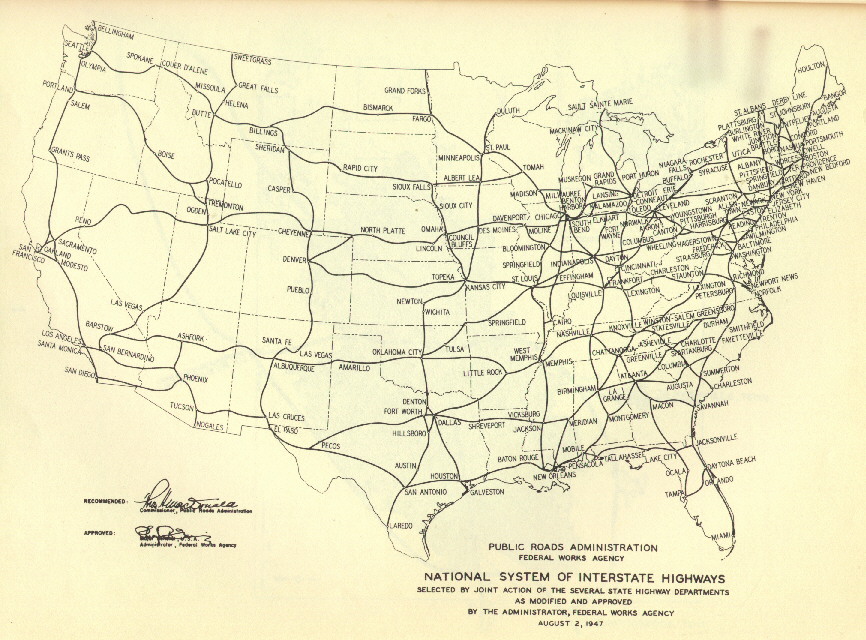
The paths of the highways that would become the interstates were laid out in a 1947 map, followed by a 1955 Department of Commerce document — often called the “yellow book” — that specified the paths these highways would take through city centers:
The plan’s key contributors included members of the auto industry (including General Motors CEO Charles Erwin Wilson) and highway engineers. Curiously, urban planners were absent — the profession barely existed at the time.
“Highway engineers dominated the decision-making,” says DiMento. “They were trained to design without much consideration for how a highway might impact urban fabric — they were worried about the most efficient way of moving people from A to B.”
As a result, the official plans dictated that highways cut directly through the core of virtually every major city in order to bring commuters from newly growing suburbs in and out:
This document was the basis for the Federal Aid Highway Act of 1956, which birthed the interstate system. The bill stipulated that the rest of a massive, nationwide highway system be toll-free, with 90 percent of the construction cost borne by the federal government through both gas taxes and other funding sources.
The new bill essentially gave states highways for free — provided they consented to the paths created in the yellow book, which had highways running through every city center in the US:
The yellow book called for I-80 and 280 to connect near the Golden Gate Bridge. (Public Roads Administration — Federal Works Agency)
The racial politics of "urban renewal"
State and city politicians accepted these plans for a variety of reasons. In an era when suburbs had just begun to grow, DiMento says, “local politicians saw urban freeways as a way of bringing suburban commuters into city.” Some local businesspeople supported them for similar reasons.
But an unmistakable part of the equation was the federally supported program of “urban renewal,” in which lower-income urban communities — mostly African-American — were targeted for removal.
“The idea was ‘let’s get rid of the blight,'” says DiMento. “And places that we’d now see as interesting, multi-ethnic areas were viewed as blight.” Highways were a tool for justifying the destruction of many of these areas.
The new freeways also isolated many other neighborhoods, ushering in their demise. Combined with federal housing bills that paid developers to tear down existing housing stock and replace it with high-rises, they resulted in the continued decimation of huge swaths of many cities.
“Many neighborhoods, predominantly black, were wiped out and turned into surface parking and highways,” Norton says, noting Black Bottom and Paradise Valley in Detroit, historical neighborhoods that were torn down to make way for I-375.
Downtown Detroit in 1951, versus today. The historical neighborhood of Black Bottom was on the right side of the image. (Shane Hampton/University of Oklahoma)
The same pattern was repeated over and over, leading to cities pockmarked with empty neighborhoods and destructive highways. People displaced from the destroyed areas moved to others, leading to overcrowding and increases in crime, while most people with the means fled to the suburbs — commuting on the new highways, and siphoning money away from these cities’ tax bases.
But not all the highways got built. Many city governments opposed them from the beginning — and in San Francisco, DC, and elsewhere, key segments were blocked by a coalition of local officials and residents. In New York, activists led by Jane Jacobs successfully prevented construction of I-78 through Lower Manhattan, which would have torn up much of Greenwich Village, SoHo, Little Italy, Chinatown, and the Lower East Side.
“The explanation, in almost every case, is that the relatively well-off, influential people in those cities were able to stop the urban highways that would have gone through their neighborhoods,” Norton says, pointing to Wisconsin Avenue, in DC, which was slated to become a highway but never did due to the protest of wealthy residents of the city’s Northwest quadrant.
“The destruction mostly happened in the most disenfranchised neighborhoods,” he says. “It’s astounding how selective it was.”

:format(webp)/cdn.vox-cdn.com/uploads/chorus_image/image/68728871/GrindsCut.0.0.1510007210.0.jpeg)