<?xml version="1.0" encoding="UTF-8"?><feed
	xmlns="http://www.w3.org/2005/Atom"
	xmlns:thr="http://purl.org/syndication/thread/1.0"
	xml:lang="en-US"
	>
	<title type="text">Kate Yoder | Vox</title>
	<subtitle type="text">Our world has too much noise and too little context. Vox helps you understand what matters.</subtitle>

	<updated>2026-04-03T22:31:04+00:00</updated>

	<link rel="alternate" type="text/html" href="https://www.vox.com/author/kate-yoder" />
	<id>https://www.vox.com/authors/kate-yoder/rss</id>
	<link rel="self" type="application/atom+xml" href="https://www.vox.com/authors/kate-yoder/rss" />

	<icon>https://platform.vox.com/wp-content/uploads/sites/2/2024/08/vox_logo_rss_light_mode.png?w=150&amp;h=100&amp;crop=1</icon>
		<entry>
			
			<author>
				<name>Kate Yoder</name>
			</author>
			
			<author>
				<name>Ayurella Horn-Muller</name>
			</author>
			
			<author>
				<name>Clayton Aldern</name>
			</author>
			
			<title type="html"><![CDATA[How climate science is sneakily getting funded under Trump]]></title>
			<link rel="alternate" type="text/html" href="https://www.vox.com/climate/484670/how-climate-science-is-sneakily-getting-funded-under-trump" />
			<id>https://www.vox.com/?p=484670</id>
			<updated>2026-04-03T18:31:04-04:00</updated>
			<published>2026-04-06T07:00:00-04:00</published>
			<category scheme="https://www.vox.com" term="Climate" /><category scheme="https://www.vox.com" term="Future Perfect" /><category scheme="https://www.vox.com" term="Science" />
							<summary type="html"><![CDATA[This story was originally published by Grist and is reproduced here as part of the&#160;Climate Desk&#160;collaboration. At the Department of Agriculture’s research division, everyone knows there’s one word they should never say, according to Ethan Roberts. “The forbidden C-word” — climate. Roberts, union president at the National Center for Agricultural Utilization Research in Peoria, Illinois, [&#8230;]]]></summary>
			
							<content type="html">
											<![CDATA[

						
<figure>

<img alt="an adult and child sit at the washington mall holding signs saying “you can’t delete climate change.” " data-caption="Protesters during the Stand-Up for Science rally in Washington D.C., March 2025. | Dominic Gwinn/Middle East Images/AFP/Getty Images" data-portal-copyright="Dominic Gwinn/Middle East Images/AFP/Getty Images" data-has-syndication-rights="1" src="https://platform.vox.com/wp-content/uploads/sites/2/2026/04/gettyimages-2203749079.jpg?quality=90&#038;strip=all&#038;crop=0,0,100,100" />
	<figcaption>
	Protesters during the Stand-Up for Science rally in Washington D.C., March 2025. | Dominic Gwinn/Middle East Images/AFP/Getty Images	</figcaption>
</figure>
<p class="has-text-align-none"><em>This story was originally published by <a href="https://grist.org/language/climate-federal-research-grants-national-science-foundation/">Grist</a> and is reproduced here as part of the&nbsp;<a href="https://www.climatedesk.org/about-us/">Climate Desk</a>&nbsp;collaboration.</em></p>

<p class="has-text-align-none">At the Department of Agriculture’s research division, everyone knows there’s one word they should never say, according to Ethan Roberts. “The forbidden C-word” — climate.</p>

<p class="has-text-align-none">Roberts, union president at the National Center for Agricultural Utilization Research in Peoria, Illinois, has worked for the federal government for nearly a decade. In that time, the physical science technician has weathered several political administrations, including President Donald Trump’s first term. None compare to what’s happening now.&nbsp;</p>

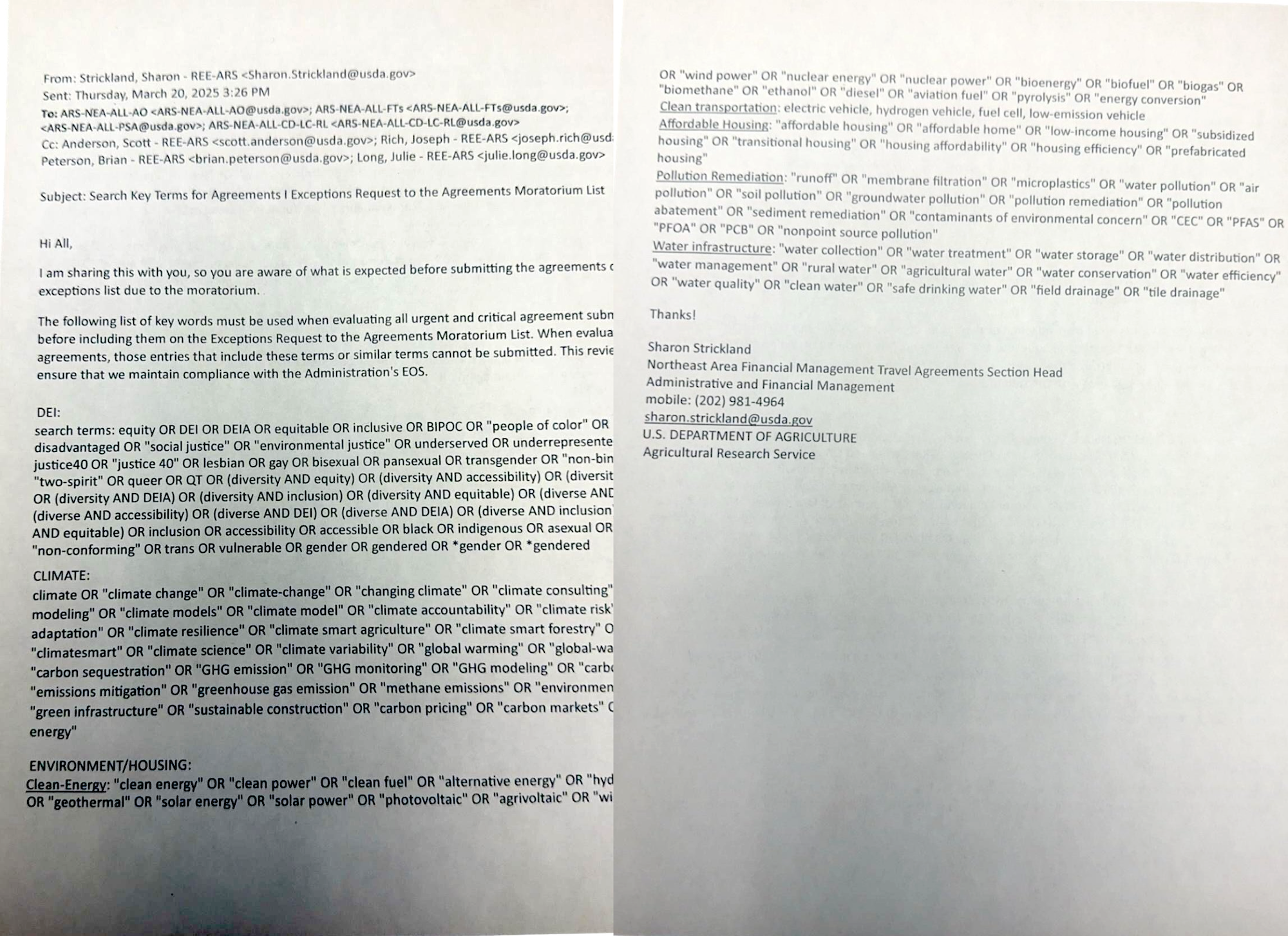
<p class="has-text-align-none">The sweeping transformation became apparent last March, after&nbsp;<a href="https://grist.org/wp-content/uploads/2026/03/more-perfect-banned-words-memo.png">a memo</a>&nbsp;from upper management at the USDA Agricultural Research Service instructed staffers to avoid submitting agreements and other contracts that used any of 100-plus&nbsp;<a href="https://grist.org/food-and-agriculture/usda-unfreezing-clean-energy-money-dei-climate/">newly banned words and phrases</a>. Roughly a third directly&nbsp;<a href="https://sentientmedia.org/phrases-newly-banned-at-usda/" rel="noreferrer noopener" target="_blank">related to</a>&nbsp;climate change, including “global warming,” “climate science,” and “carbon sequestration.”&nbsp;</p>

<p class="has-text-align-none">Roberts met with his union to figure out how to respond to the memo. They concluded that the best course of action was just to avoid the terms and try to get their research published by working around them. Throughout the federal agency, “climate change” was swapped for softer synonyms: “elevated temperatures,” “soil health,” and “extreme weather.”</p>

<p class="has-text-align-none">It’s part of a bigger trend. Across federal agencies and academic institutions, scientists are avoiding words they once used without hesitation. When Trump took office last year — calling coal “clean” and “beautiful” while deriding plans to tackle climate change as a “<a href="https://grist.org/language/strategy-behind-trump-climate-catchphrase-green-new-scam/">green scam</a>” — a so-called climate hushing took hold of the United States, as <a href="https://grist.org/business/companies-climate-plans-trump-earnings-greenhushing/">businesses</a>, <a href="http://grist.org/politics/democrats-arent-talking-about-climate-change-cheap-energy/">politicians</a>, and even <a href="https://grist.org/language/global-heating-climate-news-drought-chaos/">the news media</a> got quieter about global warming. There’s <a href="https://www.nytimes.com/interactive/2025/03/07/us/trump-federal-agencies-websites-words-dei.html" target="_blank" rel="noreferrer noopener">a long list of supposedly “woke” words</a> that agencies have been discouraged from using, many tied to climate change or diversity, equity, and inclusion (DEI) initiatives.</p>

<p class="has-text-align-none">The language changes were accompanied by larger shifts in how the federal government operates. Elon Musk’s Department of Government Efficiency (DOGE), laid off hundreds of thousands of <a href="https://www.washingtonpost.com/politics/2026/03/09/trump-hiring-federal-workers/" target="_blank" rel="noreferrer noopener">federal workers last year</a>. The Trump administration also slashed spending on science, cutting <a href="https://ourpublicservice.org/the-unraveling-of-public-science/" target="_blank" rel="noreferrer noopener">tens of billions of dollars in grants</a> for projects related to the environment and public lands. Researchers are adapting to the new landscape, with some finding creative ways to continue their climate research, from changing their wording to seeking out different sources of funding.   </p>

<p class="has-text-align-none">For federal researchers studying, say, the interplay between weather patterns and soybean diseases, the key is to reframe studies so they don’t clash with the Trump administration’s politics. “Instead of making it about the climate, you would instead just make it about the disease itself, and be like, ‘This disease does these things under these conditions,’ rather than ‘These conditions&nbsp;<em>cause</em>&nbsp;this disease to do this,’” Roberts added. “It’s just changing the focus.”</p>

<p class="has-text-align-none">You can see how federally funded research has changed by looking at the grants approved by the National Science Foundation, or NSF, an agency that provides roughly <a href="https://www.nsf.gov/about" target="_blank" rel="noreferrer noopener">a quarter</a> of the US government’s funding to universities. Grist’s analysis found that the number of NSF grants whose titles or abstracts mentioned “climate change” fell from 889 in 2023 to 148 last year, a 77 percent plunge. Part of that’s a result of NSF staffers approving fewer grants related to climate change under Trump. But researchers self-censoring by omitting the phrase in their proposals also appears to play a role, evidenced by the corresponding rise of “extreme weather” — a synonym that gets around the politicized language.</p>
<img src="https://platform.vox.com/wp-content/uploads/sites/2/2026/04/nsf-climate-interactive-static-vox.png?quality=90&#038;strip=all&#038;crop=0,0,100,100" alt="chart showing the distribution of climate language in NSF grant summaries" title="chart showing the distribution of climate language in NSF grant summaries" data-has-syndication-rights="1" data-caption="" data-portal-copyright="" />
<p class="has-text-align-none">Trent Ford, the state climatologist for Illinois, said he’s started using terms like “weather extremes” and “weather variability” in framing his proposals for grants.&nbsp;</p>

<p class="has-text-align-none">“It’s sort of a weird thing, because on principle, if we’re studying climate change, to not name climate change feels dirty,” said Ford, who’s also a research scientist at the Illinois State Water Survey at the University of Illinois Urbana Champaign. But it’s more of a practical decision than anything else: “We’ve seen where grants that say everything but ‘climate change’ and are obviously studying the impacts of climate change get through with no problem.” He only uses the phrase in grant proposals when he thinks it’s absolutely necessary and when efforts to steer around the term would look too obvious to a reviewer.</p>

<p class="has-text-align-none">Researchers have always had to tailor their framing to align with a funder’s priorities, in this case the federal government. Near the end of President Joe Biden’s term in late 2024, when Ford’s team applied for an NSF grant to study how climate conditions could affect Midwestern agriculture, it made sense to include a line about talking to a&nbsp;<em>diverse</em>&nbsp;group of farmers. But that word became a problem after Trump returned to office.</p>

<p class="has-text-align-none">“By the time the proposal got reviewed by the program manager at NSF, that same language that was required four months ago was now actually a death sentence on it,” Ford said. The NSF liked the proposal, but wanted the researchers to remove the line about reaching a diverse set of agricultural stakeholders and confirm that they would talk to “all American farmers,” Ford said. The team sent it back in, and the NSF approved it last April.</p>

<p class="has-text-align-none">Others weren’t so lucky. Another scientist at the Agricultural Research Service, who asked to remain anonymous out of fear of retaliation, said DOGE eliminated major research programs at the agency and, in the process, wiped out hundreds of thousands of dollars in federal funds for an initiative to grow plants without soil that “really didn’t have anything to do with climate change.” The scientist said it had only been labeled as climate research to “satisfy the previous Biden administration.”<br><br>“Anything, any project, that had ‘CC’ in front of it, was eliminated. Because ‘CC’ stands for climate change,” the staffer said. “So, unfortunately, that came back to bite them during this administration.”   </p>

<p class="has-text-align-none">Though not to this extreme, researchers have&nbsp;<a href="https://www.npr.org/sections/thetwo-way/2017/11/29/564043596/climate-scientists-watch-their-words-hoping-to-stave-off-funding-cuts" rel="noreferrer noopener" target="_blank">found themselves staying away from politically fraught terms</a>&nbsp;like “climate change” before. During the first Trump administration, Austin Becker, a professor at the University of Rhode Island who studies how ports and maritime infrastructure can be made more resilient to hazards like storms and flooding, started avoiding the phrase, even though it’s what motivated his research. “Everything that was ‘climate’ just became ‘coastal resilience,’” he said. “And we’ve kind of just stuck with that ever since.”</p>

<p class="has-text-align-none">Ford initially resisted pressure to stop using the phrase from colleagues he was writing grants with, but he gave in this time around for financial reasons. “Getting a grant could be the difference between a graduate student getting a paycheck and us having to let a graduate student go, or having to let a full-time employee of the university go,” he said.</p>

<p class="has-text-align-none">Some researchers have been looking for grants in new places as federal money dries up. Dana Fisher, a professor at American University and the director of its Center for Environment, Community, and Equity, has procured private funding to research ways to improve and expand communication about climate change in North America. She’s also looking overseas for funding, where she’s had success during past Republican administrations that were hesitant to approve grants for climate research. When George W. Bush was president, Fisher got a grant to study how climate action in US cities and states could influence federal policymaking, an effort funded by the Norwegian Research Council. That fact raised some eyebrows when she mentioned it to people she was interviewing in Congress. “They’re like, ‘Huh?’” Fisher said. “I was like, ‘Well, that’s what happens when there’s a Republican administration.’”</p>

<p class="has-text-align-none">As scarce as funding for anything related to the climate has become under Trump, some topics appear to be even more politically toxic. In Ford’s experience, and from what he’s heard from other researchers, “equity” and “environmental justice” are “actually dirtier words.” The Trump administration has closed the Environmental Protection Agency’s environmental justice offices at its headquarters and in all 10 of its regional offices, and continues to <a href="https://www.eenews.net/articles/trump-epa-lays-off-more-environmental-justice-staff/" target="_blank" rel="noreferrer noopener">lay off EPA staff</a> who helped communities dealing with pollution. Grist’s analysis of grants reveals a similar pattern: Under Trump, mentions of DEI have vanished from NSF grants entirely. Terms like “clean energy” and “pollution” have also declined, but not as sharply as climate change.</p>
<img src="https://platform.vox.com/wp-content/uploads/sites/2/2026/04/nsf-decline-bar-vox.png?quality=90&#038;strip=all&#038;crop=0,0,100,100" alt="" title="" data-has-syndication-rights="1" data-caption="" data-portal-copyright="" />
<p class="has-text-align-none">You could view the federal government’s pressure on scientists to change their language in different ways. Is it Orwellian-style censorship, silencing dissent and policing language? Or simply the right of a funder, whose politics changes with each administration, to ask for research that reflects its concerns? Does it affect what research gets done, or will applicants simply swap in harmless synonyms to ensure the work can continue?&nbsp;</p>

<p class="has-text-align-none">The answer is complicated, according to the USDA’s Roberts. Many of the climate projects at the agency’s research division that have so far avoided cancellation are stuck in funding purgatory, awaiting a fate that could hinge on a politically charged word or two. Scientists are adapting their research to better align with White House priorities, hoping to continue equipping farmers with the knowledge of how to adapt to a warming world — and scrubbing any forbidden language in the meantime.</p>

<p class="has-text-align-none">“Clever word usage, and controlling the scope of how the research is presented, allows for scientists to keep doing the work,” Roberts said. “There’s no one going around hunting these people down, thankfully. Not yet, anyway.”</p>

<hr class="wp-block-separator has-alpha-channel-opacity" />

<p class="has-text-align-none"><strong>A list of words related to climate and the environment included in the leaked USDA ARS banned words memo</strong></p>

<p class="has-text-align-none"><strong>Climate:</strong>&nbsp;climate OR “climate change” OR “climate-change” OR “changing climate” OR “climate consulting” modeling” OR “climate models” OR “climate model” OR “climate accountability” OR “climate risk adaptation” OR “climate resilience” OR “climate smart agriculture” OR “climate smart forestry” O[–] “climatesmart” OR “climate science” OR “climate variability” OR “global warming” OR “global-wa[–] “carbon sequestration” OR “GHG emission” OR “GHG monitoring” OR “GHG modeling” OR “carb[–] “emissions mitigation” OR “greenhouse gas emission” OR “methane&nbsp;emissions” OR “environmen[–] “green infrastructure” OR “sustainable construction” OR “carbon pricing” OR “carbon markets” O[–] energy”</p>

<p class="has-text-align-none"><strong>Clean energy:</strong>&nbsp;“clean energy” OR “clean power” OR “clean fuel” OR “alternative energy” OR “hyd[–] OR “geothermal” OR “solar energy” OR “solar power” OR “photovoltaic” OR “agrivoltaic” OR “wi[–] OR “wind power” OR “nuclear energy” OR “nuclear power” OR “bioenergy” OR “biofuel” OR “biogas” OR “biomethane” OR “ethanol” OR “diesel” OR “aviation fuel” OR “pyrolysis” OR “energy conversion”</p>

<p class="has-text-align-none"><strong>Clean transportation:</strong>&nbsp;electric vehicle, hydrogen vehicle, fuel cell, low-emission vehicle</p>

<p class="has-text-align-none"><strong>Pollution remediation:</strong>&nbsp;“runoff” OR “membrane filtration” OR “microplastics” OR “water pollution” OR “air pollution” OR “soil pollution” OR “groundwater pollution” OR “pollution remediation” OR “pollution abatement” OR “sediment remediation” OR “contaminants of environmental concern” OR “CEC” OR “PFAS” OR “PFOA” OR “PCB” OR “nonpoint source pollution”</p>

<p class="has-text-align-none"><strong>Water infrastructure:</strong>&nbsp;“water collection” OR “water treatment” OR “water storage” OR “water distribution” OR “water management” OR “rural water” OR “agricultural water” OR “water conservation” OR “water efficiency” OR “water quality” OR “clean water” OR “safe drinking water” OR “field drainage” OR “tile drainage”</p>

<p class="has-text-align-none"><em><strong>Note:&nbsp;</strong>The original leaked&nbsp;<a href="https://grist.org/wp-content/uploads/2026/03/more-perfect-banned-words-memo.png">memo screenshot</a>&nbsp;was obtained by More Perfect Union. Cut off words or phrases are marked with [–].</em></p>
						]]>
									</content>
			
					</entry>
			<entry>
			
			<author>
				<name>Kate Yoder</name>
			</author>
			
			<title type="html"><![CDATA[Inside the federal government’s purge of climate data]]></title>
			<link rel="alternate" type="text/html" href="https://www.vox.com/climate/420289/national-climate-assesment-trump-administration-climate-science-data-purge" />
			<id>https://www.vox.com/?p=420289</id>
			<updated>2025-07-18T12:13:58-04:00</updated>
			<published>2025-07-21T07:00:00-04:00</published>
			<category scheme="https://www.vox.com" term="Climate" /><category scheme="https://www.vox.com" term="Donald Trump" /><category scheme="https://www.vox.com" term="Natural Disasters" /><category scheme="https://www.vox.com" term="Politics" /><category scheme="https://www.vox.com" term="Science" /><category scheme="https://www.vox.com" term="Trump Administration" />
							<summary type="html"><![CDATA[This story was originally published by Grist and is reproduced here as part of the Climate Desk collaboration. For 25 years, a group of the country’s top experts has been fastidiously tracking the ways that climate change threatens every part of the United States. Their findings informed the National Climate Assessments, a series of congressionally [&#8230;]]]></summary>
			
							<content type="html">
											<![CDATA[

						
<figure>

<img alt="GIF illustrating map of United States and it slowly disappearing, referencing the purge of climate data" data-caption="" data-portal-copyright="" data-has-syndication-rights="1" src="https://platform.vox.com/wp-content/uploads/sites/2/2025/07/natl-climate-assessment-colorful-2.webp?quality=90&#038;strip=all&#038;crop=0,0,100,100" />
	<figcaption>
		</figcaption>
</figure>
<p class="has-text-align-none"><em>This story was originally published by </em><a href="https://grist.org/language/trump-administration-climate-data-disappear-national-climate-assessment/">Grist</a><em> and is reproduced here as part of the <a href="https://www.climatedesk.org/">Climate Desk</a> collaboration. </em></p>

<p class="has-text-align-none">For 25 years, a group of the country’s top experts has been fastidiously tracking the ways that climate change threatens every part of the United States. Their findings informed the National Climate Assessments, a series of congressionally mandated reports released every four years that translated the science into accessible warnings for policymakers and the public. But that work came to a halt this spring when the Trump administration abruptly dismissed all 400 experts working on the next edition. Then, late last month, all of the past reports vanished too, along with the federal website they lived on.</p>

<p class="has-text-align-none"></p>

<p class="has-text-align-none">A lot of information about the changing climate has disappeared under President Donald Trump’s second term, but the erasure of the National Climate Assessments is “by far the biggest loss we’ve seen,” said Gretchen Gehrke, who monitors federal websites with the Environmental Data and Governance Initiative. The National Climate Assessments were one of the most approachable resources that broke down how climate change will affect the places people care about, she said. The reports were also used by a wide swath of stakeholders — policymakers, farmers, businesses — to guide their decisions about the future. While the reports have been archived elsewhere, they’re no longer as easy to access. And it’s unclear what, if anything, will happen to the report that was planned for 2027 or 2028, which already existed in draft form.</p>

<p class="has-text-align-none">So why did the reports survive Trump’s first term, but not his second? </p>

<p class="has-text-align-none">You could view their disappearance in a few different ways, experts said — as a flex of executive power, an escalation in the culture war over climate change, or a strategic attempt to erase the scientific foundation for climate policy. “If you suppress information and data, then you don’t have the evidence you need to be able to create regulations, strengthen regulations, and even to combat the repeal of regulations,” Gehrke said.&nbsp;</p>

<p class="has-text-align-none">This isn’t climate denial in the traditional sense. The days of loudly debating the science have mostly given way to something quieter and more insidious: a campaign to withhold the raw information itself. “I don’t know if we’re living in climate denial anymore,” said Leah Aronowsky, a science historian at the Columbia Climate School. “We have this new front of denial by erasure.”</p>

<p class="has-text-align-none">By cutting funding for research and withholding crucial data, the Trump administration is making it harder to know exactly how the planet is changing. </p>

<p class="has-text-align-none">In April, the administration pulled nearly $4 million in funding from a Princeton program to improve computer models predicting changes in the oceans and atmosphere, claiming the work created “climate anxiety” among young people. That same month, the Environmental Protection Agency failed to submit its annual report to the United Nations detailing the country’s greenhouse gas emissions. In May, the National Oceanic and Atmospheric Administration ended its 45-year tradition of tracking billion-dollar weather disasters. Trump also hopes to shut down the Mauna Loa laboratory in Hawaii, which has measured the steady rise in atmospheric levels of carbon dioxide since the 1950s — the first data to definitively show humans were changing the climate. </p>

<p class="has-text-align-none">“This kind of wholesale suppression of an entire field of federally sponsored research, to my knowledge, is historically unprecedented,” Aronowsky said.</p>
<div class="spotify-embed"><iframe src="https://open.spotify.com/embed/episode/0ifr5thyodF5RWQWaUt6Ns" width="100%" height="152" frameborder="0" allowfullscreen="" allow="autoplay; clipboard-write; encrypted-media; fullscreen; picture-in-picture" loading="lazy"></iframe></div>
<p class="has-text-align-none">In a response to a request for comment, a NASA spokesperson said that it has “no legal obligations to host globalchange.gov’s data,” referring to the site that hosted the National Climate Assessments, adding that the US Global Change Research Program had already “met its statutory requirements by presenting its reports to Congress.” The EPA directed Grist to a webpage containing past greenhouse gas emissions reports, as well as a version of what was supposed to be this year’s report obtained by the Environmental Defense Fund. However, the agency confirmed that the latest data has not been officially released. The White House declined to comment, and the National Oceanic and Atmospheric Administration did not respond.</p>

<figure class="wp-block-pullquote"><blockquote><p>Climate denial first took off in the 1990s, when the oil and gas companies and industry-friendly think tanks started sowing doubt about climate science.</p></blockquote></figure>

<p class="has-text-align-none">Last year, a leaked training video from Project 2025 — the policy roadmap organized by the Heritage Foundation, a conservative think tank — showed a former Trump official declaring that political appointees would have to “eradicate climate change references from absolutely everywhere.” The strategy appears to be designed to boost the fossil fuel industry at a time when clean energy has become competitive and the reality of climate change harder to dismiss, as floods, fires, and heat waves have become perceptibly worse. “We will drill, baby, drill,” Trump said in his inauguration speech in January.</p>

<p class="has-text-align-none">The administration hasn’t exactly been subtle about its endgame. Lee Zeldin, the head of the EPA, doesn’t deny the reality of climate change (he calls himself a “climate realist”), but he’s zealously dismantled environmental programs and has recommended that the White House strike down the “endangerment finding,” the bedrock of US climate policy. It comes from a 2007 Supreme Court ruling on the Clean Air Act that required the EPA to regulate greenhouse gases as pollutants since they endanger public health. If the administration can convince the courts that climate change isn’t a health consideration, it could end that regulatory obligation. </p>

<p class="has-text-align-none">“If you’re removing information about climate change, its reality, and its impact on people, then I think it’s a lot easier to make the case that it’s not an environmental health issue,” Gehrke said.</p>

<p class="has-text-align-none">There’s a word for the idea that ignorance can serve political ends: agnotology (from the Greek “agnosis,” or “not knowing”), the study of how knowledge is deliberately obscured. What Trump is doing to information about climate change fits squarely in that tradition, according to Aronowsky: “If you remove it, then in a certain sense, it no longer exists, and therefore, there’s nothing to even debate, right?”</p>

<p class="has-text-align-none">Climate denial first took off in the 1990s, when the oil and gas companies and industry-friendly think tanks started sowing doubt about climate science. Over the decades, as the evidence became rock-solid, those who opposed reducing the use of fossil fuels gradually shifted from outright denying the facts to attacking solutions like wind and solar power. What the Trump administration is doing now marks a radical break from this long-term trend, said John Cook, a climate misinformation researcher at the University of Melbourne in Australia. </p>

<p class="has-text-align-none">“This is a 180, not just a turn, but diving into something we’ve never even seen before,” he said. On the other hand, Cook said, the administration is taking a classic climate denial tactic — painting scientists as “alarmists” or conspirators who can’t be trusted — and turning it into government policy.</p>

<p class="has-text-align-none">Half a year in, the second Trump administration’s treatment of climate information hasn’t yet reached the “eradication” levels that Project 2025 aspired to, at least on government websites. The EPA’s climate change website, for instance, is still up and running, even though all references to the phenomenon were erased on the agency’s home page. Most of the website deletions so far have served to isolate climate change as an issue, erasing its relationship to topics such as health and infrastructure, Gehrke said. Up until the National Climate Assessments disappeared, she would have said that “climate erasure” was an inappropriate characterization of what’s happening. “But now, I’m really not so sure,” she said.</p>

<p class="has-text-align-none">Rachel Cleetus, the senior policy director with the Union of Concerned Scientists, thinks that the administration’s actions actually go beyond erasure. “They’re literally trying to change the basis on which a lot of policymaking is advanced — the science basis, the legal basis, and the economic basis,” she said. Her biggest concern isn’t just what facts have been removed, but what political propaganda might replace them. “That’s more dangerous, because it really leaves people in this twilight zone, where what’s real, and what’s important, and what is going to affect their daily lives is just being obfuscated.” </p>
						]]>
									</content>
			
					</entry>
			<entry>
			
			<author>
				<name>Kate Yoder</name>
			</author>
			
			<title type="html"><![CDATA[Conservatives tried to repeal one of the country’s strongest climate policies. They failed big time.]]></title>
			<link rel="alternate" type="text/html" href="https://www.vox.com/climate/383706/climate-washington-cap-trade-carbon-tax-repeal-election-2024" />
			<id>https://www.vox.com/?p=383706</id>
			<updated>2024-11-08T13:13:39-05:00</updated>
			<published>2024-11-08T12:20:00-05:00</published>
			<category scheme="https://www.vox.com" term="2024 Elections" /><category scheme="https://www.vox.com" term="Climate" /><category scheme="https://www.vox.com" term="Energy" /><category scheme="https://www.vox.com" term="Politics" />
							<summary type="html"><![CDATA[This story was originally published by&#160;Grist&#160;and is republished here as part of the&#160;Climate Desk&#160;collaboration. The people of Washington state elected to save the most ambitious price on carbon in the country. A large majority of voters,&#160;62 percent, rejected a ballot initiative to repeal the state’s Climate Commitment Act, the cap-and-trade law that has already raised [&#8230;]]]></summary>
			
							<content type="html">
											<![CDATA[

						
<figure>

<img alt="The Shell Puget Sound Oil Refinery with Mt. Baker behind, near Anacortes, Washington state." data-caption="Mount Baker is seen just behind a Shell oil refinery near Anacortes, Washington. | Getty Images/Gallo Images/ROOTS" data-portal-copyright="Getty Images/Gallo Images/ROOTS" data-has-syndication-rights="1" src="https://platform.vox.com/wp-content/uploads/sites/2/2024/11/GettyImages-998732292.jpg?quality=90&#038;strip=all&#038;crop=0,0,100,100" />
	<figcaption>
	Mount Baker is seen just behind a Shell oil refinery near Anacortes, Washington. | Getty Images/Gallo Images/ROOTS	</figcaption>
</figure>
<p class="has-text-align-none"><em>This story was originally published by&nbsp;<a href="https://grist.org/politics/washington-climate-law-repeal-failed-cap-and-trade/">Grist</a>&nbsp;and is republished here as part of the&nbsp;<a href="http://climatedesk.org/">Climate Desk</a>&nbsp;collaboration.</em></p>

<p class="has-text-align-none">The people of Washington state elected to save the most ambitious price on carbon in the country. A large majority of voters,&nbsp;<a href="https://www.seattletimes.com/seattle-news/politics/washington-state-general-election-results-2024/?300_tab=5&amp;300_filter=0" target="_blank" rel="noreferrer noopener">62 percent</a>, rejected a ballot initiative to repeal the state’s Climate Commitment Act, the cap-and-trade law that has already raised more than $2 billion for cleaning up transportation, shifting to clean energy, and helping people adapt to the effects of a changing climate.</p>

<p class="has-text-align-none">On an otherwise depressing election night for voters who consider climate change a top concern, there was an air of victory at the Seattle Convention Center on Tuesday evening, where Gov. Jay Inslee and a couple hundred organizers with the campaign opposing the repeal gathered for a watch party. As news rolled in that former President Donald Trump was the favorite to win the presidential election, many in the crowd did their best to focus on their success in rescuing the state’s landmark carbon-cutting law. Inslee, the outgoing Democratic governor whose signature climate legislation was at risk, said that the results should embolden states to take action on climate change.</p>

<p class="has-text-align-none">“I really feel it was important from a national perspective, because every state legislator can now look to Washington and say, ‘This is a winning issue,’” Inslee said in an interview with Grist. “This is something you can defend and win big on. And we won big.”</p>

<p class="has-text-align-none">Inslee said that the effort to defeat the initiative had emphasized the concrete, local benefits of the program to voters, rather than getting into the weeds about how cap and trade works. “We focused on the easiest thing for people to wrap their minds and hearts around,” Inslee said, pointing to the tangible economic benefits that the repeal would take away: the funding for transportation, schools, and fighting fires.</p>

<p class="has-text-align-none">Putting any kind of price on carbon has long been seen as <a href="https://grist.org/politics/who-killed-the-carbon-tax-republicans-or-democrats/">politically risky</a>. Opponents of Washington’s Climate Commitment Act, including Brian Heywood, the hedge fund manager driving the repeal effort, blamed it for raising gas prices. The ballot measure would have not only struck down the state’s price on pollution — it would have also prevented the state from ever enacting a similar policy in the future.</p>

<p class="has-text-align-none">The resounding public support for Washington’s cap-and-trade program “is going to echo coast to coast,” said Democratic state Rep. Joe Fitzgibbon, who helped pass the legislation in 2021, during a speech at the convention center. Officials in states including <a href="https://www.reuters.com/markets/carbon/washington-state-vote-harbinger-wider-carbon-markets-2024-11-01/" target="_blank" rel="noreferrer noopener">New Jersey, Maryland, and New York</a> have been eyeing similar policies, and they’ve been watching the results in Washington to see how voters responded. “I know that there are states that are thinking, ‘What can we do?’” Fitzgibbon told Grist. “And especially when there’s a vacuum at the federal level, that’s when I think you see the most motivation in state capitols to move.”</p>

<p class="has-text-align-none">Cap and trade already exists in California, and in a more limited form among <a href="https://www.rggi.org/" target="_blank" rel="noreferrer noopener">a network of states in the East</a>, but <a href="https://grist.org/economics/washington-state-cap-and-invest-california-lessonsit-works/">Washington’s law is more ambitious</a>, aiming to slash emissions nearly in half by 2030, using 1990 levels as a baseline, and by 95 percent by 2050.</p>

<p class="has-text-align-none">“Washington state is the gold standard for how we tackle climate change in a way that’s inclusive, in a way that’s politically popular, in a way that actually will decarbonize,” said state Sen. Joe Nguyễn, a Democrat who chairs the state’s Environment, Energy, and Technology Committee. A review of existing climate policies in 41 countries in August found that <a href="https://grist.org/economics/climate-policy-emissions-study/">carbon pricing programs were the most likely of any policy to lead to large emissions cuts</a>.</p>

<p class="has-text-align-none">The Climate Commitment Act’s passage in 2021 followed&nbsp;<a href="https://grist.org/economics/after-a-decade-of-failures-washington-state-passes-a-cap-on-carbon-emissions/">more than a decade of failed attempts to put a price on pollution</a>&nbsp;in Washington state. It requires companies to buy pollution permits at quarterly auctions, a way to generate money for climate solutions and at the same time incentivize businesses to reduce their emissions. The number of permits available decreases over time. The program has so far raised billions to make public transit free for youth, install energy-efficient heat pumps in homes, and reduce local air pollution, among other measures.<a href="https://grist.org/politics/environment-conservation-climate-resilience-ballot-initaitives-election/"></a></p>

<p class="has-text-align-none">Across the state, almost 600 organizations joined the “No on 2117” coalition to defend the law in 2024, ultimately raising <a href="https://www.pdc.wa.gov/political-disclosure-reporting-data/browse-search-data/committees/co-2024-35713" target="_blank" rel="noreferrer noopener">$16 million</a>. Many businesses, religious organizations, health advocates, and agricultural organizations were on board. At the event Tuesday, there were security guards representing unionized labor, the chair of the Suquamish Tribe, and a public policy manager from the tech giant Amazon. “We put together, all of us, the most extraordinary coalition in the history of this state, on any issue, ever,” said Gregg Small, executive director of the group Climate Solutions, in a speech at the convention center.</p>

<p class="has-text-align-none">The initiative faced other headwinds. Ballots explicitly alerted voters to the fiscal costs of the repeal, despite <a href="https://www.nwprogressive.org/weblog/2024/08/washington-state-supreme-court-quashes-jim-walshs-lawsuit-to-hide-the-costs-of-his-destructive-initiatives-from-voters.html" target="_blank" rel="noreferrer noopener">appeals to the state Supreme Court</a> by the Washington State Republican Party to get that language removed. And Washington’s gas prices — which soared to <a href="https://www.cascadepbs.org/environment/2023/07/why-washington-gas-prices-are-nations-highest" target="_blank" rel="noreferrer noopener">$5, the highest in the country</a>, in 2023 — have now come down to around <a href="https://gasprices.aaa.com/?state=WA" target="_blank" rel="noreferrer noopener">$4 a gallon</a>.</p>

<p class="has-text-align-none"><a href="https://www.seattletimes.com/seattle-news/politics/washington-state-general-election-results-2024/?300_tab=5&amp;300_filter=0">Another ballot initiative</a>, which would complicate the state’s plans to get off natural gas, was still too close to call on Friday. With ballots still left to count, 51 percent of voters approved of the measure, which targets new building codes that make installing natural gas more difficult and <a href="https://www.seattletimes.com/seattle-news/climate-lab/states-new-law-involving-pse-aspires-to-set-a-course-for-the-future/" target="_blank" rel="noreferrer noopener">legislation to help the state’s largest utility accelerate its use of clean energy</a>.</p>

<p class="has-text-align-none">Now that Washington’s cap-and-trade program survived the repeal, the state can move forward with plans to <a href="https://ecology.wa.gov/air-climate/climate-commitment-act/cap-and-invest/linkage" target="_blank" rel="noreferrer noopener">link its carbon market up with California and Quebec’s</a>. The state can also begin the years-long process of implementing the Climate Commitment Act’s program to regulate air quality. This summer, the state began <a href="https://washingtonstatestandard.com/2024/08/27/new-wa-program-aims-to-curb-air-pollution-in-parts-of-state-most-affected-by-it/" target="_blank" rel="noreferrer noopener">releasing grants to help reduce air pollution in “overburdened” communities</a>, but much of the work had been on hold as the state waited to see if voters would keep the law, according to David Mendoza, the director of public advocacy and engagement at the Nature Conservancy in Washington state.</p>

<p class="has-text-align-none">The whole repeal initiative might have been a blessing in disguise, Nguyễn said. It gave people a chance to pay attention to all the work the state had done on climate change that might otherwise have been ignored. “I actually want to thank Brian Heywood and his cronies for putting this on the ballot, and just reaffirming to everybody that we care about climate change in Washington state.”</p>
						]]>
									</content>
			
					</entry>
			<entry>
			
			<author>
				<name>Kate Yoder</name>
			</author>
			
			<title type="html"><![CDATA[Pizzlies, narlugas, and other creatures from our weird changing world]]></title>
			<link rel="alternate" type="text/html" href="https://www.vox.com/2016/6/4/11850862/real-animal-hybrids-pizzly-narluga" />
			<id>https://www.vox.com/2016/6/4/11850862/real-animal-hybrids-pizzly-narluga</id>
			<updated>2016-06-03T10:15:46-04:00</updated>
			<published>2016-06-04T10:00:03-04:00</published>
			<category scheme="https://www.vox.com" term="Climate" />
							<summary type="html"><![CDATA[Originally published on Grist. Climate change is one strange matchmaker. Warmer temperatures have led to shifting habitats and shifting mating habits. And occasionally, when two bears collide, the result is neither grizzly nor polar, but pizzly. Or should I say grolar? In the coming years, we&#8217;ll face more naming conundrums like this one. A 2015 [&#8230;]]]></summary>
			
							<content type="html">
											<![CDATA[

						
<figure>

<img alt="" data-caption="" data-portal-copyright="Grist/&lt;a href=&quot;http://www.kameliabates.com/&quot;&gt;Amelia Bates&lt;/a&gt;" data-has-syndication-rights="1" src="https://platform.vox.com/wp-content/uploads/sites/2/chorus/uploads/chorus_asset/file/6589179/hybrid-animals.jpg?quality=90&#038;strip=all&#038;crop=0,0,100,100" />
	<figcaption>
		</figcaption>
</figure>
<p><em>Originally published on </em><a href="https://cdn.ampproject.org/c/grist.org/climate-energy/pizzlies-narlugas-and-other-creatures-from-our-weird-changing-world/amp/"><em>Grist</em></a><em>.</em></p>

<p>Climate change is one strange matchmaker. Warmer temperatures have led to shifting habitats and shifting mating habits. And occasionally, when two bears collide, the result is neither grizzly nor polar, but pizzly.</p>

<p>Or should I say grolar? In the coming years, we&rsquo;ll face more naming conundrums like this one. A <a href="http://www.nature.com/nclimate/journal/v5/n9/full/nclimate2699.html">2015 <em>Nature</em> study</a> found that by the end of the century, 6 percent of species worldwide are likely to come into contact with new species to potentially reproduce with. Hybrids are an ordinary part of the evolutionary process (even some humans are<a href="http://www.nytimes.com/2016/02/23/science/ancient-humans-may-have-left-a-genetic-mark-on-neanderthals.html?_r=0"> part Neanderthal</a>), but interbreeding isn&rsquo;t always advantageous. <a href="https://www.washingtonpost.com/news/animalia/wp/2016/05/23/love-in-the-time-of-climate-change-grizzlies-and-polar-bears-are-now-mating/">Washington Post reports</a> that as grizzlies and grolars encroach on dwindling polar territory, they may accelerate the decline of their purebred cousins.</p>

<p>In the Arctic, where icy habitats are melting together, even more weird stuff is going down. Introducing some hybrids brought to life by the Cupid&rsquo;s arrow of climate change &mdash; and some speculation as to what we&rsquo;ll end up calling these critters.</p>
<h2 class="wp-block-heading">Grolar vs. pizzly bear</h2><div data-chorus-asset-id="6589203"><img src="https://platform.vox.com/wp-content/uploads/sites/2/chorus/uploads/chorus_asset/file/6589203/grolar-pizzly.gif"></div>
<p>Grizzly-polar bear hybrids, the existence of which was confirmed <a href="https://grist.org/article/fo-shizzle-my-pizzly/">10 years</a> ago, are once again in the news after one was <a href="https://www.washingtonpost.com/news/animalia/wp/2016/05/23/love-in-the-time-of-climate-change-grizzlies-and-polar-bears-are-now-mating/">shot by a hunter in a remote territory</a> of Canada. The bear has white fur, brown paws, and a grizzly-shaped head. Climate change has encouraged the two species to mingle <a href="http://www.theguardian.com/environment/2016/may/18/pizzly-grolar-bear-grizzly-polar-hybrid-climate-change">more often</a> recently, prodding polar bears to roam farther from their shrinking Arctic territory while grizzlies in Canada and Alaska move north.</p>

<p>Many names have cropped up over the years: <a href="http://www.smh.com.au/environment/animals/grolar-or-pizzly-hybrid-bear-a-victim-of-global-warming-says-expert-20160518-goyh3k.html#ixzz4997R8H1Z">pizzly-grizzly</a>, <a href="http://www.smh.com.au/environment/animals/grolar-or-pizzly-hybrid-bear-a-victim-of-global-warming-says-expert-20160518-goyh3k.html#ixzz4997R8H1Z">polargrizz</a>, and <a href="http://grist.org/article/fo-shizzle-my-pizzly/">nanulak</a> (a combination of the Inuit nanuk<em>, </em>polar bear, and aklak<em>, </em>grizzly bear). But <a href="http://www.natureworldnews.com/articles/22559/20160519/pizzly-grolar-bear-hybrid-grizzly-polar-cutest-result-climate-change.htm">recent</a> <a href="http://www.theguardian.com/environment/2016/may/18/pizzly-grolar-bear-grizzly-polar-hybrid-climate-change">headlines</a> <a href="http://www.cbc.ca/news/canada/north/grizzly-polar-bear-hybrid-arviat-nunavut-1.3586738">show</a> pizzly versus grolar is where the debate lies today. Though pizzly is pretty fun, <a href="https://www.google.com/trends/explore#q=pizzly%2C%20grolar&amp;cmpt=q&amp;tz=Etc%2FGMT%2B7">Google Trends shows</a> grolar is currently winning the popularity prize.</p>
<h2 class="wp-block-heading">Rotted vs. spinged seal</h2><div data-chorus-asset-id="6589217"><img src="https://platform.vox.com/wp-content/uploads/sites/2/chorus/uploads/chorus_asset/file/6589217/spinged-rotted.gif"></div>
<p>As sea ice habitats shift, the chance of ringed seals, uh, &#8220;sealing the deal&#8221; with spotted seals increases, according to a <a href="http://www.nature.com/nature/journal/v468/n7326/extref/468891a-s1.pdf">2010 study from <em>Nature</em></a>. Other seal species are beginning to blend, too, like bearded, ribbon, and harp seals (now <em>there&rsquo;s</em> a combo). No word yet as to whether a spotted-ringed seal has been seen in the wild, but we&rsquo;re guessing it would look something like the drawing above.</p>

<p>The question of rotted vs. spinged is a tough one. &#8220;Rotted&#8221;<em> </em>is unnervingly close to rotten<em> (</em>not a thing we want for these li&rsquo;l guys!), whereas &#8220;spinged&#8221; has the danger of being pronounced with the soft <em>g</em> of sponged. In this case, we may have to settle for spotted-ringed seal unless someone has a better suggestion.</p>
<h2 class="wp-block-heading">Narluga vs. belwhal</h2><div data-chorus-asset-id="6589241"><img src="https://platform.vox.com/wp-content/uploads/sites/2/chorus/uploads/chorus_asset/file/6589241/narluga-beluwhal.gif"></div>
<p>In the 1980s, researchers discovered a <a href="http://www.nature.com/nature/journal/v468/n7326/extref/468891a-s1.pdf">whale skull</a> in West Greenland that looked suspiciously like a beluga-narwhal mashup. Since then, hunters have spotted the hybrid creatures in chilly Arctic waters. Apparently beluga whales and narwhals produce offspring with <a href="http://www.smithsonianmag.com/science-nature/brown-polar-bears-beluga-narwhals-and-other-hybrids-brought-to-you-by-climate-change-7331236/">big, burly heads</a> &mdash; but, sadly, no tusks. (We drew one in anyway.)</p>

<p>While belwhal is a worthwhile contender, narluga<em> </em>is hard to beat. It captures the distinctive sounds of both animals&rsquo; names &mdash; the nar- of narwhal and the -luga<em> </em>of<em> beluga &mdash;</em> and sounds pretty mellifluous, to boot. Try it yourself: <em>Narluuuuuuuuga!</em></p>
<hr class="wp-block-separator" />
<p>Whatever else happens to the climate, one thing&rsquo;s for sure: We&rsquo;re bearing witness to a future that looks and sounds pretty weird. What&rsquo;s next? A bottlenose-orca (bottlenorca)? Perhaps a caribou-moose (carimoose or moosibou)?</p>

<p><em>Grist is a nonprofit news site that uses humor to shine a light on big green issues. Get their email newsletter </em><a href="http://grist.org/subscribe/"><em>here</em></a><em>, and follow them on </em><a href="https://www.facebook.com/grist.org"><em>Facebook</em></a><em> and </em><a href="https://twitter.com/grist"><em>Twitter</em></a><em>.</em></p>
<hr class="wp-block-separator" />
						]]>
									</content>
			
					</entry>
			<entry>
			
			<author>
				<name>Kate Yoder</name>
			</author>
			
			<title type="html"><![CDATA[Climatarian, vegavore, reducetarian: why we have so many words for cutting back on meat]]></title>
			<link rel="alternate" type="text/html" href="https://www.vox.com/2016/5/21/11715014/climatarian-vegavore-reducetarian" />
			<id>https://www.vox.com/2016/5/21/11715014/climatarian-vegavore-reducetarian</id>
			<updated>2016-05-19T15:24:26-04:00</updated>
			<published>2016-05-21T10:00:02-04:00</published>
			<category scheme="https://www.vox.com" term="Climate" />
							<summary type="html"><![CDATA[Originally published on Grist. A climatarian, a reducetarian, and a sustainatarian walk into a bar. It sounds like the beginning of a joke (and it is*) but it&#8217;s also the world we live in now. Those words are just the tip of the iceberg lettuce when it comes to words to describe semi-vegetarians. Any quipster [&#8230;]]]></summary>
			
							<content type="html">
											<![CDATA[

						
<figure>

<img alt="" data-caption="" data-portal-copyright="&lt;a href=&quot;http://www.shutterstock.com&quot;&gt;Shutterstock&lt;/a&gt;" data-has-syndication-rights="1" src="https://platform.vox.com/wp-content/uploads/sites/2/chorus/uploads/chorus_asset/file/6513061/shutterstock_83394145.jpg?quality=90&#038;strip=all&#038;crop=0,0,100,100" />
	<figcaption>
		</figcaption>
</figure>
<p><em>Originally published on </em><a href="http://grist.org/food/climatarian-vegavore-reducetarian-why-we-have-so-many-words-for-cutting-back-on-meat/"><em>Grist</em></a><em>.</em></p>

<p>A <a href="http://grist.org/food/what-on-earth-is-a-climatarian/">climatarian</a>, a <a href="http://grist.org/food/love-bacon-but-want-to-eat-less-meat-try-reducetarianism/">reducetarian</a>, and a sustainatarian walk into a bar.</p>

<p>It sounds like the beginning of a joke (and it is<a href="http://grist.org/food/climatarian-vegavore-reducetarian-why-we-have-so-many-words-for-cutting-back-on-meat/#asterisk">*</a>) but it&rsquo;s also the world we live in now. Those words are just the tip of the iceberg lettuce when it comes to words to describe semi-vegetarians. Any quipster with a keyboard and internet access can coin a new one. Perhaps you prefer <a href="http://nws.merriam-webster.com/opendictionary/newword_display_recent.php?last=10">vegavore</a> or <a href="https://twitter.com/plantmy400/status/723505858966069248">carnesparsian</a>?</p>

<p>Beneath their silly sounding veneer, these words reflect a shift in our understanding of what food choices mean. A decade after <a href="http://michaelpollan.com/books/the-omnivores-dilemma/"><em>The Omnivore&rsquo;s Dilemma</em></a> planted a stake in the vast middle ground between carnivore and vegan, the quandary of what to eat for dinner hasn&rsquo;t gotten any simpler &mdash; and neither has the quest for the right word to describe the ethical moderate.</p>

<p>Cutting meat consumption to 60 grams per person per day &mdash; half what the average American eats &mdash; would result in a <a href="http://www.huffingtonpost.com/entry/diet-shifts-greenhouse-gas-emissions_us_57167a85e4b0060ccda48e44">40 to 45 percent drop</a> in food-related greenhouse gas emissions (which represent a <a href="http://grist.org/food/what-would-actually-happen-if-we-stopped-eating-so-much-meat/">quarter</a> of the global total). We&rsquo;re beginning to look beyond <a href="http://health.usnews.com/best-diet/flexitarian-diet">flexitarian</a> and food&rsquo;s impact on our own bodies. With the rise of climatarian, reducetarian, and sustainatarian, we&rsquo;re taking into account how our food choices affect others.</p>
<h2 class="wp-block-heading">The -arian explosion</h2><div data-chorus-asset-id="6513055"><img src="https://platform.vox.com/wp-content/uploads/sites/2/chorus/uploads/chorus_asset/file/6513055/shutterstock_146551364.jpg"></div>
<p>These new identities allow people to unite around something that signals to others that they take their food choices very seriously, says Samuel Boerboom, an expert in political language and communication and author of <a href="http://www.amazon.com/Political-Language-Food-Samuel-Boerboom/dp/1498505554"><em>The Political Language of Food</em></a><em>. </em>In other words, these eaters won&rsquo;t just scarf any old grub. Their diets require mission statements and methodology.</p>

<p>Our current diet words &mdash; meat-eater, vegetarian, vegan &mdash; don&rsquo;t necessarily capture the nuances of ethical eating. So people started looking for new words.</p>

<p>Brian Kateman, founder and CEO of the <a href="http://reducetarian.org/">Reducetarian Foundation</a>, said that we tend to see meat consumption as an &#8220;all-or-nothing premise.&#8221; To fill the gap between vegetarian and meat-eater, Kateman came up with <em>reducetarian</em> &mdash; someone who decreases the amount of meat in their diet no matter the motivation. He points out that reducing a person&rsquo;s meat consumption from 200 pounds a year to 160 makes a much bigger impact than turning someone who already eats very little meat into a textbook vegetarian.</p>

<p>Inspired by reducetarian, Mark Pershin, founder and CEO of Australian nonprofit <a href="http://www.lessmeatlessheat.org/">Less Meat Less Heat</a>, coined a word of his own. <em>Climatarian</em> describes someone who eats less meat, particularly emissions-intensive kinds like beef, for climate reasons. Pershin felt that reducetarian left out the motivation for reducing meat consumption &mdash; a reduction he says is crucial to keep us within the proposed limit of 2 degrees Celsius of warming.</p>

<p>But wait, there&rsquo;s more! While researching these words, I received an email from Maxwell Strotbeck, a University of North Carolina, Wilmington, graduate, who advocated a new term: <em>sustainatarian</em>, a person who cuts their intake of animal products and minimizes food waste. (And both Strotbeck and Pershin later found out that the words they had respectively &#8220;coined&#8221; had already been floating around on the web.)</p>

<p>These words are the intersection of two American obsessions: who we are and what we eat. It&rsquo;s no coincidence that Dictionary.com named &#8220;identity&#8221; the <a href="http://time.com/4139350/dictionary-2015-word-of-the-year/">word of the year</a> in 2015. <a href="http://qz.com/568567/dictionary-coms-very-political-word-of-the-year/">Quartz</a> points out that our culture&rsquo;s heightened obsession with identity is a political one, often linked to gender, sexuality, and race. Is it possible that food choice is taking on a political dimension, too, and our vocabulary is scrambling to catch up?</p>

<p>As Boerboom likes to say, &#8220;You vote for an elected official every few years, but you vote for political conscience three times a day.&#8221;</p>
<h2 class="wp-block-heading">Humor and hipsters</h2><div data-chorus-asset-id="6513037"> <img src="https://platform.vox.com/wp-content/uploads/sites/2/chorus/uploads/chorus_asset/file/6513037/portlandia.jpg"><div class="caption">Portlandia.</div> </div>
<p>If you think all of this sounds like the premise of a <em>Portlandia </em>sketch, you&rsquo;re not alone. These words strike us as funny for some obvious reasons: Since they&rsquo;re new, they surprise us. And they&rsquo;re ungainly: <em>Reducetarian</em> clocks in at a stocky six syllables.</p>

<p>Boerboom says these words tend to come across as a &#8220;hipster&#8221; &mdash; an attempt to distinguish oneself from the crowd and appear ironic or cool. (Hence the <em>Portlandia</em> vibe.) A good case in point: this <a href="https://www.youtube.com/watch?v=vXIdcA6mlV4">satirical video about a &#8220;frutarian&#8221;</a> who thinks it&rsquo;s cruel to cook fruits and vegetables because they &#8220;have feelings,&#8221; pointed out by <a href="http://www.huffingtonpost.com/entry/climatarian-food-identities_us_5696caace4b0b4eb759d1e34">the Huffington Post</a>.</p>

<p>Geoffrey Nunberg, a linguist at UC Berkeley, wrote in an email that the <em>-arian </em>suffix has many uses (think <em>veterinarian</em>) but that the relevant meaning here is a &#8220;true believer in a cult or doctrine,&#8221; like <em>unitarian</em>. He says these words are funny because they turn a special liking for something into dogma, noting that they sound &#8220;self-mocking, self-inflating, or derisive &mdash; or sometimes a little of each, depending on who&rsquo;s talking.&#8221;</p>

<p>Boerboom says this conclusion is common in the academic sphere, but it overlooks the sincerity behind these words: &#8220;I think it really, really reduces the complexity of these identities, in that so many people, for so long, have felt that part of their political identity is food-based, but have just lacked the vocabulary to express it.&#8221;</p>
<h2 class="wp-block-heading">The future of diet-based identities</h2><img src="https://platform.vox.com/wp-content/uploads/sites/2/chorus/uploads/chorus_asset/file/6513051/shutterstock_69126820.jpg?quality=90&#038;strip=all&#038;crop=0,0,100,100" alt="Let&#039;s Eat green neon sign" title="Let&#039;s Eat green neon sign" data-has-syndication-rights="1" data-caption="" data-portal-copyright="&lt;a href=&quot;http://www.shutterstock.com&quot;&gt;Shutterstock&lt;/a&gt;" />
<p>Boerboom says that too many competing identities present the danger of losing political solidarity. &#8220;That&rsquo;s where the sort of &lsquo;true believer&rsquo; identity is problematic,&#8221; he says. But the trailblazers behind reducetarian, climatarian, and sustainatarian hesitate to pit the movements against one another, even though each has faith in his own darling creation.</p>

<p>&#8220;When I started the Reducetarian Foundation, I said we would be successful when reducetarian was in a registered dictionary,&#8221; says Kateman. &#8220;In a few years, hopefully we&rsquo;ll see that happen.&#8221;</p>

<p>Pershin is similarly optimistic, saying he believes climatarian &mdash; named one of the <a href="http://www.nytimes.com/2015/12/16/dining/new-food-words.html?ref=dining&amp;mtrref=undefined&amp;_r=1">New York Times</a> top 10 food words of 2015 &mdash; will become part of the vernacular. &#8220;Ultimately, I see a vision of restaurants around the world offering climatarian options,&#8221; Pershin says.</p>

<p>Strotbeck admits that sustainatarianism is still a fledgling movement but hopes all three of these movements will band together to influence policy in the years to come. Sustainatarian made it into <a href="http://www.urbandictionary.com/define.php?term=Sustainatarian">Urban Dictionary</a> years ago, but it has not yet make a blip on Google Trends:</p>
<img src="https://platform.vox.com/wp-content/uploads/sites/2/chorus/uploads/chorus_asset/file/6513305/Screen_Shot_2016-05-19_at_3.39.36_PM.0.png?quality=90&#038;strip=all&#038;crop=0,0,100,100" alt="" title="" data-has-syndication-rights="1" data-caption="" data-portal-copyright="&lt;a href=&quot;http://www.google.com/trends/explore?hl=en-US#q=reducetarian,+climatarian,+sustainatarian&amp;cmpt=q&amp;tz=Etc/GMT%2B7&amp;tz=Etc/GMT%2B7&quot;&gt;Google Trends&lt;/a&gt;" />
<p>Boerboom is skeptical: &#8220;Most of these identities will remain marginal,&#8221; he says. But he&rsquo;s grateful for these new words because they&rsquo;re empowering to those who claim them: &#8220;People can see their diets as not just something intimate, but as something political and social that impacts other people for better or for ill.&#8221;</p>

<p>Food and identity are becoming increasingly intertwined. Perhaps now more than ever, the saying is true: You are what you eat.</p>
<hr class="wp-block-separator" />
<p>*A climatarian, a reducetarian, and a sustainatarian walk into a bar. They each order a special treat: a burger.</p>

<p>&#8220;How do you like your beef?&#8221; asks the bartender.</p>

<p>&#8220;Rare,&#8221; says the climatarian. &#8220;I only eat red meat once a week.&#8221;</p>

<p>&#8220;Well done!&#8221; the reducetarian and sustainatarian say.</p>

<p>Later, the three complain to the bartender. &#8220;My burger&rsquo;s basically raw!&#8221; the climatarian says. &#8220;And mine tastes like overcooked cardboard,&#8221; the reducetarian laments.</p>

<p>The bartender says, &#8220;Well, you asked for it! Don&rsquo;t have a cow.&#8221;</p>

<p><em>Grist is a nonprofit news site that uses humor to shine a light on big green issues. Get their email newsletter </em><a href="http://grist.org/subscribe/"><em>here</em></a><em>, and follow them on </em><a href="https://www.facebook.com/grist.org"><em>Facebook</em></a><em> and </em><a href="https://twitter.com/grist"><em>Twitter</em></a><em>.</em></p>
						]]>
									</content>
			
					</entry>
	</feed>