<?xml version="1.0" encoding="UTF-8"?><feed
	xmlns="http://www.w3.org/2005/Atom"
	xmlns:thr="http://purl.org/syndication/thread/1.0"
	xml:lang="en-US"
	>
	<title type="text">Kenny Torrella | Vox</title>
	<subtitle type="text">Our world has too much noise and too little context. Vox helps you understand what matters.</subtitle>

	<updated>2026-04-06T20:06:40+00:00</updated>

	<link rel="alternate" type="text/html" href="https://www.vox.com/author/kenny-torrella" />
	<id>https://www.vox.com/authors/kenny-torrella/rss</id>
	<link rel="self" type="application/atom+xml" href="https://www.vox.com/authors/kenny-torrella/rss" />

	<icon>https://platform.vox.com/wp-content/uploads/sites/2/2024/08/vox_logo_rss_light_mode.png?w=150&amp;h=100&amp;crop=1</icon>
		<entry>
			
			<author>
				<name>Kenny Torrella</name>
			</author>
			
			<title type="html"><![CDATA[Why so many men freaked out when a nutrition influencer ate tofu]]></title>
			<link rel="alternate" type="text/html" href="https://www.vox.com/future-perfect/484276/meat-tofu-masculinity-plant-based-carnivore-diet" />
			<id>https://www.vox.com/?p=484276</id>
			<updated>2026-04-06T16:06:40-04:00</updated>
			<published>2026-03-31T06:15:00-04:00</published>
			<category scheme="https://www.vox.com" term="Animal Welfare" /><category scheme="https://www.vox.com" term="Future Perfect" /><category scheme="https://www.vox.com" term="The Future of Meat" />
							<summary type="html"><![CDATA[In January, a 24-year-old nutrition influencer named Jacob Smith made the grave mistake of becoming a little too curious about tofu.&#160; Smith had read a study about the health benefits of eating less meat and figured he’d try to replace a small amount of the animal products he ate with plant-based foods. So, as content [&#8230;]]]></summary>
			
							<content type="html">
											<![CDATA[

						
<figure>

<img alt="a collage of various meats surround an illustrated bodybuilder lifting a weighted barbell" data-caption="" data-portal-copyright="Paige Vickers/Vox; Getty Images" data-has-syndication-rights="1" src="https://platform.vox.com/wp-content/uploads/sites/2/2026/03/02_meatandmasculinity.jpg?quality=90&#038;strip=all&#038;crop=0,0,100,100" />
	<figcaption>
		</figcaption>
</figure>
<p class="has-text-align-none">In January, a 24-year-old nutrition influencer named <a href="https://www.jacobfoods.co/">Jacob Smith</a> made the grave mistake of becoming a little too curious about tofu.&nbsp;</p>

<p class="has-text-align-none">Smith had read a study about the health benefits of eating less meat and figured he’d try to replace a small amount of the animal products he ate with plant-based foods. So, as content creators do, Smith brought his 170,000 Instagram followers along on his plant-based exploration.</p>

<p class="has-text-align-none">In his first plant-based video, he filmed himself cooking tofu. In the comments, some of his followers gave him helpful tips on how to make it better next time. But a lot of people called him the well-worn insult known to any guy with a platform who dares to proudly eat tofu on social media: <a href="https://www.the-independent.com/life-style/soy-boy-insult-what-is-definition-far-right-men-masculinity-women-a8027816.html">soy boy</a>.&nbsp;</p>

<div class="wp-block-vox-media-highlight vox-media-highlight">
<h2 class="wp-block-heading">Key takeaways</h2>


<ul class="wp-block-list">
<li>In order to sustainably feed a growing world population, people in rich countries will need to eat less meat and more plant-based foods. But that’s proven to be a tough sell to men, many of whom believe that eating meat is part of what makes them masculine.&nbsp;</li>


<li>The idea that real men must eat meat is pervasive in food advertising and pop culture, and its roots can be found in the “man the hunter” theory of anthropology, which argues that prior to modern civilization, men handled the hunting. The theory has come under increasing criticism, as researchers have found more evidence that throughout human history women hunted too.</li>


<li>At the same time, a growing movement of professional and amateur male athletes have embraced plant-based eating, arguing it helps them competitively — and doesn’t make them any less manly.</li>
</ul>
</div>

<p class="has-text-align-none">Cooking tofu was a departure for Smith, as just a few years prior, he had virtually no interest in plant-based proteins. Early on in college, Smith had followed what amounted to a carnivore diet — eating loads of meat and eggs — and dabbled in other dietary trends. But he eventually went back to a more “normal diet,” he told me, and went on to earn a master’s degree in dietetics. During his graduate program, he built a large Instagram following by explaining what he describes as “evidence-based nutrition,” covering research and debunking inaccurate health information.&nbsp;</p>

<p class="has-text-align-none">Although Smith has remained a meat-eater, the response to his tofu video inspired him to start a series of videos testing out other plant-based protein sources, like seitan and tempeh, cheekily leaning into the criticisms he was getting. “I started calling it the Soy Boy Chronicles,” Smith told me.&nbsp;</p>

<p class="has-text-align-none">The chronicles caught fire, each video racking up hundreds of thousands of views and with them, a flood of angry comments.</p>

<p class="has-text-align-none">For “almost the majority of haters,” he told me, “their main critique about eating plant-based is it&#8217;s going to make you have more estrogen and that&#8217;s going to make you more feminine.” Of course, men and women both naturally produce the hormone estrogen, and eating soy foods doesn’t change men’s hormonal makeup. Plus, it’s <a href="https://pmc.ncbi.nlm.nih.gov/articles/PMC12303811/">well-established</a> that soy products are not only safe to eat but also confer a number of health benefits, especially when <a href="https://nutritionsource.hsph.harvard.edu/soy/">replacing processed and red meats</a>. (And estrogen, it turns out, may have been critical to early humans’ hunting abilities — more on this later.)</p>
<img src="https://platform.vox.com/wp-content/uploads/sites/2/2026/03/unnamed.jpg?quality=90&#038;strip=all&#038;crop=0,0,100,100" alt="A shirtless man in the gym" title="A shirtless man in the gym" data-has-syndication-rights="1" data-caption="Jacob Smith in the gym. | Brady Campbell" data-portal-copyright="Brady Campbell" />
<p class="has-text-align-none">Some commenters said his newfound interest in plant-based foods explained why he’s weak (he is, in fact, <a href="https://www.tiktok.com/@jacbfoods/photo/7614720275363532062">quite jacked</a>), made his voice sound “feminine” (he sounds like your average dude), or even more absurdly, that it would lead him to grow breasts or become gay. “I don&#8217;t even know where these ideas come from,” he told me, exasperated.</p>

<p class="has-text-align-none">But <a href="https://www.uantwerpen.be/en/staff/elina-vrijsen_23276/">Elina Vrijsen</a>, who researches food and communication sciences at the University of Antwerp, in Belgium, has some ideas about that. “People probably perceive him as a very normative masculine man because he eats meat” and he’s fit, she told me. “But then he breaks his boundaries of masculinity by eating vegan food, and for a lot of people, this brings a lot of tension and a lot of questions.”</p>

<p class="has-text-align-none">Smith has a similar theory. If he became fully vegan, he suggests, the criticism might have been more tame. But “people have more desire to defend themselves against people who <em>somewhat</em> eat like them,” he said. He’s showing a middle ground is possible — that one doesn’t need to be vegan, nor endorse carnivorism.&nbsp;</p>

<p class="has-text-align-none">One day, just a couple of weeks after he had launched the Soy Boy Chronicles, he tried to log on to Instagram only to find that his account had been taken down. The reason? According to a screenshot Smith shared with Vox, Meta said it doesn’t allow its users to follow, praise, or support people or organizations it defines as dangerous.&nbsp;</p>

<p class="has-text-align-none">Smith was confused. He never cursed in his videos or even talked much about politics, save for occasional nutrition news, and said he certainly hadn’t promoted violence, criminal activity, or terrorism (which would have violated Meta’s terms if he had). He described it as a “family-friendly account.”</p>

<p class="has-text-align-none">Meta told me the company reviewed his account and stands by the ban. “We reviewed and determined the correct enforcement action was taken for violating our policies,” a spokesperson told me over email. The company declined to answer specific questions about Smith’s account and how he had violated its policies.&nbsp;</p>

<figure class="wp-block-embed is-type-rich is-provider-tiktok wp-block-embed-tiktok"><div class="wp-block-embed__wrapper">
<blockquote class="tiktok-embed" cite="https://www.tiktok.com/@jacbfoods/video/7618318747845037343" data-video-id="7618318747845037343" data-embed-from="oembed"> <section> <a target="_blank" title="@jacbfoods" href="https://www.tiktok.com/@jacbfoods?refer=embed">@jacbfoods</a> <p>Soy boy chronicles part 17</p> <a target="_blank" title="♬ Coffe and Jazz - Baby thug" href="https://www.tiktok.com/music/Coffe-and-Jazz-7411578567904331792?refer=embed">♬ Coffe and Jazz &#8211; Baby thug</a> </section> </blockquote> 
</div></figure>

<p class="has-text-align-none">Smith has continued his <a href="https://www.tiktok.com/@jacbfoods">Soy Boy Chronicles on TikTok</a>, but he says commenters there are even nastier than on Instagram.&nbsp;</p>

<p class="has-text-align-none">Putting aside the Instagram suspension and whatever caused it, the backlash Smith garnered for eating tofu is just one of the latest examples of what can happen when men, especially those who appear traditionally “masculine,” promote plant-based eating. And Smith probably won’t be the last, so long as legions of people believe that masculinity requires heavy meat consumption and perceive men who question that belief to somehow be a threat to the status quo.&nbsp;</p>

<p class="has-text-align-none">From the mid-2010s to the early 2020s in the United States, there was a brief window of time in which <a href="https://www.vox.com/future-perfect/473023/eat-less-meat-plant-based-new-years-resolution-2026">plant-based eating</a> was gaining more popular traction <em>and </em>many more people were questioning conventional gender norms. But numerous trends suggest those cultural currents have changed direction in recent years. American culture has become increasingly <a href="https://www.vox.com/future-perfect/410565/protein-muscle-gain-weightlifting-plant-based-vegan">fixated on protein</a>, especially from animal-based foods; Health and Human Services Secretary Robert F. Kennedy Jr. <a href="https://www.foxnews.com/food-drink/robert-f-kennedy-jr-only-eats-meat-fermented-foods-heres-what-experts-say">promotes</a> a <a href="https://www.vox.com/future-perfect/406933/maha-meat-dairy-rfk-dietary-guidelines">carnivore diet</a>; and then there has been the further rise of the so-called manosphere, a loose network of male influencers promoting an intensified vision of masculinity that often entails high levels of meat intake.&nbsp;</p>

<p class="has-text-align-none">But the belief that “real men eat meat” long preceded the latest nutritional and cultural trends, and it is so deeply ingrained that a small but rich academic field has sprung up to study it.&nbsp;</p>

<p class="has-text-align-none">It’s much more than a niche intellectual pursuit, though.</p>

<p class="has-text-align-none">Figuring out how to reduce the consumption of animal products in wealthy countries is a pressing issue, as meat and dairy production account for up to <a href="https://www.vox.com/future-perfect/23738600/un-fao-meat-dairy-livestock-emissions-methane-climate-change">one-fifth of global greenhouse gas emissions</a> and are the leading drivers of <a href="https://www.vox.com/future-perfect/22287498/meat-wildlife-biodiversity-species-plantbased">global deforestation</a> and <a href="https://www.vox.com/future-perfect/2023/8/31/23852325/farming-myths-agricultural-exceptionalism-pollution-labor-animal-welfare-laws">US water pollution</a>. Global meat production also represents a <a href="https://www.vox.com/future-perfect/363550/factory-farming-human-progress-sustainable-food-movement">moral atrocity</a>, with hundreds of billions of animals reared in grueling <a href="https://www.vox.com/future-perfect/405341/mountaire-farms-poultry-investigation-trump">factory</a> <a href="https://www.vox.com/future-perfect/420545/fairlife-milk-animal-cruelty-dairy-coca-cola">farms</a>.</p>

<p class="has-text-align-none">Women in Western cultures have generally <a href="https://www.mdpi.com/2071-1050/12/16/6292">proven to be more open-minded</a> to reducing their meat intake. But to bring about wide-scale change in our food system, nonprofits, academics, policymakers, food businesses, content creators, and others will have to figure out how to persuade the other half of the population that what they eat doesn’t make them more or less of a man.</p>

<h2 class="wp-block-heading"><strong>The myth of man the hunter</strong></h2>

<p class="has-text-align-none">The idea that “real men eat meat” is a pervasive belief across Western cultures, and research in the US, Europe, and Australia bears this out. Studies from these places have found that:&nbsp;</p>

<ul class="wp-block-list">
<li>Men <a href="https://www.eurekalert.org/news-releases/1047703">eat more meat</a> than women and report enjoying meat more than women.</li>


<li>Men who more <a href="https://www.tandfonline.com/doi/pdf/10.1080/03670244.2024.2361818">strongly conform to masculine norms</a> report eating more meat and show less willingness to reduce meat consumption (men who identify as <a href="https://link.springer.com/content/pdf/10.1007/s11199-023-01346-0.pdf">more masculine</a> are also more resistant to considering vegetarianism).</li>


<li>Men are more likely than women to perceive meat as masculine, while both men and women are more likely to <a href="https://academic.oup.com/jcr/article-abstract/39/3/629/1822638">associate meat with masculinity</a> and vegetables with femininity.</li>
</ul>

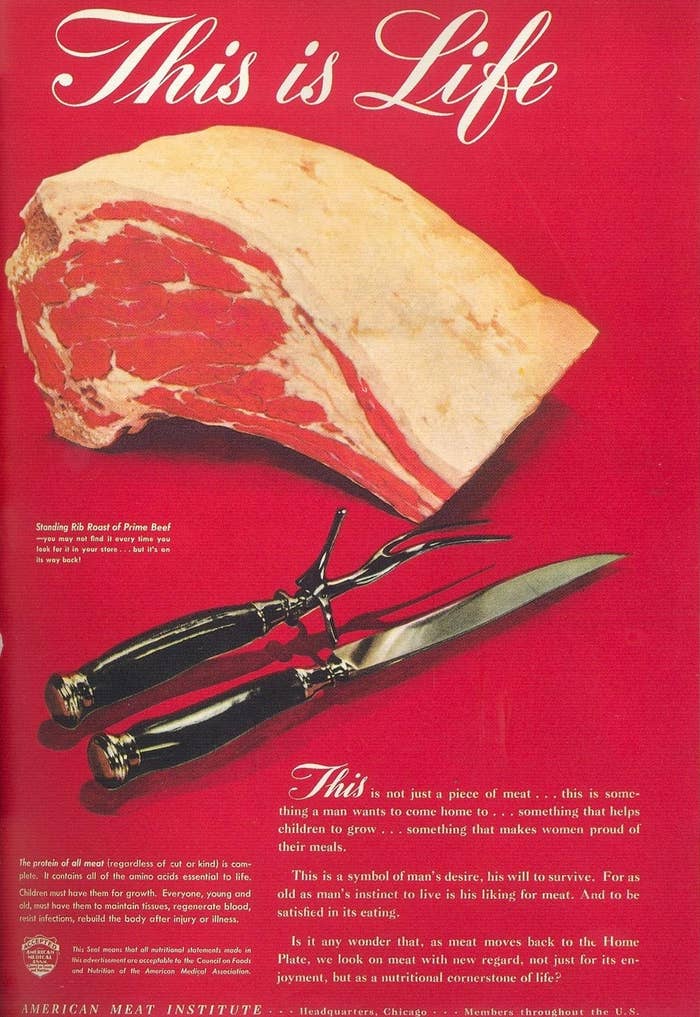
<p class="has-text-align-none">When I asked several researchers how this belief came to be so prominent, all of them pointed first to food advertising, which began to be <a href="https://nymag.com/article/2016/06/macho-food-marketing-is-killing-men.html">segregated by sex</a> in the 1950s.&nbsp;</p>

<p class="has-text-align-none">That’s given us TV ads like Burger King’s 2006 <a href="https://www.youtube.com/watch?v=GESbm9ocIgs">“Manthem” commercial</a>, in which a guy served what appears to be a plate of vegetables in a fancy restaurant stands up and marches out while breaking into song, declaring he’s “too hungry to settle for ‘chick food.’” He heads straight to a Burger King as other men join him in song, pledging to “wave tofu bye-bye.” Burgers in hand, they march onto the highway and together, throw a minivan off an overpass, a show of the strength that meat gives them.&nbsp;</p>

<p class="has-text-align-none">The commercial ends with a blunt message: “The Texas Double Whopper: Eat like a man, man.”&nbsp;</p>
<div class="youtube-embed"><iframe title="Burger King&quot;Manthem&quot;" src="https://www.youtube.com/embed/GESbm9ocIgs?rel=0" allowfullscreen allow="accelerometer *; clipboard-write *; encrypted-media *; gyroscope *; picture-in-picture *; web-share *;"></iframe></div>
<p class="has-text-align-none"><a href="https://thediscerningbrute.wordpress.com/wp-content/uploads/2009/08/eatlikemannotrabbit.png?w=108&amp;h=376">WeightWatchers (For Men)</a>, <a href="https://www.youtube.com/watch?v=lL4ZkYPLN38">Hummer</a>, <a href="https://www.youtube.com/watch?v=Lxp_3000h_U">Slim Jim</a>, and the <a href="https://img.buzzfeed.com/buzzfeed-static/static/enhanced/webdr03/2013/4/13/10/enhanced-buzz-orig-18725-1365863514-10.jpg?downsize=700%3A%2A&amp;output-quality=auto&amp;output-format=auto">American Meat Institute</a> have similarly over-the-top ads, while <a href="https://www.youtube.com/watch?v=C_3mieCS7u0">Manwich</a>, <a href="https://www.youtube.com/watch?v=RVWNOWZ6goI">Campbell’s Soup</a>, <a href="https://www.youtube.com/watch?v=tMVE2MaLe8I">KFC</a>, and others have sent the signal perhaps slightly more subtly. The underlying message can be found beyond the realm of advertising and throughout <a href="https://tvtropes.org/pmwiki/pmwiki.php/Main/RealMenEatMeat">pop culture</a>, too.&nbsp;</p>

<p class="has-text-align-none">Even plant-based protein companies <a href="https://sentientmedia.org/impossibles-new-ad-campaign/">sometimes use this tactic</a>, advertising with a “masculinized aesthetic,” Vrijsen pointed out. The companies are, according to Vrijsen, seeking to “reassure consumers that reducing meat does not mean giving up your masculine identity…even when the product changes, the general logic often stays in place.”&nbsp;</p>

<p class="has-text-align-none">The answer as to why such marketing has proven so effective can be found in the field of anthropology, which for decades has posited that throughout the long trajectory of human history, a clear division of labor separated the sexes: The men went off to hunt while the women stayed behind to safely gather edible plants and raise children, a vision put forth in then-popular theories, such as in the influential 1968 book <a href="https://archive.org/details/ManTheHunter"><em>Man the Hunter</em></a>.</p>

<p class="has-text-align-none">But some scholars have been poking holes in this widely accepted theory. Two of the most prominent critics of the “man the hunter” theory today are <a href="https://www.udel.edu/academics/colleges/cas/units/departments/anthropology/our-people/sarah-lacy/">Sarah Lacy</a>, an assistant professor of anthropology at the University of Delaware, and <a href="https://anthropology.nd.edu/people/cara-ocobock/">Cara Ocobock</a>, an associate professor of human biology at the University of Notre Dame, who’ve published papers together on the issue.&nbsp;</p>

<p class="has-text-align-none">Most hunting didn’t look like “a super strong man by himself” engaged in a “battle of will against a wooly mammoth,” Lacy told me. Rather, much of it was probably mixed-sex groups who chased animals off cliffs, ambushed them from bushes and trees, caught them in nets, and injured them with weapons, which made it easier to chase them down to the point of exhaustion.</p>

<p class="has-text-align-none">While this work required strength, it also required endurance. And women, Lacy and Ocobock <a href="https://anthrosource.onlinelibrary.wiley.com/doi/abs/10.1111/aman.13915">argue</a> in a 2023 paper published in the journal <em>American Anthropologist</em>, are particularly well-suited for the endurance needed to effectively hunt, thanks in part to higher estrogen levels.&nbsp;</p>

<p class="has-text-align-none">“During exercise, estrogen seems to encourage the body to use stored fat for energy before stored carbohydrates,” the two wrote in a piece for <a href="https://www.scientificamerican.com/article/the-theory-that-men-evolved-to-hunt-and-women-evolved-to-gather-is-wrong1/">Scientific American</a>. “Fat contains more calories per gram than carbohydrates do, so it burns more slowly, which can delay fatigue during endurance activity.”</p>

<p class="has-text-align-none">There’s “this emphasis that testosterone is the only hormone that gives people an [athletic] advantage,” Lacy told me, but “estrogen absolutely conveys sports advantages,” too.&nbsp;</p>

<p class="has-text-align-none">Some archaeological evidence also conflicts with the dominant “man the hunter” theory, Lacy said. This includes prehistoric women <a href="https://www.nature.com/articles/s41598-023-45743-7">buried with hunting equipment</a> and Neanderthal remains that suggest men and women were potentially <a href="https://www.sciencedirect.com/science/article/abs/pii/0305440395900136">facing off with animals</a> at a similar rate.</p>
<img src="https://platform.vox.com/wp-content/uploads/sites/2/2026/03/Spot_Masculinity.png?quality=90&#038;strip=all&#038;crop=0,0,100,100" alt="an illustrated man flexes his muscles while holding a large portion of meat on a plate" title="an illustrated man flexes his muscles while holding a large portion of meat on a plate" data-has-syndication-rights="1" data-caption="" data-portal-copyright="" />
<p class="has-text-align-none">Much of the “man the hunter” theory, Lacy said, also rests on research into a small number of well-studied hunter-gatherer, or forager, societies, which only tells us so much. These handful of groups represent “such a tiny snapshot of the amount of variation that would&#8217;ve been present throughout multiple millions of years of human evolution.” At the same time, more recent <a href="https://journals.plos.org/plosone/article?id=10.1371/journal.pone.0287101">historical ethnographic and archaeological research</a>, along with <a href="https://anthrosource.onlinelibrary.wiley.com/doi/abs/10.1111/aman.13914">research into Indigenous groups</a>, provide plenty of evidence of women hunting.</p>

<p class="has-text-align-none">This kind of research “challenges the assumption that the link between masculinity and meat consumption has a clear historical foundation,” Vrijsen, the food and communications researcher, told me. “And instead, it suggests that this association is more cultural than biological — and shaped sometimes by ideology rather than evidence.”</p>

<p class="has-text-align-none">Lacy and Ocobock felt this observation firsthand in the wake of their published research. While it was well received among their anthropology peers, Lacy told me, some people on the internet were incensed.</p>

<p class="has-text-align-none">The overwhelmingly negative public response came from “predominantly men who were just so offended by the insinuation that hunting is not the special thing” that they did that drove human evolution, Lacy told me. “It was really wild.” After Lacy and Ocobock had published their piece on the topic in Scientific American, the magazine offered them counseling “because the reaction — specifically on Twitter — was so virulent,” Lacy said.&nbsp;</p>

<h2 class="wp-block-heading"><strong>Masculinity, with less meat</strong></h2>

<p class="has-text-align-none"><a href="https://robvelzeboer.com/">Rob Velzeboer’s</a> first glimpse into the dicey gender politics of meat came to him when he briefly competed as a boxer in the mid-2010s. He decided to go vegetarian out of a sense of duty to help animals, and while his peers weren’t necessarily hostile to the change — these were real-life acquaintances and friends, not internet strangers — they were often “very, very suspicious,” he told me.&nbsp;</p>

<p class="has-text-align-none">Velzeboer is now a researcher at the University of British Columbia, where he studies meat and masculinity, among other topics. Lately, though, he’s become less interested in <em>why</em> this issue is so charged and more interested in figuring out how to have more productive conversations with men about it. </p>

<p class="has-text-align-none">He’s currently working on a meta-analysis review of numerous studies to look at how men and women react to different messages on the issue. So far, by looking through dozens of studies, he told me that women are more open to messages about harms inflicted on animals in meat production, while men are more receptive to messages about the <a href="https://www.vox.com/future-perfect/24034578/vegan-twin-study-stanford-you-are-what-you-eat-netflix">health benefits of plant-based eating</a>.</p>

<p class="has-text-align-none">Meanwhile, other <a href="https://pmc.ncbi.nlm.nih.gov/articles/PMC11057354/">research by Velzeboer has found</a> that some vegetarian and vegan men frame their lifestyle through traditional American masculine norms, like: independent thought, rationality, discipline, health, alignment between their values and behavior, or even as a rebellious act that demonstrates they don’t just go along with the crowd.</p>

<p class="has-text-align-none">Some of those traits apply to <a href="https://www.bjjheroes.com/bjj-fighters/david-meyer">David Meyer</a>, an 11-time Brazilian jiu-jitsu world champion and host of the <a href="https://www.youtube.com/@AgelessWarriorLab"><em>Ageless Warrior Lab</em> podcast</a>.&nbsp;</p>

<p class="has-text-align-none">“I’m suspicious of when culture tells us we should be this way or that way,” Meyer told me. “[Food] companies are trying to make something appeal to us in a certain way, and we need to think for ourselves.”</p>

<p class="has-text-align-none">Meyer told me that he thinks meat can certainly be part of a healthy diet, but for him, he felt that eliminating animal products from his diet decades ago improved his own health and athletic performance. He’s also an animal lover, and said he doesn’t want to support animal cruelty if he doesn’t have to.</p>
<img src="https://platform.vox.com/wp-content/uploads/sites/2/2026/03/GettyImages-180123982.jpg?quality=90&#038;strip=all&#038;crop=0,0,100,100" alt="A man breaking the world record by carrying 555 kilos for 10 meters" title="A man breaking the world record by carrying 555 kilos for 10 meters" data-has-syndication-rights="1" data-caption="&lt;p&gt;Vegan strongman Patrik Baboumian breaks a world record by carrying 555 kilos for 10 meters.&lt;/p&gt; | &lt;p&gt;David Cooper/Toronto Star via Getty Images&lt;/p&gt;" data-portal-copyright="&lt;p&gt;David Cooper/Toronto Star via Getty Images&lt;/p&gt;" />
<p class="has-text-align-none">“It works for me, and I&#8217;m not saying it would work for anybody else, but a lot of the fighters that I work with have reduced animal products and even dairy specifically, and they feel much better,” Meyer said. But if for some men, eating meat is part of their view of themselves as being masculine, that&#8217;s fine by him.&nbsp;</p>

<p class="has-text-align-none">There are plenty of other professional male athletes who have embraced a <a href="https://grist.org/culture/meet-the-jacked-vegan-strength-athletes-defying-stereotypes/">plant-based diet</a>, too, like NBA players <a href="https://www.nbcsportsboston.com/nba/boston-celtics/kyrie-irvings-vegan-venture-celtics-star-featured-in-beyond-meat-ad/338380/">Kyrie Irving</a> and <a href="https://www.gq.com/story/real-life-diet-chris-paul">Chris Paul</a>, strongman <a href="https://www.instagram.com/patrikbaboumian/?hl=en">Patrik Baboumian</a>, tennis star <a href="https://www.youtube.com/watch?v=7Zcn-mwcTFs">Novak Djokovic</a>, and UFC champion <a href="https://www.instagram.com/lightningwilks/">James Wilks</a>, featured in <a href="https://gamechangersmovie.com/"><em>The Game Changers</em></a>, a documentary about elite athletes who happen to eat plant-based.&nbsp;</p>

<p class="has-text-align-none"><a href="https://www.instagram.com/domzthompson/">Dominick Thompson</a>, a content creator and longtime vegan with very big muscles, views his veganism, in some ways, as an extension of his traditional masculine side.</p>
<img src="https://platform.vox.com/wp-content/uploads/sites/2/2026/03/IMG_2017.jpeg?quality=90&#038;strip=all&#038;crop=0,0,100,100" alt="A muscular man in the gym wearing a sleeveless shirt that says eat what elephants eat" title="A muscular man in the gym wearing a sleeveless shirt that says eat what elephants eat" data-has-syndication-rights="1" data-caption="Dominick Thompson, a plant-based influencer, in the gym. | Johnny Billups" data-portal-copyright="Johnny Billups" />
<p class="has-text-align-none">“No matter your diet, masculinity is about protecting — being a natural protector of the most weak and the most vulnerable,” Thompson told me. “And that includes not only animals, but human animals — those that simply can&#8217;t protect themselves. To me, that&#8217;s a pillar of what masculinity really is.”&nbsp;</p>

<p class="has-text-align-none">After thinking about it long and hard enough, it all can get a bit muddling. Masculinity, femininity — these are squishy, evolving terms that mean different things to different people at different times, and are hard to pin down. Vrijsen, who’s conducted focus groups with young men about masculinity, told me they themselves often have a hard time defining what it means to them.&nbsp;</p>

<p class="has-text-align-none">That uncertainty might explain some of the rise of the manosphere, in which prominent male influencers have stepped into the void to define masculinity for young men — and for some, like <a href="https://www.youtube.com/shorts/cKF1jQyzF3I">Andrew Tate</a>, <a href="https://www.theguardian.com/food/2024/sep/12/carnivore-diet-meat-plants">Jordan Peterson, and Joe Rogan</a>, high-meat diets are part of it.</p>

<p class="has-text-align-none">It’s a big shift from where the plant-based movement was just a decade ago, Thompson said, when people seemed much more open to it. It was also a time when more and more people were questioning conventional gender norms. “But now I do feel like a lot of people are a little bit more close-minded” to eating plant-based, Thompson said. “We have a lot of work cut out for us.”</p>

<p class="has-text-align-none">And Smith, for his part, is still posting through it with his Soy Boy Chronicles, forging ahead in the gray — often viciously patrolled — online territory of what it means to be a man in this country who also eats tofu.&nbsp;</p>
						]]>
									</content>
			
					</entry>
			<entry>
			
			<author>
				<name>Kenny Torrella</name>
			</author>
			
			<title type="html"><![CDATA[James Talarico’s “no meat” controversy explains a lot about America]]></title>
			<link rel="alternate" type="text/html" href="https://www.vox.com/future-perfect/483200/james-talarico-meat-texas-bbq-livestock-cattle" />
			<id>https://www.vox.com/?p=483200</id>
			<updated>2026-03-23T14:56:05-04:00</updated>
			<published>2026-03-19T18:05:00-04:00</published>
			<category scheme="https://www.vox.com" term="Animal Welfare" /><category scheme="https://www.vox.com" term="Explainers" /><category scheme="https://www.vox.com" term="Future Perfect" /><category scheme="https://www.vox.com" term="Politics" /><category scheme="https://www.vox.com" term="The Future of Meat" />
							<summary type="html"><![CDATA[Earlier this month, Texas state Rep. James Talarico eked out victory in a heated race to become Texas’s Democratic nominee for the US Senate race this November. Texans haven’t elected a Democrat to the Senate since 1988, and a lot of hopes are riding on Talarico’s longshot campaign to change that.&#160; But this week, an [&#8230;]]]></summary>
			
							<content type="html">
											<![CDATA[

						
<figure>

<img alt="" data-caption="State Rep. James Talarico, a Democrat from Texas and US Senate candidate, speaks during a Texas primary election night event on Wednesday, March 4, 2026. | Jordan Vonderhaar/Bloomberg via Getty Images" data-portal-copyright="Jordan Vonderhaar/Bloomberg via Getty Images" data-has-syndication-rights="1" src="https://platform.vox.com/wp-content/uploads/sites/2/2026/03/GettyImages-2264127811_5851c7.jpg?quality=90&#038;strip=all&#038;crop=0,0,100,100" />
	<figcaption>
	State Rep. James Talarico, a Democrat from Texas and US Senate candidate, speaks during a Texas primary election night event on Wednesday, March 4, 2026. | Jordan Vonderhaar/Bloomberg via Getty Images	</figcaption>
</figure>
<p class="has-text-align-none">Earlier this month, <a href="https://www.vox.com/politics/480894/james-talarico-jasmine-crockett-faith-love-healing-texas-voters-senate-primary-democratic-religion-left">Texas state Rep. James Talarico</a> eked out victory in a <a href="https://www.vox.com/politics/481483/james-talarico-stakes-texas-primary-latino-white-black-democratic-party">heated race</a> to become Texas’s Democratic nominee for the US Senate race this November. Texans haven’t elected a Democrat to the Senate since 1988, and a lot of hopes are riding on Talarico’s longshot campaign to change that.&nbsp;</p>

<p class="has-text-align-none">But this week, an unexpected video from Talarico’s past resurfaced that caused so much uproar he issued a hefty rebuttal within 24 hours.&nbsp;</p>

<p class="has-text-align-none">The video didn’t revolve around the typical political scandal fodder, like allegations of an affair or bribery. In the eyes of his opponents, it would seem, he had committed a far graver offense: Talarico had endorsed…veganism.</p>

<p class="has-text-align-none">For the record, Talarico has never claimed to be vegan himself, but at a 2022 <a href="https://www.youtube.com/watch?v=SB1Q3jYzxZ4&amp;list=LL&amp;index=3">fundraiser event</a> in support of strengthening animal abuse laws, he <a href="https://x.com/bobby_lavallley/status/2034003528516051016?s=46">said</a> that his campaign — at the time for reelection in the Texas House of Representatives — had officially become a “non-meat” campaign. Talarico stated that the campaign would only buy “vegan products from our local vegan businesses,” and mentioned a local plant-based pizzeria. He said it was an existential matter to try to reduce meat consumption because “it’s necessary to fight climate change” but also as a means to “respect animals in all aspects of society.” The crowd cheered.</p>

<p class="has-text-align-none">In advocating for plant-based eating, Talarico joined a handful of other politicians: New Jersey Sen. Cory Booker, former <a href="https://www.vox.com/future-perfect/22927412/eric-adams-fish-vegan-plant-based-new-york">New York City Mayor Eric Adams</a>, and Maryland Rep. Jamie Raskin, among others. But the message hit different in Texas, which raises more cattle than any other state by far, and where the mascot of the state’s second largest university is the longhorn steer.</p>

<figure class="wp-block-embed is-type-rich is-provider-twitter wp-block-embed-twitter"><div class="wp-block-embed__wrapper">
<blockquote class="twitter-tweet" data-dnt="true"><p lang="en" dir="ltr">In 2022, James Talarico said it’s “existential” to reduce meat consumption to fight climate change.<br><br>&quot;I am proud to say that our campaign has officially become a non-meat campaign&#8230; We are only buying vegan products from our local vegan businesses.&quot; <a href="https://t.co/tz6K1aGYsy">pic.twitter.com/tz6K1aGYsy</a></p>&mdash; Bobby LaValley (@Bobby_LaVallley) <a href="https://twitter.com/Bobby_LaVallley/status/2034003528516051016?ref_src=twsrc%5Etfw">March 17, 2026</a></blockquote>
</div></figure>

<p class="has-text-align-none">The responses to the resurfaced post have been fast and furious. Texas Sen. Ted Cruz <a href="https://x.com/tedcruz/status/2034127614604886153">called</a> Talarico a “freak” who wants to “ban BBQ” (Talarico has said no such thing). Texas’s other senator, John Cornyn — who Talarico <a href="https://www.nbcnews.com/politics/2026-election/texas-republicans-senate-runoff-moves-forward-withdrawal-deadline-pass-rcna263891">might face off against</a> in November’s election — <a href="https://x.com/JohnCornyn/status/2034041530709688360">urged</a> Texans to vote this November because “the steaks couldn’t be higher” (get it?). Voices on the political <a href="https://x.com/tobinjstone/status/2034054372057890852">left</a> and <a href="https://x.com/chiproytx/status/2034104932408684608">right</a> agreed his election bid might just&nbsp;be cooked, as the kids say.</p>

<p class="has-text-align-none">But within 24 hours, Talarico’s campaign responded with a <a href="https://x.com/jt_ennis/status/2034320270694011071/photo/1">“press release”</a> that was just a picture of him wearing a Texas flag button-down shirt while taking a bite out of a hunk of meat, though it’s hard to tell if it was meant to reassure voters he doesn’t pose a threat to the state’s identity, a satirical bit, or both.&nbsp;</p>

<figure class="wp-block-embed is-type-rich is-provider-twitter wp-block-embed-twitter"><div class="wp-block-embed__wrapper">
<blockquote class="twitter-tweet" data-dnt="true"><p lang="en" dir="ltr">Official statement from <a href="https://twitter.com/jamestalarico?ref_src=twsrc%5Etfw">@JamesTalarico</a> on vegan accusations <a href="https://t.co/pLwtlknBYj">pic.twitter.com/pLwtlknBYj</a></p>&mdash; JT Ennis (@jt_ennis) <a href="https://twitter.com/jt_ennis/status/2034320270694011071?ref_src=twsrc%5Etfw">March 18, 2026</a></blockquote>
</div></figure>

<p class="has-text-align-none">We’ve seen this movie before. In 2021, Colorado Gov. Jared Polis <a href="https://www.cpr.org/2021/03/09/meatout-or-meat-in-governors-declaration-ignites-carnivorous-culture-war/">proclaimed</a> March 20 as “MeatOut” day, encouraging Coloradans to give plant-based eating a try. Like Talarico, Polis eats meat, too. Nonetheless, Colorado’s livestock lobby was incensed, and to appease them, Polis designated another day as <a href="https://www.axios.com/local/denver/2021/03/19/how-meatout-day-backfired-on-colorado-governor-jared-polis">“Colorado Livestock Proud Day&#8221;</a> and shared his own brisket rub recipe.&nbsp;&nbsp;</p>

<p class="has-text-align-none">It doesn’t take a political strategist to conclude that Talarico’s “non-meat” campaign announcement was a potentially reckless move for a Texas politician and that it could’ve easily come back to haunt him if his political ambitions were to grow beyond the greater Austin area, which they now have. But the response to the 2022 video highlighted how, despite years of evidence mounting about the <a href="https://www.vox.com/future-perfect/23817808/pig-farm-investigation-feedback-immunity-feces-intestines">depravity</a> of the <a href="https://www.vox.com/future-perfect/405341/mountaire-farms-poultry-investigation-trump">US meat</a> <a href="https://www.vox.com/future-perfect/420545/fairlife-milk-animal-cruelty-dairy-coca-cola">industry</a>, Americans on both sides of the aisle are still unable to have a nuanced, honest debate about meat’s role in our diets, culture, and politics.&nbsp;</p>

<h2 class="wp-block-heading"><strong>Why Americans can’t seem to have an open conversation about meat</strong></h2>

<p class="has-text-align-none">If you look long and hard enough at how meat gets to our plates, Talarico’s 2022 campaign position was a sensible response.&nbsp;</p>

<p class="has-text-align-none">The vast majority of the <a href="https://www.vox.com/future-perfect/24079424/factory-farming-facts-meat-usda-agriculture-census">10 billion animals</a> raised for meat in the US are kept on factory farms, where horrific practices — which would be illegal if done to a pet cat or dog — are business as usual: <a href="https://www.vox.com/future-perfect/419385/switzerland-meat-mutilation-anesthesia-milk-egg-label">ripping out piglets’ testicles without anesthesia</a>, <a href="https://www.vox.com/future-perfect/353393/farm-bill-republicans-prop-12-gestation-crates-pork">cramming hens and pigs in tiny cages</a>, <a href="https://www.cambridge.org/core/journals/world-s-poultry-science-journal/article/abs/broiler-breeders-feed-restriction-and-welfare/F1077D49FA7F1A5D2122E5EA654FACC9">starving breeding chickens</a>, <a href="https://wcroc.cfans.umn.edu/research/dairy/alt-disbudding-calves">burning out calves’ horn buds (also without anesthesia)</a>.&nbsp;</p>

<p class="has-text-align-none">Americans of all political stripes <a href="https://faunalytics.org/public-acceptability-of-standard-u-s-animal-agriculture-practices/">overwhelmingly oppose</a> these bedrock practices of US meat production, but they remain legal because industry lobbyists and their allied politicians keep it that way.&nbsp;&nbsp;&nbsp;</p>

<p class="has-text-align-none">While beef cattle tend to have higher welfare than pigs, chickens, and turkeys, <a href="https://vimeo.com/349213938">undercover</a> <a href="https://www.youtube.com/watch?v=Ki57eFs7XFo">investigations</a> into some Texas cattle operations have <a href="https://www.fooddive.com/news/danone-horizon-organic-suspends-milk-dairy-texas-farm-peta-report-animal-abuse/700437/">revealed</a> <a href="https://www.vox.com/future-perfect/379527/livestock-auctions-animal-abuse-investigation-cow-sheep-goats">stomach-churning cruelty</a>. And to be sure, Texas’s livestock industry is a lot more than just cows; it’s also a top producer of <a href="https://www.nass.usda.gov/Charts_and_Maps/Poultry/eggmap.php">eggs</a> and <a href="https://www.wattagnet.com/broilers-turkeys/article/15535958/top-broiler-producing-states-differ-by-head-weight">chicken meat</a>, industries notorious for <a href="https://www.vox.com/future-perfect/408152/animal-cruelty-factory-farms-chicken-welfare-genetics">terrible treatment</a> of <a href="https://www.vox.com/future-perfect/2019/5/10/18564455/washington-jay-inslee-hens-animal-cruelty">animals</a>.</p>

<figure class="wp-block-gallery has-nested-images columns-2 is-cropped wp-block-gallery-1 is-layout-flex wp-block-gallery-is-layout-flex"><img src="https://platform.vox.com/wp-content/uploads/sites/2/2026/03/GettyImages-2139529471.jpg?quality=90&#038;strip=all&#038;crop=0.50106420716566,0,98.997871585669,100" alt="" title="" data-has-syndication-rights="1" data-caption="&lt;p&gt;A cattle feedlot near Lubbock, Texas, USA. &lt;/p&gt;&lt;br&gt; | &lt;p&gt;Richard Hamilton Smith /Design Pics Editorial/Universal Images Group via Getty Images&lt;/p&gt;" data-portal-copyright="&lt;p&gt;Richard Hamilton Smith /Design Pics Editorial/Universal Images Group via Getty Images&lt;/p&gt;" />

<img src="https://platform.vox.com/wp-content/uploads/sites/2/2026/03/GettyImages-564105559.jpg?quality=90&#038;strip=all&#038;crop=0.53257497414684,0,98.934850051706,100" alt="" title="" data-has-syndication-rights="1" data-caption="A chicken factory farm in Alabama. | &lt;p&gt;Carol M. Highsmith/Buyenlarge/Getty Images&lt;/p&gt;" data-portal-copyright="&lt;p&gt;Carol M. Highsmith/Buyenlarge/Getty Images&lt;/p&gt;" /></figure>

<p class="has-text-align-none">On the climate change front, more than 200 agricultural and environmental scientists <a href="https://www.vox.com/future-perfect/2024/3/20/24105735/peak-meat-livestock-emissions-plant-based-climate-deadline">surveyed</a> in 2021 concluded that rich countries need to reduce their consumption of animal products to meet global climate targets. But even those unconcerned with climate change still have plenty to worry about; meat production is a leading cause of America’s <a href="https://www.vox.com/future-perfect/2023/8/31/23852325/farming-myths-agricultural-exceptionalism-pollution-labor-animal-welfare-laws">water</a> and <a href="https://www.vox.com/future-perfect/398131/factory-farm-air-pollution-space-north-carolina">air pollution</a>, contributing to the <a href="https://www.vox.com/future-perfect/395967/iowa-factory-farm-pollution-sacrifice-state">declining quality of life</a> in rural areas.&nbsp;</p>

<p class="has-text-align-none">But most Americans would rather not think too long or too hard about where meat, milk, and eggs come from. Meanwhile, many politicians, pundits, and special interest groups seek to turn anyone who does into an example. They often resort to childish insults and hollow platitudes about how meat is essential to be a real American (or Texan) instead of seriously grappling with what our meat-heavy diets have done to our land, our air, our rivers and streams, and billions of animals who can suffer — and experience a range of other emotions — just the same as our cats and dogs. </p>

<p class="has-text-align-none">They also narrow the window of debate. While some might argue Talarico is guilty of this, too, by staking out an explicitly non-meat campaign policy, in actuality there’s a whole range of options to address the ills of meat production beyond the binaries of all-out veganism and full-throated defense of the status quo. Some lawmakers push for <a href="https://www.wattagnet.com/business-markets/policy-legislation/article/15818521/ventilation-shutdown-ban-proposed-in-colorado">bills</a> to ban particularly cruel practices on farms, or to reduce <a href="https://www.nytimes.com/2026/01/20/opinion/manure-population-rivers-water.html">air and water pollution</a> from the trillion pounds of manure generated by livestock. Others try to expand <a href="https://www.vox.com/future-perfect/362923/plant-based-food-meat-dairy-lobbying-congress-research-schools">plant-based food choices in schools</a>.</p>

<h2 class="wp-block-heading"><strong>There’s more to Texas than beef</strong></h2>

<p class="has-text-align-none">Change is even afoot in cattle country. Austin and Houston are home to some of the finest plant-based cooking in the US, and some of the <a href="https://allyallsfoods.com/pages/about-us?srsltid=AfmBOoo0mbBPhNEEp_eilwxas37ElUMiX9K1hkWVglm7dgXSmr9gHHc8">best vegan jerky</a> I’ve ever tasted came from a small company based an hour’s drive north of Dallas. But perhaps no one shatters the self-image of Texas as an immutable BBQ-loving monolith more than <a href="https://rowdygirlsanctuary.org/renee-king-sonnen/">Renee King-Sonnen and Tommy Sonnen</a>.&nbsp;</p>

<p class="has-text-align-none">For years, the husband and wife operated a cattle ranch near the Texas Gulf Coast. But over time, Renee formed emotional bonds with their animals and grew increasingly distraught by the sound of the mother cows wailing as their babies were hauled off for sale. She eventually became vegan herself and launched a fundraising campaign to turn their ranch into an animal sanctuary. Today, more than <a href="https://rowdygirlsanctuary.org/our-animals/">100 rescued livestock</a> — cows, but also turkeys, goats, and pigs — live out their much more natural lives there.</p>
<img src="https://platform.vox.com/wp-content/uploads/sites/2/2026/03/GettyImages-1533760047.jpg?quality=90&#038;strip=all&#038;crop=0,0,100,100" alt="A woman petting a cow who is standing on a bed of hay outdoors. " title="A woman petting a cow who is standing on a bed of hay outdoors. " data-has-syndication-rights="1" data-caption="&lt;p&gt;Rowdy Girl Sanctuary resident “Stormy” is petted by Renee King-Sonnen.&lt;/p&gt;&lt;br&gt; | &lt;p&gt;Steve Gonzales/Houston Chronicle via Getty Images&lt;/p&gt;" data-portal-copyright="&lt;p&gt;Steve Gonzales/Houston Chronicle via Getty Images&lt;/p&gt;" />
<p class="has-text-align-none">That might amount to heresy to some Texans, but it shows that many Texans’ — and Americans’ — views about animals are too complex to condense into a snarky tweet. The Sonnens’ story also reminds me of some of Talarico’s most <a href="https://www.nytimes.com/2026/01/13/opinion/ezra-klein-podcast-james-talarico.html">stirring messages</a> about compassion, love, personal transformation, and protecting the vulnerable — messages that helped to launch him onto the national political stage.&nbsp;</p>

<p class="has-text-align-none">America clearly isn’t yet ready to put animals, especially the ones we eat, into that narrative, or to openly and clearly argue the merits of factory-farming 10 billion animals each year. But I hope one day we will — and that politicians will be able to turn down the temperature and engage in honest discourse, too.&nbsp;</p>
						]]>
									</content>
			
					</entry>
			<entry>
			
			<author>
				<name>Kenny Torrella</name>
			</author>
			
			<title type="html"><![CDATA[What a massive blind taste test of vegan milk, cheese, and ice cream found — explained in one chart]]></title>
			<link rel="alternate" type="text/html" href="https://www.vox.com/future-perfect/482758/what-a-massive-blind-taste-test-of-vegan-milk-cheese-and-ice-cream-found-explained-in-one-chart" />
			<id>https://www.vox.com/?p=482758</id>
			<updated>2026-03-17T19:17:56-04:00</updated>
			<published>2026-03-18T09:00:00-04:00</published>
			<category scheme="https://www.vox.com" term="Animal Welfare" /><category scheme="https://www.vox.com" term="Future Perfect" /><category scheme="https://www.vox.com" term="The Future of Meat" />
							<summary type="html"><![CDATA[Over the last two decades, the availability of plant-based foods has exploded.&#160; You can get a meat-free patty in your Burger King Whopper if that’s your thing, buy&#160;realistic “chicken” nuggets at your local grocery store, or order marbled plant-based steak from food startups. But one animal-free food category has truly escaped containment from the vegan [&#8230;]]]></summary>
			
							<content type="html">
											<![CDATA[

						
<figure>

<img alt="Various plant-based and dairy milks in a grocery store." data-caption="A variety of dairy and dairy-free products at a supermarket in Miami, Florida. | Jeffrey Greenberg/Universal Images Group via Getty Images" data-portal-copyright="Jeffrey Greenberg/Universal Images Group via Getty Images" data-has-syndication-rights="1" src="https://platform.vox.com/wp-content/uploads/sites/2/2026/03/GettyImages-2050740197.jpg?quality=90&#038;strip=all&#038;crop=0,0,100,100" />
	<figcaption>
	A variety of dairy and dairy-free products at a supermarket in Miami, Florida. | Jeffrey Greenberg/Universal Images Group via Getty Images	</figcaption>
</figure>
<p class="has-text-align-none">Over the last two decades, the availability of plant-based foods has exploded.&nbsp;</p>

<p class="has-text-align-none">You can get a meat-free patty in your Burger King Whopper if that’s your thing, buy&nbsp;realistic “chicken” nuggets at your local grocery store, or order marbled plant-based steak from food startups. But one animal-free food category has truly escaped containment from the vegan menu: plant-based milk.&nbsp;</p>

<div class="wp-block-vox-media-highlight vox-media-highlight">
<h2 class="wp-block-heading">Key takeaways</h2>


<ul class="wp-block-list">
<li>Dairy production is a large driver of climate change, and dairy-free alternatives, like oat milk and cashew-based ice cream, haven’t gained enough market share to significantly displace it.</li>


<li>To see how the dairy-free sector can improve, a nonprofit conducted the largest ever blind taste test, pitting plant-based versions of milk, cheese, yogurt, and more against conventional dairy.</li>


<li>The experiment found that, on average, consumers enjoy conventional dairy more than dairy-free products. However, some of the top-performing dairy-free versions came close, demonstrating there’s potential for the plant-based market to further grow.&nbsp;</li>
</ul>
</div>

<p class="has-text-align-none">Milk made from soybeans, oats, almonds — even <a href="https://www.maizly.com/">corn</a>, <a href="https://mooala.com/products/original-bananamilk">bananas</a>, <a href="https://ripplefoods.com/collections/all?srsltid=AfmBOop3MEpAPwy2_0N1yIsQ_c-5ILSiAIEBWE6Za_8oTx38Q9rXevii">peas</a>, or <a href="https://www.kofio.co/coffee-equipment/dug-potato-drink-barista-1000-ml/13966">potatoes</a> — or any other plant-based source now accounts for around <a href="https://agfundernews.com/us-retail-sales-of-plant-based-milk-by-numbers-coconut-is-up-almond-is-down-soy-and-oat-are-flat">15 percent of fluid milk sales</a> in the US. For comparison, sales of plant-based <em>meat</em> make up around <a href="https://gfi.org/marketresearch/#plant-based-meat">just 1 percent</a> of the American meat market.&nbsp;</p>

<p class="has-text-align-none">A <a href="https://www.nectar.org/sensory-research/2026-taste-of-the-industry">new, massive blind taste test</a> might help explain plant-based milk’s notable rise: A lot of people just think it tastes good — in some cases, almost as good, or just as good, as cow’s milk. (Read on to see which products rose to the top.) Other dairy-free products, like plant-based mozzarella and yogurt? A lot less so, the experiment found. The same goes for most plant-based meats, according to a similar blind taste test <a href="https://www.vox.com/future-perfect/409175/meat-plant-based-blind-taste-test">I wrote about</a> when it was released last year.&nbsp;</p>

<p class="has-text-align-none">Knowing which of these products people like — and dislike — and more importantly, how to make them better, is important, because dairy has a significant environmental footprint. Global dairy production spews about the same amount of <a href="https://www.sciencedirect.com/science/article/pii/S0022030225005636">climate-warming emissions</a> into the atmosphere as <a href="https://www.iea.org/energy-system/transport/aviation">global air travel</a>, and cows’ waste is a <a href="https://www.vox.com/future-perfect/2023/8/31/23852325/farming-myths-agricultural-exceptionalism-pollution-labor-animal-welfare-laws">major source of water pollution</a>. In <a href="https://www.vox.com/future-perfect/403444/dairy-industry-cow-life-milk-america">dairy farming</a>, cows are also subjected to a <a href="https://www.vox.com/future-perfect/420545/fairlife-milk-animal-cruelty-dairy-coca-cola">number</a> of <a href="https://www.vox.com/the-highlight/480529/calf-ranches-grimmius-investigation-dairy-confinement">cruel practices</a>, and the industry comes with <a href="https://www.propublica.org/series/americas-dairyland">threats</a> to <a href="https://www.vox.com/future-perfect/459417/dairy-farm-deaths-cow-manure-osha-colorado">human workers, as well</a>. A more sustainable and humane future, then, depends on making <em>all</em> dairy alternatives go mainstream, not just your favorite cow-free milk.&nbsp;&nbsp;&nbsp;</p>

<h2 class="wp-block-heading"><strong>Results of the big dairy-free blind taste test, explained&nbsp;&nbsp;</strong></h2>

<p class="has-text-align-none">Late last year, a nonprofit called <a href="https://www.nectar.org/">NECTAR</a> — which researches alternative proteins like plant-based meat and dairy — recruited 2,183 people in San Francisco and New York City to participate in the largest ever blind taste test of dairy-free foods. Six percent of participants were vegetarian, 3 percent were pescatarian, and the rest considered themselves either <a href="https://www.vox.com/22842911/how-to-eat-less-meat-newsletter-course">“flexitarians”</a> or omnivores. </p>
<img src="https://platform.vox.com/wp-content/uploads/sites/2/2026/03/Granola-and-Yogurt-rotated.jpeg?quality=90&#038;strip=all&#038;crop=0,0,100,100" alt="A small bowl of yogurt topped with granola. A piece of paper with the number 923 is next to the bowl." title="A small bowl of yogurt topped with granola. A piece of paper with the number 923 is next to the bowl." data-has-syndication-rights="1" data-caption="One of the many dishes of yogurt, topped with granola, served to taste testers. | NECTAR/Palate Insights" data-portal-copyright="NECTAR/Palate Insights" />
<p class="has-text-align-none">Without knowing which version of a product they were tasting, participants tried a number of some of the top-selling 98 plant-based dairy products across 10 categories tested in the experiment, which included ice cream, barista-style milk, yogurt, cream cheese, and regular drinking milk — alongside one animal-based “benchmark” per category for comparison. Each item was prepared as it would be in a real-world setting: cream cheese was smeared on bagels, mozzarella was served on pizzas, creamers were used in coffee, and so on.</p>

<p class="has-text-align-none">Participants then rated each product on a seven-point scale — from “dislike very much” to “like very much” — and provided feedback on flavor, texture, and appearance.&nbsp;</p>

<p class="has-text-align-none">It might not come as a huge surprise to hear that most participants tended to like conventional dairy products more than plant-based versions. Taking the combined ratings of all products tested, on average, 65 percent of participant ratings on conventional dairy products were “like very much” or “like,” while only 35 percent of ratings of the plant-based dairy products reached those levels.&nbsp;&nbsp;&nbsp;&nbsp;</p>

<p class="has-text-align-none">The results also highlighted a wide gap in quality among plant-based products. The top dairy-free creamer, sour cream, barista milk, and regular plant-based milk rated at similar levels as the dairy versions. But the averages tended to lag far behind.&nbsp;</p>
<img src="https://platform.vox.com/wp-content/uploads/sites/2/2026/03/QwOiI-in-a-blind-taste-test-most-people-prefer-dairy-over-dairy-free-but-some-dairy-free-versions-come-close-.png?quality=90&#038;strip=all&#038;crop=0,0,100,100" alt="A chart that displays what percent taste testers rated products as “very much like” or “like.” Scores are listed per category, such as creamer, sour cream, milk, and ice cream, and by type of product (dairy-free average scores combined, top-performing dairy-free product, and the conventional dairy benchmark). " title="A chart that displays what percent taste testers rated products as “very much like” or “like.” Scores are listed per category, such as creamer, sour cream, milk, and ice cream, and by type of product (dairy-free average scores combined, top-performing dairy-free product, and the conventional dairy benchmark). " data-has-syndication-rights="1" data-caption="" data-portal-copyright="" />
<p class="has-text-align-none">This finding confirms something I’ve previously <a href="https://www.vox.com/future-perfect/23065941/vegan-vegetarian-plant-based-food-tech-bad-products">written</a> about: There are some very tasty plant-based meat and milk products out there — and a whole lot of not-so-tasty ones. And the latter reality might cause some people to write off whole categories of meat and dairy alternatives after buying and disliking one or two disappointing products.</p>

<p class="has-text-align-none">In a head-to-head comparison, only one plant-based product out of the 98 tested achieved “taste parity” with its dairy counterpart: Califia Farms’ Oat Barista Blend, which is primarily used in coffee drinks and is meant to replicate something like whole milk. It was tested in lattes against whole cow’s milk from Horizon Organic. Participants were split, with 35 percent preferring the oat milk, 35 percent preferring the cow’s milk, and 30 percent having no preference between the two.&nbsp;</p>

<p class="has-text-align-none">Caroline Cotto, the director of NECTAR, told Vox that Califia Farms achieving taste parity “is really exciting — just to show that this is possible…and [that] this category has legs.”</p>

<p class="has-text-align-none">Although only one product achieved this vaunted status of taste parity, several others came close. And in other head to head comparisons, 27 percent of the products had at least half of the participants either rate it better than the animal benchmark or had no preference between the two.&nbsp;</p>

<p class="has-text-align-none">For context, in NECTAR’s <a href="https://www.vox.com/future-perfect/409175/meat-plant-based-blind-taste-test">blind taste test for plant-based meats</a> released last year, only 16 percent of plant-based meat products reached that bar.</p>

<p class="has-text-align-none">“It met my expectations that dairy is a little bit further ahead of where meat alternatives are,” Cotto said.&nbsp;</p>

<div class="wp-block-vox-media-highlight vox-media-highlight">
<h2 class="wp-block-heading"><strong>The best dairy-free products, according to the blind taste test of 98 top sellers</strong></h2>


<ul class="wp-block-list">
<li><strong>Barista milk: </strong>Califia Farms (oat), DREAM<strong> </strong>(oat), Milkadamia (macadamia), Minor Figures (oat), Planet Oat (oat), Ripple&nbsp;</li>


<li><strong>Butter (sticks): </strong>Violife, Melt Organic, Country Crock</li>


<li><strong>Cheddar (slices): </strong>Field Roast, Daiya Foods, Follow Your Heart, Miyoko’s Creamery, Plant Ahead</li>


<li><strong>Cream cheese: </strong>Violife (supreme original)</li>


<li><strong>Creamer: </strong>Coffee-mate (Italian sweet crème), Oatly (sweet &amp; creamy oat), Planet Oat (sweet &amp; creamy oat), Silk (sweet &amp; creamy almond), SOWN (sweet &amp; creamy oat), Violife (supreme sweet cream)</li>


<li><strong>Ice cream: </strong>So Delicious (very vanilla cashewmilk)</li>


<li><strong>Milk: </strong>Almond Breeze (original almondmilk), Maïzly (original), Silk (original soymilk)</li>


<li><strong>Sour cream: </strong>Violife</li>


<li><strong>Yogurt: </strong>Cocojune (plain Greek-style)</li>
</ul>
</div>

<p class="has-text-align-none">But it’s worth noting that plant-based dairy has an inherent leg up. Many people opt for dairy-free products due to allergies or lactose intolerance, which isn’t typically the case with meat. And dairy tends to more often be an ingredient — think milk in coffee, cheese on pizza, sour cream on nachos — rather than the main course, like a steak or sausage. That means how dairy-free products perform on their own matters a bit less than for plant-based meat products.&nbsp;</p>

<p class="has-text-align-none">Perhaps the most important finding, in my view, is that, for each dairy-free product — even some of the most poorly rated ones — a good amount of participants enjoyed them. That suggests the market has a lot more potential to grow, and NECTAR has some ideas on how to make that happen.&nbsp;</p>

<h2 class="wp-block-heading"><strong>What the dairy-free industry needs to do to level up their products</strong></h2>

<p class="has-text-align-none">Improving products in the worst-performing categories — like plant-based yogurt and mozzarella — should probably be a top priority for the sector. But every category has room for improvement, NECTAR found.&nbsp;</p>

<p class="has-text-align-none">The organization analyzed participants’ feedback on flavor, texture, and appearance for each product and found that off flavors and funky aftertastes were a leading complaint, especially for dairy-free yogurt and sour cream. “Increase richness” was the top request for numerous categories, including ice cream, cream cheese, cheddar, and butter. The group shares its results with the companies involved to potentially inform product improvements. </p>

<p class="has-text-align-none">“Increase stretchiness” was ranked as a common request for mozzarella, a problem that has long vexed the vegan cheese business. In 2021, I asked in a piece for Vox, <a href="https://www.vox.com/22456572/plant-based-vegan-cheese-motif-perfect-day">“Where’s the ‘Impossible Burger’ of cheese?”</a> As far as I’m aware, it still doesn’t exist, though there’s buzz around super-stretchy dairy-free mozzarella from the startup <a href="https://bettani.com/">Bettani Farms</a>, which launches in restaurants and cafeterias later this year.&nbsp;</p>
<img src="https://platform.vox.com/wp-content/uploads/sites/2/2026/03/pizza-stretch.png?quality=90&#038;strip=all&#038;crop=0,0,100,100" alt="A close-up of a fork pulling stretchy dairy-free mozzarella cheese up off of a pizza." title="A close-up of a fork pulling stretchy dairy-free mozzarella cheese up off of a pizza." data-has-syndication-rights="1" data-caption="Bettani Farms’ stretchy dairy-free mozzarella cheese. | Bettani Farms" data-portal-copyright="Bettani Farms" />
<p class="has-text-align-none">NECTAR also wants to bring the results to food service operations, like restaurants and university and corporate cafeterias where consumers are usually presented with one unbranded option (like a single oat milk carafe), so they know which products are most popular.</p>

<p class="has-text-align-none">But, perhaps, what would be most effective in getting more people to embrace plant-based dairy would be finding ways to lower prices. NECTAR found that, in surveying people, when plant-based milk costs even just 25 percent more than cow’s milk, 43 percent fewer people said they would intend to buy it than if it cost the same. And, in the real world, compared to conventional dairy milk, soy and almond milk cost much more. To be sure, people often act differently when shopping. But it does suggest that consumers are price sensitive when swapping dairy products for dairy-free, and <a href="https://ag.purdue.edu/cfdas/wp-content/uploads/2023/07/An-Analysis-of-U.S.-Dairy-and-Non-Dairy-Milk-Demand_USB-approval_6-29-update.pdf">other research</a> has borne this out for some milk alternatives.</p>

<p class="has-text-align-none">It’s worth noting, however, that the low price of cow’s milk is somewhat artificial; the US dairy industry is <a href="https://www.vox.com/future-perfect/477787/trump-rfk-whole-milk-dairy-democrats">heavily dependent on government support</a> by way of subsidies, environmental and animal welfare deregulation, and <a href="https://www.vox.com/future-perfect/352359/milk-dairy-schools">federal nutrition policy</a> that all heavily favor conventional dairy over plant-based varieties.</p>

<p class="has-text-align-none">While NECTAR’s experiment focused on market fundamentals like flavor, texture, and price, there are a number of squishier barriers that stand in the way of widespread plant-based food adoption. Food preferences are shaped not just by our taste buds but also what we ate as children, what our peers like, cultural traditions, and social norms. Addressing those will be just as challenging, if not more so, than improving flavor and price. </p>

<p class="has-text-align-none">Plant-based meat and milk alternatives remain one of the more promising avenues available to address our <a href="https://www.vox.com/future-perfect/363550/factory-farming-human-progress-sustainable-food-movement">inhumane</a> and <a href="https://www.vox.com/future-perfect/2024/3/20/24105735/peak-meat-livestock-emissions-plant-based-climate-deadline">environmentally unsustainable</a> <a href="https://www.vox.com/future-perfect/24079424/factory-farming-facts-meat-usda-agriculture-census">factory farming system</a>, though the sector hasn’t quite taken off in the way many of its boosters predicted a decade ago. But widespread adoption was never likely to happen overnight. Instead, if it does happen, it’ll more likely be a slow, gradual process, with wonky, technical interventions — like food science R&amp;D and blind taste tests — underpinning its success.</p>
						]]>
									</content>
			
					</entry>
			<entry>
			
			<author>
				<name>Kenny Torrella</name>
			</author>
			
			<title type="html"><![CDATA[Bugs were supposed to be the future of food. Now, the insect farming industry is collapsing. ]]></title>
			<link rel="alternate" type="text/html" href="https://www.vox.com/future-perfect/481920/insect-bug-farming-industry-startup-bankruptcy" />
			<id>https://www.vox.com/?p=481920</id>
			<updated>2026-03-18T11:38:36-04:00</updated>
			<published>2026-03-09T07:15:00-04:00</published>
			<category scheme="https://www.vox.com" term="Animal Welfare" /><category scheme="https://www.vox.com" term="Future Perfect" /><category scheme="https://www.vox.com" term="The Future of Meat" />
							<summary type="html"><![CDATA[“We have to get used to the idea of eating insects.” This proclamation came from, of all people, an insect researcher. Dutch entomologist Marcel Dicke pitched eating bugs in his 2010 TED talk as critical to sustainably feeding a growing human population, because insects have a much smaller carbon footprint than beef, pork, and chicken.&#160; [&#8230;]]]></summary>
			
							<content type="html">
											<![CDATA[

						
<figure>

<img alt="A worker wearing a face mask holds a few black soldier fly larvae in his hand, gestured toward the camera. He stands in an insect farm, with machinery in the background." data-caption="A worker at Protifly, a France-based insect farming startup, holds black soldier fly larvae. | Mehdi Fedouach/AFP via Getty Images" data-portal-copyright="Mehdi Fedouach/AFP via Getty Images" data-has-syndication-rights="1" src="https://platform.vox.com/wp-content/uploads/sites/2/2026/03/GettyImages-1233020980.jpg?quality=90&#038;strip=all&#038;crop=0,0,100,100" />
	<figcaption>
	A worker at Protifly, a France-based insect farming startup, holds black soldier fly larvae. | Mehdi Fedouach/AFP via Getty Images	</figcaption>
</figure>
<p class="has-text-align-none">“We have to get used to the idea of eating insects.”</p>

<p class="has-text-align-none">This proclamation came from, of all people, an insect researcher. Dutch entomologist Marcel Dicke pitched eating bugs in his 2010 <a href="https://www.ted.com/talks/marcel_dicke_why_not_eat_insects?subtitle=en">TED talk</a> as critical to sustainably feeding a growing human population, because insects have a much <a href="https://www.nature.com/articles/s41538-025-00694-3">smaller carbon footprint</a> than beef, pork, and chicken.&nbsp;</p>

<div class="wp-block-vox-media-highlight vox-media-highlight">
<h2 class="wp-block-heading">Key takeaways</h2>


<ul class="wp-block-list">
<li>In the mid-2010s, insects were hailed as the future of food — a way to sustainably feed the world’s growing human population and the hundreds of billions of animals farmed for meat.&nbsp;&nbsp;</li>


<li>Investors and governments alike poured $2 billion into insect farming startups. But now, a decade later, many are going belly up.</li>


<li>The sector has hit two main obstacles: Most people don’t want to eat bugs, and insects cost too much to produce in order to be an affordable source of livestock feed.</li>


<li>Without a clear market, many startups have shut down. The future of insect farming is likely destined for more niche markets, like pet food, novelty human food, and livestock feed additives.&nbsp;&nbsp;</li>
</ul>
</div>

<p class="has-text-align-none">To make his point, he even featured photographs of what might be a common meal in this bold new future: a stir fry with mealworm larvae, mushrooms, and snap peas, finished with a chocolate dessert topped with a large fried cricket.</p>

<p class="has-text-align-none">Three years later, the United Nations published a <a href="https://www.fao.org/fsnforum/resources/reports-and-briefs/edible-insects-future-prospects-food-and-feed-security?utm_source=chatgpt.com">comprehensive report</a> that echoed many of Dicke’s ideas and argued that insects could be a more eco-friendly food source not just for humans, but also for livestock. The report received widespread media coverage and helped to trigger a wave of investment from venture capital firms and governments alike into insect farming startups across Europe, the US, Canada, and beyond, totaling some <a href="https://rethinkpriorities.org/research-area/investments-into-insect-farming/">$2 billion</a>.&nbsp;</p>

<p class="has-text-align-none">There’s a ring of truth, it turns out, to the conspiracy theory that <a href="https://www.npr.org/2023/03/31/1167550482/how-a-conspiracy-theory-about-eating-bugs-made-its-way-to-international-politics">the globalist elites want us to eat bugs</a>.</p>

<p class="has-text-align-none">This money was pouring into insect agriculture at a time when investors and policymakers were <a href="https://www.dtnpf.com/agriculture/web/ag/blogs/minding-ags-business/blog-post/2021/05/05/global-investment-agtech-startup-5">hungry for new models</a> to fix the conventional meat industry’s <a href="https://www.vox.com/future-perfect/2024/3/20/24105735/peak-meat-livestock-emissions-plant-based-climate-deadline?utm_campaign=vox.social&amp;utm_medium=social&amp;utm_source=twitter&amp;utm_content=voxdotcom">massive carbon footprint</a>. And what’s more disruptive and novel than farming and eating bugs?&nbsp;</p>

<p class="has-text-align-none">You personally might recoil at the thought of eating fried crickets or roasted mealworms, but <a href="https://www.nature.com/articles/s41598-024-55603-7">many cultures</a> around the world consume insects, either caught from the wild or farmed on a small scale. And while grubs don’t feature prominently in current paleo cookbooks, our<a href="https://www.vox.com/future-perfect/466465/hunter-gatherers-meat-myths-carnivore-paleo-maggots"> paleolithic ancestors</a> most certainly ate plenty of bugs.&nbsp;</p>

<p class="has-text-align-none">But the past decade has shown that even if you build an insect farm, the global market may not come. Of the <a href="https://rethinkpriorities.org/research-area/investments-into-insect-farming/#Around_$2B_has_been_invested_into_insect_farming">20 or so largest insect farming startups</a>, almost a quarter have gone belly up in recent years, including the very largest, <a href="https://agfundernews.com/judicial-liquidation-for-ynsect-as-insect-farming-sector-struggles-to-become-competitive">Ÿnsect</a>, which ceased operations in December.&nbsp;</p>

<p class="has-text-align-none">All told, shuttered insect farming startups account for almost half of all investment into the industry.&nbsp;</p>
<img src="https://platform.vox.com/wp-content/uploads/sites/2/2026/03/ZaBpX-the-insect-farming-industry-is-collapsing-.png?quality=90&#038;strip=all&#038;crop=0,0,100,100" alt="A pie chart that shows the money invested in the largest insect agriculture companies. Around 40 percent of the pie is shaded gray, denoting startups that have shut down." title="A pie chart that shows the money invested in the largest insect agriculture companies. Around 40 percent of the pie is shaded gray, denoting startups that have shut down." data-has-syndication-rights="1" data-caption="" data-portal-copyright="" />
<p class="has-text-align-none">“Things have gone from bad to worse for the big insect factory business model,” one insect farming CEO <a href="https://www.youtube.com/watch?v=NQ5ltI6-euA">said</a> late last year in a YouTube video.&nbsp;</p>

<p class="has-text-align-none">And Vox can exclusively report that plans to build a large insect farm in Nebraska — a <a href="https://www.insectcenter.org/news/tysonprotixpartnership">joint project</a> between Tyson Foods, America’s largest meat company, and Protix, now the world’s second largest insect farming company — are indefinitely on hold.&nbsp;&nbsp;</p>

<p class="has-text-align-none">Beyond the financial woes of the insect farming industry, some philosophers worry about the ethical implications of potentially farming <a href="https://rethinkpriorities.org/research-area/insects-raised-for-food-and-feed/#The_potential_scale_of_insect_farming">tens of trillions of bugs</a> for food, as emerging research suggests insects may well have some form of consciousness and hold the capacity to <a href="https://asteriskmag.com/issues/09/the-case-for-insect-consciousness">feel pain and suffer</a>.&nbsp;</p>

<p class="has-text-align-none">“Evidence is building that there’s a form of sentience there in insects,” <a href="https://www.vox.com/future-perfect/386449/2024-future-perfect-50-progress-ai-climate-animal-welfare-innovation?section=jonathanbirch">Jonathan Birch</a>, a philosopher at the London School of Economics who leads the Foundations of Animal Sentience project at the university, <a href="https://www.vox.com/future-perfect/412688/fish-chicken-insect-shrimp-farming">told</a> me last year.</p>

<p class="has-text-align-none">But it looks like they may not have too much to worry about. In spite of the initial hype surrounding the bug farming boom, the insect agriculture industry has learned just how difficult it is to compete with the incumbent, larger animal-based meat industry — and that, perhaps, it never really made sense to try doing so with bugs.</p>

<h2 class="wp-block-heading"><strong>The insect startup world is pivoting into oblivion</strong></h2>

<p class="has-text-align-none">Insect farming is similar to other types of animal farming. The insects reproduce, and the offspring are raised in large numbers in factory-style buildings. Many of the same welfare concerns for farmed chickens and pigs are present <a href="https://rethinkpriorities.org/research-area/insects-raised-for-food-and-feed/#Insect_farming_welfare_concerns">on insect farms</a>, like disease, cannibalism, and painful slaughter. In the case of insects, the creatures are killed by a <a href="https://pmc.ncbi.nlm.nih.gov/articles/PMC10951668/#:~:text=BSF%20are%20expected%20to%20become,2023a).">variety of means</a>. They might be frozen, baked, roasted, shredded, grinded, microwaved, boiled, or suffocated.</p>

<figure class="wp-block-gallery has-nested-images columns-2 is-cropped wp-block-gallery-2 is-layout-flex wp-block-gallery-is-layout-flex"><img src="https://platform.vox.com/wp-content/uploads/sites/2/2026/03/AP931562782195.jpg?quality=90&#038;strip=all&#038;crop=0,0,100,100" alt="" title="" data-has-syndication-rights="1" data-caption="A worker at a large-scale insect farm in The Netherlands. | &lt;p&gt;Ton Koene/picture-alliance/dpa/AP Images&lt;/p&gt;" data-portal-copyright="&lt;p&gt;Ton Koene/picture-alliance/dpa/AP Images&lt;/p&gt;" />

<img src="https://platform.vox.com/wp-content/uploads/sites/2/2026/03/GettyImages-965350790.jpg?quality=90&#038;strip=all&#038;crop=0,0.0062492188476426,100,99.987501562305" alt="" title="" data-has-syndication-rights="1" data-caption="&lt;p&gt;A worker fills cricket feed trays in the final grow room at Entomo Farms in Norwood, Ontario, Canada.&lt;/p&gt;&lt;br&gt; | &lt;p&gt;James MacDonald/Bloomberg via Getty Images&lt;/p&gt;" data-portal-copyright="&lt;p&gt;James MacDonald/Bloomberg via Getty Images&lt;/p&gt;" /></figure>

<p class="has-text-align-none">In 2020, insect companies farmed an estimated <a href="https://rethinkpriorities.org/research-area/insects-raised-for-food-and-feed/#Insect_farming_welfare_concerns">one trillion bugs</a>, and the most commonly farmed species today are black soldier fly larvae, mealworms, and crickets.</p>

<p class="has-text-align-none">While some people might <a href="https://www.sciencedirect.com/science/article/pii/S2666833521000368"><em>tell</em> researchers</a> they’re open to adding bugs to their diet, these smallest of animals remain a novelty food in the US and Europe, as opposed to a commodity capable of displacing wings or burgers.</p>

<p class="has-text-align-none">“The human food market, basically, has not materialized,” Dustin Crummett, a philosopher and executive director of <a href="https://www.insectinstitute.org/">The Insect Institute</a> — a nonprofit that researches the environmental and animal welfare implications of large-scale insect agriculture — told me. “Only a tiny fraction of farmed insects are used for human food.”&nbsp;</p>

<p class="has-text-align-none">But insect farming startups haven’t only sought to put insects on our plates or grind them into protein bars; many want to sell insect meal (ground up insects) as feed for <em>other</em> farmed animals. It’s a sustainable alternative, they argue, to the soy fed to factory-farmed chickens and cattle, much of which is grown on <a href="https://www.vox.com/future-perfect/22287498/meat-wildlife-biodiversity-species-plantbased">deforested land</a>. Insect meal could also replace fishmeal (largely composed of small, wild-caught species, like anchovies and sardines), which is fed to farmed fish and <a href="https://www.vox.com/future-perfect/379564/fish-farming-sustainable-wild-caught">heavily contributes to overfishing</a>.</p>

<p class="has-text-align-none">This approach of farming insects for livestock feed, however, isn’t materializing either, and much of it comes down to cost.</p>

<p class="has-text-align-none">According to a <a href="https://www.sciencedirect.com/science/article/pii/S2949824424001587">2024 analysis</a> published in the journal <em>Food and Humanity</em> and co-authored by Crummett, one ton of insect meal costs about 10 times that of soybean meal and 3.5 times that of fishmeal, a major cost gap that is unlikely to narrow anytime soon.</p>

<p class="has-text-align-none">Insect meal is so expensive, in part, because feeding insects is expensive.&nbsp;</p>

<p class="has-text-align-none">Farmed insects are typically fed agricultural “co-products” — like wheat bran and corn gluten — most of which is already fed to livestock, and so insect farmers have wound up in competition with big meat companies to buy up these ingredients. This simple fact weakens the narrative <a href="https://fd.nl/businesslife/1555354/how-investeers-s-swhelm-in-edible-insects">often</a> <a href="https://www.washingtonpost.com/climate-solutions/interactive/2025/bug-farm-insect-protein-innovafeed/">driven</a> by insect farming startups that they are putting food scraps that otherwise would’ve been thrown away to good use.</p>

<div class="wp-block-vox-media-highlight vox-media-highlight">
<h2 class="wp-block-heading">This story was first featured in the&nbsp;<a href="https://www.vox.com/pages/processing-meat-newsletter-signup">Processing Meat newsletter</a>.</h2>


<p class="has-text-align-none">Sign up&nbsp;<a href="https://www.vox.com/pages/processing-meat-newsletter-signup">here</a>&nbsp;to learn how the meat and dairy industries shape our health, politics, culture, and environment. </p>
</div>

<p class="has-text-align-none">“Organic waste from the industry becomes feed for insects,” Protix’s website reads. “This circular food production mirrors nature’s circle of life.” But this is misleading; Protix feeds its insects ingredients like <a href="https://www.sciencedirect.com/science/article/pii/S0959652625015902">oat husk and starch</a>, which are typically used in traditional livestock feed anyway.</p>

<p class="has-text-align-none">“It doesn’t really make sense to buy chicken feed to feed insects to feed to chicken,” as one insect farming startup founder <a href="https://agfundernews.com/entosystem-ceo-the-whole-purpose-of-our-company-is-based-on-diverting-organic-waste-from-landfill">told</a> AgFunder News a couple of years ago. </p>

<p class="has-text-align-none">And it’s not guaranteed that insect meal will be more sustainable than soy or fishmeal. According to a <a href="https://sciencesearch.defra.gov.uk/ProjectDetails?ProjectId=21021">UK government report</a>, the environmental impact of insect farming depends on a number of factors, including what insects are fed and whether startups power their farms with fossil fuels or renewable energy.</p>

<p class="has-text-align-none">Energy usage explains a lot of the industry’s cost challenge. Farmed insects require warm temperatures, and in Europe, where so many of the startups are based, energy prices have <a href="https://ec.europa.eu/eurostat/web/products-eurostat-news/-/ddn-20220225-2">sharply risen in recent years</a>.</p>

<p class="has-text-align-none">To lower costs and develop new revenue streams, some insect farming startups have pivoted to become “waste management” companies, too. Rotting food waste in landfills is a <a href="https://www.vox.com/future-perfect/2024/5/4/24147350/billions-of-meals-wasted-unep-study-food">huge source of global greenhouse gas emissions</a>, and insect farming companies can earn money by taking it off other companies’ hands and letting bugs eat it.</p>

<p class="has-text-align-none">But here, too, the industry has run into obstacles, including <a href="https://ipiff.org/insects-eu-legislation-general/">strict EU regulations</a> around what can be fed to insects and an inconsistent product. When insects are fed food waste, their <a href="https://link.springer.com/article/10.1007/s44187-025-00741-8">final nutritional profile</a> can vary widely depending on what they’re fed, but livestock feed companies need nutritional consistency.</p>

<p class="has-text-align-none">And it turns out that even the largest and most powerful companies in the space can run into hard, economic realities when trying to rear bugs on waste en masse.&nbsp;</p>

<h2 class="wp-block-heading"><strong>Big Meat meets Big Bug</strong></h2>

<p class="has-text-align-none">In late 2023, America’s biggest meat company, Tyson Foods, <a href="https://www.tysonfoods.com/news/news-releases/2023/10/tyson-foods-announces-partnership-protix-more-sustainable-protein">announced</a> it had invested an undisclosed sum of money in Protix, a large Dutch insect farming startup. That Tyson was putting its weight behind it seemed like much-needed proof that insects could be the future of food, as so many startups, investors, and researchers had claimed.&nbsp;&nbsp;</p>

<p class="has-text-align-none">The two companies planned to build a massive insect farm together near Tyson’s cattle slaughterhouse in Dakota City, Nebraska. At the insect farm, Protix would raise and kill around <a href="https://www.allaboutfeed.net/all-about/new-proteins/protix-secures-a-collaboration-with-tyson-foods/">70,000 tons</a> of larvae annually — what I estimate to be approximately 300 billion individual insects. The bugs would feed on cattle paunch, partially digested plant matter removed from the stomachs of cattle slaughtered at Tyson’s plant. After a few weeks of feeding on the animal waste, the larvae would be slaughtered and ground up into insect meal, destined to become food for pets and livestock.</p>

<p class="has-text-align-none">It was a way for Tyson to “derive value” from its waste, as it <a href="https://edition.cnn.com/2023/10/20/business/tyson-insect-ingredients/index.html">told</a> CNN.&nbsp;</p>

<p class="has-text-align-none">Now, Vox can exclusively report that Tyson Foods has withdrawn its air permit application to build the plant, and the plant itself is “on hold indefinitely.” That’s according to email exchanges last December between Tyson Foods and the Nebraska Department of Water, Energy, and Environment, which were obtained through public records requests by the nonprofit <a href="https://www.protectinsects.org/">Society for the Protection of Insects</a>.&nbsp;</p>

<p class="has-text-align-none">Tyson and Protix did not respond to questions for this story.</p>

<p class="has-text-align-none">The companies’ stalled plans aren’t unique in the insect farming space.</p>

<p class="has-text-align-none">In early 2024, Innovafeed — currently the largest insect farming startup — opened a pilot plant in Decatur, Illinois, in <a href="https://www.adm.com/en-us/news/news-releases/2024/4/innovafeed-expands-to-u.s.-french-agtech-firm-opens-insect-innovation-center-in-decatur/">partnership with ADM</a>, the massive food and livestock feed manufacturing company. The US Department of Agriculture awarded Innovafeed a $11.7 million grant to turn insect waste into fertilizer at the plant, but a year and a half after it opened, it suspended operations, citing <a href="https://www.petfoodindustry.com/insect-based-cat-and-dog-food/news/15754500/innovafeed-suspends-operations-at-decatur-illinois-insect-facility">funding challenges</a>.&nbsp;</p>

<figure class="wp-block-gallery has-nested-images columns-2 is-cropped wp-block-gallery-3 is-layout-flex wp-block-gallery-is-layout-flex"><img src="https://platform.vox.com/wp-content/uploads/sites/2/2026/03/AP23306724155137.jpg?quality=90&#038;strip=all&#038;crop=0,0,100,100" alt="" title="" data-has-syndication-rights="1" data-caption="&lt;p&gt;Black soldier flies are kept in laying and rearing aviaries at the Innovafeed factory in Nesle, France &lt;/p&gt;&lt;br&gt; | &lt;p&gt;AP Photo/Aurelien Morissard&lt;/p&gt;" data-portal-copyright="&lt;p&gt;AP Photo/Aurelien Morissard&lt;/p&gt;" />

<img src="https://platform.vox.com/wp-content/uploads/sites/2/2026/03/GettyImages-1252131214_9b2f71.jpg?quality=90&#038;strip=all&#038;crop=0.0050000000000026,0,99.99,100" alt="" title="" data-has-syndication-rights="1" data-caption="&lt;p&gt;Innovafeed’s insect farm in Nesle, France.&lt;/p&gt; | &lt;p&gt;Benjamin Girette/Bloomberg via Getty Images&lt;/p&gt;" data-portal-copyright="&lt;p&gt;Benjamin Girette/Bloomberg via Getty Images&lt;/p&gt;" /></figure>

<p class="has-text-align-none">Through a public records request, Society for the Protection of Insects obtained over 600 pages of documents pertaining to the grant, though about half of it is redacted, including much of the environmental review and Innovafeed’s commercial records. Last week, the organization sued the USDA over the heavy redactions, arguing it’s in the public’s interest to fully disclose the details of the deal.&nbsp;</p>

<p class="has-text-align-none">The USDA declined to comment on pending litigation, and Innovafeed did not respond to questions for this story.</p>

<p class="has-text-align-none">The biggest blow to the industry yet came late last year when the largest startup of them all — France-based Ÿnsect, which had raised over $600 million, representing nearly a full third of the sector’s funding — <a href="https://agfundernews.com/judicial-liquidation-for-ynsect-as-insect-farming-sector-struggles-to-become-competitive">ran out of money</a>. And a <a href="https://www.lafranceagricole.fr/financement/article/893980/avant-liquidation-ynsect-a-beneficie-de-148-millions-d-euros-de-financement-publ?utm_source=chatgpt.com">quarter</a> of that backing had come from the French government. A <a href="https://www.youtube.com/watch?v=rC7mKYfGFqA">recent whistleblower investigation</a> alleged severe mismanagement at Ÿnsect’s production facility that led to filthy conditions and health problems for workers. The company didn’t respond to a request for comment.</p>

<h2 class="wp-block-heading"><strong>The future of farming bugs</strong></h2>

<p class="has-text-align-none">As insect farming startups struggle to stay afloat, their main trade group — the International Platform of Insects for Food and Feed (IPIFF) — is going so far as to <a href="https://ec.europa.eu/info/law/better-regulation/have-your-say/initiatives/15492-EU-public-procurement-rules-revision/F33367038_en">call on</a> the European Union to mandate publicly funded food services, like school cafeterias, to buy insect meat and publicly owned farms to buy insect meal to feed to their animals. IPIFF didn’t respond to an interview request for this story, nor did the North American Coalition for Insect Agriculture.</p>

<p class="has-text-align-none">As for the outlook of the insect farming sector, more startups will probably go under in the years ahead, and for the survivors to continue on, they may need to <a href="https://perma.cc/ML9R-QNDW">leave Europe and North America for warmer climates</a> and lower operating costs.&nbsp;</p>

<p class="has-text-align-none">But the rise, fall, and resettling of the industry isn’t uncommon in the agricultural technology field, Crummett says. Vertical farming, for example, seemed like a great idea on paper, but it’s been an <a href="https://www.foodnavigator.com/Article/2026/02/24/why-vertical-farming-failed/">economic failure</a>.</p>

<p class="has-text-align-none">“It is not at all unusual that some new thing gets hyped as the silver bullet that&#8217;s going to solve such and such environmental problem,” Crummett said, especially when it’s a striking idea — eating insects — and is backed by influential institutional actors, like the United Nations and university researchers.&nbsp;&nbsp;</p>

<p class="has-text-align-none">But it’s undeniable that the insect agriculture sector’s ambitions have fallen far from disrupting the meat and livestock feed supply to a future in smaller niche markets, like <a href="https://www.bloomberg.com/news/features/2024-02-24/insects-were-the-future-of-food-they-ve-ended-up-in-the-pet-aisle">pet food</a>, <a href="https://www.edibleinsects.com/">novelty human foods</a>, waste management, and livestock feed additives.&nbsp;</p>

<p class="has-text-align-none">It all amounts to a massive retrenchment from its ambitious goals of revolutionizing the food system to now merely tinkering at its edges.</p>

<p class="has-text-align-none">But in another way, it was never truly ambitious enough. Decades of environmental and food systems research has concluded that what we ultimately need is <a href="https://www.vox.com/future-perfect/2024/3/20/24105735/peak-meat-livestock-emissions-plant-based-climate-deadline">fewer animals</a> — be them chickens; pigs; birds; fishes; or, yes, bugs — in farms and on our plates.&nbsp;</p>

<p class="has-text-align-none"><em><strong>Correction, March 18, 11:15 am ET: </strong>A previous version of this piece misattributed a quote by an insect farming startup founder. The quote was told to AgFunder News.</em></p>

<p class="has-text-align-none"></p>
						]]>
									</content>
			
					</entry>
			<entry>
			
			<author>
				<name>Kenny Torrella</name>
			</author>
			
			<title type="html"><![CDATA[The real reason all of your eggs still aren&#8217;t cage-free]]></title>
			<link rel="alternate" type="text/html" href="https://www.vox.com/future-perfect/481729/cage-free-eggs-grocery-ahold-delhaize" />
			<id>https://www.vox.com/?p=481729</id>
			<updated>2026-03-09T17:44:44-04:00</updated>
			<published>2026-03-06T08:00:00-05:00</published>
			<category scheme="https://www.vox.com" term="Animal Welfare" /><category scheme="https://www.vox.com" term="Explainers" /><category scheme="https://www.vox.com" term="Future Perfect" /><category scheme="https://www.vox.com" term="The Future of Meat" />
							<summary type="html"><![CDATA[Nearly half of the eggs sold in the US today come from cage-free farms. That’s an astounding turn, considering that in the early 2000s, just a few percent did.&#160; But according to pledges made by many of the country&#8217;s largest food companies — from McDonald’s to IHOP to Starbucks — most of the 94 billion [&#8230;]]]></summary>
			
							<content type="html">
											<![CDATA[

						
<figure>

<img alt="A carton of a dozen eggs with a black background. " data-caption="Almost half of America’s eggs now come from cage-free farms. Animal advocates say it would be closer to 100 percent if it weren’t for the grocery sector, which has been slow to transition to a cage-free egg supply. | Mike Campbell/NurPhoto via Getty Images" data-portal-copyright=" Mike Campbell/NurPhoto via Getty Images" data-has-syndication-rights="1" src="https://platform.vox.com/wp-content/uploads/sites/2/2026/03/GettyImages-2224064863.jpg?quality=90&#038;strip=all&#038;crop=0,0,100,100" />
	<figcaption>
	Almost half of America’s eggs now come from cage-free farms. Animal advocates say it would be closer to 100 percent if it weren’t for the grocery sector, which has been slow to transition to a cage-free egg supply. | Mike Campbell/NurPhoto via Getty Images	</figcaption>
</figure>
<p class="has-text-align-none">Nearly half of the eggs sold in the US today come from cage-free farms. That’s an astounding turn, considering that in the early 2000s, just a few percent did.&nbsp;</p>

<p class="has-text-align-none">But according to pledges made by many of the country&#8217;s largest food companies — from McDonald’s to IHOP to Starbucks — most of the 94 billion eggs sold each year in America were supposed to be cage-free by now. What happened?&nbsp;</p>
<img src="https://platform.vox.com/wp-content/uploads/sites/2/2026/03/VkYVw-almost-half-of-the-us-egg-supply-is-now-cage-free-sparing-146-million-hens-from-cage-confinement-.png?quality=90&#038;strip=all&#038;crop=0,0,100,100" alt="A chart showing how the share of US eggs that come from cage-free farms has steadily risen from 10 percent in 2012 to 47.7 percent in early 2026. " title="A chart showing how the share of US eggs that come from cage-free farms has steadily risen from 10 percent in 2012 to 47.7 percent in early 2026. " data-has-syndication-rights="1" data-caption="" data-portal-copyright="" />
<p class="has-text-align-none">To be sure, there’s been <a href="https://www.vox.com/bird-flu">bird flu</a>, <a href="https://www.vox.com/future-perfect/23588340/egg-prices-expensive-bird-flu-shortage-price-gouging">spikes in egg prices</a>, and broader shifts in consumer priorities. But most critically, one group of key players in America’s food system largely haven’t made good on their promises to go cage-free: grocery stores.&nbsp;</p>

<p class="has-text-align-none"><a href="https://www.incredibleegg.org/about-us/industry-data/">More than half</a> of US eggs are sold in supermarkets, so if the US egg industry is to get anywhere close to ending the confinement of laying hens in cages, it must have the backing of the nation’s grocery chains. Which is why it’s big news that this week, one of the nation’s largest grocery companies <a href="https://www.adusa.com/sustainability/animal-welfare">recommitted</a> to its cage-free goal.&nbsp;</p>

<p class="has-text-align-none">The news may seem small — one grocery company changing one of its thousands of products. But it’s a <a href="https://www.vox.com/future-perfect/22331708/eggs-cages-chickens-hens-meat-poultry">major animal welfare success story</a> in that it will reduce the suffering of millions of chickens. And it demonstrates the power of small but concentrated advocacy work even in the face of massive, multinational companies, giving animal welfare activists even further leverage to get other food giants to keep their own cage-free promises.</p>

<h2 class="wp-block-heading"><strong>Grocery stores are why we don’t have a lot more cage-free eggs</strong></h2>

<p class="has-text-align-none">Over the last year, many of the largest US animal welfare groups have directed their activism at a Dutch company you’ve probably never heard of: Ahold Delhaize. But, especially if you live on the East Coast of the US, you’ve probably shopped at one of their more than 2,000 grocery stores. The European company owns Food Lion, Stop &amp; Shop, Giant, Hannaford, and Martin’s.&nbsp;&nbsp;</p>

<p class="has-text-align-none">A decade ago, the grocery giant — the fourth-largest in the US — had <a href="https://progressivegrocer.com/delhaize-america-kroger-shifting-cage-free-eggs">promised</a> that its egg supply would be cage-free by the end of 2025. Hundreds of other food companies had made a similar commitment after pressure from animal activists who urged them to banish cages from their egg supply chains.&nbsp;</p>

<p class="has-text-align-none">It was a David-and-Goliath scenario — nonprofits with budgets in the millions going up against food corporations worth billions. </p>

<p class="has-text-align-none">At the time, the vast majority of America’s 300 million or so egg-laying hens were perpetually confined in cages, which are so small the birds can hardly move around or flap their wings for their entire lives. Animal welfare experts consider cage confinement in egg farming to be a <a href="https://www.humaneworld.org/sites/default/files/uploads/assets/pdfs/scientists-and-experts-on-battery-cages-and-laying-hen-welfarehsi.pdf">particularly cruel</a> practice.&nbsp;</p>

<figure class="wp-block-gallery has-nested-images columns-2 is-cropped wp-block-gallery-4 is-layout-flex wp-block-gallery-is-layout-flex"><img src="https://platform.vox.com/wp-content/uploads/sites/2/2026/03/GettyImages-516657863.jpg?quality=90&#038;strip=all&#038;crop=0.093984962406012,0,99.812030075188,100" alt="" title="" data-has-syndication-rights="1" data-caption="Hens confined in battery cages, which are so small the birds can’t flap their wings or move about much. | punghi/Getty Images/iStockphoto" data-portal-copyright="punghi/Getty Images/iStockphoto" />

<img src="https://platform.vox.com/wp-content/uploads/sites/2/2026/03/GettyImages-1982292613.jpg?quality=90&#038;strip=all&#038;crop=0,0.022871332418475,100,99.954257335163" alt="" title="" data-has-syndication-rights="1" data-caption="Inside a large egg factory farm. | iStock/Getty Images Plus" data-portal-copyright="iStock/Getty Images Plus" /></figure>

<p class="has-text-align-none">But at the end of 2024, with the cage-free deadline fast approaching, Ahold Delhaize <a href="https://progressivegrocer.com/ahold-delhaize-usa-forced-revise-targets-cage-free-eggs-group-housed-pork">pushed its deadline back</a> seven years to 2032, citing supply issues from the bird flu outbreak, lack of customer demand, and high egg prices. Activists cried foul because some of its competitors — most notably Costco and Trader Joe’s — <em>had</em> switched to selling almost entirely cage-free eggs.</p>

<p class="has-text-align-none">On top of extending its deadline so long, Ahold Delhaize also didn’t commit to sharing periodic updates on its progress. These shifts rankled animal welfare groups like <a href="https://accountabilityboard.org/">the Accountability Board</a>, which was founded a few years ago to execute on its name: hold food companies accountable to their animal welfare policies. </p>

<p class="has-text-align-none">So, over the last year, the Accountability Board and other animal activists trained their focus on the company. Groups organized intense protests at the company’s international headquarters outside Amsterdam and ran Super Bowl ads in New England where its US stores are concentrated, among other tactics.</p>

<figure class="wp-block-gallery has-nested-images columns-2 is-cropped wp-block-gallery-5 is-layout-flex wp-block-gallery-is-layout-flex"><img src="https://platform.vox.com/wp-content/uploads/sites/2/2026/03/nl-2026-01-13-ahold-delhaize-civil-disobedience-002-4000x2667-1.jpg?quality=90&#038;strip=all&#038;crop=0,0.0062492188476426,100,99.987501562305" alt="" title="" data-has-syndication-rights="1" data-caption="An activist with the nonprofit Animal Equality is dragged by police while protesting outside Ahold Delhaize’s headquarters in the Netherlands. | Animal Equality" data-portal-copyright="Animal Equality" />

<img src="https://platform.vox.com/wp-content/uploads/sites/2/2026/03/nl-2026-11-22-ahold-delhaize-civil-disobedience-004-4000x2667-1.jpg?quality=90&#038;strip=all&#038;crop=0,0.0062492188476426,100,99.987501562305" alt="" title="" data-has-syndication-rights="1" data-caption="An activist with the nonprofit Animal Equality protests outside Ahold Delhaize’s headquarters in the Netherlands. | Animal Equality" data-portal-copyright="Animal Equality" /></figure>

<p class="has-text-align-none">Eventually, it paid off. While Ahold Delhaize is retaining its new 2032 deadline for selling only cage-free eggs in its stores, this week the company set two-year benchmarks to hit to reach its cage-free goal on time and said it’ll share its progress annually, in addition to posting signs in the egg aisles of its stores to spotlight its cage-free cartons.&nbsp;</p>

<p class="has-text-align-none">“Ahold Delhaize USA has reached an agreement following a constructive dialogue” with animal advocates, a company spokesperson wrote in an email to Vox. “We appreciate the partnership and collaboration as we shared more detail about our previously announced plans that we aim to achieve as part of our goal to become cage-free by 2032.”</p>

<p class="has-text-align-none">The increased transparency may seem insignificant on the surface, but to Josh Balk, CEO of the Accountability Board — who has negotiated with hundreds of companies to improve animal welfare — it’s a “night and day” difference. (Disclosure: From 2012 to 2017, I worked at Humane World for Animals, formerly the Humane Society of the United States, where Balk also worked.)</p>

<p class="has-text-align-none">As Balk told me: “It’s literally doing nothing [then], compared to now, this is the strongest policy of any conventional grocery store in the country.”&nbsp;</p>

<h2 class="wp-block-heading"><strong>How half of our eggs became cage-free</strong></h2>

<p class="has-text-align-none">The company’s policy is something of a watershed moment for the US animal welfare movement and the future of the egg industry. To understand why, it’s helpful to briefly trace how the US egg supply has shifted over the last two decades.</p>

<p class="has-text-align-none">The swift change from such little cage-free production to now accounting for nearly half of the country’s stock in under two decades was the result of two interlocking campaigns: persuading corporations to switch to cage-free eggs, and getting a <a href="https://www.humaneworld.org/sites/default/files/docs/farm_animal_protection_laws.pdf">dozen states</a> — one of which I worked on — to pass cage-free laws.&nbsp;</p>

<p class="has-text-align-none">To be sure, cage-free doesn’t equate to cruelty-free; <a href="https://www.animaljusticeproject.com/campaigns/cage-free-exposed-part-two">exposés</a> of <a href="https://www.directactioneverywhere.com/dxe-in-the-news/2016-10-24-costco-cage-free">cage-free egg farms</a> have also revealed cruel conditions, but it represents a major improvement from <a href="https://www.youtube.com/watch?v=DrTYfZAv0eY">perpetual cage confinement</a>.&nbsp;</p>

<div class="wp-block-vox-media-highlight vox-media-highlight">
<h2 class="wp-block-heading">This story was first featured in the&nbsp;<a href="https://www.vox.com/pages/future-perfect-newsletter-signup">Future Perfect newsletter</a>.</h2>


<p class="has-text-align-none">Sign up&nbsp;<a href="https://www.vox.com/pages/future-perfect-newsletter-signup">here</a>&nbsp;to explore the big, complicated problems the world faces and the most efficient ways to solve them. Sent twice a week.</p>
</div>

<p class="has-text-align-none">It’s unclear now, though, how much further this momentum will take the cause. Nearly all of the states that have passed cage-free laws have implemented them, and few other states seem like good prospects for new laws in the near future. And many of the companies that didn’t meet their 2025 deadline don’t seem too motivated to follow through, with some even <a href="https://farmanimalwelfare.substack.com/p/crunch-time-for-cage-free">quietly removing</a> their pledges from their websites.</p>

<p class="has-text-align-none">This is why the Ahold Delhaize push was seen as a must-win for animal welfare activists; it served as a sort of test case as to whether the tried and true method of pressuring corporations to treat animals less cruelly could still work.&nbsp;</p>

<p class="has-text-align-none">“The major reason why we&#8217;re at roughly 48 percent cage-free, and not 80 percent cage-free, is because of the grocery sector,” Balk said. The other major egg-buyers, he said — such as fast food chains and companies that operate university cafeterias — have “moved in a very good direction.”</p>

<h2 class="wp-block-heading"><strong>What it’ll take for America’s egg industry to be fully cage-free</strong></h2>

<p class="has-text-align-none">Some grocery stores, like Costco, Trader Joe’s, and BJ’s Wholesale, have mostly fulfilled their cage-free pledges, while others have made moderate progress, like Sam’s Club, Meijer, and Target. Some are far behind their goals, including Kroger, Publix, and Walmart, or are not making their progress public, like ALDI, Wegmans, H-E-B, and Albertsons, which owns Safeway, Jewel Osco, VONS, and other grocery chains.</p>

<p class="has-text-align-none">When I reached out to these companies for details on progress toward their cage-free pledges, only two responded.&nbsp;</p>

<p class="has-text-align-none">A Target spokesperson directed me to the company’s sustainability report, which didn’t answer any of my questions. A Meijer spokesperson told me the company’s egg supply is now majority cage-free but didn’t share a percent, and explained the challenges they’ve faced in reaching their goal: consumer demand and “highly publicized issues in the poultry industry,” which I took to mean the bird flu, which has resulted in the deaths of tens of millions of hens in recent years, reducing the US egg supply and <a href="https://www.vox.com/future-perfect/466446/bird-flu-vaccine-eggs-chicken">leading to higher prices</a>.</p>

<p class="has-text-align-none">These explanations make sense to some degree, but can also fall short under scrutiny, especially in light of some of their competitors reaching their 2025 deadlines.&nbsp;</p>

<p class="has-text-align-none">For one, the pledges companies made to go cage-free weren’t necessarily based on consumer demand. Most consumers oppose caging hens, but only a small share call the corporations they buy food from and demand more humane policies. Rather, the cage-free promises were based more on the social good of reducing animal cruelty and pushed through by the advocacy groups.&nbsp;</p>

<p class="has-text-align-none">While the bird flu has constrained the US egg supply in recent years, during some periods it disproportionately hit cage farms and at other times, disproportionately hit cage-free farms, so theoretically, supply shouldn’t be too much of an issue but more of a short-term obstacle.&nbsp;</p>

<p class="has-text-align-none">On the affordability question, cage-free eggs cost egg companies about <a href="https://farmanimalwelfare.substack.com/p/crunch-time-for-cage-free">19 cents more per dozen</a> — or 1.6 cents more per egg — to produce compared to cage eggs, price hikes that grocers and most consumers would hardly feel.</p>

<p class="has-text-align-none">Against the backdrop of <a href="https://www.vox.com/future-perfect/24079424/factory-farming-facts-meat-usda-agriculture-census">America’s brutal animal factory farming system</a>, which confines, <a href="https://www.vox.com/future-perfect/419385/switzerland-meat-mutilation-anesthesia-milk-egg-label">mutilates</a>, and subjects some 10 billion animals to terribly cruel conditions, incremental cage-free progress can feel so insufficient. And it is.&nbsp;</p>

<p class="has-text-align-none">But there’s also another way to look at it. The last two decades should provide anyone agitating for social change some hope — that even a small movement, operating on a tiny budget against a giant and politically powerful industry — can move humanity and fellow animals in a better direction. We’ll see if it’s still moving even further in that direction come 2032.&nbsp;</p>

<p class="has-text-align-none"></p>
						]]>
									</content>
			
					</entry>
			<entry>
			
			<author>
				<name>Kenny Torrella</name>
			</author>
			
			<title type="html"><![CDATA[The big case against owning small pets]]></title>
			<link rel="alternate" type="text/html" href="https://www.vox.com/the-highlight/476655/small-pet-welfare-cruelty-birds-fish-reptiles-rodents" />
			<id>https://www.vox.com/?p=476655</id>
			<updated>2026-02-27T10:46:51-05:00</updated>
			<published>2026-02-27T06:14:00-05:00</published>
			<category scheme="https://www.vox.com" term="Animal Welfare" /><category scheme="https://www.vox.com" term="Future Perfect" /><category scheme="https://www.vox.com" term="The Highlight" />
							<summary type="html"><![CDATA[I grew up in the Maryland suburbs and spent much of my childhood in the woods. I would turn over rocks to find shiny centipedes and watch small schools of fish glide through the creek as box turtles sunbathed on the banks. A squirrel’s frenzied search for a nut would capture my full attention.&#160; I [&#8230;]]]></summary>
			
							<content type="html">
											<![CDATA[

						
<figure>

<img alt="" data-caption="" data-portal-copyright="Janik Söllner for Vox" data-has-syndication-rights="1" src="https://platform.vox.com/wp-content/uploads/sites/2/2026/01/vox-highlight-story02.png?quality=90&#038;strip=all&#038;crop=0,0,100,100" />
	<figcaption>
		</figcaption>
</figure>
<p class="has-drop-cap has-text-align-none">I grew up in the Maryland suburbs and spent much of my childhood in the woods. I would turn over rocks to find shiny centipedes and watch small schools of fish glide through the creek as box turtles sunbathed on the banks. A squirrel’s frenzied search for a nut would capture my full attention.&nbsp;</p>

<p class="has-text-align-none">I liked these critters so much that I wanted animals around all the time. So I asked my parents to take me to the pet store — a place where many small animals, for a small price, could be mine.</p>

<div class="wp-block-vox-media-highlight vox-media-highlight">
<h2 class="wp-block-heading">Key takeaways</h2>


<ul class="wp-block-list">
<li>Cats and dogs may get all the attention, but around 40 percent of America’s pets are small or “exotic,” like fish, snakes, lizards, hamsters, and birds. These smaller critters spend most or all of their lives in cages, which are unnatural environments that prohibit them from engaging in basic natural behaviors.&nbsp;</li>


<li>Other issues, like cruel breeding practices, poor diets, and lack of exercise, enrichment, and veterinary care, have led some veterinarians and animal behaviorists to argue that small pet keeping is an enormous, but largely hidden, source of animal suffering that should largely end.</li>


<li>Animal advocates campaign for a variety of solutions: banning pet stores from selling certain species as pets, increasing regulatory oversight of the pet industry, and fundamentally rethinking our relationship to animals and pets.</li>
</ul>
</div>

<p class="has-text-align-none">Fish were my first passion, and I can still picture the aquarium store I frequented: rows of tanks holding tropical fish of unknown provenance, their lives just a couple dollars apiece. I bought a few with my allowance, and despite closely following the feeding and water quality instructions, the fish would inevitably die a few weeks or months later, and I would reliably return to the aquarium store to buy a few more.&nbsp;</p>

<p class="has-text-align-none">Eventually, I moved on from fish and bought two hamsters, which was fun — until one ate the other. Hamsters are highly solitary, it turns out, and can <a href="https://www.theguardian.com/world/2017/jan/28/frances-wild-hamsters-being-turned-into-crazed-cannibals-by-diet-of-corn#:~:text=According%20to%20a%202017%20article%20in%20*Agence,and%20they%20are%20suffering%20from%20vitamin%20deficiencies.">turn cannibalistic</a> when confined together; no pet store employee warned me.</p>

<p class="has-text-align-none">When the other one died, I gave up on small pets, and resigned myself to observing animals in the woods. (I tried — and failed — to win the affection of our family cat, Clover, who only ever really liked my dad.)</p>

<p class="has-text-align-none">My experience was hardly unique. Each year, American households buy tens of millions of small animals to keep as pets — mostly fish, but also gerbils, lizards, birds, snakes, frogs, turtles, and more. Many are bred in the US, but an estimated <a href="https://biologicaldiversity.org/campaigns/exotic-exploitation-how-u-s-pet-trade-threatens-global-wildlife/">90 million</a> individuals are imported annually, one-third of whom are taken from the wild.&nbsp;</p>

<p class="has-text-align-none">While many people have probably experienced something like I did, there&#8217;s still a general sense that small pets are good — compared to cats and dogs, they take up less space, they’re ostensibly easier for kids to care for, and even if they’re kept in confinement, surely their lives are better than they would be in the wild.&nbsp;Right?</p>

<p class="has-text-align-none">But in recent years, I’ve come to believe that pet ownership is much more ethically fraught than I once did, and more than most would assume. I say this as a pet owner myself. Like so many people, my partner and I adopted a dog, Evvie, early in the Covid-19 pandemic. But as the pandemic subsided, she spent more time alone, even beyond the hours we worked on our laptops and tended to the rest of our lives.&nbsp;</p>

<p class="has-text-align-none">That meant less time to do her favorite things — walk around the neighborhood, run in the woods, play tug of war, and meet new people — and more time bored on the couch.</p>

<p class="has-text-align-none">It compelled me to look more closely at the ethics of pet keeping, and eventually, I outlined those concerns in a <a href="https://www.vox.com/future-perfect/2023/4/11/23673393/pets-dogs-cats-animal-welfare-boredom">story</a> provocatively titled “The case against pet ownership.” I argued that beneath the warm and fuzzy narrative of a life with pets — companionship, love, and mutual affection — lies a darker side.&nbsp;</p>

<p class="has-text-align-none">There are the unambiguous cruelties, like ​​physical abuse, hoarding, <a href="https://www.vox.com/future-perfect/23562811/puppy-mills-pets-dog-breeding-adoption-usda">puppy mills</a>, and dog fighting. Then there are the cruelties that have long been socially acceptable but are falling out of favor, like declawing and ear cropping. But there’s also more casual neglect and harm that often goes unseen and unspoken: aversive training, prolonged crating, monotonous diets, <a href="https://www.psychologytoday.com/us/blog/canine-corner/201904/how-many-people-dont-walk-their-dogs">lack of exercise</a> and agency, and the ensuing <a href="https://www.vox.com/future-perfect/2023/4/11/23673393/pets-dogs-cats-animal-welfare-boredom">boredom of captivity</a>.&nbsp;</p>

<p class="has-text-align-none">The article focused on dogs and cats, which make up the slight majority of the US pet population, but they’re just part of the story. Around 40 percent of America’s pets are small, largely wild or “exotic” animals — fish, birds, small mammals, amphibians, and reptiles — and they likely suffer far more than our canine and feline companions.&nbsp;</p>
<img src="https://platform.vox.com/wp-content/uploads/sites/2/2026/01/so6Lz-small-animals-such-as-birds-reptiles-and-fish-account-for-almost-40-percent-of-america-s-pets-.png?quality=90&#038;strip=all&#038;crop=0,0,100,100" alt="" title="" data-has-syndication-rights="1" data-caption="" data-portal-copyright="" />
<p class="has-text-align-none">These animals might seem logically poised for captivity, given their typically smaller sizes and seemingly stoic dispositions. But as we learn more about their <a href="https://www.vox.com/future-perfect/469054/fish-pain-debate-sentience-consciousness" data-type="post" data-id="469054">inner lives</a> and consider the behaviors they evolved to have in the wild, the serious problems with this arrangement quickly emerge.&nbsp;</p>

<p class="has-text-align-none">Think of the tropical bird caged in a city apartment, unable to fly; the Australian bearded dragon languishing in a suburban American basement under a heat lamp; the ball python native to Central and Western Africa with a diverse diet and impressive hunting finesse subsisting off one frozen-thawed rat every other week; or the countless species of fish whose miles-wide ranges in the wild are shrunk down to a couple of feet in a tank.</p>

<p class="has-text-align-none">“I think that the welfare of these animals is worse than anybody else’s,” <a href="https://www.jessicapierce.net/">Jessica Pierce</a>, a bioethicist and author of several books on the ethics of pet keeping, told me. Yet pet stores, who often market these animals as starter pets for children, “really capitalize on small animals…that&#8217;s where they make a lot of money.”</p>

<figure class="wp-block-gallery has-nested-images columns-2 is-cropped wp-block-gallery-6 is-layout-flex wp-block-gallery-is-layout-flex"><img src="https://platform.vox.com/wp-content/uploads/sites/2/2026/01/GettyImages-508993262.jpg?quality=90&#038;strip=all&#038;crop=0.093984962406012,0,99.812030075188,100" alt="" title="" data-has-syndication-rights="1" data-caption="&lt;p&gt;Fish swim around their tank at the Pet World store in Lakewood, Colorado. &lt;/p&gt;&lt;br&gt; | &lt;p&gt;Anya Semenoff/The Denver Post via Getty Images&lt;/p&gt;" data-portal-copyright="&lt;p&gt;Anya Semenoff/The Denver Post via Getty Images&lt;/p&gt;" />

<img src="https://platform.vox.com/wp-content/uploads/sites/2/2026/01/GettyImages-659073994.jpg?quality=90&#038;strip=all&#038;crop=0,0,100,100" alt="" title="" data-has-syndication-rights="1" data-caption="A lovebird in their cage at a New York City residence. | &lt;p&gt;Zach Hyman/Patrick McMullan via Getty Images&lt;/p&gt;" data-portal-copyright="&lt;p&gt;Zach Hyman/Patrick McMullan via Getty Images&lt;/p&gt;" /></figure>

<p class="has-text-align-none">Other species have found strong markets in dedicated communities of adult hobbyists who share pictures and trade tips on Reddit, Facebook groups, and other forums. Given their exotic looks, the rise of shortform video content — via TikTok, YouTube, and Instagram Reels — has driven even <a href="https://www.wired.com/story/exotic-pets-instagram/">more interest</a> in <a href="https://www.newyorker.com/magazine/2024/02/26/inside-the-world-of-designer-ball-pythons">breeding</a> and <a href="https://apnews.com/article/cites-convention-uzbekistan-exotic-pet-trade-3db6781c7a70b479d7087e899bd7aee5">owning them</a>.&nbsp;</p>

<p class="has-text-align-none">Even <a href="https://www.aquariumcoop.com/blogs/aquarium/cherry-shrimp-care?srsltid=AfmBOoouF4j_CigI9brGzct-LxF46Sxh-FzkQ8TTKZ1FOXxZHmBBX6Ry">shrimp</a>, <a href="https://www.thesprucepets.com/madagascar-hissing-cockroach-1236891">cockroaches</a>, <a href="https://www.youtube.com/watch?v=_AdUJVUXhyg">giant snails</a>, and <a href="https://www.nytimes.com/2026/01/28/climate/isopods-pillbugs-for-sale-online.html">rare isopods</a> are kept as pets now.&nbsp;</p>

<p class="has-text-align-none">I have no doubt that many of the millions of Americans who keep these animals as pets love them and go the extra mile to give them as good of a life as they can. Indeed, companionship, love, and company is a top motivator to get a small pet, according to a large survey on pet ownership. But the same survey also shows that <em>the</em> top motivator to acquire small pets is &#8220;fun to watch/have in household.&#8221;</p>

<p class="has-text-align-none">It all suggests that these living arrangements might be much more about us and what we want than what animals need.</p>

<p class="has-text-align-none">“People are happy because they have animal companions,” Pierce has <a href="https://time.com/6990723/case-against-pets/">written</a>. “Animals are happy because &#8230; well, we don’t ever really ask this question. If we did, we might not like the answer.”</p>

<p class="has-text-align-none">After working with exotic pets as a veterinarian in New York City for nearly 20 years, Alix Wilson told me she’s “become a firm, strong believer that most of these animals shouldn&#8217;t be pets.” </p>

<p class="has-text-align-none">And long before they reach our homes, many of these animals are bred in neglectful conditions. A <a href="https://www.vox.com/future-perfect/478071/inside-the-squalid-bird-mills-that-breed-tropical-parrots-for-americas-pet-stores">new investigation</a> into bird breeding operations for example, shared exclusively with Vox, reveals the cruelty behind the supply of some of these pets.</p>

<p class="has-text-align-none">Given the complexities of these animals’ needs in the wild, and the inability for us to give them comparable lives in captivity, to some veterinarians, animal behaviorists, and ethicists, our massive small pet population represents a quiet, invisible crisis of animal suffering.&nbsp;</p>

<h2 class="wp-block-heading"><strong>What does a fish, lizard, bird, or hamster need?</strong></h2>

<p class="has-text-align-none">As a young boy in 1970s North London, Clifford Warwick developed a “stamp collector mentality” when it came to animals.&nbsp;</p>

<p class="has-text-align-none">“I wanted as many different species as possible,” Warwick told me — especially reptiles and amphibians. But eventually he felt there was something wrong with his hobby because “these animals would spend so much time…trying to get out of their enclosures, and although I wasn&#8217;t necessarily the smartest kid in the world, I was able to work out if something wants to get out, there&#8217;s something wrong.”</p>

<p class="has-text-align-none">When he was 14, Warwick traveled to Central and South America to see animals in the wild, and he was struck at just how hard it was to find them. The amount of space available to animals in their natural environments compared to how little space his pets had in London caused a sudden change of heart: When he got home, he gave away or sold off all of them.</p>

<p class="has-text-align-none">He went on to earn degrees in biology, animal behavior, and medical science, and has published a wide-ranging collection of academic papers, articles, and books on the welfare of exotic pets. One thing he said to me in our conversation sums up his viewpoint: &#8220;Just because you <em>can</em> keep an animal captive doesn&#8217;t mean you should.”</p>

<p class="has-text-align-none">It’s difficult to make sweeping generalizations about the welfare harms of keeping small animals as pets, because this group is composed of wildly different phylogenetic classes and hundreds of species, each with distinct behaviors and needs that have evolved to survive in a diversity of ecosystems. For example, think of how some of the most popular pet species live in the wild:&nbsp;</p>

<ul class="wp-block-list">
<li><a href="https://ebird.org/species/budger">Budgerigars</a>, often called parakeets, are a type of parrot native to Australia. They’re highly social and nomadic, traveling great distances in large flocks in search of food.</li>


<li>The <a href="https://www.nationalgeographic.com/animals/fish/facts/blue-tang">Blue tang</a> fish originates from the Indo-Pacific ocean region. They can travel miles in a day, often swim with large schools of fellow Blue tangs, and spend their days cleaning algae from coral reefs.</li>


<li><a href="https://www.gbif.org/species/144097761">Leopard geckos</a> are native to desert and grassland regions in the Middle East and South Asia, where they hunt for insects at night — they’re nocturnal — and burrow in the daytime. They’ve also been found to <a href="https://www.iucnredlist.org/species/164745/1072324#habitat-ecology">live in colonies</a>.</li>


<li><a href="https://animaldiversity.org/accounts/Mesocricetus_auratus/">Golden hamsters</a>, one of the most common pet rodents, are native to the Aleppinian plateau in Syria, and have incredibly sensitive hearing. They travel up to eight miles in the nighttime to gather food, which they take back to their burrows where they spend most of the day.&nbsp;</li>
</ul>

<p class="has-text-align-none">Despite the vast range of wild lives these animals have evolved to have, what most clearly unifies the harm of keeping all of them as pets, according to Warwick and others, is the fact that all of them will be confined in cages for nearly their entire lives.</p>

<p class="has-text-align-none">“Control over the environment is something that all animals, including humans, need in order <em>not</em> to be stressed — it&#8217;s a fundamental,” Warwick told me. “The way we punish people is to take away their control, i.e. we incarcerate them, and they&#8217;ll do anything to get out.”&nbsp;</p>
<img src="https://platform.vox.com/wp-content/uploads/sites/2/2026/02/vox-highlight-spot-story02-1.png?quality=90&#038;strip=all&#038;crop=0,0,100,100" alt="an illustration of a bright orange lizard in a glass tank with a sad expression on its face. It seems to have spelled out the word “help” in small pebbles." title="an illustration of a bright orange lizard in a glass tank with a sad expression on its face. It seems to have spelled out the word “help” in small pebbles." data-has-syndication-rights="1" data-caption="" data-portal-copyright="Janik Söllner for Vox" />
<p class="has-text-align-none">Very few pet owners would think it’s fine to confine their dogs or cats in a cage, or even a whole room, for most of their lives. It shouldn’t be a huge moral leap to extend that concern to smaller animals we might assume are fine with such confinement.</p>

<p class="has-text-align-none">It especially irks Pierce, the bioethicist, that major retailers like PetSmart — which sell live animals and pet supplies — call cages and tanks for smaller animals “<a href="https://www.petsmart.com/small-pet/cages-habitats-and-hutches">habitats</a>.” “That&#8217;s another part of tricky advertising,” she told me. “They are not habitats; that’s a lie. But it sounds nice.”</p>

<p class="has-text-align-none">PetSmart and its competitor Petland didn’t respond to interview requests for this story, nor did Pet Advocacy Network, a pet industry lobbying group. Petco, another pet retailer, declined an interview request.&nbsp;</p>

<figure class="wp-block-pullquote"><blockquote><p>&#8220;Just because you <em>can</em> keep an animal captive doesn&#8217;t mean you should.”</p><cite>Clifford Warwick</cite></blockquote></figure>

<p class="has-text-align-none">In the wild, most of these animals have ranges that span miles and miles, yet in people’s homes, they’re often given a few square feet in a tank. (If they’re “lucky”; PetSmart even sells a <a href="https://www.petsmart.com/fish/tanks-aquariums-and-nets/aquariums/penn-plax-aqua-ponic-kit-and-betta-bowl-78899.html">half-gallon fish tank</a>, which is about six inches wide.) Some non-aquatic animals might be given free reign of a home, and many get to spend some time outside the cage — a poor substitute for a sprawling savanna or jungle, though better than nothing. But most have little outdoor time, or none at all, out of a fear they’d fall ill, become prey, or, perhaps most reasonably, escape.</p>

<p class="has-text-align-none">Cage confinement also deprives animals of the opportunity to engage in the range of natural behaviors for which they&#8217;re evolved. One of those is hunting and foraging for food. It turns out that one of the most basic elements of caring for a pet — regularly giving them enough food — isn’t so straightforward.</p>

<p class="has-text-align-none">“We think, ‘Oh, well, it&#8217;s just a kindness to give animals food for free, and they don&#8217;t have to do any work,’” Pierce said. “But that&#8217;s just such a profound misassumption on our part.” She pointed to research on <a href="https://lucklab.ucdavis.edu/blog/2019/2/9/contra-freeloading">contra-freeloading,</a> the idea that “if given a choice between a free lunch and working for their lunch, animals will always choose to work for their lunch, except sometimes cats…” Pierce said. “And it makes sense if you think about it from an evolutionary point of view, because we have to work hard in order to get what we need to survive, so there&#8217;s going to be some chemical-physiological reward for hard work.”</p>

<p class="has-text-align-none">Some <a href="https://pmc.ncbi.nlm.nih.gov/articles/PMC5483610/">pet-critical experts</a> will make exceptions for small pets that have largely been domesticated, reasoning that it’s easier to meet the needs of species that have been habituated to humans, like rabbits and guinea pigs.&nbsp;</p>

<p class="has-text-align-none">It sounds like a reasonable enough line to draw, though <a href="https://pmc.ncbi.nlm.nih.gov/articles/PMC5483610/">surveys</a> have <a href="https://research-information.bris.ac.uk/ws/files/219739995/Harrup_and_Rooney_Current_Welfare_State_of_Pet_Guinea_Pigs_within_the_UK_revised_with_no_changes_tracked_.pdf">found</a> that large swathes of the owners of these more domesticated small animals don’t follow basic care recommendations, such as keeping rabbits in large enclosures and vaccinating them against fatal diseases, or for guinea pigs, raising the highly social animals in pairs or ensuring they have constant access to hay for proper digestion.&nbsp;</p>
<img src="https://platform.vox.com/wp-content/uploads/sites/2/2026/01/GettyImages-566037083.jpg?quality=90&#038;strip=all&#038;crop=0,0,100,100" alt="A close-up shot of two hamsters in an exercise wheel. One is looking at the camera, the other is looking away. " title="A close-up shot of two hamsters in an exercise wheel. One is looking at the camera, the other is looking away. " data-has-syndication-rights="1" data-caption="&lt;p&gt;Hamsters in an exercise wheel at the Animal Connection, a pet store in San Francisco. &lt;/p&gt;&lt;br&gt; | &lt;p&gt;Bob Chamberlin/Los Angeles Times via Getty Images&lt;/p&gt;" data-portal-copyright="&lt;p&gt;Bob Chamberlin/Los Angeles Times via Getty Images&lt;/p&gt;" />
<p class="has-text-align-none">And Pierce argues that it’s a mistake to silo “animals into wild versus domestic, and having different ethical frameworks” for them. “There&#8217;s this very sneaky transition from, ‘domesticated equals comfortable around humans’ to ‘domesticated equals comfortable in captivity.’ And that&#8217;s a very different thing.”</p>

<p class="has-text-align-none">Other near universal welfare issues among small pets — which apply to our cats and dogs, too — include monotonous and unnatural diets, boredom, and lack of enrichment. Pierce said that handling can also be a problem, considering many small pets are cared for in part by children who may not have the proper motor skills to gently manage them.</p>

<p class="has-text-align-none">“I think a lot of the interactions that animals experience are extremely stressful for them,” Pierce said. In other words, being stuck in a cage is bad, but being taken out can be bad too.&nbsp;</p>

<p class="has-text-align-none">While some small pet owners certainly form close bonds with their animals, learn extensively about their needs, and become highly attuned to their behavior, research shows that many are <a href="https://improveinternational.com/uk/news/one-in-three-guinea-pig-owners-cant-recognise-stress-signs">unable</a> to <a href="https://www.mdpi.com/2076-2615/11/10/2964">properly</a> <a href="https://pmc.ncbi.nlm.nih.gov/articles/PMC5483610/">interpret</a> their pet’s behavior, <a href="https://www.mdpi.com/2076-2615/11/10/2964">notice</a> <a href="https://improveinternational.com/uk/news/one-in-three-guinea-pig-owners-cant-recognise-stress-signs">signs of stress</a>, or <a href="https://www.researchgate.net/publication/294050418_Fishing_for_answers_improving_welfare_for_aquarium_fish">assess</a> their <a href="https://pmc.ncbi.nlm.nih.gov/articles/PMC5483610/">health</a>. The Internet is riddled with questionable advice and conflicting care tips, leading to what Warwick described as “folklore husbandry.”</p>

<p class="has-text-align-none">“All the animals that were coming in with problems, they were all human-created problems,” Wilson the veterinarian said, and mentioned inadequate light and heat for reptiles and improper diets for exotic pets more broadly as examples. But that’s just the tip of the iceberg, Wilson said: “Those two examples — multiply that by a thousand.”</p>

<p class="has-text-align-none">Their needs, and their suffering, might often be overlooked because humans tend to view animals who are further from us on the evolutionary tree as <a href="https://www.sciencedirect.com/science/article/pii/S016815912400282X?">less intelligent and less capable of suffering</a>, according to a <a href="https://www.sciencedirect.com/science/article/pii/S016815912400282X?">2024 paper</a> published in the journal <em>Applied Animal Behaviour Science</em>. As the study authors <a href="https://www.sciencedirect.com/science/article/pii/S016815912400282X">put it</a>, this long-entrenched viewpoint likely leads to “unequal treatment of … perceived lower-evolved pets, such as reptiles, amphibians, and invertebrates.”</p>

<h2 class="wp-block-heading"><strong>When small pet keeping becomes a bigger problem</strong></h2>

<p class="has-text-align-none">Last year, Crystal Heath — a veterinarian and founder of the animal advocacy nonprofit Our Honor — attended the Reptile Super Show, a pet expo, in Southern California.&nbsp;</p>

<p class="has-text-align-none">There, she found tables and tables of large snakes for sale in enclosures hardly bigger than restaurant takeout containers; turtles trying in vain to escape tiny bins; and lizards confined in cages barely larger than their own bodies.&nbsp;</p>

<p class="has-text-align-none">She described the atmosphere to me as similar to that of a car show, where people display their rare models and custom work. (Reptile Super Show didn’t respond to an interview request.)</p>

<figure class="wp-block-gallery has-nested-images columns-2 is-cropped wp-block-gallery-7 is-layout-flex wp-block-gallery-is-layout-flex"><img src="https://platform.vox.com/wp-content/uploads/sites/2/2026/01/Screenshot-2026-01-27-at-5.15.01%E2%80%AFPM.png?quality=90&#038;strip=all&#038;crop=8.1574185765983,0,83.685162846803,100" alt="" title="" data-has-syndication-rights="1" data-caption="Turtles trying in vain to get out of their bin at the Reptile Super Show in California. | Crystal Heath" data-portal-copyright="Crystal Heath" />

<img src="https://platform.vox.com/wp-content/uploads/sites/2/2026/01/Screenshot-2026-01-27-at-5.15.39%E2%80%AFPM.png?quality=90&#038;strip=all&#038;crop=8.2129963898917,0,83.574007220217,100" alt="" title="" data-has-syndication-rights="1" data-caption="A snake and a lizard in tanks at the Reptile Super Show in California. | Crystal Heath" data-portal-copyright="Crystal Heath" /></figure>

<figure class="wp-block-gallery has-nested-images columns-2 is-cropped wp-block-gallery-8 is-layout-flex wp-block-gallery-is-layout-flex"><img src="https://platform.vox.com/wp-content/uploads/sites/2/2026/01/DSC02980.jpg?quality=90&#038;strip=all&#038;crop=0,0,100,100" alt="" title="" data-has-syndication-rights="1" data-caption="Snakes tightly packed into bins at the Reptile Super Show in California. | Crystal Heath" data-portal-copyright="Crystal Heath" />

<img src="https://platform.vox.com/wp-content/uploads/sites/2/2026/01/DSC03404.jpg?quality=90&#038;strip=all&#038;crop=0,0,100,100" alt="" title="" data-has-syndication-rights="1" data-caption="Dozens of snakes tightly packed into containers at the Reptile Super Show in California. | Crystal Heath" data-portal-copyright="Crystal Heath" /></figure>

<p class="has-text-align-none">Pet stores can have a similar feel and experience, with animals on display in a fashion not all that different from Victorian-era curio collections, just with live specimens instead of dead ones.&nbsp;</p>

<p class="has-text-align-none">“If I go back to my own experience…there&#8217;s a general sort of fascination with wildlife,” Warwick said about exotic pet owners. “I think that underpins the drive for many, and I see that as perfectly healthy. The problem is it can go very wrong.”</p>

<p class="has-text-align-none">Spend enough time reading pet subreddits and pet ownership surveys, and you’ll see how things can go awry: cage escapes, bites, unpleasant odors, self-mutilation, and <a href="https://www.tandfonline.com/doi/pdf/10.1080/08927936.2023.2238434">excessive noise</a> (birds can get especially loud, and many smaller pets are nocturnal or crepuscular). It’s not unusual for children who once clamored for a snake or a bird to lose interest in their new pets, and lots of owners are unable or unwilling to take care of long-lived species, like <a href="https://www.scribd.com/document/27571933/National-Parrot-Relinquishment-Research-Project">parrots</a> and <a href="https://turtlerescueleague.org/emergencies/can-no-longer-care-for-pet-turtle/">turtles, for the full length of their lives,</a> which results in difficult rehoming.</p>

<p class="has-text-align-none">“Inevitably, the situation for the owner changes over time,” for long-lived species, Wilson, the veterinarian, said. “They get old or they get divorced, or they have a kid or they get sick, and they can&#8217;t care for that animal anymore…and there are very few resources for rehoming exotic pets.”</p>

<p class="has-text-align-none">Some people don’t get what they expected in the animal they’ve bought.</p>

<p class="has-text-align-none">Karen Windsor is the executive director of <a href="https://www.fosterparrots.com/">Foster Parrots and the New England Exotic Wildlife Sanctuary</a>, a Rhode Island-based bird and exotic pet sanctuary, and knows this all too well. Windsor told me that on social media people see “that really smart African Gray who can practically have a conversation with you,” and they want one. But after acquiring their parrots, people might quickly learn that some parrots don’t talk at all, and many are not cuddly and don’t want to be handled. That results in disappointed parrot owners trying to dump their birds on organizations like hers, but the inflow of unwanted parrots is far too great for them to take in.&nbsp;</p>

<figure class="wp-block-gallery has-nested-images columns-2 is-cropped wp-block-gallery-9 is-layout-flex wp-block-gallery-is-layout-flex"><img src="https://platform.vox.com/wp-content/uploads/sites/2/2026/01/Foster-Parrots-Mango-copy-6.jpeg?quality=90&#038;strip=all&#038;crop=0.01953125,0,99.9609375,100" alt="" title="" data-has-syndication-rights="1" data-caption="Mango, a rescued parrot living at Foster Parrots &amp; The New England Exotic Wildlife Sanctuary in Rhode Island. | Foster Parrots and the New England Exotic Wildlife Sanctuary" data-portal-copyright="Foster Parrots and the New England Exotic Wildlife Sanctuary" />

<img src="https://platform.vox.com/wp-content/uploads/sites/2/2026/01/Foster-Parrots-Ozzy.jpeg?quality=90&#038;strip=all&#038;crop=0.01953125,0,99.9609375,100" alt="" title="" data-has-syndication-rights="1" data-caption="Ozzy, a rescued parrot living at Foster Parrots &amp; The New England Exotic Wildlife Sanctuary in Rhode Island. | Foster Parrots and the New England Exotic Wildlife Sanctuary" data-portal-copyright="Foster Parrots and the New England Exotic Wildlife Sanctuary" /></figure>

<p class="has-text-align-none">Some desperate pet owners even abandon their animals in the wild, where they are either poorly adapted to survive or far too well adapted and can <a href="https://www.nationalgeographic.com/animals/article/exotic-pets-become-invasive-species">wreak havoc on local ecosystems</a>.&nbsp;</p>

<p class="has-text-align-none">Occasionally, <a href="https://www.reddit.com/r/Aquariums/comments/47xky2/is_our_hobby_cruel/">Reddit users</a> <a href="https://www.reddit.com/r/Conures/comments/104f3kn/does_anyone_else_feel_guilty_for_keeping_a_bird/">share</a> <a href="https://www.reddit.com/r/parrots/comments/160fkfa/is_there_a_hint_of_cruelty_in_owning_birds/">soul-searching</a> <a href="https://www.reddit.com/r/snakes/comments/17qg5qi/do_you_guys_think_keeping_snakes_as_pets_is_cruel/">posts</a> about their ethical concerns of keeping small pets. Some fellow pet owners respond with similar feelings of unease, but most say that as long as they provide their animal with food, water, enrichment, a clean cage, and other basics, they should feel good about it — that they’re giving them a better life than they would if they were in the wild.&nbsp;</p>

<p class="has-text-align-none">It’s a curious response, because the choice isn’t whether someone should keep that animal in their home or toss them out into the wild; it’s whether that animal should’ve been bred into existence (or taken from the wild) only to live their life in such intensive, unnatural captivity.</p>

<h2 class="wp-block-heading"><strong>Where small pets come from</strong></h2>

<p class="has-text-align-none">Each year, the US imports on average more than 90 million animals — mostly on the smaller side — to keep as pets, according to a <a href="https://biologicaldiversity.org/programs/international/pdfs/Exotic-Exploitation-How-U-S-Pet-Trade-Threatens-Global-Wildlife.pdf">new analysis</a> using federal government data by the nonprofit Center for Biological Diversity. Around 30 percent of them are taken directly from the wild, and many of these are species that are threatened or even endangered. Their trading is facilitated by animal laundering schemes, weak US trade restrictions, and insufficient funding to enforce US wildlife laws.&nbsp;</p>

<p class="has-text-align-none">“Wildlife exploitation, including for the pet trade, is a major driver of the global extinction crisis,” the organization said in its report. And most of these animals who are taken from the wild never even make it into people’s homes.</p>

<p class="has-text-align-none">In 2009, a PETA investigator <a href="https://investigations.peta.org/us-global-exotics-exposed/">worked undercover</a> at a major exotic pet importer in Texas and documented shocking conditions, including tree frogs packed and shipped in 2-liter soda bottles and snakes deprived of food for months. At the time, PETA alleged, the company was a supplier to Petco, PetSmart, and an accredited aquarium.</p>

<p class="has-text-align-none">PETA turned its evidence over to the US Fish and Wildlife Service, which seized 26,400 animals from the company.</p>

<p class="has-text-align-none">In a <a href="https://pubmed.ncbi.nlm.nih.gov/24875063/">peer-reviewed analysis</a> of the the company’s records in the aftermath of the seizure, experts found that, typically, 72 percent of its animals would die during a six week period — equaling hundreds per day — from cannibalism, dehydration, starvation, crushing, disease, injury, and a range of other problems. It may seem like an abnormally high mortality rate, but in judicial proceedings against the company, it cited an expert who confirmed its mortality rate was similar to the rest of the industry’s.&nbsp;</p>
<img src="https://platform.vox.com/wp-content/uploads/sites/2/2026/01/2009-12-15_Dead_iguanas_DB.jpg?quality=90&#038;strip=all&#038;crop=0,0,100,100" alt="Long pieces of cardboard laid out on a concrete floor, with each piece of cardboard containing dozens of dead iguanas. " title="Long pieces of cardboard laid out on a concrete floor, with each piece of cardboard containing dozens of dead iguanas. " data-has-syndication-rights="1" data-caption="&lt;p&gt;Hundreds of dead iguanas found at US Global Exotics.&lt;/p&gt;&lt;br&gt; | PETA" data-portal-copyright="PETA" />
<p class="has-text-align-none">But even animals bred in captivity in the US are hardly safe. Facilities that breed fish, reptiles, and amphibians <a href="https://www.aphis.usda.gov/sites/default/files/graybook.pdf">aren’t subject to US Department of Agriculture oversight</a>, and while those that breed birds and small mammals, including rabbits and chinchillas, do face some oversight, there are plenty of loopholes, and USDA enforcement is <a href="https://www.vox.com/future-perfect/464012/animal-welfare-act-usda-enforcement">notoriously weak</a>.&nbsp;</p>

<p class="has-text-align-none">PETA, for example, has also exposed horrific conditions at some of these large-scale facilities that breed <a href="https://investigations.peta.org/bearded-dragons-suffer-at-petsmart-supplier/?utm_source=chatgpt.com">bearded dragons</a>, <a href="https://www.peta.org/features/rat-snake-investigation-california-dealer-warehouse/">various reptiles</a>, <a href="https://www.peta.org/features/rat-snake-investigation-california-dealer-warehouse/">rats</a>, and <a href="https://www.youtube.com/watch?v=hNq6efSjIr0">numerous other species</a>.&nbsp;And a <a href="https://www.vox.com/476765/bird-parrot-mill-cruelty-pets">new investigation</a>, published today in Vox, highlights the cruelty involved in the pet bird breeding business.</p>

<p class="has-text-align-none">Exotic pet breeders have also flocked to social media, where a cottage industry of breeding influencers <a href="https://www.youtube.com/watch?v=3-zEhHbfxaQ">walk</a> <a href="https://www.youtube.com/watch?v=vKtWaiOt_LY">viewers</a> through their <a href="https://www.youtube.com/watch?v=tc4YWSVLYlE">operations</a> and how they, too, can get into the biz. Their facilities as they present them often appear much cleaner compared to what has been found in undercover exposés, but they engage in the most troubling aspect of high-volume pet breeding all the same: confining hundreds to thousands of wild animals in small cages.&nbsp;&nbsp;&nbsp;</p>

<h2 class="wp-block-heading"><strong>What should we do about America’s tens of millions of small pets?&nbsp;</strong></h2>

<p class="has-text-align-none">It is, of course, out of the question to throw America’s tens of millions of small pets out into the wild, where most would surely perish.</p>

<p class="has-text-align-none">The best option for these animals already in our homes is to give them the best lives possible. Build large, complex tank environments, provide enrichment, feed them appropriate diets, learn about their needs and behavior, and follow their lead when it comes to handling, interaction, and time out of the cage or outdoors.&nbsp;</p>

<p class="has-text-align-none">But to shape a better future, I think it’s time we wind down the mass, factory-style breeding of small pets — and certainly end their capture from the wild. I think it is plainly unethical to prioritize our need for companionship, our feeling that animals are nice or pretty to have around, or our desire to teach children responsibility over the undeniable fact of these animals’ suffering.</p>

<p class="has-text-align-none">Pet stores could — at minimum — stop selling especially small cages and tanks, stop advertising any animal as a low-maintenance pet, and require new pet owners to take classes to learn the basics of good pet care and how to read their animals’ behavior, given how much <a href="https://www.cambridge.org/core/journals/animal-welfare/article/what-are-the-priority-welfare-issues-facing-parrots-in-captivity-a-modified-delphi-approach-to-establish-expert-consensus/64E8B6F1F3FFC5D7E5107B6F2BA0BD68">experts</a> cite a lack of species-specific knowledge as a root cause of poor welfare.&nbsp;</p>

<p class="has-text-align-none">Austria has gone so far as to <a href="https://www.theinternational.at/austria-tightens-pet-breeding-rules/">mandate</a> such courses, while <a href="https://swedenherald.com/article/swedish-authorities-demand-companion-for-solitary-guinea-pig-in-eslov">Sweden</a> requires that guinea pigs — because they’re highly social — be kept in pairs or groups (<a href="https://www.swissinfo.ch/eng/culture/loo-flushing-explosives-gold_fact-check-lonely-guinea-pigs-and-other-quirky-swiss-rumours/45067078">Switzerland</a> goes further and includes parrots and other highly social species in a similar law).</p>

<p class="has-text-align-none">Other policy actions could help, too.</p>

<div class="wp-block-vox-media-highlight vox-media-highlight">
<h2 class="wp-block-heading"><strong>Resources for more responsible small pet ownership</strong><br></h2>


<ul class="wp-block-list">
<li><strong>Adopt </strong>via <a href="http://rescueme.org/">RescueMe.org</a>, <a href="http://adoptapet.com/">AdoptAPet.com</a>, <a href="http://pet%20finder.com">PetFinder.com</a>, or seek out a reputable rescue group in your area:<a href="https://reptifiles.com/reptile-rescues-directory/">Reptiles</a>, <a href="https://mainelyratrescue.org/rattieblog2/rat-or-small-animal-rescues">rats</a>, <a href="https://rabbit.org/rescue/rabbit-rescue-groups/">rabbits</a>, <a href="https://www.bettaworldforbettas.org/fish-rescue-map">fish</a>, <a href="https://www.guinealynx.info/rescue_organizations.html">guinea pigs</a>, <a href="https://ferretshelters.org/shelters-directory/">ferrets</a></li>


<li><strong>Check out these care guides: </strong><a href="https://houserabbit.org/care">Rabbits</a>, <a href="https://www.fosterparrots.com/living-with-a-parrot">parrots</a>, <a href="https://www.guinealynx.info/index.html">guinea pigs</a>, <a href="https://www.rspca.org.uk/adviceandwelfare/pets/ferrets">ferrets</a>, <a href="https://www.rspca.org.uk/adviceandwelfare/pets/fish">fish</a>, <a href="https://www.rspca.org.uk/adviceandwelfare/pets/birds">birds</a>, <a href="https://www.rspca.org.uk/adviceandwelfare/pets/rodents">rodents</a>, <a href="https://www.rspca.org.uk/adviceandwelfare/pets/other">reptiles</a>&nbsp;&nbsp;</li>
</ul>
</div>

<p class="has-text-align-none">The federal government should crack down on the illegal exotic pet trade, and the USDA ought to <a href="https://www.vox.com/future-perfect/464012/animal-welfare-act-usda-enforcement">significantly step up</a> its enforcement of the Animal Welfare Act, which covers some animal breeding operations. And Congress should amend this law so <em>all</em> pet breeders are subject to inspection; currently, a number of exemptions result in an untold number of animals being bred essentially without any oversight.&nbsp;</p>

<p class="has-text-align-none">Already, <a href="https://docs.google.com/spreadsheets/d/1ST__hm2bc5_CRCcOgNxjHuPs7dHoBRbPBIiSfc3y4pw/edit?gid=0#gid=0">hundreds of jurisdictions</a> have banned the sale of dogs and cats in pet stores, and some have banned rabbit sales, too. In light of their own investigation into bird mills, the animal advocacy nonprofit World Animal Protection is pushing for New York City to expand its pet retail ban to include birds.&nbsp;</p>

<p class="has-text-align-none">A dozen European countries have developed short lists of species that are allowed to be kept as pets — what are called <a href="https://therevelator.org/exotic-pet-trade-european-union/">“positive” lists</a> — which, by default, prohibit owning any species not on the list. The European Union is considering a <a href="https://eur-lex.europa.eu/legal-content/EN/TXT/PDF/?uri=CELEX%3A52022IP0425">continent-wide positive list</a>.</p>

<p class="has-text-align-none">For now, the law of supply and demand is perhaps the strongest law that can be exercised to help small pets in the US; people who have their hearts set on owning a particular species should adopt instead of shop. That’ll be hard, because animal shelters aren’t necessarily overrun with orphaned chinchillas, ferrets, fish, and snakes, but there are some available on popular pet adoption sites and through specialized rescue organizations.</p>

<p class="has-text-align-none">Ultimately, though, I think we need a fundamental shift in how we view animals. I know this shift is possible, because I’ve undergone it. I think back to my younger self, who expressed his love for animals through a pursuit of possessing them — subjecting them to confinement for my pleasure.&nbsp;</p>

<p class="has-text-align-none">In time, I came to express that love by giving my time and money to organizations that protect animals and their habitats, instead of to pet stores and breeders. I learned about animals through books; documentaries; and most importantly, time in nature.&nbsp;</p>

<p class="has-text-align-none">Two decades later, that’s still how I get my fill. I’m fortunate enough to live a short drive from a trail system that winds through deciduous forests, and a few times a week, I take long walks as I did when I was a child. I still regularly spot turtles, fish, squirrels, and centipedes, and if I’m lucky, I might see a toad or a heron. They’re living life on their own terms, which, ultimately, is far more satisfying for me to witness than watching them from the other side of a cage.</p>

<p class="has-text-align-none"><em>This story was originally published in&nbsp;</em><a href="https://www.vox.com/the-highlight/477049/welcome-to-the-february-issue-of-the-highlight"><em>The Highlight</em></a><em>, Vox’s member-exclusive magazine. To get access to member-exclusive stories every month,&nbsp;</em><a href="https://www.vox.com/support-membership?itm_campaign=article-header-Q42024&amp;itm_medium=site&amp;itm_source=in-article"><em>join the Vox Membership program today</em></a><em>.</em></p>
						]]>
									</content>
			
					</entry>
			<entry>
			
			<author>
				<name>Kenny Torrella</name>
			</author>
			
			<title type="html"><![CDATA[One of Trump’s cruelest policies yet has received almost zero attention]]></title>
			<link rel="alternate" type="text/html" href="https://www.vox.com/future-perfect/480302/trump-slaughter-line-speed-usda" />
			<id>https://www.vox.com/?p=480302</id>
			<updated>2026-02-26T09:56:16-05:00</updated>
			<published>2026-02-25T08:30:00-05:00</published>
			<category scheme="https://www.vox.com" term="Animal Welfare" /><category scheme="https://www.vox.com" term="Future Perfect" />
							<summary type="html"><![CDATA[Last week, the US Department of Agriculture proposed a strikingly cruel policy, even for this administration: speeding up the kill lines at America’s chicken, turkey, and pig slaughterhouses. The plan will make one of the country’s most dangerous jobs — working in a meat processing plant — even more unsafe, labor advocates argue. The new [&#8230;]]]></summary>
			
							<content type="html">
											<![CDATA[

						
<figure>

<img alt="" data-caption="Poultry workers cut up chicken carcasses in a chilled room. | Leonard Ortiz/Digital First Media/Orange County Register via Getty Images" data-portal-copyright="Leonard Ortiz/Digital First Media/Orange County Register via Getty Images" data-has-syndication-rights="1" src="https://platform.vox.com/wp-content/uploads/sites/2/2026/02/GettyImages-1033375992.jpg?quality=90&#038;strip=all&#038;crop=0,0,100,100" />
	<figcaption>
	Poultry workers cut up chicken carcasses in a chilled room. | Leonard Ortiz/Digital First Media/Orange County Register via Getty Images	</figcaption>
</figure>
<p class="has-text-align-none">Last week, the US Department of Agriculture proposed a strikingly cruel policy, even for this administration: speeding up the kill lines at America’s <a href="https://www.federalregister.gov/documents/2026/02/19/2026-03227/maximum-line-speed-rates-for-young-chicken-and-turkey-establishments-operating-under-the-new-poultry">chicken, turkey</a>, and <a href="https://www.federalregister.gov/documents/2026/02/19/2026-03228/maximum-line-speed-under-the-new-swine-slaughter-inspection-system-nsis">pig</a> slaughterhouses. The <a href="https://www.usda.gov/about-usda/news/press-releases/2026/02/17/usda-takes-action-lower-food-costs-consumers-and-strengthen-supply-chain-through-proposed-changes">plan</a> will make one of the country’s <a href="https://www.vox.com/future-perfect/405972/trump-slaughter-line-speed-poultry-pork">most dangerous jobs</a> — working in a meat processing plant — even more unsafe, labor advocates argue.</p>

<p class="has-text-align-none">The new draft rules would allow slaughterhouses that participate in certain inspection systems — which account for the majority of poultry and pork processing in the US — to move even faster than they already do. Chicken slaughterhouses would be able to increase kill line speeds from 140 birds per minute to 175 — a 25 percent increase. Turkey slaughterhouses would be able to accelerate from 55 birds per minute to 60. Pig slaughterhouses currently have a maximum line speed limit of 1,106 pigs per hour, but under the new rule, there will be no speed limit.</p>

<p class="has-text-align-none">The USDA has also proposed ending the requirement for these slaughter plants to publish annual reports on worker safety.</p>

<div class="wp-block-vox-media-highlight vox-media-highlight">
<h2 class="wp-block-heading">This story was first featured in the&nbsp;<a href="https://www.vox.com/pages/future-perfect-newsletter-signup">Future Perfect newsletter</a>.</h2>


<p class="has-text-align-none">Sign up&nbsp;<a href="https://www.vox.com/pages/future-perfect-newsletter-signup">here</a>&nbsp;to explore the big, complicated problems the world faces and the most efficient ways to solve them. Sent twice a week.</p>
</div>

<p class="has-text-align-none">If finalized, the rules will apply to <a href="https://public-inspection.federalregister.gov/2026-03227.pdf">94 percent</a> of chickens slaughtered, <a href="https://www.federalregister.gov/documents/2026/02/19/2026-03227/maximum-line-speed-rates-for-young-chicken-and-turkey-establishments-operating-under-the-new-poultry">79 percent</a> of turkeys slaughtered, and <a href="https://www.federalregister.gov/documents/2026/02/19/2026-03228/maximum-line-speed-under-the-new-swine-slaughter-inspection-system-nsis">64 percent</a> of pigs slaughtered.</p>

<p class="has-text-align-none">The nearly 500,000 people who work in meat processing plants in the US — <a href="https://www.theguardian.com/environment/2025/jul/17/how-many-immigrants-food-industry-workers">one-third of whom are immigrants</a> — use sharp knives to quickly cut up animal carcasses over long shifts, already making them susceptible to high rates of cuts, lacerations, amputations, and carpal tunnel syndrome. The work can take a heavy toll on their mental health, too, as many suffer from <a href="https://www.vox.com/future-perfect/415294/slaughterhouse-meat-workers-ptsd-mental-health">anxiety, depression, and a form of PTSD</a> they often didn’t carry before taking up the job.</p>

<p class="has-text-align-none">The proposed rules are all but certain to increase injury rates for these workers, who already have some of the highest in the nation, according to the Bureau of Labor Statistics (and which, according to numerous federal government sources, are <a href="https://www.gao.gov/products/gao-16-337">likely</a> <a href="https://www.cdc.gov/niosh/hhe/reports/pdfs/2014-0040-3232.pdf">severe</a> <a href="https://www.federalregister.gov/documents/2014/08/21/2014-18526/modernization-of-poultry-slaughter-inspection">underestimates</a>).&nbsp;</p>
<img src="https://platform.vox.com/wp-content/uploads/sites/2/2026/02/UMB56-meatpacking-workers-are-far-more-likely-to-be-seriously-injured-than-people-in-nearly-every-other-industry-.png?quality=90&#038;strip=all&#038;crop=0,0,100,100" alt="A chart that shows that injury rates for slaughterhouse workers, when compared to all industries, are much higher (the chart looks at cuts and lacerations, carpal tunnel syndrome, and amputations). " title="A chart that shows that injury rates for slaughterhouse workers, when compared to all industries, are much higher (the chart looks at cuts and lacerations, carpal tunnel syndrome, and amputations). " data-has-syndication-rights="1" data-caption="" data-portal-copyright="" />
<p class="has-text-align-none">Animal welfare groups <a href="https://www.aspca.org/about-us/press-releases/aspca-opposes-dangerous-rule-would-increase-slaughter-line-speeds">worry</a> the draft rules could increase botched slaughter, too, as faster lines can make it more difficult for workers to <a href="https://www.ciwf.com/media-and-news/blog/the-hidden-costs-of-speed-why-faster-slaughter-lines-threaten-animals-workers-and-public-health/">properly stun animals</a>, leading to further suffering.&nbsp;</p>

<p class="has-text-align-none">The trade groups that represent meatpackers, however, are cheering on the USDA’s proposed rules.&nbsp;</p>

<p class="has-text-align-none">“Thank you, Secretary Rollins and the Food Safety and Inspection Service, for taking steps to unleash the potential to process pork more efficiently,” reads part of a <a href="https://nppc.org/news/usda-line-speeds-program-another-step-closer-to-widespread-adoption-boosting-pork-processing-capacity/">statement</a> from Duane Stateler, president of the National Pork Producers Council.</p>

<p class="has-text-align-none">On top of the worker and animal welfare issues, Trump’s USDA has also withdrawn a Biden-era rule to <a href="https://www.cidrap.umn.edu/foodborne-disease/usda-withdraws-proposal-reduce-salmonella-poultry">reduce salmonella</a> in poultry and has <a href="https://www.foodnavigator-usa.com/Article/2026/02/16/fda-and-usda-staff-cuts-under-trump-raise-food-safety-risks/">reduced</a> its number of slaughterhouse inspectors.</p>

<p class="has-text-align-none">Magaly Licolli, the cofounder and director of the poultry worker advocacy group Venceremos, said that increased line speeds can further compromise food safety: “Many workers explain that they simply cannot check for contamination, defects, or improperly processed meat when items pass by them in a blur.”</p>

<p class="has-text-align-none">The Trump administration has, over and over again, vowed to improve the food system on behalf of the American people, but its latest proposal is one in a <a href="https://www.vox.com/future-perfect/410733/trump-meat-agriculture-100-days">series of actions</a> that demonstrates its allegiances lie on the side of the large businesses that run much of that food system.</p>

<h2 class="wp-block-heading"><strong>The bipartisan project to speed up slaughter lines</strong></h2>

<p class="has-text-align-none">However, the blame doesn’t entirely rest on the Trump administration; the effort to speed up slaughter lines is a bipartisan project decades in the making.&nbsp;</p>

<p class="has-text-align-none">The effort began in 1997 when, under President Bill Clinton, the USDA allowed a small number of <a href="https://investigatemidwest.org/2025/08/13/faster-lines-less-federal-oversight-and-rising-risks-at-us-pork-and-poultry-plants/">poultry and pig slaughterhouses</a> to operate faster.</p>

<p class="has-text-align-none">In 2012, President Barack Obama’s USDA <a href="https://www.motherjones.com/food/2013/12/usda-big-chicken-kill-lines/">proposed</a> increasing the chicken slaughter rate from 140 birds per minute to 175. After strong pushback from labor and food safety groups, the agency dropped it.</p>

<p class="has-text-align-none">But everything accelerated during the first Trump administration. Trump’s USDA <a href="https://civileats.com/2018/11/07/workers-fear-injury-as-administration-clears-way-for-faster-chicken-slaughter/">expanded</a> the number of poultry slaughterhouses that could speed up their lines and finalized a <a href="https://www.federalregister.gov/documents/2019/10/01/2019-20245/modernization-of-swine-slaughter-inspection">rule</a> to allow for some pig slaughterhouses to do the same.</p>

<p class="has-text-align-none">The United Food and Commercial Workers Union sued over the pork line speed increase and a judge ruled that the USDA had to abandon the measure because it had failed to consider how it would impact worker safety.&nbsp;</p>

<p class="has-text-align-none">Still determined to increase slaughter line speeds, the USDA — during the Biden administration — hired third-party researchers to conduct experiments on how line speed affects worker safety. The study found that 81 percent of line workers <a href="https://www.fsis.usda.gov/sites/default/files/media_file/documents/PULSE_PoultryStudy_250109_Final.pdf">at poultry plants</a> and 46 percent <a href="https://www.fsis.usda.gov/sites/default/files/media_file/documents/PULSE_SwineStudy_250109_Final.pdf">at pork plants</a> are at high risk for musculoskeletal disorders, like tendonitis and carpal tunnel syndrome.</p>
<img src="https://platform.vox.com/wp-content/uploads/sites/2/2026/02/GettyImages-688007720.jpg?quality=90&#038;strip=all&#038;crop=0,0,100,100" alt="A few workers using knives to remove organs from dead pigs on a slaughter line. " title="A few workers using knives to remove organs from dead pigs on a slaughter line. " data-has-syndication-rights="1" data-caption="&lt;p&gt;Employees remove internal organs from pigs at a Smithfield Foods Inc. pork processing facility in Milan, Missouri.&lt;/p&gt; | &lt;p&gt;Daniel Acker/Bloomberg via Getty Images&lt;/p&gt;" data-portal-copyright="&lt;p&gt;Daniel Acker/Bloomberg via Getty Images&lt;/p&gt;" />
<p class="has-text-align-none">But the results were also counterintuitive. The risk wasn’t correlated with how fast the kill line moved; it was correlated with the employee’s workload — what’s called the “piece rate,” or the number of animals or amount of meat they’re required to process in a given amount of time.&nbsp;</p>

<p class="has-text-align-none">To compensate for the increased workload that came with faster line speeds, some chicken plants in the study also increased staffing, which prevented further injury risk. The chicken plants that didn’t add extra staff did see injury risk increase.</p>

<p class="has-text-align-none">The researchers made it clear that this finding should be implemented in meat processing plants: &#8220;Any establishment anticipating an increase in evisceration line speed should proactively mitigate MSD [musculoskeletal disorder] risk by increasing job-specific staffing levels and/or decreasing job-specific line speeds.&#8221;&nbsp;&nbsp;</p>

<p class="has-text-align-none">But the USDA didn’t incorporate any rules about increasing staffing to compensate for increased line speeds into its new draft proposals.&nbsp;</p>

<p class="has-text-align-none">When asked about this, an agency spokesperson told me that the USDA does not “have the power to regulate piece rates or how private companies manage their staff.”</p>

<p class="has-text-align-none">Debbie Berkowitz, who served as a chief of staff and senior policy adviser at the Occupational Safety and Health Administration (OSHA) under Obama, told me that she and other labor advocates have long urged the USDA to require companies to add workers to the line if they’re going to increase line speeds. But, she said, “they refuse because the [meat] industry runs the agency and they don&#8217;t want to spend money where they don&#8217;t have to.”</p>

<p class="has-text-align-none">The National Pork Producers Council declined to answer questions about whether it would encourage its member companies to increase staffing when line speeds go up. The National Chicken Council and the National Turkey Federation didn’t respond to a request for comment.</p>

<p class="has-text-align-none">Berkowitz said the two USDA proposals represent an effort on the agency’s part to relinquish its responsibility to protect workers. During past rulemaking processes on line speeds, the agency — under both Obama and Trump administrations — asked the public for input on worker safety. This time around, it is not, even though a judge told the agency it has to consider worker safety. </p>

<p class="has-text-align-none">The move sets a “huge” precedent, Berkowitz said. And they’re doing this “knowing full well that the Trump administration is hollowing out OSHA and the number of inspections has already fallen precipitously.”</p>

<p class="has-text-align-none">Taken together, the draft rules are a “very telling sign of this administration and how they view blue-collar workers…they have decided that they no longer have to care about workers at all.”</p>

<p class="has-text-align-none">It’s unclear when the USDA will finalize its rules, though the public <a href="https://www.fsis.usda.gov/policy/federal-register-rulemaking/federal-register-rules/maximum-line-speed-under-new-swine">can weigh in</a> until April 20. But given the USDA’s longrunning <a href="https://www.vox.com/future-perfect/2023/8/31/23852325/farming-myths-agricultural-exceptionalism-pollution-labor-animal-welfare-laws">deference to the meat industry</a>, its final rules are unlikely to look much different than its drafts.</p>
						]]>
									</content>
			
					</entry>
			<entry>
			
			<author>
				<name>Kenny Torrella</name>
			</author>
			
			<title type="html"><![CDATA[Why the Western US is running out of water, in one chart]]></title>
			<link rel="alternate" type="text/html" href="https://www.vox.com/future-perfect/479784/colorado-river-water-crisis-cattle-beef-dairy" />
			<id>https://www.vox.com/?p=479784</id>
			<updated>2026-04-02T17:06:48-04:00</updated>
			<published>2026-02-20T08:30:00-05:00</published>
			<category scheme="https://www.vox.com" term="Climate" /><category scheme="https://www.vox.com" term="Explainers" /><category scheme="https://www.vox.com" term="Future Perfect" />
							<summary type="html"><![CDATA[More than one in 10 Americans rely on the Colorado River to take showers and drink clean water. But with no end in sight to the decades-long drought in the Western US and rapidly decreasing river levels, this essential resource is fueling bitter disputes over who, exactly, should be cutting back on water.  This fight [&#8230;]]]></summary>
			
							<content type="html">
											<![CDATA[

						
<figure>

<img alt="" data-caption="An aerial view of the Colorado River emptying into Lake Mead at the Nevada-Arizona border. | Marli Miller/UCG/Universal Images Group via Getty Images" data-portal-copyright="Marli Miller/UCG/Universal Images Group via Getty Images" data-has-syndication-rights="1" src="https://platform.vox.com/wp-content/uploads/sites/2/2026/02/GettyImages-1486098221.jpg?quality=90&#038;strip=all&#038;crop=0,0,100,100" />
	<figcaption>
	An aerial view of the Colorado River emptying into Lake Mead at the Nevada-Arizona border. | Marli Miller/UCG/Universal Images Group via Getty Images	</figcaption>
</figure>
<p class="has-text-align-none">More than one in 10 Americans rely on the Colorado River to take showers and drink clean water. But with no end in sight to the decades-long drought in the Western US and rapidly decreasing river levels, this essential resource is fueling bitter disputes over who, exactly, should be cutting back on water. </p>

<p class="has-text-align-none">This fight has been coming to a head especially among the seven states that make up the Colorado River Compact — California, Arizona, Colorado, Utah, Nevada, New Mexico, and Wyoming — as well as a sliver of Mexico and over 20 tribal nations that rely on the&nbsp;1.9 trillion gallons of water pulled from the Colorado River for use each year.&nbsp;</p>

<p class="has-text-align-none"><a href="https://www.wired.com/story/record-low-snow-in-the-west-will-mean-less-water-more-fire-and-political-chaos/">Record low snowfall</a> in the West this winter has further strained the situation, and this week, tensions are running especially high.&nbsp;</p>

<div class="wp-block-vox-media-highlight vox-media-highlight">
<h2 class="wp-block-heading">This story was first featured in the&nbsp;<a href="https://www.vox.com/pages/future-perfect-newsletter-signup">Future Perfect newsletter</a>.</h2>


<p class="has-text-align-none">Sign up&nbsp;<a href="https://www.vox.com/pages/future-perfect-newsletter-signup">here</a>&nbsp;to explore the big, complicated problems the world faces and the most efficient ways to solve them. Sent twice a week.</p>
</div>

<p class="has-text-align-none">The Colorado River Compact states failed to <a href="https://coloradosun.com/2026/02/17/colorado-river-negotiations-federal-government-trump/">reach a Valentine’s Day deadline for a deal</a> on how water would be apportioned for the next two decades, with the current rules set to expire this fall. If the states don’t agree to more ambitious cuts soon, the federal government could step in and unilaterally decide for them.&nbsp;</p>

<p class="has-text-align-none">But it’s unclear exactly what that future would look like. Last year, the US Department of the Interior <a href="https://www.usbr.gov/ColoradoRiverBasin/documents/post2026/alternatives/Post-2026_Alternatives_Report_20250117_508.pdf">published a proposal</a> with five potential options for the river’s future. Most involve a mix of voluntary and mandated water usage cuts, while another — fairly dire — option is “no action” at all.&nbsp;</p>

<p class="has-text-align-none">The ongoing and escalating water crunch has inspired localities throughout the West to creatively conserve water through <a href="https://ktar.com/arizona-water-news/drinking-water-phoenix-plants/5748193/">water recycling programs</a>, <a href="https://www.cbsnews.com/news/las-vegas-water-conservation-grass/">ripping out grass lawns</a>, and <a href="https://www.irwd.com/images/pdf/rates/ADOPTED-RatesCharges82725.pdf">hiking rates</a> when households use water in excess. But ultimately, if the Colorado River has any chance at sustaining tens of millions of Americans for decades to come, the Western United States will need to do something that, on the surface, doesn’t seem to have much to do with water conservation at all: raise <em>a lot</em> fewer cows. </p>

<h2 class="wp-block-heading"><strong>The Colorado River is running dry to feed cows</strong></h2>

<p class="has-text-align-none">When we think about water use, we probably think of ourselves first — the water we drink, the toilets we flush, or the lawns we tend. Next, we might think of commercial uses, like water to irrigate golf courses and run car washes; or on an even larger scale, water used for fracking or operating power plants. But the biggest user of water, by far — especially among the Colorado River states — is agriculture.&nbsp;</p>

<p class="has-text-align-none">Farming accounts for about 75 percent of annual Colorado River water usage, according to a 2024 <a href="https://www.nature.com/articles/s43247-024-01291-0">paper</a> published in the journal <em>Nature Communications Earth &amp; Environment</em>.</p>

<p class="has-text-align-none">But not all agricultural sectors are equally thirsty. While a small share of the Colorado River water is used on farms to grow fruits and vegetables, like lettuce, oranges, and grapes, almost half of it — by far the lion’s share — is used to grow just alfalfa and other types of hay, virtually all of which is <a href="https://www.sustainablewaters.org/why-do-we-grow-so-much-alfalfa/">used to feed beef and dairy cattle</a>.&nbsp;</p>
<img src="https://platform.vox.com/wp-content/uploads/sites/2/2026/02/euJll-about-half-of-colorado-river-water-goes-to-growing-feed-for-cows-.png?quality=90&#038;strip=all&#038;crop=0,0,100,100" alt="A pie chart that shows where water taken from the Colorado River goes. 47% for alfalfa/hay, 25% for residential/commercial/industrial use, 8% for wheat, 4% for cotton, 1.7% for corn/oats/sorghum, and 14.3% to “other crops.”" title="A pie chart that shows where water taken from the Colorado River goes. 47% for alfalfa/hay, 25% for residential/commercial/industrial use, 8% for wheat, 4% for cotton, 1.7% for corn/oats/sorghum, and 14.3% to “other crops.”" data-has-syndication-rights="1" data-caption="" data-portal-copyright="" />
<p class="has-text-align-none">Portions of the other crops grown with Colorado River water, like corn, wheat, cotton, sorghum, and oats, are likely fed to livestock, too.</p>

<p class="has-text-align-none">All told, animal feed accounts for at least 47 percent of <em>all</em> water pulled from the Colorado River — yet the imprudence of devoting so much water to one industry receives little to no attention in public discussion over the West’s water crisis.&nbsp;</p>

<p class="has-text-align-none">What’s more, the millions of cows in the American West are themselves fueling climate change in a non-insignificant way with their <a href="https://www.vox.com/future-perfect/22905381/meat-dairy-eggs-climate-change-emissions-rewilding">methane-rich burps</a>, which in turn accelerates the water shortages for the river.</p>

<figure class="wp-block-gallery has-nested-images columns-2 is-cropped wp-block-gallery-10 is-layout-flex wp-block-gallery-is-layout-flex"><img src="https://platform.vox.com/wp-content/uploads/sites/2/2026/02/GettyImages-2163438649.jpg?quality=90&#038;strip=all&#038;crop=0,0,100,100" alt="" title="" data-has-syndication-rights="1" data-caption="&lt;p&gt;Dairy cows feed on haylage at a dairy farm in San Joaquin County, California.&lt;/p&gt;&lt;br&gt; | &lt;p&gt;Bill &amp; Brigitte Clough/Design Pics Editorial/Universal Images Group via Getty Images&lt;/p&gt;" data-portal-copyright="&lt;p&gt;Bill &amp; Brigitte Clough/Design Pics Editorial/Universal Images Group via Getty Images&lt;/p&gt;" />

<img src="https://platform.vox.com/wp-content/uploads/sites/2/2026/02/GettyImages-2260914235.jpg?quality=90&#038;strip=all&#038;crop=0.041666666666664,0,99.916666666667,100" alt="" title="" data-has-syndication-rights="1" data-caption="&lt;p&gt;A tractor cuts alfalfa on a farm in the Arizona desert. &lt;/p&gt;&lt;br&gt; | &lt;p&gt;Jim West/UCG/Universal Images Group via Getty Images&lt;/p&gt;" data-portal-copyright="&lt;p&gt;Jim West/UCG/Universal Images Group via Getty Images&lt;/p&gt;" /></figure>

<p class="has-text-align-none">And these crops provide little economic activity to the region. For example, almost <a href="https://www.sltrib.com/opinion/editorial/2022/12/04/why-its-time-utah-buy-out/">70 percent of all of Utah’s water</a> is used to grow alfalfa, though it represents just 0.2 percent of the state’s GDP.</p>

<p class="has-text-align-none">As I <a href="https://www.vox.com/the-highlight/23655640/colorado-river-water-alfalfa-dairy-beef-meat">wrote</a> a few years ago: “The West’s already limited water is primarily used to grow a low-value crop, alfalfa, while cities are left to spend heavily on water-saving infrastructure to keep the H2O running and ensure reserves.”&nbsp;</p>

<p class="has-text-align-none">Yet few politicians — or us, the consumers of burgers, cheese, and steaks — are willing to question the status quo of ceding so much of this shared and increasingly sparse natural resource to the cattle industry.</p>

<h2 class="wp-block-heading"><strong>The uncertain future of the West’s water supply</strong></h2>

<p class="has-text-align-none">If policymakers and agricultural researchers were to start our food system from scratch, they probably wouldn’t put a bunch of cows in the desert.&nbsp;</p>

<p class="has-text-align-none">Despite the problems the West’s large cow population has created, policymakers also can’t just pull them off the land or rip alfalfa plants from the soil. Or turn off the spigots for either. That’s because in the American West, water rights are set by what’s called the <a href="http://www.waterencyclopedia.com/Po-Re/Prior-Appropriation.html#:~:text=The%20prior%20appropriation%20model%20of,located%20far%20from%20the%20watercourse.">“prior appropriation” doctrine</a> — whoever uses the water first lays claim to those rights and holds them indefinitely so long as they use the water.&nbsp;</p>

<p class="has-text-align-none">California farmers were among the first to claim these rights in the mid- and late-1800s in the wake of the 1862 Homestead Act, which gave Western settlers free land to cultivate. Today, senior water rights holders are given priority, by law, over more junior water rights holders. (In the eastern US, where water is more plentiful, water rights are more egalitarian.)</p>
<img src="https://platform.vox.com/wp-content/uploads/sites/2/2026/02/GettyImages-2203441821.jpg?quality=90&#038;strip=all&#038;crop=0,0,100,100" alt="An aerial photo of a large, sprawling cattle feedlot. " title="An aerial photo of a large, sprawling cattle feedlot. " data-has-syndication-rights="1" data-caption="&lt;p&gt;A cattle feedlot operated by Five Rivers Cattle Feeding-Colorado Beef. The company feeds 61,000 cattle here, and nearly a million cattle at a dozen locations in the Western United States.&lt;/p&gt; | &lt;p&gt;Jim West/UCG/Universal Images Group via Getty Images&lt;/p&gt;" data-portal-copyright="&lt;p&gt;Jim West/UCG/Universal Images Group via Getty Images&lt;/p&gt;" />
<p class="has-text-align-none">“It is a stupid system, but the problem is that people are really heavily invested in that system,” <a href="https://www.alliance4water.org/team/john-matthews">John Matthews</a>, executive director of the nonprofit Alliance for Global Water Adaptation, <a href="https://www.vox.com/the-highlight/23655640/colorado-river-water-alfalfa-dairy-beef-meat">told</a> me a few years back. There are some potential solutions, such as paying farmers to <a href="https://water.ca.gov/landflex">fallow their fields</a> and allowing more farmers to sell or lease their water rights to municipalities.</p>

<p class="has-text-align-none">While farms across the Colorado River Compact have innovated to <a href="https://www.cdfa.ca.gov/oars/sweep/">cut water use</a> and <a href="https://extension.arizona.edu/programs/water-irrigation-efficiency-program">waste</a>, they’re still the biggest H2O guzzler by far. One California irrigation district <a href="https://alfalfasymposium.ucdavis.edu/+symposium/proceedings/2010/10-175.pdf">dominated by alfalfa crops</a> for cattle alone uses <a href="https://www.nytimes.com/2026/02/02/opinion/water-shortage-colorado-river.html">more water than all of Colorado</a> uses for everything.&nbsp;</p>

<p class="has-text-align-none">In current negotiations, the Lower Basin states — California, Arizona, and Nevada — have all <a href="https://www.gov.ca.gov/2026/02/13/governor-gavin-newsom-governor-katie-hobbs-and-governor-joe-lombardo-release-joint-statement-on-colorado-river-deadline/">committed to significant cuts</a>. But the Upper Basin states — Colorado, Utah, New Mexico, and Wyoming — have <a href="https://www.nytimes.com/2026/02/02/opinion/water-shortage-colorado-river.html">refused to commit to such reductions</a>, arguing that California and Arizona have long overconsumed water. The stalemate shows no signs of resolving soon.</p>

<p class="has-text-align-none">Such battles over water in the West have been playing out for more than a century, and it’s all but certain they’ll continue, especially in the increasingly parched decades ahead. That is, unless policymakers — along with food companies and we consumers — address the cow in the room and challenge our meat- and dairy-centric status quo.&nbsp;</p>

<p class="has-text-align-none">In the meantime, people living in the West will continue to be told to remove their grass lawns and take shorter showers while largely symbolic scapegoats like <a href="https://www.latimes.com/environment/story/2023-01-29/colorado-river-in-crisis-desert-lakes-and-golf-courses">golf courses</a> and <a href="https://andymasley.substack.com/p/the-ai-water-issue-is-fake">data centers</a> will take the fall for the real source of the West’s water crisis: ranchers, dairy producers, and their millions and millions of cows.&nbsp;</p>
						]]>
									</content>
			
					</entry>
			<entry>
			
			<author>
				<name>Kenny Torrella</name>
			</author>
			
			<title type="html"><![CDATA[Those cute talking parrots on TikTok? A new investigation reveals the cruel “bird mills” that breed them for profit.]]></title>
			<link rel="alternate" type="text/html" href="https://www.vox.com/future-perfect/478071/inside-the-squalid-bird-mills-that-breed-tropical-parrots-for-americas-pet-stores" />
			<id>https://www.vox.com/?p=478071</id>
			<updated>2026-02-06T15:46:51-05:00</updated>
			<published>2026-02-06T06:00:00-05:00</published>
			<category scheme="https://www.vox.com" term="Animal Welfare" /><category scheme="https://www.vox.com" term="Future Perfect" />
							<summary type="html"><![CDATA[Statistically speaking, a lot of your neighbors probably have a dog or cat. But there’s a decent chance that there are at least a few parrots in your neighborhood, too: About one in 20 US households owns at least one pet bird. There’s the popular parakeet, a small parrot native to Australia and other regions [&#8230;]]]></summary>
			
							<content type="html">
											<![CDATA[

						
<figure>

<img alt="A small cage with around two dozen parakeets inside. " data-caption="An animal cruelty investigator toured several “bird mills,” large-scale operations that breed parrots for the pet retail market, and found unhygienic and inhumane conditions. | World Animal Protection/SEED" data-portal-copyright="World Animal Protection/SEED" data-has-syndication-rights="1" src="https://platform.vox.com/wp-content/uploads/sites/2/2026/02/Screenshot-2026-02-05-at-12.43.44%E2%80%AFPM.png?quality=90&#038;strip=all&#038;crop=0,0,100,100" />
	<figcaption>
	An animal cruelty investigator toured several “bird mills,” large-scale operations that breed parrots for the pet retail market, and found unhygienic and inhumane conditions. | World Animal Protection/SEED	</figcaption>
</figure>
<p class="has-text-align-none">Statistically speaking, a lot of your neighbors probably <a href="https://www.avma.org/resources-tools/reports-statistics/us-pet-ownership-statistics">have a dog or cat</a>. But there’s a decent chance that there are at least a few parrots in your neighborhood, too: About one in 20 US households owns at least one pet bird.</p>

<p class="has-text-align-none">There’s the popular parakeet, a small parrot native to Australia and other regions south of the equator; there are the cockatiels, who appear to have perpetual bed-head, with a tuft of feathers springing from their forehead; and a diverse cast of other parrot species: macaws, lovebirds, amazons, conures, African Greys, cockatoos, and many more.</p>

<div class="wp-block-vox-media-highlight vox-media-highlight">
<h2 class="wp-block-heading">K<strong>ey takeaways</strong></h2>


<ul class="wp-block-list">
<li>The US is home to an estimated 13 million pet birds, most of whom are species of parrots. Their owners may love them, but keeping them as pets raises a number of ethical questions since they spend all or most of their lives in a cage, unable to fly or engage in other natural behaviors, sometimes resulting in signs of stress and physical issues.</li>


<li>And many are bred in inhumane conditions. A new undercover investigation into three “bird mills” — high-volume, large-scale operations that breed birds for the retail pet market — reveals birds in small, unclean cages, and numerous severe welfare problems.&nbsp;</li>


<li>Some experts now want to ban pet stores from selling parrots and urge animal lovers to avoid buying birds as pets in the future.</li>
</ul>
</div>

<p class="has-text-align-none">Some 13 million birds are kept as pets in the United States, making them the fourth most popular type of pet and a sizable share of the broader exotic pet market, which also includes fish, lizards, snakes, chinchillas, and frogs. Cats and dogs may get most of the attention, but these smaller, more wild animals account for around 40 percent of the US pet population.&nbsp;</p>

<p class="has-text-align-none">As cute as they may be, however, a number of animal behaviorists, veterinarians, and ethicists are <a href="https://www.vox.com/the-highlight/476655/small-pet-welfare-cruelty-birds-fish-reptiles-rodents">challenging the practice</a> of keeping these smaller species as pets.&nbsp;</p>

<p class="has-text-align-none">For one, they’re largely wild, undomesticated animals, who’ve evolved to thrive in rich and often vast habitats in nature. But as pets, they spend all or most of their life confined in a small cage or tank. Add to that the fact that owners often aren&#8217;t well equipped to provide the enrichment and individualized care these animals need, and keeping them as pets becomes much more ethically thorny than it otherwise might appear.</p>

<p class="has-text-align-none">The harms of bird ownership stand out the most, if only for the stark reason that in captivity, pet birds can’t do what millions of years of evolution has propelled them to do: fly. And given their <a href="https://royalsocietypublishing.org/rspb/article/288/1960/20211952/86390/Nature-calls-intelligence-and-natural-foraging">advanced cognitive capacities</a>, captivity is likely particularly stressful for them — and exacerbated when kept alone, considering that many are highly social.&nbsp;&nbsp;</p>

<p class="has-text-align-none">Liz Cabrera Holtz of the animal advocacy nonprofit World Animal Protection put it bluntly: ”These are wild animals whose physical and psychological needs are not even close to being met.”</p>

<p class="has-text-align-none">But even before they’re bought as pets, the business of bringing the majority of these animals into the world often involves serious harm and neglect. A new investigation suggests that this might be common when they come from “<a href="https://www.earth.com/news/bird-mills-pets/">bird mills</a>” — high-volume, large-scale operations that breed birds for the retail pet market.</p>

<p class="has-text-align-none">Last year, a prolific animal cruelty investigator who goes by the pseudonym Pete Paxton, due to the clandestine nature of his work, toured and covertly filmed several US bird mills and shared his <a href="https://www.youtube.com/watch?v=UhduudqH5Z8">investigation</a> exclusively with Vox. He found dirty conditions, thousands of birds stuffed in cages, and alleged violations of the Animal Welfare Act, a federal law that sets minimum welfare standards for some of the pet breeding industry.&nbsp;</p>

<p class="has-text-align-none">Over the course of his career, Paxton has investigated some 300 factory farms and slaughterhouses, and more than 1,000 puppy mills. He has seen animals beaten, starved, hanged, and shocked. Even so, he was still surprised by what he saw in the bird breeding operations. “I did not expect it to be as bad as it was,” Paxton told me about his <a href="https://www.youtube.com/watch?v=UhduudqH5Z8">new investigation</a>, which is one of the first such exposés of the industry that supplies pet birds to millions of American homes.&nbsp;</p>

<h2 class="wp-block-heading"><strong><strong>Inside the bird mill</strong></strong></h2>

<p class="has-text-align-none"><a href="https://www.youtube.com/watch?v=UhduudqH5Z8">Paxton’s investigation</a> began last spring in South Texas, just 20 miles north of the Mexico border. He was there to visit a bird breeding operation called Fancy Parrots, which has more than 3,000 parrots of various species on site, including African Greys, macaws, and cockatoos, locked in rusting cages across 17 barns. (The descriptions of Fancy Parrots and the other facilities below come from Paxton’s investigation video.)&nbsp;</p>

<p class="has-text-align-none">It was “very loud — lots of birds calling out to us,” Paxton said, comparing them to puppy mills he’s visited, the air full of bird screeches instead of dog barks.&nbsp;</p>

<p class="has-text-align-none">On a tour of the facility, Paxton was told that a few years ago, some 20 birds died during a cold snap. The barns each had a roof but no sides, which meant they could get some fresh air and sunlight, but it also meant they were vulnerable to weather extremes not found in their native habitats.&nbsp;</p>
<div class="youtube-embed"><iframe title="Where Birds in Pet Stores Come From" src="https://www.youtube.com/embed/UhduudqH5Z8?rel=0" allowfullscreen allow="accelerometer *; clipboard-write *; encrypted-media *; gyroscope *; picture-in-picture *; web-share *;"></iframe></div>
<p class="has-text-align-none">Some of the birds had plucked some of their feathers out, which Alix Wilson, an exotic pet veterinarian, told me is abnormal. “Birds in their natural environment wouldn&#8217;t do that because their feathers are so vital for survival,” Wilson said.</p>

<p class="has-text-align-none">The reasons for feather-plucking are often behavioral in nature, Wilson said, due to boredom, stress, or sexual frustration from the inability to mate, though it can also be brought on by <a href="https://www.vetmed.ucdavis.edu/sites/g/files/dgvnsk491/files/inline-files/Feather-picking_in_Birds.pdf">disease or poor diet</a>, according to UC Davis School of Veterinary Medicine.</p>

<p class="has-text-align-none">At bird mills, larger parrots are caged as mating pairs, and parakeets are caged in groups. The birds first mate in the spring, and a week or so after mating, the female will lay a clutch of about two to six eggs. The eggs of larger parrots are typically taken away and placed in artificial incubators, which can trigger the females to lay more eggs. After the chicks hatch, they’re reared either by humans or adult parrots.</p>

<p class="has-text-align-none">Eventually, the juvenile birds are sold, usually at a few months of age, for <a href="https://www.kookshop.com/online-store/Birds-Available-Now-c137725552?offset=8&amp;limit=8">hundreds to thousands of dollars</a> each.&nbsp;</p>

<p class="has-text-align-none">About two decades ago, Wilson briefly worked at a parrot mill. “I quickly became aware of the issues of just confining these animals and just basically breeding [them] for profit,” Wilson told me. Those issues included fighting, which resulted in wounds and missing eyes and toes; resource-guarding (some birds keeping other birds away from food); parent-chick separation, either immediately after birth or post-weaning; and cramming birds into crates for long-distance transportation to pet stores.&nbsp;&nbsp;</p>

<p class="has-text-align-none">Bird breeders are <a href="https://www.ecfr.gov/current/title-9/chapter-I/subchapter-A/part-3/subpart-G/subject-group-ECFRce446b3de315c55/section-3.154">legally required to provide enrichment</a> for their birds, such as perches, swings, mirrors, and other objects the birds can manipulate to express natural behaviors. Fancy Parrots does provide perches, but when Paxton asked about other enrichment, he was told that the US Department of Agriculture “wanted toys in all the cages; how stupid.” They had suggested to the USDA inspector that they could give the parrots bamboo, which the birds like to chew on, though Paxton didn’t see any.</p>

<p class="has-text-align-none">Fancy Parrots declined an interview request for this story.</p>

<p class="has-text-align-none">During the tour, Paxton was told that Fancy Parrots supplies to a “Petco distributor.” Petco declined an interview request for this story, though a spokesperson said over email that “Fancy Parrots is not nor has ever been a Petco vendor.”</p>

<p class="has-text-align-none">This may be true. But it is also possible Petco does sell birds from Fancy Parrots, which underscores a major issue in tracking exotic pets in the United States.&nbsp;</p>

<p class="has-text-align-none">Breeders typically don’t market their juvenile birds directly to large retailers like Petco. Instead, the animals first get purchased by intermediary operations called brokers. The “Petco distributor” could well be a broker that Fancy Parrots sells to, which then sells to Petco. (Petco did not respond to follow-up questions about whether it might indirectly source birds, via a broker, from Fancy Parrots.)&nbsp;</p>

<p class="has-text-align-none">Months after visiting Fancy Parrots, Paxton headed to Central Oklahoma, where he toured a massive parakeet breeding operation about 70 miles east of downtown Oklahoma City owned by a family named the Pletts. There, he found rows and rows of tiny cages stacked atop one another, each packed with birds, totaling some 7,500 animals. Some of the cages were caked in feces.&nbsp;</p>

<p class="has-text-align-none">The parakeet mill, he said, reminded him of egg-producing operations, where chickens are crammed into stacked cages — “factory farm-like,” Paxton said.</p>

<p class="has-text-align-none">Paxton documented a pile of dead parakeets and severed body parts in a trash can, including one dead bird placed headfirst into a red Solo cup.</p>

<figure class="wp-block-gallery has-nested-images columns-2 is-cropped wp-block-gallery-11 is-layout-flex wp-block-gallery-is-layout-flex"><img src="https://platform.vox.com/wp-content/uploads/sites/2/2026/02/Screenshot-2025-09-22-at-8.46.42%E2%80%AFAM.png?quality=90&#038;strip=all&#038;crop=8.0235602094241,0,83.952879581152,100" alt="" title="" data-has-syndication-rights="1" data-caption="Rows and rows of stacked cages at one of the parakeet breeding operations. | SEED/World Animal Protection" data-portal-copyright="SEED/World Animal Protection" />

<img src="https://platform.vox.com/wp-content/uploads/sites/2/2026/02/Screenshot-2025-09-22-at-9.32.51%E2%80%AFAM-1.png?quality=90&#038;strip=all&#038;crop=7.9890167364017,0,84.021966527197,100" alt="" title="" data-has-syndication-rights="1" data-caption="An Amazon parrot and a cockatoo parrot look at each other from separate cages. | SEED/World Animal Protection" data-portal-copyright="SEED/World Animal Protection" /></figure>

<p class="has-text-align-none">One of the owners is heard saying on the video that some birds peck at each other, which causes injuries, and he can’t sell the ones that are pecked at. These ones are killed, the man explains, by suffocating them in bags.</p>

<p class="has-text-align-none">“There are always some dead,” the man is heard saying. “Always.”</p>

<p class="has-text-align-none">The owner of the facility didn’t respond to multiple requests for an interview.</p>

<p class="has-text-align-none">Paxton visited another parakeet breeder in Oklahoma, some 60 miles farther east, run by relatives of the Pletts. The operation had two barns holding 1,500 birds total. In one barn, the birds allegedly had no perches or enrichment of any kind, which are required by the Animal Welfare Act. Paxton also found several dead, featherless chicks decomposing atop cages.</p>

<p class="has-text-align-none">“Both facilities were filthy, with every surface I could see being dusty, dirty, and in some cases piled with manure and old feed,” Paxton said.</p>

<p class="has-text-align-none">In 2024, an inspector with the USDA, which enforces the Animal Welfare Act, <a href="https://www.peta.org/wp-content/uploads/2024/07/arden-and-carol-plett-inspection-reports.pdf">found at least six birds</a> at the operation showed signs of heat stress, after the barn temperature had reached 93.4 degrees Fahrenheit with a heat index of 110.7. At the time, they also found at least six dead birds.&nbsp;</p>

<p class="has-text-align-none">The USDA classified it as a “direct” violation of the Animal Welfare Act, but only issued an <a href="https://www.aphis.usda.gov/sites/default/files/ardencarolp.pdf">official warning</a> — which <a href="https://www.vox.com/future-perfect/464012/animal-welfare-act-usda-enforcement">amounts to a slap on the wrist</a> — rather than a license suspension or even a nominal fine.</p>

<p class="has-text-align-none">When reached by phone, one of the owners of the operation answered but did not respond to requests for comment.</p>

<p class="has-text-align-none">As terrible as the conditions were, they may well be typical of how most soon-to-be pet birds are reared in the US, rather than exceptions.&nbsp;</p>

<p class="has-text-align-none">“These bird mills I filmed are not outliers,” Paxton said in his investigation video. “All of the places that I went to are USDA-licensed, government regulated. Essentially, these places are operating legally and [largely] in compliance, so when it comes to bird mills…that’s as good as a place can get.”</p>

<p class="has-text-align-none">Paxton investigated the bird mills on behalf of the nonprofits World Animal Protection and Strategies for Ethical and Environmental Development. (Disclosure: In 2024, my partner worked on a short-term consulting project for the latter group.)</p>

<p class="has-text-align-none">Beyond captive breeding, some birds that wind up in US homes have been taken directly from the wild, according to a <a href="https://biologicaldiversity.org/programs/international/pdfs/Exotic-Exploitation-How-U-S-Pet-Trade-Threatens-Global-Wildlife.pdf">new analysis</a> by the nonprofit Center for Biological Diversity using federal government data. From 2016 to 2024, the US imported more than 37,000 birds on average each year, with 5 percent of them — 1,865 birds — plucked from the wild. It’s a small share, but the true number could well be much higher, as it’s not uncommon in the exotic pet trade for importers to launder wild-caught animals through captive-bred operations and mislabel them.&nbsp;</p>

<p class="has-text-align-none">It’s unknown how many birds are captive-bred in the US, as neither the pet industry nor the federal government publish data on pet breeding.</p>

<p class="has-text-align-none">Paxton’s investigation reveals a paradox in the exotic pet trade. Surveys show that people buy parrots in large part because they’re “fun to watch” and have at home, given their exotic looks, intelligence, sociability, and some species’ capability for human-like speech. But parrot owners are also highly motivated, surveys show, to buy a bird for companionship, love, and affection. And yet, they’re bought from businesses that frequently treat them with just the opposite.&nbsp;</p>

<h2 class="wp-block-heading"><strong>The many problems with keeping birds as pets</strong></h2>

<p class="has-text-align-none">Even if pet owners have the best of intentions, some of the same welfare issues found at breeders persist when the birds are taken home. The most pressing and obvious one is captivity, as it puts the animals in an unnatural environment and prevents them from engaging in basic natural behaviors.</p>

<p class="has-text-align-none">“The cages in the [investigation] video — that&#8217;s the same size cage that people put a bird in in their house,” Wilson, the veterinarian, said. Some birds may be kept in bigger cages — and many are provided with a fair amount of time outside their cage, or even free rein of a room or entire home — but they’re still captive all the same, and deprived of meaningful flight. It’s <a href="https://www.aav.org/blogpost/2127750/503645/Wing-Trimming-in-Pet-Parrots-Understanding-Best-Practices-and-Implications-for-this-Welfare-Issue">common for parrot owners</a> to clip or trim their animals’ wings to limit their flight capability in order to prevent escape or injury from, say, flying into a ceiling fan.</p>
<img src="https://platform.vox.com/wp-content/uploads/sites/2/2026/02/GettyImages-659073994_568d8f.jpg?quality=90&#038;strip=all&#038;crop=0,0,100,100" alt="A lovebird in a small cage in an apartment. " title="A lovebird in a small cage in an apartment. " data-has-syndication-rights="1" data-caption="A lovebird at a home in New York City. | &lt;p&gt;Zach Hyman/Patrick McMullan via Getty Images&lt;/p&gt;" data-portal-copyright="&lt;p&gt;Zach Hyman/Patrick McMullan via Getty Images&lt;/p&gt;" />
<p class="has-text-align-none">Caging is “a setup for problems,” Wilson said. Another one of those problems is unhygienic conditions.</p>

<p class="has-text-align-none">“If you confine a bird, they&#8217;re just very messy — they poop a lot, and when they eat, they make a mess, and so it doesn&#8217;t take much for the birds to end up in a really filthy environment,” Wilson said, not unlike what Paxton saw at the bird mills. In a survey, pet bird owners rated “general clean up” as the leading drawback to having a bird.&nbsp;</p>

<p class="has-text-align-none">Another is the sedentary lifestyle imposed by captivity, which — especially when combined with diets high in fatty nuts and seeds — can lead to obesity, Wilson said. It’s common among pet birds, and it makes them <a href="https://www.merckvetmanual.com/bird-owners/disorders-and-diseases-of-birds/nutritional-disorders-of-pet-birds">more likely</a> to develop arthritis, heart disease, and other conditions.</p>

<p class="has-text-align-none">Feather plucking and other self-destructive behaviors are common among pet birds, too, with estimates of it afflicting some 10 to 17.5 percent of these animals, suggesting general distress.&nbsp;</p>

<p class="has-text-align-none">Parrots’ high intelligence could worsen the harms of captivity. A 2021 study found that the <a href="https://royalsocietypublishing.org/rspb/article/288/1960/20211952/86390/Nature-calls-intelligence-and-natural-foraging">larger a captive bird’s brain</a>, the more likely they were to develop behaviors that indicate stress, such as abnormal and repetitive pacing and cage bar biting.&nbsp;</p>

<p class="has-text-align-none">Other issues include lack of enrichment and access to veterinary care, and bird owners’ lack of knowledge about what their pet needs.&nbsp;</p>

<p class="has-text-align-none">Even the most devoted bird owners, Wilson said — the ones who are with their birds around the clock, who don’t go on vacation, and who even cook for them — will fall short: “There&#8217;s no way anyone could reasonably provide good welfare to those animals in captivity.”</p>
<img src="https://platform.vox.com/wp-content/uploads/sites/2/2026/02/Foster-Parrots-Juliet.jpeg?quality=90&#038;strip=all&#038;crop=0,0,100,100" alt="" title="" data-has-syndication-rights="1" data-caption="Juliet, a rescued macaw, who lives at the Foster Parrots animal sanctuary in Rhode Island. | Foster Parrots" data-portal-copyright="Foster Parrots" />
<p class="has-text-align-none">And many bird owners, she said, aren’t prepared for these animals’ long lifespans: Some popular parrot species can live up to 50 years or longer. Long-lived pet species — parrots, but also some turtles and snakes — often end up shuffled around to different homes or to <a href="https://www.youtube.com/watch?v=mBrw-ulA8-c">underfunded animal sanctuaries</a> when their owner dies, divorces, moves, or can no longer deal with the difficulty of keeping them as pets.</p>

<p class="has-text-align-none">Few understand this better than Karen Windsor, the executive director of <a href="https://www.fosterparrots.com/">Foster Parrots and the New England Exotic Wildlife Sanctuary</a>, a Rhode Island-based<strong> </strong>animal sanctuary. Windsor told me that a lot of people fall for these birds after seeing videos of parrots who seem to talk so conversantly with their owners. But not all parrots talk or like to be cuddled or handled, she said. Some are <a href="https://www.tandfonline.com/doi/pdf/10.1080/08927936.2023.2238434">really loud</a>, destructive, or aggressive. That leads to a lot of disappointed and desperate parrot owners asking sanctuaries like Windsor’s to take them in, but many don’t have the space and resources to accommodate most requests.&nbsp;</p>

<p class="has-text-align-none">“We’re still dealing with birds that were bred in the ’70s and ’80s — they’re still in the system,” Judy Tennant, executive director of the rescue organization Parrot Partners Canada, recently <a href="https://www.youtube.com/watch?v=mBrw-ulA8-c">told</a> CTV News. And the industry is “still pumping out new birds,” Tennant said.</p>

<h2 class="wp-block-heading"><strong>What to do about America’s millions of exotic pet birds</strong></h2>

<p class="has-text-align-none">If it’s impossible to meet birds’ complex needs in captivity, then there’s only one logical conclusion: We should stop breeding them. But breaking the pet bird habit might be easier said than done.</p>

<p class="has-text-align-none">Keeping parrots as pets was largely a niche hobby in the United States and Europe up until the 1970s, when interest began to surge. <a href="https://www.avma.org/sites/default/files/2023-03/190115a_3_lg.png">Bird ownership has declined</a> a little in recent decades, though millions of Americans are still dazzled enough by their striking colors and high intelligence and sociability to buy one — and tens of millions more look on through short-form videos on <a href="https://www.rollingstone.com/culture/culture-features/african-grey-parrot-tiktok-black-market-1235460022/">TikTok</a> and beyond.&nbsp;</p>

<p class="has-text-align-none">So how can we start to shift away from bird ownership?</p>

<p class="has-text-align-none">We could start by making their purchase a little harder. Hundreds of US jurisdictions — mostly cities and counties but also some states — have banned pet stores from selling cats, dogs, and sometimes rabbits, instead only allowing adoption, but only a small handful of these laws have included birds. World Animal Protection, the animal advocacy nonprofit involved in Paxton’s investigation, is advocating for that to change, and if successful, it could make a meaningful impact; nationally, more than half of all pet birds are currently purchased from pet stores.</p>

<div class="wp-block-vox-media-highlight vox-media-highlight">
<h2 class="wp-block-heading"><strong>Resources for more responsible pet bird ownership</strong></h2>


<ul class="wp-block-list">
<li>Adopt via <a href="http://rescueme.org/">RescueMe.org</a>, <a href="http://adoptapet.com/">AdoptAPet.com</a>, <a href="https://www.petfinder.com/">PetFinder.com</a>, or seek out a reputable parrot rescue group in your area (here are <a href="http://theroamingparrot.com/rescue-list/">two</a> <a href="https://www.caare.net/info/display?PageID=17263">lists</a> to get you started).</li>


<li>Check out care guides by <a href="https://www.fosterparrots.com/living-with-a-parrot">Foster Parrots</a>, <a href="https://www.rspca.org.uk/adviceandwelfare/pets/birds">RSPCA</a>, and <a href="https://learning.parrotpartners.org/">Parrot Partners Canada</a>.</li>
</ul>
</div>

<p class="has-text-align-none">Federal action is needed, too. For decades, bird breeding operations were exempt from the Animal Welfare Act, which means they weren’t inspected by the USDA for potential welfare violations. That <a href="https://content.govdelivery.com/accounts/USDAAPHIS/bulletins/3496d4f">changed</a> a couple years ago. The move represents progress, but the USDA’s enforcement of the Animal Welfare Act has <a href="https://www.vox.com/future-perfect/2022/12/11/23500157/neuralink-animal-testing-elon-musk-usda-probe">long been</a> <a href="https://www.vox.com/future-perfect/464012/animal-welfare-act-usda-enforcement">terrible</a>. Improving it would help, and so would congressional action that requires <em>all</em> bird breeders be subject to inspection. Currently, smaller operations — those that sell fewer than 200 small birds annually, or eight larger birds annually — are exempt.&nbsp;&nbsp;</p>

<p class="has-text-align-none">The pet industry as well as the pet bird keeping community could also step up more. For the millions of American households that already have a pet bird, they can give their animals as good of a life as possible. That would look like providing ample enrichment, adequate veterinary care, and balanced and diverse diets; a large cage and plenty of time out of it; learning extensively about their bird’s natural behaviors and needs; and paying close attention to their birds’ cues when it comes to handling, interaction, and time out of the cage or outdoors.&nbsp;</p>

<p class="has-text-align-none">For those still seeking to get a pet bird, they should adopt instead of shop.</p>

<p class="has-text-align-none">More fundamentally, according to Paxton, the investigator, avowed animal lovers can channel that love into more altruistic endeavors.</p>

<p class="has-text-align-none">“If you want to buy a bird as a pet, the first thing I would say is, ‘I love that you love animals, that’s fantastic,’” he says in his investigation video. “But since you love animals, do something that’s going to help them…you could volunteer at a wildlife sanctuary, or at a bird rescue. You can do something so at the end of the day, you know you have been part of the solution.”</p>

<p class="has-text-align-none"><em><strong>Correction, February 6, 3:30 pm ET</strong>: A previous version of this story misstated the jurisdictions that have banned the sale of birds. Hundreds of US jurisdictions — mostly cities and counties but also some states — have banned pet stores from selling cats, dogs, and sometimes rabbits, instead only allowing adoption, but only a small handful of these laws have included birds.</em><br></p>
						]]>
									</content>
			
					</entry>
			<entry>
			
			<author>
				<name>Kenny Torrella</name>
			</author>
			
			<title type="html"><![CDATA[Why the government really, really wants you to drink (whole) milk]]></title>
			<link rel="alternate" type="text/html" href="https://www.vox.com/future-perfect/477787/trump-rfk-whole-milk-dairy-democrats" />
			<id>https://www.vox.com/?p=477787</id>
			<updated>2026-02-04T13:18:42-05:00</updated>
			<published>2026-02-04T08:30:00-05:00</published>
			<category scheme="https://www.vox.com" term="Animal Welfare" /><category scheme="https://www.vox.com" term="Explainers" /><category scheme="https://www.vox.com" term="Future Perfect" />
							<summary type="html"><![CDATA[After decades of declining sales, whole milk consumption has been on the upswing in recent years. Its return was crowned when, last month, the Trump administration published updated federal dietary guidelines that recommend full-fat dairy, like whole milk, and passed a new law that allows public schools to serve whole milk, which had been effectively [&#8230;]]]></summary>
			
							<content type="html">
											<![CDATA[

						
<figure>

<img alt="" data-caption="WASHINGTON, DC - JANUARY 14: U.S. President Donald Trump speaks during a bill signing with dairy farmers in the Oval Office of the White House on January 14, 2026 in Washington, DC. Trump is expected to sign a series of bills including the &quot;Whole Milk for Healthy Kids Act&quot; to allow the sale of whole milk in school cafeterias across the country. (Photo by Anna Moneymaker/Getty Images) | Getty Images" data-portal-copyright="Getty Images" data-has-syndication-rights="1" src="https://platform.vox.com/wp-content/uploads/sites/2/2026/02/GettyImages-2256295184.jpg?quality=90&#038;strip=all&#038;crop=0,0,100,100" />
	<figcaption>
	WASHINGTON, DC - JANUARY 14: U.S. President Donald Trump speaks during a bill signing with dairy farmers in the Oval Office of the White House on January 14, 2026 in Washington, DC. Trump is expected to sign a series of bills including the "Whole Milk for Healthy Kids Act" to allow the sale of whole milk in school cafeterias across the country. (Photo by Anna Moneymaker/Getty Images) | Getty Images	</figcaption>
</figure>
<p class="has-text-align-none">After decades of declining sales, whole milk consumption has been on the upswing in recent years. Its return was crowned when, last month, the Trump administration published updated <a href="https://www.vox.com/future-perfect/474554/food-pyramid-dietary-guidelines-maha-protein">federal dietary guidelines</a> that recommend full-fat dairy, like whole milk, and passed a new law that allows <a href="https://www.usda.gov/about-usda/news/press-releases/2026/01/14/whole-milk-back-president-trump-signs-whole-milk-healthy-kids-act">public schools to serve whole milk</a>, which had been effectively prohibited since 2012 in an effort to reduce students’ saturated fat intake.&nbsp;&nbsp;</p>

<p class="has-text-align-none">Cue a flurry of odd social media posts from the Trump administration’s offices.</p>

<div class="wp-block-vox-media-highlight vox-media-highlight">
<h2 class="wp-block-heading">This story was first featured in the&nbsp;<a href="https://www.vox.com/pages/future-perfect-newsletter-signup">Future Perfect newsletter</a></h2>


<p class="has-text-align-none">Sign up&nbsp;<a href="https://www.vox.com/pages/future-perfect-newsletter-signup">here</a>&nbsp;to explore the big, complicated problems the world faces and the most efficient ways to solve them. Sent twice a week.</p>
</div>

<p class="has-text-align-none">One bore an <a href="https://x.com/WhiteHouse/status/2011589151305458055">illustration</a> of President Donald Trump as a 1950’s-era milkman, while an <a href="https://x.com/SecKennedy/status/2011894691705585764?s=20">AI-generated video</a> had Health and Human Services Secretary Robert F. Kennedy Jr. drinking whole milk in a dark nightclub. Perhaps the strangest post was made by the US Department of Agriculture, which released a <a href="https://x.com/USDA/status/2012563411805126674">video</a> of kids posing for department-store portraits repeating “drink whole milk” as ominous electronic music pulses in the background.</p>

<p class="has-text-align-none">Every action on the internet has an equal and opposite reaction, so many social media users are sharing their theories about the milk posting blitz. Is this a MAHA thing, considering <a href="https://www.vox.com/future-perfect/474554/food-pyramid-dietary-guidelines-maha-protein">Kennedy’s demonstrated love for saturated fat</a>? Is this a racist dog whistle, given that <a href="https://www.nytimes.com/2018/10/17/us/white-supremacists-science-dna.html">white supremacists have made milk</a> their beverage of choice (because <a href="https://www.americandairy.com/wp-content/uploads/2024/01/Science-Summary-Lactose-Intolerance-Final-2022.pdf">many people of color can’t digest lactose</a>)? Or is the Trump administration just <a href="https://x.com/RealDrJaneRuby/status/2012152084272161068">shilling for Big Dairy</a>?</p>

<figure class="wp-block-embed is-type-rich is-provider-twitter wp-block-embed-twitter"><div class="wp-block-embed__wrapper">
<blockquote class="twitter-tweet" data-dnt="true"><p lang="en" dir="ltr">Kids deserve real nutrition. Always have.<a href="https://twitter.com/hashtag/DrinkWholeMilk?src=hash&amp;ref_src=twsrc%5Etfw">#DrinkWholeMilk</a> 🥛 <a href="https://t.co/5uNO90Nqc7">pic.twitter.com/5uNO90Nqc7</a></p>&mdash; Dept. of Agriculture (@USDA) <a href="https://twitter.com/USDA/status/2012563411805126674?ref_src=twsrc%5Etfw">January 17, 2026</a></blockquote>
</div></figure>

<p class="has-text-align-none">The answer is probably some mix of all of the above. But promoting dairy milk of any sort is not exclusive to the Trump administration, nor the Republican Party. </p>

<p class="has-text-align-none">President Bill Clinton’s health secretary appeared in a <a href="https://bambootrading.com/vintage-ads-sheet-music/got-milk-ads/donna-shalala-got-milk-ad/">1990s Got Milk? ad</a>, while President Barack Obama’s agriculture secretary, Tom Vilsack, went on to earn a $1 million salary as a <a href="https://www.motherjones.com/food/2021/02/its-official-a-former-dairy-exec-now-runs-bidens-agriculture-department/">dairy industry lobbyist</a> during Trump’s first term and then returned to the US Department of Agriculture to serve as secretary under President Joe Biden in which he, too, <a href="https://x.com/SecVilsack/status/1664676207470706694">regularly</a> <a href="https://x.com/SecVilsack/status/1745487793793434010">praised</a> the <a href="https://x.com/SecVilsack/status/1842325377638908034">virtues</a> of <a href="https://x.com/SecVilsack/status/1745155958248984812">dairy</a> on X.</p>

<p class="has-text-align-none">“There is a reflexive deference to dairy at USDA and in federal food policy circles regardless of political affiliation,” a former USDA official, who wished to remain anonymous due to fear of retaliation, told me. “Dairy is treated as a cultural and political baseline, receiving more attention than almost all other US commodities…USDA staff feel almost a paternal sense of protection over the industry, at all costs.”&nbsp;</p>

<p class="has-text-align-none">The administration &#8220;is utilizing all the tools available to ensure farmers have what they need to continue their farming operations,&#8221; a USDA spokesperson wrote to Vox, adding: &#8220;Our government is taking bold steps to strengthen school nutrition, including the Whole Milk for Healthy Kids Act, which would bring whole milk back to school cafeterias.&#8221; The agency did not respond to the criticism that it is overly deferential to the dairy sector.</p>

<h2 class="wp-block-heading"><strong>How your tax dollars subsidize dairy</strong></h2>

<p class="has-text-align-none">To understand just how much politicians of all stripes like to advance the interests of Big Dairy, consider this one figure: In 2015, an estimated 71 percent of <a href="http://www.greyclark.com/wp-content/uploads/2018/02/US-Subsidies-Post-2014-Farm-Bill-FEB-2018.pdf">US dairy farmers’ revenue</a> was dependent on government support.</p>

<p class="has-text-align-none">That support takes many forms, including:&nbsp;</p>

<ul class="wp-block-list">
<li><a href="https://www.fsa.usda.gov/resources/programs/dairy-margin-coverage-program-dmc">Subsidized insurance</a> to pay dairy producers when the price of milk or their cows’ output fall below certain levels;</li>


<li>A comprehensive USDA <a href="https://www.ams.usda.gov/about-ams/programs-offices/dairy-program">in-house dairy marketing program</a>;</li>


<li>Bailouts for when cows <a href="https://www.fsa.usda.gov/sites/default/files/documents/fsa_elap_h5n1_factsheet_2024.pdf">catch certain diseases</a> or when <a href="https://www.fsa.usda.gov/resources/programs/dairy-indemnity-payment-program-dipp">toxic substances</a> are found in their milk;</li>


<li><a href="https://www.vox.com/future-perfect/2023/8/31/23852325/farming-myths-agricultural-exceptionalism-pollution-labor-animal-welfare-laws">Environmental exemptions</a> that allow the dairy industry — like the rest of the livestock sector — to pollute air and water on a massive scale.&nbsp;</li>
</ul>

<p class="has-text-align-none">But likely the most beneficial policy for milk companies comes down to school cafeterias.&nbsp;</p>

<p class="has-text-align-none">In the 1940s, Congress developed the National School Lunch Program, which required schools to serve each student at participating schools a cup of whole milk. That helped the industry sell off surpluses, which beneficially raised prices for farmers.&nbsp;</p>
<img src="https://platform.vox.com/wp-content/uploads/sites/2/2026/02/Screenshot-2026-02-03-at-3.25.14%E2%80%AFPM.png?quality=90&#038;strip=all&#038;crop=0,0,100,100" alt="A picture of two posters. One says “Don’t like milk? You don’t have to take it.” Another says “Hey Students! Ace Water is now available in your cafeteria.”" title="A picture of two posters. One says “Don’t like milk? You don’t have to take it.” Another says “Hey Students! Ace Water is now available in your cafeteria.”" data-has-syndication-rights="1" data-caption="In an attempt to reduce food waste, schools in Kansas and Oklahoma hung posters telling students they didn’t have to take milk if they didn’t want to — and that water was available. A dairy group and two large dairy companies complained to the USDA, resulting in the agency sending out a memo to school food directors that water offerings cannot interfere with the sale or marketing of milk. | USDA" data-portal-copyright="USDA" />
<p class="has-text-align-none">Today, about 20 percent of public schools must serve milk to students, while the other 80 percent must at least offer it, even though <a href="https://www.dairyreporter.com/Article/2025/06/02/whole-milk-for-healthy-kids-act-expected-to-move-to-senate/">kids throw away</a> 41 percent of it. In an effort to reduce food waste, some schools have tried a different approach by, for example, suggesting children can choose water if they don’t want milk. But even such light nudges have been met with <a href="https://www.vox.com/future-perfect/352359/milk-dairy-schools">reprimands from the USDA</a>.</p>

<p class="has-text-align-none">All this <a href="https://web.archive.org/web/20250712223650/https://health.wusf.usf.edu/health-news-florida/2023-07-13/got-milk-in-school-farmers-fight-health-advocates-over-the-creamy-whole-variety">milk in schools</a> accounts for about 8 percent of the US dairy industry’s annual revenue.&nbsp;</p>

<p class="has-text-align-none">Few sectors of the food industry seem to have so much influence over school food, or the USDA itself for that matter. How did that come to be?&nbsp;</p>

<h2 class="wp-block-heading"><strong>The myth of milk as a superfood and the bipartisan consensus to promote it</strong></h2>

<p class="has-text-align-none">While dairy can certainly be part of a healthy diet, the idea that it’s essential for both children and adults is a myth, and an outdated one at that. It stems from long-held concerns around calcium, which milk is rich in, and its role in bone health later in life.&nbsp;</p>

<p class="has-text-align-none">But decades of nutritional research has reached a <a href="https://www.nejm.org/doi/full/10.1056/NEJMra1903547">more nuanced conclusion</a> — that calcium absorption is complex, and high milk consumption in adolescence and adulthood doesn’t reduce the chance of hip fractures in old age.&nbsp;</p>

<p class="has-text-align-none">US dietary guidelines have long recommended three daily servings of dairy, though Harvard University’s public health school <a href="https://nutritionsource.hsph.harvard.edu/dairy/">recommends zero to two</a>. There are, of course, plenty of other sources of calcium beyond dairy, like nuts, beans, lentils, tofu, sardines, seeds, dark leafy greens, and fortified nondairy products.&nbsp;</p>

<p class="has-text-align-none">And dairy is rife with ethical concerns. Undercover investigations into massive <a href="https://www.vox.com/future-perfect/420545/fairlife-milk-animal-cruelty-dairy-coca-cola">corporate-run dairy factory farms</a> and <a href="https://www.theatlantic.com/ideas/archive/2024/04/alexandre-farms-treatment-of-animals/677980/">small organic operations</a> alike have revealed horrific cruelty. Journalists and labor groups have exposed <a href="https://stacks.cdc.gov/view/cdc/211740">abysmal</a> <a href="https://www.propublica.org/article/wisconsin-dairy-farm-immigrant-workers-injury-safety">working conditions</a> for the industry’s largely immigrant workforce. And <a href="https://www.vox.com/future-perfect/2024/3/20/24105735/peak-meat-livestock-emissions-plant-based-climate-deadline">scientists warn</a> we need to decrease our consumption of dairy and other animal products to lower our risk of climate catastrophe.&nbsp;</p>

<figure class="wp-block-gallery has-nested-images columns-2 is-cropped wp-block-gallery-12 is-layout-flex wp-block-gallery-is-layout-flex"><img src="https://platform.vox.com/wp-content/uploads/sites/2/2026/02/GettyImages-539037072.jpg?quality=90&#038;strip=all&#038;crop=0,0.0062492188476426,100,99.987501562305" alt="" title="" data-has-syndication-rights="1" data-caption="&lt;p&gt;Cows stand in the milking parlor at a dairy farm in Wisconsin. &lt;/p&gt;&lt;br&gt; | &lt;p&gt;Daniel Acker/Bloomberg via Getty Images&lt;/p&gt;" data-portal-copyright="&lt;p&gt;Daniel Acker/Bloomberg via Getty Images&lt;/p&gt;" />

<img src="https://platform.vox.com/wp-content/uploads/sites/2/2026/02/GettyImages-1197967924.jpg?quality=90&#038;strip=all&#038;crop=0.11741329479769,0,99.765173410405,100" alt="" title="" data-has-syndication-rights="1" data-caption="Confined calves at a dairy farm in New York. | &lt;p&gt;Angela Weiss/AF&lt;span style=&quot;font-family: -apple-system, BlinkMacSystemFont, &quot;Segoe UI&quot;, Roboto, Oxygen-Sans, Ubuntu, Cantarell, &quot;Helvetica Neue&quot;, sans-serif;&quot;&gt;P via Getty Images&lt;/span&gt;&lt;/p&gt;" data-portal-copyright="&lt;p&gt;Angela Weiss/AF&lt;span style=&quot;font-family: -apple-system, BlinkMacSystemFont, &quot;Segoe UI&quot;, Roboto, Oxygen-Sans, Ubuntu, Cantarell, &quot;Helvetica Neue&quot;, sans-serif;&quot;&gt;P via Getty Images&lt;/span&gt;&lt;/p&gt;" /></figure>

<p class="has-text-align-none">But exposés and advances in nutrition and climate research haven’t stopped policymakers on either side of the aisle from <a href="https://www.statnews.com/2026/01/22/new-whole-milk-campaign-raises-questions/">promoting milk</a>. That’s likely in large part due to the fact that the <a href="https://www.statista.com/statistics/194962/top-10-us-states-by-number-of-milk-cows/?srsltid=AfmBOooStVtc44zHGSSi4fNyHVh_FziXxyqNBVGZok1kReeWC2jhJEbk">top 10 dairy states</a> include a mix of blue, red, and purple electorates.</p>

<p class="has-text-align-none">As a result, dairy state Democrats join with Republicans to champion <a href="https://cheesereporter.com/news/policy-legislation/2025/02/06/bipartisan-bicameral-legislation-aims-to-boost-dairy-business-innovation-initiatives/">bill</a> after <a href="https://www.agproud.com/articles/61354-economic-update-several-dairy-bills-receive-support-in-congress">bill</a> to further aid the industry or <a href="https://www.baldwin.senate.gov/news/press-releases/baldwin-risch-collins-welch-introduce-bipartisan-dairy-pride-act-to-stop-mislabeling-of-dairy-imitation-products">attack its plant-based competition</a>, even though the dairy industry goes against many of the Democratic Party’s stated values.</p>

<p class="has-text-align-none">The dairy sector also spends millions annually in <a href="https://www.opensecrets.org/industries/indus?ind=A04">federal elections</a>, <a href="https://www.opensecrets.org/industries/lobbying?ind=A">lobbying</a>, and <a href="https://pmc.ncbi.nlm.nih.gov/articles/PMC4938679/">nutrition research</a> (at least three of the nine reviewers for the new federal dietary guidelines have <a href="https://www.nytimes.com/2026/01/09/well/dietary-guidelines-conflicts-of-interest.html">financial ties</a> to dairy groups).&nbsp;</p>

<p class="has-text-align-none">There are also <a href="https://www.theatlantic.com/health/2026/01/whole-milk-saturated-fat-trump-kennedy/685669/">cultural explanations</a> for milk’s popularity in Washington right now. It’s a symbol of wholesomeness and “simpler” times, one that has proven particularly potent for MAGA and MAHA — hence the Trump-as-1950s-milkman meme and <a href="https://www.youtube.com/watch?v=v-4tWtvwR7k">tradwife-influencer phenomenon</a>. Even as their numbers <a href="https://www.ers.usda.gov/data-products/chart-gallery/chart-detail?chartId=58268">decline</a>, farmers maintain a vaunted status in American society, so lawmakers are hesitant to criticize them and quick to propose favorable policies.&nbsp;</p>

<p class="has-text-align-none">“The sector has a halo over it given the unshakable narrative of dairy as the engine for rural communities and American tradition,” the former USDA official said.&nbsp;</p>

<p class="has-text-align-none"><a href="https://onlinelibrary.wiley.com/doi/full/10.1111/1467-9566.13528">White supremacists</a> have also made it a symbol for their ideology because the lactose in milk is most commonly tolerated by white people and less frequently so people of color.&nbsp;</p>

<p class="has-text-align-none">It’s reasonable to interpret the Trump administration’s milk posts as the next front in their culture war. But its extremely online milk content is much more likely what it appears to be on its face: an advertising campaign for the dairy industry. And in spirit it’s really not that much different from what other administrations — whether Republican or Democrat — have done, and I’d wager, what the next one will do, too.</p>
						]]>
									</content>
			
					</entry>
	</feed>