<?xml version="1.0" encoding="UTF-8"?><feed
	xmlns="http://www.w3.org/2005/Atom"
	xmlns:thr="http://purl.org/syndication/thread/1.0"
	xml:lang="en-US"
	>
	<title type="text">Liz Scheltens | Vox</title>
	<subtitle type="text">Our world has too much noise and too little context. Vox helps you understand what matters.</subtitle>

	<updated>2024-03-09T19:36:59+00:00</updated>

	<link rel="alternate" type="text/html" href="https://www.vox.com/author/liz-scheltens" />
	<id>https://www.vox.com/authors/liz-scheltens/rss</id>
	<link rel="self" type="application/atom+xml" href="https://www.vox.com/authors/liz-scheltens/rss" />

	<icon>https://platform.vox.com/wp-content/uploads/sites/2/2024/08/vox_logo_rss_light_mode.png?w=150&amp;h=100&amp;crop=1</icon>
		<entry>
			
			<author>
				<name>Liz Scheltens</name>
			</author>
			
			<title type="html"><![CDATA[What your credit score actually means]]></title>
			<link rel="alternate" type="text/html" href="https://www.vox.com/videos/2023/12/14/24000469/what-does-credit-score-mean" />
			<id>https://www.vox.com/videos/2023/12/14/24000469/what-does-credit-score-mean</id>
			<updated>2024-03-09T14:36:59-05:00</updated>
			<published>2023-12-14T15:30:26-05:00</published>
			<category scheme="https://www.vox.com" term="Even Better" /><category scheme="https://www.vox.com" term="Life" /><category scheme="https://www.vox.com" term="Money" /><category scheme="https://www.vox.com" term="Personal Finance" /><category scheme="https://www.vox.com" term="Video" /><category scheme="https://www.vox.com" term="Your Money, Explained" />
							<summary type="html"><![CDATA[When credit scores were invented just a few decades ago, they were hailed as a way to democratize lending. Today, they&#8217;ve become so essential that not having one can lock you out of daily life. Having a low score can make life challenging, too.&#160; These scores have a long history &#8212; and a lot of [&#8230;]]]></summary>
			
							<content type="html">
											<![CDATA[

						<p>When credit scores were invented just a few decades ago, they were hailed as a way to democratize lending. Today, they&rsquo;ve become so essential that not having one can lock you out of daily life. Having a low score can make life challenging, too.&nbsp;</p>

<p>These scores have a long history &mdash; and a lot of problems. In this video, we&rsquo;ll show you where they came from, how they&rsquo;ve changed over the years, and explain what that three-digit number means for you.&nbsp;</p>

<p>This video is presented by Secret. Secret doesn&rsquo;t have a say in our editorial decisions, but they make videos like this possible.</p>

<p>You can find the video above and the entire library of&nbsp;<a href="https://www.youtube.com/channel/UCLXo7UDZvByw2ixzpQCufnA"><strong>Vox&rsquo;s videos on YouTube</strong></a>.</p>
						]]>
									</content>
			
					</entry>
			<entry>
			
			<author>
				<name>Liz Scheltens</name>
			</author>
			
			<title type="html"><![CDATA[Where was the Israeli army on October 7?]]></title>
			<link rel="alternate" type="text/html" href="https://www.vox.com/videos/2023/10/16/23919562/israeli-army-october-7-hamas-attack" />
			<id>https://www.vox.com/videos/2023/10/16/23919562/israeli-army-october-7-hamas-attack</id>
			<updated>2023-10-20T15:02:18-04:00</updated>
			<published>2023-10-16T15:00:00-04:00</published>
			<category scheme="https://www.vox.com" term="Israel" /><category scheme="https://www.vox.com" term="Palestine" /><category scheme="https://www.vox.com" term="Politics" /><category scheme="https://www.vox.com" term="Video" /><category scheme="https://www.vox.com" term="World Politics" />
							<summary type="html"><![CDATA[In the early hours of Saturday, October 7, Israelis living near the border with Gaza awoke to the sounds of Hamas fighters killing and kidnapping their neighbors. As the hours stretched on and they hid, terrified, their frantic text messages contained versions of this question: where is the army? To answer that question, we need [&#8230;]]]></summary>
			
							<content type="html">
											<![CDATA[

						<p>In the early hours of Saturday, October 7, Israelis living near the border with Gaza awoke to the sounds of <a href="https://www.vox.com/politics/2023/10/10/23911661/hamas-israel-war-gaza-palestine-explainer" data-source="encore">Hamas</a> fighters killing and kidnapping their neighbors. As the hours stretched on and they hid, terrified, their frantic text messages contained versions of this question: where is the army?</p>

<p>To answer that question, we need to travel to the West Bank.&nbsp;</p>

<p>Watch the video above to better understand how Israeli Prime Minister Benjamin Netanyahu&rsquo;s obsessive focus on the West Bank has left Israelis everywhere vulnerable.</p>

<p>Further reading and sources:</p>
<ul class="wp-block-list"><li>Read Nathan Thrall’s latest book: <a href="https://us.macmillan.com/books/9781250854971/adayinthelifeofabedsalama"><em>A Day in the Life of Abed Salama</em></a></li><li>B’Tselem has a lot of background on <a href="https://www.btselem.org/settler_violence_updates_list">settler violence</a> and <a href="https://www.vox.com/israel" data-source="encore">Israel</a>’s <a href="https://conquer-and-divide.btselem.org/">encroachment on Palestinian land</a> </li><li>We used <a href="https://peacenow.org.il/en/settlements-watch/settlements-data/population">settlement data from Peace Now</a></li><li>Amnesty International put out a <a href="https://www.amnesty.org/en/documents/mde15/5141/2022/en/">comprehensive report</a> that provided background</li><li>We relied a lot on the <a href="https://101.visualizingpalestine.org/">data and research from Visualizing Palestine</a></li><li>We used <a href="https://www.aljazeera.com/news/2023/10/11/how-big-is-israels-military-and-how-much-funding-does-it-get-from-the-us">military data compiled by Al Jazeera</a></li></ul>
<p>You can find the video above and the entire library of&nbsp;<a href="https://www.youtube.com/channel/UCLXo7UDZvByw2ixzpQCufnA"><strong>Vox&rsquo;s videos on YouTube</strong></a>.</p>
						]]>
									</content>
			
					</entry>
			<entry>
			
			<author>
				<name>Liz Scheltens</name>
			</author>
			
			<title type="html"><![CDATA[It’s time to replace urban delivery vans with e-bikes]]></title>
			<link rel="alternate" type="text/html" href="https://www.vox.com/videos/2023/9/20/23882159/e-bikes-emissions-cargo-vans-delivery-climate" />
			<id>https://www.vox.com/videos/2023/9/20/23882159/e-bikes-emissions-cargo-vans-delivery-climate</id>
			<updated>2023-09-20T12:32:36-04:00</updated>
			<published>2023-09-20T12:40:00-04:00</published>
			<category scheme="https://www.vox.com" term="Climate" /><category scheme="https://www.vox.com" term="Video" />
							<summary type="html"><![CDATA[Remember, during lockdown, how we all got obsessed with ordering everything online and having it delivered right to our doorsteps? Yeah, turns out that isn&#8217;t going away anytime soon &#8212; and we&#8217;re starting to understand the many downsides. The delivery vans that make our next-day shipping dreams come true are driving up CO2 emissions while [&#8230;]]]></summary>
			
							<content type="html">
											<![CDATA[

						<p>Remember, during lockdown, how we all got obsessed with ordering everything online and having it delivered right to our doorsteps? Yeah, turns out that isn&rsquo;t going away anytime soon &mdash; and we&rsquo;re starting to understand the many downsides. The delivery vans that make our next-day shipping dreams come true are driving up CO2 emissions while making our streets more crowded and less safe.</p>

<p>Fortunately, there&rsquo;s a hero waiting in the wings: the e-cargo bike. Not only can these bad boys deliver packages in urban environments just as quickly (and sometimes faster) than delivery vans, they take up far less space and are much less likely to cause pedestrian deaths. Companies like Amazon, DHL, and UPS are using them in several European cities, but American cities haven&rsquo;t followed suit.</p>

<p>In this video, we explore why that is, and lay out some of the big steps American cities would need to take to join the e-bike delivery revolution.</p>

<p><em>This episode is presented by Delta. Delta doesn&rsquo;t have a say in our editorial decisions, but they make videos like this possible. For more information, visit </em><a href="http://www.delta.com/sustainability"><em>www.delta.com/sustainability</em></a><em>.</em></p>

<p>You can find this video and the entire library of&nbsp;<a href="https://www.youtube.com/channel/UCLXo7UDZvByw2ixzpQCufnA"><strong>Vox&rsquo;s videos on YouTube</strong></a>.</p>
						]]>
									</content>
			
					</entry>
			<entry>
			
			<author>
				<name>Liz Scheltens</name>
			</author>
			
			<title type="html"><![CDATA[How solar energy got so cheap]]></title>
			<link rel="alternate" type="text/html" href="https://www.vox.com/videos/23682054/solar-policy-cost-us-germany-china" />
			<id>https://www.vox.com/videos/23682054/solar-policy-cost-us-germany-china</id>
			<updated>2023-04-13T14:50:25-04:00</updated>
			<published>2023-04-13T14:50:23-04:00</published>
			<category scheme="https://www.vox.com" term="Climate" /><category scheme="https://www.vox.com" term="Energy" /><category scheme="https://www.vox.com" term="Solar energy" /><category scheme="https://www.vox.com" term="Video" />
							<summary type="html"><![CDATA[Since 2009, the price of solar energy has come down by 90 percent. That&#8217;s no accident. It&#8217;s the result of policy interventions from the US to Germany to China.&#160; As policy analyst Gregory Nemet puts it, &#8220;No one country is responsible. It was a relay race rather than a competition.&#8221; The global flow of knowledge, [&#8230;]]]></summary>
			
							<content type="html">
											<![CDATA[

						<p>Since 2009, the price of solar energy has come down by 90 percent. That&rsquo;s no accident. It&rsquo;s the result of policy interventions from the US to Germany to China.&nbsp;</p>

<p>As policy analyst Gregory Nemet puts it, &ldquo;No one country is responsible. It was a relay race rather than a competition.&rdquo; The global flow of knowledge, people, technology, and policy helped bring down the price per watt from more than $100 in 1976 to less than 50 cents today, according to this analysis from the folks at <a href="https://ourworldindata.org/cheap-renewables-growth">Our World in Data</a>.</p>

<p>If we can learn the right lessons from solar&rsquo;s success, it could help us develop and deploy the technology we need to keep our planet habitable and avoid the worst impacts of climate change.&nbsp;</p>

<p>Watch the video above to see more of our conversation with Nemet and the policies that brought the cost of solar down.</p>

<p>You can find this video and the entire library of&nbsp;<a href="https://www.youtube.com/channel/UCLXo7UDZvByw2ixzpQCufnA"><strong>Vox&rsquo;s videos on YouTube</strong></a>.</p>
						]]>
									</content>
			
					</entry>
			<entry>
			
			<author>
				<name>Liz Scheltens</name>
			</author>
			
			<title type="html"><![CDATA[The Trump investigations you should actually care about]]></title>
			<link rel="alternate" type="text/html" href="https://www.vox.com/videos/2023/4/10/23677451/trump-criminal-investigations-indictment-video" />
			<id>https://www.vox.com/videos/2023/4/10/23677451/trump-criminal-investigations-indictment-video</id>
			<updated>2023-08-03T14:35:20-04:00</updated>
			<published>2023-04-10T13:40:00-04:00</published>
			<category scheme="https://www.vox.com" term="Donald Trump" /><category scheme="https://www.vox.com" term="Investigations into Donald Trump" /><category scheme="https://www.vox.com" term="Politics" /><category scheme="https://www.vox.com" term="Video" />
							<summary type="html"><![CDATA[Donald Trump is now the first former US president to face criminal charges. He pleaded not guilty to 34 counts of falsifying business records in the first degree. This case involves hush money that Trump&#8217;s lawyer paid to an alleged former sexual partner. But it&#8217;s actually one of four criminal investigations into the former president. [&#8230;]]]></summary>
			
							<content type="html">
											<![CDATA[

						<p>Donald Trump is now the first former US president to face criminal charges. He pleaded not guilty to 34 counts of falsifying business records in the first degree.</p>

<p>This case involves hush money that Trump&rsquo;s lawyer paid to an alleged former sexual partner. But it&rsquo;s actually one of four criminal investigations into the former president. The other three investigations focus on his behavior after the 2020 presidential election.&nbsp;</p>

<p>A Georgia team is examining Trump&rsquo;s efforts to persuade Georgia Secretary of State Brad Raffensperger to &ldquo;find&rdquo; more Trump votes after the votes had been counted and Raffensperger had declared Joe Biden the winner.&nbsp;</p>

<p>Federal special counsel Jack Smith is heading up the other two investigations. One group is looking at the Trump team&rsquo;s attempts to persuade officials in a handful of states where Biden won not to certify his victory, and instead to claim Trump won the state despite the vote counts.&nbsp;</p>

<p>The other federal investigation is focused on classified documents that Trump brought with him from the White House to his Florida estate after losing the 2020 election. According to reports from <a href="https://www.washingtonpost.com/national-security/2022/09/06/trump-nuclear-documents/">the Washington Post</a> and <a href="https://www.nytimes.com/2022/08/26/us/politics/trump-affidavit-warrant.html">the New York Times</a>, when the FBI searched his estate in August 2022, they found documents related to nuclear weapons, as well as files containing information that could put US informants in the field in danger.&nbsp;</p>

<p>As president, Trump didn&rsquo;t just say outrageous things; he also acted in unprecedented ways. Now that he&rsquo;s out of office, investigators in a variety of jurisdictions are trying to figure out if he broke the law, too.</p>

<p>You can find this video and the entire library of&nbsp;<a href="https://www.youtube.com/channel/UCLXo7UDZvByw2ixzpQCufnA"><strong>Vox&rsquo;s videos on YouTube</strong></a>.</p>
						]]>
									</content>
			
					</entry>
			<entry>
			
			<author>
				<name>Liz Scheltens</name>
			</author>
			
			<title type="html"><![CDATA[Why is everything getting so expensive?]]></title>
			<link rel="alternate" type="text/html" href="https://www.vox.com/videos/2023/2/24/23613892/inflation-prices-rising-explained" />
			<id>https://www.vox.com/videos/2023/2/24/23613892/inflation-prices-rising-explained</id>
			<updated>2023-02-24T17:25:10-05:00</updated>
			<published>2023-02-24T17:25:08-05:00</published>
			<category scheme="https://www.vox.com" term="Video" />
							<summary type="html"><![CDATA[Inflation is inescapable. At the grocery store and the gas station, in almost every country in the world, people are paying more &#8212; way more &#8212; for everything than they did just a couple of years ago. Diapers in the US, food in Ghana, and home prices in India. What caused all this inflation? In [&#8230;]]]></summary>
			
							<content type="html">
											<![CDATA[

						<p>Inflation is inescapable. At the grocery store and the gas station, in almost every country in the world, people are paying more &mdash; way more &mdash; for everything than they did just a couple of years ago.</p>

<p>Diapers in the US, food in Ghana, and home prices in India. What caused all this inflation? In the US, the Federal Reserve expects inflation to be about 2 percent a year. Right now, that&rsquo;s true for some goods like clothing, prescription drugs, and education; they&rsquo;re only slightly above that 2 percent mark. For other goods like used cars and trucks, gasoline, internet service, and phone plans, prices are actually lower than this time last year.</p>

<p>But let&rsquo;s look at the cost of diapers. Between 2018 and 2022, the <a href="https://parentstogetheraction.org/2022/09/19/open-letter-from-parents-to-procter-gamble-ceo/#:~:text=The%20overall%20cost%20of%20diapers,to%20keep%20their%20babies%20dry">overall cost of diapers increased by 22 percent</a>. Rent, airfare, dairy products, and baked goods all went up significantly, too. In this video, we explore three competing explanations for why prices are rising, as well as different policy options for bringing them down.</p>

<p>Read more on some of the sources and ideas for the video above:&nbsp;</p>
<ul class="wp-block-list"><li><a href="https://www.vox.com/2018/11/26/18112651/monopoly-open-markets-institute-report-concentration">America’s monopoly problem, in one chart</a></li><li><a href="https://seekingalpha.com/article/4548770-inflation-no-evidence-of-wage-price-spiral">Inflation: No evidence of a wage-price spiral</a></li><li><a href="https://rooseveltinstitute.org/wp-content/uploads/2022/06/RI_PricesProfitsPower_202206.pdf">“Prices, Profits, and Power: An Analysis of 2021 Firm-Level Markups”</a></li><li><a href="https://groundworkcollaborative.org/news/inflation-corporate-power-explained-supply-disruptions-corporate-power/">Inflation &amp; Corporate Power Explained: Supply Disruptions &amp; Corporate Power. The Groundwork Collaborative</a></li></ul>
<p>You can find this video and all of&nbsp;<a href="https://www.youtube.com/channel/UCLXo7UDZvByw2ixzpQCufnA"><strong>Vox&rsquo;s videos on YouTube</strong></a>.</p>
						]]>
									</content>
			
					</entry>
			<entry>
			
			<author>
				<name>Liz Scheltens</name>
			</author>
			
			<title type="html"><![CDATA[Why so many “election deniers” lost in 2022]]></title>
			<link rel="alternate" type="text/html" href="https://www.vox.com/videos/2022/11/18/23466119/why-election-deniers-lost-in-2022" />
			<id>https://www.vox.com/videos/2022/11/18/23466119/why-election-deniers-lost-in-2022</id>
			<updated>2022-11-21T12:17:04-05:00</updated>
			<published>2022-11-18T09:40:00-05:00</published>
			<category scheme="https://www.vox.com" term="Explainers" /><category scheme="https://www.vox.com" term="Midterm Elections 2022" /><category scheme="https://www.vox.com" term="Politics" /><category scheme="https://www.vox.com" term="Video" />
							<summary type="html"><![CDATA[The belief that Donald Trump actually won the 2020 election is widespread among his most devoted followers. It rests on claims of massive voter fraud that have never been substantiated. And in the 2022 elections, many &#8220;election deniers&#8221; ran for state-level offices that have direct control over elections, promising to limit access to voting if [&#8230;]]]></summary>
			
							<content type="html">
											<![CDATA[

						<p>The belief that Donald Trump actually won the 2020 election is widespread among his most devoted followers. It rests on claims of massive voter fraud that have never been substantiated. And in the 2022 elections, many &ldquo;election deniers&rdquo; ran for state-level offices that have direct control over elections, promising to limit access to voting if they won. Of all Republican nominees for election-administration positions this year, over half openly claimed that Trump won in 2020.</p>

<p>But when the election came, the most high profile of those election-denier nominees, many of whom were favored to win, actually lost. And the story of why many of them lost is actually the story of thousands of ordinary citizens using the tools of democracy to protect democracy.</p>
						]]>
									</content>
			
					</entry>
			<entry>
			
			<author>
				<name>Liz Scheltens</name>
			</author>
			
			<title type="html"><![CDATA[How do we fix the zoo?]]></title>
			<link rel="alternate" type="text/html" href="https://www.vox.com/videos/2022/10/20/23414626/zoo-conservation-animal-behavior-audience-answer" />
			<id>https://www.vox.com/videos/2022/10/20/23414626/zoo-conservation-animal-behavior-audience-answer</id>
			<updated>2023-07-07T10:51:15-04:00</updated>
			<published>2022-10-20T14:50:00-04:00</published>
			<category scheme="https://www.vox.com" term="Video" />
							<summary type="html"><![CDATA[Many of us have fond memories of visiting the zoo as a child (or at any age), and more than a few of us probably credit those visits with turning us into animal lovers. So how should we square those warm, fuzzy feelings with research that shows the psychological harms of captivity for some animals?&#160; [&#8230;]]]></summary>
			
							<content type="html">
											<![CDATA[

						<p>Many of us have fond memories of visiting the zoo as a child (or at any age), and more than a few of us probably credit those visits with turning us into animal lovers. So how should we square those warm, fuzzy feelings with research that shows the <a href="https://apnews.com/article/from-our-partner-the-conversation-environment-lifestyle-stress-environment-and-nature-a71d4d06cfd306d7568e0dc4c15fd8d7">psychological harms of captivity</a> for some animals?&nbsp;</p>

<p>That&rsquo;s what Vox subscriber Gaurav Patil wanted to know, so producer Liz Scheltens started digging in. One way that zoos maintain their social license to operate despite our <a href="https://www.cbc.ca/natureofthings/features/new-research-shows-that-elephants-and-other-animals-can-suffer-from-ptsd">growing understanding </a>of the harms to certain species is by marketing themselves as beacons of conservation.&nbsp;</p>

<p>Proponents argue that not only do zoos help preserve endangered wild populations, they also help make humans better conservationists. But when you look at the research, a different picture starts to emerge.</p>

<p>You can find this video and all of&nbsp;<a href="https://www.youtube.com/channel/UCLXo7UDZvByw2ixzpQCufnA"><strong>Vox&rsquo;s videos on YouTube</strong></a>.</p>

<p>If you have a question like Gaurav&rsquo;s and would love to be featured in a Vox video where we help find your answer, you can <a href="https://forms.gle/ATu6kYgKNaEXSr3UA">submit a video of your question through our form here</a>.</p>

<p>Please note that for this format, we&rsquo;re only accepting video questions, and text-only questions will not be considered at this time. It&rsquo;s your question, so expect to be featured in a video should we choose to help answer!</p>
						]]>
									</content>
			
					</entry>
			<entry>
			
			<author>
				<name>Liz Scheltens</name>
			</author>
			
			<title type="html"><![CDATA[How US corporations poisoned this Indigenous community]]></title>
			<link rel="alternate" type="text/html" href="https://www.vox.com/2022/8/16/23308638/mohawk-akwesasne-fishing-chemicals-pollution" />
			<id>https://www.vox.com/2022/8/16/23308638/mohawk-akwesasne-fishing-chemicals-pollution</id>
			<updated>2022-08-16T16:22:43-04:00</updated>
			<published>2022-08-16T16:30:00-04:00</published>
			<category scheme="https://www.vox.com" term="Video" />
							<summary type="html"><![CDATA[In the 1950s, the US and Canada embarked on a massive project to widen the St. Lawrence River, transforming the region to facilitate commerce, attract industry, and boost both nations&#8217; economies. But there was a third nation in the region whose people were not consulted, and whose lifestyle was completely transformed by the project: the [&#8230;]]]></summary>
			
							<content type="html">
											<![CDATA[

						<p>In the 1950s, the US and Canada embarked on a massive project to widen the St. Lawrence River, transforming the region to facilitate commerce, attract industry, and boost both nations&rsquo; economies. But there was a third nation in the region whose people were not consulted, and whose lifestyle was completely transformed by the project: the Mohawk of Akwesasne.</p>

<p>The St. Lawrence River has been central to Mohawk culture in the region for thousands of years. The river&rsquo;s fish form the central part of their diet. But for the Mohawk, the fish aren&rsquo;t a &ldquo;resource&rdquo; to be used. They&rsquo;re an equal partner in a relationship in which both humans and wildlife have sacred responsibilities to one another. These relationships are central to the Mohawk worldview, and they mirror similar ways of understanding the natural world in other Indigenous communities.</p>

<p>But the bid to lure industry to the region worked. Two major manufacturers built factories close to Akwesasne, and by the 1980s, the Mohawk learned that General Motors and Reynolds Metals <a href="https://www.latimes.com/archives/la-xpm-1988-01-24-mn-37912-story.html">had been poisoning the river for decades</a> with cancer-causing chemicals called PCBs. Fish in the river were found to have extremely dangerous levels of PCBs. It presented the community with a devastating choice: continue to fish and risk health problems like cancer and thyroid disorders, or stop fishing and lose the connection with the river, and with their ancestors.</p>

<p>The full statement we received from Alcoa, owner of Reynolds Metals, is as follows:</p>
<blockquote class="wp-block-quote has-text-align-none is-layout-flow wp-block-quote-is-layout-flow">
<p>Today, Reynolds Metals Company and the U.S. EPA continue to monitor the various remediation solutions related to the St. Lawrence River and the historical operations from Reynolds Metals Company near Massena. The remediation work was designed in 2000, after public input and consultation, to protect human health and the environment. The work included dredging and capping portions of the river.</p>

<p>In 2021, the U.S. EPA completed its fourth, five-year review of the remediation project.&nbsp; EPA confirmed that the remediation work is effective and that it continues to protect human health and the environment.</p>

<p>Alcoa Inc., the former parent company to Alcoa Corporation, acquired Reynolds Metals in 2000. In November of 2016, Alcoa Inc. separated into two companies, Arconic Inc. and Alcoa Corporation, and Reynolds was assigned to Alcoa Corporation.</p>
</blockquote>
<p>You can find this video and all of&nbsp;<a href="https://www.youtube.com/channel/UCLXo7UDZvByw2ixzpQCufnA"><strong>Vox&rsquo;s videos on YouTube</strong></a>.</p>
						]]>
									</content>
			
					</entry>
			<entry>
			
			<author>
				<name>Liz Scheltens</name>
			</author>
			
			<title type="html"><![CDATA[Parasites that thrive in a warming planet are killing Minnesota’s moose]]></title>
			<link rel="alternate" type="text/html" href="https://www.vox.com/down-to-earth/2022/1/28/22872494/climate-change-moose-minnesota-brainworm-ticks-deer" />
			<id>https://www.vox.com/down-to-earth/2022/1/28/22872494/climate-change-moose-minnesota-brainworm-ticks-deer</id>
			<updated>2022-01-28T11:55:33-05:00</updated>
			<published>2022-01-28T08:00:00-05:00</published>
			<category scheme="https://www.vox.com" term="Climate" /><category scheme="https://www.vox.com" term="Down to Earth" /><category scheme="https://www.vox.com" term="Explainers" /><category scheme="https://www.vox.com" term="Science" />
							<summary type="html"><![CDATA[April McCormick was a teenager when she killed her first moose. A chill cut through the forest on a late-October morning as she tried quieting her footfalls, like her step-dad taught her, and eyed the surrounding tree trunks. Were the lower branches stripped of leaves? Was the breeze carrying a whiff of scat? A rumble [&#8230;]]]></summary>
			
							<content type="html">
											<![CDATA[

						
<figure>

<img alt="" data-caption="A moose and its calf stand on the south shore of Watap Lake in the Boundary Waters Canoe Area Wilderness in Minnesota in June 2019. | Aaron Lavinsky/Star Tribune via Getty Images" data-portal-copyright="Aaron Lavinsky/Star Tribune via Getty Images" data-has-syndication-rights="1" src="https://platform.vox.com/wp-content/uploads/sites/2/chorus/uploads/chorus_asset/file/23182811/GettyImages_1168240854.jpg?quality=90&#038;strip=all&#038;crop=0,0,100,100" />
	<figcaption>
	A moose and its calf stand on the south shore of Watap Lake in the Boundary Waters Canoe Area Wilderness in Minnesota in June 2019. | Aaron Lavinsky/Star Tribune via Getty Images	</figcaption>
</figure>
<p>April McCormick was a teenager when she killed her first moose. A chill cut through the forest on a late-October morning as she tried quieting her footfalls, like her step-dad taught her, and eyed the surrounding tree trunks. Were the lower branches stripped of leaves? Was the breeze carrying a whiff of scat?</p>

<p>A rumble rose behind her. She turned around and saw it &mdash; an enormous bull moose, its antlers brushing a nearby birch. She raised her rifle. &ldquo;I took a few deep breaths,&rdquo; McCormick, now in her 30s, recalled in an interview with Vox, &ldquo;and took the shot.&rdquo;</p>

<p>Formative experiences involving moose were once commonplace in northeast Minnesota on the north shores of Lake Superior, home of the Ojibwe people. That includes McCormick and her family, who have lived in the region for centuries.<strong> </strong>Indigenous communities in the US and Canada consider the animal a &ldquo;<a href="https://www.natureunited.ca/what-we-do/our-priorities/conserving-at-scale/moose-workshop/">cultural keystone</a>,&rdquo; historically both a critical food source and an integral part of spiritual and cultural practices.</p>

<p>A single moose can yield <a href="https://www.mprnews.org/story/2020/10/12/bands-continue-moose-hunts-for-tradition-treaty-rights">upward of 700 pounds</a> of meat, more than enough to sustain a family through a long winter. But subsistence hunting of moose has become increasingly rare as the species faces numerous threats, like disease, that come with climate change. Moose are disappearing from northeast Minnesota, where it&rsquo;s estimated they once numbered over 10,000. Since 2006, the population in the state has <a href="https://www.moosemissionmn.org/research/">fallen by 64 percent</a>.</p>

<p>&ldquo;The moose is declining directly as a result of climate change,&rdquo; said Seth Moore, a biologist who studies the animals and collaborates with McCormick&rsquo;s tribe, the Grand Portage Band of Lake Superior Chippewa, on moose conservation.</p>
<div class="video-container"><iframe src="https://volume.vox-cdn.com/embed/633e08db7?player_type=youtube&#038;loop=1&#038;placement=article&#038;tracking=article:rss" allowfullscreen frameborder="0" allow=""></iframe></div>
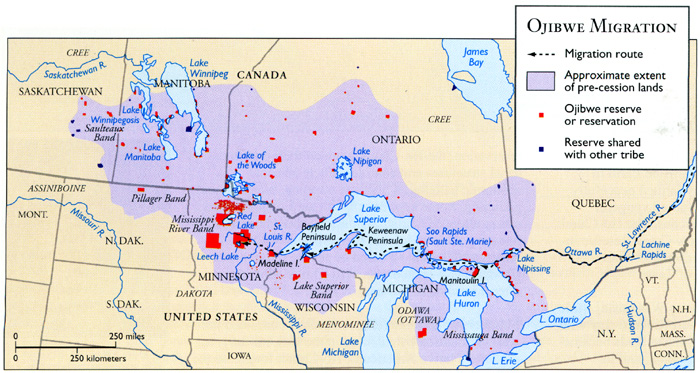
<p>When the Ojibwe first encountered European settlers <a href="https://www.mpm.edu/content/wirp/ICW-151#:~:text=The%20Ojibwe%20are%20believed%20to,groups%20farther%20to%20the%20west.">in the early 1600s</a>, their <a href="https://project.geo.msu.edu/geogmich/images/ojibwe-migration.jpeg">territory</a> stretched some 2,000 miles, from Lake Ontario to the northern Great Plains in present-day Canada. In just a few hundred years, descendants of those settlers engineered an extractive economy based around commodity farming, mining, and oil and gas. Today, Ojibwe homelands are a fraction of what they once were, and the fossil fuel economy continues to raise global temperatures, changing the life cycles &mdash; and even the <a href="https://www.vox.com/22558979/animals-birds-shrinking-size-heat-climate-change">shapes and sizes</a> &mdash; of species large and small.</p>

<p>Dwindling populations of species like the moose demonstrate how second- and third-order effects of climate change can upend ecosystems that have sustained human life, <a href="https://www.vox.com/down-to-earth/22849782/nature-conservation-indigenous-science-jessica-hernandez">ancestral knowledge</a>, and culture for generations. In southeast Alaska, for example, Indigenous peoples have documented a <a href="https://rdcu.be/cEyo6">reduced harvest of Pacific salmon</a> due to warmer waters. In the northern Great Lakes region, wild rice that Anishinaabe communities like McCormick&rsquo;s have <a href="https://www.washingtonpost.com/magazine/2022/01/12/lake-superior-forever-chemicals/">long depended on</a> can&rsquo;t properly take root during <a href="https://www7.nau.edu/itep/main/tcc/Basic/TDK_FirstFoods">warming winters</a>. (The Anishinaabe are a culturally related group of tribes that includes the Ojibwe.)</p>

<p>Minnesota&rsquo;s moose are the same species found in, say, Maine or eastern Canada. (North America&rsquo;s moose comprise four subspecies; notably, moose in Maine are facing many of <a href="https://bangordailynews.com/2019/09/28/news/new-england-moose-deaths-still-worsening-as-climate-warms/https://bangordailynews.com/2019/09/28/news/new-england-moose-deaths-still-worsening-as-climate-warms/">the same threats</a>.) But if moose in Minnesota&rsquo;s <a href="https://www.mprnews.org/episode/2020/08/27/minnesotas-boreal-forest-is-a-climate-change-hot-spot">boreal forests</a> were to blink out, not only would the downstream ripples be felt across the web of life, the region&rsquo;s original human inhabitants and environmental stewards would lose an important piece of their identity, too.</p>
<img src="https://platform.vox.com/wp-content/uploads/sites/2/chorus/uploads/chorus_asset/file/23196130/876723598.jpg?quality=90&#038;strip=all&#038;crop=0,0,100,100" alt="" title="" data-has-syndication-rights="1" data-caption="A leather work featuring tufts of moose hair on display at the Ojibwe Cultural Foundation on Manitoulin Island in M’Chigeeng, Ontario, Canada. | Steve Russell/Toronto Star via Getty Images" data-portal-copyright="Steve Russell/Toronto Star via Getty Images" /><h2 class="wp-block-heading">The moose plays a sacred role in Ojibwe culture </h2>
<p>As long as the Ojibwe have been here, they have depended on and revered the moose. Yet that history has been erased from the popular consciousness. &ldquo;If people would have taken the time to learn more about the Anishinaabe, what would this country look like?&rdquo; asked Jeff Tibbetts, a member of the Fond du Lac Band of Lake Superior Chippewa who also harvests moose. &ldquo;I think it would be a lot stronger.&rdquo;</p>

<p>Tibbetts, McCormick, and other Indigenous people who consider the moose a non-human relative face an existential dilemma. &ldquo;Most people know about the relationship between the Plains Indians and the buffalo,&rdquo; said Carl Gawboy, an Ojibwe painter who lives near Duluth, Minnesota (and features moose in many of his works). But few understand that a similar tie exists between the Ojibwe and the moose, he adds.</p>
<img src="https://platform.vox.com/wp-content/uploads/sites/2/chorus/uploads/chorus_asset/file/23196098/The_Rifle_s_Back_in_Camp_10.45_copy.jpg?quality=90&#038;strip=all&#038;crop=0,0,100,100" alt="" title="" data-has-syndication-rights="1" data-caption="“The Rifle’s Back in Camp,” a watercolor painting by Ojibwe artist Carl Gawboy, showcases a bull moose and a group of onlookers. | Carl Gawboy" data-portal-copyright="Carl Gawboy" />
<p>Gawboy&rsquo;s ancestors played games with small pieces made from moose antlers; they made rattles from the hooves, stockings from the hocks, and snowshoe lashings and other kinds of clothing from the hides, he explained. Some <a href="https://www.youtube.com/watch?v=wEIEJlzksdQ">Indigenous artists continue to practice traditional moose hair embroidery</a>, he said.&nbsp;</p>

<p>The moose is also core to the social fabric of many Ojibwe communities. &ldquo;If someone does something for you,&rdquo; McCormick explained, &ldquo;a kind gesture would be to pull out a pound of moose meat to say thank you.&rdquo;</p>

<p>After McCormick shot her first moose as a teenager, she knelt beside it and said a prayer of thanks. Later, she took the tongue &mdash; a delicacy &mdash; to an elder in the community. &ldquo;This is something that has given its life so that I can live,&rdquo; McCormick said, &ldquo;so that my family can live.&rdquo;</p>

<p>But a few years later, the moose started to vanish from those same woods.</p>
<h2 class="wp-block-heading">A moose mystery was solved with GPS collars and helicopters</h2>
<p>At first it was unclear what, exactly, was to blame.</p>

<p>In a healthy moose population, the adult mortality rate is typically between 8 and 10 percent, according to Moore. But starting about a decade ago, when McCormick&rsquo;s tribe tapped Moore to help them figure out why moose were disappearing from northern Minnesota, the rate was closer to 20 percent.</p>

<p>Moore had seen aerial surveys showing how rapidly the massive herbivores were vanishing, but still, &ldquo;at the beginning it was a total mystery,&rdquo; Moore told Vox. &ldquo;We had no idea what was causing it.&rdquo;</p>
<img src="https://platform.vox.com/wp-content/uploads/sites/2/chorus/uploads/chorus_asset/file/23196307/wolfmooseleg.jpg?quality=90&#038;strip=all&#038;crop=0,0,100,100" alt="" title="" data-has-syndication-rights="1" data-caption="A wolf carries a moose leg on the southern coast of Hudson Bay. | Getty Images" data-portal-copyright="Getty Images" />
<p>Their focus initially turned to another iconic North American species: gray wolves. Over the past three decades, the region&rsquo;s wolf population has grown exponentially. Warmer winters have made the northeastern woods hospitable to their primary food source &mdash; white-tailed deer. So when Moore and his team first began studying the moose decline here in 2010, they thought that wolf packs eating adult moose was likely a leading cause. And they were right that wolves were a factor &mdash; but it wasn&rsquo;t adults they were killing.&nbsp;</p>

<p>&ldquo;In the spring, moose calves are the easiest thing to eat,&rdquo; Moore said. He and his team have since found that eight of every 10 moose calves born in northeast Minnesota are now killed by wolves in their first two weeks of life. Such a high calf mortality rate means adult moose aren&rsquo;t being replenished when they die.&nbsp;</p>

<p>But the major killers of adult moose were altogether different. And it took a lot of intensive research to figure it out.</p>

<p>Several times each winter, Moore and his colleagues would go up in a helicopter to survey for moose. (The team does this work by air because the territory is so vast and unpopulated by people &mdash; plus, seeing a wild moose is a rare occurrence.) When they spotted one, they would dart the animal with a tranquilizer gun, bring the chopper down, and then hike to it.</p>
<img src="https://platform.vox.com/wp-content/uploads/sites/2/chorus/uploads/chorus_asset/file/23196170/moore.jpg?quality=90&#038;strip=all&#038;crop=0,0,100,100" alt="" title="" data-has-syndication-rights="1" data-caption="Seth Moore, wildlife biologist with the Grand Portage Band of Lake Superior Chippewa, poses with a moose he and his team have outfitted with a GPS collar, in order to track its movements and study the population decline. | Seth Moore" data-portal-copyright="Seth Moore" />
<p>Over the course of a decade, the researchers outfitted more than 160 adult&nbsp;moose with GPS collars to track their movements and activity level. If a moose stops moving for more than six hours, Moore gets a text alert with the animal&rsquo;s location. &ldquo;We&rsquo;ll put together a team and head out, sometimes miles into the woods,&rdquo; Moore said. &ldquo;When we get there, typically, we&rsquo;ll find a dead moose.&rdquo;</p>

<p>Moore and his team then take blood and tissue samples from the moose&rsquo;s body and send them to a lab, where technicians determine a cause of death.</p>

<p>After the researchers had accumulated three years&rsquo; worth of data, they started to see patterns that suggested that wolves, along with human recreational hunting, weren&rsquo;t primary forces hurting the adult moose, after all.</p>

<p>The biggest threats were smaller creatures but just as dangerous.</p>
<h2 class="wp-block-heading">Climate change means it’s boom times for brainworms and ticks</h2>
<p>When Moore&rsquo;s team began getting tissue sample results back after their first few winters collecting data, they pinned the leading cause of moose death in northeast Minnesota on a culprit that could fit in the palm of your hand: a type of parasitic brainworm.&nbsp;</p>

<p>An odd downstream effect of climate change is that these 2- to 3-inch long <a href="https://cwhl.vet.cornell.edu/disease/p-tenuis-brainworm">critters</a> are catching rides in from elsewhere &mdash; and are overwhelming the moose. These freeloaders have slipped into this region via white-tailed deer, a host that the worms have co-evolved with and don&rsquo;t cause any harm to (even though they burrow into the deer&rsquo;s brains).</p>
<img src="https://platform.vox.com/wp-content/uploads/sites/2/chorus/uploads/chorus_asset/file/23196199/1237453613.jpg?quality=90&#038;strip=all&#038;crop=0,0,100,100" alt="" title="" data-has-syndication-rights="1" data-caption="As temperatures rise and snow depths shrink, deer are shifting northward into moose territory — and they bring the brainworms with them. Here, a buck crosses a snow-covered street in Minneapolis, Minnesota, last year. | AaronP/Bauer-Griffin/GC Images" data-portal-copyright="AaronP/Bauer-Griffin/GC Images" />
<p>White-tailed deer and North American moose don&rsquo;t normally share habitat; the deer&rsquo;s shorter legs and thinner fur aren&rsquo;t suited for the deep snow and subzero temperatures that moose prefer. But in the past few decades, as temperatures have risen and snow depths have shrunk, deer have been shifting northward into moose territory &mdash; and they&rsquo;ve been taking the brainworms with them.</p>

<p>Brainworms eventually hatch into the deer&rsquo;s bloodstream and then get dumped in their feces. On the forest floor, snails and slugs consume the deer droppings and then climb trees and shrubs, to be inadvertently eaten by foraging moose.</p>

<p>What happens next is dire. After the eggs hatch inside the moose&rsquo;s brain, the worms tunnel around and, unlike in deer, cause serious neurological damage. Brainwormed moose show telltale signs of infestation &mdash; they walk in aimless circles, heads tilted to one side. They die either of starvation or hypothermia from loss of body fat.</p>

<p>Warmer winters are also driving the second-biggest moose killer that Moore and his team discovered: ticks.</p>

<p>Climate change has caused a tick explosion by melting away what has typically kept their numbers in check. Northern Minnesota&rsquo;s ticks survive the cold winter by attaching themselves to the warm, thick coats of moose. In the spring, the ticks fall to the ground to lay eggs. Ice and snow used to kill a sizable portion of them before they could do so. But that crusty layer is <a href="https://e360.yale.edu/features/across-the-boreal-forest-scientists-track-warmings-toll">melting earlier than ever</a>, so now more ticks survive, resulting in skyrocketing populations. It&rsquo;s enough for fatal tick infestations.</p>

<p>Moore and his colleagues have found moose covered in thousands of ticks. To relieve some of the pain and itching, moose will rub against trees, often wearing off patches of fur. Moose infested with ticks are typically missing 60 to 70 percent of their coat, according to Moore. Without their fur to protect them from the harsh winters, they often die from hypothermia or blood loss.</p>

<p>&ldquo;It&rsquo;s horrifying looking,&rdquo; he said. &ldquo;They&rsquo;re called &lsquo;ghost moose&rsquo; because their skin is much lighter than their hair.&rdquo;</p>
<img src="https://platform.vox.com/wp-content/uploads/sites/2/chorus/uploads/chorus_asset/file/23182846/AP19070755189810.jpg?quality=90&#038;strip=all&#038;crop=0,0,100,100" alt="" title="" data-has-syndication-rights="1" data-caption="A moose calf follows its mother in the snow near Grand Marais, Minnesota, in 2014. | Pete Takash/Minnesota Department of Natural Resources via AP" data-portal-copyright="Pete Takash/Minnesota Department of Natural Resources via AP" /><h2 class="wp-block-heading">“It’s a never-ending battle”</h2>
<p>Jeff Tibbetts still goes out moose hunting most seasons, but unlike in previous years, he often comes home empty-handed. There just aren&rsquo;t as many moose out there, he says. He&rsquo;s clear-eyed about what this could mean for his tribe &mdash; &ldquo;if the numbers get too low,&rdquo; he said, &ldquo;we&rsquo;ll stop hunting them.&rdquo; But he does see evidence from Moore&rsquo;s team, showing that the population has begun to stabilize in the last two years, as a reason for hope. (Moore said this could be due to recent severe winters, which dropped the number of brainworm-carrying deer in the region and also brought deeper snow, meaning more ticks are dying before they have a chance to attach to moose.)</p>

<p>Tibbetts&rsquo;s tribe decides as a group how many hunting permits to give each season. Tibbetts also sees it as his and his tribe&rsquo;s responsibility to maintain healthy moose habitat. That includes limiting carbon dioxide and other greenhouse gases, which is part of the reason why, he says, so many Indigenous people are on the front lines fighting against oil pipelines like the Dakota Access Pipeline and <a href="https://www.vox.com/22333724/oil-pipeline-expansion-protest-minnesota-biden-climate-change">Enbridge Line 3</a>.&nbsp;</p>

<p>Hundreds of years ago, the Ojibwe signed treaties that guaranteed their right to continue to hunt, fish, and gather wild foods on lands they ceded to the US government. If species like the moose can no longer thrive on those lands because of state and federal policies that promoted fossil fuel use, many Indigenous people see that as a violation of those treaties, and intend to fight to protect those rights.&nbsp;</p>

<p>&ldquo;The resiliency of native people can&rsquo;t be questioned,&rdquo; Tibbetts said. &ldquo;It&rsquo;s a never-ending battle.&rdquo;</p>
						]]>
									</content>
			
					</entry>
	</feed>