<?xml version="1.0" encoding="UTF-8"?><feed
	xmlns="http://www.w3.org/2005/Atom"
	xmlns:thr="http://purl.org/syndication/thread/1.0"
	xml:lang="en-US"
	>
	<title type="text">Will Wilkinson | Vox</title>
	<subtitle type="text">Our world has too much noise and too little context. Vox helps you understand what matters.</subtitle>

	<updated>2018-08-16T22:54:27+00:00</updated>

	<link rel="alternate" type="text/html" href="https://www.vox.com/author/will-wilkinson" />
	<id>https://www.vox.com/authors/will-wilkinson/rss</id>
	<link rel="self" type="application/atom+xml" href="https://www.vox.com/authors/will-wilkinson/rss" />

	<icon>https://platform.vox.com/wp-content/uploads/sites/2/2024/08/vox_logo_rss_light_mode.png?w=150&amp;h=100&amp;crop=1</icon>
		<entry>
			
			<author>
				<name>Will Wilkinson</name>
			</author>
			
			<title type="html"><![CDATA[“Socialism” vs. “capitalism” is a false dichotomy]]></title>
			<link rel="alternate" type="text/html" href="https://www.vox.com/the-big-idea/2018/8/16/17698602/socialism-capitalism-false-dichotomy-kevin-williamson-column-republican-ocasio-cortez" />
			<id>https://www.vox.com/the-big-idea/2018/8/16/17698602/socialism-capitalism-false-dichotomy-kevin-williamson-column-republican-ocasio-cortez</id>
			<updated>2018-08-16T18:54:27-04:00</updated>
			<published>2018-08-16T13:00:03-04:00</published>
			<category scheme="https://www.vox.com" term="Politics" /><category scheme="https://www.vox.com" term="The Big Idea" />
							<summary type="html"><![CDATA[Suddenly there&#8217;s a lively debate on both the left and&#160;the right about the specter of socialism in America. According to Gallup, Democrats now view socialism in a more positive light than capitalism. And Alexandria Ocasio-Cortez, a card-carrying member of the Democratic Socialists of America, became an instant political star after she clinched the Democratic Party&#8217;s [&#8230;]]]></summary>
			
							<content type="html">
											<![CDATA[

						
<figure>

<img alt="" data-caption="The socialist of the moment: Alexandria Ocasio-Cortez in Detroit on July 28, 2018. | Bill Pugliano/Getty Images" data-portal-copyright="Bill Pugliano/Getty Images" data-has-syndication-rights="1" src="https://platform.vox.com/wp-content/uploads/sites/2/chorus/uploads/chorus_asset/file/12111741/GettyImages_1006877668.jpg?quality=90&#038;strip=all&#038;crop=0,0,100,100" />
	<figcaption>
	The socialist of the moment: Alexandria Ocasio-Cortez in Detroit on July 28, 2018. | Bill Pugliano/Getty Images	</figcaption>
</figure>
<p>Suddenly there&rsquo;s a lively debate on both the left and&nbsp;the right about the specter of socialism in America. <a href="https://news.gallup.com/poll/240725/democrats-positive-socialism-capitalism.aspx">According to Gallup</a>, Democrats now view socialism in a more positive light than capitalism. And Alexandria Ocasio-Cortez, a card-carrying member of the Democratic Socialists of America, became an instant political star after she clinched the Democratic Party&rsquo;s nomination for the New York 14th District&rsquo;s House seat.</p>

<p>Some conservatives, brought up declaiming, &ldquo;Better dead than red,&rdquo; are understandably in a bit of a tizzy. In <a href="https://youtu.be/vW32S19vp0k">a fiery peroration on <em>The View</em></a>, Meghan McCain warned of the peril of going the way of socialist Venezuela, where, she says, people are &ldquo;starving to death.&rdquo;</p>

<p>In National Review, Kevin Williamson offers <a href="https://www.nationalreview.com/2018/08/socialism-fad-a-fixation-on-exciting-words/">a rather more measured and illuminating conservative perspective</a>. He argues that the vogue of &ldquo;socialism,&rdquo; embodied in the rise of Ocasio-Cortez, and the intemperate right-wing reaction to it, is mostly semantic &mdash; a&nbsp;matter of &ldquo;words about words,&rdquo; as he puts it, freighted with polarized sentiment and little definite meaning. &nbsp;</p>

<p>&ldquo;All this talk about socialism isn&rsquo;t about socialism,&rdquo; Williamson writes. &ldquo;It&rsquo;s about the status quo.&rdquo; The idea that &ldquo;capitalism&rdquo; has failed us and that &ldquo;socialism&rdquo; is the answer relies on a cartoonish oversimplification of reality. Current economic arrangements in the US, and throughout the developed world, involve a complex mix of &ldquo;capitalist&rdquo; market institutions and &ldquo;socialist&rdquo; regulatory and redistributive institutions.</p>

<p>If our mixed system is failing many of us, it&rsquo;s highly unlikely that the blame can be assigned exclusively to either its &ldquo;capitalist&rdquo; or &ldquo;socialist&rdquo; components, or to the fact that the system <em>is </em>mixed rather than purely one thing or the other. The real debate, as Williamson goes on to suggest, concerns the structure, balance, and integration of the elements that make up our political economy.</p>

<p>This gets lost when the debate is framed as a binary choice between &ldquo;capitalism&rdquo; &mdash; which the left blames for all contemporary ills &mdash; and &ldquo;socialism.&rdquo;</p>

<p>The polarized ideological charge around these hazily conceived rival ideals leaves both left and right with a dangerous blind spot. As Williamson argues, the left needs to better appreciate the role of capitalism in producing abundance. For its part, he says, the right needs to square up to the unyielding fact of human &ldquo;risk aversion&rdquo; and the indispensable role safety nets in placating this deep-seated distaste for feelings of uncertainty and insecurity by insuring us against the turbulence of capitalist dynamism.</p>

<p>Even if &ldquo;socialism&rdquo; isn&rsquo;t really &ldquo;what anxious young Americans are looking for,&rdquo; Williamson says, conservatives need to &ldquo;be honest with the fact that they aren&rsquo;t buying what we&rsquo;re selling, and do the hard work of understanding why and what to do about it.&rdquo;</p>

<p>He&rsquo;s right on all counts. I&rsquo;d like to lend a hand and help the right better grasp why it&rsquo;s bleeding market share, and why the &ldquo;socialist&rdquo; brand has caught fire with the &ldquo;anxious young American&rdquo; demographic.&nbsp;&nbsp;&nbsp;&nbsp;</p>
<h2 class="wp-block-heading">The free market welfare state: how to make capitalism and socialism friends   </h2>
<p>Williamson is right that the new democratic socialists running for office aren&rsquo;t calling for nationalization of industry or the abolition of private property (though <a href="https://www.vox.com/first-person/2018/8/1/17637028/bernie-sanders-alexandria-ocasio-cortez-cynthia-nixon-democratic-socialism-jacobin-dsa">some of their cheerleaders are</a>). They&rsquo;re calling for an extravagantly beefed-up welfare state, and a shift toward stronger governmental regulation of various industries. These are questionable ideas, but they won&rsquo;t <a href="https://www.vox.com/world/2017/9/19/16189742/venezuela-maduro-dictator-chavez-collapse">turn America into Venezuela</a>.</p>

<p>Still, there&rsquo;s a big difference between real, existing social democracy &mdash; of the sort on display in Denmark or Sweden &mdash;and the Christmas list exorbitance of the DSA platform. (If you&rsquo;re confused by the difference between &ldquo;social democracy&rdquo; and &ldquo;democratic socialism,&rdquo; <a href="https://www.washingtonpost.com/outlook/democratic-socialists-are-conquering-the-left-but-do-they-believe-in-democracy/2018/08/10/5bf58392-9b90-11e8-b60b-1c897f17e185_story.html?utm_term=.94c5278dec64">Sheri Berman is indispensable</a>.) As Williamson observes, progressives in the mold of Bernie Sanders and Ocasio-Cortez seem not to know or care that today&rsquo;s model social democracies also boast model capitalist economies that are in many ways more economically laissez-faire<em> </em>than the wickedly capitalist American system.</p>

<p>According to the conservative Heritage Foundation&rsquo;s <a href="https://www.heritage.org/index/ranking">Index of Economic Freedom</a>, for instance, Denmark and Sweden &mdash; where taxes are high and welfare spending is lavish&nbsp;&mdash; outscore the United States in the security of property rights, ease of starting a business, openness to trade, and monetary freedom (a measure of inflation and price controls). Both narrowly beat the US in overall &ldquo;capitalist&rdquo; economic freedom, despite receiving a stiff penalty from Heritage for their big-spending ways.</p>
<img src="https://platform.vox.com/wp-content/uploads/sites/2/chorus/uploads/chorus_asset/file/12106215/Wilkinson.illo.png?quality=90&#038;strip=all&#038;crop=0,0,100,100" alt="" title="" data-has-syndication-rights="1" data-caption="" data-portal-copyright="Heritage Foundation 2018 Index of Economic Freedom" />
<p>As I&rsquo;ve argued ad nauseam, <a href="https://www.vox.com/2016/9/1/12732168/economic-freedom-score-america-welfare-state">go-go capitalism is <em>how</em> you pay for safety-net soft socialism</a>. Ocasio-Cortez has so far flailed pretty badly on the &ldquo;how would you pay for all this stuff?&rdquo; question. She seems not to grasp that you can&rsquo;t do so just by reallocating the Navy&rsquo;s budget (though that would help). In the real world, you finance soft-socialist guarantees with a level of tax revenue and borrowing you can only sustain through capitalist innovation, competition, efficiency, trade, and growth. That&rsquo;s the lesson of the Nordic social democracies.</p>

<p>The other side of the equation, the part the <em>right</em> often misses, is that insuring folks against bad luck and the downside risks of capitalist disruption is how you maintain political support for &ldquo;neoliberal&rdquo; market dynamism &mdash; and mute democratic demand for reactionary economic nationalism. (It&rsquo;s also how you ensure that prosperity is broadly shared.)</p>

<p>On this score, Williamson insightfully chalks up the current appeal of both socialism and Trump&rsquo;s mercantilism to the urgent human desire to be insulated from the anxiety of uncertainty, and suggests that the libertarian idea that &ldquo;The free market will take care of it, or private charity will&rdquo; is the right-wing analogue to socialist wishcasting about bottomless budgets and technocratic omnicompetence. It is a fantasy vision incapable of answering deep-seated anxieties about dislocation and loss that inevitably shape democratic politics. I wholly agree.</p>

<p>Instability and uncertainty are nerve-racking. The market competition that drives innovation and efficiency is a wrecking ball that leaves some among us sifting through the rubble, all the time. For those of us living paycheck to paycheck, and that&rsquo;s most of us, it&rsquo;s scary. Capitalism creates wealth by setting up a contest for profits that necessarily creates a steady stream of losers.</p>

<p>The fact that capitalism also creates a steady stream of opportunities does not, by itself, make the risk of losing tolerable. If rough seas keep tossing folks overboard, and people are barely keeping their heads above water (&ldquo;Just keep paddling, Aunt Andrea!&rdquo;), it&rsquo;s not enough to be told that there&rsquo;s <em>usually</em> a boat to swim to. We&rsquo;re more willing to risk storm-tossed seas when the ship of state is bristling with lifeboats and manned by a competent crew.</p>

<p>That&rsquo;s a key insight of &ldquo;the free market welfare state.&rdquo; Call it &ldquo;lifeboat laissez-faire.&rdquo; I&rsquo;m glad to see Williamson sticking up for lifeboats. But I also don&rsquo;t think risk aversion is the whole story behind the recent attraction to social democracy.</p>
<h2 class="wp-block-heading">Rigged American capitalism is a big part of the problem</h2>
<p>I disagree with Elizabeth Warren on a slew of policy particulars &mdash; on the minimum wage, single-payer health care, and the Trans-Pacific Partnership, for example &mdash; but I think her <a href="https://www.cnbc.com/2018/07/23/elizabeth-warren-i-am-a-capitalist-but-markets-need-rules.html">recent affirmation</a> of the progressive power of capitalist dynamism gets the bigger picture basically right:</p>
<blockquote class="wp-block-quote has-text-align-none is-layout-flow wp-block-quote-is-layout-flow">
<p>I am a capitalist. &#8230; I believe in markets. What I don&rsquo;t believe in is theft, what I don&rsquo;t believe in is cheating. That&rsquo;s where the difference is. I love what markets can do, I love what functioning economies can do. They are what make us rich, they are what create opportunity. But only fair markets, markets with rules. Markets without rules is about the rich take it all, it&rsquo;s about the powerful get all of it. And that&rsquo;s what&rsquo;s gone wrong in America.</p>
</blockquote>
<p>She&rsquo;s right. We need markets to make us richer. But we also need them to make <em>all of us</em> richer, and that&rsquo;s not just about making sure that we&rsquo;re indemnified against the risks of wrecking-ball competition. It&rsquo;s also about making sure the basic rules of the game aren&rsquo;t rigged to favor people who already won, locking the rest of us into a lower tier of possibility. Warren is a free-market social democrat in the Nordic mold. Her vision is a far cry from the anti-capitalist agenda of the Ocasia-Cortez and the DSA.&nbsp;</p>

<p>Now, the problem isn&rsquo;t exactly &ldquo;markets without rules.&rdquo; The problem is that markets are defined by an incomprehensible jumble of regulatory <a href="https://www.nationalaffairs.com/publications/detail/kludgeocracy-in-america">kludges</a> &mdash; an accumulation of individually reasonable but cumulatively stifling technocratic fixes &mdash; that strangle economic freedom for ordinary people, allowing the powerful to <a href="https://capturedeconomy.com/">capture the economy</a> by writing and selectively enforcing the rules to their advantage.</p>

<p>Warren pretty clearly gets this too. For example, she <a href="https://www.bostonglobe.com/news/nation/2017/08/03/warren-scores-victory-bill-make-hearing-aides-cheaper-easier-buy/YjRgnSXuhwrn032Rmu11CO/story.html">led the charge to deregulate the over-the-counter sale of hearing aids</a>, <a href="https://niskanencenter.org/blog/hearing-aid-deregulation/">against the objections</a> of state-licensed audiologists and incumbent medical device manufacturers, promoting market competition that raises the quality and reduces the cost of a critical life-enhancing technology. &nbsp;&nbsp;&nbsp;&nbsp;</p>

<p>Ocasio-Cortez should take a page from Warren and learn to love markets. As should Republicans, who might come to grasp the appeal of combining sturdier safety nets with freer, fairer markets.</p>
<h2 class="wp-block-heading">The GOP’s market rigging and rejection of the social safety net drives voters toward “socialism”</h2>
<p>No less a classical liberal than F.A. Hayek supported a robust safety net capable of &ldquo;providing for those common hazards of life against which few can make adequate provision.&rdquo; It&rsquo;s true, as Williamson says, that &ldquo;There isn&rsquo;t any obvious and non-arbitrary place to draw the line on those common hazards of life.&rdquo; But he&rsquo;s wrong that &ldquo;the fundamental difference between Right and Left is where to draw that line (or those lines) and how to go about helping those we decide to help.&rdquo;</p>

<p>A Republican Party that remains doggedly devoted to Grover Norquist&rsquo;s goal of shrinking government until it&rsquo;s small enough to drown in a bathtub isn&rsquo;t pro-lifeboat. It&rsquo;s pro-drowning. Moreover, <a href="https://www.cnn.com/2018/07/10/politics/trump-obamacare-insurers/index.html">cannibalizing Obamacare</a>, <a href="https://www.vox.com/2018/2/13/17004636/snap-trump-budget-food-stamps-food-boxes">setting public assistance</a> <a href="https://khn.org/news/5-things-to-know-about-medicaid-work-requirements/">ever further out of reach</a>, and <a href="https://www.nytimes.com/2018/07/25/business/trump-corporate-tax-cut-deficit.html">exploding the deficit</a> with massive tax cuts doesn&rsquo;t make the ruling political right a friend of free markets. Trump&rsquo;s tariff-hiking, winner-picking economic nationalism, which looks to communist China as a model, is an <a href="https://www.cnbc.com/2018/08/10/as-soybean-futures-fall-farmer-says-tariffs-have-devastated-industry.html">immiserating</a> <a href="https://www.nytimes.com/2018/08/05/us/politics/nucor-us-steel-tariff-exemptions.html">morass of rank corruption</a>. But that&rsquo;s what the GOP currently stands for, whether conservative thinkers like it or not.</p>

<p>The right&rsquo;s Pavlovian reaction to Ocasio-Cortez&rsquo;s budget-busting democratic socialism has trapped it in a comforting haze of commie-fighting nostalgia. It leaves Republicans blind to the electoral threat posed by Warren&rsquo;s Nordic-style social democracy, because they can&rsquo;t see the difference; they can only see reds. Warren&rsquo;s coalescing vision of the market-friendly welfare state doesn&rsquo;t exactly amount to the second coming of Milton Friedman, but it&rsquo;s far more intellectually sound and politically attractive than anything Republicans currently have on offer.</p>

<p>If the governing GOP is unable to hear what Hayekian conservatives like Williamson are saying and just keep on smashing the lifeboats, and fail to offer a compelling alternative to Warren&rsquo;s vision for unrigging the economy, not only will they be totally overwhelmed on their left flank on social insurance, they might also find themselves outflanked on the issue of fair, open, competitive markets. They&rsquo;ll get routed by the left <em>on capitalism,</em> still screeching about Venezuelan bread lines.</p>

<p><em>Will Wilkinson is the vice president for research at the&nbsp;</em><a href="http://niskanencenter.org/"><em><strong>Niskanen Center</strong></em></a><em>, and a Vox columnist.</em></p>
<hr class="wp-block-separator" />
<p><a href="http://vox.com/the-big-idea">The Big Idea</a> is Vox&rsquo;s home for smart discussion of the most important issues and ideas in politics, science, and culture &mdash; typically by outside contributors. If you have an idea for a piece, pitch us at <a href="mailto:thebigidea@vox.com">thebigidea@vox.com</a>.&nbsp;</p>
						]]>
									</content>
			
					</entry>
			<entry>
			
			<author>
				<name>Will Wilkinson</name>
			</author>
			
			<title type="html"><![CDATA[The immigration debate is about whether Latinos are “real Americans”]]></title>
			<link rel="alternate" type="text/html" href="https://www.vox.com/the-big-idea/2018/2/22/17040286/immigration-daca-white-nationalism-ethno-trump-racist-latino-citizenship" />
			<id>https://www.vox.com/the-big-idea/2018/2/22/17040286/immigration-daca-white-nationalism-ethno-trump-racist-latino-citizenship</id>
			<updated>2018-02-22T17:36:52-05:00</updated>
			<published>2018-02-22T12:30:01-05:00</published>
			<category scheme="https://www.vox.com" term="Immigration" /><category scheme="https://www.vox.com" term="Policy" /><category scheme="https://www.vox.com" term="Politics" /><category scheme="https://www.vox.com" term="The Big Idea" />
							<summary type="html"><![CDATA[Mainstream coverage of the debate over President Donald Trump&#8217;s DACA hostage-taking has been marked by an alarming insouciance, verging on denial, about what&#8217;s actually going on &#8212; and about just how much is on the line. Trump and his restrictionist supporters are frank about what they want, and why, but the media is often too [&#8230;]]]></summary>
			
							<content type="html">
											<![CDATA[

						
<figure>

<img alt="" data-caption="A protest in favor of DREAMers. | Scott Olson/Getty Images" data-portal-copyright="Scott Olson/Getty Images" data-has-syndication-rights="1" src="https://platform.vox.com/wp-content/uploads/sites/2/chorus/assets/4400567/99616776.jpg?quality=90&#038;strip=all&#038;crop=0,0,100,100" />
	<figcaption>
	A protest in favor of DREAMers. | Scott Olson/Getty Images	</figcaption>
</figure>
<p>Mainstream coverage of the debate over President Donald Trump&rsquo;s DACA hostage-taking has been marked by an alarming insouciance, verging on denial, about what&rsquo;s actually going on &mdash; and about just how much is on the line.</p>

<p>Trump and his restrictionist supporters are frank about what they want, and why, but the media is often too genteel or too cowed by fear of the charge of bias to faithfully relate what newly energized ethnonationalist populists themselves say.</p>

<p>That needs to stop. We need to square up to the fight at hand. We aren&rsquo;t having a technocratic disagreement about the optimal number of or distribution of visas. We&rsquo;re having a fight about national identity, about what it means to be an American, about who counts as one of us, and about who should receive full and equal protection under the law.</p>

<p>And one side, led by the president of the United States, is fighting dirty, holding a sword over the necks of 700,000 young immigrants who grew up in this country.</p>

<p>To cast the DACA immigration debate as something other than 100-proof cultural identity politics sows confusion, obscures the urgency of our duty to protect vulnerable Americans, and strengthens the hand of the side that <em>knows</em> <em>what it&rsquo;s doing.</em>&nbsp;</p>
<h2 class="wp-block-heading">Mexican immigration — of all sorts — is a threat to the ethnonationalist vision       </h2>
<p>DREAMers come from all over, but <a href="http://www.pewresearch.org/fact-tank/2017/09/25/key-facts-about-unauthorized-immigrants-enrolled-in-daca/">nearly 80 percent of them were born in Mexico</a>. For the ethnonationalist populists, immigration &mdash; and Mexican immigration in particular &mdash; is a threat to authentic American national identity, which in their eyes is white and European in origin. The American immigration policy status quo is therefore an existential threat to the nation, as the ethnonationalists imagine it. It follows that the large majority of Americans who support current<em> </em>levels of immigration, or higher levels, has aligned itself directly against the true national interest.</p>

<p>To the ethnonationalists, this capitulation to the inevitability of demographic takeover is tantamount to treason, making it an urgent matter of national self-defense to stymie the majority&rsquo;s will. In making that judgment, the populists redefine &ldquo;the people&rdquo; to exclude practically everyone on the other side of the issue.</p>

<p>Donald Trump, simply by having taken DREAMers hostage while insinuating repeatedly that they (and the legal immigrant communities they represent) represent a dangerous, un-American threat to the interests of real Americans, has done grave damage to social harmony and equal liberty. He has commanded the immense cultural authority of the bully pulpit to tell Americans of all stripes how they stack up in the eyes of the American state.</p>

<p>White Americans anxious about retaining their cultural and political dominance have been told that, yes, they are the American-est and that they matter most. Hispanic Americans get the mirror-image message: Their existence here is a problem, their origins throw a cloud of suspicion over their status as members of &ldquo;the people,&rdquo; and their moral/cultural claim to equality under the law is weak.</p>
<h2 class="wp-block-heading">Supporters of immigration are lost in the policy weeds as the nativist right surges ahead</h2>
<p>The nativist premise that Mexican Americans are somehow lacking in Americanness deserves to be ground into dust. Why <em>hasn&rsquo;t</em> it been? What <em>are</em> we doing? Defending the emphasis on family reunification in current immigration policy is a fine and necessary exercise. Demonstrating mathematically that deporting DREAMers will put a dent in economic growth serves a purpose.</p>

<p>But this sort of wonkery doesn&rsquo;t hit the restrictionists where they live &mdash; in their preoccupation with an exclusive, homogeneous conception of American identity. Ethnonationalists have been walking all over liberal pluralists in the debate over national identity because the champions of multicultural America are stunned by the sudden need to defend the irreproachable against the unutterable (which Trump now utters). They can&rsquo;t figure out how to fight, because they thought this issue was settled.</p>

<p>The Americanness of Hispanic Americans ought to be indisputable. Spanish colonial culture precedes English colonial culture in North America. <a href="https://www.nps.gov/coro/learn/historyculture/stories.htm">Coronado made it all the way to where Kansas sits today</a>, not far from my birthplace in Independence, Missouri, in 1541. Spaniards established settlements in Florida in the 1560s. A Spanish mission was established in what is now the state of New Mexico in 1598 for the purpose of converting the indigenous peoples to Catholicism.</p>

<p>The English Jamestown Colony was established in 1607. The Pilgrims did not arrive at Plymouth Rock until 1620.</p>

<p>The standard narrative of American history begins with the establishment of English colonies on the East Coast and then follows the westward expansion of official US territory. This makes it easy to overlook that the &ldquo;Mestizo&rdquo; mixture of Spanish and Southwestern indigenous ancestry is older the United States, and that Mexicans inhabited US territory before it became US territory.</p>

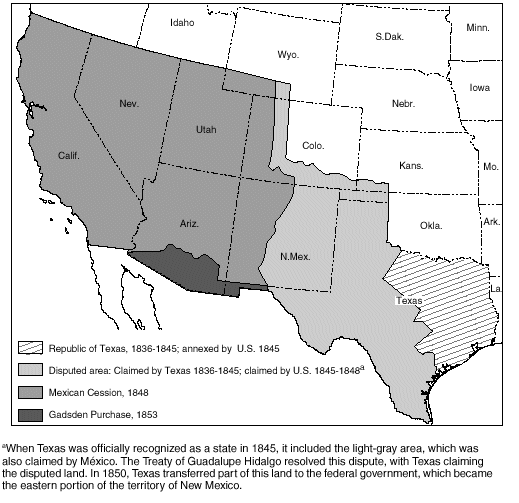
<p>Until the <a href="https://www.archives.gov/education/lessons/guadalupe-hidalgo">Treaty of Guadalupe Hidalgo</a> in 1848, <a href="http://www.thomaslegion.net/sitebuildercontent/sitebuilderpictures/treatyofguadalupehidalgomap.gif">the entire American Southwest</a>, half of Colorado, and even bits of Wyoming and Kansas were <em>literally</em> Mexico. (Texas declared independence earlier, but Mexico didn&rsquo;t recognize it.) The treaty drew the border right through the middle of a culturally coherent, economically unified trade zone and labor market. Look closely at this map:</p>
<img src="https://platform.vox.com/wp-content/uploads/sites/2/chorus/uploads/chorus_asset/file/10277277/Wilkinsonphoto.png?quality=90&#038;strip=all&#038;crop=0,0,100,100" alt="" title="" data-has-syndication-rights="1" data-caption="" data-portal-copyright="&lt;a href=&quot;https://www.economist.com/news/united-states/21595434-old-mexico-lives&quot;&gt;The Economist&lt;/a&gt;" />
<p>Trump supporters who thrill to the idea of a &ldquo;big, beautiful wall&rdquo; on the border largely fail to grasp that the ancestors of many of the people they want to keep out have been here all along, and that people cross back and forth over the border in part because the border crossed a people.</p>

<p>In 1870, the first year for which census data is available, Arizona <a href="http://www.pewresearch.org/fact-tank/2014/06/10/for-three-states-share-of-hispanic-population-returns-to-the-past/">was 61 percent Hispanic</a>. If it works its way back up to that from today&rsquo;s 30 percent, it won&rsquo;t have become less American. It will have become more like it was when it <em>became</em> American.</p>

<p>Before the Gold Rush, Spanish-speaking Mexicans and indigenous people <a href="http://www.scpr.org/news/2014/05/04/43951/california-s-latino-plurality-brings-a-sense-of-de/">outnumbered English-speaking white settlers in California</a> by a wide margin. Today in the Golden State, where the largest population of DREAMers lives, <a href="https://blogs.ancestry.com/cm/whats-the-most-popular-surname-in-your-state/">the most common last names</a> are Garcia, Hernandez, and Lopez and an American is as just as likely to be Hispanic as white. DREAMers aren&rsquo;t <em>like </em>us. <em>They are us</em>.</p>
<h2 class="wp-block-heading">Challenging the idea that Latino Americans can be truly American undercuts the very idea of America</h2>
<p>The fact that there&rsquo;s <em>any</em> question about affording legal status to a class of rooted young immigrants who grew up American among Americans is shameful. It&rsquo;s a reflection of the disgraceful fact that so many of us are doggedly ignorant of the country we claim to revere, and deny the plain historical truth that America has always been multicultural, that Spanish colonial mestizo culture is a foundational American culture, and that many Mexican Americans have deeper roots in American soil than those of us whose European ancestors arrived rather late in the day at Ellis Island.</p>

<p>It makes no more sense, culturally or ethnically, to call into question the Americanness of a young woman whose mom brought her from Hermosillo to Tucson at the age of 6 than it does to doubt that a white guy raised in Syracuse but born in Toronto can ever <em>really</em> belong there.</p>

<p>Threatening to hang DREAMers out to dry &mdash; to arrest them, to uproot them, to jail them, to rip them from their families, to sever their bonds of loyalty and love, and to cast them into exile &mdash; threatens the equality and security of tens of millions of American citizens who are ethnically and culturally <em>identical</em> to<em> </em>them.</p>

<p>And a threat to any subset of Americans is a threat to America &mdash; to <em>us.</em>&nbsp;Trump&rsquo;s unilateral act of political hostage-taking was, from the beginning, an act of violent division, an assault on the integrity of the actual, existing, real-world American people.</p>

<p>The ethnically purified fantasy of the populist imagination is a seditious force that obscures our higher loyalties, shatters the peace of liberal equality, and splits Americans into warring tribes ready to abuse people whom patriotic decency would otherwise compel us to defend.&nbsp;&nbsp;</p>

<p><em>Will Wilkinson is the vice president for policy at the&nbsp;</em><a href="http://niskanencenter.org/"><em><strong>Niskanen Center</strong></em></a><em>, and a Vox columnist.</em></p>
<hr class="wp-block-separator" />
<p><a href="http://vox.com/the-big-idea">The Big Idea</a> is Vox&rsquo;s home for smart discussion of the most important issues and ideas in politics, science, and culture &mdash; typically by outside contributors. If you have an idea for a piece, pitch us at <a href="mailto:thebigidea@vox.com">thebigidea@vox.com</a>.</p>
						]]>
									</content>
			
					</entry>
			<entry>
			
			<author>
				<name>Will Wilkinson</name>
			</author>
			
			<title type="html"><![CDATA[It may be time to disobey the commander in chief]]></title>
			<link rel="alternate" type="text/html" href="https://www.vox.com/the-big-idea/2017/5/26/15697178/legitimacy-trump-presidency-resist-corruption-constitution" />
			<id>https://www.vox.com/the-big-idea/2017/5/26/15697178/legitimacy-trump-presidency-resist-corruption-constitution</id>
			<updated>2017-05-26T12:38:05-04:00</updated>
			<published>2017-05-26T09:50:02-04:00</published>
			<category scheme="https://www.vox.com" term="Politics" /><category scheme="https://www.vox.com" term="The Big Idea" />
							<summary type="html"><![CDATA[In the space of a week, Trump fired FBI Director James Comey, lied about why he did it, then admitted in a TV interview that, actually, he prematurely terminated Comey&#8217;s 10-year term because he was annoyed with the FBI&#8217;s ongoing investigation into his campaign&#8217;s ties to Russian officials. It appears that Trump specifically asked Comey [&#8230;]]]></summary>
			
							<content type="html">
											<![CDATA[

						
<figure>

<img alt="" data-caption="President Trump’s firing of James Comey (right) may have served to undermine the rule of law. | Pool / Getty" data-portal-copyright="Pool / Getty" data-has-syndication-rights="1" src="https://platform.vox.com/wp-content/uploads/sites/2/chorus/uploads/chorus_asset/file/8583541/GettyImages_632412514.jpg?quality=90&#038;strip=all&#038;crop=0,0,100,100" />
	<figcaption>
	President Trump’s firing of James Comey (right) may have served to undermine the rule of law. | Pool / Getty	</figcaption>
</figure>
<p>In the space of a week, Trump fired FBI Director James Comey, lied about why he did it, then admitted in a TV interview that, actually, he prematurely terminated Comey&rsquo;s 10-year term because he was annoyed with the FBI&rsquo;s ongoing investigation into his campaign&rsquo;s ties to Russian officials.</p>

<p>It appears that Trump specifically asked Comey to end the investigation after he fired Michael Flynn, his first national security adviser, ostensibly because Flynn had got caught in a lie to the vice president about a conversation with the Russian ambassador. According to Comey&rsquo;s notes on the conversation, Trump said, &ldquo;I hope you can let this go.&rdquo; Comey didn&rsquo;t let it go. And one suspects that&rsquo;s why he&rsquo;s now updating his LinkedIn profile. Meanwhile, it has emerged that Trump asked the director of national intelligence and the director of the National Security Agency to deny that the FBI was investigating his campaign.</p>

<p>The whole affair reeks of obstruction of justice, which has not gone unnoticed by Rod Rosenstein, the deputy attorney general, who appointed a special counsel to investigate the mess last week. &ldquo;We cannot allow this to go unchecked,&rdquo; said Al Green, a Democratic Congress member from Houston, who called for the president&rsquo;s impeachment from the floor of the House. &ldquo;The president is not above the law &hellip; I am a voice in the wilderness, but I assure you that history will vindicate me.&rdquo;</p>

<p>Comey&rsquo;s firing is the latest and worst in a string of outrageous abuses of office. Let&rsquo;s be clear: The president of the United States asking an FBI director to end an investigation into the activities of his own campaign, and his own administration, and then firing the FBI director &mdash; who is meant to be politically independent &mdash; because he refused to stop doing his job, is a brazen assault on the rule of law. It&rsquo;s a monumental breach of the laws and norms that protect citizens from the tyrannical abuse of violent state power.</p>
<h2 class="wp-block-heading">What is “legitimacy,” really?</h2>
<p>Trump&rsquo;s presidency has been dogged with doubts about legitimacy from the beginning. There&rsquo;s a real possibility that he would have lost but for Russian interference. At this point, however, that in itself is not the biggest stain on Trump&rsquo;s legitimacy.&nbsp;He has truly undermined his legitimacy by his actions in office.</p>

<p>What is &ldquo;legitimacy&rdquo; and why does it matter? It&rsquo;s a difficult concept, but a crucial one. Political power is backed by violence. It is inherently dangerous and the temptation to abuse it is great. That is why it is essential that the people who wield power have the right to do so, and why political theorists spend so much time thinking about when they do have that right, and when they don&rsquo;t.</p>

<p>Political authority is legitimate only when it is exercised according to the legal rules and social norms that keep it aligned with the public interest and prevent its egregious abuse. When a leader flagrantly violates those rules and norms, he effectively voids the legitimacy of his claim to power. His authority becomes authoritarian and his power becomes despotic. &nbsp;</p>

<p>Trump&rsquo;s determination to personally profit from the presidency, his insistence on giving positions of power to family, his manifest indifference to truth, his attacks on an independent media, his use of the bully pulpit to run down the authority of the judicial branch, and his interference with the Justice Department all combine to strike a mighty blow against the foundations of his own legitimacy. Indeed, firing Comey takes the president&rsquo;s hostility to the rule of law to another, more alarming, level. It&rsquo;s time to seriously consider the possibility that Trump, in just four months, has stripped himself of legitimate title to the authority of his office.</p>

<p>This is a pretty radical claim. To test whether it&rsquo;s reasonable, we need to dig into what it means to say that anyone, much less a president, does or does not have legitimate authority. For now, the important thing to keep in mind is that those who wield legitimate authority have a special power: to create duties of obedience in others. But when authority isn&#8217;t legitimate, it isn&#8217;t really authority, and it need not be obeyed. When the authority in question is the president of the United States, permission to disobey the boss (because he isn&rsquo;t really the boss!) has profound implications.&nbsp;</p>

<p>Questions about legitimacy are questions about the validity of claims to authority, and the obligations of obedience that flow from authority. To have authority is to have the power to give other people reasons, even obligations, to do things.</p>

<p>If you&rsquo;re 12 years old and I&rsquo;m your dad, when I say, &ldquo;Go get ready for bed,&rdquo; that gives you a reason to get ready for bed &mdash; whether you want to or not. If I&rsquo;m your supervisor at the office, and I tell you to put a cover sheet on the TPS report, that gives you a reason to put a cover sheet on the TPS report. Indeed, you are <em>obliged</em> to put a cover sheet on the TPS report. If you fail to meet that obligation, you will have done something wrong, and it would be fair to impose some kind of punishment on you.</p>

<p>Authority is power &mdash; the power to create reasons for action and obligations of compliance in others. But this power depends entirely on the authority being real or legitimate.</p>
<figure class="wp-block-pullquote alignleft"><blockquote><p>Ultimately, our freedom and safety may depend on a handful of government officials’ personal integrity and commitment to the Constitution</p></blockquote></figure>
<p>When a 12-year-old shouts at her mom&rsquo;s new husband, &ldquo;You&rsquo;re not my dad! You can&rsquo;t tell me what to do!&rdquo; she&rsquo;s making a claim about the legitimacy of his authority. She&rsquo;s saying he doesn&rsquo;t check the boxes that would qualify him to issue orders she ought to obey. Likewise, if no one but your officious junior colleague, Vince, tells you to put a cover sheet on the TPS report, that&rsquo;s just a suggestion. Vince doesn&rsquo;t have the authority, even if he acts like he does. You can ignore him with impunity.</p>

<p>Roles that confer authority on their occupants abound. Families, firms, churches, clubs, and governments are composed of people who inhabit roles that confer authority on their occupants. Rules, whether they be conventional, institutional, legal, or moral, set out the conditions required to qualify for a role and to legitimately exercise its authority. These rules populate our world with more-or-less objective social facts about authority &mdash; facts about who has the power to give others reasons to act.</p>

<p>It&rsquo;s a fact that Germans in Potsdam don&rsquo;t have a duty to comply with the laws of&nbsp;Malaysia. It&rsquo;s a fact that your boss, but not Vince, can give you a reason to put a cover sheet on your TPS report just by telling you to do it. You might not be able to tell the difference between a genuine police officer and an imposter cop in a stolen uniform, but it&rsquo;s a fact that one of them has the authority to arrest people and the other doesn&rsquo;t. This matrix of rules, roles, and reasons is the natural human habitat. It&rsquo;s part of what Aristotle meant when he said that humans are &ldquo;political animals.&rdquo;</p>
<h2 class="wp-block-heading">Political legitimacy is unique because of the unique — even deadly — power that government holds </h2>
<p>Political authority isn&rsquo;t essentially different from the authority of football coaches and middle managers. It works the same way. When it&rsquo;s legitimate, it creates duties of obedience. When it&rsquo;s not legitimate, it&rsquo;s not <em>really </em>authority, and there is no duty to obey it all.</p>

<p>But political authority does possess some distinctive qualities &mdash; important ones. Specifically, <em>political</em> authority is distinguished from other forms of authority by its fundamentally non-voluntary character and its intimate relationship to violent coercion. When you take a job, you freely opt into a scheme of authority in which you can conceivably get fired for failing to put a cover sheet on a TPS report. But you can&rsquo;t so freely opt in or out of relationships of political authority &mdash; and if you break the law, the government can use physical coercion, or the threat of it, to take away your property, your freedom, and even your life.</p>
<img src="https://platform.vox.com/wp-content/uploads/sites/2/chorus/uploads/chorus_asset/file/8525849/trump_russia_one.jpg?quality=90&#038;strip=all&#038;crop=0,0,100,100" alt="President Trump meets with Russian Foreign Minister Sergei Lavrov and Russian Ambassador Sergey Kislyak, in the Oval Office. Even if Russia didn’t help Trump win the election, his legitimacy is in question." title="President Trump meets with Russian Foreign Minister Sergei Lavrov and Russian Ambassador Sergey Kislyak, in the Oval Office. Even if Russia didn’t help Trump win the election, his legitimacy is in question." data-has-syndication-rights="1" data-caption="President Trump meets with Russian Foreign Minister Sergei Lavrov and Ambassador Sergey Kislyak, in the Oval Office. Even if Russia didn’t help Trump win the election, his legitimacy is in question, Will Wilkinson argues. | Alexander Shcherbak / TASS / Getty" data-portal-copyright="Alexander Shcherbak / TASS / Getty" />
<p>Ideally, a widespread recognition of the legitimacy of political authority does most of the work in generating obedience to the law; threats of coercive sanction operate mainly as a backstop that helps solve collective action problems and keeps those who weren&rsquo;t going to comply anyway in check. But we can&rsquo;t always count on voluntary compliance to maintain the level of order required for a healthy, liberal society. We can&rsquo;t do without the coercive backstop. And that means that politics, by its very nature, plays with fire.</p>

<p>Political power is morally justified and infused with the mandate of legitimacy only if its exercise serves the interests and protects the rights of those subject to that power. Authoritarian governments have no <em>moral</em> authority. What they have instead is raw force &mdash; armed police, soldiers, spies, and border guards who compel obedience through violence and fear.</p>

<p>Some political philosophers argue that it&rsquo;s impossible to justify the inequalities in coercive power inherent in political authority. It&rsquo;s just too dangerous. But this radical view, which denies that political authority can ever be legitimate, obscures more than it clarifies. When everything government does is classified as an abuse of power, it&rsquo;s easy to lose track of the abuses that seriously threaten our liberty and prosperity. Few people think anarchy is an enviable state.</p>

<p>Most of us believe that political power can be justified as long as it leaves us all better off than we&rsquo;d be without it. And that demands an elaborate structure of institutions devoted to assigning, diffusing, limiting, channeling, and constraining that authority so that it protects rather than undermines life, liberty, and the pursuit of happiness. This is literally the American idea, and its success, embodied in the United States Constitution, led to the spread of the best form of political organization in human history: &ldquo;liberal democracy.&rdquo;</p>

<p>That phrase serves as shorthand for the collection of institutions known to render dangerous political authority friendly to human freedom and well-being. A charter of basic rights, the separation of powers, free and fair elections, representative legislative bodies, the rule of law, an independent judiciary, a free and independent press, and a professional nonpartisan civil service work together to make political authority something that <em>can </em>be legitimately exercised. They&rsquo;re &ldquo;legitimacy-enabling&rdquo; institutions.</p>
<h2 class="wp-block-heading">At some point, attacks on the rule of law invite disobedience</h2>
<p>Whether or not Trump was legitimately elected, his presidency thus far has been a nonstop assault on America&rsquo;s legitimacy-enabling institutions. You can bracket the question of Russian influence entirely and still find Trump up to his bronzed wattle in financial conflicts of interest, nepotism, and naked aggression against every attempt to subject him to the rule of law. It was always going to turn out this way.</p>

<p>Trump&rsquo;s basic tactic &mdash; and it&rsquo;s really his <em>only</em> tactic &mdash; is to viciously attack the perceived legitimacy of any person or institution standing in his way while aggressively stimulating the public&rsquo;s authority-identification gland through charismatic bravado and self-aggrandizing lies. Trump really will say anything &mdash; that you&rsquo;re a bastard imposter, secretly Canadian, guilty of disqualifying crimes, low-energy, little, lying, crooked; that he&rsquo;s 12-feet tall, the smartest human ever tested, worth a zillion dollars, doesn&rsquo;t need sleep &mdash; whatever it takes. And because he&rsquo;s a master of authoritative self-presentation, gullible people are inclined to believe him. It is a cretinous, bullying, dead-simple strategy that Trump deployed with remorseless (if sometimes ham-fisted) cunning all the way to the White House.</p>

<p>But once you&rsquo;re inside the White House, it&rsquo;s a recipe for mayhem. It&rsquo;s just impossible to govern the world&rsquo;s oldest, most powerful liberal-democratic state by running down the legitimacy of anyone who ever says anything you don&rsquo;t like. Trump&rsquo;s basic mode of operation practically guarantees the liberal-democratic norms and rules that make a president&rsquo;s vast political authority legitimate will be constantly violated.</p>

<p>In the hands of a president, Trump&rsquo;s one political trick becomes a wrecking ball aimed at the foundations of American freedom. The stability of the American constitutional order requires that each branch of the government accord some measure of respect and deference to the others. If that division of power breaks down, the rule of law corrodes and the moral basis of the government&rsquo;s authority to govern breaks down, too.</p>
<figure class="wp-block-pullquote alignleft"><blockquote><p>You can bracket the question of Russian influence entirely and still find Trump up to his bronzed wattle in financial conflicts of interest, nepotism, and naked aggression against every attempt to subject him to the rule of law</p></blockquote></figure>
<p>So when Trump attacks the legitimacy of the judiciary, he attacks the system of delicately balanced and constrained power that gives <em>him </em>authority. The exercise is repeated when he attacks the independent media &mdash; going far beyond complaints of unfair coverage to stocking the White House briefing room with reporters from bogus right-wing news sites, or asserting that the &ldquo;failing&rdquo; major news organizations reporting on his efforts to stop the Russia investigation are serving up &ldquo;fake news.&rdquo;</p>

<p>When he fires his own FBI director to evade inquiry into his administration&rsquo;s possible malfeasance, describing Comey as a &ldquo;nut job,&rdquo; he undermines the legitimacy of the executive branch&rsquo;s internal oversight mechanisms, which are critical to ensuring that presidents are held accountable to the law.&nbsp; With every blow to the legitimacy of the institutions that protect Americans from the abuse of unconstrained power, Trump weakens his own claim to authority &mdash; and, in turn, weakens the duties of citizens, soldiers, and bureaucrats to behave as if he has any.&nbsp;</p>

<p>This has far-reaching practical implications for those Americans who are most directly subject to the president&#8217;s authority &mdash; for White House staff, for the military officers, for Department of Justice officials, and for agents of the FBI, CIA, and Secret Service, among others. There&rsquo;s a reason government officials take an oath of loyalty to the Constitution and not to the office of the president or its inhabitant. The oath is a reminder that each and every one of these people is a small check on power.</p>

<p>When political leaders with an already dubious claim to power actively abuse it, the freedom of those down the chain of command to ignore their orders can turn into a positive duty to disobey orders. If Congressional Republicans continue to fail in their constitutional oversight duties, colluding with the Trump administration&rsquo;s attempts to foil inquiries into its corruption (or worse), it may fall to members of executive branch agencies privy to incriminating information to put it into the hand of the press. They might thereby force congressional oversight by inflaming the public&rsquo;s sense of scandal. Fidelity to their constitutional oaths might even make it imperative to actively oppose the administration from within.</p>

<p>But isn&rsquo;t it dangerous to allow bureaucrats to unilaterally decide that a president is no longer legitimate, and that their duties to the office of the presidency no longer entail obedience to Donald Trump? Yes, it&rsquo;s dangerous. And let&rsquo;s not be na&iuml;ve. Partisans always call their opponents&rsquo; legitimacy in question. Politics is always more than a little shady. Governmental stability is so incredibly important that we ought to be willing to tolerate a fair bit of degeneracy in the system for the sake of civil peace.</p>

<p>A healthy political culture isn&rsquo;t brittle, and good institutions have built-in mechanisms for dealing with some level of corruption and abuse of power. If the system can handle it, we ought to try to ride out low-grade illegitimacy using the established procedures. But when an outbreak of despotic venality threatens the long-run integrity of the institutions our lives depend upon, some public servants may find themselves forced to make critical, risky, personal judgments about the legitimacy of the president&rsquo;s authority.</p>

<p>Ultimately, our freedom and safety may depend on a handful of government officials&rsquo; personal integrity and commitment to the Constitution and to their compatriots. Conscience has authority, too.&nbsp;</p>

<p><em>Will Wilkinson, a Vox columnist, is the vice president for policy at the&nbsp;</em><a href="http://niskanencenter.org/"><em><strong>Niskanen Center</strong></em></a><em><strong>.</strong></em></p>
<hr class="wp-block-separator" />
<p><a href="http://vox.com/the-big-idea">The Big Idea</a> is Vox&rsquo;s home for smart discussion of the most important issues and ideas in politics, science, and culture &mdash; typically by outside contributors. If you have an idea for a piece, pitch us at <a href="mailto:thebigidea@vox.com">thebigidea@vox.com</a>.</p>
						]]>
									</content>
			
					</entry>
			<entry>
			
			<author>
				<name>Will Wilkinson</name>
			</author>
			
			<title type="html"><![CDATA[Don’t lose sight of how strange and dangerous the Trump administration’s anti-Islam worldview is]]></title>
			<link rel="alternate" type="text/html" href="https://www.vox.com/the-big-idea/2017/5/3/15528360/islam-jihad-sharia-trump-bannon-isis-radical" />
			<id>https://www.vox.com/the-big-idea/2017/5/3/15528360/islam-jihad-sharia-trump-bannon-isis-radical</id>
			<updated>2017-05-03T11:29:11-04:00</updated>
			<published>2017-05-03T11:00:04-04:00</published>
			<category scheme="https://www.vox.com" term="Politics" /><category scheme="https://www.vox.com" term="The Big Idea" />
							<summary type="html"><![CDATA[The first months of the Trump administration were accompanied by scores of slightly stunned explanatory news articles detailing the no-longer-fringe Islamophobic worldview of the new president&#8217;s advisers. Among the staffers espousing the view that we are at the outset of a titanic clash between Judeo-Christian and Islamic civilizations were Michael Flynn, Trump&#8217;s short-lived national security [&#8230;]]]></summary>
			
							<content type="html">
											<![CDATA[

						
<figure>

<img alt="" data-caption="Dangerous, yes — but hardly an “existential” threat to the US" data-portal-copyright="" data-has-syndication-rights="1" src="https://platform.vox.com/wp-content/uploads/sites/2/chorus/uploads/chorus_asset/file/6233419/thuumb_site.0.jpg?quality=90&#038;strip=all&#038;crop=0,0,100,100" />
	<figcaption>
	Dangerous, yes — but hardly an “existential” threat to the US	</figcaption>
</figure>
<p>The first months of the Trump administration were accompanied by scores of slightly stunned explanatory news articles detailing the no-longer-fringe Islamophobic worldview of the new president&#8217;s advisers. Among the staffers espousing the view that we are at the outset of a titanic clash between Judeo-Christian and Islamic civilizations were Michael Flynn, Trump&#8217;s short-lived national security adviser; Steve Bannon, the recently sidelined White House chief strategist; Sebastian Gorka, deputy assistant to the president (apparently soon to be reassigned); Stephen Miller, senior adviser to the president; and even the director of the CIA, Mike Pompeo.</p>

<p>Pompeo has spoken of the &ldquo;struggle against radical Islam, the kind of struggle this country has not faced since its great wars.&rdquo; Flynn, <a href="https://www.amazon.com/Field-Fight-Global-Against-Radical/dp/1250106222">in a book</a> with Michael Ledeen, a foreign policy wonk at the right-wing Foundation for the Defense of Democracies, wrote: &ldquo;We&rsquo;re in a world war against a messianic mass movement of evil people, most of them inspired by a totalitarian ideology: Radical Islam.&rdquo;</p>

<p>&ldquo;Islamic fascism&rdquo; is Bannon&rsquo;s preferred nomenclature. &ldquo;There is a major war brewing, a war that&rsquo;s already global,&rdquo; Bannon <a href="https://www.buzzfeed.com/lesterfeder/this-is-how-steve-bannon-sees-the-entire-world?utm_term=.xaMm8pJJp#.ppKyYqJJq">has said</a>. &ldquo;Every day that we refuse to look at this as what it is &hellip; will be a day where you will rue that we didn&rsquo;t act.&rdquo; The idea of a high-stakes war against radical Islam is foundational to the worldview and narrative that Breitbart News, which Bannon ran before joining the Trump campaign, has been selling to millions of readers. &ldquo;Our big belief, one of our central organizing principles at the site,&rdquo; Bannon has said, &ldquo;is that we&rsquo;re at war.&rdquo;</p>

<p>But we aren&rsquo;t at war. This hasn&rsquo;t been said frequently or forcefully enough. In fact, the idea that the West is at war with radical Islam, and that the survival of Judeo-Christian European culture is at stake, is completely bonkers &mdash; and incredibly dangerous. The beliefs underlying the clash of civilizations myth, especially when they animate American immigration and foreign policy, invite a spiral of mutual cultural antagonism that could <em>lead</em> to<em> </em>war. These beliefs promote toxic, anti-Muslim bigotry and a refusal to accept that peaceful and productive coexistence with Muslims is possible. They perversely cultivate the conditions for the marginalization, alienation, and radicalization of young Muslims where they didn&rsquo;t previously exist.</p>

<p>The war with radical Islam is not generally portrayed as a large-scale conventional war between armies and navies. The prospect of anything like that seems too far-fetched to seriously consider. That&rsquo;s why most right-wing propaganda about a notional Islamic war against the West focuses on &ldquo;stealth jihad&rdquo; &mdash; a war so insidiously quiet we might not notice we&rsquo;re in it until it&rsquo;s too late! However, the idea that stealth jihad can somehow add up to an existential<em> </em>threat to the United States, much less the entire Judeo-Christian West, is at least as implausible as the idea that a massive conventional military conflict with radical Islamic forces is looming on the horizon.</p>

<p>As it happens, Steve Bannon &mdash; who is essentially a grimly unfunny Alex Jones &mdash; believes in both of these outlandish scenarios: international warfare as well as a stealthy attack from within powerful enough to bring the US to its knees.</p>
<h2 class="wp-block-heading">The apocalyptic worldview of Trump’s advisers is built on shaky scholarly foundations — to put it mildly</h2>
<p>Thanks to a book called <em>The Fourth Turning </em>by two amateur historians, Neil Howe and William Strauss (the noted social-scientific genius behind the Capitol Steps), Bannon thinks the world faces a huge transformative crisis every four generations &mdash; every 80 years or so. If you cut yourself enough slack, you can jam the American Revolution, the Civil War, the Great Depression, and World War II into the pattern.</p>

<p>There is no credible evidence for this idiosyncratic conjecture, divined only by these two authors, but it is nevertheless the intellectual engine of Bannon&#8217;s worldview, which is described at length in his film <a href="https://www.youtube.com/watch?v=bsqu9gh6xhk"><em>Generation Zero</em></a>. Bannon thinks the fourth crisis started with the financial crash of 2007 and will end with a world-historical clash against &#8220;Islamic fascism.&#8221;</p>

<p>For <em>Generation Zero</em>, Bannon managed to find one credible historian, David Kaiser, who claims to have gleaned some insight from the generational theory of cyclical crises. He is featured prominently in the film, although, as Kaiser recalled in <a href="http://time.com/4575780/stephen-bannon-fourth-turning/">Time</a>, Bannon cut out the bit of the interview in which Kaiser disagreed that the pattern of previous conflicts establishes that the next one is bound to be apocalyptic. &ldquo;[K]nowing that the history of international conflict was my own specialty,&rdquo; Kaiser wrote, &ldquo;he repeatedly pressed me to say we could expect a conflict at least as big as the Second World War in the near or medium term. I refused.&rdquo;</p>
<figure class="wp-block-pullquote alignleft"><blockquote><p>This hasn’t been said frequently or forcefully enough: The idea that the West is at war with radical Islam, and that the survival of the Judeo-Christian European culture is at stake, is completely bonkers </p></blockquote></figure>
<p>Bannon nevertheless imagines that the theory of <em>The Fourth Turning</em> means his made-up war against radical Islam is destined to be as big as the fight against the Nazis. He also likes to compare the threat of &ldquo;Islamic fascism&rdquo; to the threat of Cold War&ndash;era totalitarian communism. These comparisons are hard to take seriously. But Steve Bannon still has the ear of the commander in chief, and he&rsquo;s a master of propaganda, so we&rsquo;d better take it seriously.</p>

<p>At its peak, the Soviet Union and its communist allies controlled one-third of the Earth&#8217;s landmass. State communism in the Soviet Union and China led to the deaths of around 100 million of their own citizens. When Nikita Khrushchev said, &#8220;We will bury you,&#8221; to capitalist North America and Western Europe, he had the ability to do it. The Soviet Union was a nuclear power with the means to unilaterally end all life on Earth.</p>

<p>Similarly, Nazi Germany assembled what was arguably the most effective war machine in human history up to that point. At their peak, the Nazis and their allies controlled about half the territory of Europe. It took the combined military power of the British Empire, the United States, and the Soviet Union to subdue them.</p>

<p>For much of the war, the Germans had superior military technology, and they consistently inflicted more casualties than they sustained. More than 10 million Soviet soldiers died in order to take about 4 million German lives and turn back the Nazi attack on the Eastern Front. The effort may well have failed if not for the assistance of a brutal Russian winter.</p>

<p>The Nazis and the Cold War communist bloc were a threat to the free world because they controlled vast territories, had huge conscripted armies drawn from huge populations, and projected massive military power. These avowed enemies of the United States could and did conquer entire countries and regions, installing their own client governments and propaganda machines.</p>

<p>&ldquo;Radical Islam&rdquo; cannot pose a remotely comparable threat to the United States, much less the entire West.</p>
<h2 class="wp-block-heading">Even if every Islamic country turned hostile overnight, “the West” has an insurmountable lead in wealth and force</h2>
<p>The combined military budget of the nine biggest-spending Muslim-majority countries came to about $186 billion in 2015. The United States alone more than tripled that, spending $596 billion in 2015. And the NATO countries combined &mdash; a good proxy for &ldquo;the West&rdquo; &mdash; spent $892 billion. Of course, most Muslim-dominant countries are friendly to the United States. The biggest spenders &mdash; Saudi Arabia, the United Arab Emirates, Turkey, Iraq, and Algeria &mdash;&nbsp;are all either allies or friendly to the US and Europe. Turkey is in fact a member of NATO.</p>

<p>Of Muslim countries, only Pakistan has nuclear capabilities, and its weapons are aimed at India. Iran, the biggest predominantly Muslim country officially hostile to the United States, spends less on its military than Canada. The most populous Muslim-majority country in the world, Indonesia, maintains close and friendly relations with the United States and spends just a little more than Mexico on defense.</p>

<p>Geopolitical power, hard and soft, is largely a function of economic strength. The combined GDP of the 57 member countries of the Organization of Islamic Cooperation is about $7 trillion. That&rsquo;s less than half the GDP of the United States alone. The European Union&rsquo;s GDP is roughly the size of America&rsquo;s. In sum, the combined economy of the US and the EU is nearly five times larger than the combined economy of all Muslim-majority countries.</p>

<p>But this is an exceedingly silly exercise. It shows only that even if the entire Muslim world were<em> </em>hostile to the United States, and unified in that hostility, it would not pose much of a threat. But how many radical anti-US Muslims are there? Not many. Again, the vast majority of the world&rsquo;s 1.7 billion Muslims live in countries with which the US is friendly.&nbsp;&nbsp;&nbsp;</p>

<p>None of this is to deny that fundamentalist groups like al-Qaeda and ISIS have basically declared war on the entire world. Nor is it to deny that ISIS is a traveling horror show of deranged murder-cultists who rule despotically over a sizable patch of territory. And it&#8217;s certainly not to say that terrorists animated by an extremist version of Islam don&#8217;t kill plenty of people, and will continue to &mdash; some Americans included. It&#8217;s just to say that from the perspective of empirically grounded risk assessment, this barely ranks as a <em>minor</em> threat to American or Western life and limb. The<em> </em>threat to European or American <em>civilization</em> is zilch. &nbsp;&nbsp;</p>

<p>ISIS came to life because the American invasion of Iraq and Afghanistan weakened those states and destabilized the region, making it possible to conquer some territory with motivated troops and a bunch of Ford F-150s mounted with machine guns and rocket launchers. ISIS doesn&rsquo;t have tank brigades, doesn&rsquo;t have a navy, doesn&rsquo;t have an air force, and is not going to get much further than it&rsquo;s gotten. ISIS poses a terrifying existential threat to people in bits of Syria, Iraq, and Afghanistan, but that&#8217;s it. The threat the group poses to anybody else is sporadic terrorism, which is the weapon of choice when you don&#8217;t have real geopolitical power.</p>

<p>An American is more likely to die from a lightning strike than an act of terrorism committed by a Muslim &mdash; and that estimate takes into account the 3,000 deaths on 9/11. You might argue that Americans are more likely to die beneath a toppled bookshelf than in a jihadist&rsquo;s suicide attack <em>because </em>of aggressive anti-terror policies. I&rsquo;m not so sure about that. America&rsquo;s war on terror produced the regional destabilization that allowed ISIS to get a footing.</p>

<p>In any case, if it is truly the case that the risk of death by Islamic terrorism can<em> </em>be reduced to approximately zero through official anti-terror zeal, that suggests the threat is manageable &mdash; indeed, that it is being managed.</p>
<h2 class="wp-block-heading">The conceptual — and numerical — absurdity of “stealth jihad”      </h2>
<p>Ah, but what about the enemy within? When pressed about the weakness of ISIS as a military force, defenders of the clash of civilizations view tend to retreat to the idea that radical Islam is waging war on the West <em>in secret. </em>The &ldquo;stealth jihad&rdquo; view can be largely traced to Frank Gaffney, a conspiracy theorist and Trump campaign adviser credited with giving Trump the idea for the &ldquo;Muslim ban.&rdquo;</p>

<p>A key assumption of stealth jihad propaganda is that something like ISIS&#8217;s fundamentalist vision of Islam &mdash; the medieval elements, the torture, the beheadings, the obsession with building a caliphate &mdash; is indeed the genuine article. On this view, Islam is <em>essentially</em> committed to the imposition of religious law, or sharia, on believers and nonbelievers alike.</p>

<p>In their heart of hearts, therefore, <em>all</em> Muslims are committed to replacing secular political authority with Islamic religious law. This makes Islam an inherently seditious doctrine impossible to square with loyalty to a secular liberal-democratic regime.&nbsp; Those who take this line &mdash; and Bannon, Gorka, Miller, Pompeo, and Attorney General Jeff Sessions seem to number among them &mdash; tend to think that affording First Amendment protection to Islam threatens the very fabric of liberal, Western, Judeo-Christian civilization.</p>

<p>Trump&rsquo;s travel ban is going sideways in the courts because it was, in fact, conceived as straightforward religious discrimination based on the idea that America is at war with Islam. Under such conditions, religious liberty for Muslims is an unaffordable luxury. The Constitution isn&rsquo;t a suicide pact!</p>

<p>This is all quite crazy. But we need greater clarity about just how crazy it is. So let&rsquo;s grant the assumption that all Muslims seek to replace secular, democratic government with sharia. Muslims make up just 7 percent of Europe&rsquo;s population. Pew Research projects that the number will increase to 10 percent by 2050. In the United States, Muslims make up just 1 percent of the population, and are projected to hit 2 percent in about three decades. The states of Europe and North America are not weak. They maintain strong and effective<em> </em>control over their territory and populations.</p>

<p>The means by which such tiny minorities could assert control in strong states dominated by other religions and robust liberal norms remains utterly mysterious.</p>

<p>Of course, there&rsquo;s a great deal of doctrinal variety within Islam, just as there is within Christianity. The idea that all Muslims are committed to fundamentalist ideas about the political authority of Islamic religious law is absurd. It&rsquo;s not much less absurd than assuming that all Catholics &mdash; or even all Christians &mdash; are inherently seditious, because they all secretly swear fidelity to the pope as their political leader. It&rsquo;s nonsense.</p>

<p>Muslims in countries in which Islam is already recognized as the official religion do<em> </em>tend to<em> </em><a href="http://www.pewresearch.org/fact-tank/2017/02/27/muslims-and-islam-key-findings-in-the-u-s-and-around-the-world/">support</a> the integration of sharia into their countries&rsquo; legal codes. In Muslim-majority countries in which Islam is not given official legal recognition, fewer Muslims wish to see sharia made the law of the land. There&rsquo;s no good data on Muslim support for the incorporation of sharia into the official law of Western liberal democracies, because it&rsquo;s irrelevant. Muslims are very small minorities throughout Europe and North America. &nbsp;&nbsp;</p>
<img src="https://platform.vox.com/wp-content/uploads/sites/2/chorus/uploads/chorus_asset/file/8456723/GettyImages_668216396.jpg?quality=90&#038;strip=all&#038;crop=0,0,100,100" alt="CIA director Mike Pompeo" title="CIA director Mike Pompeo" data-has-syndication-rights="1" data-caption="CIA Director Mike Pompeo has compared the clash with “radical Islam” to World Wars I and II. | Chip Somodevilla / Getty" data-portal-copyright="Chip Somodevilla / Getty" />
<p>Germany&rsquo;s population of 4.8 million Muslims &mdash; that&rsquo;s about 6 percent of the total population &mdash; is the largest in Europe. The majority of German Muslims are of Turkish descent. According to Pew, just 12 percent of Turks want to make sharia the official law of <em>Turkey</em> &mdash; an overwhelmingly Muslim country. Suppose we then double that for Germany, and say that 25 percent of German Muslims want German law to be replaced by sharia. That&rsquo;s 1.45 percent of the German population. What can that tiny sliver of the population possibly do to undermine the institutions of one of Europe&rsquo;s strongest states, and a national culture deeply committed to liberal ideals?</p>

<p>If Muslims in majority-Christian Western liberal democracies had three times as many kids as the rest of the population over several generations <em>and</em> every single member of the Muslim population 30 years from now actually did adhere to ISIS&rsquo;s extremist throwback version of Islam <em>and</em> all of them actively coordinated to impose sharia on the West &mdash; they still wouldn&rsquo;t get close.</p>

<p>In the real world, by contrast &mdash; in which Muslims in Europe and North America are hearty supporters of liberal norms and institutions; in which they practice mainstream, non-fundamentalist versions of their religion; in which they strongly disapprove of radical Islamic terrorism; and in which they will still be outnumbered 9 to 1 in Europe and 98 to 1 in the United States 30 years from now &mdash;&nbsp;the idea that anything at all about the West could be threatened by &ldquo;stealth jihad&rdquo; is either an expression of studied ignorance or a form of malicious religious intolerance.</p>

<p>It is a bitter irony that those who claim to defend Western civilization are waging a political assault on the bedrock principles of religious toleration and pluralist mutual accommodation that the freedom, prosperity, and power of the West were built upon. If we are in a war to save the West, it is a war against those who invent phantom enemies, and against those who think we can no longer afford the principles that make our civilization worth defending.&nbsp;</p>

<p><em>Will Wilkinson is the vice president for policy at the&nbsp;</em><a href="http://niskanencenter.org/"><em><strong>Niskanen Center</strong></em></a><em>, and a Vox columnist.</em></p>
<hr class="wp-block-separator" />
<p><a href="http://vox.com/the-big-idea"><em>The Big Idea</em></a><em> is Vox&rsquo;s home for smart discussion of the most important issues and ideas in politics, science, and culture &mdash; typically by outside contributors. If you have an idea for a piece, pitch us at </em><a href="mailto:thebigidea@vox.com"><em>thebigidea@vox.com</em></a><em>.</em></p>
						]]>
									</content>
			
					</entry>
			<entry>
			
			<author>
				<name>Will Wilkinson</name>
			</author>
			
			<title type="html"><![CDATA[How godless capitalism made America multicultural]]></title>
			<link rel="alternate" type="text/html" href="https://www.vox.com/the-big-idea/2016/9/21/12992880/immigration-identity-nostalgia-white-christian-america" />
			<id>https://www.vox.com/the-big-idea/2016/9/21/12992880/immigration-identity-nostalgia-white-christian-america</id>
			<updated>2016-09-20T17:35:29-04:00</updated>
			<published>2016-09-21T09:40:03-04:00</published>
			<category scheme="https://www.vox.com" term="Politics" /><category scheme="https://www.vox.com" term="The Big Idea" />
							<summary type="html"><![CDATA[I&#8217;ve seen the future of America, and it&#8217;s the University of Houston. Houston, Texas, is an immense immigration magnet, and its big public school is one of America&#8217;s great institutions of integration and upward mobility. UH is by one measure the second most diverse public research university in the country. What that means is that [&#8230;]]]></summary>
			
							<content type="html">
											<![CDATA[

						
<figure>

<img alt="" data-caption="A naturalization ceremony in Pomona, California. | David McNew/Getty" data-portal-copyright="David McNew/Getty" data-has-syndication-rights="1" src="https://platform.vox.com/wp-content/uploads/sites/2/chorus/uploads/chorus_asset/file/7136185/GettyImages-75714109.jpg?quality=90&#038;strip=all&#038;crop=0,0,100,100" />
	<figcaption>
	A naturalization ceremony in Pomona, California. | David McNew/Getty	</figcaption>
</figure>
<p>I&rsquo;ve seen the future of America, and it&rsquo;s the University of Houston.</p>

<p>Houston, Texas, is an immense immigration magnet, and its big public school is one of America&rsquo;s great institutions of integration and upward mobility. UH is by one measure the second most diverse public research university in the country. What that means is that the primordial black-white American racial dynamic doesn&rsquo;t really exist there.</p>

<p>Houston doesn&rsquo;t have &#8220;Asian&#8221; students. It has students of Vietnamese, Korean, Chinese, Indian, and Indonesian ancestry. Lots of them. There are plenty of African Americans, but also plenty of Nigerian Americans. One sees young women in a variety of fashionable headscarves. When I finished my MFA there in 2015, whites were still the largest group on campus, edging out Hispanics, 27.6 to 27.5 percent.</p>

<p>The University of Houston is a pretty good preview of what America is going to look like within my toddler son&rsquo;s lifetime. A lot of Americans &mdash;especially older white ones &mdash; are pretty freaked out about this.</p>

<p>In <a href="http://www.cbc.ca/interactives/longform/news/trump-2016-us-presidential-election-race-white-voters">an interview with the Canadian Broadcasting Company</a>, Ed Hunter, a 50-something Maryland construction worker and Donald Trump enthusiast, summed up the anxiety of many older white folks in six pithy words: &#8220;The American people are being replaced.&#8221; The &#8220;American people,&#8221; Hunter maintains, &#8220;don&rsquo;t want to be fighting off hordes and hordes of people from foreign cultures that are utterly changing their country to the core.&#8221;</p>

<p>For Americans like Hunter, to &#8220;make America great again&#8221; is to defend a certain idea of American national identity &mdash; an idea of what this country is at its core. And that means making sure that America doesn&rsquo;t become what the University of Houston already is. But no matter who wins the election this November, Hunter has already lost. It&rsquo;s too late.</p>
<h2 class="wp-block-heading">American national identity has already changed, and there’s no going back</h2>
<p>The Census Bureau projects that whites will cease to be a majority of the population around 2045 &mdash; about 30 years from now. This eventuality is baked into the demographic cake. In 10 years, by the time my toddler is in middle school, white kids will be less than half of the under-18 population.</p>

<p>And unless the United States sees an unlikely influx of white immigrants (for every European who became an American legal permanent resident in 2014, there was an African, 1.5 Mexicans, and four Asians), or white birthrates rise above replacement level, even the absolute size of the white population is likely to shrink. Add to all this a happy increase in interracial marriage, and you have all the ingredients for what resurgent white supremacists ridiculously and self-pityingly call &#8220;white genocide.&#8221;</p>
<img src="https://platform.vox.com/wp-content/uploads/sites/2/chorus/uploads/chorus_asset/file/7136059/Screen%2520Shot%25202016-09-20%2520at%25205.06.13%2520PM.png?quality=90&#038;strip=all&#038;crop=0,0,100,100" alt="" title="" data-has-syndication-rights="1" data-caption="" data-portal-copyright="William H. Frey, &lt;a href=&quot;https://www.brookings.edu/book/diversity-explosion/&quot;&gt;&lt;em&gt;The Diversity Explosion: How New Racial Demographics are Remaking America&lt;/em&gt;&lt;/a&gt;" />
<p>To many older Americans, authentic American identity is Christian as well as white, and white Christians have already fallen into the minority &ndash; no demographic projections necessary. Non-Hispanic white Christians now make up just 45 percent of the American population &mdash; down from 54 percent just eight years ago.</p>

<p>In his recently published book <a href="http://www.simonandschuster.com/books/The-End-of-White-Christian-America/Robert-P-Jones/9781501122293"><em>The End of White Christian America</em></a><em>, </em>Robert Jones, head of the Public Religion Research Institute, observes that the fading dominance of white Christianity at the core of American culture isn&rsquo;t simply a demographic change caused by immigration and differential birthrates. It&rsquo;s also a consequence of a decline in religious commitment, especially among white millennials. Religious people tend to have more children, so secularization and demographic change are related: That white millennials are losing their religion helps explain why they&rsquo;re unlikely to have enough kids to replace themselves.</p>
<img src="https://platform.vox.com/wp-content/uploads/sites/2/chorus/uploads/chorus_asset/file/7136077/Screen%2520Shot%25202016-09-20%2520at%25205.11.20%2520PM.png?quality=90&#038;strip=all&#038;crop=0,0,100,100" alt="" title="" data-has-syndication-rights="1" data-caption="" data-portal-copyright="Public Religion Research Institute, American Values Atlas, 2014" />
<p>&#8220;[W]hile the country&rsquo;s shifting racial dynamics are certainly a source of apprehension for many white Americans,&#8221; Jones <a href="https://www.washingtonpost.com/news/monkey-cage/wp/2016/08/15/white-christian-america-is-dying/">has said</a>, &#8220;it is the disappearance of White Christian America that is driving their strong, sometimes apocalyptic reactions. Falling numbers and the marginalization of a once-dominant racial and religious identity &mdash; one that has been central not just to white Christians themselves but to the national mythos &mdash; threatens white Christians&rsquo; understanding of America itself.&#8221;</p>

<p>This sort of momentous cultural change threatens white Christians&rsquo; understanding of what it means to be an American because what it means to be an American <em>has actually changed</em>. Trumpism <em>looks </em>like white identity politics rather than just regular old American politics that happens to be dominated by an entitled white majority, precisely because traditional white identity has already moved out of the core of American national identity.</p>

<p>Many white Americans, Jones says, are in the process of grieving this fact, and that helps explain the contours of this year&rsquo;s election. The first stage of grief is denial. The second is anger.</p>
<h2 class="wp-block-heading">America’s new national identity is a triumph of capitalism over cultural control</h2>
<p>It&rsquo;s worth emphasizing that certain racial and religious aspects of American national identity can move toward the margins of the culture without anyone <em>doing </em>the marginalizing. Nobody <em>caused</em> secularization, for example. It&rsquo;s happening in all wealthy, liberal-democratic countries. The needs served by religious belief and participation seem to weaken as people become more prosperous and oriented toward individual self-realization. This is not to say the evolution of what it means to be an American doesn&rsquo;t reflect some policy choices. Of course it does.</p>

<p>Americans have always been worried about letting in the wrong sort. As Aristide Zolberg emphasized in <em>A Nation by Design: Immigration Policy in the Fashioning of America,</em> the United States has always rigged immigration and citizenship policy on the basis of ideas about which of the world&rsquo;s people were and were not well-suited to the American way of life. Benjamin Franklin and Thomas Jefferson worried <em>a lot</em> that the non-English just didn&rsquo;t love republican self-government enough to sustain the distinctive freedoms of a brutal colonial slave state.</p>

<p>But the project of fashioning an ethnoreligious American identity has always been in conflict with a dominant and defining American impulse: to get rich. The United States has always been a distinctly commercial republic with expansionary, imperial impulses. High demand for workers and settlers led early on to a variegated population that encouraged the idea, largely traceable to Tom Paine, that American national identity is civic and ideological rather than racial and ethnic.</p>

<p>The idea that Americanness is based on belief and not blood has always been inviting, and helped supply the young, westward-expanding commercial republic with the people it needed to grow economically and territorially in a way that made inclusion and assimilation possible, if not painless. The American ruling elite has always been picky about who got in. But they&rsquo;ve always prioritized money and power over WASP dominance; given their nation-building ambitions, they could never be as picky as they might have liked.</p>

<p>The satisfaction of capitalist impulses has always led to a more diverse and multicultural America. And this has been met time and again with the reassertion of nativist worries about which of Earth&rsquo;s peoples are racially and culturally fit to honor and live according to the American creed.</p>

<p>For example, Chinese workers were brought in to build the railroads, then explicitly barred by the 1882 Chinese Exclusion Act. And the Ellis Island&shy;&ndash;era surge was met with the Immigration Act of 1924, enacted during the high tide of Progressive Era scientific racism. The law set quotas on immigration from any given country at 2 percent of the number of American residents who were born in that country in the 1890 census. (Surprisingly, by today&#8217;s standards, immigrants from Latin America were not covered, as they were not yet considered a &#8220;threat.&#8221;)</p>
<p>By using the immigrant mix of 1890 as a baseline, the 1924 law effectively closed the gates of the United States to almost everyone outside the Western Hemisphere except for Northern and Central Europeans. </p>
<p>Agricultural labor shortages led to official guest-worker programs for Mexican workers in the 1940s and &#8217;50s, which permanently altered the ethnic mix in the burgeoning American Southwest. And then we got &#8220;Operation Wetback&#8221; to try to put the genie we&rsquo;d summoned back in the bottle.</p>

<p>The 1965 Immigration and Nationality Act, which went into effect in 1968, was a political choice that broke decisively with America&rsquo;s four-decade era of highly restricted, explicitly racist immigration policy. But it certainly wasn&rsquo;t a plan to create the University of Houston&rsquo;s current student body. Nobody expected it to have the effect that it did.</p>

<p>In some ways, this stuttering, schizophrenic pattern in immigration policy may &mdash; ironically &mdash; have deepened America&rsquo;s sense of itself as an exceptional &#8220;nation of immigrants.&#8221; There&rsquo;s a case to be made that the slowdown in immigration from the 1920s through the &#8217;60s made the absorption and integration of Ellis Island&ndash;era immigrants easier, heightening American confidence in its exceptional capacity for assimilation.</p>

<p>The 1965 immigration law, in the spirit of the era&rsquo;s landmark egalitarian civil rights legislation, greatly expanded national quotas, added hemispheric caps, and favored high-skilled immigrants and family reunification. The supporters of the bill, including President Lyndon Johnson, expected mainly Europeans, whose economies were still struggling to bounce back from the war, to take advantage of a newly open America&rsquo;s booming economy. But that&rsquo;s not what happened.</p>

<p>The family reunification exemption from the hemispheric caps led to a huge, unanticipated surge in Mexican immigration. Moreover, doing away with the old racial quotas, in combination with Cold War&ndash;era refugee policy, led to waves of immigration from Asia and Africa that no one expected in 1965.</p>

<p>Consider how my hometown, Marshalltown, Iowa, has been transformed. In early 1980s, when my family hosted a family of refugees displaced by the Vietnam War, there were maybe three or four Hispanic families in town. Today, Marshalltown&rsquo;s population is about 25 percent Hispanic. <a href="http://whotv.com/2014/07/24/vandals-spray-mexico-on-marshalltown-sign/">It hasn&rsquo;t been easy for the town</a>. But it&rsquo;s also the reason Marshalltown <a href="http://iipdigital.usembassy.gov/st/english/article/2010/10/20101019151854enna0.6003992.html#axzz4K3JUFxHd">hasn&rsquo;t suffered a population and economic death spiral</a>. The town is the same size now as it was then, thanks to the Mexicans and their all-American kids.</p>
<h2 class="wp-block-heading">What we talk about when we talk about assimilation</h2>
<p>In a debate early on in the primaries, <a href="http://www.realclearpolitics.com/video/2015/09/16/trump_to_bush_this_is_a_country_where_we_speak_english_not_spanish.html#!">Trump criticized Jeb Bush</a> for having spoken Spanish in a town hall meeting. &#8220;We have a country where, to assimilate, you have to speak English,&#8221; Trump said. &#8220;We have to have assimilation &mdash; to have a country, we have to have assimilation.&#8221;</p>

<p>Trump is constantly saying what needs to be the case &#8220;to have a country,&#8221; and none of it makes sense unless you interpret him to mean &#8220;to maintain traditional American identity.&#8221; And he has repeatedly defended his call for a blanket ban on Muslim immigration by claiming, <a href="http://www.factcheck.org/2016/06/trumps-baseless-assimilation-claim/">falsely</a>, that &#8220;there&rsquo;s no real assimilation&#8221; of Muslims to American culture.</p>

<p>But assimilation is a two-way street. The status quo national culture has to assimilate newcomers &mdash; that is to say, it has to <em>accept</em> them, welcome them, absorb them &mdash; and the newcomers have to assimilate the receiving culture. By speaking Spanish to a native Spanish speaker, Bush was facilitating assimilation by signaling acceptance and inclusion. And that&rsquo;s a powerful signal indeed, when it comes from the powerful son and brother of American presidents.</p>

<p>From an assimilationist perspective, it&rsquo;s the right thing to do. Immigrants are most willing to buy into American culture when they sense that it accepts them as fully fledged members of American society. In contrast, Trump&rsquo;s comments about the non-assimilation of Muslims and Spanish speakers straightforwardly discourage assimilation by withholding inclusion and reinforcing the boundaries between &#8220;real&#8221; Americans and these immigrant groups.</p>

<p>You can be sure Muslim immigrants and their fully assimilated children and grandchildren heard loud and clear what Trump was really saying &mdash; that they <em>couldn&rsquo;t</em> assimilate because their religion is antithetical to genuine American identity.</p>

<p>The point is that the facts about assimilation are seldom the real issue when assimilation comes up. American culture really is <em>outstanding</em> at assimilating immigrants. Jacob Vigdor, an expert on the measurement of assimilation, <a href="https://www.manhattan-institute.org/html/measuring-immigrant-assimilation-united-states-5835.html">finds that</a> &#8220;[i]mmigrants are now more assimilated, on average, than at any point since the 1980s.&#8221;</p>

<p>And this is actually what troubles many white Americans, like Ed Hunter. Assimilation is an issue not because it isn&rsquo;t happening, but because it is. The issue is that the post-1968 immigrants and their progeny are here at all. And their successful assimilation means that American culture, and American national identity, has already been updated and transformed.</p>
<h2 class="wp-block-heading">Swift cultural change is extremely disorienting</h2>
<p>What we think it means to assimilate depends on what we think American culture is. And what we think American culture is depends on what it <em>was</em> when we were children and young adults.</p>

<p>Human beings are <a href="http://www.apa.org/science/about/psa/2011/11/human-evolution.aspx">built by evolution to transmit and assimilate culture</a>. But our window for absorbing culture begins to close we as enter adulthood, and the internalization of our culture&rsquo;s norms and expectations is more or less complete by middle age. (Consider the way <a href="http://www.avclub.com/article/new-study-shows-people-stop-listening-new-music-33-218752">we basically stop listening to new music in our early 30s</a>.) Throughout human history, cultural change has been slow enough that that people could expect to pass from cradle to grave within a stable system of social status, moral convention, belief, and symbols of group identity.</p>

<p>Thanks to rapid technological change, economic growth, and increasing global interconnectivity, that&rsquo;s no longer the case. Swift and dramatic cultural changes can leave us with the baffled feeling that the soil in which we laid down roots has somehow become foreign. Older people who have largely lost the capacity to easily assimilate to a new culture can feel that the rug has been pulled out from under them.</p>

<p>This is something we need to be compassionate about. We have no choice but to rely on our cultural training to guide us through the social world. But when the practical value of the norms and expectations you internalized in your youth begins rapidly to depreciate, it&rsquo;s almost impossible not to see further cultural change as deterioration &mdash; no matter what objective indicators of cultural health may say.</p>

<p>This means that rapid cultural change can make a truly common national identity hard to come by, if not impossible. It&rsquo;s not clear to me <em>how</em> important it is to have one. But it does seem that a badly bifurcated cultural self-understanding can have very dramatic and potentially dangerous political consequences. David Cameron imperiled the integrity of the entire European Union by fundamentally misunderstanding the facts about the evolution of British national identity and putting it up for a vote. Donald Trump, you may have noticed, has called for a referendum on American national identity, and he&rsquo;s getting one.</p>
<h2 class="wp-block-heading">The third stage of grief is negotiation</h2>
<p>I try to think about it from the perspective of my Fox News&ndash;watching, ex-cop father. The America in which he got married and had children was grappling violently with its primal black-white racial dynamic, but it wasn&rsquo;t worried about immigration. When I was born, in 1973, the foreign-born population was around 5 percent, close to its lowest point in American history. In 2014, when my son was born, America&rsquo;s foreign-born population was over 13 percent &mdash; its highest point since 1920 &mdash; and another 20 percent of the population was the offspring of a parent born abroad.</p>

<p>There is a real sense that we brought our white sons into different countries. By pretty much every measure, it&rsquo;s a better country &mdash; especially if you&rsquo;re not white, but also if you are. And the version of American identity that prevails among the millennials on the campus of the University of Houston &mdash; commercial, striving, patriotic, conservative about family and faith, but multicultural, inclusive, and tolerant &mdash; fits the facts of the living, breathing United States of America a lot better than the version that Ed Hunter wants and Donald Trump promises to bring back.</p>

<p>But walls and mass deportation and religious and cultural tests can&rsquo;t bring anything back. They can only deliver an ugly, fractious, brand new American identity nobody wants.</p>

<p>America&rsquo;s angry Ed Hunters are telling us they won&rsquo;t assimilate to the new multicultural dispensation, that they shouldn&rsquo;t have to. But it&rsquo;s here, and we need to give them a chance to adapt. Remember, assimilation is a two-way street. Those alarmed by the emergence of an America that doesn&rsquo;t feel like home need to know that we have every confidence that they are and can be outstanding Americans. They need to know that it is home, and they are welcome here.</p>

<p><em>Will Wilkinson, a columnist for </em><a href="http://www.vox.com/the-big-idea"><em>The Big Idea</em></a><em>, is the vice president for policy at the </em><a href="http://niskanencenter.org/"><em><strong>Niskanen Center</strong></em></a><em>.</em></p>
<hr class="wp-block-separator" />
<p>The Big Idea is Vox&rsquo;s home for smart, scholarly excursions into the most important issues and ideas in politics, science, and culture &mdash; often written by outside contributors. If you have an idea for a piece, pitch us at <a href="mailto:thebigidea@vox.com"><strong>thebigidea@vox.com</strong></a>.</p>
						]]>
									</content>
			
					</entry>
			<entry>
			
			<author>
				<name>Will Wilkinson</name>
			</author>
			
			<title type="html"><![CDATA[The freedom lover&#8217;s case for the welfare state]]></title>
			<link rel="alternate" type="text/html" href="https://www.vox.com/2016/9/1/12732168/economic-freedom-score-america-welfare-state" />
			<id>https://www.vox.com/2016/9/1/12732168/economic-freedom-score-america-welfare-state</id>
			<updated>2016-08-31T14:39:33-04:00</updated>
			<published>2016-09-01T07:00:03-04:00</published>
			<category scheme="https://www.vox.com" term="Policy" /><category scheme="https://www.vox.com" term="Politics" /><category scheme="https://www.vox.com" term="Social Programs" />
							<summary type="html"><![CDATA[American exceptionalism has been propelled by exceptionally free markets, so it&#8217;s tempting to think the United States has a freer economy than Western European countries &#8212; particularly those soft-socialist Scandinavian social democracies with punishing tax burdens and lavish, even coddling, welfare states. As late as 2000, the American economy was indeed the freest in the [&#8230;]]]></summary>
			
							<content type="html">
											<![CDATA[

						
<figure>

<img alt="" data-caption="" data-portal-copyright="" data-has-syndication-rights="1" src="https://platform.vox.com/wp-content/uploads/sites/2/chorus/uploads/chorus_asset/file/15893536/24380053070_a989e821f2_o.0.0.1540330364.jpg?quality=90&#038;strip=all&#038;crop=0,0,100,100" />
	<figcaption>
		</figcaption>
</figure>
<p>American exceptionalism has been propelled by exceptionally free markets, so it&rsquo;s tempting to think the United States has a freer economy than Western European countries &mdash; particularly those soft-socialist Scandinavian social democracies with punishing tax burdens and lavish, even coddling, welfare states. As late as 2000, the American economy was indeed the freest in the West. But something strange has happened since: Economic freedom in the United States has dropped at an alarming rate.</p>

<p>Meanwhile, a number of big-government welfare states have become at least as robustly capitalist as the United States, and maybe more so. Why? Because big welfare states needed to become better capitalists to afford their socialism. This counterintuitive, even paradoxical dynamic suggests a tantalizing hypothesis: America&rsquo;s shabby, unpopular safety net is at least partly responsible for capitalism&rsquo;s flagging fortunes in the Land of the Free. Could it be that Americans aren&rsquo;t socialist enough to want capitalism to work? It makes more sense than you might think.</p>
<h2 class="wp-block-heading">America’s falling economic freedom</h2>
<p>From 1970 to 2000, the American economy was the freest in the West, lagging behind only Asia&#8217;s laissez-faire city-states, Hong Kong and Singapore. The average economic freedom rating of the wealthy developed member countries of the Organization for Economic Cooperation and Development (OECD) has slipped a bit since the turn of the millennium, but not as fast as America&#8217;s.</p>

<p>&#8220;Nowhere has the reversal of the rising trend in the economic freedom been more evident than in the United States,&#8221; write the authors of Fraser Institute&rsquo;s 2015 <a href="http://www.freetheworld.com/2015/economic-freedom-of-the-world-2015.pdf">Economic Freedom of the World report</a>, noting that &#8220;the decline in economic freedom in the United States has been more than three times greater than the average decline found in the OECD.&#8221;</p>
<img src="https://platform.vox.com/wp-content/uploads/sites/2/chorus/uploads/chorus_asset/file/7024941/chart.econ.freedom.jpg?quality=90&#038;strip=all&#038;crop=0,0,100,100" alt="The economic freedom of selected countries, 1999 to 2016" title="The economic freedom of selected countries, 1999 to 2016" data-has-syndication-rights="1" data-caption="The economic freedom of selected countries, 1999 to 2016. | Heritage Foundation 2016 Index of Economic Freedom" data-portal-copyright="Heritage Foundation 2016 Index of Economic Freedom" />
<p><a href="http://www.heritage.org/index/">The Heritage Foundation</a> and the Canadian <a href="http://www.freetheworld.com/release.html">Fraser Institute</a> each produce an annual index of economic freedom, scoring the world&rsquo;s countries on four or five main areas, each of which breaks down into a number of subcomponents. The main rubrics include the size of government and tax burdens; protection of property rights and the soundness of the legal system; monetary stability; openness to global trade; and levels of regulation of business, labor, and capital markets. Scores on these areas and subareas are combined to generate an overall economic freedom score.</p>

<p>The rankings reflect right-leaning ideas about what it means for people and economies to be free. Strong labor unions and inequality-reducing redistribution are more likely to hurt than help a country&rsquo;s score.</p>
<div id="O7P7AH"><div><div><iframe src="https://www.youtube.com/embed/aC8nnUy_exI?wmode=transparent&amp;rel=0&amp;autohide=1&amp;showinfo=0&amp;enablejsapi=1" frameborder="0" allowfullscreen="true"></iframe></div></div></div>
<p><br>So why should you care about some right-wing think tank&rsquo;s ideologically loaded measure of economic freedom? Because it matters. More economic freedom, so measured, predicts higher rates of economic growth, and higher levels of wealth predict <a href="http://www.nber.org/papers/w14282">happier</a>, healthier, <a href="https://www.gapminder.org/world/#%24majorMode=chart%24is;shi=t;ly=2003;lb=f;il=t;fs=11;al=30;stl=t;st=t;nsl=t;se=t%24wst;tts=C%24ts;sp=5.59290322580644;ti=2013%24zpv;v=0%24inc_x;mmid=XCOORDS;iid=phAwcNAVuyj1jiMAkmq1iMg;by=ind%24inc_y;mmid=YCOORDS;iid=phAwcNAVuyj2tPLxKvvnNPA;by=ind%24inc_s;uniValue=8.21;">longer lives</a>. Higher levels of economic freedom are also linked with greater political liberty and civil rights, as well as higher scores on the left-leaning <a href="http://www.socialprogressimperative.org/global-index/#data_table/countries/spi/dim1,dim2,dim3">Social Progress Index</a>, which is based on indicators of social justice and human well-being, from nutrition and medical care to tolerance and inclusion.</p>

<p>The authors of the Fraser report estimate that the drop in American economic freedom &#8220;could cut the US historic growth rate of 3 percent by half.&#8221; The difference between a 1.5 percent and 3 percent growth rate is roughly the difference between the output of the economy tripling rather than octupling in a lifetime. That&rsquo;s a huge deal.</p>

<p>Over the same period, the economic freedom scores of Canada and Denmark have improved a lot. According to conservative and libertarian definitions of economic freedom, Canadians, who enjoy a socialized health care system, now have more economic freedom than Americans, and Danes, who have one of the world&rsquo;s most generous welfare states, have just as much.</p>

<p>What the hell&rsquo;s going on?</p>
<h2 class="wp-block-heading">The redistributive state and the regulatory state are separable</h2>
<p>To make headway on this question, it is crucial to clearly distinguish two conceptually and empirically separable aspects of &#8220;big government&#8221; &mdash; the regulatory state and the redistributive state.</p>

<p>The redistributive state moves money around through taxes and transfer programs. The regulatory state places all sorts of restrictions and requirements on economic life &mdash; some necessary, some not. Most Democrats and Republicans assume that lots of regulation and lots of redistribution go hand in hand, so it&rsquo;s easy to miss that you can have one without the other, and that the relationship between the two is uneasy at best. But you can&rsquo;t really understand the politics behind America&rsquo;s declining economic freedom if you fail to distinguish between the regulatory and fiscal aspects of the economic policy.</p>

<p>Standard &#8220;supply-side&#8221; Republican economic policy thinking says that cuts in tax rates and government spending will unleash latent productive potential in the economy, boosting rates of growth. And indeed, when taxes and government spending are very high, cuts produce gains by returning resources to the private sector. But it&rsquo;s important to see that questions about government control versus private sector control of economic resources are categorically different from questions about the freedom of markets.</p>

<p>Free markets require the presence of good regulation, which define and protect property rights and facilitate market processes through the consistent application of clear law, and an absence of bad regulation, which interferes with productive economic activity. A government can tax and spend very little &mdash; yet still stomp all over markets. Conversely, a government can withdraw lots of money from the economy through taxes, but still totally nail the optimal balance of good and bad regulation.</p>

<p>Whether a country&rsquo;s market economy is free &mdash; open, competitive, and relatively unmolested by government &mdash; is more a question of regulation than a question of taxation and redistribution. It&rsquo;s not primarily about how &#8220;big&#8221; its government is. Republicans generally do support a less meddlesome regulatory approach, but when they&rsquo;re in power they tend to be much more persistent about cutting taxes and social welfare spending than they are about reducing economically harmful regulatory frictions.</p>

<p>If you&rsquo;re as worried about America&rsquo;s declining economic freedom as I am, this is a serious problem. In recent years, the effect of cutting taxes and spending has been to distribute income upward and leave the least well-off more vulnerable to bad luck, globalization, &#8220;disruptive innovation,&#8221; and the vagaries of business cycles.</p>

<p>If spending cuts came out of the military&rsquo;s titanic budget, that <em>would</em> help. But that&rsquo;s rarely what happens. The least connected constituencies, not the most expensive ones, are the first to get dinged by budget hawks. And further tax cuts are unlikely to boost growth. Lower taxes make government seem cheaper than it really is, which <a href="http://object.cato.org/sites/cato.org/files/serials/files/cato-journal/2006/11/cj26n3-8.pdf">leads voters to ask for more, not less, government spending</a>, driving up the deficit. Increasing the portion of GDP devoted to paying interest on government debt isn&rsquo;t a growth-enhancing way to return resources to the private sector.</p>

<p>Meanwhile, wages have been flat or declining for millions of Americans for decades. People increasingly <a href="http://www.vox.com/policy-and-politics/2016/7/15/12200990/bernie-sanders-economy-rigged">believe the economy is &#8220;rigged&#8221; in favor of the rich</a>. As a sense of economic insecurity mounts, people anxiously cast about for answers.</p>

<p>Easing the grip of the regulatory state is a <em>good</em> answer<em>.</em> But in the United States, its close association with &#8220;free market&#8221; supply-side efforts to produce growth by slashing the redistributive state has made it an unattractive answer, even with Republican voters. That&rsquo;s at least part of the reason the GOP wound up nominating a candidate who, in addition to promising not to cut entitlement spending, openly favors protectionist trade policy, giant infrastructure projects, and huge subsidies to domestic manufacturing and energy production. Donald Trump&rsquo;s economic policy is the worst of all possible worlds.</p>

<p>This is doubly ironic, and doubly depressing, once you recognize that the sort of big redistributive state supply-siders fight is not necessarily the enemy of economic freedom. On the contrary, high levels of social welfare spending can actually drive political demand for growth-promoting reform of the regulatory state. That&rsquo;s the lesson of Canada and Denmark&rsquo;s march up those free economy rankings.</p>
<h2 class="wp-block-heading">The welfare state isn’t a free lunch, but it is a cheap date</h2>
<p>Economic theory tells you that big government ought to hurt economic growth. High levels of taxation reduce the incentive to work, and redistribution is a &#8220;leaky bucket&#8221;: Moving money around always ends up wasting some of it. Moreover, a dollar spent in the private sector generally has a more beneficial effect on the economy than a dollar spent by the government. Add it all up, and big governments that tax heavily and spend freely on social transfers ought to hurt economic growth.</p>

<p>That matters from a moral perspective &mdash; <em>a lot</em>. Other things equal, people are better off on just about every measure of well-being when they&rsquo;re wealthier. Relative economic equality is nice, but it&rsquo;s not so nice when relatively equal shares mean smaller shares for everyone. Just as small differences in the rate at which you put money into a savings account can lead to vast differences in your account balance 40 years down the road, thanks to the compounding nature of interest, a small reduction in the rate of economic growth can leave a society&rsquo;s least well-off people <em>much </em>poorer in absolute terms than they might have been.</p>

<p>Here&rsquo;s the puzzle. As a general rule, when nations grow wealthier, the public demands more and better government services, increasing government spending as a percentage of GDP. (This is known as <a href="https://en.wikipedia.org/wiki/Wagner%27s_law">&#8220;Wagner&rsquo;s law.&#8221;</a>) According to standard growth theory, ongoing increase in the size of government ought to exert downward pressure on rates of growth. But we don&rsquo;t see the expected effect in the data. Long-term national growth trends are amazingly stable.</p>

<p>And when we look at the family of advanced, liberal democratic countries, countries that spend a smaller portion of national income on social transfer programs gain very little in terms of growth relative to countries that spend much more lavishly on social programs. Peter Lindert, an economist at the University of California Davis, calls this the <a href="http://hermes-ir.lib.hit-u.ac.jp/rs/bitstream/10086/27950/1/070_hiasDP-E-30.pdf">&#8220;free lunch paradox.&#8221;</a></p>

<p>Lindert&rsquo;s label for the puzzle is somewhat misleading, because big expensive welfare states are, obviously, expensive. And they do come at the expense of some growth. Standard economic theory isn&rsquo;t completely wrong. It&rsquo;s just that democracies that have embraced generous social spending have found ways to afford it by minimizing and offsetting its anti-growth effects.</p>

<p>If you&rsquo;re careful with the numbers, you do in fact find a small negative effect of social welfare spending on growth. Still, according to economic theory, lunch ought to be <em>really</em> expensive. And it&rsquo;s not.</p>

<p>There are three main reasons big welfare states don&rsquo;t hurt growth as much as you might think. First, as Lindert has emphasized, they tend to have efficient consumption-based tax systems that minimize market distortions.</p>

<p>When you tax something, people tend to avoid it. If you tax income, as the United States does, people work a little less, which means that certain economic gains never materialize, leaving everyone a little poorer. Taxing consumption, as many of our European peers do, is less likely to discourage productive moneymaking, though it does discourage spending. But that&rsquo;s not so bad. Less consumption means more savings, and savings puts the capital in capitalism, financing the economic activity that creates growth.</p>

<p>There are other advantages, too. Consumption taxes are usually structured as national sales taxes (or VATs, value-added taxes), which are paid in small amounts on a continuous basis, are extremely cheap to collect (and hard to avoid), while being less in-your-face than income taxes, which further mitigates the counterproductively demoralizing aspect of taxation.</p>

<p>Big welfare states are also more likely to tax addictive stuff, which people tend to buy whatever the price, as well as unhealthy and polluting stuff. That harnesses otherwise fiscally self-defeating tax-avoiding behavior to minimize the costs of health care and environmental damage.</p>

<p>Second, some transfer programs have relatively direct pro-growth effects. Workers are most productive in jobs well-matched to their training and experience, for example, and <a href="http://papers.ssrn.com/sol3/papers.cfm?abstract_id=2604397">unemployment benefits offer displaced workers time to find a good, productivity-promoting fit</a>. There&rsquo;s also some evidence that health care benefits that aren&rsquo;t linked to employment <a href="http://www.sciencedirect.com/science/article/pii/S0167629610001207">can promote economic risk-taking and entrepreneurship</a>.</p>

<p>Fans of open-handed redistributive programs tend to oversell this kind of upside for growth, but there really is some. Moreover, it makes sense that the countries most devoted to these programs would fine-tune them over time to amplify their positive-sum aspects.</p>

<p>This is why you can&rsquo;t assume all government spending affects growth in the same way. The composition of spending &mdash; as well as cuts to spending &mdash; matters. Cuts to efficiency-enhancing spending can hurt growth as much as they help. And they can <em>really </em>hurt if they increase economic anxiety and generate demand for Trump-like economic policy.</p>

<p>Third, there are lots of regulatory state policies that hurt growth by, say, impeding healthy competition or closing off foreign trade, and if you like high levels of redistribution better than you like those policies, you&rsquo;ll eventually consider getting rid of some of them. If you do get rid of them, your economic freedom score from the Heritage Foundation and the Fraser Institute goes up.</p>

<p>This sort of <a href="http://onlinelibrary.wiley.com/doi/10.1111/j.1467-6419.2011.00697.x/full">compensatory economic liberalization is how big welfare states can indirectly promote growth</a>, and more or less explains why countries like Canada, Denmark, and Sweden have become more robustly capitalist over the past several decades. They needed to be better capitalists to afford their socialism. And it works pretty well.</p>

<p>If you bundle together fiscal efficiency, some offsetting pro-growth effects, and compensatory liberalization, you can wind up with a <em>very</em> big government, with <em>very</em> high levels of social welfare spending and very little negative consequences for growth. Call it &#8220;big-government laissez-faire.&#8221;</p>
<h2 class="wp-block-heading">The missing political will for genuine pro-growth reform</h2>
<p>Enthusiasts for small government have a ready reply. Fine, they&rsquo;ll say. Big government can work through policies that offset its drag on growth. But why not a less intrusive regulatory state <em>and</em> a smaller redistributive state: small-government<em> </em>laissez-faire. After all, this is the formula in Hong Kong and Singapore, which rank No. 1 and No. 2 in economic freedom. Clearly that&rsquo;s our best bet for prosperity-promoting economic freedom.</p>

<p>But this argument ignores two things. First, Hong Kong and Singapore are authoritarian technocracies, not liberal democracies, which suggests (though doesn&rsquo;t prove) that their special recipe requires nondemocratic government to work. When you bring democracy into the picture, the most important political lesson of the Canadian and Danish rise in economic freedom becomes clear: When democratically popular welfare programs become politically nonnegotiable fixed points, they can come to exert intense pressure on fiscal and economic policy to make them sustainable.</p>

<p>Political demand for economic liberalization has to come from somewhere. But there&rsquo;s generally very little organic, popular democratic appetite for capitalist creative destruction. Constant &#8220;disruption&#8221; is scary, the way markets generate wealth and well-being is hard to comprehend, and many of us find competitive profit-seeking intuitively objectionable.</p>

<p>It&rsquo;s not that Danes and Swedes and Canadians ever <em>loved </em>their &#8220;neoliberal&#8221; market reforms. They fought bitterly about them and have rolled some of them back. But when their big-government welfare states were creaking under their own weight, enough of the public was willing, thanks to the sense of economic security provided by the welfare state, to listen to experts who warned that the redistributive state would become unsustainable without the downsizing of the regulatory state.</p>

<p>A sound and generous system of social insurance offers a certain peace of mind that makes the very real risks of increased economic dynamism seem tolerable to the democratic public, opening up the political possibility of stabilizing a big-government welfare state with growth-promoting economic liberalization.</p>

<p>This sense of baseline economic security is precisely what many millions of Americans lack.</p>
<h2 class="wp-block-heading">Learning the lesson of Donald Trump</h2>
<p>America&rsquo;s declining economic freedom is a profoundly serious problem. It&#8217;s already putting the brakes on dynamism and growth, leaving millions of Americans with a bitter sense of panic about their prospects. They demand answers. But ordinary voters aren&rsquo;t policy wonks. When gripped by economic anxiety, they turn to demagogues who promise measures that make intuitive economic sense, but which actually make economic problems worse.</p>

<p>We may dodge a Trump presidency this time, but if we fail to fix the feedback loop between declining economic freedom and an increasingly acute sense of economic anxiety, we risk plunging the world&rsquo;s biggest economy and the linchpin of global stability into a political and economic death spiral. It&rsquo;s a ridiculous understatement to say that it&rsquo;s important that this doesn&rsquo;t happen.</p>

<p>Market-loving Republicans and libertarians need to stare hard at a framed picture of Donald Trump and reflect on the idea that a stale economic agenda focused on cutting taxes and slashing government spending is unlikely to deliver further gains. It is instead likely to continue to backfire by exacerbating economic anxiety and the public&rsquo;s sense that the system is rigged.</p>

<p>If you gaze at the Donald long enough, his fascist lips will whisper &#8220;thank you,&#8221; and explain that the close but confusing identification of supply-side fiscal orthodoxy with &#8220;free market&#8221; economic policy helps authoritarian populists like him &mdash; but it hurts the political prospects of regulatory state reforms that would actually make American markets freer.</p>

<p><em>Will Wilkinson is the vice president for policy at the </em><a href="http://niskanencenter.org/"><em><strong>Niskanen Center</strong></em></a><em>.</em></p>
						]]>
									</content>
			
					</entry>
			<entry>
			
			<author>
				<name>Will Wilkinson</name>
			</author>
			
			<title type="html"><![CDATA[How political idealism leads us astray]]></title>
			<link rel="alternate" type="text/html" href="https://www.vox.com/2016/8/4/12376522/political-idealism-enemy" />
			<id>https://www.vox.com/2016/8/4/12376522/political-idealism-enemy</id>
			<updated>2016-08-04T12:32:53-04:00</updated>
			<published>2016-08-04T13:50:04-04:00</published>
			<category scheme="https://www.vox.com" term="Criminal Justice" /><category scheme="https://www.vox.com" term="Policy" /><category scheme="https://www.vox.com" term="Politics" /><category scheme="https://www.vox.com" term="The Big Idea" />
							<summary type="html"><![CDATA[Do you want to stop Donald Trump from rounding up Mexicans into camps? Try this: Encourage your idealistic, third-party-voting progressive and libertarian friends to drop their fantasies of an ideal, radically revised political and economic order and fight instead to protect what we&#8217;ve got. It&#8217;s the prudent thing to do, and it&#8217;s the principled move. [&#8230;]]]></summary>
			
							<content type="html">
											<![CDATA[

						
<figure>

<img alt="" data-caption="When it comes to achieving justice, it pays to climb the mountain you’re already on, rather than seeking out a taller one. | Xinhua News Agency" data-portal-copyright="Xinhua News Agency" data-has-syndication-rights="1" src="https://platform.vox.com/wp-content/uploads/sites/2/chorus/uploads/chorus_asset/file/6889211/Everest.peaks.jpg?quality=90&#038;strip=all&#038;crop=0,0,100,100" />
	<figcaption>
	When it comes to achieving justice, it pays to climb the mountain you’re already on, rather than seeking out a taller one. | Xinhua News Agency	</figcaption>
</figure>
<p>Do you want to stop Donald Trump from rounding up Mexicans into camps? Try this: Encourage your idealistic, third-party-voting progressive and libertarian friends to drop their fantasies of an ideal, radically revised political and economic order and fight instead to protect what we&rsquo;ve got. It&rsquo;s the prudent thing to do, and it&rsquo;s the principled move.</p>

<p>In a profound and persuasive new book, <a href="http://amzn.to/2aiHqg3"><em>The Tyranny of the Ideal: Justice in a Diverse Society</em></a>, the political philosopher <a href="http://www.3ammagazine.com/3am/the-tyranny-of-the-ideal/">Gerald Gaus</a> shows that visions of political perfection are bound to lead us astray. Gaus&rsquo;s argument is forbiddingly technical, but it&rsquo;s not merely academic. It matters a great deal to the way we think about practical policy advocacy and presidential elections. And if your political identity is built around a dream of an ideally just society, Gaus&rsquo;s argument is shattering.</p>

<p>Libertarian and progressive purists planning to vote for Gary Johnson, the Libertarian Party candidate, or Jill Stein, the socialist Green Party candidate, don&#8217;t think they&#8217;re pitting the perfect against good, because they don&#8217;t see much good in the status quo American political and economic order or in the morally compromised establishment&#8217;s perfect embodiment, Hillary Clinton.</p>

<p>So does it really matter if they <a href="https://www.washingtonpost.com/news/the-fix/wp/2016/07/26/how-vulnerable-is-clinton-to-sanders-voter-defections/">draw more votes away from Hillary Clinton</a> than from Donald Trump? What&rsquo;s the big moral difference, they may ask, between a transparent thug and the bland administrator of a thuggish imperial state?</p>

<p>In <em>The</em> <em>Tyranny of the Ideal, </em>Gaus helps us understand why captivating theories of political perfection can make us miss the value of what we&rsquo;ve got, why they tempt us to make things worse in order to make them better, and why this is so dangerous. Gaus shows that your theory of the ideal social system, whatever it may be, is almost certainly wrong. And even if it isn&rsquo;t, it probably can&rsquo;t work as a useful guide to political decision-making &mdash; especially not in a diverse liberal society, like ours, rife with disagreement about ideals.</p>

<p>Ditching our utopias for an appreciation of what Gaus, following <a href="http://amzn.to/2aUmY7H">Karl Popper</a>, calls an &#8220;Open Society&#8221; of liberal pluralism, mutual accommodation, and incremental democratic reform brings clarity and gravity to this election season&rsquo;s big choice.</p>
<h2 class="wp-block-heading">Maybe we don’t need political ideals at all</h2>
<p>In his 2009 book <em>The Idea of Justice</em>, Amartya Sen, a political theorist and Nobel Prize&ndash;winning economist, argued that there&#8217;s no satisfactory way to decide among several equally compelling but incompatible ideals of justice. This sort of obdurate pluralism is huge problem if you want to use an ideal to generate a picture of the perfectly just society by which to orient and guide political reform and public policy. If, say, three equally good theories deliver conflicting advice, what do you do?</p>

<p>Sen&rsquo;s insight was that a plurality of ideals isn&rsquo;t really a problem <em>because we don&#8217;t need ideals at all</em>. Do you really need a theory of justice to know that the boot on your neck is unjust? You don&rsquo;t. As long as we can reliably identify injustice, we can focus on fixing injustices that enough of us agree to be urgent and obvious, and simply make things progressively better. That&#8217;s all we need.</p>

<p>If you&#8217;re climbing a mountain, you don&#8217;t need to know what the peak looks like to know what to do next. All you have to do is make sure your next step is up. Similarly, by rectifying injustices, one after another, we can just keep gaining in moral altitude. When there&#8217;s nothing left to be done, we&#8217;ve made it. We don&#8217;t need a picture of the top to get there.</p>
<div id="0bltmt" data-chorus-asset-id="6889317"> <img src="https://platform.vox.com/wp-content/uploads/sites/2/chorus/uploads/chorus_asset/file/6889317/Amartya.Sen%20(1).jpg"><div class="caption">The eminent economist Amartya Sen has argued that to fight injustice, you don&rsquo;t need a vision of the ideal society.</div> </div>
<p>Philosophers who specialize in theorizing about perfect justice weren&rsquo;t impressed with Sen&rsquo;s argument. The problem, they noted, is that Sen&#8217;s &#8220;just go up&#8221; model will only get you to the peak of the mountain you&#8217;re <em>already </em>standing on.</p>

<p>It may be true that we don&rsquo;t need to know where Everest is to know which way is up &mdash; that we don&rsquo;t need to know what perfect justice looks like to recognize and address injustice. But why think we&rsquo;re standing on a tall mountain, much less the tallest one?</p>

<p><em>That </em>is why you need a theory of the ideally just society. You need it to tell you the relative height of different mountains, of different political arrangements &mdash; and to identify which political order is the best of all. The &#8220;just go up&#8221; rule risks stranding us at a &#8220;local optimum&#8221; of justice, lacking in moral ambition. But morality demands that we don&rsquo;t stop short. We&rsquo;re duty-bound to shoot for the best possible social order &mdash; the &#8220;global optimum.&#8221;</p>

<p>Gaus argues that Sen is more right than wrong. Once we understand what it <em>really</em> means to commit to the optimizing perspective of an ideal, we&rsquo;ll see that &#8220;just go up&#8221; is better</p>
<h2 class="wp-block-heading">Ideals commit us to making things worse to make them better</h2>
<p>Gaus argues that if we reject Sen&rsquo;s climbing model out of fear of getting stranded on a morally middling peak, then our theory of the ideal will sometimes demand that we forget about correcting the injustices that are right in front of us.</p>

<p>Indeed, a theory-driven ideal of perfect justice is likely to demand that we go down the mountain &mdash; making our society less just &mdash; in order to set out for a higher peak. It&rsquo;s inherently risky. It&rsquo;s easy to go downhill, making life more harsh, oppressive, and unfair for some of us, in the hopes of eventual significant improvement for all (or almost all). But there&rsquo;s no guarantee we&rsquo;ll ever get to that higher mountain, to the more perfectly just society. There&rsquo;s no guarantee it&rsquo;s even there.</p>

<p>This is by no means a theoretical worry. Revolutionary communists understood the implications of aspiring to a &#8220;global optimum&#8221; and didn&#8217;t flinch. They fought the incremental reforms that led to European social democracy precisely because they knew these local improvements in justice did make things better. And they worried, reasonably enough, that this would leave workers obliviously satisfied with a less bad but still profoundly wicked system of structural inequality.</p>

<p>Lenin was a strategic genius who understood that a commitment to an ideal of perfect justice is a commitment to making things worse to make them better or it&rsquo;s no commitment at all. His style of thinking prevailed in many places, and <a href="https://en.wikipedia.org/wiki/The_Black_Book_of_Communism">tens of millions of people</a> were killed, disappeared, and starved to death. The socialist paradise never materialized. It was never even possible.</p>

<p>Drawing on formal models inspired by Sen, Gaus demonstrates that the practical logic of transformative political ideals forces what he calls &#8220;the choice.&#8221; Either give up on seeking guidance from ideals and embrace &#8220;just go up,&#8221; or accept that the quest for perfect justice is a risky bet that moral benefits will someday compensate for clear, immediate moral costs. If you&rsquo;re willing to gamble, you&rsquo;d better be very certain about the correctness of your ideal.</p>

<p>The thing is, no matter how confident you are, you&rsquo;re probably wrong.</p>
<h2 class="wp-block-heading">Pure political ideals are predictions based on guesswork</h2>
<p>I used to think that justice requires a society of maximum individual liberty and entirely non-coercive social relations, which means there can&rsquo;t be a state. My vision of the maximally free, <a href="https://en.wikipedia.org/wiki/Anarcho-capitalism">anarcho-capitalist</a> society seemed to me an indispensable guiding light, a compass by which to steer a course through the rugged landscape of real-world politics toward the promised land &mdash; the ideally good and morally well-ordered society.</p>

<p>In order for my ideal to play this orienting function, I needed to think that it was both possible and <em>awesome</em>. So I did. And that meant pretending to have good answers to hard questions I really didn&rsquo;t really have evidence to back up.</p>

<p>For example, did I really know that an advanced economy can function without a tax-financed public infrastructure? Did I really know that competing <a href="https://en.wikipedia.org/wiki/Private_defense_agency">private defense agencies</a> wouldn&rsquo;t just collude and establish a new state more oppressive and coercive than the one we&rsquo;ve got? I did not.</p>

<p>Indeed, the historical evidence strongly suggests that they would. But I held out for a good long while by very tenaciously inflating the credibility of every scrap of evidence for my worldview, and mercilessly discounting the credibility of contrary evidence. This is what you do when you&rsquo;re in the grip of a picture of political perfection, and it doesn&rsquo;t matter what the picture is.</p>

<p>All our evidence about the way complex societies function comes from actual societies, past or present. Modest changes to policy in familiar institutional settings often have consequences nobody predicted or wanted.</p>

<p>Gaus emphasizes that the more exotic the social and institutional arrangements of your ideal, the lower the odds that it will function in the real world as it does in your imagination. But if you can&rsquo;t be confident about the way a social order will actually play out, you can&rsquo;t be confident that you&rsquo;ve ranked it correctly relative to the other possibilities &mdash; no matter what moral criterion you&rsquo;re using to do the rankings.</p>
<div id="uBajmD" data-chorus-asset-id="6889381"><img src="https://platform.vox.com/wp-content/uploads/sites/2/chorus/uploads/chorus_asset/file/6889381/Gaus.cover.princeton.gif"></div>
<p>This isn&rsquo;t a conservative point about the prudence of cautious incrementalism. This is a point about when we&rsquo;re entitled to believe that a possible social system <em>is </em>the ideal according to our own standards. Gaus wants you to see that you can&rsquo;t justifiably rank a possible system of norms and institutions as <em>the best one</em> if you&rsquo;re just guessing about the pattern of social relations the system would sustain.</p>

<p>After all, if you don&rsquo;t really know what it would look like, how can you compare it to the alternatives along the dimensions of evaluation that determine <em>bestness</em> according to your own theory of justice?</p>

<p>The more our social world would have to change to get to a never-yet-tried social world, the more likely you are to be wrong about it being the best. This means that a speculative utopian vision is about as usefully orienting as a demagnetized compass.</p>
<h2 class="wp-block-heading">The Open Society wrings justice from diversity</h2>
<p>Of course, we do not and never will agree about what makes a society morally best. Donald Trump, Hillary Clinton, Gary Johnson, and Jill Stein can&rsquo;t all be right, and none of them is about to change his or her mind.</p>

<p>This fragmentation of moral opinion, characteristic of free societies, makes it impossible to arrive at consensus about the ultimate ideal, because some degree of consensus is necessary in order to undertake a remaking of society. That makes it unlikely that we&rsquo;re about to climb down off this mountain on a collective expedition to some faction&rsquo;s harebrained idea of the &#8220;global optimum.&#8221; If Gaus is right, that&rsquo;s good.</p>

<p>But it doesn&rsquo;t mean we&rsquo;re simply stuck at our current moral elevation. Gaus shows that pluralism and disagreement improve our odds of stumbling on the truth about the good society, even if the multiplication of moral perspectives makes it impractical and objectionable to restructure society on the plan of any one sect&rsquo;s ideal. This enhancement of moral vision leaves the bickering denizens of the Open Society well-equipped to recognize and remedy injustice without any overarching vision in mind.</p>

<p>A society of unruly pluralism and grudging mutual toleration hammering out one bitterly negotiated compromise after another isn&rsquo;t anybody&rsquo;s idea of perfection. But Gaus proves, as nearly as it&rsquo;s possible to prove anything in political theory, that the non-ideal ideal of the Open Society is our best bet for doing progressively better.</p>
<h2 class="wp-block-heading">Just go up</h2>
<p>So we&rsquo;re back where we started, with Amartya Sen&rsquo;s advice to address the injustices that immediately confront us and just keep going up &mdash; or to at least keep ourselves from slipping down.</p>

<p>But if we can&rsquo;t shake free from our fanciful political ideals, it can be hard to tell up from down. Dreams of paradise leave us comparing where we are with something we imagine to be vastly better. Compared to a pristine ideal of perfect justice, the status quo is bound to look profoundly wicked, and perhaps irremediably so, which might suggest that things will have to get worse before they can get better &mdash; that down is, in some sense, up.</p>

<p>That brings us back to the moral choices facing us in the current presidential election. To those entranced by a vision of utopia, the options may seem insignificant. Again we are confronted with the question: What&rsquo;s the big difference, really, between a racist authoritarian thug and a hawkish imperialist technocrat? What&rsquo;s worth saving in a comprehensively rigged, thoroughly unjust system?</p>

<p>But the truth is that our system is not so thoroughly unjust. And it is the nature of that truth that accounts for the difference between the thug and the technocrat. We are, more or less, an Open Society of diversity, mutual toleration, and free inquiry.</p>

<p>That&rsquo;s why we have managed to gain altitude in the climb toward greater justice. That&rsquo;s why, if we&rsquo;re to rise higher still, it&rsquo;s imperative to defend the openness we&rsquo;ve got. But we can&rsquo;t do that if we fail to recognize that leaders who are openly hostile to diversity and liberal toleration pose a special threat to the Open Society, and demand a special response.</p>

<p>From the improbably lofty height of a functional liberal democracy, the path of least resistance is definitely down. On the path up our mountain we push, always, an immense boulder, and it takes a monumental collective effort simply to hold it in place. We Americans do have an exceptional track record of upward progress, of recovery from slips.</p>

<p>But once the boulder starts rolling backward, it&rsquo;s not easy to stop.</p>

<p>The fact that Donald Trump became the Republican Party&rsquo;s nominee for president by promising religious and racial oppression, by expressing bald authoritarian contempt for liberal tolerance and constitutional constraint, means that our traction has already slipped. We&rsquo;re already moving down the mountain. From the perspective of the Open Society, something awful has already happened.</p>

<p>If radicals for liberty and equality can&rsquo;t be bothered to stop planning their trips to paradise with Gary Johnson and Jill Stein, if they don&rsquo;t see the point of lining up behind this damn boulder and pushing like hell, we&rsquo;ve already lost more ground than we know.</p>

<p><em>Will Wilkinson is the vice president for policy at the </em><a href="http://niskanencenter.org/"><em><strong>Niskanen Center</strong></em></a><em>.</em></p>
						]]>
									</content>
			
					</entry>
			<entry>
			
			<author>
				<name>Will Wilkinson</name>
			</author>
			
			<title type="html"><![CDATA[Bernie Sanders is right the economy is rigged. He’s dead wrong about why.]]></title>
			<link rel="alternate" type="text/html" href="https://www.vox.com/policy-and-politics/2016/7/15/12200990/bernie-sanders-economy-rigged" />
			<id>https://www.vox.com/policy-and-politics/2016/7/15/12200990/bernie-sanders-economy-rigged</id>
			<updated>2016-07-15T14:46:35-04:00</updated>
			<published>2016-07-15T16:00:03-04:00</published>
			<category scheme="https://www.vox.com" term="Politics" /><category scheme="https://www.vox.com" term="The Big Idea" />
							<summary type="html"><![CDATA[The economy is rigged. Everybody thinks so. Donald Trump thinks so. Hillary Clinton thinks so. Bernie Sanders really, really thinks so. &#8220;Wall Street and the billionaire class,&#8221; Sanders has said, &#8220;has rigged the rules to redistribute wealth and income to the wealthiest and most powerful people of this country.&#8221; Even Charles Koch, Sanders&#8217;s go-to &#8220;billionaire [&#8230;]]]></summary>
			
							<content type="html">
											<![CDATA[

						
<figure>

<img alt="" data-caption="When you need a license to give a massage, something is wrong. | Quinn Rooney/Getty Images" data-portal-copyright="Quinn Rooney/Getty Images" data-has-syndication-rights="1" src="https://platform.vox.com/wp-content/uploads/sites/2/chorus/uploads/chorus_asset/file/15871362/GettyImages-533642340.0.1468611766.jpg?quality=90&#038;strip=all&#038;crop=0,0,100,100" />
	<figcaption>
	When you need a license to give a massage, something is wrong. | Quinn Rooney/Getty Images	</figcaption>
</figure>
<p>The economy is rigged. Everybody thinks so. <a href="http://money.cnn.com/2016/06/22/news/economy/donald-trump-rigged-economy/">Donald Trump thinks so</a>. <a href="http://www.bloomb">Hillary Clinton thinks so</a>. <a href="https://www.youtube.com/watch?v=pnSQVixz7wg">Bernie Sanders </a><a href="https://www.youtube.com/watch">really, really </a><a href="https://www.youtube.com/watch?v=pnSQVixz7wg">thinks so</a>. &#8220;Wall Street and the billionaire class,&#8221; <a href="https://berniesanders.com/issues/income-and-wealth-inequality/">Sanders has said</a>, &#8220;has rigged the rules to redistribute wealth and income to the wealthiest and most powerful people of this country.&#8221; Even Charles Koch, Sanders&rsquo;s go-to &#8220;billionaire class&#8221; villain, <a href="http://dailycaller.com/2016/04/24/koch-the-economy-is-absolutely-rig">thinks so</a>.</p>

<p>Well, not <em>everybody </em>thinks the economy&rsquo;s rigged. Some Americans &mdash; <a href="http://fortune.com/2016/06/29/marketplace-edison-survey-rigged/">29 percent of them</a> &mdash; don&rsquo;t. They&rsquo;re wrong. The economy <em>is</em> rigged. When Bernie Sanders and Charles Koch agree, they&rsquo;re probably onto something. But <em>how </em>did the economy get rigged? We need an accurate theory of system rigging. We can&rsquo;t fix the problem if we misdiagnose it.</p>

<p>Sanders thinks Koch and his billionaire comrades did it, more or less. <a href="https://www.washingtonpost.com/opinions/charles-koch-this-is-the-one-issue-where-bernie-sanders-is-right/2016/02/18/cdd2c228-d5c1-11e5-be55-2cc3c1e4b76b_story.html">Koch thinks</a> an active, hands-on approach to economic regulation &mdash; an approach Sanders strongly favors &mdash; has allowed interest groups to capture the regulatory process and rig markets in their favor. Sorry, Bernie fans: Charles Koch is a lot closer to the truth.</p>
<h2 class="wp-block-heading">Why Bernie’s wrong</h2>
<p>According to Sanders, failure to maintain a relatively equal distribution of income and wealth allows the rich to &#8220;buy elections,&#8221; which allows them to exploit the political system to rig the economy in their favor &mdash; and to prevent non-rich voters from doing anything about it. His theory really is that simple. Look:</p>
<div id="RV09R8"><iframe frameborder="0" src="https://www.youtube.com/embed/pnSQVixz7wg" height="315" width="560"></iframe></div>
<p>This is a poor theory, and it&rsquo;s not very useful for helping us understand how we might unrig the economy.</p>

<p>The malign effects of money in politics are generally overblown, as <a href="http://www.vox.com/2016/2/9/10941690/campaign-finance-left">Vox&rsquo;s Dylan Matthews has explained</a>. This year&rsquo;s Republican primary vividly illustrated the dynamics that make it tough to &#8220;buy&#8221; an election. Ordinary GOP primary voters simply didn&rsquo;t want the immigration policies rich Republicans wanted. That&rsquo;s why all the billionaire cash behind Jeb Bush, Marco Rubio, and Ted Cruz was wasted, and why Donald Trump, who ran a shoestring campaign directly against the preferences of the Republican billionaire class, is the Republican nominee.</p>

<p>But it&rsquo;s important to emphasize that the sort of split we see in the GOP between the views of rich donors and rank-and-file voters on the issue of immigration isn&rsquo;t actually very common. Generally, the political preferences of rich voters aren&rsquo;t all that different from those of middle-income voters. When rich and middle-income voters do disagree (and, again, it&rsquo;s not that common), <a href="http://www.vox.com/2016/5/9/11502464/gilens-page-oligarchy-study">the rich prevail only about half the time</a>. This does suggest a disproportionate influence on the system, but it&rsquo;s much weaker than the sort of influence Sanders suggests.</p>

<p>In any case, the influence of the rich isn&rsquo;t all in an anti-progressive direction. On some issues, such as the public financing of political campaigns, <a href="http://www.sciencedirect.com/science/article/pii/S0261379411000291">the rich are more likely to agree with Sanders than they are to agree with middle-income voters</a>. But that hasn&rsquo;t helped them get their way.</p>

<p>And many billionaires, such as Warren Buffett, Nick Hanauer, and George Soros, generously support organizations and politicians who favor exactly the sort of equalizing redistribution that Sanders demands. Others, such as the Koch brothers, oppose leveling redistribution.</p>

<p>The net effect of billionaires&rsquo; attempts to influence redistributive policy is very hard to gauge. Some of the mega rich squander titanic sums backing unviable political candidates, while others make small, targeted, strategic gifts that deliver outsize returns. That&rsquo;s why comparisons of the raw number of left-leaning and right-leaning billionaire donors, or the size of their political contributions, can&rsquo;t tell us much about the overall balance of effective political influence. The safe guess is that anti-redistribution billionaire cash neutralizes pro-redistribution cash, and vice versa. It&rsquo;s probably close to a wash.</p>
<aside id="VYKkYW"><q class="is-align-right">The story of how the economy gets rigged is a bunch of homely little stories of people with nice watches screwing over people with less-nice watches. But it&rsquo;s not class war. </q></aside>
<p>The case that the &#8220;billionaire class&#8221; blocks redistributive policies that the American public would otherwise support is weak. It&rsquo;s closer to the truth to say that the middle class, entirely of its own accord, reliably <a href="http://nymag.com/daily/intelligencer/2016/04/we-want-to-be-like-denmark-whom-do-we-tax.html">opposes the high middle-class tax rates and generous progressive transfers</a> that we see in the sort of egalitarian country Bernie Sanders would like the United States to become.</p>

<p>Some of this opposition has to do with America&rsquo;s fraught race relations: Many white voters, who are more likely to be wealthy, <a href="http://paper">dislike welfare transfers to black Americans</a>, who are more likely to be poor. Some of it has to do with the unusual prevalence in the United States of <a href="https://www.princeton.edu/~rbenabou/papers/beliefs%20qje%201%20web.pdf">the belief that effort is more important to economic success than luck</a>.</p>

<p>Overturning <em>Citizens United</em> and taxing the hell out of Charles Koch may or may not be good ideas. But there&rsquo;s little reason to think that limiting the influence of rich people on the political system would much affect the underlying causes of American opposition to leveling redistribution. Surely inequality is to some degree a <em>consequence</em> of our rigged economy. But it&rsquo;s not the primary cause.</p>

<p>So what is?</p>
<h2 class="wp-block-heading">How trampling on economic liberty led to a rigged economy</h2>
<p>The first step on the path to wisdom is to give up on the idea that there&rsquo;s any such thing as <em>the </em>economy, exactly. What we have instead is a dizzying array of interlocking markets that function (or don&rsquo;t) to meet consumer demand for specific goods and services, and a vast body of law that defines these markets and regulates their operation.</p>

<p><em>The </em>economy is the sum of this incomprehensibly complex ecosystem of human exchange, and is far too variegated and decentralized to &#8220;rig&#8221; all at once. So it gets rigged little by little, one market and one jurisdiction at a time.</p>

<p>The story of how the economy gets rigged is therefore a bunch of homely little stories of people with nice watches screwing over people with less-nice watches. But it&rsquo;s not class war. It&rsquo;s not the mega rich against the rest of us. It&rsquo;s insiders seeking and then protecting special privileges that give them a leg up.</p>

<p><a href="http://reason.com/archives/2008/07/09/what-are-you-smiling-at">Dentists rig the system against dental hygienists</a> by working to make it illegal for hygienists to clean teeth without totally unnecessary supervision by dentists. Taxi medallion oligopolists rig the system against regular folks with cars who would like turn a buck giving people rides. <a href="http://ij.org/issues/economic-liberty/braiding/">Beauty school cosmetologists rig the system against hair braiders</a> and sidewalk hair-clipper artistes. &#8220;Massage therapists&#8221; rig the system against anybody with strong hands who might want to give back rubs for cash.</p>

<p>About 30 percent of all jobs in the United States today require some sort of occupational license, up from 5 percent in the early 1950s. This rather dramatic shift is evidence that the economy has indeed become increasingly rigged &mdash; which is really just another word for &#8220;regulated.&#8221;</p>

<p>But the rigging of the economy is not just the story of occupational licensing. It&rsquo;s also the story of big-city gentrifiers who block construction projects that would reduce the cost of housing by expanding its supply, which has the effect of rigging the economy against workers who can no longer afford to live where the best jobs are.</p>

<p>It&rsquo;s the story of petty restrictions on the freedom to buy and sell &mdash; to commit &#8220;capitalist acts between consenting adults,&#8221; as the philosopher Robert Nozick once put it &mdash; which deny dignity and safety to those who work on the margins of the economy. Think of Eric Garner <a href="http://www.nytimes.com/2015/06/14/nyregion/eric-garner-police-chokehold-staten-island.html">selling untaxed cigarettes</a> on a street corner.</p>
<h2 class="wp-block-heading">Small regulations create an entangling web</h2>
<p>Many of these economic regulations seem trivial in isolation. So what if you can&#8217;t just decide to give back rubs for money? But when you add up all the things you can&#8217;t do for money without meeting costly, unjustifiable requirements, you get a dense web of restriction that acts as a suffocating structural barrier to economic opportunity, mobility, and equality.</p>

<p>Occupational licensing helps insiders keep outsiders on the outside by raising the cost of entry into their lines of work. When more and more lines of work impose licensing requirement, it pushes workers into competition for jobs in unlicensed fields. Ryan Nunn, a labor economist at the Brookings Institution, <a href="http://www.brookings.edu/research/papers/2016/06/21-occupational-licensing-and-the-american-worker">puts it this way</a>:</p>
<blockquote class="wp-block-quote has-text-align-none is-layout-flow wp-block-quote-is-layout-flow">
<p>Intuitively, licensing creates &#8220;crowding&#8221; in unlicensed occupations and labor scarcity in licensed occupations, driving a wedge between the unemployment rates in the two sectors. &hellip; Not only does licensing redistribute earnings from unlicensed to licensed workers; it also shifts the burden of unemployment away from licensed workers.</p>
</blockquote>
<p>That is to say, licensing makes it less likely that unlicensed workers will be able to find a job at all, and when they can, those jobs will pay less.</p>

<p>The combined exclusionary effects of all these regulations push many of our society&rsquo;s least privileged people into gray- and black-market work that courts abuse, dangerous interactions with law enforcement, and prison records that hurt their chances of ever finding less risky, legal work. To make matters worse, we&rsquo;ve imposed more and more work requirements on public assistance, even as we&rsquo;ve regulated away access to legally legitimate jobs.</p>
<h2 class="wp-block-heading">A rigged health care system affects the job market, too</h2>
<p>And it&rsquo;s not just people in big cities who suffer from the knock-on effects of licensing. Take Arkansas, a poor, largely rural state undergoing an epidemic of obesity and diabetes. There aren&rsquo;t nearly enough doctors to go around. More than half the population lives in an officially designated &#8220;medically underserved area,&#8221; and more than one in five live in a &#8220;health professional shortage area&#8221; &mdash; places with fewer than one doctor for every 3,500 people. The American Diabetes Association estimates there are about 75,000 people in Arkansas who don&rsquo;t even know they have diabetes.</p>

<p>Untreated diabetes can lead to blindness, amputation, kidney failure, and death. Diagnosing and treating diabetes is not especially complicated. But <a href="http://uca.edu/acre/files/2014/11/Nurse-Practitioners-Health-Care.pdf">it is illegal</a> in Arkansas for a nurse practitioner &mdash; basically, a registered nurse with a graduate degree &mdash; to treat patients without the supervision of a doctor, and nurse practitioners are banned from prescribing drugs needed to treat people suffering from diabetes.</p>

<p>Health and safety considerations certainly justify rules that prevent just anybody from setting up shop, examining patients, and prescribing insulin and antibiotics. Health and safety surely justify licensing requirements for, say, emergency medical technicians and nuclear engineers, too. Yet petty violations of economic liberty, such as the regulations that forbid Arkansans with diabetes from receiving health services from nurse practitioners, can hurt health and safety, too &mdash;and leave many people too unhealthy to stand a chance in the economy.</p>

<p>In 2007, <a href="http://www.healthy.arkansas.gov/programsServices/chronicDisease/diabetesPreventionControl/Documents/BurdenofDiabetesAR.pdf">the most recent year for which I could find data</a>, 738 Arkansans had some part of a foot or leg amputated due to diabetes, and the trends for diabetes and amputation trends <a href="http://www.amputee-coalition.org/resources/arkansas-2/">have only worsened since</a>. Needless to say, being blind or not having feet is a serious obstacle to finding and holding down a job.</p>

<p>That Arkansas is second only to West Virginia in the percentage of the working-age population receiving Social Security disability benefits (8.4 percent) is no surprise. Rigging one important market, like the market for health services, can have serious ripple effects that stack the deck even further against those already in a precarious economic position.</p>
<h2 class="wp-block-heading">No rational explanation necessary</h2>
<p>The problem is that, as the law stands today, economic liberties are not considered &#8220;fundamental&#8221; enough to merit special legal protection. And that means regulations of the economic sphere are subject to the <em>least</em> demanding level of legal scrutiny &mdash; &#8220;rational basis.&#8221; They are considered justified, more or less, simply by virtue of the fact that they have made it through a legislature or city council.</p>

<p>If Arkansas doctors want to protect their monopoly on the provision of medical services, they don&rsquo;t have to provide any evidence that the risks of allowing nurses to treat patients outweigh the benefits. As a matter of fact, people are healthier in the states that allow nurse practitioners more leeway. But if Arkansas <em>says </em>the restriction on the liberty of nurses and sick citizens promotes health or safety, or anything else that states ordinarily promote, then it&rsquo;s presumed to be justified. It doesn&rsquo;t have to be true.</p>

<p>As a practical matter, this means that just about any well-organized professional group can pad its bottom line by lobbying legislators to suppress market competition on totally specious grounds. No doubt that&rsquo;s why, in Michigan, it takes more than twice as many days of training to become a licensed massage therapist as it does to become a licensed emergency medical technician. Legally, restrictions on economic liberty don&rsquo;t <em>have</em> to make sense.</p>

<p>And that, in a nutshell, is how the economy got rigged &mdash; from bottom to top, from occupational licensing for hair braiders to ironclad intellectual property protections for tech billionaires. American law does not consider economic liberties to be &#8220;fundamental&#8221; in the way that, say, the right to have an abortion or the right to get a same-sex marriage are fundamental, and so regulations of economic life aren&rsquo;t required, as matter of law, to have any practical relationship to the goals they are supposed to achieve.</p>

<p>And that means there has been very little to keep interest groups, large and small, from slowly rigging our economy with self-serving regulations under the guise of the public interest.</p>

<p>If it ever does become possible to unrig the system, it will be because enough of us have come to agree about how it got that way and have set to work restoring our economic liberties in the same way they were whittled away: doggedly, democratically, one market and one jurisdiction at a time.</p>

<p><em>Will Wilkinson is the vice president for policy at the </em><a href="http://niskanencenter.org"><em>Niskanen Center</em></a><em>.</em></p>
<div class="vox-cardstack"><a href="http://www.vox.com/cards/occupational-licensing">Everything you need to know about occupational licensing</a></div><p></p><hr class="wp-block-separator" /><h2 class="wp-block-heading">Sanders worries America is becoming an oligarchy</h2><div class="video-container"><iframe src="https://volume.vox-cdn.com/embed/3a5e13d56?player_type=youtube&#038;loop=1&#038;placement=article&#038;tracking=article:rss" allowfullscreen frameborder="0" allow=""></iframe></div>
						]]>
									</content>
			
					</entry>
	</feed>