Here’s an environmental story not many people know about. Between 1990 and 2008, US manufacturing output grew by one-third.* Yet air pollution from US factories fell by about two-thirds:
US factories are polluting way less — but it’s not because of offshoring


How did this happen? One possibility is that by cracking down on air pollution, we simply pushed our dirtiest factories overseas to countries like China. If so, that would be bad news — it would mean we’re offloading pollution elsewhere rather than cleaning it up.
But this gloomy story doesn’t appear to hold up. In a recent NBER working paper, Georgetown economist Arik Levinson estimated that more than 90 percent of the drop in US factory pollution since 1990 was due to companies adopting cleaner production techniques — things like switching fuels, becoming more efficient, recycling, or adopting pollution-capture technology.
How did he figure? Levinson collected data on pollution from more than 400 different manufacturing industries between 1990 and 2008. Among other things, this let him see what would have happened if the composition of US manufacturing hadn’t changed — in essence, factoring out the effects from all the offshoring that has occurred.
And what he found was that the decline in pollution wasn’t driven by offshoring. US factories were genuinely finding ways to cut emissions. In fact, the industries that saw the biggest drops in pollution intensity actually grew as a share of output.
The study doesn’t say what, exactly, spurred companies to clean up their act — that’s a topic for future research. If any of this drop was driven by environmental regulations, however, then those regulations worked by getting companies to clean up, not by pushing dirty factories overseas.
“If true, this is welcome news,” Levinson writes. For one, it suggests that it will be possible for heavier-polluting factories in developing countries like China and India to clean up their act too, just as the US did.
Now, Levinson’s study just focused on the six big “conventional” pollutants — sulfur dioxide, nitrogen dioxide, carbon monoxide, volatile organic compounds, and two types of particulate matter. But as he notes, this is a relevant question for efforts to tackle carbon-dioxide emissions and global warming too.
“Any US cleanup that results from... shifting US manufacturing abroad has no climate mitigation benefits, because carbon emitted overseas is just as damaging as carbon emitted domestically,” Levinson notes. “But any US cleanup that results from technique changes represents real reductions in global pollution and real climate benefits.”
Other studies have found that both the US and Europe have indeed “exporting” more and more carbon dioxide emissions to countries like China. In other words, we’re consuming more and more stuff made in China, which causes their emissions to grow. Levinson’s paper doesn’t necessarily contradict those findings about carbon outsourcing (one looks at domestic production, the other at consumption habits). What it does suggests is that the factories making all that stuff can get cleaner — the world doesn’t just have to keep shuffling pollution around indefinitely.
Notes
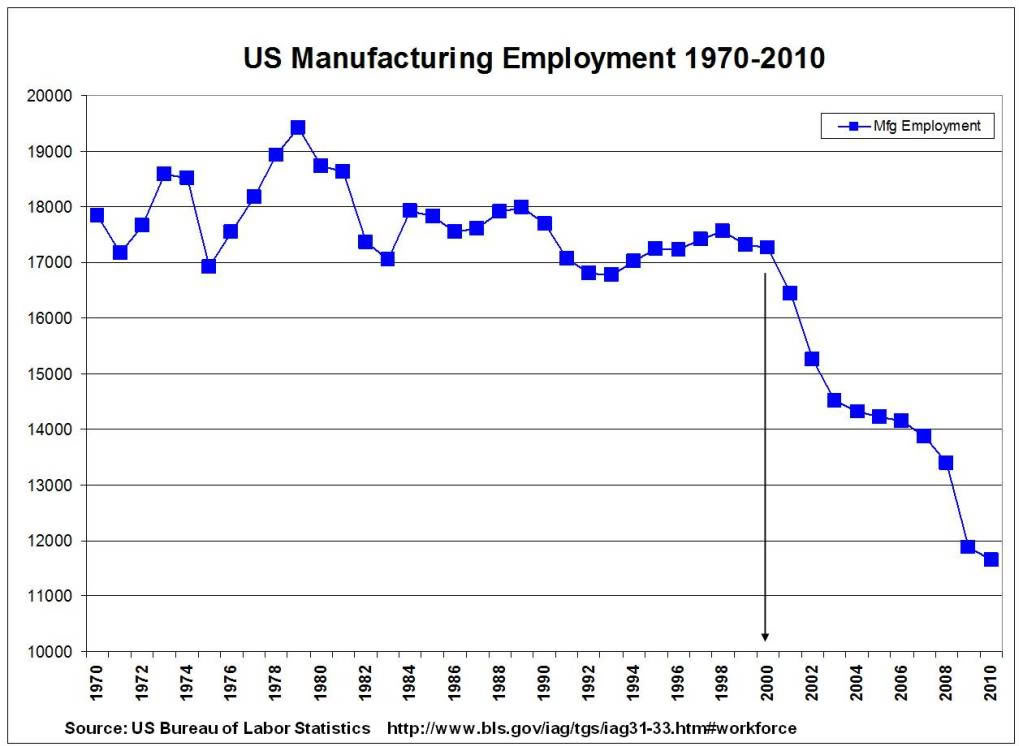
* It’s worth clarifying that US manufacturing output has kept rising even though US manufacturing jobs declined over this period. Employment staying roughly steady between 1990 and 2000 and then fell off a cliff starting around 2001. Automation is one likely culprit here.
** Levinson's paper isn't the first to suggest US factories are genuinely reducing pollution by adopting cleaner production techniques. It's just that earlier studies, including one by Levinson, had only measured this indirectly — and were based on far less comprehensive data. Other papers have found similar trends in Europe.