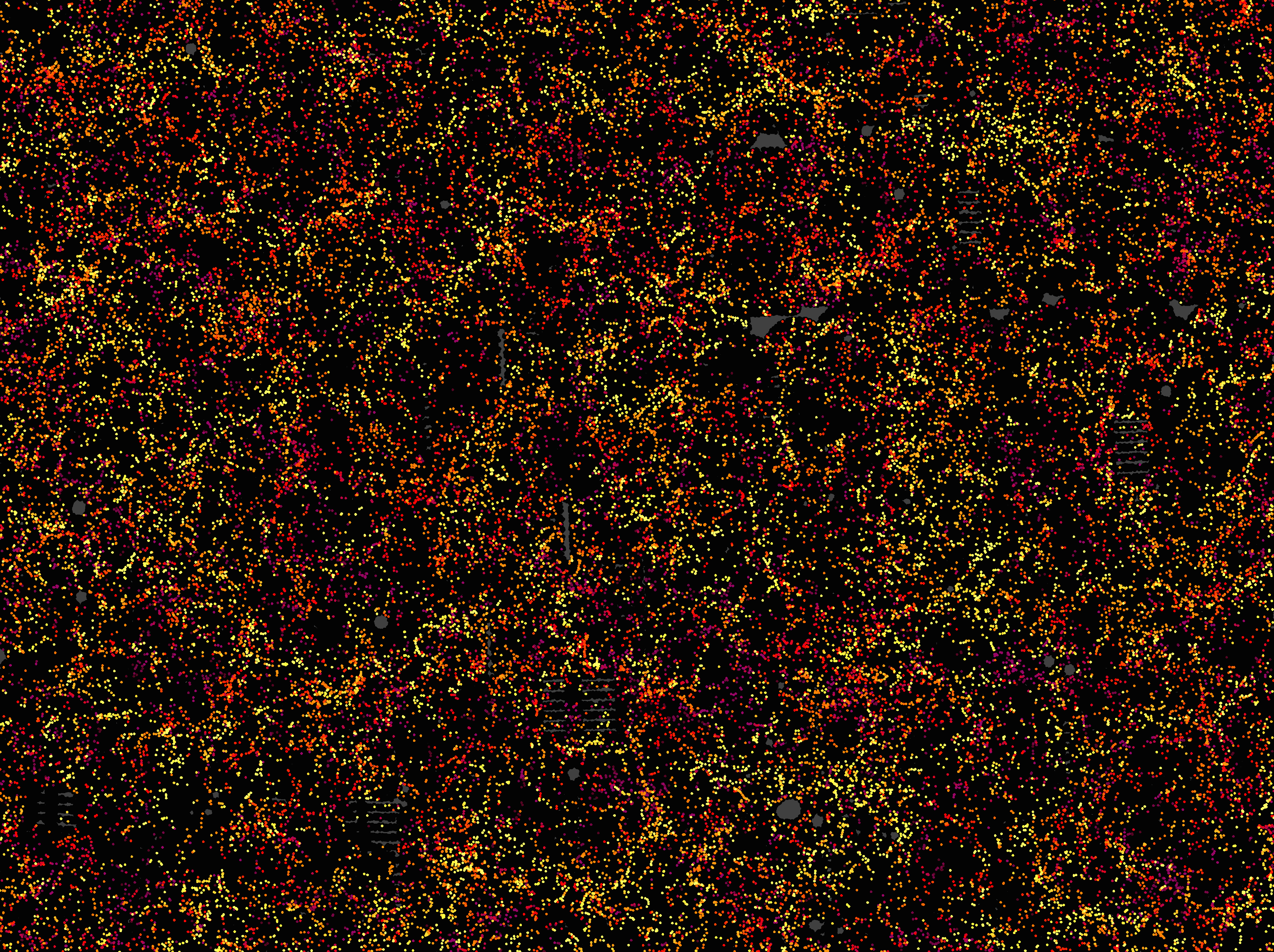
This image makes me feel so incredibly small.
This small slice of the night sky contains 48,741 galaxies

Daniel Eisenstein and the SDSS-III collaboration. Here’s a huge, high resolution version.

Brian Resnick was Vox’s science and health editor and is the co-creator of Unexplainable, Vox’s podcast about unanswered questions in science.
Each of these 48,741 dots represents a galaxy. Each galaxy is a collection of billions of stars. The stars themselves trap untold planets, asteroids, and possibly even life in their gravitational clutches.
But this image, which is just one-twentieth of the night sky, is a mere pinprick of a window into the universe. The universe is thought to be 93 billion light-years wide. The width of this image is 6 billion light-years.

We’re privy to this vision of the cosmos thanks to the Sloan Digital Sky Survey III, a digitized atlas of the known universe. The full survey, which was recently released, charts a total of 1.2 million galaxies in three dimensions. That means it shows not just their locations in the sky but their distance from the Earth as well.
The SDSS-III was a huge undertaking, the result of a multi-year collaboration of hundreds of scientists from around the world. The observations were carried out by SDSS-III’s Baryon Oscillation Spectroscopic Survey, which uses a large telescope in New Mexico to not only map the galaxies but also make inferences about the expansion rate of the universe.
In the image above, the colors tell us how far the galaxies are from Earth. Yellow is closer to us, purple is farther away, and red represents an intermediate distance. “Galaxies are highly clustered,” the Sloan sky survey website explains, “revealing superclusters and voids whose presence is seeded in the first fraction of a second after the Big Bang.”
Here’s another slice of the Sloan survey represented in a three-dimensional form. This image depicts 120,000 galaxies.

Astronomers need such detailed maps to answer big questions about the universe, such as how fast it’s expanding and what it’s made of. It also helps to confirm the gravitational effects of general relativity.
“This map has allowed us to make the best measurements yet of the effects of dark energy in the expansion of the Universe,” Jeremy Tinker, a New York University astronomer, said Thursday in an SDSS press statement. Dark energy is a mysterious force that opposes gravity and is believed to fuel the expansion of the universe.
It’s all pretty heady stuff. For us non-astronomers, it’s bewildering enough to know how much of the universe there is to study. When you look up at just a small corner of the sky, untold masses of the cosmos are before you.