Here’s a fun way to spend a long weekend: Contemplating whether you’ll be replaced by a robot.
Robots want half of your jobs
That’s $16 trillion in worldwide wages. Can’t blame China for that.

Ethan Miller / Getty Images

Peter Kafka covered media and technology, and their intersection, at Vox. Many of his stories can be found in his Kafka on Media newsletter, and he also hosts the Recode Media podcast.
Employers could feasibly swap out machines, using existing technology, for humans in 50 percent of today’s jobs, says a new McKinsey report.
That’s not just low-paying work but plenty of white-collar employment as well, and that works out to $16 trillion in wages worldwide and $2.7 trillion in the U.S.
There are plenty of caveats to that projection; the biggest one is that the automation won’t happen until 2055, or maybe 2035, or maybe 2075?
But it’s still the kind of big, headline-grabbing number that definitely gets your attention, particularly when the incoming U.S. administration is talking about saving/restoring jobs by pulling them back from the likes of Mexico and China.
Trump-watchers, including the New York Times’ Maggie Haberman and Axios’ Mike Allen, have already taken notice.
Okay. But what about your job? When do the robots come for that?
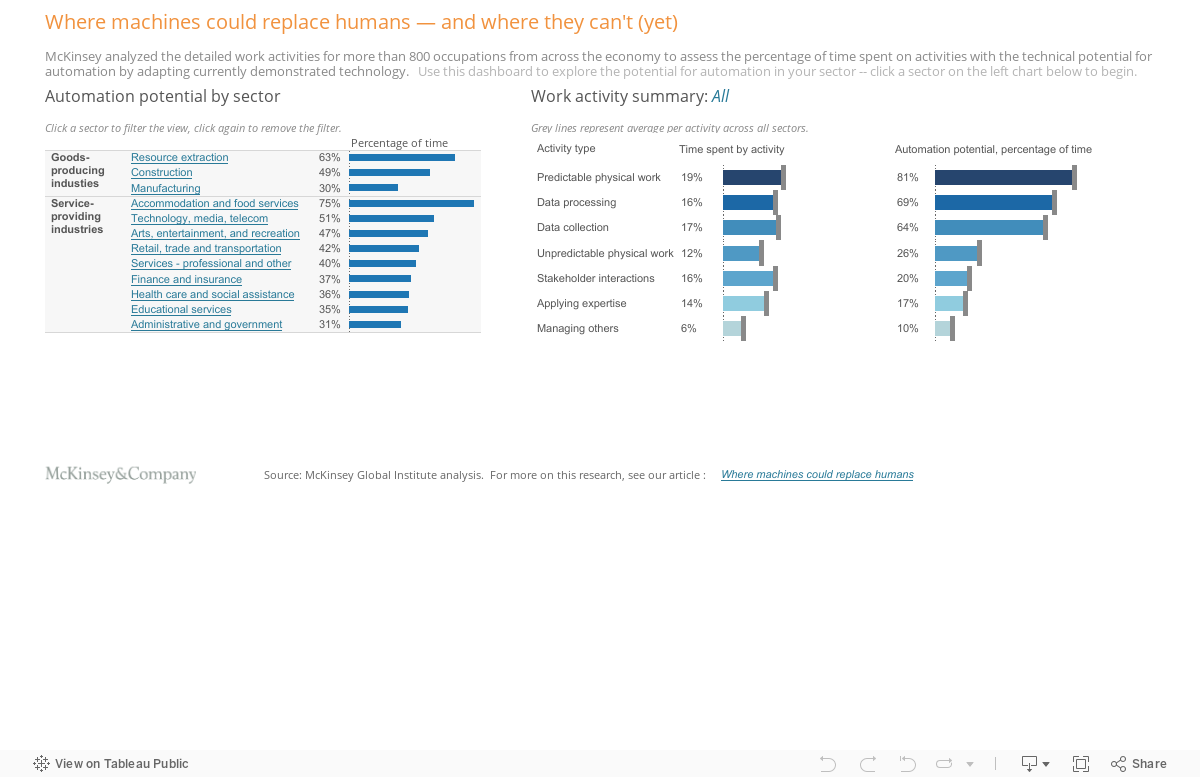
Last year, McKinsey laid out in this report some estimates about the kinds of jobs most likely to be automated. There’s also a fun (?) infographic that allows you to look, sector by sector and job by job, at the kind of tasks most likely to go away (this includes journalism, where robots are already at work) :
Would you like to hear about the upside of job-eating robots? Here you go: In addition to all the money those robots will save employers, they will also save people time, since they can do other tasks. So they can do other things, including other jobs.
Not good enough? Okay: Just because robots can replace workers doesn’t mean that employment in that sector will shrink. Employment for grocery cashiers, for instance, has continued to grow over the last three decades, even as machines increased their presence in check-out lines.
Robots won’t take every job. Some are too hard for robots to do, even if they don’t pay humans well: McKinsey says people who clean up after you when you leave your hotel room will likely remain people, because robots don’t like random, and “different guests throw pillows in different places, may or may not leave clothing on their beds, and clutter up the floor space in different ways.”
And some jobs won’t be replaced by robots because the humans who do them get paid so little it’s not worth it to use machines.
McKinsey notes that while there’s now a cooking robot that can make 360 burgers an hour, “Since restaurant employees who cook earn an average of about $10 an hour, a business case based solely on reducing labor costs may be unconvincing.”

This article originally appeared on Recode.net.
See More:


