Tropical Storm Barry, which the National Weather Service said has brought 75 mph winds to the Gulf Coast, was upgraded to a Category 1 hurricane Saturday morning as it made landfall in Louisiana. By Saturday afternoon, it had been downgraded to a tropical storm. (To be considered a hurricane, a storm’s winds must reach at least 74 mph.)
Tropical Storm Barry: What we know
The storm was briefly the first hurricane of the 2019 Atlantic season.

A tropical storm warning remains in effect for the western section of the Louisiana coast.
“On the forecast track, the center of Barry will move through southern Louisiana today, into central Louisiana tonight, and into northern Louisiana on Sunday,” the NWS said in a public advisory.
Forecasters expected a two-foot storm surge (when high winds force water ashore above normal tide levels), heavy rains, and strong winds to affect the Gulf Coast and warned residents to stay inside.
“Eighty-three percent of fatalities from these systems have been from inland rain,” National Hurricane Center Director Ken Graham said Saturday. “So let’s stay off the roads. Let’s prevent these preventable fatalities.”
The heavy rain is more dangerous than usual because Louisiana has suffered intense flooding over the past week due to other storms. A number of streets in New Orleans were already at dangerous water levels ahead of the hurricane, and some feared Barry could swell the Mississippi River so much that it would top the city’s levees (which vary in height from 20 to 25 feet).
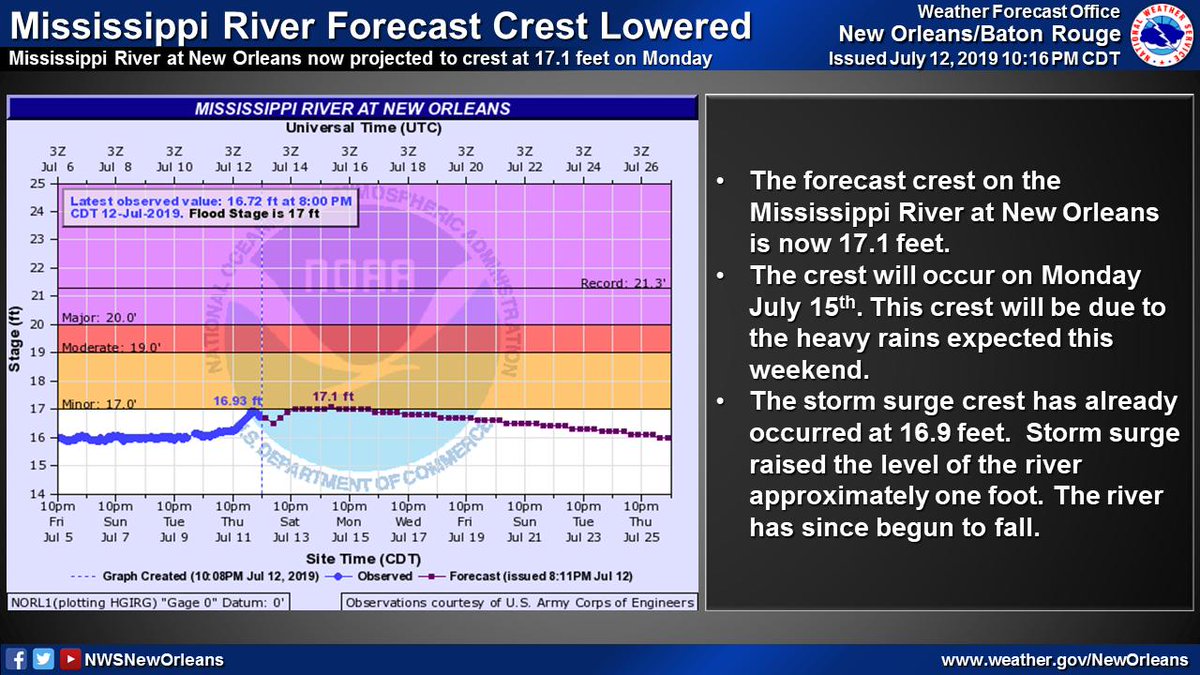
Those fears have been allayed somewhat; the Mississippi River rose to 17.1 feet after a storm surge Friday and forecasters now expect its levels to decrease and the levees to hold.
Other rivers, however, are also of concern.
The Comite River in Baton Rouge, for instance, is forecasted to rise to well over 30 feet Saturday, which would break the record of its previous flooding three years ago. At that time, the flooding killed 13 people and damaged 140,000 homes, resulting in at least $10 billion in property damage, according to meteorologist Bill Karins.
What we know
- Barry was upgraded from a tropical storm to a Category 1 hurricane Saturday morning.
- It was downgraded to a tropical storm Saturday afternoon (storms must have winds of at least 74 mph to be hurricanes).
- Airlines cancelled flights into and out of Louis Armstrong New Orleans International Airport. Normal operations resumed Sunday.
- Power began to go down ahead of Barry’s landfall. More than 100,000 Louisianians are currently without power. Louisiana parishes with power can be tracked using this tool.
- The first major rescue was successfully executed early Saturday morning when the Coast Guard rescued multiple people on Isle de Jean Charles, 45 miles south of New Orleans.
- A levee in Plaquemines Parish south of New Orleans overflowed Saturday but officials said these are not the levees that protect the Mississippi River. Louisiana Lt. Gov. Billy Nungesser told CNN “the water is coming over the levee pretty good,” but said the levee can hold up to several hours of overflow. Should the overtopping last more than a few hours, however, major flooding would become likely.
- National Hurricane Center Director Ken Graham said Saturday afternoon levees along the Mississippi River are expected to hold; Louisiana Governor John Bel Edwards confirmed the river won’t rise beyond 17.1 feet, well below the height of its levees.
- Coastal communities in Mississippi and Alabama are seeing heavy rains despite their distance from Barry’s center; some are under flash flood warnings. Saturday afternoon, Mobile, Alabama, saw rainfall of two to three inches per hour.
- According to the National Hurricane Center, Barry’s winds continue to slow; as of Sunday morning, maximum sustained wind speeds were measured at 40 mph. The storm is moving north slowly at six mph.
- Water overflowing a levee in Terrebonne Parish, a coastal community southwest of New Orleans, has led to an evacuation order there — the Terrebonne sheriff stressed “the levee has not broke,” but all residents have been ordered to leave before conditions worsen.
- Three hundred oil rigs and platforms off the shore of Louisiana have also been evacuated.
- New Orleans is now expected to be spared major rainfall; initial forecasts projected the city would see up to 20 inches. Forecasters now believe the city will not see more than four inches before Sunday evening.
- Other cities are expected to see more rain, however. Lafayette, Louisiana, which is about 140 miles west of New Orleans, is expected to face continuing heavy rains throughout Sunday and has been placed under a flash flood warning. Western Mississippi is expected to see up to eight inches of rain through Monday, and is also under a flash flooding warning.
- Experts and politicians have warned residents to stay alert; the storm is slow-moving and will continue to release rain, increasing flooding risks throughout the affected area. Saturday evening, Louisiana Gov. John Bel Edwards said, “This storm still has a long way to go before it leaves the state. The worst is yet to come.”
- NASA scientists also warned Sunday morning that heavy rainmaking sections of Barry remain in the Gulf of Mexico but are making their way ashore.
- At least three Louisiana levees had been overtopped as of Sunday morning; however, all have held.
- President Trump called Louisiana Governor John Bel Edwards Saturday night and promised federal aid for the state; the president also told the governor he is “pulling for” Louisiana.
- Tornado warnings were in effect Sunday afternoon for multiple areas in Mississippi and Louisiana, including the Baton Rogue metro area and Pike County, Mississippi.
- The National Weather Service has advised southeast Texas to be on guard for flooding Sunday night and Monday morning.
- Flooding is expected to affect the Mississippi River Valley through next week. Beyond Louisiana and Mississippi, Arkansas, Missouri, and Tennessee could be affected.
What we don’t know
- How rainfall will affect rivers other than the Mississippi River.
- The extent of the damage.
- If there were any casualties.
- When power will completely return.
See More: