Two more Senate Republicans came out against the party’s revised health care bill Monday evening. The Senate push to repeal and replace Obamacare is now short of the votes it would need to advance on the Senate floor, leaving the current version of the plan effectively dead.
With 2 more defections, the Senate health care bill just died — for now
Four Republican senators oppose the current bill.

Alex Wong / Getty Images

Dylan Scott covers health for Vox, guiding readers through the emerging opportunities and challenges in improving our health. He has reported on health policy for more than 10 years, writing for Governing magazine, Talking Points Memo, and STAT before joining Vox in 2017.
The defections are a devastating blow to Senate Majority Leader Mitch McConnell’s hopes of passing an Obamacare repeal-and-replace bill. Leadership had hoped to vote on the bill this week, but a health emergency for Sen. John McCain (R-AZ) had delayed that plan. Now the bill is short of the votes it needs and could still lose more support.
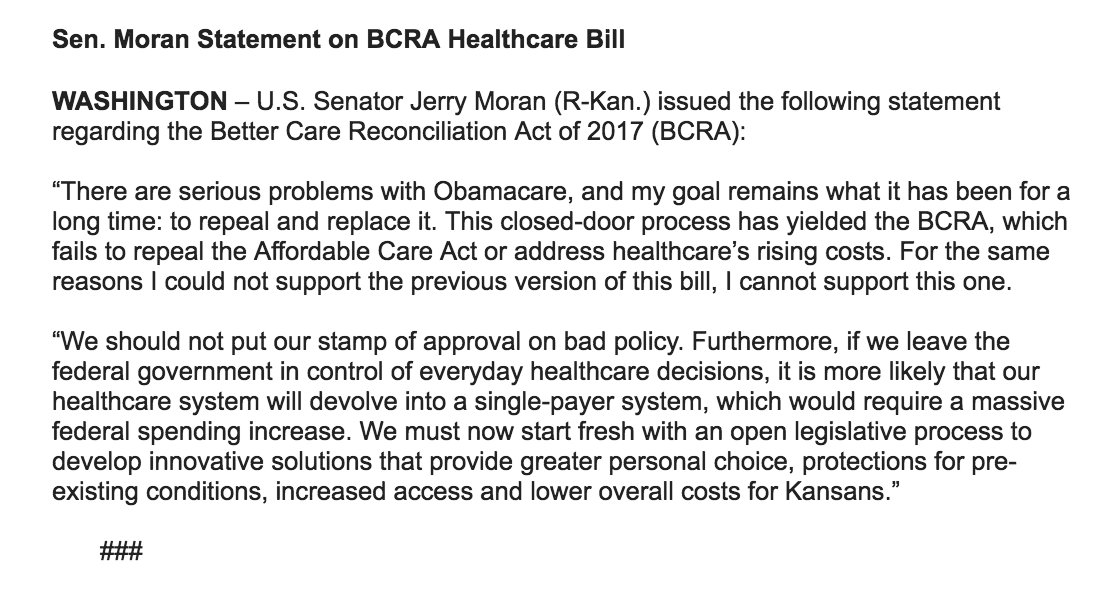
Sens. Mike Lee (R-UT) and Jerry Moran (R-KS) said they would vote to block the start of the debate on the revised Better Care Reconciliation Act. Sens. Susan Collins (R-ME) and Rand Paul (R-KY) said last week that they would oppose the bill as well and vote to block debate.
McConnell could lose only two of the 52 Senate Republicans and still advance the legislation. Now that four senators oppose it, the current version of the bill appears to be dead. Further changes would have to be made to win over these skeptics.
Another half-dozen moderate Republicans also have grave concerns about the Republican plan’s cuts to Medicaid. So the bill as currently structured may be far from the 50 votes it needs to pass.
Lee, one of the most conservative members, has pressed to roll back more of Obamacare’s insurance regulations. The revised bill included a version of a proposal from Sen. Ted Cruz, which allowed insurers to sell health plans that did not comply with the law’s insurance regulations.
But Lee, writing at the Resurgent, said he was unsatisfied with the proposal as it was written in the bill. He argued that because it technically requires the Obamacare and non-Obamacare plans to be pooled together, it wasn’t the same proposal he had said he would support.
“Experts are divided on the impact keeping this Obamacare regulation would have on the Consumer Freedom Amendment. Some say it would make no difference, while others say it would nullify the entire amendment. Either way, a new analysis by a government agency claims it would raise insurance premiums for people on freedom plans by $600 a year,” he wrote. “I do not want to gamble $600 in relief for middle-class families in exchange for an amendment that might be undermined because of Obamacare regulations.”
Experts were indeed unclear on what the Cruz provision would actually do and whether there would be two pools — one Obamacare market, one non-Obamacare market — or one.
“I think my position is, it is a single risk pool as written,” Dave Dillon, an expert with the Society of Actuaries, told me last week.
But because the bill would drive healthier people into the skimpier non-Obamacare plans and sicker people into the more robust Obamacare plans — driving up costs for the latter — the single pool could eventually be unsustainable and the market could eventually be forced to segment into two completely separate pools.
Other experts, like the Kaiser Family Foundation’s Larry Levitt, noted that because non-Obamacare plans would be exempt under the Cruz amendment from other provisions in the health care law meant to link all insurance plans into one market, the Senate bill would effectively break the market into two pools.
“I think it is to be determined if it will be able to stay the single risk pool or not,” Dillon said. “I can definitely see the concerns that it may not be possible.”
That technical problem seems to have been enough for Lee to oppose the current version of the bill.
“In addition to not repealing all of the Obamacare taxes, it doesn’t go far enough in lowering premiums for middle class families; nor does it create enough free space from the most costly Obamacare regulations,” Lee said in a separate statement.
Moran, for his part, was more opaque in his problems with the bill, but he urged Senate leadership to “start fresh with an open legislative process” to develop a new health care plan.
“This closed-door process has yielded the BCRA, which fails to repeal the Affordable Care Act or address health care-rising costs,” he said in a statement. “For the same reasons I could not support the previous version of this bill, I cannot support this one.”
See More: