Early Wednesday morning, those on the West Coast of the United States who braved the cold predawn hours witnessed a stunning event: a total lunar eclipse.
Watch: the total lunar eclipse, in 60 seconds
The silvery moon turns blood red in this stunning time lapse.

Brian Resnick was Vox’s science and health editor and is the co-creator of Unexplainable, Vox’s podcast about unanswered questions in science.
Over the course of five hours, the moon was slowly obscured by Earth’s shadow. And at the peak of the eclipse, for 77 minutes, the moon was bathed in a somber red-orange hue, the result of all the sunrises and sunsets on Earth projecting themselves onto the moon. Better yet, the moon was a “supermoon,” meaning it appeared slightly bigger than average.
For those who didn’t make the wake-up call (or who were on the East Coast, where the eclipse was cut short due to the sunrise), here’s the short version.
The Griffith Observatory in Los Angeles captured this stunning time lapse of the entire eclipse, condensed into 60 seconds. See the gray moon slowly darken into a crescent and then turn deep red before returning to its normal gray color and setting at dawn.
Missed it? Here’s the next total lunar eclipse.
Luckily, NASA keeps a five-millennium catalog of all the eclipses (both solar and lunar) that have occurred or will occur since 1999 BC to the year AD 3000. So schedule accordingly. Want to see a total lunar eclipse during the 2040s? You have nine to choose from.
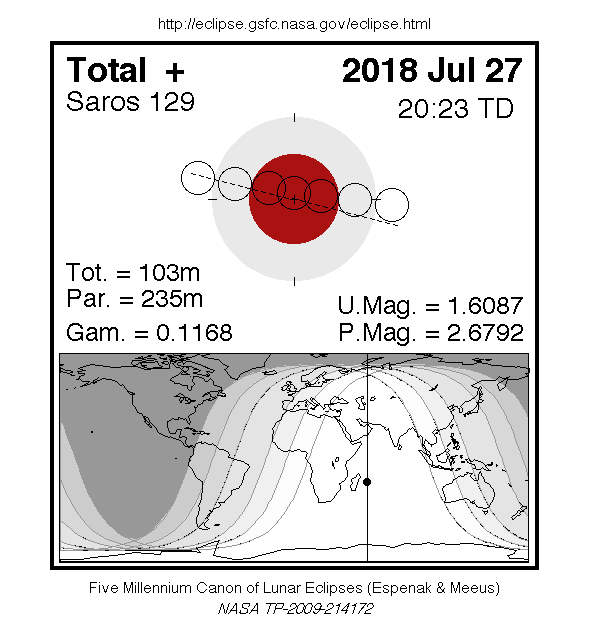
The next total lunar eclipse in on July 27 of this year, but North America will have no shot at seeing it, as we’ll be in daylight when the eclipse occurs. (It will be great in India, however.)
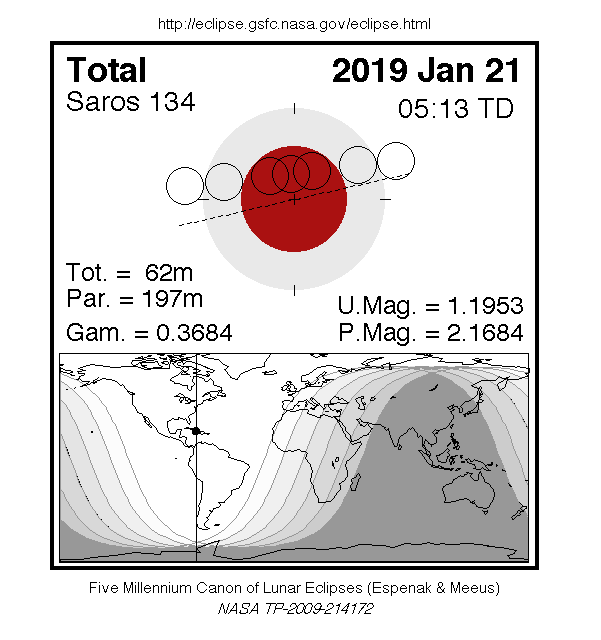
In North America, we’ll have to wait until January 21, 2019, for the next one. And that one should be viewable throughout North and South America. Get excited! After that, we’ll have to wait until 2021.