LuLaRoe, the multilevel marketing company that’s known for colorful leggings and geometric-patterned dresses, claims it was founded “on a driving force to help other people succeed.”
More than 100 LuLaRoe sellers have filed for bankruptcy
LuLaRoe claims to offer financial freedom. But some sellers are facing financial ruin instead.

It’s built on a structure where its so-called consultants buy its inventory at a wholesale price and then sell it for retail as independent salespeople. The business attracts a large population of homemakers and military wives. Unlike the Tupperware parties of the 1950s, LuLaRoe consultants don’t necessarily need to commit to home visits, as Facebook groups have become a primary method for selling LuLaRoe clothes. If you’ve never personally been invited to a frenzied LuLaRoe group on social media, you definitely know people who have.
In 2017, the company had as many as 77,000 sellers, most of whom were women eager to cash in on the brand’s promise that they would “have the freedom and flexibility that comes from building your own business at your own pace.” But a new investigation published April 30 tells a very different brand story about LuLaRoe — one where some sellers have faced financial ruin.
A study conducted by Truth in Advertising (TINA), a Connecticut-based watchdog that analyzes deceptive marketing practices, found that more than 100 LuLaRoe consultants have personally filed for bankruptcy since 2016. This is reportedly partly to do with the company’s strict rules and regulations regarding its pay structure, and with the fact that the earning potential for consultants is far lower than it’s made to seem. Vox reached out to LuLaRoe for comment and did not hear back.

In order to join LuLaRoe, consultants must start by spending about $5,000 for an “initial order kit,” which comes with 248 pieces of clothing. Consultants have to sell these items but must also buy additional monthly items in order to be eligible for potential bonuses. And there are additional costs to running a LuLaRoe business, like paying for clothing racks and hangers, not to mention time spent.
One major issue TINA discovered was that LuLaRoe products have become virtually “unsellable.” Struggling consultants say their market is overcrowded, since LuLaRoe and its army of sellers have been aggressively recruiting more people to join — in the structure of an MLM, sellers who recruit become the “upline” and are able to earn a commission from their recruited sellers’ earnings, called the “downline.” TINA reports that there are too many sellers and not enough buyers. Some consultants, according to TINA, were stuck with as much as $15,000 worth of unsold clothes.
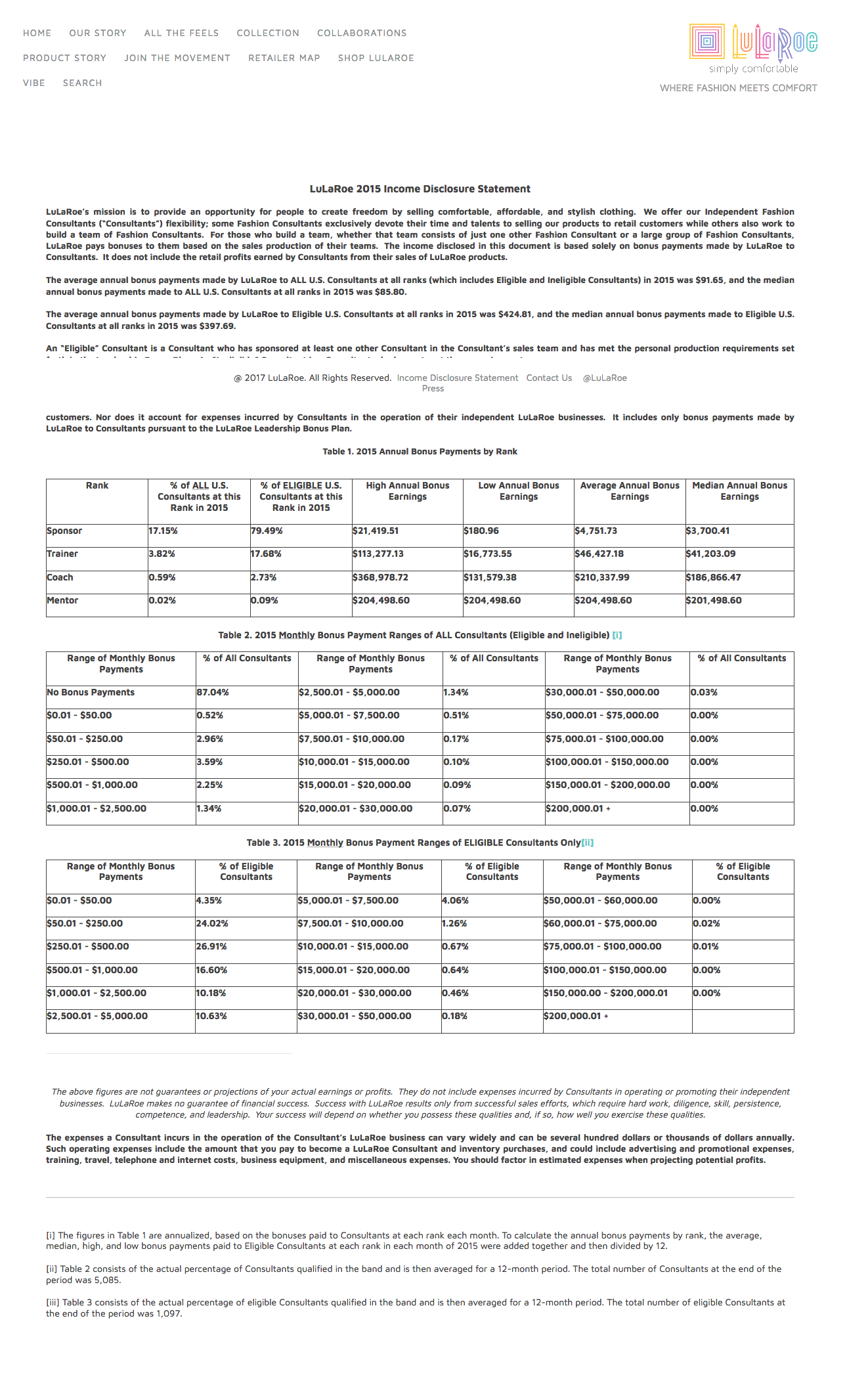
TINA also found that LuLaRoe uses deceptive marketing practices and makes deceptive claims about how sellers can become “social selling entrepreneurs.” LuLaRoe touts financial freedom in its marketing materials, and claims there are thousands of dollars’ worth of bonuses to be made if consultants climb the company’s seller tiers. TINA, however, found that the average annual bonus paid to LulaRoe sellers was actually just $92. It also discovered that many sellers don’t even make enough money to earn back what they originally invested into LuLaRoe. TINA concludes that sellers are more likely to end up bankrupt than to move up LuLaRoe’s seller tiers.
The TINA investigation, which found LuLaRoe seller bankruptcies in 33 states, is hardly the first to illuminate LuLaRoe’s reportedly problematic and often deceptive practices. The company has been labeled “a scam” by Bloomberg and a “pyramid scheme” by disgruntled former consultants. In January, the state of Washington filed a class-action lawsuit against the company for deceptive practices, accusing LuLaRoe of focusing on recruiting instead of actually selling its products.
”LuLaRoe tricked consumers into buying into its pyramid scheme with deceptive claims of high profits and refunds for unsold merchandise,” Washington Attorney General Bob Ferguson told Business Insider. “Instead, many Washingtonians lost money and were left with piles of unsold merchandise and broken promises from LuLaRoe. It’s time to hold LuLaRoe accountable for its deception.”
There are more than a dozen private lawsuits from LuLaRoe sellers still currently pending, according to Bloomberg, and the company has been sued by unpaid suppliers, which claim it’s using shell companies to hide its wealth from creditors (the company has denied these claims).
With all the bad press, many sellers have opted to leave LuLaRoe, in what’s been dubbed a mass exodus. The company is now reportedly down to 35,000 sellers. But these sellers have found that it’s not so easy to just leave: They won’t be refunded the full amount of what they spent, per the company’s return policy. Some have also complained that they’ve been owed refund money for months, even after they followed all the necessary moves to shut down their business.
These are all telltale signs that there’s trouble at LuLaRoe. And even though the company insisted in February that it was turning over a new leaf to appease consultants’ woes, the TINA investigation says plenty of people are still falling prey to LuLaRoe’s false promises, and paying for it dearly.
Want more stories from The Goods by Vox? Sign up for our newsletter here.
See More: