The context you need, when you need it

When news breaks, you need to understand what actually matters — and what to do about it. At Vox, our mission to help you make sense of the world has never been more vital. But we can’t do it on our own.

We rely on readers like you to fund our journalism. Will you support our work and become a Vox Member today?

Join now

When is the next total solar eclipse?

Don’t worry if you missed the 2024 eclipse. There will be more.

A partial solar eclipse that shows a crescent-shaped rim of the sun against a black sky.
Camilo Freedman/SOPA Images/LightRocket via Getty Images
Brian Resnick
Brian Resnick was Vox’s science and health editor and is the co-creator of Unexplainable, Vox’s podcast about unanswered questions in science.

Total solar eclipses like the one crossing America today are beautiful, but they’re fleeting. Totality, when the sun is completely covered by the moon, lasts just a few minutes. And the whole thing — from the start of the partial eclipse to the end — takes just a few hours. The experience is sublime, but it’ll leave you wanting more.

Here’s the good news: Total solar eclipses happen somewhere in the world about every 18 months. That’s how long it takes for the specific conditions that create eclipses (the phases of the moon, the distance of the moon to Earth, and the moon crossing the plane of Earth’s orbit) to line back up.

The big questions about solar eclipses

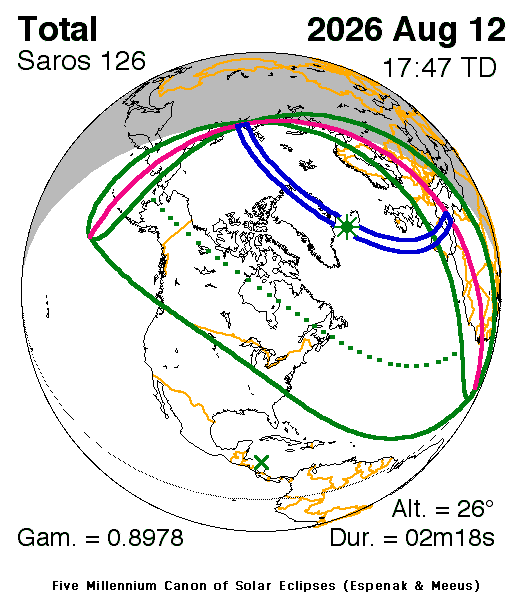
The next total solar eclipse will be on August 12, 2026, and it will pass over Spain, Iceland, and Greenland. The one after that? August 2, 2027, over North Africa.

NASA keeps a catalog of all the eclipses (both solar and lunar) that have occurred or will occur from 1999 BCE to 3000 CE.

That’s why we know, for instance, that on January 27, 2837, a total solar eclipse will pass over southern Mexico. (Will any humans be around to see it?)

The next solar eclipse over the United States will be visible in Alaska in 2033. And the next one in the lower 48 states will be in 2045.

See More:

More in Science

Future Perfect
Human bodies aren’t ready to travel to Mars. Space medicine can help.Human bodies aren’t ready to travel to Mars. Space medicine can help.
Future Perfect

Protecting astronauts in space — and maybe even Mars — will help transform health on Earth.

By Shayna Korol
Podcasts
The importance of space toilets, explainedThe importance of space toilets, explained
Podcast
Podcasts

Houston, we have a plumbing problem.

By Peter Balonon-Rosen and Sean Rameswaram
Climate
How climate science is sneakily getting funded under TrumpHow climate science is sneakily getting funded under Trump
Climate

Scientists are keeping their climate work alive by any other name.

By Kate Yoder, Ayurella Horn-Muller and 1 more
Good Medicine
You can’t really “train” your brain. Here’s what you can do instead.You can’t really “train” your brain. Here’s what you can do instead.
Good Medicine

The best ways to protect your cognitive health might surprise you.

By Dylan Scott
Future Perfect
Humanity’s return to the moon is a deeply religious missionHumanity’s return to the moon is a deeply religious mission
Future Perfect

Space barons like Jeff Bezos and Elon Musk don’t seem religious. But their quest to colonize outer space is.

By Sigal Samuel
Health
Why the new GLP-1 pill is such a big dealWhy the new GLP-1 pill is such a big deal
Health

The FDA just approved Foundayo. Here’s what it can and can’t do.

By Dylan Scott